Team No Comments

Tatton Monday Digest

Please see below article received from Tatton Investment Management this morning, which reflects on the market’s reaction to global banking issues over the past week.

Overview: Bank stress-testing in real-time 


Following the run on Silicon Valley Bank (SVB), fear has spread. The nervousness of market participants over recently elevated stock and bond valuations found its focal point and so the stock index of the aggregate global bank sector had a very bad week. SVB has become the first sizeable victim of the steepest rise in rates since the 1970s, but its close affiliation with tech, healthcare and crypto is particularly notable. After seeing a near tripling of money deposited by start-up companies and their affiliates during the good times (namely the 2020/2021 tech and healthcare boom), those deposits were heavily drawn on recently when those same companies required funds to bridge the financial strains of these distinctively more challenging times.

Taking into account how much better capitalised and less credit risk exposed banks are today when compared to the run up to the GFC, they seemed an unlikely target and victim this time, but it turns out banking sector trust had never been fully rebuilt. Given SVB specific weakness was an outlier, with its losses from its long maturity government bonds wiping out its equity base, it was right that central banks stepped in to stop the self-enforcing avalanche of mistrust. That stock markets continued their highly volatile trading into the latter part of the week goes to show that once confidence is dented investor are more open to consider that there is the possibility for a much worse than the ‘steady as she goes’ scenario that could play out this year.

The lesson from the past few days is that the pain caused by the rises in rates is hitting small and micro-cap firms particularly hard, even if they are strictly speaking growth stocks whose valuations would otherwise benefit. But we should be heartened that this week proved central banks are reactive to issues of financial instability. The centre of the storm moved to Europe and particularly Switzerland as Credit Suisse came under pressure. The European Central Bank (ECB) still raised rates by 0.5% on Thursday as it had promised at its previous meeting, but President Christine Lagarde was notably reticent about offering any further indications of rate moves.

To top it all off, the market is now pricing in the strong likelihood that March will see an end to all the rate rises in the Western world, and that rates could be cut everywhere by year-end. This week, the Federal Reserve (Fed) and the Bank of England (BoE) meet. Despite the turmoil, markets on balance expect a 0.25% move from both. We have revised our views as well and see a 0.25% move in the US where data remains strong enough to justify it, but we expect the UK will not move. So, for the shorter term it appears that central banks’ objective to tighten financial condition to bring down inflation has suddenly been significantly accelerated through market action.

Is this a banking crisis? And if so, could it get as bad as last time?

 
What makes a crisis a crisis? Ernest Hemingway said bankruptcy happens “gradually, then suddenly”. Weaknesses build up over time, and wider economic circumstances add pressure on them. But for any given company, the full extent of its weaknesses is only revealed when things get so bad those weaknesses cannot stay hidden. The nature of banks means the financial system is more vulnerable than other sectors. Often the first bank failures in a downturn don’t precipitate a crisis but they do reduce the system’s overall willingness to tolerate risk. When the next set of bad news gets out, confidence plummets and financial problems spiral. We saw this a decade and a half ago with Bear Stearns and later Lehman Brothers. Cracks emerge slowly, but shattering happens all at once.

Over the last year, interest rates have risen at the fastest pace in a generation. Meanwhile, economic growth has slowed dramatically. That means higher capital costs with lower aggregate returns, a difficult environment for banks as a whole. When crypto hub FTX collapsed last year, we said this was a sign of the times – opaque high-risk investments being exposed – and that further casualties down the line were likely. That is exactly what happened with Silvergate Capital l, and then SVB. 

The fact that troubles have spilt over to Credit Suisse is a sign that contagion is still very possible, though. Even if the US tech banks can fail in a relatively isolated fashion, a bank as big and important as Credit Suisse is a different matter. Moreover, European banks are much more tightly linked than US counterparts. If Credit Suisse had been allowed to collapse, shockwaves would have been felt far away, and weaknesses at other banks would certainly be exposed. The Swiss regulators’ decision to wipe out holders of Credit Suisse Coco bonds as part of the UBS ‘shot-gun’ marriage deal may still prove too much for the system, with a need to address the failout in some way. That being said, there are two key differences to the events of the global financial crisis. First, the policy response has been swift and decisive. In the US, the Biden administration effectively bailed out depositors of a bank considered too small to be systemically important, as soon as troubles began. Meanwhile, SNB provided billions in liquidity to Credit Suisse on the same day its stock sunk. The long-term merit of these moves is debatable; indeed, European lawmakers are reportedly angry about the US flouting bailout rules they helped create. But they undoubtedly make short-term financial contagion less likely. Second, crises spiral when unknown risks come to light, but most of the current risks exposed at Credit Suisse were already in the light, and known about for some time. We should not underplay the troubles that could spread from such a big institution, but it is important to note that many other banks will have already reduced their exposure to the investment bank. 

We have no doubt that further problems – at different, as yet unknown banks – will become known in the weeks and months ahead. Such is the nature of a monetary tightening cycle. Those institutions that end up in trouble will be those with opaque or misleading balances of assets and liabilities. In that respect, we also expect financial hardship at some (probably recent entrant) private equity or private debt funds (private meaning not available to the general public and therefore not part of Tatton’s portfolios). It may be that such hardship catches only a very small number, and will be seen as idiosyncratic and containable as the demise of SVB, but it is something of which investors should be wary. 

Please check in again with us shortly for further market updates and news.

Chloe

20/03/2023
Team No Comments

Brooks Macdonald Daily Market Update

Please see below article received from Brooks Macdonald today, which provides a global market update for your perusal.

What has happened

With markets having run out of fresh reasons to panic, we saw a marked rally across the board in risk assets on Tuesday. Equities, and importantly including bank stocks, saw a major recovery, and sovereign bond yields pared back a good chunk of their declines suffered in recent days. On some measures, US and European banks saw their best positive trading day in 4 and 5 months respectively on Tuesday. In US Treasuries, the 2-year yield saw it’s biggest one-day rise since June last year. Also supporting yields, the US CPI print for February, out yesterday, saw another repeat of the sticky-inflation narrative, with US core CPI month-on-month up 0.5%, above the 0.4% consensus estimate.

Panic over, no global financial meltdown after all?

After the SVB-driven risk-version over the past week, markets seemed to be settling back into a more constructive mood on Tuesday. At their simplest, banks’ operating models are intrinsically linked to a liability-asset duration mis-match… after all, it’s in a bank’s DNA to borrow short (deposits) in order to lend long (loans), and profit from the interest rate spread less some provisioning for the risk of loan-defaults. The fact that banks might choose to park excess deposits into generally-considered-risk free assets such as government bonds is not necessarily bad in and of itself. If banks can hold to maturity, then in nominal terms, there is no risk (assuming we’re not worrying about a government default). As we’ve seen from the SVB debacle last week, the problem arises when a bank cannot hold to maturity, where the discounted mark-to-market price of a bond reflects the impact of the remainder of the bond’s life in real terms. With the Fed now allowing banks to swap Treasury holdings for cash loans at par (the value that the bonds were originally issued at) through a so-called Bank Term Funding Programme (BTFP), this has significantly eased that problem. Initially, the BTFP is to run for one year, but frankly, given the hitherto history of central bank QE-led intervention over the years, it’s probably not a big stretch to assume this programme could be extended if it were needed.

Not yet all clear for bank profit margins though?

Whilst the consensus is that we are not facing financial systemic risk after all, there is still the problem of varied margin impacts for banks. The speed of interest rate hikes over the past year provided a boost to banks’ net interest margins, as interest rates on loans repriced quicker than deposits. The events over the past week have reminded us that with greater competition for deposits, this has given rise to concerns of whether we have seen peak net interest margins for the time being. That said, some relative perspective is important – given we have mostly moved-on from a world of zero interest rates, with interest rates higher and likely to be around these higher levels for some time, the medium-term outlook for bank profitability in aggregate is still arguably much better than it was over the past decade or so.

What does Brooks Macdonald think

With the SVB-induced volatility in recent days now falling, markets are turning back to weighing up the latest economic data, and how it might influence interest rate policy ahead. We have the ECB rate decision up tomorrow, and then it’s the turn of the Fed next week. How these and other central banks balance the recent bout of worries around financial conditions, versus still sticky-inflation pressures, will clearly be the key focus over the near term.

Index 1 Day1 Week1 MonthYTD
 TRTRTRTR
MSCI AC World GBP 0.9%-4.6%-4.9%2.0%
MSCI UK GBP 1.1%-3.5%-3.5%3.1%
MSCI USA GBP 1.8%-4.3%-5.2%1.9%
MSCI EMU GBP 1.8%-3.6%-1.8%9.0%
MSCI AC Asia Pacific ex Japan GBP -1.7%-6.8%-7.3%-1.3%
MSCI Japan GBP -3.4%-5.6%-3.6%0.7%
MSCI Emerging Markets GBP -1.6%-6.8%-6.7%-1.6%
Bloomberg Sterling Gilts GBP -0.8%2.6%0.6%1.7%
Bloomberg Sterling Corps GBP -0.9%1.0%-0.8%2.4%
WTI Oil GBP -4.6%-10.5%-9.8%-11.6%
Dollar per Sterling 0.0%2.7%0.0%0.7%
Euro per Sterling 0.0%1.1%-0.1%0.4%
MSCI PIMFA Income GBP 0.4%-2.1%-2.8%1.6%
MSCI PIMFA Balanced GBP 0.5%-2.5%-3.1%1.8%
MSCI PIMFA Growth GBP 0.8%-3.4%-3.8%1.7%
Index 1 Day1 Week1 MonthYTD
 TRTRTRTR
MSCI AC World USD 0.9%-2.1%-5.0%2.6%
MSCI UK USD 1.1%-0.9%-3.5%3.7%
MSCI USA USD 1.7%-1.8%-5.2%2.5%
MSCI EMU USD 1.8%-1.0%-1.8%9.7%
MSCI AC Asia Pacific ex Japan USD -1.7%-4.3%-7.3%-0.7%
MSCI Japan USD -3.4%-3.0%-3.7%1.3%
MSCI Emerging Markets USD -1.7%-4.3%-6.7%-1.0%
Bloomberg Sterling Gilts USD -0.9%5.0%0.5%2.7%
Bloomberg Sterling Corps USD -1.0%3.3%-0.9%3.4%
WTI Oil USD -4.6%-8.1%-9.8%-11.1%
Dollar per Sterling 0.0%2.7%0.0%0.7%
Euro per Sterling 0.0%1.1%-0.1%0.4%
MSCI PIMFA Income USD 0.3%0.5%-2.8%2.2%
MSCI PIMFA Balanced USD 0.4%0.2%-3.1%2.4%
MSCI PIMFA Growth USD 0.7%-0.8%-3.8%2.3%
      

Bloomberg as at 15/03/2023. TR denotes Net Total Return.

Please check in again with us shortly for further relevant content and news.

Chloe

15/03/2023

Team No Comments

China sets economic growth target

Please see below weekly market commentary received from Brooks Macdonald yesterday afternoon, which provides global economic data and market news.

  • China officials set out an economic growth target of “around 5%”, a little below expectations and potentially cooling hopes for fresh stimulus later this year
  • Next 8 days will be crucial for shaping the market’s outlook on jobs and inflation, with US Federal Reserve (Fed) Chair testimony to Congress plus monthly jobs and Consumer Price Index (CPI) all in the mix
  • Bank of Japan’s Governor Kuroda takes his last meeting this week, as markets continue to speculate if and when his successor might change BoJ policy goals

China officials opt for a slightly-softer-than-expected economic growth target of “around 5%”

Over the weekend, China officials set out a modest economic growth target of “around 5%” for 2023, at the low end of estimates that had hoped for more than 5% or maybe even 5.5%; the implication is that it lowers, a little, hopes for the size of any fresh policy stimulus later this year. As a result, Chinese equities are lagging small gains across Asia Pacific in early trade this morning. Over in the US, equity futures are indicating up, having capped off a positive day on Friday – that was despite a stronger US ISM Services print pointing to a still-tight labour market and inflation stickiness. Turning to the week ahead, the US will dominate the news flow with the latest jobs report out on Friday, along with US Fed Chair Powell’s biannual monetary policy report to Senate and House committees tomorrow and Wednesday respectively. Elsewhere this week, we also get China CPI on Thursday, UK January GDP on Friday, as well as 3 central bank decisions this week from Australia (tomorrow), Canada (Wednesday) and Japan (Friday). Also looming on the horizon for investors is next week’s CPI print (next Tuesday) which will cap a busy next 8 days for news flow.

What markets are looking for in this week’s US monthly jobs report

This coming Friday sees the latest print for the US monthly jobs report (for February), the non-farm payrolls data. It’s always a key print for markets, but arguably more so now given the importance that the Fed has put on the strength of the jobs data as a key factor in sticking to its hawkish rhetoric on interest rates in recent months. Friday’s monthly jobs data will also be the last one ahead of the Fed’s next FOMC (Federal Open Market Committee) decision due 22 March. In terms of what to expect, Bloomberg’s estimate is for 215,000 jobs added in February (down from January’s monster gain of 517,000 where some think the mild winter weather ended up providing a bit of a boost), with the unemployment rate expected to hold at over-50-year-lows of 3.4%.

Bank of Japan’s last meeting for Kuroda, and expectations for policy change are low….for now

Also due Friday is the Bank of Japan (BoJ)’s rate decision, and it’s the last meeting for the outgoing Governor Kuroda. Expectations for any fireworks are low, given the incoming Governor Ueda (pending final voting by Japan’s parliament on his appointment) said last month that current monetary policy settings remained appropriate. That said, markets are still speculating that the BoJ might change its yield-curve-control policy framework later this year, allowing bond yields to rise. The BoJ policy direction this year could have major ramifications for markets globally – with the BoJ as the last major central bank hold-out of zero rates, it has arguably hitherto pushed Japanese liquidity overseas in the hunt for yield – but if the BoJ allows yields to rise later this year, this could suck some of that liquidity back home again, and which might end up creating upward pressure on yields in other international bond markets.

Will the Fed stick to its rate-hike down-shift path or change course?

Fed speakers in recent weeks have raised the risk of a higher terminal interest rate, with market expectations for peak rate currently at 5.439% in September this year, and vs the current Fed policy rate range of 4.5-4.75%. After last month’s nonfarm payrolls print came in well above expectations, and the recent CPI (Consumer Price Index) and PCE (Personal Consumption Expenditures) reports showed stickier-than-expected price pressures, this next set of data will be crucial. Markets are currently pricing in 29.8bps of hike in March, so split between expecting 25bps which is still seen as the most likely for now, or whether there’s a small-outside-chance of a 50bps move instead – the latter would be tough pill for markets to swallow, with the Fed so far having down-shifted its rate-hike pace from 75bps to 50bps to 25bps over the last 3 consecutive meetings.

Please check in again with us soon for further relevant content.

Chloe

07/03/2023

Team No Comments

Tatton Monday Digest

Please see below Tatton Monday Digest article received this morning, which provides a global market update and an update on the UK economy.    

Overview: Balancing acts


Last week saw global equity markets give back some of February’s earlier gains. Even so, global equities have made a total return of around 5% in £-sterling terms since the start of the year. Over the past fortnight though, market participants have come to accept inflation – and in its wake interest rates – will stay higher for longer than previously anticipated. As a result, rising bond yields have been one factor pushing equity markets lower. Global risk assets tend to fare better when the US Dollar is in a bit of a decline, and that was the situation for November through to January. However, as February has progressed, the Dollar has strengthened. The biggest driver of the moves appears to be China, with weakness in the Renminbi. The surprise caused by the end of its zero- Covid policy generated optimism, but a bounce in the economy is taking longer than hoped. Activity may start getting stronger when spring arrives, but global metals and energy price falls are not a great sign.

Still, last week’s preliminary Purchasing Manager Index (PMI) data for January pointed to remarkable strength, especially within services. The resilience of households is striking, but not really surprising, given the buoyancy of jobs markets across the western industrialised world. In the US, seasonally adjusted initial claims (the weekly count of people applying for unemployment insurance) remained below 200,000. A normal level (when the job offers and seekers are in balance) is around 300,000. However, as we discussed last week, despite the tightness in labour markets there is a growing sense that inflation is not in any upward wage-price spiral. Consumption is being underpinned by the solid jobs markets, but not by household borrowing, nor by reducing savings. Spending growth is solid and sustainable rather than booming, and therefore unlikely to be overly inflationary. 

To summarise, it looks as though the big threat to market valuations of a deep and sustained recessionary period – as anticipated at the market lows of last autumn – has passed and given way to a more moderate outlook. At the same time and against the backdrop of once again considerably elevated stock market valuations, this does not mean it is all plain sailing for investors. Nevertheless, as long as labour markets and with them consumer demand continue to be resilient – weakening global growth scenarios should only result in short-term volatility. Patience will once again be of the essence for the long term investor, while for their investment managers, continued scrutiny in assessing and identifying the relative winners and losers from the gradually unfolding scenarios will be the order of the day.

Inconclusive recession indicators leave markets guessing


Recession talk has been rife over the last year, with media commentators – and even some policymakers – suggesting investors and the public should brace for an upcoming global recession. These calls are backed up by many classic contraction signals: bond market upheaval, compressed business sentiment and mortgage credit stress depressing housing market activity. Contrary to this though, several key indicators are suggesting things are not so dire: employment is strong, consumer demand is resilient and equity valuations are still relatively high. With all these mixed signals, what should we make of recession chances?
One of the most well-known predictors of recession is the shape of the yield curve – the difference in maturity between long and short-term government bonds. In a healthy growing economy, the curve should slope upward, as investors expect a stronger economy in the future and therefore demand higher returns when lending over the long-term. By contrast, when investors expect the economy to be weaker in the future than it is now, the reverse happens. The US yield curve has inverted only a handful of times in the last half century. Every single one was followed by a recession. The US yield curve is currently inverted steeper than at any point since the 1980s, as short-term (three-month) deposit rates, and two-year government yields, are significantly higher than the 10-year yield on US Treasury bonds. But this does not mean a recession is guaranteed, much less imminent. For starters, the time lag between inversion and recession is long and variable, historically speaking. And in any case, the effects of rapid inflation and aggressive monetary tightening are severely distorting bond market dynamics. That makes classic signals like these much harder to interpret.

As another fairly reliable recession indicator, credit spreads do reliably spike before and during recessions. But interestingly, the highest credit spreads tend to come when a recession is already at its nadir, which if anything can be seen as a sign of recovery ahead. In fact, since the end of last year, credit spreads around the world have trended downwards. This suggests conditions are not immediately going to turn sour, and explains some of the more positive indicators we are seeing, such as relatively high equity valuations. So, we should take heart in the recent fallback in credit spreads. We are still on recession watch, but the alarms are not sounding just yet.

European gas prices 


Britons are bracing for another energy price hike next month. The energy price guarantee – currently at £2,500 a month per household – will rise to £3,000 in March, unless the Treasury’s plans change, which seems unlikely, despite pressure from major industry players. The recent fallback in wholesale gas prices – which should give the Treasury some breathing room – will only have a “marginal” benefit to public finances, according to Chancellor Jeremy Hunt. That is debatable, depending on how you look at Government spending on the cap which will fall. 

The market prices for natural gas are expected to continue to decline quite substantially. European natural gas recently became cheaper than at any point since the summer of 2021, six months before Russia’s invasion of Ukraine and the subsequent upheaval in international energy markets. Gas is still expensive by historical standards, but crucially, energy supplies – particularly those from Russia – are no longer the immediate threat to British and European economic stability that they seemed for much of last year. Analysis from Morgan Stanley suggests European gas consumption was 22% below the seasonal average in January. Even adjusting for the warmer weather, demand was 14% lower than would be expected at this time of year. The shortfall is not only big but growing too, down from a 10% weather-adjusted fall in December. Much of this seems due to a change in the energy mix, with a 20% increase in wind power generation.

Unfortunately for UK households, falling prices will take time to filter through. But it is only a matter of time, and the effect on budgets should be roughly proportional to the fall in wholesale prices. That means, should gas tumble by more than expected – as is very possible – bills should be lower too. For growth, inflation and for people more generally, that would be a welcome relief during the next cold season.

Please check in again with us shortly for further market news and relevant content.

Chloe

27/02/2023

Team No Comments

Brewin Dolphin – What is the true state of the UK economy?

Please see below article received from Brewin Dolphin yesterday evening, which provides a positive outlook on the UK economy and global markets.

The UK has been the subject of many headlines in recent weeks as journalists and politicians spar over the country’s economic performance. Ironically, this comes at a time when the economy is doing very little. We therefore felt it might be worth giving some consideration to the true state of the UK economy and what it means for investors.

Recession bound?

Traditionally, we measure economic strength by looking at the speed of growth (or shrinkage) in economic activity. The go-to measure here is gross domestic product (GDP). Faster GDP growth is assumed to be better, while two consecutive quarters of declining GDP is often considered a technical recession.

Speculation has been rife recently over whether the UK will enter a recession. If the economy shrank during the final quarter of 2022, then it would meet the technical definition of a recession because it had already contracted in the third quarter. Hence, there was great focus on the first estimate of growth for that period. As it transpired, it neither grew nor shrank, meaning that a recession has been averted for now. This splitting of hairs misses the point that the UK economy stagnated during 2022 and is in danger of doing the same during 2023.

Taking 2022 and 2023 as a whole, a recession could be avoided, or suffered, but the likelihood is that either way the economy will be a lethargic performer throughout. When we talk about the risk of a recession in the UK it conjures pictures of queues outside job centres as unemployment picks up sharply. But the opposite remains the problem for now. Jobs growth has been strong and the challenge for businesses has been finding workers.

Although the worst fears of rapidly rising energy bills due to spiralling gas prices have been eased by a warm winter and bolstering of gas supplies, prices seem likely to hover around the level of the fuel bill cap. More pressing will be the cost of refinancing mortgages for anyone whose deal is coming to an end. Mortgage interest rates have moved sharply higher during the last few years. Taxes are also set to rise from April in a bid to shore up the public finances.

The current economic environment is a difficult one, and so lower rates of growth might be inevitable to some extent.

New highs for the UK stock market

At the same time, though, the FTSE 100 has hit all-time highs. While rising oil and gas prices have weighed on the UK economy, they have helped the commodity-sector[1]heavy FTSE 100 rise by 6.2% year-to-date and breach the 8,000-point mark for the first time ever. Meanwhile, the FTSE 250 is up by around 5% year-to-date. This may initially appear counter-intuitive and, historically, the strength of an economy would inevitably have an impact upon the companies listed on the stock market there.

However, in one of the anomalous features of modern finance, that is no longer necessarily the case. Most of the major companies on the UK stock market are listed there by virtue of history, not as a reflection of their current business activities. Some 80% of FTSE 100 revenues and 50% of FTSE 250 revenues arise from outside the UK. Most companies gather sales from around the world, and a few are even specifically focused on individual countries outside the UK.

That is not just the case in the UK. New technology companies seeking to list on the stock market would feel inclined to do so on the US Nasdaq exchange, almost no matter where they were founded.

The long term

If we were to look to the long term, what can we conclude about the UK?

Convention dictates that we should judge the UK’s performance relative to its peers in the G7. This is a collection of countries who loosely formed a group in the 1970s when they were among the biggest economies in the world, excluding the Soviet Union. Today, most of these countries remain towards the top of the table, with China and India having supplanted the Soviet Union.

Starting at a discreet distance, the UK economy has been a relatively strong performing economy against this peer group since 2000. The trailblazers have been the US and Canada, but the UK has outpaced its European peers.

Much of that strong performance for the UK, however, came in the early years and a series of shocks mark useful milestones to check on our national progress. Since the financial crisis, for example, Germany has pretty much caught up with the UK, while France, Japan and Italy have all lagged.

Looking ahead, we can observe that there are some features of the UK which act as impediments to its economic growth.

The most obvious is demographics. In many parts of the world, populations are growing more slowly or, in some cases, starting to decline. Demographics is one of the key determinants of growth. The UK population has been growing faster than its European peers, but Canada has been the fastest growing in the G7 both economically and in terms of population. The worst-performing economies for growth have been Japan and Italy whose populations, unsurprisingly, are contracting.

Connected with demographics is the fact that the UK is the second-most densely populated of the G7 (after Japan). This results in a lot of opposition to new development, particularly on greenfield sites. This has been a hindrance to economically stimulative activities such as housebuilding as well as new infrastructure projects such as rail links or runways. The UK has a similar population growth rate to that of the US but the latter is managing to grow more strongly than demographics alone would suggest.

The UK also has a disproportionate share of its economy devoted to services. One of the advantages of this is that many services activities create a lot of value. However, one of the shortcomings is that the services sector tends to experience less productivity growth than the goods and production sectors, where new tools and techniques see a more stable pace of efficiency gains.

All European states suffer relative to G7 highflyers like Canada and the US from being relatively poor in natural resources. The UK, in particular, with its higher-than[1]average population density, imports a higher share of energy and food than some other members of the G7.

Growth isn’t everything

If this description of the UK seems very downbeat, then some additional context is needed.

The UK has several strengths, most notably its time zone, its language, its legal system, its universities and its history. As a desirable place to work and live, the UK continues to be an attractive destination for talented young workers. The UK has a strong competence in technology and science, which is not represented in its investment market.

As mentioned at the beginning, GDP is a conventional way of measuring economic performance, but that doesn’t mean that it necessarily captures every aspect of standard of living, which most people would care more about. And which contribute to creating a desirable place in which to work and live.

What does this mean for investors?

When deciding which investment market to invest in, the constituents of the index are as important as the region it is based in. Technology is the largest sector in the US, for example. The UK, on the other hand, has quite a spread of industries represented. The biggest sector is financial companies but that can be misleading; many of them are investment trusts, which themselves invest across a whole host of other sectors within the public markets or more diverse asset classes. The UK is rich in defensive ‘staple’ goods, which are less exposed to the vagaries of the global business cycle. Conversely, however, it also has some of the most economically sensitive companies in the form of its substantial constituents from the energy and mining sectors.

Whilst it makes the market somewhat incoherent – it is neither defensive nor cyclical – it does mean investors in the UK have scope to choose from a lot of different kinds of companies.

The fact that UK stocks generally generate a lot of their revenues from overseas provides some benefits. When the UK economy performs poorly or suffers shocks, the pound tends to fall. We saw this around the global financial crisis, Brexit referendum and emergence of Covid. These falls increase the value of the overseas profits UK companies generate, which helps to cushion some of the falls (although the same can generally be said of overseas-listed companies too).

Other assets such as UK bonds, and particularly UK government bonds (or gilts), are more connected to the UK economy. When the economy is struggling with a more conventional recession, the Bank of England is expected to cut interest rates. This increases the value of UK government bonds, which pay a fixed rate of interest. Some government bonds provide protection against inflation as well, although they are still sensitive to interest rates; balancing the extent to which they may benefit from higher inflation but suffer from higher interest rates is a complex analytical task.

Across the spectrum of company shares, bonds and the pound, there are various ways to benefit from the UK, whether it is on the up or down in the dumps. Currently, we believe that the UK’s economic headwinds make gilts more attractive than most other government bonds. However, we have reduced our long-term UK equity weightings after a strong year that was driven by the resource-heavy nature of the market during 2022.

Please check in again with us shortly for further relevant content and news.

Chloe

17/02/2023

Team No Comments

Brooks Macdonald Daily Investment Bulletin

Please see below article received from Brooks Macdonald earlier this afternoon, which delivers a succinct global market update.

What has happened

Equities struggled yesterday as concerns over hawkish central bank commentary returned, with markets continuing to whipsaw between positivity and negativity. US technology stocks underperformed with Alphabet a standout after its new generative AI tool showed inaccuracies during a demonstration. European equities managed to eke out a small positive gain despite the poor sentiment within US equity markets yesterday.

Central bank speak

Starting off with the more hawkish commentary, President Williams of the NY Fed said that a terminal rate of between 5-5.25% was a reasonable view, effectively endorsing the run up in bond market expectations that we have seen over the last week. Williams referred to wage growth as a concern saying that ‘there’s definitely scenarios where inflation ends up being more persistent for various reasons.’ The overall tone yesterday was one of caution, which stressed, in the words of Governor Waller, ‘It might be a long fight, with interest rates higher for longer than some are currently expecting.’ President Kashkari said that he would need to see wage growth back to around 3% before the Fed could gain confidence over the disinflation narrative. As a consequence of these comments, bond yields rose and the market’s expectation for the US terminal rate also ticked up yet again.

ECB

Yesterday’s moves were not just confined to the US with ECB speakers taking a similarly hawkish line. ECB Vice President de Guindos said that ‘it might well be that financial markets are too optimistic with regard to inflation and our monetary policy response.’ The ECB’s Knot added to this, saying that if the current inflationary pressures persist, the ECB could continue to hike interest rates at 50bp increments into May. Later today we will see the release of the delayed German CPI numbers which will help investors decide whether January’s downside misses to European inflation were a blip or part of a trend.

What does Brooks Macdonald think

Both the ECB and Fed sounded more hawkish yesterday, but the bond market and equity market damage was done in the US given heightened expectations of a Fed pivot. The ECB sounded hawkish but this is very much what the bond market expects, with the European Central Bank seen as behind the curve versus the US and UK.

Index 1 Day1 Week1 MonthYTD 
 TRTRTRTR 
MSCI AC World GBP -0.5%1.3%5.5%7.8% 
MSCI UK GBP 0.3%1.7%2.2%5.6% 
MSCI USA GBP -1.1%1.8%6.2%7.8% 
MSCI EMU GBP -0.3%1.1%5.7%11.3% 
MSCI AC Asia Pacific ex Japan GBP 0.6%-0.1%4.4%8.0% 
MSCI Japan GBP -0.2%0.9%6.8%5.9% 
MSCI Emerging Markets GBP 0.5%-0.4%3.3%6.9% 
Bloomberg Sterling Gilts GBP -0.2%0.1%1.6%2.7% 
Bloomberg Sterling Corps GBP -0.1%0.6%3.1%4.6% 
WTI Oil GBP 1.7%4.5%6.4%-2.1% 
Dollar per Sterling 0.2%-2.5%-0.2%-0.1% 
Euro per Sterling 0.3%0.1%-0.8%-0.2% 
 
Index 1 Day1 Week1 MonthYTD 
 TRTRTRTR 
MSCI AC World USD -0.5%-0.5%5.5%7.6% 
MSCI UK USD 0.3%-0.1%2.2%5.5% 
MSCI USA USD -1.1%0.0%6.2%7.7% 
MSCI EMU USD -0.3%-0.7%5.7%11.1% 
MSCI AC Asia Pacific ex Japan USD 0.6%-1.8%4.4%7.9% 
MSCI Japan USD -0.2%-0.9%6.8%5.8% 
MSCI Emerging Markets USD 0.5%-2.1%3.3%6.8% 
Bloomberg Sterling Gilts USD 0.3%-1.9%1.8%3.1% 
Bloomberg Sterling Corps USD 0.5%-1.5%3.4%5.0% 
WTI Oil USD 1.7%2.7%6.4%-2.2% 
Dollar per Sterling 0.2%-2.5%-0.2%-0.1% 
Euro per Sterling 0.3%0.1%-0.8%-0.2% 
  Bloomberg as at 09/02/2023. TR denotes Net Total Return   

 Please check in again with us shortly for further market updates and news.

Chloe

09/02/2023

Team No Comments

Brooks Macdonald Daily Investment Bulletin

Please see below article received from Brooks Macdonald this morning, which provides a summary of market movements around the globe.

What has happened

The equity market rally continued apace yesterday as the Bank of England and ECB concluded their policy meetings and risk appetite enjoyed the post Powell press conference glow. US equities hit a 5-month high and the US technology index was a small margin away from entering a bull market (defined as a 20% rally from its lows). US equity futures are pointing to a less positive day today however as Apple, Alphabet and Amazon all disappointed analyst expectations after the closing bell.

Bank of England

Yesterday, the Bank of England and ECB raised rates by 50bps, in line with expectations, but their narratives were quite distinct. While the Bank of England raised rates by 0.5%, two members dissented, backing a smaller move. Within Threadneedle Street, there is a growing feeling that the UK economy will struggle with the cumulative impact of interest rates, and for that reason, bond markets expect this to be the last outsized hike before a downshift to 25bps and a pause over the summer.

ECB

Before yesterday’s meeting, European bond markets were volatile as investors tried to reconcile better data, falling inflation, and lower energy prices with a hawkish central bank. The market had already priced in a 50bp hike and a good chance of another in March, but the ECB’s terminal rate is expected to be only 3.25%, much lower than the Bank of England and Federal Reserve. The ECB is expected to maintain its hawkish narrative, as they are further from restrictive territory than the US and UK, who have already raised interest rates. That said, investors thought that yesterday’s meeting did contain some more dovish overtones with the ECB committing to ‘evaluate the subsequent path of monetary policy’ after March’s anticipated 50bp rate hike.

What does Brooks Macdonald think

With this week’s central bank meetings now done, investors will now be myopically focused on inflation data in the coming weeks. In the US, they will also be looking for signs of shrinking wage price inflation, which is an important gauge for the Fed. The positive for markets this week is that central banks have made it clear that if inflation fades faster than they expect and more in line with financial market expectations, they will react and pivot. This only makes the CPI releases even more important than they already were. The speed at which inflation fades in the US, Eurozone, and UK will drive financial markets for the rest of 2023

Index 1 Day1 Week1 MonthYTD 
 TRTRTRTR 
MSCI AC World GBP 1.7%3.3%7.6%8.2% 
MSCI UK GBP 0.5%0.5%4.4%4.4% 
MSCI USA GBP 2.0%4.2%7.6%8.1% 
MSCI EMU GBP 2.3%3.4%10.8%12.6% 
MSCI AC Asia Pacific ex Japan GBP 0.8%0.7%8.4%8.9% 
MSCI Japan GBP 0.9%2.0%5.5%5.9% 
MSCI Emerging Markets GBP 0.7%0.4%7.6%8.1% 
Bloomberg Sterling Gilts GBP 2.7%2.2%5.4%5.4% 
Bloomberg Sterling Corps GBP 2.3%2.1%6.4%6.4% 
WTI Oil GBP -0.2%-5.3%-6.6%-6.6% 
Dollar per Sterling -1.2%-1.5%1.5%1.2% 
Euro per Sterling -0.5%-1.7%-0.8%-0.8% 
MSCI PIMFA Income GBP 1.3%1.6%5.0%5.1% 
MSCI PIMFA Balanced GBP 1.4%1.9%5.5%5.6% 
MSCI PIMFA Growth GBP 1.3%1.9%5.8%5.9% 
 
Index 1 Day1 Week1 MonthYTD 
 TRTRTRTR 
MSCI AC World USD 1.2%2.2%9.3%9.5% 
MSCI UK USD 0.1%-0.6%5.7%5.7% 
MSCI USA USD 1.5%3.1%9.4%9.4% 
MSCI EMU USD 1.8%2.4%12.6%14.0% 
MSCI AC Asia Pacific ex Japan USD 0.3%-0.3%10.2%10.2% 
MSCI Japan USD 0.4%0.9%7.2%7.2% 
MSCI Emerging Markets USD 0.3%-0.7%9.4%9.4% 
Bloomberg Sterling Gilts USD 2.5%1.7%7.7%7.7% 
Bloomberg Sterling Corps USD 2.0%1.6%8.8%8.8% 
WTI Oil USD -0.7%-6.3%-5.5%-5.5% 
Dollar per Sterling -1.2%-1.5%1.5%1.2% 
Euro per Sterling -0.5%-1.7%-0.8%-0.8% 
MSCI PIMFA Income USD 0.8%0.6%6.7%6.4% 
MSCI PIMFA Balanced USD 0.9%0.8%7.2%6.9% 
MSCI PIMFA Growth USD 0.8%0.9%7.5%7.1% 
  Bloomberg as at 03/02/2023. TR denotes Net Total Return   

Please check in with us soon for further updates.

Adam

03rd February 2023

Team No Comments

Markets in a Minute – Stocks rise as US economy grows

Please see below ‘Markets in a Minute’ article received from Brewin Dolphin yesterday afternoon, which provides a succinct global market update.

Most major stock markets rose last week as encouraging financial data helped to ease concerns about a global recession and the pace of monetary policy tightening.

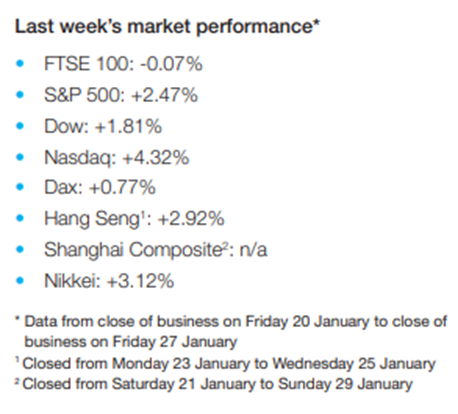
Major US indices ended the week higher. Consumer discretionary stocks outperformed thanks partly to a jump in Tesla shares. Performance was aided by higher-than[1]expected GDP growth and indications from the Federal Reserve of a potential lower-than-expected rate hike of 0.25 percentage points. A statement from the Treasury secretary on falling energy prices and easing supply chain bottlenecks also helped to boost investor sentiment. The S&P 500 rose 2.5% and the Nasdaq added 4.3%.

In Europe, the STOXX 600 gained 0.7%, and the Dax added 0.8% after business activity in the eurozone unexpectedly stabilised in January and consumer confidence rose. The FTSE 100 slipped 0.1% as investors expect the Bank of England to raise its base rate by 0.5 percentage points to 4.0%, its highest level in 15 years.

In Asia, Japan’s Nikkei 225 rose 3.1% on news the Bank of Japan will examine the impact of its yield curve control policy modification on market functioning. Hong Kong’s Hang Seng ended its holiday-shortened trading week up 2.9% with markets underpinned by lunar new year holiday spending and a sharp drop in Covid cases in China. The Shanghai Composite was closed all week for the lunar new year celebrations.

Investors eye interest rate hikes

US indices started this week in the red, with the S&P 500 down 1.3% on Monday (30 January) ahead of the Federal Reserve’s interest rate decision. The Fed is expected to slow its pace of interest rate hikes in light of cooling inflation. Last year, it delivered four 0.75 percentage point increases, followed by a 0.5 percentage point rise in December. Germany’s Dax also fell on Monday following news that Europe’s largest economy shrank by 0.2% in the fourth quarter of last year, leaving Germany on the brink of a recession. The European Central Bank and the Bank of England are due to deliver their rate decisions this week, with markets expecting a 0.5 percentage point hike by both central banks.

The FTSE 100 was down 0.3% at the start of trading on Tuesday following a prediction from the International Money Fund that the UK economy will shrink by 0.6% this year – a 0.9 percentage point downward revision from October. The UK is the only G7 country forecast to shrink in 2023.

US GDP growth exceeds expectations

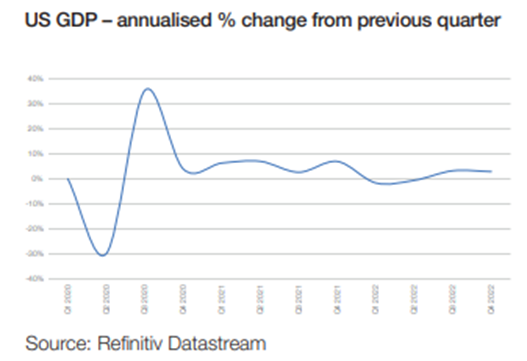
Figures released last week showed the US economy grew by 2.9% in the last quarter of 2022. This was slightly higher than economists’ forecasts of 2.6%, but lower than the 3.2% growth seen in Q3. Consumer spending rose by 2.1%, with growth concentrated primarily at the beginning of the quarter. A main driver of this was businesses building inventories, particularly across the manufacturing and utilities sectors.

Rate increases have had a significant negative impact on the manufacturing and housing markets. Housing[1]related investment fell by 26.7% on an annualised basis, shaving 1.3 percentage points off overall GDP. The drop comes from delayed or cancelled projects as higher rates increased borrowing costs.

Separate figures showed core personal consumption expenditures (PCE), which excludes food and energy, rose by 0.3% in December, up from 0.2% the month before. This represents a 4.4% rise year-on-year, the slowest annual rate of increase since October 2021.

Meanwhile, new unemployment claims fell to 186,000 in the week ending 21 January, according to a report from the Department of Labor. This represented the lowest level in nine months and a decrease of 6,000 compared to the week before.

Despite the robust figures, many economists expect the US to go into a recession in the second half of the year, albeit a milder one than previous downturns.

Tokyo core CPI rises

Over in Japan, Tokyo core consumer price inflation (CPI) rose by 4.3% year-on-year in January, exceeding the Bank of Japan’s (BoJ) inflation target of 2% for the eight consecutive month. The increase marked the fastest annual gain in over 40 years and followed a 3.9% rise in December. Following the data release, the yield on the ten-year Japanese government bond rose to 0.47% from 0.40% at the end of the previous week.

At its 17-18 January monetary policy meeting, the BoJ concluded that it needs to examine the impact that modifying its yield curve control policy in December has had on market functioning. It added that it is appropriate to continue with monetary easing at this point. The International Monetary Fund proposed on Thursday that the BoJ allow government bond yields to rise more flexibly due to “significant upside risks” to inflation in the near term.

Please check in again with us soon for further relevant content and news.

Chloe

01/02/2023

Team No Comments

Evelyn Partners Update – UK December CPI inflation

Please see below article received from Evelyn Partners earlier this morning, which provides details on today’s UK December CPI inflation announcement.

What happened?

UK December annual headline CPI inflation was reported at 10.5% (consensus: 10.5%), down from 10.7% in November and a peak of 11.1% in October. The CPI monthly increase was 0.4% (consensus: 0.3%), compared to 0.4% in November.

What does it mean?

There is increasing evidence that UK headline CPI inflation has peaked and is being led down by lower energy prices. High frequency data show that this has further to go. Take wholesale one-month ahead natural gas prices. They have now fallen to below the pre-Russian invasion of Ukraine level and are down 19% so far in January. This should reduce the upward pressure in household energy bills. Petrol prices are also declining. The latest price of unleaded petrol on 17 January was £1.50, down from £1.52 at the end of 2022 and a peak of £1.92 last summer. Expect lower energy prices to exert downward pressure on inflation, at least in next month or two.

Looking beyond the near term, slowing economic growth, along with higher taxes and rising mortgage rates, are likely to be a drag on real household take-home pay in 2023. Lower discretionary incomes should prove to be a significant headwind against another upward acceleration in inflation from here. Moreover, high base effects from sharp price increases in 2022 will make it difficult to sustain high annual CPI inflation rates in 2023. Finally, the impact of supply chain disruption on prices in the goods market should begin to fade, while recent sterling appreciation will lower the cost of imported goods.

The Bank of England (BOE) expects headline CPI inflation to essentially halve to around 5% by the fourth quarter of 2023. Even so, core CPI inflation (excluding food, energy, alcohol and tobacco) remains fairly sticky. The risk to BOE’s inflation outlook is the potential secondary impact of workers demanding higher wages to keep up with the high cost of living. With the unemployment rate still near cyclical lows, there is a possibility that higher wage rates become entrenched in the economy, increasing the risk of a wage-inflation upward spiral.

Bottom Line

Given the current high rate of consumer price rises, the Bank of England will likely raise interest rates again at its next Monetary Policy Committee meeting on 2 February.

For investors, elevated inflation and likely negative GDP growth in 2023 are clear risks. However, the UK economy is not the equity market, and this probably explains why UK stocks gained nearly 17% more than the rest of the world in 2022, its biggest beat since 1990.

Moreover, UK-listed multinationals are largely linked to what goes on in the rest of the world. Looking forward, the reopening of the Chinese economy from Covid zero policy is a shot in the arm for externally focused UK companies. China seems to be willing to go for growth by relaxing restrictive policies applied to its all-important property sector. According to a Bloomberg report in early January, the Chinese authorities are set to raise lending caps for developers and extend the deadline for firms to meet debt limits. This could be a green light from the Chinese leadership to go for growth and should support overall UK EPS growth. Analysts are already starting to revise up 2024 UK EPS growth expectations in anticipation of global economic recovery. Given low valuations, UK stocks can perform this year.

Please check in again with us soon for further relevant content and market news.

Chloe

18/01/2023

Team No Comments

Stocks rise as pace of inflation slows

Please see below ‘Markets in a Minute’ article received from Brewin Dolphin yesterday afternoon, which provides a positive global market update as we continue through the first month of 2023.  

Most major stock markets finished their first week of 2023 in the green as data suggested inflation was cooling in both the US and Europe.

The S&P 500 and the Nasdaq ended their four-day trading week up 1.5% and 1.0%, respectively, after Friday’s nonfarm payroll report raised hopes the Federal Reserve could engineer a ‘soft landing’ for the US economy – i.e. slowing inflation without sparking a significant recession.

The pan-European STOXX 600 and Germany’s Dax surged 4.6% and 4.9%, respectively, as inflation in the eurozone fell below 10% for the first time in two months.

In Asia, the Hang Seng surged 6.1% and the Shanghai Composite added 2.2% on news that Hong Kong was considering reopening its border with mainland China after three years of coronavirus restrictions.

Stocks rally as Hong Kong-China border reopens

Stocks extended gains on Monday (9 January) after Hong Kong and China resumed quarantine-free travel over the weekend. It is hoped the reopening will provide a much-needed boost for Hong Kong’s economy, which is projected to have shrunk by 3.2% in 2022, according to reports in the Financial Times. The Hang Seng gained 1.9% on Monday while the Shanghai Composite added 0.6%. The positive sentiment spread to Europe, where the FTSE 100 climbed to its highest level since August 2018. In contrast, US indices slipped into the red as investors looked ahead to this week’s inflation data and earnings reports from major banks.

US jobs growth slows

The release of the official nonfarm payrolls report last Friday showed US jobs growth slowed for a fifth consecutive month in December. This fuelled optimism among some commentators that the Federal Reserve will be able to slow its pace of interest rates hikes and, in turn, avoid sparking a severe recession.

According to the Bureau of Labor Statistics, 223,000 jobs were added in the final month of 2022. This was above consensus expectations, but less than the 256,000 jobs added in November.

Average hourly earnings growth slowed to 0.3% month[1]on-month, and November’s wage growth was revised down from 0.6% to 0.4% month-on-month, easing concerns about wage inflation. Nevertheless, the average wage gain over the past two months has amounted to 0.35%, which is slightly higher than what would be considered consistent with the Federal Reserve hitting its 2% inflation target. The unemployment rate also dropped back to its cycle low of 3.5%, while the job openings to unemployed ratio remained very high.

Services and manufacturing activity fall

Separate data released on Friday showed services and manufacturing activity in the US fell in December, but so did price pressures. The Institute for Supply Management’s (ISM) services index dropped to 49.6, putting it into contraction territory (below 50.0) for the first time since May 2020. Excluding the Covid-19 pandemic slump, this was the weakest reading since late 2009. Prices paid continued to increase but at their slowest pace since January 2021.

Meanwhile, manufacturing activity contracted for the second month in a row, falling to 48.4 in December from 49.0 in November. Prices paid by manufacturers dropped sharply to their lowest level since February 2016, excluding the early pandemic plunge.

Eurozone inflation returns to single figures

Last week also brought encouraging signs of easing inflation in the eurozone. Lower energy prices helped the annual inflation rate fall to 9.2% in December from 10.1% in November, according to Eurostat’s flash index. However, core inflation, which excludes volatile food and energy prices, rose to a new high of 5.2% year-on-year, exceeding economists’ expectations.

It came after François Villeroy de Galhau, governor of the Banque de France and a European Central Bank (ECB) policymaker, said interest rates would need to rise further to reduce underlying price pressures. The ECB is expected to raise rates by 0.5 percentage points at both its February and March policy meetings.

UK mortgage approvals fall sharply

Here in the UK, data from the Bank of England showed mortgage approvals fell to their lowest level in two years in November as increased borrowing costs put off buyers. Approvals fell to 46,100, down from 57,900 the previous month and the lowest level since June 2020, when the pandemic brought the housing market to a standstill. The interest rate paid on new mortgages rose by 26 basis points to 3.35% in November, the highest since 2013.

Separate figures from Halifax showed the average house price fell by 1.5% in December from the previous month. Halifax said it expects house prices to fall by around 8% during 2023, which would see the cost of the average property returning to April 2021 prices.

Please check in again with us soon for further relevant content and news.

Chloe

11/01/2023