Team No Comments

Abrdn: Autumn Statement 2022 – what it means for you

Please see below an article from Abrdn with an overview of the main points of today’s (17th November) Autumn Statement.

Autumn Statement 2022 – what it means for you and your clients

Jeremy Hunt used the Autumn Statement in an attempt to calm markets and reset public finances with a series of tax rises achieved through cuts and freezes to allowances.

In his first few days in office he had already reversed most of the measures announced in his predecessor’s September Mini Budget. But today he went further by cutting the CGT annual exemption, lowering the additional rate threshold to £125,140 and extending the freezing of other allowances by a further two years.

For advisers, these measures amplify the need for their clients to make the most of annual tax allowances, and maximising tax efficient savings into pensions and ISAs.

Read our summary of the key points from today’s Autumn Statement.

Income tax

  • Rates – Income tax rates for 2023/24 will remain at the basic, higher and additional rates of 20%, 40% and 45% respectively. The abolition of the additional rate of tax announced in the Mini Budget will not happen.
  • The Scottish Government intend to hold their own Budget on 15 December, and this will determine the rates which will apply to Scottish taxpayers.
  • Allowances and thresholds – The point at which additional rate tax becomes payable will be cut from £150,000 to £125,140 from 6 April 2023. This will mean that those already paying tax at 45% will pay an extra £1,243 in 2023/24. The Government forecast that approximately 250,000 individuals will pay some extra tax due to this measure.
  • The personal allowance and basic rate band remain frozen at £12,570 and £37,700 respectively. This freeze of allowances has been extended by a further two years until April 2028. This means that the higher rate tax threshold will remain at £50,270 for those entitled to a full personal allowance.
  • Dividends – The dividend allowance is to be halved from £2,000 to £1,000 for 2023/24, and halved again to £500 for 2024/25. Consequently, many more investors will need to complete tax returns if their dividend income exceeds £1,000 next year. The dividend tax rates for basic rate, higher rate and additional rate taxpayers will remain at 8.75%, 33.75% and 39.35% for both the current tax year and 2023/24. The 1.25% increase installed from the start of 2022/23 will not be reversed.

Pensions

  • There were no changes announced to pension tax relief. However, the reduction of the threshold for additional rate tax to £125,140 will see more high earners benefit from relief at 45% on their pension savings. Wage inflation may also mean that a pension contribution is a more attractive option for those who may otherwise lose out on child benefit or personal allowance.
  • It was also confirmed that the triple lock on the State Pension would be maintained, guaranteeing the 10.1% CPI-based increase for next April along with the same level of increase to the Pension Credit.
  • There has been an ongoing review of State Pension age and whether the current timetable for changes is still appropriate. The Government will publish their response in early 2023.
  • There was no mention of any extension to the freeze to the lifetime allowance which is expected to remain fixed at £1,073,100 until April 2026.

National Insurance

  • The increase to NI to help pay for social care reforms has been scrapped. The additional 1.25% which was added to the rates of NI for 2022/23 for employees, employers and the self-employed has been removed from November 2022.
  • NI thresholds will be fixed at the current 2022/23 levels. The changes to the thresholds at which individuals (both employed and self-employed) start to pay NI, which were introduced in July 2022, will remain – i.e. they’re kept in line with the annual personal allowance of £12,570.

Capital Gains Tax

  • The chancellor announced that the CGT annual exemption would be cut from £12,300 to £6,000 from April 2023, and to £3,000 from April 2024. Based on 2021/22 figures an estimated extra 235,000 individuals will need to file a self-assessment return in 2023/24 as a consequence.
  • There was no change to the rates of CGT and these will continue to be 10% and 20% (18% and 28% respectively for gains on residential property).

Inheritance Tax

  • The freeze on both the nil rate band (NRB) and residence nil rate band (RNRB) has been extended for an additional two years. The NRB will remain at £325,000 and the RNRB at £175,000 until April 2028.

Corporation Tax

  • Corporation tax will rise to 25% from April 2023 as originally planned. However, small companies with profits below £50,000 will continue to pay at the current rate of 19%. There will also be a reintroduction of tapering relief for businesses with profits between £50,000 and £250,000 so that they pay less than the main rate.

Please continue to check our blog for further analysis of the Autumn Statement 2022, as well as advice, planning issues and investment, markets and economic updates.

Cyran Dorman

17th November 2022

Team No Comments

Stocks rise as US inflation eases

Please see below ‘Markets in a Minute’ article received from Brewin Dolphin yesterday evening, which provides a largely positive global market update.

Global stock markets rallied last week as lower-than[1]expected US inflation raised hopes the Federal Reserve would slow its pace of interest rate hikes.

The S&P 500 rose 5.9% to mark its best week since June. Technology stocks performed particularly strongly, helping the Nasdaq surge 8.1%.

Signs of easing US inflation also boosted stocks in Europe and Asia, with Germany’s Dax and Japan’s Nikkei 225 advancing 5.7% and 3.9%, respectively. China’s Shanghai Composite added 0.5%, with gains held back by the first decline in Chinese exports for two years.

The FTSE 100 was the weakest performer among the major indices, declining 0.2% on the back of disappointing UK gross domestic product (GDP) numbers.

Investors look ahead to autumn statement

The FTSE 100 started this week in the green, rising 0.9% on Monday (14 November) as investors looked ahead to UK chancellor Jeremy Hunt’s autumn statement on Thursday. Hunt is expected to announce a range of tax increases and spending cuts to help plug a hole in the public finances. In economic news, data from Rightmove showed the average UK house price declined by 1.1% in November following a 0.9% increase the previous month.

US stocks fell on Monday following reports that e-commerce giant Amazon is considering laying off 10,000 employees – roughly 1% of its global workforce. The S&P 500 slipped 0.9% and the tech-heavy Nasdaq lost 1.1%.

The FTSE 100 was up 0.2% at the start of trading on Tuesday, as investors digested the latest labour market data from the Office for National Statistics (ONS). The unemployment rate was an estimated 3.6% in July to September, 0.2 percentage points lower than the previous three-month period and 0.4 percentage points below pre-pandemic levels.

US inflation lower than expected

Last week’s economic headlines were dominated by the surprise drop in US inflation. The headline CPI rose by 7.7% year-on-year in October – the slowest rate since January and below the 8.0% figure expected by economists. On a monthly basis, the CPI rose 0.4%, below expectations of around 0.6%.

Even more encouraging was an easing in core inflation, which strips out food and energy prices. This fell back to an annual rate of 6.3% from a 40-year high of 6.6% in September. Shelter was the dominant factor driving core CPI, rising by 0.8% month-on-month in October – the biggest increase in over 32 years. When food, energy and shelter are stripped out, the CPI declined by 0.1% from the previous month.

Following the release of the data, several Federal Reserve officials appeared to signal their support for a slower pace of interest rate hikes. Patrick Harker, president of the Philadelphia Fed, was quoted in the Financial Times as saying: “In the upcoming months, in light of the cumulative tightening we have achieved, I expect we will slow the pace of our rate hikes as we approach a sufficiently restrictive stance.” And Lorie Logan, president of the Dallas Fed, said: “While I believe it may soon be appropriate to slow the pace of rate increases so we can better assess how financial and economic conditions are evolving, I also believe a slower pace should not be taken to represent easier policy.”

But consumer sentiment remains low

On a less positive note, a report on Friday showed US consumer sentiment fell in November to its lowest level since July. The University of Michigan’s preliminary reading dropped to 54.7 from 59.9 the previous month. Economists polled by Reuters had forecast a reading of 59.5. One-year inflation expectations edged up to 5.1% from 5.0% in October, while buying conditions for durable goods fell 21% due to high interest rates and continued high prices.

“Instability in sentiment is likely to continue, a reflection of uncertainty over both global factors and the eventual outcomes of the election,” said survey director Joanne Hsu.

UK economy shrinks in third quarter

Here in the UK, figures released on Friday showed UK GDP shrank by 0.2% in the third quarter, marking the first quarterly decline since the start of 2021. Output slowed in services, production and construction, while real household expenditure declined by 0.5% as prices soared. GDP in September alone fell by 0.6%, although the ONS noted that data for the month was affected by the bank holiday for the state funeral of HM Queen Elizabeth II.

Regardless, it leaves the UK economy, unlike its developed European peers, smaller than it was before the pandemic.

The data came a week after the Bank of England warned the UK was heading for its longest recession since records began a century ago. GDP is expected to continue falling through 2023 and into the first half of 2024.

Chancellor Jeremy Hunt said he would try to make any recession “shallower and quicker” than predicted, adding that there is “a tough road ahead”.

Eurozone facing imminent recession

The eurozone and most EU countries are also heading for an imminent recession, according to the European Commission. EU economy commissioner Paolo Gentiloni said at a press conference that the economic situation had “deteriorated markedly” and the eurozone was heading into two consecutive quarters of contraction – the technical definition of a recession.

The commission said that while GDP growth in the EU is likely to be better than expected this year – at 3.3% rather than 2.7% – a weaker external environment and tighter financing conditions are expected to tip the EU, the euro area and most member states into a recession in the last quarter of the year. “As inflation keeps cutting into households’ disposable incomes, the contraction of economic activity is set to continue in the first quarter of 2023,” the commission added. “Growth is expected to return to Europe in spring, as inflation gradually relaxes its grip on the economy.”

Please check in again with us soon for further relevant content and news.

Chloe

16/11/2022

Team No Comments

Brooks Macdonald: Weekly Market Commentary – US CPI Boosts Hopes of Less Hawkish Monetary Policy

Please see the below article from Brooks Macdonald, detailing the key news from markets over the past week. Received yesterday afternoon – 14/11/2022

Equities rallied significantly last week as a downside miss to US CPI boosted hopes of less hawkish monetary policy

Equity markets continued their gains on Friday with the US outperforming as investors priced in the implications of the lower than expected US Consumer Price Index (CPI) report.

China releases a plan to ease COVID restrictions and loosen policy for the embattled Chinese property sector

Prior to the Chinese party congress, investors had hoped that the new leadership would feel comfortable easing COVID rules and loosening economic policy. Foreign investor sentiment towards China has become decidedly poorer in the last month however, as investors fear that Xi’s consolidation of power may lead to policies which deprioritise economic growth. Pushing back against some of these concerns, China has released a 20-point plan to ease its zero-COVID policy which has stifled recent economic growth. In addition to this, the government also announced a 16-point plan to support the domestic property sector which has looked increasingly weak in the aftermath of the Evergrande default and as property developers focus on complying with the central bank’s ‘three red lines’ governing leverage. It is too early to say whether these two announcements are part of a broader attempt to provide additional impetus to the Chinese economy however they have been welcomed within Chinese equity markets this morning.

US Central Bank governors have begun to comment on the inflation numbers, warning that more hikes are still needed

Bond and equity markets welcomed the downside miss to headline and core CPI last week which may mean that the US Federal Reserve (Fed) will not need to be as hawkish to keep inflation under control. We are yet to see how the Fed, in aggregate, will respond to last week’s reading but we have heard from a few Fed Governors, including Waller earlier today. Waller said that there was still ‘a ways to go’ in tightening US monetary policy, predominantly as the central bank would need to see a run of softer CPI readings before it gained confidence that it could stop hiking rates. Waller also speculated that some of the exuberance last week echoed the market’s, ultimately premature, rally after the July CPI release which commenced a rally which was eventually snubbed by Fed Chair Powell.

Fed speak will be important as we look ahead to the December Fed meeting and we get further clues as to whether the Fed is now less concerned about inflation. In reality however, Fed sentiment may impact the size of the December rate hike but inflation itself will dictate how high interest rates need to go in 2023.

Please continue to check our Blog content for advice and planning issues and the latest investment, markets and economic updates from leading investment houses.

Alex Kitteringham

15th November 2022

Team No Comments

Tatton – Monday Market Digest

Please see the below an article from Tatton Investment Management which was received this morning (14/11/2022) and details their thoughts on last week’s events and their impact on markets:  

Overview: signs of ‘peak’ inflation emboldens markets

There were three big stories in capital markets last week: the US midterm elections, the latest crash in the surreal world of crypto currencies, and the release of US inflation data for October. By Friday, it was the lower-than-expected inflation data that took precedence. Thursday’s report from the Bureau of Labor Statistics revealed annual consumer price index (CPI) inflation slowed to 7.7% in October, below the 8% expected by most economists, and the lowest level since January. So, for the first time this year it appeared that current rising inflation may be over for the US. While it is still too early to assume the Federal Reserve (Fed) will pivot away from its monetary tightening policy, the market euphoria following the data release was quite something. We may not have reached the actual turning point in terms of shifting economic tides, but perhaps this week’s activity confirms our suspicion of the shared belief among market participants that the current economic downturn is more likely to be shorter and shallower than some scaremongers (including the Governor of the Bank of England) suggest.

Last week also saw FTX, the second-largest crypto exchange, become a casualty of both crypto’s defining feature (lack of regulation) and the less forgiving market environment. It turns out that diehard cryptocurrency traders still prefer the stability of the money created by central banks. For us, what is most interesting about this episode is the likely impact on general credit spreads – the proverbial canary in the coalmine of capital markets during economic downturns. While FTX’s demise and bankruptcy filing is still in its early stages, talk of FTX as a “mini-Lehman” will depend on which financial institutions  report large exposures (if any). This may change this week when the impact of FTX’s related hedge fund, Alameda Research, on prime brokers and other hedge funds emerges.

As we head towards the close of the year, when asset managers have a tendency to shut down exposures, last week’s positive upturn certainly felt encouraging. However, investors should not expect 2022’s market pressures to end here. The Fed’s December meeting may well cause yet another turn in market sentiment and the underlying corporate profit development, coupled with thinning seasonal liquidity from institutional investors, leaves us bracing for more potential volatility before the year ends.

Republican ‘red wave’ fizzles out

Last week’s midterm elections in the US had been labelled as the most important midterms in recent memory, with democracy itself on the ballot. But while Republicans went as far as to predict a ‘red wave’, the weekend brought news that the Democrats had retained Senate control at least, with the House of Representatives still up for grabs. The Republican party’s underperformance was an unwelcome surprise for capital markets last week, mostly because investors crave stability, which means a preference for the status quo and even political gridlock. 

For markets, the real test lies in judging what fiscal policy will emerge after all the votes have been counted. The Democrats have shown a desire to increase the overall tax base in line with spending proposals – coming out at fiscally neutral – and control of the Senate could them make progress with this agenda. What the future holds for the Republican party after this ballot box set back  is much less clear, and could come down to whoever gains the Republican presidential nomination in 2024. Trump is expected to announce his candidacy this week and, were he to be successful, some fear a return to fiscal indiscipline, especially in the face of slower growth. On the other hand, the unexpectedly poor performance of Republicans – particularly those linked to Trump himself – suggests the party may field someone else. That someone would almost certainly be Florida Governor Ron DeSantis. His successful re-election campaign was built around promises of sales-tax cuts targeted on everyday items, which would benefit the less well-paid. It is yet to be seen how the lower tax revenues will impact Florida’s provision of public services. It would be difficult to achieve a similar policy at the federal government level, as sales tax is levied by the states, so the equivalent would be lower income tax. 

Meanwhile, Biden and the Democrats gained a fillip from the electorate, and will be poring over the voter data and surveys to divine what were the key positives. Recapturing the Senate gives Biden some ammunition to counter critics who believe his age and frailty should render him a one-term-only president. The Democrats have no obvious centre-ground alternative candidate themselves, but Trump’s early entry into the nomination race means they may wait to see how things pan out, especially if the Republican fight gets messy. With Trump involved, it almost certainly will. 

To PE or not to PE? That is the question

This year, private equity (PE) has protected some of the world’s largest investors from the misery in publicly-traded securities. On average, PE firms recorded 1.6% of gains in the first quarter of 2022, and only some mild falls since then. Publicly-traded global equities by contrast are down 22% over the same timeframe. Lower volatility does not seem to come at the cost of growth either. The industry has grown exponentially in the last decade and a half and, while it was thought rising interest rates would make things much harder, PE firms predict a bright future. According to BlackRock analysts, returns from US private equity are expected to eclipse other asset classes over the next decade.

Of course, when something seems too good to be true, it usually is, especially when you remember that private fund managers set those fund valuations themselves. Private equity funds hold their assets for a long period, so at any given time it is difficult to work out what the market value for those assets should be. And on other measures, the private equity market looks much less rosy. Carlyle Group, for example, has lost more than half of its stock value this year – despite flat or even positive reported returns in its underlying assets.

PE funds also recently struggled to attract capital in similar amounts as in recent years. That much should be expected, given the tightening of global financial conditions. But this is being compounded by the so-called ‘denominator effect’. PE funds work by setting up a closed-end fund for certain acquisitions, then drawing in ‘limited partners’ (LPs) to foot the bill. These funds are then managed by PE firms like KKR or Carlyle – which take a healthy chunk of the profits – but the risks are borne by the LPs. The problem comes from the fact that the LPs are often large institutional investors like pension funds, which have strict regulatory requirements on where they can put their money. These rules often dictate that only a certain percentage of an overall portfolio can be put into private assets, usually in the 20-30% range. If those PE funds outperform other parts of the portfolio by a significant margin – as seen this year – the ratio gets out of kilter. PE backers therefore have to pull out some funding as a regulatory requirement.

Many have taken to calling on existing LPs for more capital. Large pension funds and the like should have enough cash to do so, but smaller investors may be forced to sell some assets to meet these payments. Given how large PE exposure has become over the last decade and a half, this could have serious knock-on effects in publicly-traded markets. Moreover, if PE funding continues to dry up and firms keep having to make capital calls, we could see a similar liquidity crunch

Please continue to check our Blog content for advice and planning issues and the latest investment, markets and economic updates from leading investment houses.

Carl Mitchell – Dip PFS

Independent Financial Adviser

14/11/2022

Team No Comments

Singles Day 2022: What’s in store for the world’s largest e-commerce festival?

Please see the below article from Invesco about this years ‘Single’s Day’ online shopping event which is taking place today:

Key Takeaways

  • Singles Day 2022 – World’s largest online shopping event, outstripping Cyber Monday and Black Friday
  • Trends for brands – Keeping consumers engaged and entertained have been a trend for brands participating in the event
  • Customer lifetime value – Brands that focus on creating customer lifetime value and cultivating loyalty keep shoppers engaged and entertained

The worlds’ largest online shopping event, Singles Day or Double 11, this year features experiences in the metaverse, livestreaming sessions, while big themes of the festival are sustainability and inclusiveness.

First created in 1993 by four single university students to celebrate being single, the day became a commercial event in China in 2009 and now global sales – mostly online – generate billions and outstrip Cyber Monday and Black Friday.  This year more than 290,000 brands from 90 countries are participating in the sale.

What will be the trends for brands this Singles Day?

The shopping extravaganza usually kicks off with a gala celebration the night before. In the past, there’s been no shortage of guest star appearances, including Benedict Cumberbatch showing up via a pre-recorded video last year, previous years have seen performances by Taylor Swift and Katy Perry.

Keeping consumers engaged and entertained have been a trend for brands participating in the event.  Consumers can play games to win discounts, while celebrities and influencers entertain them through livestreaming demonstrations of products. Shoppers can have their products delivered to their doorsteps within an hour or even minutes.

Livestreamed shopping has been one of the most successful sales channels. Li Jiaqi, a top Chinese livestreaming host sold US$1.9 billion of goods during China’s Singles Day last year. In a recent livestreaming session in September 2022, Li attracted 150,000 viewers in just the first 10 minutes.

Gross Merchandise Value (GMV) or the total value of merchandise sold over a given period has become for companies an important measure of success for Singles Day. GMV is used to determine the health of an e-commerce site.  Since 2009, this figure for the festival has proliferated in China. The first Singles Day sales dating back more than a decade ago generated GMV 50 million yuan, while last year, traditional online retailer platforms totalled GMV of RMB 314.63 bn, while livestreaming platforms recorded RMB 73.76 bn.

How can brands gain new joiners, while maintaining customer loyalty?

Singles Day sales are not just celebrated by customers from tier-1 cities, the largest and wealthiest cities in China. Penetration to lower-tiers cities has also increased in recent years. Last year, non-tier 1 cities shoppers accounted for 77% of all shoppers during the festival.

Despite these impressive figures, it is challenging for brands to increase their market share through Singles Day.

To increase growth, brands are looking at ways to improve the shopping experience, while maintaining customer loyalty.

Various online platforms offer pre-sale events to attract customers’ attention. This year, pre-sale started on 20 Oct 2022. The impact of pre-sale numbers can’t be ignored, last year a top Chinese e-commerce platform experienced a 20-min system breakdown during the event.

Attractive discounts will be offered during the shopping extravaganza. For instance, a large variety of cross-store rebates, such as an extension on returns for purchased products, and compensation for the price difference should customers discover the same product is cheaper on another platform.

In addition, there are heart-warming promotions such as the “one-shoe scheme.” This started last year and enables disabled people to purchase shoes at half the price. University students have also set up online stores to help them gain entrepreneurial experience in Singles Day sales.

E-commerce platforms further created impact via diversification of marketing strategy. Metaverse is another initiative to launch, where consumers can virtually participate in online shopping in the metaverse. Platforms are also using interest-based marketing to individually tailor messages to customers and making entertaining videos that are a bit more personal to the consumer, lifting the excitement of online shopping.

Eco-friendly products are also offered, there are more than 3 million green products on shelves this year. Green logistics is also being promoted in the Singles Day sales, such as offering a self-pickup locker network to reduce carbon footprint, targeting environmentally conscious customers.

Defining the success of Singles Day for e-commerce platforms is not as simple as it used to be. Although there are still discounts and deals for consumers, brands that focus on creating customer lifetime value and cultivating loyalty keep shoppers engaged and entertained.

Maybe todays the day to do some early Christmas shopping online and partake in singles day?

Please continue to check back for our variety of blog content.

Andrew Lloyd DipPFS

11th November 2022

Team No Comments

Brooks Macdonald: Daily Investment Bulletin – US Midterm Elections and the upcoming US CPI report

Please see below the daily investment bulletin from Brooks Macdonald, which looks at the US Midterm Elections and expectations regarding today’s (10/11/2022) US CPI report. Received this morning – 10/11/2022.

What has happened

US equities struggled yesterday after a solid run of gains, with the headline US index down over 2% on the day. European equities posted small losses with sentiment boosted by news that Russian troops were withdrawing from the Ukrainian city of Kherson.

Midterm elections

With the midterm elections significantly closer than many commentators had expected, the last remaining states will determine the victors in the House of Representatives and the Senate. Electoral models still suggest that the Republicans will take the House but by a far smaller margin than previously expected. Within the Senate, one of the remaining seats is Georgia, where no candidate received the 50% needed to avoid a run-off race which will now take place on 6th December. Should the other remaining two Senate seats be split between the two parties, the Georgia race will determine control of the Senate, as it did in 2020. With Republican Ron DeSantis one of the strong performers of the midterms, speculation is building that he will announce shortly that he will run for President in 2024.

US CPI

Later today will see the release of the US CPI report which remains the most important of the monthly data releases. The report last month catalysed a broad sell-off in risk assets as core CPI surpassed economist expectations. This month the market is expecting a 0.6% month-on-month gain in the headline CPI report which would bring the year-on-year number down to 8% from 8.2%. The core month-on-month number is expected to ease slightly, coming in at 0.5%, which would bring the year-on-year figure to 6.5% rather than 6.6%.

What does Brooks Macdonald think

The importance of today’s CPI report is clear, with bond investors looking for signals as to whether US inflation has peaked and is starting to plateau. Before the next Federal Reserve meeting we have today’s release and one in December, therefore today’s report will have less of a direct follow through to Fed policy than previous months. That said, market pricing will rapidly incorporate the latest change in US price pressures, although investors should be cautious of extrapolating today’s datapoint too far into the future given the uncertainty and volatility of US inflation in 2022 so far.

Please continue to check our Blog content for advice and planning issues and the latest investment, markets and economic updates from leading investment houses.

Cyran Dorman

10th November 2022

Team No Comments

European stocks soar as BoE turns more dovish

Please see below ‘Markets in a Minute’ article received from Brewin Dolphin this morning, which offers a global market update and touches on higher interest rates and inflation levels.   

UK and European stocks rose for a third consecutive week last week after the Bank of England (BoE) signalled a more dovish outlook for UK interest rates.

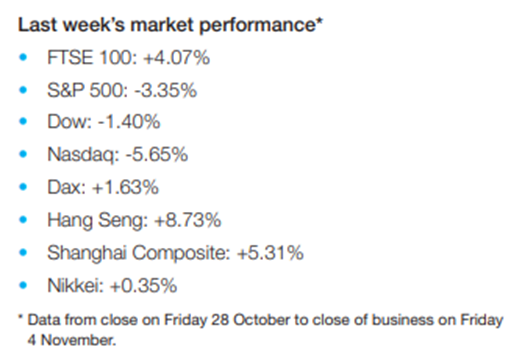
The FTSE 100 leapt 4.1%, Germany’s Dax gained 1.6% and the pan-European STOXX 600 rose 1.5%. This was despite warnings of a two-year UK economic slump and higher-than-expected eurozone inflation.

China’s stock markets also rallied, with the Shanghai Composite surging 5.3% on rumours the country was considering relaxing its zero-Covid strategy. These hopes were subsequently quashed over the weekend, when China’s National Health Commission reiterated its commitment to eliminating Covid-19 and said its prevention and control strategy was “completely correct”.

US indices ended the week lower after Federal Reserve chair Jerome Powell said it was “very premature” to consider pausing interest rate hikes. Better-thanexpected nonfarm payroll numbers helped the S&P 500 rebound on Friday after a four-day selloff, but the index still finished the week down 3.4%. The Nasdaq sank 5.7% as the fallout from disappointing technology sector earnings continued.

Stocks rise ahead of US CPI

US indices rose on Monday (7 November) as investors looked ahead to Tuesday’s midterm elections and the release of the closely watched consumer price index (CPI) report. The Dow advanced 1.3% and the S&P 500 added 1.0%.

In contrast, the FTSE 100 slipped 0.5% on Monday as the denial of any easing of China’s zero-Covid policy dented investor sentiment. In economic news, data from Halifax showed house prices fell by 0.4% month-onmonth in October, the steepest monthly decline since February last year. The blue-chip index extended declines at the start of trading on Tuesday, as figures from BRC/ KPMG showed UK retail sales slowed in October.

BoE lifts base interest rate to 3.0%

Last week, the Bank of England’s monetary policy committee (MPC) voted to increase the base interest rate by 0.75 percentage points – the biggest rate hike since 1989. The base rate now stands at 3.0%, up from just 0.1% in December last year. The BoE warned of a “very challenging outlook”, with the economy forecast to remain in recession for two years until mid-2024 and unemployment rising to 6.4%.

BoE governor Andrew Bailey said that while the Bank couldn’t make any promises about future interest rates, “we think [the] bank rate will have to go up by less than currently priced into financial markets.” The BoE pointed out that if rates rose to 5.25%, inflation would fall to zero in three years’ time. This suggests smaller rate hikes would be needed to return inflation to the 2% target. Following the MPC meeting, markets now expect interest rates to peak at about 4.6%.

Fed warns of higher interest rates

Whereas the BoE’s comments were seen as relatively dovish, the chair of the Federal Reserve adopted a hawkish tone after US interest rates were lifted by 0.75 percentage points, in line with expectations.

A statement by the Federal Open Market Committee was interpreted by markets as a signal that the central bank could slow the pace of rate hikes. In a post-meeting press conference, however, Powell said interest rates would peak at a higher level than previously expected and that the Fed has “some ways to go” in its attempt to rein in inflation. He also hinted that the central bank preferred to raise interest rates too high, potentially sparking a recession, rather than risk keeping rates too low to bring down inflation.

“If we were to overtighten, we could then use our tools strongly to support the economy,” he said, in comments reported by the New York Times. “Whereas if we don’t get inflation under control because we don’t tighten enough, now we’re in a situation where inflation will become entrenched. And the costs – the employment costs, in particular – will be much higher.”

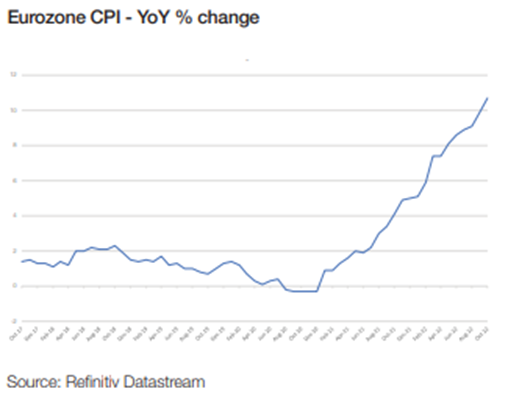
Eurozone inflation hits 10.7%

Last week also saw the release of the latest eurozone inflation figures. According to Eurostat, annual inflation rose to a higher-than-expected rate of 10.7% in October, up from 9.9% in September. This was driven by surging energy prices, which increased 41.9% year-on-year. Food, alcohol and tobacco prices also rose sharply, by 13.1% year-on-year.

On Friday, European Central Bank (ECB) president Christine Lagarde reiterated the ECB’s focus on bringing down inflation. She said that in order to avoid fuelling prices, member states should stick to temporary and targeted support for households affected by the cost-ofliving crisis.

Global manufacturing PMI slips further

Elsewhere, JPMorgan’s global manufacturing purchasing managers’ index (PMI) fell further into contraction territory in October, slipping to 49.4 from 49.8 in September. The output index signalled a third successive monthly drop, with the rate of decline accelerating to the fastest since June 2020. Of the 31 economies included in the survey, 21 reported falling production. The eurozone and the UK saw marked downturns on the back of weak demand, while the pace of growth in North America remained only marginal. The gauge of business optimism fell to its lowest level since May 2020 and was particularly weak across the eurozone, UK and US.

Please check in again with us shortly for further relevant content and news.

Chloe

09/11/2022

Team No Comments

Brooks Macdonald: Weekly market commentary – Market focus will be on US inflation report

Please see below the weekly market commentary from Brooks Macdonald, covering the latest economic and markets news. Received late yesterday afternoon – 07/11/2022.

Last week saw hopes for a dovish US Federal Reserve peter out as Powell delivered a hawkish message

The start of last week saw hopes for a dovish US Federal Reserve (Fed) fizzle out with Chair Powell’s press conference eliminating hopes of an imminent Fed pivot, for the short term at least. Against that backdrop, bond yields rose with the US 2-year yield rising an outsized amount as the yield curve inverted further.

Thursday’s CPI inflation print will yet again set the tone for a market eager to see easing price pressure

The market will focus its attention on the US inflation report due on Thursday. Last month the upside beat to core Consumer Price Index (CPI) inflation rattled market sentiment with investors particularly concerned about the breadth of inflationary pressures. Core CPI is expected to ease slightly on a year-on-year basis, falling from 6.6% last month to 6.5%. Headline CPI remains highly volatile due to the large energy component of the reading and the market expects headline CPI to rise by 0.6% over the month, but for the year-on-year reading to fall from 8.2% to 8.1% due to base effects. 

 The US midterm elections are likely to end with a divided US government

The midterm elections take place tomorrow and will set the scene for the balance of political power over the next two years in the US. The latest polling suggests that Republicans are likely to take control of at least one element of Congress which will prevent the Democrats from passing any partisan legislation. The House of Representatives currently looks likely to move into Republican hands with the Senate a coin toss between the two parties. Whilst, optically, there has been political alignment between the US President, Senate and House of Representatives, all currently Democrat, the day-to-day reality has been far less united. Given the Democrat’s wafer-thin majority within the Senate, moderate Democrat Senators such as Joe Manchin have been hugely influential in watering down policies over the last two years. The Democrat party has been forced to use budget reconciliation bills to avoid the Senate filibuster and even then, with the pressure from Democrat moderates, the ambition of these bills has had to be constrained.

A divided government will mean that the President is limited, in practice, to executive powers and only using Congress for bipartisan measures. Budget bills could prove to be particularly contentious with Congress needing to decide how to deal with the US budget deficit. Should a split Congress threaten not to raise the US debt ceiling, this could catalyse a broad market concern over the US economy and US dollar.

Please continue to check our Blog content for advice and planning issues and the latest investment, markets and economic updates from leading investment houses.

Alex Kitteringham

8th November 2022

Team No Comments

AJ Bell – Why the supply issue isn’t going away

Please see below an article published by AJ Bell on Saturday (05/11/2022) and received yesterday afternoon, which covers their views on the global supply chain issues:

Please continue to check our Blog content for advice and planning issues and the latest investment, markets and economic updates from leading investment houses.

Carl Mitchell – Dip PFS

Independent Financial Adviser

07/11/2022

Team No Comments

Global markets: What to watch in November

Please see the below article from Invesco received this morning:

Key takeaways

The global economy is slowing.

The eurozone economy showed signs of further weakening, and China reported data that revealed a bumpy path toward an economic rebound.

All eyes on the Fed.

The Federal Open Market Committee meets this week. The most important thing to watch, in my view, is the press conference following the rate announcement.

Singles Day in China.

In my view, a good gauge of the Chinese consumer is Singles Day, an extremely important shopping event in China that occurs in November.

Global markets: What to watch in November

October was quite a month, and November promises to be just as busy in terms of market news. Here’s a brief summary of the highlights – and lowlights — of the past month, and what I’ll be watching in the weeks ahead.

The highlights and lowlights of October

Lowlight: With little fanfare, the 3-month/10-year US Treasury yield curve inverted last week, arguably confirming the 2-year/10-year US Treasury yield curve inversion as a recession indicator. Keep in mind that the 3-month/10-year yield curve is generally the preferred recession indicator of Federal Reserve (Fed) officials, and is even used by the New York Fed in its recession probability models. Ironically, however, while investors fretted about the 2-year/10-year inversion, they seem to be more sanguine about this inversion, assuming it could mean a faster Fed pivot.

Highlight: October brought positive performance from US stocks.1 I think a combination of factors were at work, including expectations of a Fed pivot coming sooner rather than later, oversold conditions created by the sell-off in September, and better-than-expected earnings thus far (although there have been some very notable disappointments).

Lowlight: The European Central Bank (ECB) hiked rates 75 basis points again, with little guidance on what will happen in the future. In its most recent statement, the ECB noted it had made “substantial progress” in tightening and replaced language indicating that it will raise rates for the “next several meetings” with a more ambiguous reference to increasing interest rates “further.” This has suggested to some that the ECB will soon make a subtle pivot.2 However, whether the ECB will soon pivot is unclear. ECB President Christine Lagarde shared, “We have acknowledged more rate hikes are in the pipeline but at which pace and to which level I cannot tell you.”3 As I have said before, I worry about the ECB hiking rates significantly since much of the inflationary pressures in Europe can’t be impacted by monetary policy. It’s no surprise that the outlook for the European economy is growing dimmer.

Highlight: The Bank of Canada got less aggressive, hiking rates just 50 basis points last week. Bank of Canada Governor Tiff Macklem explained, “This tightening phase will draw to a close…We are getting closer, but we’re not there yet.”4 This occurred despite relatively strong economic data and an anticipated hike of 75 basis points by the US Federal Reserve next week. As someone who has been concerned about the breakneck speed of tightening for some central banks, I believe this is welcome news. The Bank of Canada may be in the vanguard of Western central banks making a “subtle pivot.”

Highlight: The Bank of Japan is in a very different place than its Western counterparts. In its most recent decision, it kept rates static and maintained yield curve control. It also increased its inflation forecast to 2.9%.

Lowlight: The global economy is slowing:

  • Eurozone. The eurozone economy showed signs of further weakening, as October flash Purchasing Managers Indexes (PMIs) deteriorated from their September readings. Manufacturing PMI fell to 46.6 in October, from 48.4 in September.5 This was well below expectations – and marked the fourth month in contraction territory. Perhaps most concerning is that new orders contracted substantially. Services PMI also fell in October, marking the third month in contraction territory.5 In addition, input cost inflation accelerated in October.
  • United States. US third-quarter gross domestic product (GDP) growth of 2.6% was better than expected, and a welcome change after two quarters of contraction. Not surprisingly, it was met with a positive stock market reaction.6 However, my colleague Paul Jackson has pointed out that stripping out the net export and inventory effect paints a different picture – one of far lower growth (though still in positive territory). He also noted that fixed investment has shrunk in the last two quarters, which is concerning given that it has often been the component that leads the economy into recession.
  • China. China reported its delayed GDP and economic data, which revealed a bumpy path toward an economic rebound. The good news is that household consumption has risen significantly; the bad news is that it is still below pre-pandemic levels.

Lowlight: Last week was a difficult one for Chinese equities, which were down dramatically following the National Party Congress. There could be continued weakness in the near term, as investors worry about reports of COVID-related lockdowns and wait for more information on economic policies going forward. The good news is that China equity valuations look attractive relative to history. The most recent sell-off has pushed valuations close to historical lows. Chinese equities’ cyclically adjusted price-to-earnings ratio (CAPE) is 13.7, slightly above its historical low of 13.1 (by way of comparison, the current CAPE for the US stock market is 31.8 and that for India is 37.6).7

Medium-light”: US earnings reports were relatively disappointing last week, with some major tech companies posting underwhelming results. But the news across the board hasn’t all been disappointing, and thus far earnings season has been relatively solid. As of October 28, 52% of S&P 500 companies have reporting earnings. Of those, 71% reported a positive earnings per share surprise and 68% reported a positive revenue surprise.8 The energy and information technology sectors have had a better earnings season so far, with the highest percentages of companies reporting earnings above estimates, 89% and 84% respectively. However, the materials and utilities sectors have had disappointing earnings seasons so far, with the lowest percentages of companies reporting earnings above estimates, 55% and 57% respectively.8

What to watch in November

The Federal Open Market Committee (FOMC). The FOMC will be meeting this week, but I’m not expecting any surprises. There is strong consensus that the fed funds rate will be increased 75 basis points. The most important thing to watch, in my view, is the press conference following the announcement. Some believe this will be when the Fed pivots. I think this could very well be the pivot, but it could be a subtle pivot like the Bank of Canada’s. I think it’s very possible that Fed Chair Jay Powell could echo Macklem’s message that it is appropriate to slow down rate hikes going forward, to give time for the tightening that has happened thus far to be reflected in the economy. In other words, tightening would continue – just at a slower pace. That would be good enough for me, but it might not be good enough for markets.

US midterm elections. It seems very clear to me that Democrats are likely to lose the House of Representatives, although it’s questionable what will happen in the Senate. For our purposes, though, the midterm elections are unlikely to have much impact on markets. Of course, investors tend to like checks and balances in government, so a split Congress could be a slight positive. However, it is worth noting that what has historically mattered more is the year itself; the third year of a presidential cycle has, over time, tended to be the most positive for stock market returns.9 Let’s hope history repeats itself this time around.

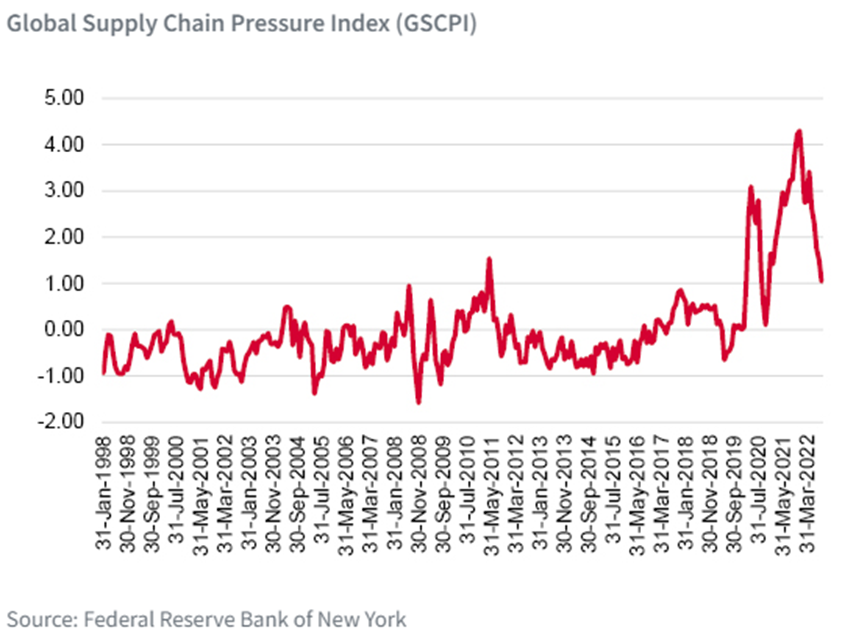
Inflation. Some are hoping for “immaculate disinflation,” the idea that prices fall quickly, especially in the US. However, I don’t think it will be as easy or clean as that. Some sources of inflationary pressure are easing quickly, such as global supply chain pressures, while other sources could be more stubborn, including wages. What’s more, components that are easing, such as global supply chain pressures, could reverse if we were to see significant COVID lockdowns again, as we did in the spring.

Global PMIs. We’ve been in an extraordinary environment of synchronized tightening on the part of many central banks. Given that there is a lag, while we have seen some economic damage, I believe we have yet to see much of the impact of this tightening on the economy. PMIs, especially the new orders subindex, can often be the first “canary in the coal mine.”  We will want to monitor those closely. I’m comfortable with modest month-over-month declines, given that central banks are engineering a potent slowdown. However, any sharp drop would be cause for concern and a sign that central banks had “overdone” tightening.

Singles Day in China. There’s a lot of gloom and doom surrounding China and its economy. However, more important than sentiment is actual results. In my view, a good gauge of the Chinese consumer is Singles Day, an extremely important shopping event in China that occurs on November 11 (although in recent years has been extended into multiple days). Recall that in 2020, Singles Day sales provided an accurate sign that the Chinese economy had rebounded substantially from the initial COVID downturn. Sales numbers this year could give us a good sense of how the Chinese economy is rebounding from its recent downturn – and especially how strong the Chinese consumer is.

The Russia-Ukraine war. Of course, this war has had a major impact on the global economy, driving down growth and driving up inflation. So we will want to follow developments in coming weeks, especially as the weather gets colder; some believe this could give Russia a military advantage, given Russia’s history of several notable military successes in winter. One development that could be very problematic for food prices is the new Russian embargo on Ukrainian grain (basically a suspension of participation in a previously agreed-upon deal to allow Ukrainian grain to be exported from its Black Sea ports).

More earnings. We still have a ways to go with earnings season, and the coming weeks could reveal more disappointing earnings that could alter market sentiment for the worse.

Please continue to check our Blog content for advice and planning issues and the latest investment, markets and economic updates from leading investment houses.

Andrew Lloyd DipPFS

4th November 2022