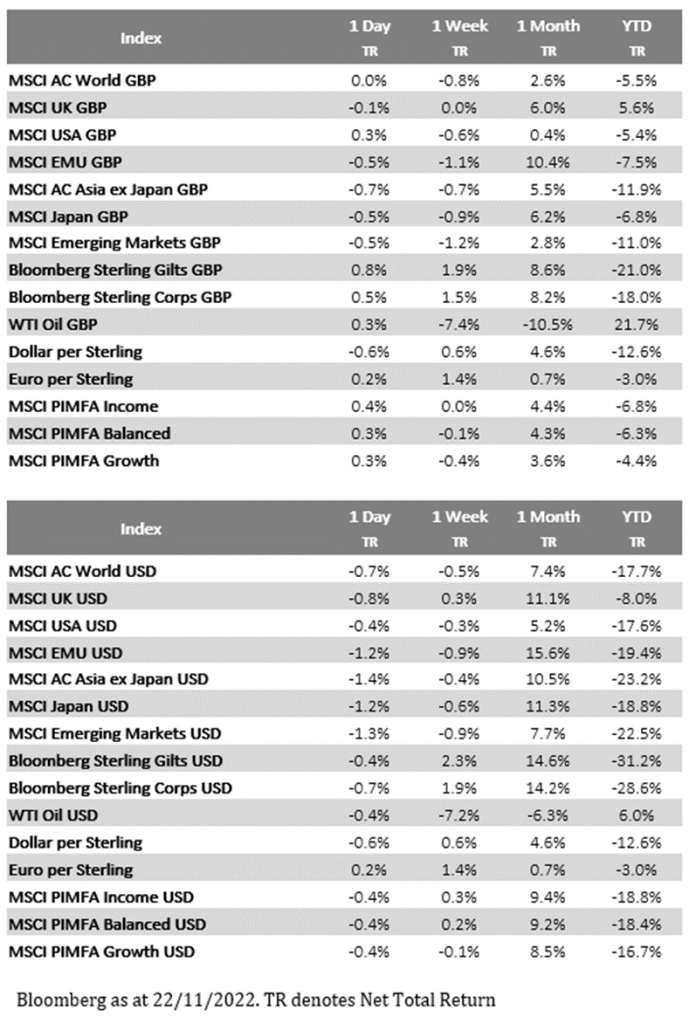
Please see below Daily Investment Bulletin received from Brooks Macdonald this morning, which provides a global market update as we enter the festive season.
What has happened
European equities rose yesterday, reflecting some of the large surge in US indices seen after the European close on Wednesday. US equities meanwhile trod water with banks declining due to a further fall in bond yields and US interest rate expectations. With yields falling and economic growth fears rising, growth equities continued their outperformance yesterday with large cap technology shares rising despite the slight fall in the headline US index.
Economic data
There was little good news within the ISM manufacturing data yesterday which fell into contractionary territory for the first time since May 2020. Both new orders and the employment measure also contracted. The release has added to market concerns over the risk of recession in 2023 and mirrors some of the negativity seen in other data releases in recent weeks. With the Fed, after Powell’s speech, now viewed as more aware of the economic risks in 2023 and beyond, bad economic news is no longer necessarily good news for markets. In a sign that a bit of normality has returned, yields fell on the back of this poorer data as bond markets priced in a loosening of Fed policy in future years. The terminal rate is now only expected to reach 4.86% in the US, a major downgrade from last week’s figure.
US employment report
Today sees the latest release of the US non-farm payroll figures which the market expects to come in at 200,000 new jobs created in November compared to 261,000 created in October. Whilst the overall unemployment rate is expected to hold steady at 3.7%, 200,000 new jobs would be the weakest reading in two years. With markets already concerned about economic growth momentum, a weak employment report would likely catalyse further fears of a cyclical slowdown.
What does Brooks Macdonald think
More positively, reduced economic momentum does appear to be filtering through to the inflation numbers, however. The PCE inflation number, which is the Fed’s preferred gauge, came in below expectations at both a headline and a core level. The question for markets now is how quickly the inflation numbers can fall and therefore allow the Fed and other central banks to react to the recessionary risks in 2023.
Index
1 Day
1 Week
1 Month
YTD
TR
TR
TR
TR
MSCI AC World GBP
-1.9%
0.4%
1.5%
-5.5%
MSCI UK GBP
-0.2%
1.2%
5.5%
8.3%
MSCI USA GBP
-2.6%
0.2%
-0.9%
-6.0%
MSCI EMU GBP
-0.1%
0.4%
7.9%
-6.9%
MSCI AC Asia ex Japan GBP
-1.5%
3.4%
9.6%
-10.1%
MSCI Japan GBP
0.1%
-0.9%
4.7%
-5.6%
MSCI Emerging Markets GBP
-2.0%
2.3%
5.8%
-10.0%
Bloomberg Sterling Gilts GBP
0.4%
-1.3%
2.6%
-21.4%
Bloomberg Sterling Corps GBP
0.5%
-0.6%
4.0%
-17.5%
WTI Oil GBP
-1.8%
2.3%
-13.9%
19.2%
Dollar per Sterling
1.6%
1.1%
6.6%
-9.5%
Euro per Sterling
0.5%
0.1%
0.1%
-2.1%
MSCI PIMFA Income
-0.7%
0.0%
2.2%
-6.6%
MSCI PIMFA Balanced
-0.9%
0.1%
2.4%
-6.0%
MSCI PIMFA Growth
-1.2%
0.3%
2.2%
-4.1%
Index
1 Day
1 Week
1 Month
YTD
TR
TR
TR
TR
MSCI AC World USD
0.7%
1.6%
8.3%
-14.4%
MSCI UK USD
2.5%
2.3%
12.6%
-1.9%
MSCI USA USD
0.0%
1.3%
5.7%
-14.8%
MSCI EMU USD
2.6%
1.5%
15.2%
-15.6%
MSCI AC Asia ex Japan USD
1.1%
4.6%
16.9%
-18.6%
MSCI Japan USD
2.8%
0.2%
11.7%
-14.5%
MSCI Emerging Markets USD
0.6%
3.5%
13.0%
-18.4%
Bloomberg Sterling Gilts USD
3.4%
-0.3%
9.8%
-28.8%
Bloomberg Sterling Corps USD
3.5%
0.5%
11.3%
-25.3%
WTI Oil USD
0.8%
4.2%
-8.1%
8.0%
Dollar per Sterling
1.6%
1.1%
6.6%
-9.5%
Euro per Sterling
0.5%
0.1%
0.1%
-2.1%
MSCI PIMFA Income USD
1.9%
1.1%
9.1%
-15.4%
MSCI PIMFA Balanced USD
1.7%
1.3%
9.3%
-14.9%
MSCI PIMFA Growth USD
1.4%
1.4%
9.1%
-13.1%
Bloomberg as at 02/12/2022. TR denotes Net Total Return
Please check in again with us soon for further relevant content and news.
Please see below, the ‘Markets in a Minute’ article from Brewin Dolphin, providing an update on the latest markets and economic news. Received late yesterday afternoon – 29/11/2022.
Stocks rise on hopes of slower rate hikes
Stock markets rose last week on positive US earnings reports and hopes of a slower pace of interest rate hikes.
In the US, the S&P 500 finished its holiday-shortened trading week above the 4,000 level for the first time in two months, rising 1.5% from the previous week. Technology and retail stocks performed particularly strongly after several earnings reports beat expectations.
The prospect of less aggressive interest rate increases boosted indices in Europe, with the STOXX 600, Dax and FTSE 100 rising 1.7%, 0.8% and 1.4%, respectively. This was despite business activity in the eurozone and the UK shrinking in November.
In China, the Shanghai Composite edged up 0.1% as investors weighed expectations of further monetary stimulus in China against the prospect of tighter Covid-19 restrictions.
China protests dent investor sentiment
Stocks started this week in the red as anti-lockdown protests in China dented investor sentiment. The Shanghai Composite and the Hang Seng shed 0.8% and 1.6%, respectively, on Monday (28 November) and the Chinese yuan tumbled against the US dollar. Oil futures dropped to new lows for the year before reclaiming around half of their earlier losses. Stock markets in other regions also fell, with the S&P 500 and the FTSE 100 down 1.5% and 0.2%, respectively.
In economic news, UK retail sales slumped in November, according to a survey by the Confederation of British Industry. The reported sales balance – the weighted difference between the percentage of retailers reporting an increase in sales and those reporting a decrease – declined to -19 from +18 in October.
Stocks bounced back on Tuesday, with the Hang Seng closing 5.2% higher and the Shanghai Composite gaining 2.3% as China reported a rise in the number of over-80s getting Covid-19 boosters and a new push to get more elderly people further vaccinated.
Fed officials see slower rate hikes
Last week, investors were cheered by the release of the Federal Reserve’s November policy meeting minutes. The minutes stated that a “substantial majority” of policymakers judged that slowing the pace of interest rate increases would likely soon be appropriate.
“A slower pace in these circumstances would better allow the [Federal Open Market] Committee to assess progress toward its goals of maximum employment and price stability,” the minutes said. “The uncertain lags and magnitudes associated with the effects of monetary policy actions on economic activity and inflation were among the reasons cited regarding why such an assessment was important.”
In the Fed’s November meeting, interest rates were increased by 0.75 percentage points for the fourth time in a row. Following the release of the minutes, it is now expected that rates will be lifted by 0.5 percentage points in December.
The case for slowing the pace of rate hikes was supported by signs of a weakening US economy. S&P Global’s flash composite new order index fell to its lowest level in over two years in November, while initial claims for unemployment benefits for the week ending 19 November were the highest since mid-August. In contrast, new home sales unexpectedly rebounded in October, rising by 7.5% from the previous month.
Business activity shrinks in the UK…
Business activity in the UK contracted for the fourth month in a row in November, while new orders decreased at the fastest pace for almost two years. The headline seasonally adjusted S&P Global / CIPS flash UK composite output index measured 48.3 in November, up only fractionally from 48.2 in October and registering below the crucial 50.0 no-change value for four consecutive months.
On a more positive note, business expectations for the year ahead rebounded from the 30-month low seen in October. Many survey respondents commented on recession worries and increasingly challenging economic conditions, but there were fewer comments citing domestic political uncertainty.
Chris Williamson, chief business economist at S&P Global Market Intelligence, said the data added to growing signs that the UK is in recession. “If pandemic lockdown months are excluded, the PMI for the fourth quarter so far is signalling the steepest economic contraction since the height of the global financial crisis in the first quarter of 2009, consistent with the economy contracting at a quarterly rate of 0.4%,” he said.
Despite the slowdown, Bank of England chief economist Huw Pill said last week that more interest rate hikes will likely be needed to return inflation to the bank’s 2% target.
…and the eurozone
The eurozone also saw business activity shrink in November, for the fifth month in a row. The composite PMI rose from 47.3 to 47.8, but was still below the 50.0 mark. S&P Global said data for the fourth quarter so far puts the eurozone economy on course for its steepest quarterly contraction since late 2012, excluding the pandemic lockdown months.
Manufacturing continued to lead the downturn, with factory output dropping for a sixth successive month. Service sector output also fell, down for a fourth consecutive month. One upside of weaker demand and alleviating supply constraints was a cooling of price pressures, most notably in the manufacturing sector. Firms’ costs rose at the slowest rate for 14 months, in turn allowing selling price inflation to moderate.
“Most encouragingly, supply constraints are showing signs of easing, with supplier performance even improving in the region’s manufacturing heartland of Germany,” said Williamson. “Warm weather has also allayed some of the fears over energy shortages in the winter months.”
Please continue to check our Blog content for advice and planning issues and the latest investment, markets and economic updates from leading investment houses.
Please see Brooks Macdonald’s weekly market commentary below received yesterday evening:
Signs that global inflation may be peaking helped buoy equity sentiment last week
Equities rose last week, with hopes that global inflation may start to ease outweighing increased concerns over the Chinese COVID-19 response.
Wednesday’s Eurozone CPI report will be the latest gauge of European inflation pressure
Wednesday sees the release of the latest Eurozone Consumer Price Index (CPI) report with headline CPI expected to fall from 10.6% to 10.4%. With European natural gas prices far below the peaks set in August, headline European inflation pressures should continue to fall. In terms of other lead indicators, German factory gate prices fell by 4.2% in October month-on-month with UK and US producer inflation also slowing since the summer. This sets up a more constructive backdrop for inflation readings coming into 2023 and has added to optimism within the bond market that inflation figures will begin to slow globally. With energy prices falling, it is likely that we see a peak in headline inflation before a peak in core (excluding food and energy) inflation as it will take some time for additional high energy costs seen in August to work through the global supply chain.
China’s COVID-19 restrictions led to protests over the weekend, increasing the political cost of stricter short-term measures
Over the weekend, a series of protests began against the Chinese government’s COVID-19 restrictions. Whilst the protests themselves do not pose a current threat to the regime in China, it does suggest a population increasingly weary of COVID-19 restrictions, making further lockdowns politically unpalatable. The timing of the recent COVID-19 surge has meant that Chinese authorities have struggled to implement two contrasting approaches, seek to reduce the impact of COVID-19 restrictions on everyday life and the economy, but at the same time, tackle the current elevated case rate. For the time being, policy choices appear to have favoured tougher short-term measures however the protests may change some views in Beijing.
China is likely to continue to find a balance between the broader opening up of China from COVID-19 restrictions whilst also trying to limit the rise in case numbers. It is likely that cases will continue to edge up without a strict containment regime therefore Chinese authorities are likely to favour managing hospital capacity rather than seeking zero COVID-19. One risk is that different local authorities take different approaches, leading to a range of severity in restrictions and a range of economic outcomes for parts of China.
Please continue to check our Blog content for advice and planning issues and the latest investment, markets and economic updates from leading investment houses.
Please see below article received from Tatton this morning, which provides a global market update as we approach the festive season.
Overview: Strength in weakness
Market sentiment seems to have improved significantly from one month ago. The release of the minutes from the Federal Open Markets Committee’s (FOMC, US central bank rate setters) 2nd November meeting offered documented evidence that members see a case for tempering its interest rate increases at future meetings. It is reasonably clear that recent declines in both actual inflation data and continued falls in the raw material cost inputs have changed perceptions of medium-term risks.
Moreover, despite the still-present potential for shock from the crypto-currency market, US retail investors appear to be heading back into the equity market. Government and corporate bonds have all recently gone up in price, although equity investors appear to be more positive about the future than bond investors. They expect earnings growth to either rebound next year or for the following years to be more profitable than usual. Perhaps investors have given up on the promise of fanciful riches from speculation in new currencies, and would rather invest in the more certain profits of companies. November retail volume flows have been the best in two years for small and mid-caps, according to JP Morgan’s flow data.
For us, one of the most interesting dynamics in capital markets this year has been the massive decline in corporate high-yield bond issuance. Given how fast and far yields rose, companies may be awaiting a better opportunity to issue debt, as investors are turning more optimistic and willing to buy at a yield that is significantly lower than seen two months ago. If and when issuance finally picks up, it will provide a real acid test and unveil whether lower junk bond yields have been the result of low issuance or a real sentiment shift towards a more optimistic 2023 outlook.
A last word on China, which we talked about last week in positive tones. While moving away from its ‘zero-Covid’ policy was inevitable, the transition was never likely to be smooth. Chinese authorities’ relentless past messaging about the dangers of the virus spreading may have been useful in gaining acceptance of the stringent lockdowns, but now those fears are a big impediment to opening up. It is going to be challenging, for sure, but nevertheless, there is no real alternative and so we expect China to gradually open up, even if that is interspersed by many renewed regional short-term lockdowns.
PMIs paint a gloomy picture for businesses
Regular readers will know that Purchaser Manager Indices (PMIs) surveys are important surveys of business sentiment. These surveys have been a surprisingly reliable indicator of future growth, where marks above 50 indicate expansion, and anything below that points to contraction. Across the latest PMI surveys for Europe and the US, companies are showing a high degree of pessimism. For November, every single European and American PMI we monitor came in below 50.
This is more confirmation, if any was needed, that times are tough. However, we should note that there was nevertheless a fair amount of good news in last week’s PMI releases, particularly coming from Europe. Economists expected the Eurozone PMI for the manufacturing sector would be again lower at 46, down 0.4 points from the previous month. In fact, European manufacturers posted a more upbeat reading of 47.3. Likewise, Europe’s services sector PMI came in at 48.6, matching last month’s reading and beating expectations of 48. The Eurozone’s composite figure beat both expectations and last month’s figure with a reading of 47.8. Clearly, these are not levels to get too excited about – they still point to a dreary picture in absolute terms. But they indicate a surprising amount of resilience from European businesses. That is hugely significant, given the overwhelming negativity on the continent.
The biggest surprise within the latest set of PMIs however, came from the US. Even though the US economy has slowed in recent months, economists expected only a mild decline. The November flash data was therefore quite worrisome: US PMIs came in well below expectations across the board, showing a sharp drop-off from last month. Manufacturing sentiment was expected to stay exactly neutral at 50, but instead came in at a decidedly downbeat 47.6. The predictions for the services sector were slightly worse at 48, but even that proved too optimistic, as US firms posted 46.1. It is difficult to make cross-country comparisons with the absolute figures, but even so, the fact that the aggregate reading for the US was below even struggling Germany is remarkable.
These PMIs suggest we may be entering a new phase of the global slowdown. Before, the focus was on hard input cost pressures and which region might be worst affected. Now, the problem may be more about employment and wage inflation and lagged effects of monetary tightening. While labour markets are tight around the world, the US jobs market is particularly tight, forcing the Fed to be more aggressive than most. This is perhaps a sign that the much-discussed ‘engineered recession’ could be upon us – to the relative benefit of Europe and the relative detriment of the US.
Continued labour market tightness keeps up pressure
Even with slowing growth and generally pessimistic outlooks from companies, labour shortages continue. This is a particular issue in the US, where wage pressures have stayed high despite aggressive monetary tightening from the Fed. US employers added 261,000 extra jobs in October alone, after similar figures over the previous two months. This may come as a surprise, given high-profile reports of job losses across key US industries. Tech giants like Amazon and Meta made headlines recently by announcing a wave of job cuts and hiring freezes. But these news stories are not a good guide to overall employment trends. First, tech sector job openings remain well above their pre-pandemic peak. And more importantly, the US mega-tech sector accounts for a rather small part of overall US employment.
Cyclical factors have contributed to the labour market squeeze. But the problem that policymakers now realise is that labour shortages appear to be structural. Over the past five years, governments (especially the UK and US) have moved towards tighter immigration controls, with the explicit aim of preventing employment competition for domestic workers. The result is a disconnect between what businesses and politicians say about jobs. We see this here in the UK, and the Confederation of British Industry (CBI) recently pleaded with Rishi Sunak’s government to ease migration controls, while policy continues to move in the opposite direction.
This creates a difficult situation for central banks, and especially the Fed. The FOMC minutes last week revealed most committee members expect to slow the pace of interest rate rises, and falling input price inflation backs this up. The next meeting is less than three weeks away, on 14th December. The underlying structure of the labour market is still such that wage-inflation could return quickly. Policymakers will be focused on the festive period ahead, to see how resilient consumer demand is. Anyone expecting the Fed or the Bank of England to ease off soon might be disappointed.
Please check in again with us soon for further relevant content and news.
Please see below market insight received this morning from J.P. Morgan, which re-caps 2022 and provides an outlook for 2023.
Developed world growth to slow with housing activity bearing the brunt As we look to 2023 the most important question is actually quite straightforward: will inflation start to behave as economic activity slows? If so, central banks will stop raising rates, and recessions, where they occur, will likely be modest. If inflation does not start to slow, we are looking at an uglier scenario.
Fortunately, we believe there are already convincing signs that inflationary pressures are moderating and will continue to do so in 2023.
Housing markets are, as usual, the first to react to central banks touching the monetary brake. Materially higher new mortgage rates are crimping new housing demand and we think the ripples of weaker housing activity will permeate through the global economy in 2023. Construction will weaken, spending on furniture and other household durables will fall and falling house prices could weigh on consumer spending for the next few quarters. The decline in activity should have the intended effect of taming inflation.
Thankfully, the risks of a deep, housing-led recession of the type experienced in 2008 are low. First, housing construction was relatively subdued for much of the last decade, which means we are unlikely to see a glut of oversupply driving house prices materially lower (Exhibit 1). Second, those that have recently bought at higher prices were still constrained by the banks’ more stringent loan-to-value and loan-to-income ratios.
Finally, the impact of higher rates on mortgage holders is likely to be less severe. In the US, households did a good job of locking in the low rates experienced a couple of years ago. Only about 5% of US mortgages are on adjustable rates today, compared with over 20% in 2007. In 2020 the 30-year mortgage rate in the US hit just 2.8%, prompting a flurry of refinancing activity. Unless those individuals seek to move, their disposable income won’t be impacted by the recent increase in interest rates.
In the UK, some households have similarly done a good job of protecting themselves from the near-term hike in rates. In 2005 – the start of the last significant tightening cycle – 70% of mortgages were variable rate. Today, variable rate mortgages account for only 14%. However, a further 25% of mortgages were fixed for only two years. This makes the UK more vulnerable than the US, albeit with a bit of a delay.
It’s also worth remembering that not everyone has a mortgage, while individuals that have cash savings will see their disposable income rise as interest rates increase. This factor is particularly important when thinking about the larger countries in continental Europe, where fewer households have a mortgage, and household savings as a percentage of GDP are higher than in the US and UK (Exhibit 2). The European Central Bank (ECB) was often warned that zero interest rates would be counterproductive because of the degree of savings in the region.
Europe is weathering the energy crisis well
For Europe, the key risk is less about a housing bust and more about energy supply, given that Russia – the former supplier of 40% of Europe’s gas – stopped the bulk of its supplies this summer.
For the coming winter, at least, the risk to gas supplies is in fact diminishing due to a combination of good judgment and good luck. Europe managed to fill its gas tanks over the summer, largely replacing Russian gas with liquefied natural gas from the US.
Since then, Europe has had the good fortune of a very mild autumn and, as a result, enters the three key winter months with storage tanks that are almost full (Exhibit 3). Unless temperatures turn and we face bitterly cold weather in the first months of 2023, Europe looks increasingly likely to make it through this winter without having to resort to energy rationing.
The gas in storage was, of course, obtained at a very high price. However, governments are to a large extent shielding consumers from the bulk of higher energy prices. We will have to wait to the spring to see whether the cost to the public purse is proving too great for support to continue.
China to open up post Covid, easing global supply chain pressures
The Chinese economy has been faced with an entirely different set of challenges to the developed world with widespread lockdowns still in place to contain the spread of Covid-19. Low levels of vaccination, particularly among the elderly, coupled with a less comprehensive hospital network than in the west, have left the Chinese authorities reluctant to move towards a ‘living with Covid’ policy. However, a prolonged period of lockdown also appears untenable and we expect China to experience an acceleration in activity as pent-up demand is released. While the timing of policy changes remains uncertain, the market’s performance has highlighted how sensitive investors are to any signs of a shift in approach.
Importantly, normalisation of the Chinese economy could significantly ease the supply chain disruptions that have contributed to rapidly rising goods inflation. Although a rebound in growth in China could also boost demand for global commodities, our assessment is that on balance this is another driver of lower inflation in 2023.
Inflation panic subsides, central banks pause
Signs of slowing activity in the west, and a return to full production in China, should ease inflation through the course of 2023, with the shrinking contributions from energy and goods sectors in particular helping price pressures to moderate in the months ahead.
However, to be sure that we’re out of the inflationary woods, wage pressures also need to ease. This is where the central banks went wrong in assuming inflation would prove “transitory”, as they underestimated the extent to which labour market tightness would result in workers asking for more pay (Exhibit 4).
Job vacancies – which in all major regions still exceed the number of unemployed – will be a key indicator to watch in the next couple of months (Exhibit 5). Job hiring and quits are already rolling over and, given higher pay is one of the most common reasons for people moving jobs, we see this as a sign that wage growth should ease.
Assuming headline inflation and wage inflation are easing, we see US interest rates rising to around 4.5%- 5.0% in the first quarter of 2023 and stopping there. The ECB is similarly expected to pause at 2.5%-3.0% in the first quarter. The Bank of England may take slightly longer to reach a peak, given that inflation is likely to prove stickier in the UK. We see a peak UK interest rate of 4.0%-4.5% in the second quarter.
Central banks also have ambitions to reduce the size of their balance sheets by engaging in quantitative tightening, but we do not expect a particularly concerted effort, nor any significant disruption. Quantitative easing was designed to give central banks extra control and leverage over long-term interest rates, helping the market to absorb large scale government issuance. We expect quantitative tightening to operate under the same principle and, given bond supply is still expected to be meaningful in size in 2023 – and borrowing costs have already risen meaningfully – we expect central banks to be modest in their ambitions to reduce their balance sheets.
Recessions to be modest
Ultimately, our key judgment is that signs will emerge in the coming months that inflation is responding to weakening activity. Inflation may not be heading back quickly to 2%, but we suspect that the central banks will be happy to pause, so long as inflation is headed in the right direction.
Against this view, there are two types of bearish forecasters. Some still believe we have returned to a 1970s inflation problem, which will require a much deeper recession and much larger rise in unemployment than we expect to drive inflation away.
Others argue that moderate recessions are difficult to engineer because slowdowns take on a life of their own, with a tendency to spiral. This situation has been true in the past, when deep recessions were busts that followed a boom. Following excessive growth in one area of the economy – most commonly business investment or housing – it has often taken a long time for the economy to adjust and find alternative sources of growth. However, this time round, investment and housing growth has been more modest (Exhibit 6).
In addition, bouts of excess enthusiasm have usually been fuelled by excessive bank lending, which has historically led to a period of weak credit growth, further compounding the downturn. This time round, however, more than a decade of regulation since the global financial crisis means that the commercial banks come into the current slowdown extremely well capitalised, and they have been thoroughly stress-tested to ensure they can absorb losses without triggering a credit crunch (Exhibit 7).
In short, busts follow booms. But booms were notably absent in the last decade where activity across sectors was, if anything, too sluggish. Although economic activity does need to weaken to be sure inflation moderates, we do not expect a lengthy, or deep, period of contraction. Given the decline already seen in the price of both stocks and bonds, we believe that while 2023 will be a difficult year for economies, the worst of the market volatility is behind us and both stocks and bonds look increasingly attractive.
The fixed income reset
Allocating to fixed income has been a never-ending source of headaches for multi-asset investors in recent times. After a long bull market, yields had reached the point where government bonds could no longer offer either of the key characteristics that they are typically expected to deliver: 1) income, and 2) diversification against risky assets. At one point, a staggering 90% of the global government bond universe was offering a yield of less than 1%, forcing investors to take on ever greater risk in extended credit sectors that had much higher correlations to equities. Low starting yields had also diminished the ability of government bonds to deliver positive returns that could offset losses during equity bear markets (Exhibit 8).
This year’s record-breaking drawdown has added to fixed income investors’ woes. Surging inflation, central banks desperately trying to play catch-up and governments that had seemingly lost their fear of debt, have all combined to trigger a brutal repricing. Markets have had to totally rethink the outlook for monetary policy rates and the risk premium that should exist in a world in which central banks cannot backstop the market. The drawdown in the Bloomberg Barclays Global Bond Aggregate in the first 10 months of 2022 was around -20%, four times as bad as the previous worst year since records began in 1992.
Crucially, while the correction in global bond markets has been incredibly painful, we believe that it is nearing completion. Further hikes from the central banks are likely in 2023 as policymakers continue to battle inflation. Yet with the market now pricing a terminal rate close to 5% in the US, around 4.5% in the UK and near 3% in the eurozone, the scope for further upside surprises is significantly diminished provided that inflation starts to cool. This is a key difference versus the start of 2022: this year’s problem has not only been that the central banks have been hiking rates aggressively, but that they have been hiking by far more than the market expected.
Looking forward, it is clear that the income on offer from bonds is now far more enticing. The global government bond benchmark has seen yields rise by roughly 200 basis points (bps) since the start of the year, while high yield (HY) bonds are again worthy of such a title with yields approaching double digits. Valuations in inflationadjusted terms also look more attractive – while the roughly 1% real yield on global government bonds may not sound particularly exciting, it is back to the highest level since the financial crisis and around long-term averages.
What about the correlation between stocks and bonds? What has been so punishing for investors this year has been the fact that bond prices have fallen alongside stock prices. This could continue if stagflation remains a key theme through 2023. While our base case sees stocks and bonds staying positively correlated in 2023, we think this time both asset classes’ prices will rise together. If inflation dissipates quickly, we could see central banks pause their tightening earlier than forecast or even ease policy, supporting both stock and bond prices.
The potential for bonds to meaningfully support a portfolio in the most extreme negative scenarios – such as a much deeper recession than we envisage, or in the event of geopolitical tensions – is perhaps most important for multi-asset investors. For example, if 10- year US Treasury bond yields fell from 4% to 2% between November 2022 and the end of 2023, that would represent a return of c.20% which should meaningfully cushion any downside in stocks (Exhibit 9). Such diversification properties simply weren’t available for much of the past decade when yields were so low.
Given this uncertainty about inflation and growth, and the chunky yields available in short-dated government bonds, investors might want to spread their allocation along the fixed income curve, taking more duration than we would have advised for much of the year.
Within credit markets, we believe that an “up-in-quality” approach is warranted. The yields now available on lower quality credit are certainly eye-catching, yet a large part of the repricing year to date has been driven by the increase in government bond yields. Take US HY credit as an example, where yields increased by around 500bps in the first 10 months of 2022, but wider spreads only accounted for around 40% of that move. HY credit spreads still sit at or below long-term averages both in the US and Europe. It is possible that spreads widen moderately further as the economic backdrop weakens over the course of 2023.
The reset in fixed income this year has been brutal, but it was necessary. After the pain of 2022, the ability for investors to build diversified portfolios is now the strongest in over a decade. Fixed income deserves its place in the multi-asset toolkit once again.
The bull case for equities
Our 2023 base case of positive returns for developed market equities rests on a key view: a moderate recession has already largely been priced into many stocks.
By the end of September 2022, the S&P 500 had declined 25% from its peak. Historically, following this level of decline, the stock market has tended to be higher a year later. There have been two exceptions since 1950: the 2008 financial crisis and the bursting of the dot-com bubble in 2000.
We don’t see macroeconomic parallels with 2008, but what about valuation similarities with 2000? One risk to our bullish base case scenario for stocks would be if valuations still need to fall considerably further from here.
S&P 500 valuations started 2022 not far off those seen during the dot-com bubble. However, high valuations could largely be attributed to growth stocks (Exhibit 10). Despite underperforming in 2022, these stocks are still not particularly cheap by historical standards.
Value stocks, however, are now quite reasonably priced compared with history. We have stronger conviction that value stocks will be higher by the end of 2023 than we do for those growth stocks that still look expensive. However, a peak in government bond yields could provide some support to growth stock valuations in 2023.
Another risk to equities is that consensus 12-month forward earnings expectations currently look too high, having only declined by about 5% from their recent peak. A recession is likely to lead to further reductions in earnings expectations. We believe that in a moderate recession, 12-month forward earnings estimates are likely to decline somewhere around 10% to 20% from the peak, as they did in the 1990s or early 2000s.
While some might argue that when these earnings downgrades materialise, they will lead the stock market lower, we believe that the market has already priced in some further downgrades to consensus forecasts (Exhibit 11). For example, at the beginning of 2022, US bank stocks were reasonably valued at 12x earnings and consensus 12-month forward earnings forecasts rose about 10% over the course of the year – yet bank stocks fell about 35% from peak to trough. This supports our view that the market is already factoring in worse news than consensus earnings forecasts suggest.
We also note that the interaction between consensus earnings forecasts and markets has been inconsistent over time. In the early 2000s and in the 2008 financial crisis, reductions in earnings forecasts led to further stock market declines; but in the early 1990s, stocks rallied as 12-month forward earnings expectations declined (Exhibit 12).
While falling earnings forecasts could lead stocks lower, if the magnitude of the decline in earnings is moderate – as we expect – then it would likely only lead to limited further downside for reasonably valued stocks, relative to the declines already seen in 2022.
We acknowledge that it would be unusual for the stock market to have bottomed already—that does not tend to occur before the unemployment rate has started to rise and the Federal Reserve (Fed) has started to cut interest rates. However, the market has already declined much more than usual before jobs have started to be lost. Given this is probably the best predicted recession in the last 50 years, we believe there is a chance that equity markets could have priced it in sooner than they normally do.
Overall, while we are not calling the bottom for equity markets, we do think that the risk vs. reward for equities in 2023 has improved, given the declines in 2022. With quite a lot of bad news already factored in, we think that the potential for further downside is more limited than at the start of 2022. Importantly, the probability that stocks will be higher by the end of next year has increased sufficiently to make it our base case.
Defend with dividends
Our base case sees a moderate recession in most major developed economies in 2023. We believe that equity markets have already priced in a lot of the bad news in 2022, but stocks which provide an attractive income appear more reasonably valued than those with little or no income (Exhibit 13). Investors who are more cautious than us about the outlook may want to focus on this cheaper segment of the market to hopefully limit further downside.
Of course, the income stream from dependable dividend payers can also help buffer returns. Strong, dividend paying companies often go to great lengths to maintain dividends, even when earnings are under pressure. With payout ratios relatively modest at present, maintaining current dividends looks more feasible than in some prior recessions (Exhibit 14).
Another factor worth considering is that the universe of companies currently paying healthy dividends is fairly diverse, spanning a wide range of sectors. Some of the usual suspects like utilities remain in the pool but we believe sectors such as financials, healthcare, industrials and even some parts of tech contain a number of dependable dividend payers that can also grow their dividends over time. As a result, should the macro backdrop not improve, and stagflationary pressures persist into 2023, we would expect income paying stocks to prove relatively resilient.
In conclusion, even though we expect a challenging macroeconomic environment in 2023 and downward corporate earnings revisions, we think income stocks could have a good year with dividends proving more resilient than earnings. For investors that are tentatively looking to increase their equity exposure, an income tilt could prove relatively resilient in the worstcase scenario, while also providing the potential for outperformance in our more optimistic scenario for markets given attractive valuations.
Catalysts for a recovery in emerging market assets
Emerging market equities had another very challenging year and disappointed investors’ expectations for this promising high growth asset class. By the end of October, the MSCI Emerging Markets Index had lost 29% in 2022, underperforming developed market equities by 10%.
Emerging markets were hit by multiple headwinds, including a sharply slowing global economy, escalating political risks, China’s zero-Covid policy and the fastest Federal Reserve (Fed) tightening cycle in more than three decades.
Due to the sharp drop in share prices, equity valuations have fallen across the board. As a result, emerging market equities now look increasingly attractive from a valuation perspective. Our proprietary valuation composite for emerging markets, which includes price-to-earnings, price-to-book and price-to-cash flow ratios, as well as dividend yield, is currently significantly below its long-term average and is also cheap relative to global equities (Exhibit 15).
What are the potential catalysts to watch that could help to close this valuation discount in 2023?
The Fed pausing
The Fed, and the other large central banks in Europe, are determined to slow growth to ease inflationary pressures. Rising interest rates, increasing energy and input costs, and changing consumer patterns (from goods to services) are already slowing down demand for goods and hampering global manufacturing. North-east Asian markets, with their high export dependency, have been hit hard in the past couple of quarters as manufacturing purchasing managers’ indices have fallen and earnings expectations have been revised down. In Taiwan and Korea, the highly significant semiconductor industry was at the centre of the storm as a combination of weakening demand, higher capacity and US restrictions on Chinese exports added to the overall economic headwinds.
Given our base case macro outlook of a modest recession in the US and Europe, and retreating inflation in 2023, we expect the Fed to stop increasing rates early in 2023. In such a scenario, cyclical stocks, such as those in the technology sector, and cyclical markets, such as Korea and Taiwan (which have also derated), would find a much more favourable environment, since equity markets are usually forward-looking and look ahead to price in an economic recovery.
2. The end of the zero-Covid policy in China
Beijing has stuck to a restrictive lockdown policy through much of 2022, with serious consequences for economic growth. Consumption growth remains subdued, weighing particularly on the services sector. Meanwhile the struggling property sector has limited room to improve as home buyer sentiment remains depressed by uncertainty over future incomes.
However, policymakers introduced an easing of Covid control measures in November which re-ignited confidence that China is moving incrementally towards an ending of its zero-Covid policy. While an announcement of a complete end to Covid measures does not look imminent, even a roadmap for gradual easing could provide the catalyst for a strong recovery in Chinese demand, which would be beneficial for not only for China but also for all its major trading partners in the region.
3. Abating political risk
Emerging markets were also hit hard by an escalation of political risk in 2022. Russian equities (3.6% of the MSCI Emerging Markets Index at the beginning of 2022) became un-investable following the Russia-Ukraine war and the subsequent international sanctions imposed on Russia. In addition, a tightening of regulations in China and growing Sino-American tensions contributed to the decline in Chinese equities.
While political outcomes are hard to predict, investors need to acknowledge that abating political risks are a possible outcome in 2023. The Chinese economy is highly dependent on global demand, and global consumers are highly dependent on Chinese production (Exhibit 16). As a result, there are significant economic incentives for both sides to remain on good terms.
For attractively valued emerging markets to shine in 2023, at least one of these three featured catalysts need to occur. We strongly believe that central banks will be less restrictive in 2023, but certain political outcomes, such as the end of China’s zero-Covid policy, or a cessation of hostilities in Ukraine, remain very uncertain.
Therefore, while the significant valuation contraction in the past year has made emerging markets an attractive choice for cyclical exposure in portfolios, investors should continue to acknowledge that some risks are likely to linger.
Sticking with sustainability
2022 has been a very challenging year for all investors, but there have arguably been additional headwinds for those with a sustainable tilt. The strong performance of oil and gas companies has led many sustainably tilted strategies – particularly those that apply blanket exclusion policies – to underperform benchmarks, while the growth tilt of renewable technology stocks has also been problematic in a year where surging bond yields prompted a broad-based growth sell off.
A closer look under the surface of the equity market helps to track how sentiment has ebbed and flowed. Fossil fuel companies have been the major beneficiary of high commodity prices, outperforming global stocks by more than 50% in the first 10 months of 2022. Sustainably focused strategies that tilt away from the traditional energy sector are therefore likely laggards. Performance across the broader renewable energy sector has been more nuanced, with a sharp sell-off at the start of the year as bond yields rose followed by a turnaround that began with the RussiaUkraine war. Strategies linked to hydrogen stocks have suffered much more, with several of the most popular funds down more than 40% from January to October 2022 given their acute sensitivity to rising bond yields (Exhibit 17).
Despite these near-term difficulties, we see many reasons why it would be a mistake for investors to shy away from reflecting sustainability considerations in portfolios.
In Europe, the energy crisis has forced governments to prioritise energy security in the short term, with coal demand set to reach new record highs in 2022, and oil and gas companies delivering strong profits growth as prices surged. Yet these events must not obscure the bigger picture. To reduce dependency on Russian fuel while also meeting climate objectives, Europe needs to reshape how it sources and uses energy, and fast.
An accelerated rollout of lower priced renewable projects is the only medium-term solution, with associated earnings tailwinds for energy companies that can scale up their renewable capacity. Clean energy investment is accelerating in response, with the International Energy Agency expecting at least USD 1.4 trillion in new investment in 2022 and the sector now accounting for almost three quarters of the growth in overall energy investment. The European Union’s (EU’s) REPowerEU plan allocates nearly EUR 300 billion in investment by 2030 to help reduce the bloc’s dependence on Russian fossil fuels. The US is also joining the party, with the Inflation Reduction Act including tax credits and other financial incentives aimed at making clean energy more accessible.
Fears around windfall taxes – not just for energy companies but also for electricity providers – may be one reason why this earnings optimism has not been fully reflected in prices so far. Clearly it is not socially acceptable to allow utility companies to reap large windfall profits from surging electricity prices in the midst of a cost-of-living crisis. Yet given the need for governments to encourage investment as part of the energy transition, we would expect any impact of windfall taxes on renewable providers to be far less than for traditional energy companies. If the marginal cost of electricity is eventually de-linked from the natural gas price – as the EU and UK are examining – then renewables providers would probably fall out of scope of such taxes too.
Changes in the broader macro environment could also be more conducive for sustainable equity strategies in 2023. After a historic sell-off in the bond market, our base case sees moderating inflation leading to more stable bond yields next year. This should help to reduce the pressure on companies pushing for technological breakthroughs who have a much greater proportion of their earnings assumed to be further in the future (and are therefore much more sensitive to changes in discount rates).
Sustainably minded investors should not only look to equity markets next year – we also expect green bond markets to see significant development. With governments and corporates across Europe looking to raise capital to tackle environmental challenges, there is no shortage of projects that could be financed via greater green bond issuance. Issuers in these markets benefit not only from strong demand that can help to drive down yields (Exhibit 18) relative to traditional bond counterparts, but also an investor base that is tilted towards more stable lenders of capital than conventional syndications.
While the prospect of greater issuance is rarely something to cheer for bond investors, this activity should go a long way to addressing one of the green bond market’s key deficiencies: the lack of a “green yield curve” that makes manoeuvring portfolios in this universe more challenging. As the green bond market matures, an expanded opportunity set that offers greater flexibility will be a major requirement. The key for investors will be to scrutinise covenants for measurable and specific targets, and ensure that proceeds make a material difference to the ability of the issuer to deliver their green, social or sustainable project.
In sum, many investors will end 2022 feeling battered and bruised and, unlike in recent years, a sustainable tilt is unlikely to have helped to boost portfolio resilience. Yet we believe it would be short-sighted to shun the sustainable agenda as a result. Policy tailwinds look set to combine with improved valuations and a more conducive macro backdrop, creating investment opportunities that are too exciting to ignore.
Central projections and risks
Our core scenario sees developed markets falling into a mild recession in 2023 on the back of tighter financial conditions, less supportive fiscal policy in the US, geopolitical uncertainties and the loss of purchasing power for households. Despite remaining above central banks’ targets, inflation should start to moderate as the economy slows, the labour market weakens, supply chain pressures continue to ease and Europe manages to diversify its energy supply. However, we remain in an unusual environment, and it’s as important as ever to keep an eye on the risks to our central view, as they are skewed to the downside.
Please check in again with us shortly for further relevant content and news.
Please see below, an article from Brewin Dolphin regarding the performance of global stock markets over the past week. Received late yesterday afternoon – 22/11/2022.
Stocks mixed as UK chancellor hikes taxes
Stock markets gave a mixed performance last week as investors digested a slew of tax hikes in the UK and signs of an economic slowdown in the US.
The FTSE 100 ended the week up 0.9% after data showed UK retail sales bounced back in October. Germany’s Dax gained 1.5% as a survey showed investors became less pessimistic for a second month in row in November.
In contrast, US stocks fell last week following mixed economic data. Whereas US retail sales were above forecasts, a gauge of manufacturing fell to its lowest level since May 2020. The S&P 500 lost 0.7% and the Nasdaq declined 1.6%.
In Asia, Japan’s Nikkei 225 slid 1.3% as core consumer price inflation rose to a 40-year high and gross domestic product (GDP) unexpectedly contracted in the third quarter. China’s Shanghai Composite added 0.3% after a meeting between Chinese president Xi Jinping and US president Joe Biden helped to boost sentiment despite a rise in Covid-19 cases.
Last week’s market performance*
• FTSE 100: +0.92%
• S&P 500: -0.69%
• Dow: -0.01%
• Nasdaq: -1.57%
• Dax: +1.46%
• Hang Seng: +3.85%
• Shanghai Composite: +0.32%
• Nikkei: -1.29%
* Data from close on Friday 11 November to close of business on Friday 18 November.
China reports first Covid deaths since April
Stocks started this week in the red on concerns China could implement further lockdowns after reporting its first Covid-related deaths since April. In Beijing, where cases have hit a fresh record high, business and schools in the most affected districts have been shut and there are tighter rules for entering the city. The FTSE 100 slipped 0.1% on Monday (21 November) while the S&P 500, Shanghai Composite and Dax all lost 0.4%. Oil prices also declined as analysts warned lockdowns could dampen demand.
The FTSE 100 was up 0.7% at the start of trading on Tuesday after Saudi Arabia denied reports that OPEC was considering an increase in oil production.
Hunt confirms tax increases
Last Thursday saw UK chancellor Jeremy Hunt deliver his autumn statement, in which he confirmed a range of tax increases and spending cuts to help narrow the gap between the government’s income and outgoings and demonstrate fiscal responsibility to the markets.
The raft of tax hikes included slashing the capital gains tax exemption, dividend allowance and additional-rate income tax threshold, and extending the freeze on the personal allowance, higher-rate income tax threshold and inheritance tax nil-rate band. Hunt also announced that public spending would rise by just 1% a year in real terms in the next parliament. The energy price cap will increase from April 2023, meaning the average household will see their bills rise from £2,500 to £3,000 a year.
The autumn statement was accompanied by the Office for Budget Responsibility’s economic and fiscal outlook, which warned that a squeeze on real incomes, rise in interest rates and fall in house prices would see the economy fall into a year-long recession from the third quarter of 2022. GDP is forecast to contract by 1.4% in 2023 before rising by 1.3% in 2024 as energy prices and inflation fall.
UK retail sales rise in October
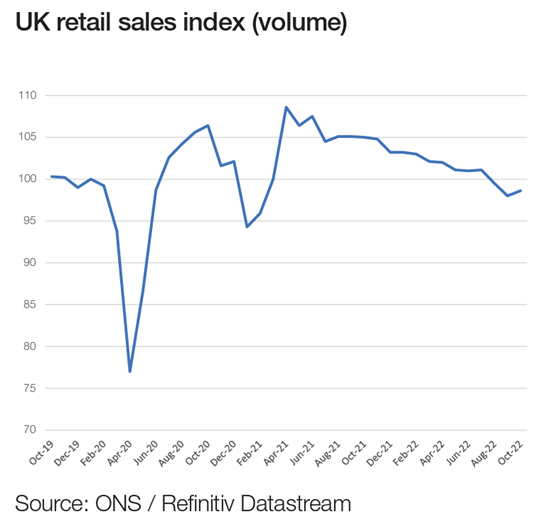
More positively, data published on Friday showed UK retail sales bounced back in October, with volumes up 0.6% from the previous month, according to the Office for National Statistics (ONS). This was double the 0.3% increase forecast by economists in a Reuters poll. It followed a 1.5% decline in September, when sales were impacted by the bank holiday for the funeral of HM Queen Elizabeth II.
Sales in the three months to October were 2.4% lower than the previous quarter, suggesting the rising cost of living is resulting in consumers reining in their spending. Sales were also 0.6% below their pre-pandemic February 2020 level, yet shoppers spent 14.2% more as a result of high inflation.
Earlier in the week, the ONS’s consumer price index (CPI) report showed UK inflation rose to a 41-year high of 11.1% in October, up from 10.1% in September, mainly due to increases in energy bills and food prices.
US economic data mixed
US retail sales figures were also published last week and were well above consensus expectations. Sales rose by 1.3% in October from the previous month, the biggest gain since May. The increase was led by car sales and higher petrol prices (US retail sales are based on receipts as opposed to volume). Even when volatile car sales and petrol prices were excluded, sales were up 0.9% on the previous month.
Conversely, industrial production in the US decreased by 0.1% in October, as a slight gain in manufacturing output was offset by weaker mining and utilities production. A gauge of manufacturing in the mid-Atlantic region also worsened. The Federal Reserve Bank of Philadelphia’s current activity index dropped from -8.7 in October to -19.4 in November, the lowest reading since the early months of the pandemic.
Japan core inflation hits 40-year high
Over in Japan, core inflation (excluding fresh food prices) hit a 40-year high in October as a weak yen pushed up the cost of imported commodities. Prices rose at an annual rate of 3.6% in October, up from 3.0% in September. Unlike other central banks, the Bank of Japan (BoJ) is sticking with its policy of ultra-low interest rates. The BoJ’s governor, Haruhiko Kuroda, reiterated the bank’s pledge to maintaining monetary stimulus to achieve wage growth and sustainable and stable inflation.
Separate figures from the Cabinet Office showed Japan’s GDP fell by an annualised 1.2% in the three months to the end of September. Again, this was largely due to external factors. Imports grew by 5.2% from the previous quarter as higher energy costs and the weak yen drove up the prices of products coming to Japan, whereas exports grew by just 1.9%. The steep rise in imports meant net exports declined, which dragged GDP lower.
Please continue to check our Blog content for advice and planning issues and the latest investment, markets and economic updates from leading investment houses.
Please see below, the Daily Investment Bulletin from Brooks Macdonald. Received late this morning – 22/11/2022
What has happened
US equity markets fell yesterday as investors pondered what the Chinese authorities may do in response to the rising COVID cases in the country.
Energy
The oil price was hit yesterday by a confluence of factors: reduced expectations of Chinese demand, US recessionary fears and rumours that OPEC may increase supply. Both WTI and Brent measures moved more than 6% lower intraday yesterday as speculation of reduced demand and increased supply left few places to hide. Eventually Saudi sources issued a strong denial of the supply-side rumours which led WTI and Brent to end broadly flat on the day. This latest volatility within the oil market is another reminder of how easily the narrative can shift when markets lack direction.
China
Whilst it was only a week ago that investors were looking forward to an easing of Chinese COVID restrictions, sentiment has swung in the other direction given the pickup in COVID cases. The key question is whether the recent uptick in cases will be enough for the government to abandon their reopening ambitions in the medium term. In the short term we have seen Beijing increasing its restrictions with new arrivals required to take 3 PCR tests over 3 days and to stay at home until all results are negative. We have also seen some return to online learning rather than in-person schooling as officials respond. While the US CPI release has undoubtedly been the major driver of the optimism of the last two weeks, the release of a Chinese plan to reduce COVID restrictions was also a key driver. Reduced Chinese COVID restrictions mean not only that the outlook for the Chinese economy would improve but also that Chinese consumer demand would begin to support the global recovery.
What does Brooks Macdonald think
The Federal Reserve did not come to the rescue yesterday, with President Daly speaking about the economic risks of over-tightening but in the same speech warning that the US terminal rate may need to go above 5% to be sufficiently restrictive. President Mester put it in plainer language, saying that the Fed was not ‘anywhere near to stopping’ its interest rate hike process. Markets still expect the Fed to hike by 50bps rather than 75bps in the December meeting but the terminal rate for this cycle remains highly uncertain.
Please continue to check our Blog content for advice and planning issues and the latest investment, markets and economic updates from leading investment houses.
Please see the below article from Tatton Investment Management which was received this morning detailing their thoughts on last week’s events and their impact on markets:
Overview: Prospects of a Fed pivot put on pause
On the whole, investors enjoyed another positive week in markets, as better-than-expected US retail spending figures, a falling dollar and still-declining European energy prices prolonged last week’s positive sentiment swing initiated by slowing US inflation. The downside of this is that all these data points indicate more current and future resilience in the US economy and a potentially shallower recession in Europe. This is not providing central banks with the confidence that labour supply pressures are likely to ease any time soon. As a result, a near-term pivot in their monetary policy away from tightening is no more likely now than it was a month ago. The December meeting of the US Federal Reserve rate setters will be awaited with a fair dose of nervousness, and anything less than a clear signal of a pivot is likely to lead to significant market disappointment.
Return of ‘Rishinomics’ plugs the holes
Last week’s Autumn Statement was perceived as quite sensible from a capital market perspective, with sterling and bond yields closing within their most recent trading ranges. However, it is hard to shake the feeling that the measures introduced amounted to little more than a short-term repair job rather than a long-term strategy to overcome the UK’s structural weaknesses: comparatively low productivity – caused by the lack of capital and education investment – paired with a paucity of post-Brexit trade opportunities.
So, Trussonomics is history, while Rishinomics returns. For now it seems Chancellor Jeremy Hunt has managed to keep foreign buyers of UK government bonds onside, while maintaining the enormous fiscal expansion of the energy price cap but pushing the bulk of the tax rises and spending cuts into the next parliament in 2024 and beyond. No wonder the shadow Chancellor called the postponement of the brunt of the tax rises and public spending cuts an election ‘trap’. Should dire Office for Budget Responsibility (OBR) forecasts become reality, UK households will be faced with the inevitability of shrinking real incomes for years to come. But the OBR report also contained a few lifelines for UK wage-earners, such as the prospect that inflation may well turn negative in 2024 and pull bring down mortgage costs with it. Given the recent steep fall in European gas and electricity prices, the energy cost price shock may also end sooner, lowering the upward pressure on energy-intensive goods.
China bullishness returns
While the UK public was focused on the Autumn Statement, and despaired over the latest inflation data, the most significant news in the global investment world once again came from China. Less than a month ago, overseas investors were fleeing, and commentators were decrying China was yet again becoming “un-investable”, following the dogmatic inflexibility on display at the Communist Party congress a few weeks ago. This resulted in a 20% stock market drop over October. Now, those losses are more or less recovered, thanks to an impressive two-and-a-half-week Chinese stock market rally.
Like the losses beforehand, recent gains have been driven by political decisions. In the last couple of weeks, Beijing has changed its tune on three extremely important issues. Firstly, policymakers issued a sweeping plan to help the struggling property sector. Secondly, official Covid rules were relaxed, in the first major sign that President Xi might change his zero-Covid directives. And finally, Xi’s appearance at the G20 summit, where he held a one-on-one meeting with US President Biden, pointed to better relations between China and its major trading partners. We should not get ahead of ourselves: the biggest problems in US-China relations are deep-rooted, ranging from economic ideology to Taiwan’s independence. These will not go away with a few nice words. Even if Xi is happy to shelve his plans for annexing Taiwan, it is a goal tied up in the very fabric of the People’s Republic. Geopolitical flashpoints are therefore a given in the months and years ahead.
Even so, the pragmatism shown by Beijing in the past couple of weeks is comforting. To be sure, Xi’s extreme consolidation of power of the last decade has shifted China’s focus from growth and globalisation to stability and ideological conformity. But as we have often noted, a vibrant private sector is crucial to China’s future, and the government has repeatedly made attempts to support that. China has been one of the biggest contributors to global growth for more than a decade and, being at a completely different stage of its cycle, a policy push now could counteract weakness elsewhere. What’s more, because of China’s production build-up over the pandemic, the growth it pushes out to the world might not even be inflationary. This is an optimistic scenario, but a perfectly plausible one. As ever with China, investors must keep an eye on the risks – but the benefits could be vast.
FTX: A pitfall on the path to cryptomaturity?
The dust is still settling from the collapse of FTX, the cryptocurrency trading hub that went into meltdown earlier this month. For the uninitiated, FTX is a digital currency exchange run by (former) crypto icon Sam Bankman-Fried. Bankman-Fried was regarded by industry insiders and regulators alike as the Warren Buffet of the crypto world, though the last few weeks have made him look more like its Bernie Madoff. Michael Lewis, author of Liars’ Poker and The Big Short was in the process of writing a book about him when the troubles emerged – given he writes about financial disasters, Lewis remains remarkably prescient.
For all the technicalities and jargon surrounding this story, the basic plotline is all too familiar: certain market players tried to hide their leverage to make assets look better than they really were. It went so well they felt like they could print their own money. In FTX’s case, this was literally true: the value of its own FTT token was backed by more FTT. When this came to light, the whole thing unravelled spectacularly. Commentators have suggested this could be the crypto market’s ‘Lehman moment’, as other exchanges struggle to mitigate their exposure and shore up liquidity. Any rush of that sort inevitably means forced selling, and the majority of cryptocurrency exchanges’ assets are cryptocurrencies. We should therefore expect to see price falls across the crypto space. Sure enough, Bitcoin – the most well-known cryptocurrency, has fallen about 20% since the start of November.
FTX is not Lehman’s, by a long stretch. But its demise is certainly a destruction of capital, and it may be a long time before we know the wider damage. While other crypto exchanges are the obvious ones in peril, we should not be surprised if other financial institutions take a hit down the line. It is notable, for example, that Bitcoin volatility has been relatively low, compared to previous crypto downturns. While this might show resilience in the crypto sphere, it might also point to a lack of appreciation for the deeper risks. Regardless, episodes like this are thinning the crypto field. The fallout is likely to increase volatility further even for the better-known brands, but it will hurt the little guys more. And in order to rebuild the trust of their believers those better-known brands might just have to accept regulation from the very institutions they demonised as inherently untrustworthy.
Please continue to check our Blog content for advice and planning issues and the latest investment, markets and economic updates from leading investment houses.
Please see below article received from Brewin Dolphin yesterday evening following the 2022 Autumn Statement.
Chancellor Jeremy Hunt has delivered his autumn statement, in which he set out plans to increase taxes and reduce spending in an effort to narrow the gap between the government’s income and outgoings
After his predecessor’s mini-budget in September triggered a slump in the pound and a sell-off in UK government bonds, this autumn statement was very much about reassuring the markets by demonstrating fiscal responsibility. The statement did not contain any nasty surprises, as many of the tax increases had been leaked in advance, and it was accompanied by growth forecasts from the Office for Budget Responsibility (OBR) – something that was noticeably missing from the mini-budget.
The raft of tax hikes included slashing the capital gains tax (CGT) exemption, dividend allowance and additional-rate income tax threshold, and extending the freeze on the personal allowance, higher-rate income tax threshold and inheritance tax (IHT) nil-rate band. Hunt also announced that public spending would rise by just 1% a year in real terms in the next parliament. The energy price cap will increase from April 2023, meaning the average household will see their bills rise from £2,500 to £3,000 a year.
Here, we highlight the key announcements, before giving Guy Foster’s view on the implications for UK economic growth and investors.
Capital gains tax
What has changed? The chancellor announced that the annual CGT exemption will be slashed from £12,300 in the current tax year to £6,000 in 2023/24 and £3,000 in 2024/25. Any profits (‘gains’) that exceed the exemption will be taxed at the existing rates of 20% for higher and additional-rate taxpayers and 10% for some basic-rate taxpayers (28% or 18% on gains from residential property).
What does it mean for investors? A higher-rate taxpayer who makes a capital gain of £20,000 in the 2023/24 tax year could face a CGT bill of £2,800, rising to £3,400 in 2024/25. This is a considerable increase from £1,540 currently. There are several ways to mitigate CGT, including investing in an ISA, making the most of the CGT exemption each tax year, and using losses to reduce your gain.
Dividend tax
What has changed? The annual dividend allowance – the amount of dividend income you do not have to pay tax on – will fall from £2,000 in the current tax year to £1,000 in 2023/24 and £500 in 2024/25. The rate of dividend tax will remain at 8.75% for basic-rate taxpayers, 33.75% for higher-rate taxpayers and 39.35% for additional-rate taxpayers.
What does it mean for investors? A higher-rate taxpayer who receives dividend income of £5,000 in the 2023/24 tax year could pay £1,350 in dividend tax, rising to £1,518.75 in 2024/25. This compares with £1,012.50 currently. Maximising your ISA allowance each year could become even more important, as any dividends you receive on investments held in an ISA are tax free. Some specialised investments may enable you to reduce dividend tax, but it’s important to seek advice on whether they are right for you.
Income tax thresholds
What has changed? The additional-rate income tax threshold will be lowered from £150,000 to £125,140 from April 2023. The personal allowance (the amount you can earn each year before you start paying income tax)
and the higher-rate income tax threshold have been frozen at their 2021/22 levels of £12,570 and £50,270, respectively, for an additional two years until 2028. Over a nine-year period from 2019/20, the personal allowance and higher-rate tax thresholds will have risen by just £70 and £270, respectively.
What does it mean for investors? Lowering the additional-rate income tax threshold will result in more people paying the 45% top rate of income tax. Someone earning £150,000 could face an income tax bill of £53,703 in 2023/24, up from £52,460 currently. Meanwhile, freezing the personal allowance and higher-rate tax threshold could see more people drifting into higher tax bands because of inflation. An individual who earned £50,000 in 2021, and whose income rises in line with actual and forecast consumer price index (CPI) inflation1 , could see their income tax bill rise from £7,486 to £15,825 by 2028.
One way to potentially reduce your income tax bill is to save into a pension. If your salary and/or bonus means you cross into a higher tax band, making a personal pension contribution could mean your adjusted net income falls to below the threshold and potentially avoids higher or additional-rate tax.
Inheritance tax nil-rate band
What has changed? The IHT nil-rate band and residence nil-rate band have also been frozen for another two years until 2028. The IHT nil-rate band has remained at £325,000 since 20092. Over this period, the average UK house price has surged by 77% from £154,006 to £273,135 in 2022, according to Nationwide3 . By 2028, families will have missed out on almost 20 years of inflation-linked increases. The residence nil-rate band – an additional allowance for those who pass on their main residence to children or grandchildren when they die – was last increased in April 2020 to its current level of £175,000.
What does it mean for investors? Freezing the thresholds could result in more families being caught in the IHT net. In the last decade alone, IHT receipts have rocketed from £2.9bn in 2011/12 to £6.1bn in 2021/224 . There are several ways to help mitigate IHT, particularly if you plan ahead.
Pension lifetime allowance
What has changed? Nothing. It was widely expected that the pension lifetime allowance – the total amount you can save into your pension before incurring tax charges – would also be frozen for another two years, but this did not happen. The existing freeze will therefore end in 2026, unless anything changes between now and then. The lifetime allowance rose in line with CPI inflation between 2018/19 and 2020/21, but has stayed at its current level of £1,073,100 since then. If it were to keep pace with actual and projected CPI1 , and therefore retain its value to individuals, the lifetime allowance would need to rise to £1,432,337 by 2026, according to our calculations.
What does it mean for investors ? The combination of long-term investment growth and high inflation could see more people inadvertently breaching the lifetime allowance and facing a hefty tax charge when they come to draw pension income.
Pension tax relief
What has changed? Nothing. There were rumours that the chancellor was considering scrapping higher rates of pension tax relief and moving to a single flat rate of 20%, but this did not come to fruition.
What does it mean for investors? Higher and additional-rate taxpayers can continue to benefit from tax relief of up to 40% and 45%, respectively (subject to limitations).
State pension
What has changed? The state pension will increase in line with inflation by 10.1% in April 2023.
What does it mean for investors? Those who qualify for the full state pension will receive an additional £870 in the 2023/24 tax year.
The economy
This autumn statement was accompanied by the OBR’s economic and fiscal outlook5 , which painted a gloomy picture of the UK economy. High inflation is expected to result in living standards declining by 7% in total over the two years to 2023/24, wiping out the previous eight years’ growth. The OBR warned that the squeeze on real incomes, rise in interest rates and fall in house prices would weigh on consumption and investment, tipping the economy into a recession lasting just over a year from the third quarter of 2022. GDP is forecast to fall by 1.4% in 2023 before rising by 1.3% in 2024 as energy prices and inflation drop.
While government borrowing is forecast to rise from £133.3bn, or 5.7% of GDP, last year to £177.0bn this year (7.1% of GDP), it should gradually fall to £69.2bn (2.4% of GDP) in 2027/28 as a result of tax rises and scaledback fiscal support. Similarly, underlying debt is projected to rise sharply from 84.3% of GDP last year to a 63-year high of 97.6% in 2025/26, but then fall modestly in the subsequent two years.
With such a wide range of measures being announced, Guy Foster, our Chief Strategist, shares his views on how they could affect the economy and investors.
Even without the extensive trailing of measures in the media, the tax hikes and spending cuts in this autumn statement were to be expected, coming in the shadow of former chancellor Kwasi Kwarteng’s widely criticised minibudget. Hunt would have been keen to avoid the market turmoil created by Kwarteng’s now-scrapped tax-cutting measures and, instead, demonstrate to the markets that the UK government is capable of making responsible spending and taxation decisions. Estimates of the size, or even the existence of, the fiscal black hole vary, but if markets lose faith in the government, it can lead to higher borrowing costs which ultimately hit consumer spending as interest rates rise.
Higher taxes and lower spending should eventually help to bring down inflation, which rose to a 41-year high of 11.1% in October. This will, however, be of little consolation to households who face paying more tax at a time when wallets are already squeezed. Freezing tax thresholds draws more people into the income tax net, more assets into taxable estates for inheritance tax purposes, and diminishes the real value of the pension lifetime allowance.
The challenge for the chancellor has been to confront inflation without damaging the UK’s longer-term growth prospects. Like many developed economies, the UK has seen declining birth rates and rising life expectancy, which is a headwind for economic growth. It makes it harder to maintain a low tax base for a given level of public services, and makes achieving higher productivity more important than ever. Yet trying to increase productivity comes with many challenges: changes now may take a long time to bear fruit; determining how much benefit measures will yield is highly subjective; and there is invariably some sort of cost to such measures – either economic (i.e., investment in education) or political (i.e., immigration or planning reform).
Nonetheless, the announcements confirming funding for the Sizewell C nuclear power station and HS2 rail project, along with reforms to Solvency II insurance rules that aim to free up funding for infrastructure, were among the measures demonstrating that growth was an important part of the chancellor’s juggling act.
Please check in with us again soon for further relevant content and news.
Please see below an article from Abrdn with an overview of the main points of today’s (17th November) Autumn Statement.
Autumn Statement 2022 – what it means for you and your clients
Jeremy Hunt used the Autumn Statement in an attempt to calm markets and reset public finances with a series of tax rises achieved through cuts and freezes to allowances.
In his first few days in office he had already reversed most of the measures announced in his predecessor’s September Mini Budget. But today he went further by cutting the CGT annual exemption, lowering the additional rate threshold to £125,140 and extending the freezing of other allowances by a further two years.
For advisers, these measures amplify the need for their clients to make the most of annual tax allowances, and maximising tax efficient savings into pensions and ISAs.
Read our summary of the key points from today’s Autumn Statement.
Income tax
Rates – Income tax rates for 2023/24 will remain at the basic, higher and additional rates of 20%, 40% and 45% respectively. The abolition of the additional rate of tax announced in the Mini Budget will not happen.
The Scottish Government intend to hold their own Budget on 15 December, and this will determine the rates which will apply to Scottish taxpayers.
Allowances and thresholds – The point at which additional rate tax becomes payable will be cut from £150,000 to £125,140 from 6 April 2023. This will mean that those already paying tax at 45% will pay an extra £1,243 in 2023/24. The Government forecast that approximately 250,000 individuals will pay some extra tax due to this measure.
The personal allowance and basic rate band remain frozen at £12,570 and £37,700 respectively. This freeze of allowances has been extended by a further two years until April 2028. This means that the higher rate tax threshold will remain at £50,270 for those entitled to a full personal allowance.
Dividends – The dividend allowance is to be halved from £2,000 to £1,000 for 2023/24, and halved again to £500 for 2024/25. Consequently, many more investors will need to complete tax returns if their dividend income exceeds £1,000 next year. The dividend tax rates for basic rate, higher rate and additional rate taxpayers will remain at 8.75%, 33.75% and 39.35% for both the current tax year and 2023/24. The 1.25% increase installed from the start of 2022/23 will not be reversed.
Pensions
There were no changes announced to pension tax relief. However, the reduction of the threshold for additional rate tax to £125,140 will see more high earners benefit from relief at 45% on their pension savings. Wage inflation may also mean that a pension contribution is a more attractive option for those who may otherwise lose out on child benefit or personal allowance.
It was also confirmed that the triple lock on the State Pension would be maintained, guaranteeing the 10.1% CPI-based increase for next April along with the same level of increase to the Pension Credit.
There has been an ongoing review of State Pension age and whether the current timetable for changes is still appropriate. The Government will publish their response in early 2023.
There was no mention of any extension to the freeze to the lifetime allowance which is expected to remain fixed at £1,073,100 until April 2026.
National Insurance
The increase to NI to help pay for social care reforms has been scrapped. The additional 1.25% which was added to the rates of NI for 2022/23 for employees, employers and the self-employed has been removed from November 2022.
NI thresholds will be fixed at the current 2022/23 levels. The changes to the thresholds at which individuals (both employed and self-employed) start to pay NI, which were introduced in July 2022, will remain – i.e. they’re kept in line with the annual personal allowance of £12,570.
Capital Gains Tax
The chancellor announced that the CGT annual exemption would be cut from £12,300 to £6,000 from April 2023, and to £3,000 from April 2024. Based on 2021/22 figures an estimated extra 235,000 individuals will need to file a self-assessment return in 2023/24 as a consequence.
There was no change to the rates of CGT and these will continue to be 10% and 20% (18% and 28% respectively for gains on residential property).
Inheritance Tax
The freeze on both the nil rate band (NRB) and residence nil rate band (RNRB) has been extended for an additional two years. The NRB will remain at £325,000 and the RNRB at £175,000 until April 2028.
Corporation Tax
Corporation tax will rise to 25% from April 2023 as originally planned. However, small companies with profits below £50,000 will continue to pay at the current rate of 19%. There will also be a reintroduction of tapering relief for businesses with profits between £50,000 and £250,000 so that they pay less than the main rate.
Please continue to check our blog for further analysis of the Autumn Statement 2022, as well as advice, planning issues and investment, markets and economic updates.