Team No Comments

Multi Asset market analysis – February 2023

Please see below article from Church House Investment Management providing multi asset market analysis. Received 09/02/2023.

January set a better tone for world markets, picking-up from Q4 last year rather than December’s negative tone. Let’s hope that January has set the tone for the year.

The European Central Bank and the Bank of England put their base rates up by a further 50bp (to 3% and 4% respectively), with the promise of a further 50bp to come from the ECB and rather more talk of “considerable uncertainties” and close monitoring by the Bank.  The US Federal Reserve lifted the Fed Funds rate by just 25bp to 4.75% and Chairman Powell cheered with talk of the onset of dis-inflation, though he was careful to warn that there is a long way to go, and it was probably going to be bumpy.

The first bump followed quickly with a jump in US employment in January (half a million new jobs, far greater than expected) and US bond yields rose.  But, over this period, ten and thirty-year US Treasury yields are still lower (both trading around 3.7%).  UK Gilt yields have also fallen, the ten-year is down to 3.3% and the thirty-year to 3.8%, not leaving a lot of room for disappointment.  Lower rates and the improved background are bringing down credit spreads and the primary market is buoyant, particularly in euros, with plenty of new issues meeting strong demand.

Equity markets have had a strong month led by the NASDAQ, which was squeezed higher by 16% over this period.  Having observed last month that big tech would need to show some signs of life soon to feel at all confident about the equity rally, this condition would appear to have been met.  But this does need to be qualified with a slowing in momentum apparent in figures from a number of the big tech companies over the past ten days. 

The US dollar has continued the sell-off that began in the autumn, but the momentum is definitely slowing and most of the move appears to have happened now.  Oil prices have picked-up over the period but, thankfully, European gas prices have not.  The rise in the price of gold also appears to have halted for now, recent data have revealed strong buying by central banks over 2022 in the wake of the war in Europe and ensuing sanctions.

The principal concerns that we set out at the beginning of the year are largely unchanged:

  • Have we seen the worst of inflation? 
  • How far will the Federal Reserve (and the other CBs) go? 
  • Will the recession be worse than currently expected? 
  • Is there an endgame in Ukraine or does it get worse?

At the moment, the prospects for inflation still appear to be improving, which, in turn should limit central bank action, but…  The prospects for recession appear to be pointing more towards shallow or minimal outcomes.  I am sure this will all change.  We still like shorter-dated sterling corporate fixed interest (credit) but would be cautious for longer-dated fixed interest.  Equity markets feel more comfortable at present, and the impression is still that stocks are ‘under-owned’, though we definitely expect more volatility to come.

Please check our blog content for advice, planning issues and the latest investment, market and economic updates from leading investment houses.

Adam

10th Febraury 2023

Team No Comments

Brooks Macdonald Daily Investment Bulletin

Please see below article received from Brooks Macdonald earlier this afternoon, which delivers a succinct global market update.

What has happened

Equities struggled yesterday as concerns over hawkish central bank commentary returned, with markets continuing to whipsaw between positivity and negativity. US technology stocks underperformed with Alphabet a standout after its new generative AI tool showed inaccuracies during a demonstration. European equities managed to eke out a small positive gain despite the poor sentiment within US equity markets yesterday.

Central bank speak

Starting off with the more hawkish commentary, President Williams of the NY Fed said that a terminal rate of between 5-5.25% was a reasonable view, effectively endorsing the run up in bond market expectations that we have seen over the last week. Williams referred to wage growth as a concern saying that ‘there’s definitely scenarios where inflation ends up being more persistent for various reasons.’ The overall tone yesterday was one of caution, which stressed, in the words of Governor Waller, ‘It might be a long fight, with interest rates higher for longer than some are currently expecting.’ President Kashkari said that he would need to see wage growth back to around 3% before the Fed could gain confidence over the disinflation narrative. As a consequence of these comments, bond yields rose and the market’s expectation for the US terminal rate also ticked up yet again.

ECB

Yesterday’s moves were not just confined to the US with ECB speakers taking a similarly hawkish line. ECB Vice President de Guindos said that ‘it might well be that financial markets are too optimistic with regard to inflation and our monetary policy response.’ The ECB’s Knot added to this, saying that if the current inflationary pressures persist, the ECB could continue to hike interest rates at 50bp increments into May. Later today we will see the release of the delayed German CPI numbers which will help investors decide whether January’s downside misses to European inflation were a blip or part of a trend.

What does Brooks Macdonald think

Both the ECB and Fed sounded more hawkish yesterday, but the bond market and equity market damage was done in the US given heightened expectations of a Fed pivot. The ECB sounded hawkish but this is very much what the bond market expects, with the European Central Bank seen as behind the curve versus the US and UK.

Index 1 Day1 Week1 MonthYTD 
 TRTRTRTR 
MSCI AC World GBP -0.5%1.3%5.5%7.8% 
MSCI UK GBP 0.3%1.7%2.2%5.6% 
MSCI USA GBP -1.1%1.8%6.2%7.8% 
MSCI EMU GBP -0.3%1.1%5.7%11.3% 
MSCI AC Asia Pacific ex Japan GBP 0.6%-0.1%4.4%8.0% 
MSCI Japan GBP -0.2%0.9%6.8%5.9% 
MSCI Emerging Markets GBP 0.5%-0.4%3.3%6.9% 
Bloomberg Sterling Gilts GBP -0.2%0.1%1.6%2.7% 
Bloomberg Sterling Corps GBP -0.1%0.6%3.1%4.6% 
WTI Oil GBP 1.7%4.5%6.4%-2.1% 
Dollar per Sterling 0.2%-2.5%-0.2%-0.1% 
Euro per Sterling 0.3%0.1%-0.8%-0.2% 
 
Index 1 Day1 Week1 MonthYTD 
 TRTRTRTR 
MSCI AC World USD -0.5%-0.5%5.5%7.6% 
MSCI UK USD 0.3%-0.1%2.2%5.5% 
MSCI USA USD -1.1%0.0%6.2%7.7% 
MSCI EMU USD -0.3%-0.7%5.7%11.1% 
MSCI AC Asia Pacific ex Japan USD 0.6%-1.8%4.4%7.9% 
MSCI Japan USD -0.2%-0.9%6.8%5.8% 
MSCI Emerging Markets USD 0.5%-2.1%3.3%6.8% 
Bloomberg Sterling Gilts USD 0.3%-1.9%1.8%3.1% 
Bloomberg Sterling Corps USD 0.5%-1.5%3.4%5.0% 
WTI Oil USD 1.7%2.7%6.4%-2.2% 
Dollar per Sterling 0.2%-2.5%-0.2%-0.1% 
Euro per Sterling 0.3%0.1%-0.8%-0.2% 
  Bloomberg as at 09/02/2023. TR denotes Net Total Return   

 Please check in again with us shortly for further market updates and news.

Chloe

09/02/2023

Team No Comments

Brewin Dolphin – Markets in a Minute

Please see below, Brewin Dolphin’s ‘Markets in a Minute’ article summarising the key economic and markets news from the last week. Received late yesterday afternoon – 07/02/2023

Please continue to check our Blog content for advice and planning issues and the latest investment, markets and economic updates from leading investment houses.

Carl Mitchell – Dip PFS

Independent Financial Adviser

08/02/2023

Team No Comments

Brooks Macdonald Weekly Market Commentary: Fridays US job report reiterates the current tightness of the US labour market

Please see this weeks Weekly Market Commentary from Brooks Macdonald received yesterday afternoon:

US Federal Reserve (Fed) Chair Powell’s failure to push back on market expectations of interest rate cuts helps drive equities higher

Equity markets retreated on Friday as the market digested the latest US jobs data. That said, equities still made solid gains last week with US large cap technology names leading the way.

A strong US jobs report last Friday reiterates the current tightness of the US labour market

The US non-farm payroll report on Friday contained benchmark revisions and large beats, breaking the market complacency that had settled in after a strong January for risk assets. Revisions to the calculations in 2022 meant that the official numbers for nominal income growth have surged, suggesting an even more robust labour market than previously thought. Of course, the 2022 numbers have already filtered through to broader economic data sets including the inflation report, Gross Domestic Product reports etc, so the revision in some ways is pure history however given that labour market tightness continues to be a theme in 2023, there is some read-across. In terms of the headline jobs growth in January, 517,000 jobs were created versus expectations of just 260,000. As a result unemployment fell to 3.4%, the lowest level in half a century. There was some good news, with labour force participation (percentage of the workforce in work or actively looking for work) ticking up to 62.4%, which will provide some support to the narrative that higher wages are tempting back workers who voluntary left the workforce during the pandemic.

The positive market tone of 2023 was unscathed by a week of major central bank meetings

Last week saw a deluge of central bank meetings which, in aggregate, provided a more dovish tone than we have been used to in recent quarters. It was also a major week for economic data with inflation numbers from the Eurozone as well as key labour market inflation data from the US. This week we will see the release of the delayed German Consumer Price Index numbers with this figure closely watched to see if the disinflationary forces seen in January’s release are continuing. The US earnings season also continues this week and is joined by European oil majors such as BP and Total. Lastly, we will see whether US/China relations fray after the shooting down of a Chinese balloon which entered US airspace.

US/China relations are likely to come back into the spotlight this week with the US considering a further clampdown on Huawai’s access to US companies and now the Chinese balloon incident. Secretary of State Blinken was meant to be visiting China this weekend as part of an attempt to reset diplomatic relations. With this now postponed, and an aggressive Chinese reaction to the shooting down of the balloon, investors will be wary of a political change that could reverse the positive Chinese equity market story that has been in place since the COVID reopening.

Please continue to check our Blog content for advice, planning issues and the latest investment, markets and economic updates from leading investment houses.

Andrew Lloyd DipPFS

7th February 2023

Team No Comments

Tatton Investment Management: Monday Digest

Please see below, the ‘Monday Digest’ from Tatton Investment Management discussing the key economic news from the past week. Received this morning – 06/02/2023

Overview: Are central banks transforming from hawks into doves?

If investors were hoping for a turnaround in fortunes, they hardly could have asked for a better start to the year. February began just where January left off: dominated by central bank action, inflation, and despondency over the UK economy. Meanwhile, stock and bond markets stayed buoyant. The monthly US jobs report could have upended the week, but after a brief market wobble, the FTSE 100 ended the week by hitting an all-time high.

Friday’s US Labor Department’s report showed the US economy added an almost unbelievable 517,000 new jobs in January, while the previous month’s data was also revised up. All of a sudden, the big risk to investment markets this year is not so much a global recession, but the robust jobs market. The US employment report was probably not known to the Federal Open Market Committee (FOMC) when its members slowed the pace of rate rises earlier in the week. Last Wednesday, the US Federal Reserve (Fed) raised the Fed funds rate by 0.25% to a midpoint of 4.625%. On Thursday, the Bank of England (BoE) raised the base rate to 4.0%, and the European Central Bank (ECB) effectively raised its short-term rate by 1.0% to 3.0% (0.5% now and another 0.5% in March). However, you could be forgiven for thinking they had all announced rate cuts, given the very positive reactions of both bond and equity markets. 

Given that an end to the current tightening was signalled quite strongly by all three central banks, investors have an increasing belief that monetary policy-driven constraints on profitability are coming to end in the nearer-term. In fact, investors not only expect an imminent peak in US, UK and European interest rates, but think they will start actively loosening monetary policy before the end of the year. With financial conditions loosening, the global economy may already have started its next growth cycle. As ever, though, we suspect one shouldn’t get carried away by waves of positivity. Interest costs are still higher than before, and still have a bit further to go. There are good reasons to think that economic growth may rebound from here, but it feels less plausible that profit growth will be exceptional.

How long is the lag – or why is that lag suddenly shrinking?

We had two reports on the UK economy last week, one from the International Monetary Fund (IMF) and the other from the BoE accompanying its rate decision. The IMF report was depressing reading but was very much in line with the gloomy BoE report published last Autumn, although as is often the case, the IMF report felt out of date. In contrast, at least for the nearer-term outlook, the improving inflation picture allowed the BoE to revise its growth projections up Autumn’s report. 

Inflation optimism is the main reason for the market rally seen this year, and reflects a ‘job well done’ attitude in markets: inflation is or will soon be under control, after which things can get back to normal. But to judge how accurate this view is, we need to know how inflation will develop over the next year and how it will be impacted by monetary policy. Conventional economic wisdom tells us monetary policy has ‘long and variable lags’. In other words, rate hikes or cuts take a long time to filter through to the real economy.

One theory suggests that in the past, interest rates took a while to affect the real economy because the primary mode of transmission was bank lending – an inherently slow-moving process. But over the last decade in particular, such lending has had a much smaller role. Highly-traded corporate bond markets are much more important for businesses, while asset markets are much more important for households (as stock ownership is much higher). These markets are now more sensitive to interest rates and investor sentiment. Moreover, capital markets have become more aligned to monetary policy over the last couple of decades, in part because central bankers are eager to communicate policy far in advance and remove sudden shocks, and in part because forecasting interest rates has become one of the biggest components of any investment portfolio. This results in a feedback loop where investors look for any clues in central bank announcements, and those announcements are tailored for a nervous investor audience.

Shorter lags can be both good and bad. Optimists will say that loosening monetary policy could boost demand before the year is up. If the lag really is long, one could not expect any short-term recovery. If it is short, there is every chance the global economy will improve substantially in the second half of this year. Combine this with the strong growth boost we expect to see from China’s post-COVID re-opening, and we could be in for a decent ride.

The pessimistic view is that central banks might not loosen after all. The current expectation – backed up by comments from its members – is that the Fed now wants to wait-and-see how inflation plays out rather than committing to further tightening. But markets also expect inflation to fall to the Fed’s 2.0% target, and for the US economy to avoid a deep recession. If the policy lag is shorter than expected, those things are unlikely to all be true at once.

Ultimately, the question policymakers have to grapple with is how much growth can be allowed before it becomes inflationary. The structural evidence we have seen post-pandemic – from labour markets and increased regionalisation of global trade – suggests that bar is low. Moreover, if the lag between interest rates and inflation is shorter than expected, central banks will have more incentive to tighten in the short term. Monetary policy transmission is highly complex, but we should not assume that means the job is already done.

Please continue to check our Blog content for advice, planning issues and the latest investment, markets and economic updates from leading investment houses.

Alex Kitteringham

6th February 2023

Team No Comments

Brooks Macdonald Daily Investment Bulletin

Please see below article received from Brooks Macdonald this morning, which provides a summary of market movements around the globe.

What has happened

The equity market rally continued apace yesterday as the Bank of England and ECB concluded their policy meetings and risk appetite enjoyed the post Powell press conference glow. US equities hit a 5-month high and the US technology index was a small margin away from entering a bull market (defined as a 20% rally from its lows). US equity futures are pointing to a less positive day today however as Apple, Alphabet and Amazon all disappointed analyst expectations after the closing bell.

Bank of England

Yesterday, the Bank of England and ECB raised rates by 50bps, in line with expectations, but their narratives were quite distinct. While the Bank of England raised rates by 0.5%, two members dissented, backing a smaller move. Within Threadneedle Street, there is a growing feeling that the UK economy will struggle with the cumulative impact of interest rates, and for that reason, bond markets expect this to be the last outsized hike before a downshift to 25bps and a pause over the summer.

ECB

Before yesterday’s meeting, European bond markets were volatile as investors tried to reconcile better data, falling inflation, and lower energy prices with a hawkish central bank. The market had already priced in a 50bp hike and a good chance of another in March, but the ECB’s terminal rate is expected to be only 3.25%, much lower than the Bank of England and Federal Reserve. The ECB is expected to maintain its hawkish narrative, as they are further from restrictive territory than the US and UK, who have already raised interest rates. That said, investors thought that yesterday’s meeting did contain some more dovish overtones with the ECB committing to ‘evaluate the subsequent path of monetary policy’ after March’s anticipated 50bp rate hike.

What does Brooks Macdonald think

With this week’s central bank meetings now done, investors will now be myopically focused on inflation data in the coming weeks. In the US, they will also be looking for signs of shrinking wage price inflation, which is an important gauge for the Fed. The positive for markets this week is that central banks have made it clear that if inflation fades faster than they expect and more in line with financial market expectations, they will react and pivot. This only makes the CPI releases even more important than they already were. The speed at which inflation fades in the US, Eurozone, and UK will drive financial markets for the rest of 2023

Index 1 Day1 Week1 MonthYTD 
 TRTRTRTR 
MSCI AC World GBP 1.7%3.3%7.6%8.2% 
MSCI UK GBP 0.5%0.5%4.4%4.4% 
MSCI USA GBP 2.0%4.2%7.6%8.1% 
MSCI EMU GBP 2.3%3.4%10.8%12.6% 
MSCI AC Asia Pacific ex Japan GBP 0.8%0.7%8.4%8.9% 
MSCI Japan GBP 0.9%2.0%5.5%5.9% 
MSCI Emerging Markets GBP 0.7%0.4%7.6%8.1% 
Bloomberg Sterling Gilts GBP 2.7%2.2%5.4%5.4% 
Bloomberg Sterling Corps GBP 2.3%2.1%6.4%6.4% 
WTI Oil GBP -0.2%-5.3%-6.6%-6.6% 
Dollar per Sterling -1.2%-1.5%1.5%1.2% 
Euro per Sterling -0.5%-1.7%-0.8%-0.8% 
MSCI PIMFA Income GBP 1.3%1.6%5.0%5.1% 
MSCI PIMFA Balanced GBP 1.4%1.9%5.5%5.6% 
MSCI PIMFA Growth GBP 1.3%1.9%5.8%5.9% 
 
Index 1 Day1 Week1 MonthYTD 
 TRTRTRTR 
MSCI AC World USD 1.2%2.2%9.3%9.5% 
MSCI UK USD 0.1%-0.6%5.7%5.7% 
MSCI USA USD 1.5%3.1%9.4%9.4% 
MSCI EMU USD 1.8%2.4%12.6%14.0% 
MSCI AC Asia Pacific ex Japan USD 0.3%-0.3%10.2%10.2% 
MSCI Japan USD 0.4%0.9%7.2%7.2% 
MSCI Emerging Markets USD 0.3%-0.7%9.4%9.4% 
Bloomberg Sterling Gilts USD 2.5%1.7%7.7%7.7% 
Bloomberg Sterling Corps USD 2.0%1.6%8.8%8.8% 
WTI Oil USD -0.7%-6.3%-5.5%-5.5% 
Dollar per Sterling -1.2%-1.5%1.5%1.2% 
Euro per Sterling -0.5%-1.7%-0.8%-0.8% 
MSCI PIMFA Income USD 0.8%0.6%6.7%6.4% 
MSCI PIMFA Balanced USD 0.9%0.8%7.2%6.9% 
MSCI PIMFA Growth USD 0.8%0.9%7.5%7.1% 
  Bloomberg as at 03/02/2023. TR denotes Net Total Return   

Please check in with us soon for further updates.

Adam

03rd February 2023

Team No Comments

Evelyn Partners Update – February’s Bank of England monetary policy decision

Please see below article from Evelyn Partners providing an update on February’s Bank of England monetary policy decision. Received this afternoon (02/02/2023)

What happened?

The Bank of England increased rates by 0.5% today at their February monetary policy meeting, which is in line with market and economic expectations. This takes the base rate to 4%, its highest level since 2008, and is the 10th consecutive increase by the Bank. The Monetary Policy Committee (MPC) voted 7-2 in favour of 50bps – 0bps respectively so policymakers continue to have diverse view on the best course for rates, although not as much as the 3-way split seen in December.

What does it mean?

The Bank also published its quarterly outlook on the economy which revealed an upgrade to growth expectations. Gas and electricity prices have roughly halved compared to their November forecasts. Better than expected data in terms of GDP (0.1% for November, relative to expectations of -0.2%), and strong wage growth led the Bank to improve its growth expectations for 2023 to -0.5% from their previous estimate of -1.5% in November. This upgrade has led to a significant reduction in the forecast depth and length of recession facing the UK, with the economy now set to contract by almost 1% over five quarters, rather than 2.9% over eight quarters.

However, in terms of inflation, there are several signs pointing to its continued persistence, which will have encouraged MPC members to make the 50bps move today. Headline inflation fell for the second month in December to a level of 10.5% YoY which was in line with market expectations, but the core measure (excluding food and energy) proved slightly stickier than expected at 6.3%. There is still tightness in the labour market, with survey measures of recruitment indicating continued difficulty in hiring. Wage growth running at 7.2% in the 3 months to November remains far above a level consistent with the Bank’s 2% CPI inflation target. In today’s statement, the Bank said, “If there were to be evidence of more persistent pressures, then further tightening in monetary policy would be required.”, omitting the word ‘forcefully’ from a similar sentence in the previous statement.

Prior to the meeting, expectations for future increases in rates were modest – perhaps another cumulative 50bps before peaking at the June or August meetings. This represents a considerable downgrade on what markets expected in November, which was for rates to reach around 5.25%, and caused Governor Andrew Bailey to suggest they were too high. Market expectations now seem fairly in-line with the Bank.

Bottom Line

The UK economy is surprising on the upside, albeit from gloomy prior expectations. The Bank needs to weigh these prospects with the evidence that inflation in the UK continues to look stickier than in some other advanced economies. While the UK economy has little bearing on the international earners which dominate the UK equity market, it should continue to do well by virtue of its defensive sectoral exposure.

Please check our blog content for advice, planning issues and the latest investment, market and economic updates from leading investment houses.

Alex Clare

02/02/2023

Team No Comments

Markets in a Minute – Stocks rise as US economy grows

Please see below ‘Markets in a Minute’ article received from Brewin Dolphin yesterday afternoon, which provides a succinct global market update.

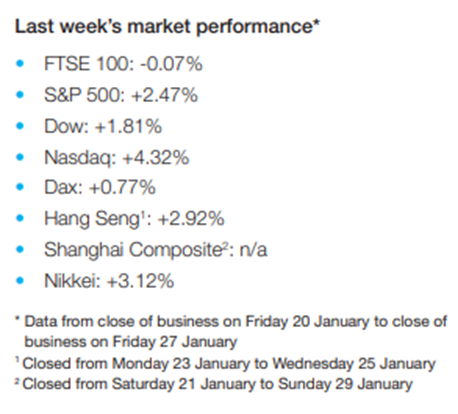
Most major stock markets rose last week as encouraging financial data helped to ease concerns about a global recession and the pace of monetary policy tightening.

Major US indices ended the week higher. Consumer discretionary stocks outperformed thanks partly to a jump in Tesla shares. Performance was aided by higher-than[1]expected GDP growth and indications from the Federal Reserve of a potential lower-than-expected rate hike of 0.25 percentage points. A statement from the Treasury secretary on falling energy prices and easing supply chain bottlenecks also helped to boost investor sentiment. The S&P 500 rose 2.5% and the Nasdaq added 4.3%.

In Europe, the STOXX 600 gained 0.7%, and the Dax added 0.8% after business activity in the eurozone unexpectedly stabilised in January and consumer confidence rose. The FTSE 100 slipped 0.1% as investors expect the Bank of England to raise its base rate by 0.5 percentage points to 4.0%, its highest level in 15 years.

In Asia, Japan’s Nikkei 225 rose 3.1% on news the Bank of Japan will examine the impact of its yield curve control policy modification on market functioning. Hong Kong’s Hang Seng ended its holiday-shortened trading week up 2.9% with markets underpinned by lunar new year holiday spending and a sharp drop in Covid cases in China. The Shanghai Composite was closed all week for the lunar new year celebrations.

Investors eye interest rate hikes

US indices started this week in the red, with the S&P 500 down 1.3% on Monday (30 January) ahead of the Federal Reserve’s interest rate decision. The Fed is expected to slow its pace of interest rate hikes in light of cooling inflation. Last year, it delivered four 0.75 percentage point increases, followed by a 0.5 percentage point rise in December. Germany’s Dax also fell on Monday following news that Europe’s largest economy shrank by 0.2% in the fourth quarter of last year, leaving Germany on the brink of a recession. The European Central Bank and the Bank of England are due to deliver their rate decisions this week, with markets expecting a 0.5 percentage point hike by both central banks.

The FTSE 100 was down 0.3% at the start of trading on Tuesday following a prediction from the International Money Fund that the UK economy will shrink by 0.6% this year – a 0.9 percentage point downward revision from October. The UK is the only G7 country forecast to shrink in 2023.

US GDP growth exceeds expectations

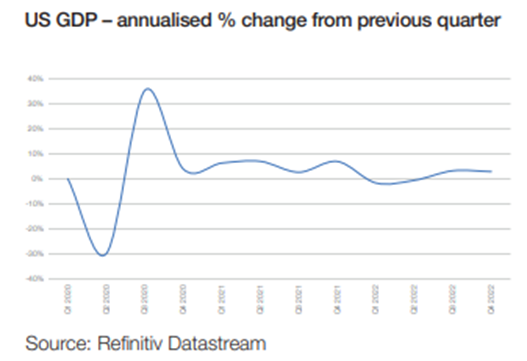
Figures released last week showed the US economy grew by 2.9% in the last quarter of 2022. This was slightly higher than economists’ forecasts of 2.6%, but lower than the 3.2% growth seen in Q3. Consumer spending rose by 2.1%, with growth concentrated primarily at the beginning of the quarter. A main driver of this was businesses building inventories, particularly across the manufacturing and utilities sectors.

Rate increases have had a significant negative impact on the manufacturing and housing markets. Housing[1]related investment fell by 26.7% on an annualised basis, shaving 1.3 percentage points off overall GDP. The drop comes from delayed or cancelled projects as higher rates increased borrowing costs.

Separate figures showed core personal consumption expenditures (PCE), which excludes food and energy, rose by 0.3% in December, up from 0.2% the month before. This represents a 4.4% rise year-on-year, the slowest annual rate of increase since October 2021.

Meanwhile, new unemployment claims fell to 186,000 in the week ending 21 January, according to a report from the Department of Labor. This represented the lowest level in nine months and a decrease of 6,000 compared to the week before.

Despite the robust figures, many economists expect the US to go into a recession in the second half of the year, albeit a milder one than previous downturns.

Tokyo core CPI rises

Over in Japan, Tokyo core consumer price inflation (CPI) rose by 4.3% year-on-year in January, exceeding the Bank of Japan’s (BoJ) inflation target of 2% for the eight consecutive month. The increase marked the fastest annual gain in over 40 years and followed a 3.9% rise in December. Following the data release, the yield on the ten-year Japanese government bond rose to 0.47% from 0.40% at the end of the previous week.

At its 17-18 January monetary policy meeting, the BoJ concluded that it needs to examine the impact that modifying its yield curve control policy in December has had on market functioning. It added that it is appropriate to continue with monetary easing at this point. The International Monetary Fund proposed on Thursday that the BoJ allow government bond yields to rise more flexibly due to “significant upside risks” to inflation in the near term.

Please check in again with us soon for further relevant content and news.

Chloe

01/02/2023

Team No Comments

Tatton Investment Management – Monday Digest

Please see below, a ‘Monday Digest’ from Tatton Investment Management discussing the key economic news from the past week. Received this morning – 30/01/2023:

Overview: Goldilocks makes a reappearance

Recent macroeconomic data releases report declining rates of inflation and underwhelming (but nevertheless still positive) economic growth across the western world. Perhaps unsurprisingly then, the term ‘Goldilocks’ (not too hot, not too cold) returned to the market narrative. There are rate rises expected from the major central banks this week, but on the back of the ‘Goldilocks’ data picture, markets now price in for the US Federal Reserve (Fed), to further reduce the size of this rate rise from 0.5% to just 0.25% – and only for a further one or two more hikes to follow before then reversing quite quickly to rate cuts again later in the year. The idea of central banks managing to induce a soft-landing – reversing inflation without causing a recession – is gaining momentum among the market commentariat.

At Tatton, we see the current environment more as a temporary market truce, or period of ‘wait-and-see’ as the economic reality unfolds and evidence tilts the balance of arguments in one direction or the other. In this respect, central bank actions and their (just as important) accompanying comments will be very closely observed as will further inflation figures and Q4 2022 company earnings trends.

As has been the case over the past few months, the UK is somewhat trailing economic trends elsewhere, and consumers and private investors can be excused for not sharing in the more upbeat sentiment. Last week’s news that UK car production had declined to the same levels as the 1950s does not indicate economic vibrance. However, the more positive economic picture emerging in some of the most important markets for UK multinational companies, bodes well for the still comparatively cheap UK large cap stocks. The UK government clearly has a substantial to‑do‑list in its in-tray for those trading opportunities to materialise. So, the next stage of post-Brexit trade normalisation will be a key area to watch here, beyond the inflation, labour market and company earnings briefings elsewhere.

US debt ceiling showdown looms (again)

The US government’s total outstanding debt has once again hit its ceiling. This legal limit on how much the US Treasury can borrow is updated periodically by Congress, and was most recently set at $31.4 trillion in December 2021. Of course, raising the debt ceiling should be a no-brainer, considering it is just a procedural financial constraint that does not affect already agreed spending commitments. But since the Obama era the Republican party has periodically used the debt ceiling to get all manner of fiscal concessions from the White House. Most recent showdowns during the Biden years have been resolved more quickly though, as Congress seemed less concerned about spending during the pandemic. Unfortunately, this time the fight could be more ferocious than at any point in the last decade.

First, the unofficial Covid moratorium on budget balancing is long gone. Second, over the years, politicians and investors have become complacent that the other side of the equation will work out in the end – meaning risks are likely underappreciated. Finally, and perhaps most worryingly, the Republican party is now at the mercy of its most radical members, as the recent protracted election of new House of Representatives speaker Kevin McCarthy demonstrated. Among the concessions McCarthy pledged Republican members to win their vote included a commitment to not raise the debt ceiling without sweeping budget cuts.

A compromise still seems inevitable, but these background factors mean it is likely to skew fiscally hawkish. We are still cautious though. We saw how damaging short-term disruption can be with the UK’s own bond yield blowout last October. The threat of default – even a brief, accidental one – with yields shooting up violently will loom large over the US bond market, and could spook investors’ fragile confidence. With such a huge amount of debt outstanding, even a short-term rise in yields could adversely affect the US fiscal position for years to come. Perhaps the most worrying part is that all of this is avoidable. Both sides know this, and yet neither seem particularly eager to avoid it. We suspect that the debt ceiling debate will become mainstream in the months ahead, and could well make fiscal policy a defining issue for the next presidential election.

LatAm common currency far from a Sur thing

According to reports from Buenos Aires, South America’s two largest countries are set to announce preparations for a single common currency, which would become the world’s second-largest currency union after the Eurozone. Brazil and Argentina want a common currency to start as a bilateral agreement between them, but with the aim of expanding it across the entire region. Both are main members of Mercosur (translation: ‘Common Market of the South’), a South American trade bloc that includes Uruguay and Paraguay as full members, with seven more associate nations. There would be a lot to gain from such an initiative. Trade between the two countries is huge and still growing – with 21% more direct trade last year than in 2021. Moreover, Latin American economies are expected to grow rapidly over the next few decades.
However, Brazilian politicians and its public would likely baulk at the idea of tying their nation’s finances to the more profligate Argentina. Argentina has defaulted on its national debt more times than most care to remember, and has effectively been cut off from international debt markets since the last default in 2020. It still owes $40 billion to the International Monetary Fund (IMF), while Brazil is a net creditor to the global financial system. Even so, there are certainly benefits for the two countries. Bilateral trade at the moment depends heavily on US dollar financing, meaning traders are often at the whim of US economic policy. Rectifying that would increase cross-border efficiencies. It is also no surprise that this proposal is favoured more by the countries’ left-wing politicians, despite its apparent focus on free trade. Freedom from US interference or economic power has long been a goal of the Latin American left. That is what Brazil-Argentina integration points to.

And even if no one else gets on board with a common currency or accounting unit, it is very likely that Latin American leaders will be swayed by the idea of stronger regional ties and less reliance on the US. Such integration often naturally leads to economic convergence – perhaps making the common currency idea less senseless in the distant future. It is worth remembering, after all, the road that led to the euro. When the Treaty of Paris was first being discussed after the Second World War, the notion of a common European currency would no doubt have seemed equally fanciful.

Please continue to check our Blog content for advice and planning issues and the latest investment, markets and economic updates from leading investment houses.

Carl Mitchell – Dip PFS

Independent Financial Adviser

30/01/2023


Team No Comments

Brooks Macdonald Investment Bulletin

Please see the latest Brooks Macdonald Investment Bulletin received this morning (26/01/2023)

What has happened

 Yesterday’s equity session started poorly but gradually recovered over the course of the day with the US index broadly flat by the close. One of the primary drivers of the weaker market narrative earlier in the day was Microsoft’s Azure sales outlook which disappointed investors. Earnings after the closing bell last night included IBM and Tesla which both beat earnings estimates, setting US index futures up for a better day today.

 Bank of Canada

 Ahead of a busy week of central bank meetings, the Bank of Canada announced their latest policy statement. The bank raised rates by 25bps, in line with expectations but did so alongside a dovish statement. The bank said it expected ‘to hold the policy rate at its current level while it assesses the impact of the cumulative interest rate increases.’ This pause in rate hikes was conditional on inflation coming under control after the bank’s 8 rate hikes in a row however with the Bank of Canada seen as a monetary policy leader this cycle it will be closely watched by other central banks.

 Preview of next week’s meetings

 On Wednesday next week we have the Federal Reserve where a 25bp rate rise is fully priced into the market’s expectations. The Fed, distinct to the Bank of England for example, operate a range for its interest rate policy, currently the lower bound is 4.25% and the upper bound 4.5%. After next week, the Fed is expected to hike again in March before taking a pause with the upper bound of 5%. The Bank of England is also expected to raise rates on Thursday next week but the bank is viewed as behind the curve by financial markets and therefore a large 50bp hike is the bond market’s base case. The UK ‘terminal rate’ is expected to reach between 4.25% and 4.5% by the summer. Lastly the pricing of ECB policy has been quite volatile as investors try to reconcile better economic data, falling inflation and lower energy prices with a hawkish central bank. The market has fully priced in a 50bp hike next week and a good chance of another in March however the terminal rate for the ECB, expected to be reached over the summer, is expected to be a mere 3.25%.

 What does Brooks Macdonald think

 The ECB is expected to maintain its hawkish narrative for the foreseeable future, in part as the ECB has been behind the US and UK in raising interest rates and therefore is further from ‘restrictive’ territory. One of the major risks in markets however is the number of rate cuts priced into the US market by the end of this year. The market expects two or three 25bp cuts before the end of 2023, and given the Fed’s hawkish narrative at recent meetings, there is a strong disconnect between the bond market and the Fed at this juncture.

Bloomberg as at 26/01/2023. TR denotes Net Total Return

Please continue to check our Blog content for advice, planning issues an the latest investment, markets and economic updates from leading investment houses.

Alex Clare

26th January 2023