Team No Comments

EPIC Investment Partners

The Daily Update: Qatar Economic Forum

Please see the below article from EPIC Investment Partners providing a Daily Update regarding the Qatar Economic Forum. Received this morning 25/05/2023.

With over 2,000 participants expected to attend the Qatar Economic Forum, half of which are expected to come from overseas, Qatar looks to be placed firmly on the global stage. Topics including, but not limited to, inflation, investing in emerging markets, energy transformation, trade, AI, sports events and geopolitics, all in the name of economic growth, are all expected to be discussed and debated.

Having been very active in the credit space over the past couple years, the nation’s wealth fund CEO Mansoor Al Mahmoud said Qatar Investment Authority is “keen to do more as companies with good business models struggle with the double whammy of interest rates and low liquidity”. He added that traditionally such liquid investment institutions have a “very long-term risk” appetite for such investments, adding that “for the next one year … the credit space is an interesting place to deploy some investments.”

Al-Kaabi, the nation’s minister for Energy Affairs and CEO of Qatar Energy, once again reiterated his concerns over shortages in oil and gas supplies amid the global push toward greener energy sources. He highlighted Europe in particular, saying it managed its energy conundrum due to mild weather and slow economic expansion, but warned “only a warm winter can save Europe this year”. He stated that the lack of future investment in gas and oil, the fuels required for the energy transition, will create shortages in both, as resources are deployed elsewhere in the “aggressive” green energy push. He noted the G7’s call for more LNG to be supplied globally, adding that Qatar currently produces 77million tonnes of LNG a year with an aim to increase that to 126mtpa in-line with contracts that have been awarded. He added that they can do more.

Meanwhile, Saudi Arabia’s Energy Minister once again warned oil speculators to watch out, and economist Nouriel Roubini discussed his concerns over market confidence if the US debt ceiling debate continues to drag on. The IMF Chief Kristalina Georgieva echoed our sentiment of a resolution to the debt ceiling: “History tells us that the US will wrestle with this notion of default but come the 11th hour it gets resolved”.

We will continue to monitor key events from the forum this week as keen investors in Qatar’s AA/AA- sovereign and quasi-sovereign debt, which our proprietary models highlight as “wealthy”, “undervalued” bonds.

Please check our blog content for advice, planning issues and the latest investment, market and economic updates from leading investment houses.

Alex Clare

25/05/2023

Team No Comments

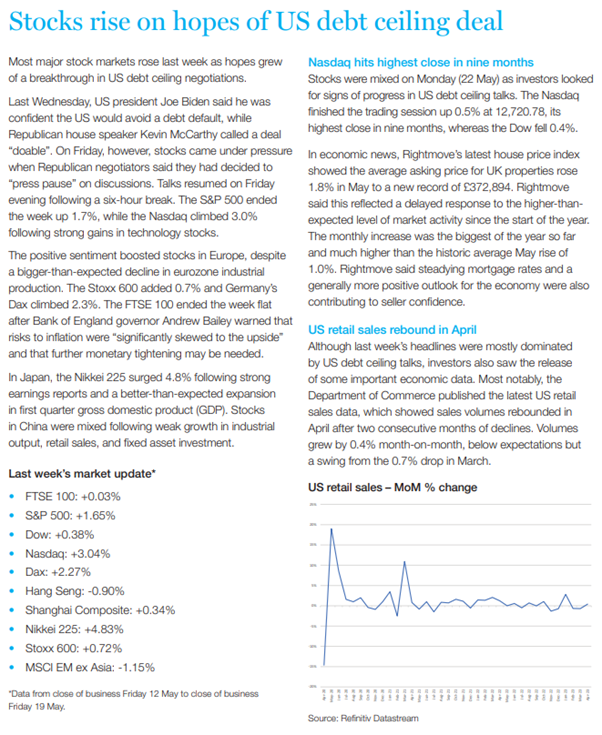
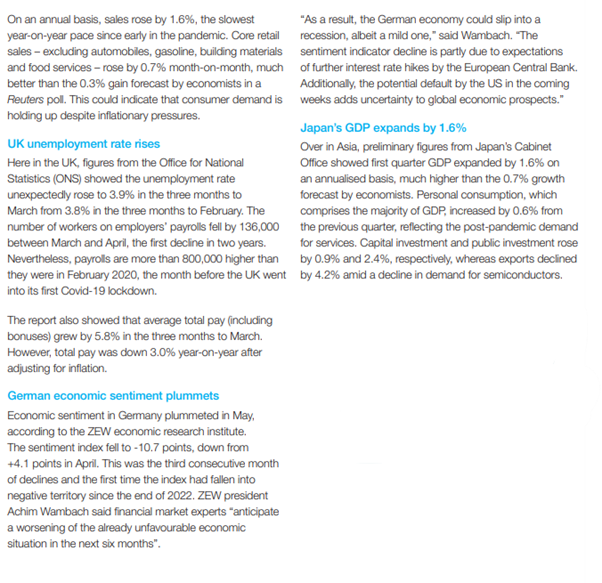
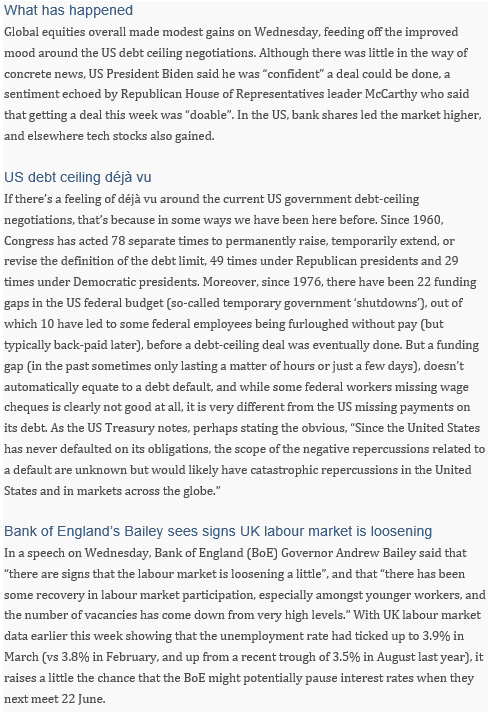
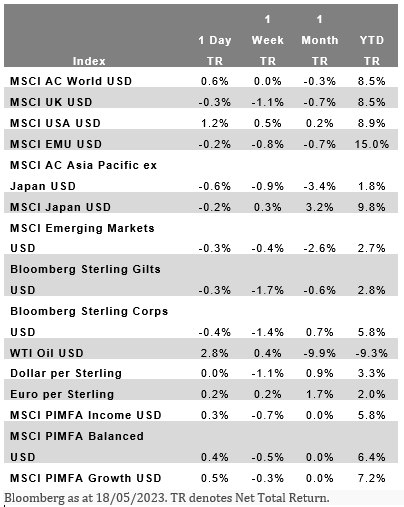
Brewin Dolphin: Markets in a Minute


Please see this week’s Markets in a Minute update from Brewin Dolphin received late yesterday afternoon:

Please continue to check our Blog content for advice and planning issues and the latest investment, markets and economic updates from leading investment houses.

Andrew Lloyd DipPFS

24/05/2023

Team No Comments

Weekly market commentary: Release of Fed’s preferred inflation measure and UK inflation numbers

Please see below article received from Brooks Macdonald yesterday afternoon, which provides a succinct but detailed global market update.

  • Equities rose last week despite the risks of the US defaulting on its debt obligations
  • President Biden and Republican Speaker McCarthy are set to meet at the White House to continue negotiations
  • This week sees the release of the US Federal Reserve’s (Fed) preferred inflation measure as well as the UK’s inflation numbers

Equities rose last week despite the risks of the US defaulting on its debt obligations

Equity markets rose last week as investors shrugged off the impending US debt ceiling deadline, focusing on a constructive earnings season and the likelihood that the US has already reached its peak interest rate for this economic cycle.

President Biden and Republican Speaker McCarthy are set to meet at the White House to continue negotiations

Despite the fact there is still no final deal, and Republican negotiators walked out of talks on Friday, last week saw growing optimism that the US political leadership would find a compromise arrangement to avoid defaulting on US obligations. This helped equity markets to rise after trading in a tight range over the last month given concerns around the US debt ceiling and US regional banks. President Biden and House Speaker McCarthy are set to continue debt ceiling talks at the White House later today. Over the weekend there was a phone call which pointed to a more constructive tone than one would have imagined from the walkout on Friday. With Treasury Secretary Yellen warning that the chances were ‘quite low’ that the US could meet its obligations from mid-June, the stakes are high even if the mood music appears more favourable.

This week sees the release of the Federal Reserve’s preferred inflation measure as well as the UK’s inflation numbers

This week will see the release of the Personal Consumption Expenditure (PCE) inflation data series in the United States. This is the Fed’s preferred inflation measure and will be a major consideration when the Fed meets to determine the US interest rate in June. The University of Michigan will also release its final survey readings on Friday which include the medium-term consumer inflation expectations. The preliminary readings showed that consumer expectations for 5-10 year inflation had risen significantly (2.9% to 3.2%) which if confirmed in the final reading would be a concern to the Fed that is trying to keep expectations closely anchored to its 2% target. The latest UK inflation numbers will come on Wednesday with the market expecting a sharp fall from last month’s 10.1% year-on-year rise to 8.2%. Core inflation is expected to remain quite sticky however, falling from 6.2% to 6% year-on-year.

Despite US, and global, inflation remaining higher than policy makers would have hoped, the market still considers a pause in US interest rates as the most likely outcome. On Friday Fed Chair Powell said that ‘we can afford to look at the data and the evolving outlook to make careful assessments’, indicating that the Fed is in no rush to raise rates given that there is a lag between their previous hikes and the impact on the economy.

Please check in again with us shortly for further relevant content and news.

Chloe

23/05/2023

Team No Comments

Tatton Investment Management: Monday Digest

Please see below, the ‘Monday Digest’ from Tatton Investment Management, providing a brief analysis of the key news from markets over the past week. Received this morning – 22/05/2023

Earnings improvements boost big tech stocks

Last week, equity markets have generally headed higher. The most notable moves were in US stocks, with the large-cap tech names doing very well in aggregate. The Q1 earnings reports have almost all been published and, on a market-cap-weighted basis, developed world stocks have seen a return to earnings growth in the forecasts for the next 12 months. That’s after six months of analysts seeing falls in earnings. In Europe, cyclical sectors have been the winner with real estate the laggard. Still, the 2023 forecast as a whole is muted at just 1%. Companies continue to be hit by higher interest rates, raising concerns that the European Central Bank (ECB) may keep tightening financial conditions through the summer. In the US, retailers have been discussing the continued softening of spending trends for big-ticket and other discretionary items. The pandemic reversal is still releasing pent-up demand for services – particularly travel and entertainment. 

But for both regions, what stands out as surprising is that ‘top-line’ revenues are better than expected. In Europe margins are still under pressure, but sales are substantially improved. In the US, both sales and margins have started to improve. That tallies with a more stable economic environment, especially for Europe where energy price declines have helped greatly. The improvement in global service sector purchasing manager indices (PMIs) also helps explain the corporate positivity.

The good earnings results in the US – and especially Europe – is cause for optimism. Still, the underlying tightness of financial conditions for many companies remains, while the AI theme seems equivalent to a narrowing of profitability breadth on just a limited number of tech firms, at least for the moment. The rise in equity markets is welcome and, if caused by a general improvement in profitability, all the better, but we would feel more optimistic if central banks were less hawkish.

Emerging market currencies suffer a downdraft

The US dollar has moved quite sharply stronger, after some weeks of weakening against most currencies. Conversely, emerging market (EM) currencies – which tend to best reflect the sentiment around underlying EM economies – sunk to a three-week low last Wednesday. The reasons for this pessimism are varied. China’s slower-than-expected growth is weighing on the outlook for EM demand, while financial stress in the US has reduced available capital and hit investor risk appetite. At the individual level, Turkey’s election returned a stronger-than-expected showing for President Erdogan – an unpopular figure with international investors – while the energy crisis in South Africa has deepened. And importantly, South Africa’s geopolitical tension with the US on suspected covert arms exports to Russia has made international investors nervous.

Last week, all but one of the emerging currencies that we follow fell fallen relative to the US dollar (the Brazilian real was unchanged). This suggests the current move may not be about problems in individual nations. It may also be about the US dollar itself. Since the start of the month, the dollar has climbed against both EM and developed currencies. There are signs of a reduction in the supply of dollars held outside of the US – as evidenced by the decline in cross-currency basis swaps (signalling people are willing to pay more for dollars). The amount of dollars available worldwide has fallen, in large part thanks to the continued tightness in US financial conditions. Should this trend continue, it would likely mean the much-discussed bout of dollar weakness could be coming to an end. Indeed, the Citi forex desk has recently cut its losses on their recommendation to be short of the dollar. That would fit with the overall narrative of disappointing global growth and increased risk aversion among corporates and financials. Unfortunately, EMs may have to pay a bigger price than most for all this.

A closer look at the new wave of US bankruptcies

May has been a bumper month for US Chapter 11 bankruptcy filings so far, and this year is on track to be the busiest year for filings since 2010. Many are suggesting this is the beginning of a new wave of business failures – unlike anything seen since the Global Financial Crisis (GFC) of 2008 – with rapidly climbing interest rates, persistently high inflation and slowing consumer demand proving too much to handle. This potent combination seems to have been reinforced by the collapse of several US regional banks over the past few months, causing lenders to rein-in credit and leaving many companies without funding. As noted previously, these problems are unfortunately worst for smaller businesses, which have seen financing costs go up by significantly more than large-caps. However, Bloomberg suggests the current bankruptcy wave is also happening among large and the slew of failures two weekends ago was the biggest burst since Bloomberg started tracking this data 15 years ago.

However, while the total number of US bankruptcies is extremely high, the total amount of debt which is subject to distress is quite low (as a percentage of total outstanding corporate debt). That backs up the idea that it is mainly smaller companies facing difficulties – even if there are lots of them. However, we are certainly not at crisis levels yet, and default rates are currently below past crisis times, and especially below the 2008 level. That is quite remarkable when you consider just how rapidly interest rates have increased over the past year, and the media doom and gloom around the economy – another sign of the US economy’s surprising resilience. We are keeping a close eye on the situation and, if there is any silver lining, it will be that US interest rates will surely stop rising, perhaps falling by the end of the year. But if that does not happen, and rates keep rising, the bankruptcy wave could indeed become a tidal wave.

Please continue to check our Blog content for advice and planning issues and the latest investment, markets and economic updates from leading investment houses.

Alex Kitteringham

22nd May 2023

Team No Comments

Rising interest rates – what happens next?

Please see below article received from Brewin Dolphin yesterday evening, which discusses why inflation remains high, whether a US recession is imminent, and the longer-term outlook.

Why is inflation still high after multiple rate hikes?

Interest rate changes can take a long time to materially affect inflation. Part of the reason is that many loans have fixed terms, where the interest payment does not immediately reflect changes in the central bank policy rate. Rate hikes have started to make an impact, but it will take time for the full effect to be felt.

The extent to which rate hikes influence different inflation categories varies. Central banks exercise a lot of control over house price and rental inflation, as this is a very interest rate-sensitive sector. Rate hikes have already depressed real-world rental inflation, but this takes time to impact consumers as it depends upon when rental agreements are renewed.

Wage inflation tends to be the most important determinant of services inflation excluding housing. The eventual drop in consumer and business spending from rate hikes leads to weaker demand for workers, which then depresses wages. In this sense, rate hikes have a big impact on services ex-housing inflation, but there can be long lags. At present, labour markets in many countries are very tight. For example, in the US there are currently 1.6 job openings for every unemployed worker. This tightness is keeping services ex-housing inflation running strong, notwithstanding the building headwind from higher rates.

Rate rises tend to have a weaker impact on tradeable goods inflation. Food inflation has dropped sharply in recent months in the US, but it remains strong in the UK and other European countries. The Russian invasion of Ukraine, regional weather and its impact on harvests, and foreign exchange movements explain much of the relative divergence in food price inflation in the US and Europe.

When will mortgage holders feel the impact?

It goes without saying that those who are on variable[1]rate mortgages are already feeling the impact of higher mortgage rates. But most households in the US and UK are on fixed-rate deals. Some households on fixed-rate mortgages have already begun to marginally reduce their spending in anticipation of their deals coming up for renewal at higher rates. In its May monetary policy report, the Bank of England (BoE) estimated that higher mortgage rates reduced UK aggregate household consumption by 0.3% in the first quarter of the year. This reduction in spending is being driven by mortgage holders on variable rates as well as those on fixed rates that have already reset.

We would expect that the majority of the reduction in spending will occur when fixed-rate deals actually renew. Roughly 85% of residential mortgages in the UK are fixed, but with terms for the most part at five years or less. The BoE estimates that higher mortgage rates will reduce aggregate household consumption by almost 0.5% by the fourth quarter of 2024. Notably, mortgage terms in the US are generally fixed for a much longer period, often to 30 years.

Another potential impact of higher mortgage rates is an increase in homeowners defaulting on their loans. The extent to which defaults occur will be linked not just to how high mortgage rates go (and for how long they stay there), but also by how the economy evolves. It is safe to say that if unemployment rises substantially, mortgage defaults will increase.

Have rate hikes been more effective in the US?

Several forces have brought inflation down faster in the US than in other regions. For one, the Federal Reserve (Fed) has been more aggressive in its monetary tightening efforts compared to most other central banks. The Fed has so far raised rates by five percentage points. This is above the 4.4 percentage points of hikes implemented by the BoE and 3.75 percentage points of hikes by the European Central Bank.

Meanwhile, until last autumn, the US dollar was strong, which depressed traded goods inflation. Weak European currencies relative to the dollar had the opposite effect. In addition, the inflation stemming from Russia’s war in Ukraine has had more of an impact on Europe. Wage-driven inflation has been a factor on both sides of the Atlantic, as demand for workers has been strong. But the UK has struggled more than most countries with labour supply, with Brexit likely a contributing factor.

What is the relationship between rate hikes and recessions?

Of the 13 Federal Reserve rate hike cycles since the mid-1950s, ten have been followed by a recession that began within a year-and-a-half of the last rate hike of the cycle. While this is clearly a high hit rate, it’s important to note that tightening cycles don’t happen in isolation and are not always the main driver of a recession.

Of the four US recessions that have occurred since 1990, the Fed certainly played a role, but the rate hikes were arguably not the primary cause of any of them. In two of these cycles, a shock rather than rate hikes was the primary cause of the recession. This was the case in 1990, when the economy only went into recession after the oil price spike due to the Gulf War. It was also the case in early 2020, when the recession was all about the Covid shock and had little to do with the Fed’s rate hikes of 2018.

In the other two cycles, the recessions were driven more by the unwinding of large excesses. In 2001, the recession was much more about the contraction in technology-related investment spending than it was about Fed rate hikes. Consumer spending (which represents about 70% of the economy) didn’t decline at all in that recession. In 2008/09, Fed rate hikes certainly acted as a catalyst (as was the case in 2001), but the recession was more about the unwinding of the excesses in banking and housing following a period of very lax lending standards. The main point is that the relationship between rate rises and recessions is not straightforward.

We believe it is more likely than not that the US suffers a recession, with a start date at the end of this year or perhaps in early 2024. But our conviction in this forecast is not high as there are pathways to a ‘soft landing’ (a slowdown in economic growth that avoids a recession). Europe and the UK may avoid an outright recession, but we expect growth to be sluggish. If a US recession does occur, it will likely be mild. A mild recession would limit increases in both the unemployment rate and mortgage defaults. It is also worth highlighting the supply/demand backdrop for housing, which is tight. House prices will suffer as this BoE rate cycle goes on, and to the extent that unemployment rises. But because there is so little supply, that should help to limit the declines. Similar supply and demand dynamics exist to support UK house prices in the face of higher mortgages rates.

What has happened historically after periods of low interest rates?

Central banks hiked rates rapidly in several periods during the 1970s and 1980s, but rates were not low heading into these cycles. Rates were low for a long time following the global financial crisis of 2008, but the subsequent rate hike cycles (2015-18 for the Fed and 2017-18 for the BoE) were very modest. There’s no good historical precedent for the current environment.

Mark Twain’s quote, “History does not repeat itself, but it often rhymes”, is often used to compare economic cycles. As highlighted above, some cycles involve shocks. Other cycles involve the build-up and subsequent unwind of excesses and imbalances. Some cycles see both occur. This cycle has its own similarities and differences with those of the past.

Please check in again with us soon for further relevant content and news.

Chloe

19/05/2023

Team No Comments

Brewin Dolphin: Markets in a Minute

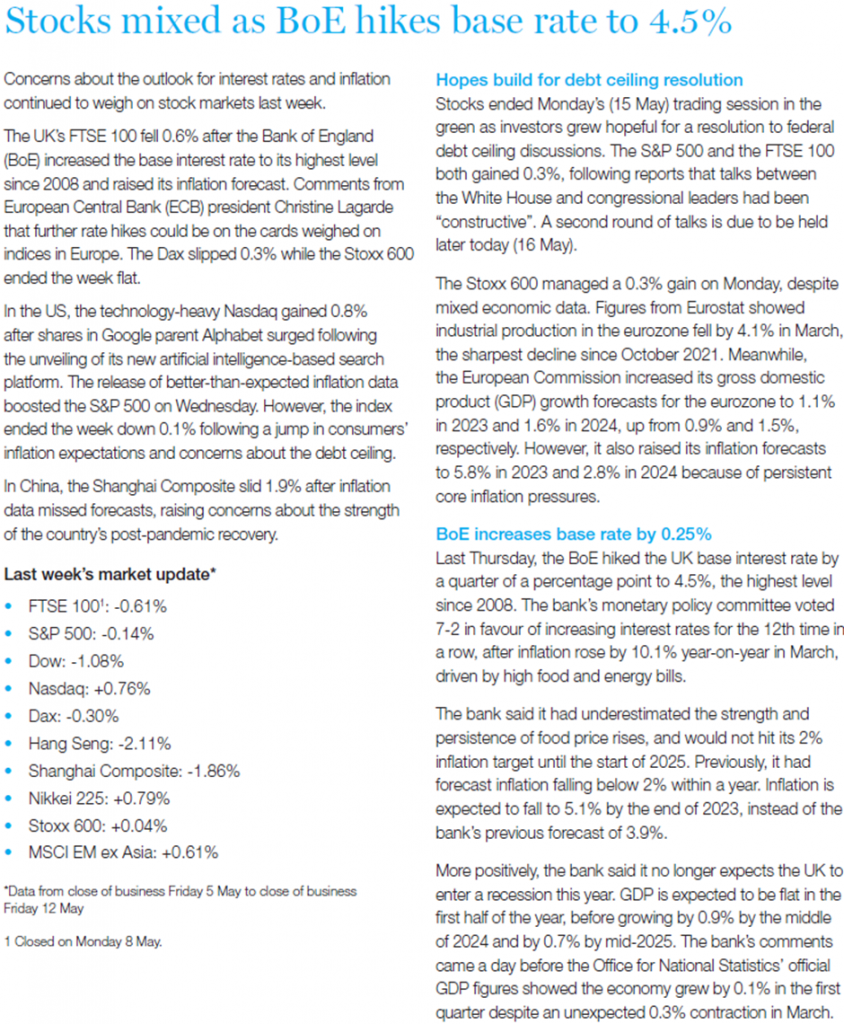
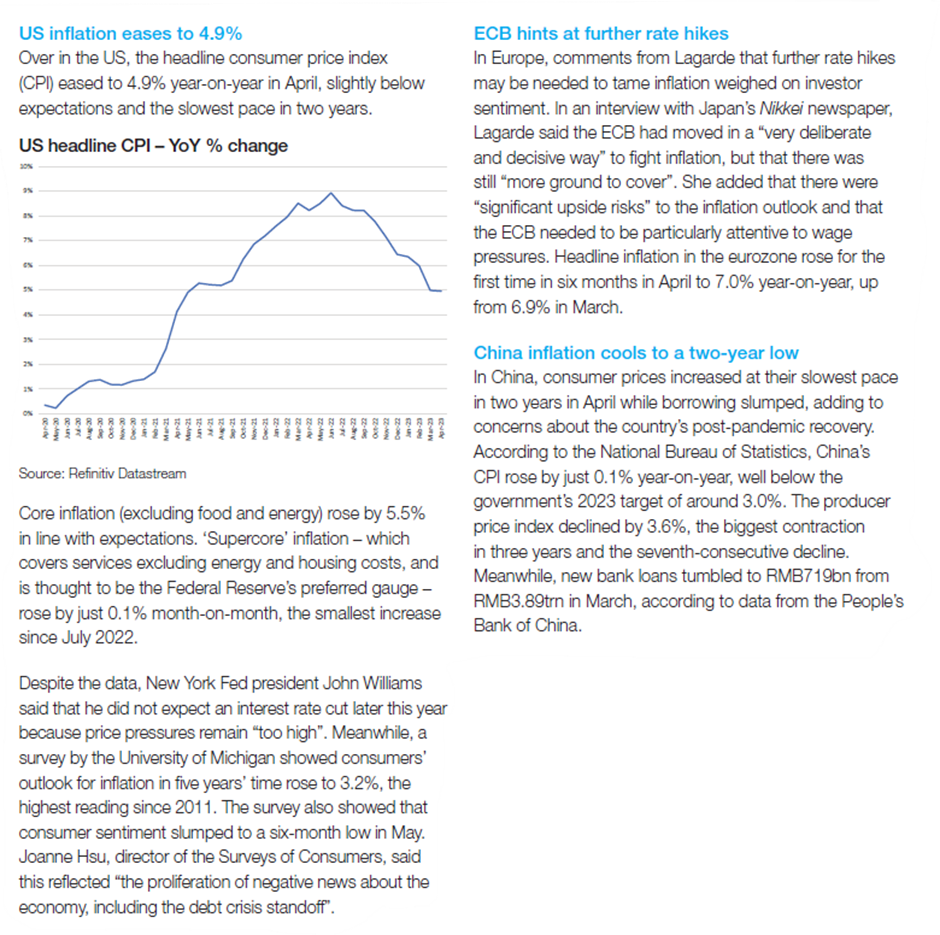
Please see this week’s Markets in a Minute update from Brewin Dolphin received late yesterday (16/05/2023) afternoon:

Please continue to check our Blog content for advice and planning issues and the latest investment, markets and economic updates from leading investment houses.

Carl Mitchell – Dip PFS

Independent Financial Adviser

17/05/2023

Team No Comments

Brooks Macdonald – Weekly Market Commentary

Please see below, Brooks Macdonald’s Weekly Market Commentary providing a brief analysis of the key economic and market news over the past week. Received yesterday afternoon – 15/05/2023

Equity markets were subdued last week with US equities seeing small losses and European equities small gains. Technology equities outperformed with large cap US names leading the narrow but powerful rally seen in 2023.

Inflation expectation data suggests that consumers think that inflation will be stickier in the US

On Friday last week the release of the University of Michigan’s consumer and inflation data damaged sentiment. The long-run consumer inflation expectations rose to 3.2%, ahead of 3% in the prior reading and market expectations of just 2.9%. This number is often revised however the US Federal Reserve (the Fed) will be concerned that this may suggest that inflation expectations are becoming more anchored. The one-year measure of expectations was also above expectations but did fall slightly from the month prior. Consumer sentiment was worse than markets had expected, with consumers citing fears of a more protracted recession as a major contributor to the more sombre reading. This week investors will be looking to the US retail sales numbers on Tuesday which are expected to have expanded but for a meaningful proportion of this expansion to have been caused by higher gas prices. The headline number therefore may be a distraction and the data is likely to confirm a slowing in consumption compared to the start of 2023.

Allegations of fraud in the initial jobless claims puts the data release in focus this week

The high-frequency US initial jobless claims data is released on a weekly basis and will be watched closely on Thursday given this is the week where the surveys are completed for the next US employment report. Media reports and statements from the Massachusetts Department of Labor suggest that the recent initial jobless claims data may be misleading in suggesting a softening of labour market tightness. The state has accounted for around half the rise in four-week moving average claims since the late January low. Should these claims have been subject to fraud, as the data and media reports suggest, the initial jobless claims may start coming down significantly, whilst this would be good news for the US economy it is of course less positive for inflation.

UK labour market data this week will help determine whether the UK continues to hike interest rates

With the focus previously on US labour market strength, this week will see the release of UK labour market data which is particularly important as bond markets debate whether there will be a pause in the UK interest rate. Should the data continue to show strength in wage prices this will put pressure on the Bank of England to maintain its tightening stance.

Please continue to check our Blog content for advice and planning issues and the latest investment, markets and economic updates from leading investment houses.

Alex Kitteringham

16th May 2023

Team No Comments

Tatton Investment Management – Monday Digest

Please see the below article from Tatton Investment Management, providing a brief analysis of the key stories from global markets and economies over the past week. Received this morning – 15/05/2023.

Overview: Trust the MPC to rain on May’s parade

After a period of waiting, things are hotting up after central banks acted as expected. Although equity and bond markets have been bearing up well, in our estimation, underlying risks have increased since May began. Last week, it was the turn of the Bank of England (BoE) to increase the UK base rate to 4.5%. After members of the Monetary Policy Committee (MPC) digested reports of tepid growth of 0.1% for Q1 (with March contracting by 0.3%), the 0.25% hike was nailed on. The BoE raised its estimate for economic activity this year and no longer thinks there will be a recession. However, year-on-year inflation is now likely to take longer to ease off, and is expected to remain above 8% as of June, and to finish 2023 at 5.1%. It says the risks are skewed towards inflation staying well above its 2% target. Not everyone agrees. The BoE still worries the UK does not have enough resources to fuel overall growth which is why it sees inflation risks skewed to the upside. The biggest resource shortage is the number of workers (skilled and unskilled) needed to do the work, and it’s difficult to see how this will be resolved in the short to medium term.

Meanwhile, the environment for businesses across the developed world remains difficult. Rises in short-term rates have happened almost everywhere and at the same time. Indeed, apart from the early 1980s, there has never been a such a period with virtually all central banks acting as if in concert. That unified action also means their policies have an unprecedented global impact, magnified by a more interlinked world than in the 1980s. At Tatton, we’re sure central bankers take into account the impact of each other’s decisions, and yet this final phase of rate rises could be viewed as coordinated overkill.

US debt ceiling brinkmanship is nothing new

US Treasury Secretary Janet Yellen has warned the federal government could default on its debt obligations very soon. Perhaps the oddest thing about this state of affairs is that it doesn’t feel like big news. The Treasury hit the current debt ceiling – at $31.4 trillion – on 19 January. Since then, it has been steadily running down the ample funds in the Treasury General Account, buffered by April’s tax receipts. President Biden wants to “take the threat of default off the table”, but Republican House speaker Kevin McCarthy has said his party’s position remains unchanged. Estimates for when the X-date (when the US is officially unable to meet its obligations) falls due are varied, with the latest suggesting it could come in August. But Yellen has warned the government might be unable to meet all its obligations as early as 1 June.

While the media gets excited about the debt ceiling soap opera, we’ve all been here before (at least three times since 2011, to be exact). And realistically the US government’s default risk is zero. Moreover, behind all the brinkmanship, US lawmakers will not want to bankrupt the government. Nevertheless, Biden’s suggested invoking of the 14th Amendment – which states the viability of US Treasury bonds cannot be placed into question – is a signal of how seriously he takes the situation. We mostly agree that reaching the dreaded X-date without an agreement is extremely unlikely but would point out brinkmanship can push things over the edge even when all participants do not mean it to. More important is what happens between now and the X-date – particularly for federal employees. The issue will likely see a short-term resolution, but that sets up an interesting budget confrontation later in the year. As well as dictating actual federal spending, that could well set the agenda for next year’s presidential election.

European energy prices: the great reset?

Wholesale gas prices – the main determinant of energy costs for European households and businesses – have not been this cheap since July 2021, when Russia began constricting supply in the lead-up to its invasion of Ukraine. Softer global economic activity appears to be a reason for commodity weakness this year – not just in gas but oil too. Brent crude prices are currently at around $75 per barrel, down from a peak of over $110 last summer. 

The removal of Covid restrictions has led to an economic rebound in China and previous Chinese growth spurts coincided with substantial commodity price rises. So why has this not happened so far this year, despite definitely positive growth in the world’s second largest economy? Recent import data from China shows a decline in the value of oil and gas imports. Interestingly though, the volumes of oil being imported are still very high – just cheap. Indeed, the implication is that the prices are well below market. This is almost certainly because China is soaking up cheap oil on offer from Russia, which has ample supply but few willing customers in the west. We suspected this was going on for some time, and the latest data effectively confirms it. Global energy distribution has reset; the higher prices of 2022 have encouraged new sources of supply. The Russian reduction of energy supply to the world as a whole has proved temporary. 

While few will be pleased that Russia is finding buyers for its gas and oil, it probably means that Europe’s peak of the energy crisis – the worst in the post-war era – is now past. After Russia began its war in Ukraine, we said global energy markets would drastically restructure, but without necessarily altering the fundamental balance of supply and demand. We are arguably seeing the results of this restructuring now. If so, it would mean downward price pressure is reaching an end. Europe’s energy crisis has certainly improved, but the continent might still have a tough winter ahead.

Please check our blog content for advice, planning issues and the latest investment, market and economic updates from leading investment houses.

Alex Clare

15/05/2023

Team No Comments

Evelyn Partners Update – May Bank of England MPC decision

Please see the below article from Evelyn Partners for their thoughts on the Bank of England Monetary Policy Committee’s decision to raise interest rates by 25bps:

What happened?

The Bank of England increased rates by 0.25% today at the May monetary policy meeting, which was consistent with market and economic expectations. This takes the base rate to 4.5%, its highest level since 2008. The Monetary Policy Committee (MPC) voted 7-2 in favour of 25bps.

What does it mean?

The Bank of England (BoE) followed the Federal Reserve (Fed) and the European Central Bank (ECB) in raising its base interest rate by 25 bps. While it appears the Fed is pausing its interest rate hiking cycle, the BoE and ECB could still have some work to do. Much will depend on the incoming data.

At 10.1% in March, UK inflation remains stubbornly high. In contrast, US and Eurozone CPI rose 4.9% and 7%, respectively in April. This divergence has been driven by two main factors. First, like the rest of Europe, the UK has experienced a major energy price shock since the Russian invasion of Ukraine.

Second, the UK has experienced far greater labour shortages than the rest of Europe, similar to what we have seen in the US. Many young European workers have left the UK after Brexit and older workers are leaving the labour force due to long-term sickness. This has placed upward pressure on wages and inflation.

As a result, markets have repriced their expectations of the peak in the UK base rate over the last month – they now expect a peak of 5% instead of 4.5%. But much will depend on the data over the next couple of quarters.

We expect to see UK inflation start to ease as the base effects turn more favourable and the impact of higher rates is felt by the real economy. In its latest forecasts, the Bank of England now expects inflation to fall to around 8% for Q2 and 5% by Q4. They expect to meet their 2% target by the end of 2024.

On the plus side, the Bank now thinks the UK will avoid recession in 2023. It revised its 2023 GDP forecast up from -0.5% to 0.25%.

Bottom Line

With inflation remaining stubborn, the Bank will continue to monitor the incoming data before deciding whether to raise interest rates again. With the Monetary Policy Committee continuing to judge that “the risks around the inflation forecast are skewed significantly to the upside” we would not be surprised to see further hikes from the MPC

Please continue to check our Blog content for advice and planning issues and the latest investment, markets and economic updates from leading investment houses.

Andrew Lloyd DipPFS

12/05/2023