Team No Comments

Tatton Investment Management – Monday Digest

Please see this week’s Tatton Monday Digest discussing the key economic news from the past week:

Overview: disinflation sentiment cheers investors

Last week was another positive one for global stock markets, with the narrative of a soft economic landing in 2023 appearing to gather support. Stock market gains in June have been spreading to the mid and small cap market segments, rather than just for a handful of mega-caps. In the US, the mostly small cap Russell 2000 index has risen about 8%, versus 4% for the mega tech-heavy NASDAQ 100. Europe has also seen similar moves, suggesting investors are gaining confidence that the headwinds to growth are turning towards tailwinds, thereby preventing a recession.

Even emerging markets have started June in a more upbeat fashion, compared to a rather muted May. This should probably be seen as win, given the disappointment around China. The world’s second-largest economy – and by far the biggest component of MSCI’s EM index – has been struggling under the weight of expectation for months now. The anti-climax has induced another policy move by Chinese authorities, this time asking banks to reduce interest payments to depositors and to indicate a round of equity market support. There is plenty of liquidity in China, but depressed investor confidence has made valuations there very cheap, so we may be in for a sharp bounce in Chinese equities should the authorities succeed.

Further China policy easing will be another tailwind, and not just for China. However, until the inflation picture really improves in the developed world, central banks will still feel obligated to keep raising interest rates. Last week, both Canada and Australia surprised markets by both hiking rates another 0.25%. This week it could be the turn of the US Federal Reserve (Fed), with its Open Market Committee meeting on Wednesday. Markets have come to expect another rate rise, if not next week, then in July. For what it’s worth, we are not so sure. May’s payroll survey showed a sharp jump in the number of people employed but was quite downbeat in other areas, and the unemployment rate rose to 3.7%. Another factor that could stay the Fed’s hand is the resumption of US Treasury financing after the debt ceiling resolution. The Fed’s current account must be replenished – by issuing large amounts of short-term government debt at competitive rates – and that could drag money away from those rather stressed US regional banks. After March’s unnerving (and economy damaging) episode, another rate rise now risks worsening the situation and causing a second round of bank failures.

We wrote last week that optimists had gained the upper hand over the pessimists and last week’s market gains tell a similar story. It seems that while markets are never without their worries even the pessimists may find it difficult to be apocalyptic when the sun shines.

Japan’s new rising sun?

Japan is having a moment. Over the last three months, its stock market has been the best performer of all the headline regions we track. In the middle of May, the Topix returned to its highest level since 1989, and in June it has taken another leg up, rallying strongly last Monday and Tuesday in particular. Inflation, something that has been virtually absent in Japan for more than three decades, came in at 3.5% in April – coming down from the 40-year high of 4.3% in January. Many investors, both foreign and domestic, expect wage growth will follow. For these reasons and more, markets are more positive about Japan than they have been for a generation.

Celebrating inflation might sound odd, given western economies are still desperately fighting price increases. But deflation has been one of Japan’s biggest problems during its stagnant period, reinforcing savings habits and holding back investment and growth. Inflation has now been running above the Bank of Japan’s (BoJ) 2.0% target for 13 months. But while these sustained price pressures are extremely unusual in Japan, the 3.5% April figure is hardly a cause for concern. The comparative lack of runaway inflation allows the BoJ much more leeway than its global peers. Its interest rates have stayed anchored below 0%, in sharp contrast to the aggressive tightening seen in the US. Lately there have been signs of a rise in the BoJ’s balance sheet. For foreign investors, this has helped underpin the belief that Japan is a safe haven in a risky world.

Before getting carried away, we note Japan has generated similar hype in the past, only for market rallies to peter out when the economy inevitably disappoints. Current detractors say Japan’s inflation is mostly coming from global factors, rather than domestic price pressures, as well as its cyclical sensitivity. Ties with China have been a positive for Japan in the past, but China’s recently disappointing growth has turned this factor into a negative for now. Some have also argued Japanese profitability is only a consequence of the falling yen value, and not a sign of genuine underlying improvement. But this is an oversimplification, as the rise in profitability is not just linked to exporters, but is broad-based across the whole economy. With the home bias among Japanese consumers, we would not expect this if currency depreciation was the only factor at play.

One could just as well argue it is a positive that Japanese profits have kept up in dollar terms – something that was difficult in the past. Moreover, the fall in the yen will have secondary impacts on Japanese exporters, making their products more attractive. If this continues with domestic corporate improvements and economic optimism – as is the case at the moment – it will only strengthen the case for Japan as an investment destination. Japan always does best when it is outward facing and connected to the global economy. Thankfully, its policymakers now seem to recognise that fact.

Please check our blog content for advice, planning issues and the latest investment, market and economic updates from leading investment houses.

Andrew Lloyd DipPFS

12/06/2023
Team No Comments

Brewin Dolphin Markets in a Minute

Please see the below article from Brewin Dolphin providing their market commentary. Received yesterday afternoon 06/06/2023.

Stock Markets Rally on US Debt Ceiling Deal

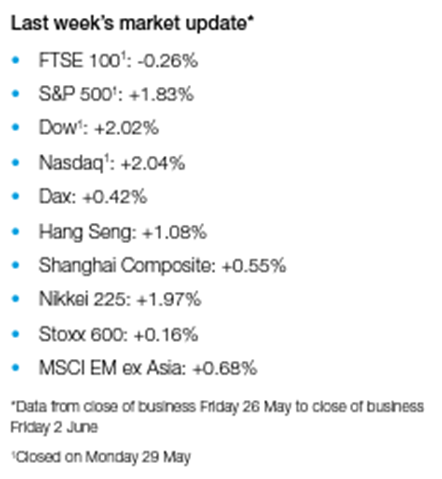
Several indices enjoyed solid gains last week after US lawmakers passed the debt ceiling deal, averting what would have been the country’s first-ever default. The House of Representatives and the Senate passed the legislation after US president Joe Biden and speaker Kevin McCarthy reached an agreement following several weeks of tense negotiations. Stocks were also boosted by the release of a forecast-busting nonfarm payrolls report on Friday. The Nasdaq rose 2.0% in its sixthconsecutive weekly gain, while the S&P 500 added 1.8% to close at its highest level in over nine months. The positive sentiment helped the pan-European Stoxx 600 claw back earlier losses to end the week up 0.2%. In Asia, disappointing factory data from China saw the Hang Seng hit a six-month low on Wednesday before finishing the week up 1.1%. The FTSE 100 was the only major index to end the week in the red, as news of the debt ceiling deal failed to outweigh concerns about China’s economic recovery.

US services sector figures disappoint

Stocks slipped on Monday (5 June) following the release of disappointing US services sector readings. The S&P 500 fell 0.2% after the Institute for Supply Management’s (ISM) non-manufacturing purchasing managers’ index (PMI) fell to 50.3 in May, just above the 50.0 mark that separates growth from contraction. This was well below the 52.2 forecast by economists in a Reuters poll. Monday also saw the release of services sector data for the UK. The S&P Global / CIPS services PMI measured 55.2 in May, down slightly from April’s one-year high of 55.9. Services sector cost inflation hit a three-month high as increased salary payments more than offset lower fuel costs. The FTSE 100 ended Monday’s trading session down 0.1% after enjoying an earlier rally on the back of higher oil prices.

Nonfarm payrolls smash forecasts

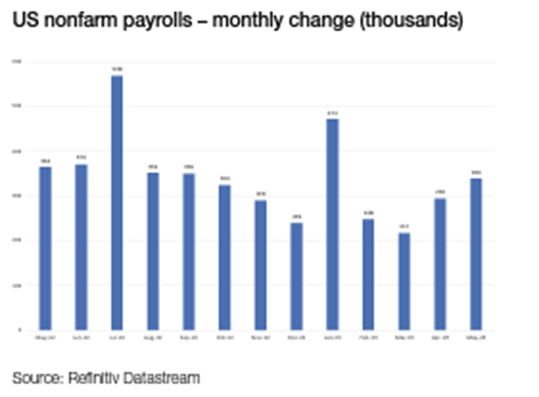
The release of the closely watched US nonfarm payrolls report last Friday saw stock markets end the week on a high note. The US economy added 339,000 new jobs in May, according to the Bureau of Labor Statistics. This was almost double expectations of around 195,000. Figures for the previous two months were also revised upwards.

However, not everything in the report signalled strength. The ‘household’ survey, which is based on a survey of around 60,000 US households, showed that jobs growth fell sharply in May. In contrast, the ‘establishment’ survey, which incorporates the payroll records of some 144,000 nonfarm establishments and government agencies, rose. Taking an average of both surveys suggests jobs growth was the weakest in over a year. The unemployment rate also rose to 3.7%, higher than any estimate in Bloomberg’s survey of economists. The data came two days after figures showed US job openings unexpectedly rose in April, indicating persistent strength in the labour market. There were 1.8 job openings for every unemployed person in April, up from 1.7 in March.

US manufacturing contracts further

The latest US manufacturing sector data added to an increasingly mixed picture for the US economy. ISM’s manufacturing PMI fell to 46.9 in May, the seventhconsecutive month it has stayed in contraction territory. The new orders sub-index dropped to 42.6. In contrast, companies continued to increase hiring in May and inflation eased. The survey’s measure of prices paid by manufacturers decreased sharply to 44.2 from 53.2, defying expectations for a modest increase.

Eurozone inflation eases

In the eurozone, headline inflation fell by more than expected in May to 6.1% year-on-year from 7.0% in April. This marked the lowest level since February 2022. Core inflation, which excludes volatile food and energy prices, also eased more than anticipated to 5.3% from 5.6%. Nevertheless, European Central Bank (ECB) president Christine Lagarde said inflation was still too high and “set to remain so for too long”. The ECB is expected to raise interest rates by a further 0.25 percentage points when it meets on 15 June and again in July or September, according to Reuters.

Separate data showed economic sentiment in the eurozone fell by more than expected in May. The European Commission’s index declined to 96.5, the lowest level since November 2022. The decrease was driven by lower confidence in industry, services and, particularly, retail trade. Construction confidence remained broadly unchanged, while consumer confidence continued recovering, albeit at a reduced pace.

China factory activity slumps

Over in Asia, markets tumbled last Wednesday following the release of China’s official manufacturing PMI. The index dropped from 49.2 in April to 48.8 in May, the weakest level since the country ended its zero-Covid policy in December. Production activity fell into contraction for the first time since January, dragged down by declines in new orders and exports. The non-manufacturing PMI, which measures sentiment in services and construction sectors, fell to a weaker-than-expected 54.5 in May, which was also the lowest level in four months.

Please check our blog content for advice, planning issues and the latest investment, market and economic updates from leading investment houses.

Alex Clare

07/06/2023

Team No Comments

EPIC Investment Partners – Daily Update

Please see below, the ‘Daily Update’ from EPIC Investment Partners, detailing inflation expectations and highlighting the key news from markets. Received today – 06/06/2023

Mark Zandi, Moody’s chief economist, believes the Federal Reserve should not “sacrifice the economy to the altar of a 2% inflation target”, adding that he expects the Fed to pause the run of interest rate hikes at the upcoming meeting. Over the weekend, Zandi tweeted “Why should the Fed sacrifice the economy to the altar of a 2% inflation target (closer to 2.5% for CPI), when most Fed officials probably think a 3% target makes more sense? The zero lower bounds is too close at 2%. They wouldn’t (shouldn’t) let on they have this view, but…,”. He went on to say “The Fed appears set to pause its rate hikes at its upcoming meeting. Thank goodness. Economic growth is fragile, the strong May payroll job gain notwithstanding. Hours worked are falling, so despite all the jobs, aggregate hours worked have gone nowhere this year”.

Another reason he believes the Fed should hit the pause button is the recent stress within the banking sector. Zandi said that government actions had curtailed the deposit run. However, he believes the sector is still “fragile” and depositors are still “on edge” as they continue to move their cash into money-market funds.

Moody’s has also stated that the recent deal on the US debt ceiling will have a minimal impact on the US’ credit profile. “The outcome is consistent with the stable outlook on the US’ Aaa sovereign credit rating,” they said in a statement, adding the agreement “does not change our assessment of the US sovereign credit profile given the act’s limited impact on the federal government’s fiscal position, institutions and governance strength, and the broader economy”.

Also, for those of you that only turn left when boarding a plane and would not dream of flying any lower than first class, Qatar Airways have some bad news for you. The airline, considered by many to be the best in the world, has announced that it will not have first-class berths on its next-generation long-haul aircraft. Akbar Al Baker, Qatar’s Chief Executive Officer, said the investment in the most luxurious seats does not justify the returns, given that Qatar’s business-class offering provides many of the same perks.

So, sorry, going forward you’ll just have to slum it in business class.

Please continue to check our Blog content for advice and planning issues and the latest investment, markets and economic updates from leading investment houses.

Alex Kitteringham

6th June 2023

Team No Comments

Tatton Investment Management – Monday Digest

Please see below, a ‘Monday Digest’ from Tatton Investment Management discussing the key economic news from the past week. Received this morning – 05/06/2023:

Overview: markets take good news in their stride

In last Tuesday’s digest, we suggested that with the absence of any good news, markets were likely overreacting to the relatively low probability of a US debt default. As it turned out, last week, not only did we get a resolution to the US debt ceiling brinkmanship, but also the welcome news that inflation pressures across Europe were declining faster than expected, while the US jobs market remains paradoxically both vibrant and at the same time showing signs of slowing down (with unemployment going back up). Unsurprisingly stock markets staged a brief relief rally on the debt ceiling resolution, but began wobbling again when Chinese, US and European manufacturing sentiment data showed sure signs of contraction.

On the back of this, bond yields stopped their ascent and declined over the course of the week on the expectation that manufacturing headwinds should persuade central bankers to stop hiking rates. The extraordinarily robust US job market figures on Friday did not appear to change this narrative for bonds, while equities took the strong economic news as outright positive for a change. This came despite expectations for the first rate cut being yet again pushed out further into the future – now only expected for January 2024 (Back in January this year it was implied for the middle of the year).

There is little doubt in our minds that higher rates and higher yields for longer will leave more collateral damage in their wake. But in all, last week was a good one for the optimists, who may well believe equities look more attractive versus bonds again. As to the already seriously expensive US stock market, those same optimists might argue this is mainly driven by companies that will shape our society’s future, and therefore justify the hefty premium. Pessimists, however, will point to the higher-for-longer risks emanating from high interest rates and lending costs eventually driving down demand (and profits), causing a recession-triggering debt default cycle. They might also point out that US tech firms will have to generate almighty profits to justify current valuation hype. Optimists are holding sway just now, but whether it stays this way over the coming weeks remains uncertain. Stay tuned.

The Eurozone is still in an inflation fight

The good mood has excited some investors about Europe’s prospects. Inflation numbers are coming down even more quickly across the continent than had been expected. German inflation fell to 6.3% in May, below the forecast figure of 6.8% and substantially lower than the previous month’s 7.6%. France, meanwhile, saw annual price increases drop to a rate of 6%. For the Eurozone as a whole (6.1% year-on-year), inflation is back to levels seen at the beginning of last year. With some relief we can say that the worst of the European energy crisis is behind us, and surely not a moment too soon. Over time, this should also feed through into wider goods and services to help alleviate second-round price pressures. The European Central Bank (ECB) meeting last month delivered just a 0.25% hike, the smallest of this cycle and a signal that rates are approaching their peak. News that inflation is falling faster than expected increases these expectations, with some investors now predicting the ECB could stop raising rates as soon as July. In any case, the market is pricing in just another 50 basis points from here.

These are certainly encouraging signs, but we should not get ahead of ourselves. While falling energy prices should give the ECB confidence that there is not much more inflation to worry about in manufacturing, services, on the other hand, are showing much more persistent inflationary signs. Strong demand – a rebound from the winter cost-of-living contraction – has allowed service providers to up their prices, and higher wages are being passed on too. The wage factor is a particular concern for the ECB, which considers a cooled labour market the key to taming underlying inflationary pressures, over the long-term at least. In that respect, the signals policymakers really care about – the ‘sticky’ prices – are not as positive as one might imagine from the headline data. This is not to suggest the ECB will follow the BoE’s lead in nailing its hawkish colours to the mast, but merely to point out policymakers will probably be more cautious in believing the hype than some market participants. In particular, due to developments in services and wider labour market concerns, we expect the ECB therefore to sacrifice medium-term economic growth for the sake of continued inflation fighting.

UK’s housing market back under pressure

Britain’s housing market has fared reasonably well over the last year or so, all things considered. However, that resilience is being tested now. Figures released last week showed the number of homes sold in April was 25% lower than a year before, and 8% below the previous month’s figure. Rapid interest rate rises – and the fear of more ahead – are now clearly having a big impact. Earlier in the week, UK lenders pulled out of almost 800 mortgage deals. The number of residential mortgage deals fell by almost 7% in one week alone. Thin volumes often precede falling prices – sometimes sharply –  and fewer mortgage offerings dampen the outlook further, almost certainly reducing demand for residential property. So far, the housing market has managed to escape the gloom engulfing most other parts of the UK economy. This is unlikely to remain the case for long.

To make matters worse, it is likely that the impact of rate rises on the housing market will increase over the rest of the year. Around 1.8 million households need to re-mortgage this year, and the majority of those have not yet done so. It is possible some are hoping rates will come down – or at least moderate – as the UK economy worsens. But all the latest communications from the Bank of England suggest they are still extremely concerned about lingering inflation, and are prepared to raise rates further if need be. When those households do re-mortgage, they could find themselves in an even worse situation. Given improved mortgage criteria checks, this should not lead to widespread distressed sales, but it will absorb discretionary spending ability, which will hurt the wider economy.

Structural weaknesses in the UK’s housing supply prevent many building projects and means Britain’s ratio of homes to people is among the lowest in western Europe. This partially explains why prices have been able to grow so dramatically despite increasingly stretched affordability. But while structural imbalances may alleviate downward pressure on prices, they are hardly anything to be pleased about. Like many structural imbalances in the UK, they are ultimately a barrier to long-term prosperity and a sign of deep-rooted challenges. The housing market’s latest malaise is yet another example.

Please continue to check our Blog content for advice and planning issues and the latest investment, markets and economic updates from leading investment houses.

Carl Mitchell – Dip PFS

Independent Financial Adviser

05/06/2023

Team No Comments

AJ Bell – Midday Market Update

Please see the below article from AJ Bell received this afternoon giving a market update for today (Friday 2nd June 2023):

Market attention on Friday turned to the US employment report and, further out, the next interest rate decision by the Federal Reserve, after legislators passed a bill that will prevent the US government from defaulting on its debts.

Stocks were higher ahead of the May nonfarm payrolls report, due out at 13:30 BST.

The FTSE 100 index was up 74.26 points, 1.0%, at 7,564.53 at midday in London. The FTSE 250 was up 225.09 points, 1.2%, at 19,052.85, and the AIM All-Share was up 5.05 points, 0.6%, at 789.50.

The Cboe UK 100 was up 0.8% at 754.70, the Cboe UK 250 was up 1.3% at 16,610.82, and the Cboe Small Companies was up 0.4% at 13,632.09.

The US Senate voted to suspend the federal debt limit, capping weeks of fraught negotiations to eliminate the threat of a disastrous credit default just four days ahead of the deadline set by the Treasury.

Economists had warned the US government could run out of money to pay its bills by Monday. This left almost no room for delays in enacting the Fiscal Responsibility Act, which extends the government’s borrowing authority through 2024 while trimming federal spending.

Hammered out between Democratic President Joe Biden and the opposition Republicans, the measure passed the Senate with a comfortable majority of 63 votes to 36 a day after it had sailed through the House of Representatives.

‘Risk sentiment has improved markedly with the passage of the US debt ceiling deal through Congress,’ said Fawad Razaqzada, market analyst at City Index and Forex.com

As US President Joe Biden prepares to sign the legislation into law, attention now turns to the key US nonfarm payrolls report for May. It is expected to show an increase in jobs of 195,000, up from 253,000 in April.

‘US jobs numbers this afternoon may provide some pointers to the next move by the Federal Reserve, whose decision making no longer needs to consider the potential financial stability risks associated with default on US debt,’ said AJ Bell investment director Russ Mould.

‘If the non-farm payrolls data indicates continued tightness in the labour market, the Fed may feel it has to continue with rate rises when it meets on 14 June.’

Fed Governor Philip Jefferson and Philadelphia Fed President Patrick Harker both made the case on Wednesday for a pause in interest rates hikes at the next meeting on June 13 and 14.

Stocks in New York look to continue their rally on Friday. The Dow Jones Industrial Average, the S&P 500 index, and the Nasdaq Composite all were called up 0.5%. On Thursday they ended up 0.5%, 1.0%, and 1.3%, respectively.

The dollar was mostly lower midday Friday in Europe.

The pound was quoted at $1.2530 at midday on Friday in London, up slightly compared to $1.2523 at the equities close on Thursday. The euro stood at $1.0770, higher against $1.0737. Against the yen, the dollar was trading at JP¥138.88, unchanged from Thursday.

Despite its softness ahead of the US jobs report, the dollar is set to rise further, Brown Brothers Harriman thinks.

‘Banking sector concerns and dovish market pricing for Fed policy had been major negative headwinds on the dollar in recent months, but those have finally begun to clear,’ BBH said. ‘Now, we believe passage of the debt ceiling deal removes the final headwind for the dollar, and so we see this recent rally continuing.’

Please check our blog content for advice, planning issues and the latest investment, market and economic updates from leading investment houses.

Andrew Lloyd DipPFS

02/06/2023

Team No Comments

Stocks fall as economic data declines

Please see below ‘Markets in a Minute’ article received from Brewin Dolphin yesterday evening, which provides a global market and economic update.

Most major markets finished in the red in a week that saw worse-than-expected economic data from the UK and Germany.

In Europe, the FTSE 100 lost 1.9% as UK inflation rose by a higher-than-expected 8.7%. Pan-European Stoxx 600 lost 1.6% as the German economy contracted 0.3%, taking it into recession.

Over in the US, the S&P 500 rose 0.3% and the Nasdaq added 2.0% as hopes were raised of an agreement on the debt ceiling and optimism over artificial intelligence boosted chip stocks. Meanwhile, the Dow lost 0.6%.

Asia saw all markets decline due to concerns of the US debt ceiling despite a boost in tech stock.

Food inflation falls in May

The FTSE 100 dropped 1.38% on Tuesday (30 May), as UK shop price inflation rose to an annualised 9% in May, up from 8.8% in April, the highest rate in 18 years, according to the British Retail Consortium (BRC).

The BRC announced Tuesday that annualised food inflation fell to 15.4% in May, declining from 15.7% in March. The decline is driven primarily by a fall in energy and commodities costs.

UK inflation remains persistently high

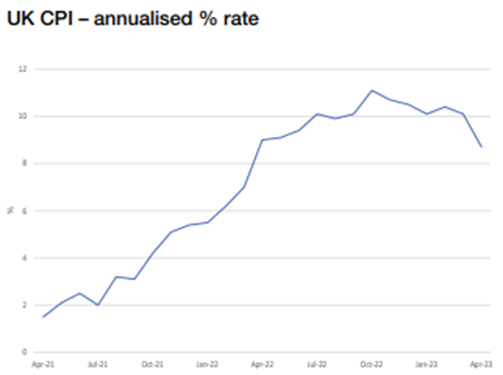
Figures from the Office of National Statistics released last week showed that the UK Consumer Price Index (CPI) rose by an annualised 8.7% in April, down from 10.1% in March and higher than a predicted 8.4%. Falling energy and gas prices contributed to the decline but remain a main driver of inflation alongside food and non-alcoholic beverages. On a monthly basis, CPI rose by 1.2% in April compared to 2.5% in April 2022.

Core CPI (excluding energy, food, alcohol and tobacco) rose by 6.8% in the year to April, up from 6.2% in March, the highest level in over 30 years.

The higher-than-expected inflation figures have led to a sharp decline in bonds, as investors expect the Bank of England (BoE) to raise interest rates further this year. The yield on two-year gilts rose to 4.4% on Wednesday last week, up from 3.7% earlier in the month. Yields rise when bond prices fall.

UK mortgage costs rose by up to 0.45 percentage points at the end of last week, with rates on fixed-rate deals now reaching 5.0% and over. The average two-year and five-year fixed-rate deals are now 5.63% and 4.80% respectively, according to USwitch.

Mortgage lenders have pulled nearly 800 residential and buy-to-let mortgage products from the UK markets in the anticipation of further interest rate hikes, figures from Moneyfacts show. Residential mortgages have fallen by almost 7% in a week, while buy-to-let products have dropped by more than 14%.

Chancellor Jeremy Hunt said on Friday that he was comfortable with the UK entering a recession if this would help bring down inflation, and that he would support the BoE raising interest rates, even as high as 5.5%, to stifle price growth.

UK retail sales volumes rise

British shoppers increased their spending last month as UK retail sales volumes grew by 0.5% in April, rebounding from a fall of 1.2% in March.

The non-food stores sector was boosted by strong performance in the other non-food stores sector, which saw 2.1% monthly growth thanks to strong sales of watches and jewellery and sports equipment. Clothing store sales volumes grew by 0.2%, while household goods fell by 0.2%.

Food store sales rose by 0.7% following a fall of 0.8% in March. Automotive fuel sales volumes fell by 2.2% in April following a 0.1% rise in March.

On a quarterly basis, sales volumes rose 0.8% in the three months to April compared to the previous three months, the highest rate since August 2021.

US debt ceiling agreement reached

US president Joe Biden and House of Representatives speaker Kevin McCarthy have agreed to suspend the US debt ceiling into 2025. The deal would see non-defence spending remaining roughly flat in 2024 before increasing by 1.0% in 2025. Defence spending would increase to $886bn, in line with president Biden’s previously proposed defence budget. The White House estimates that government spending would be reduced by at least $1tn, but no official calculations have been released yet. Most of these savings would come from capping spending on domestic programmes for housing, border control, scientific research and other discretionary spending.

The deal will need to be approved in the House of Representatives and the Senate before 5 June, when the US could default. While some lawmakers are expecting the deal to go through, several Republicans have publicly stated they will vote against it.

The deal has faced bi-partisan criticism; Republicans have argued it does not go far enough to reduce spending or target Biden’s student loan forgiveness plan, while Democrats have targeted the inclusion of work requirements for federal assistance.

Germany enters recession

Germany has entered a recession as the economy contracted 0.3% between January and March, according to government figures. The figures follow a 0.5% contraction in the final quarter of last year. A recession occurs when a country’s economy shrinks for two consecutive quarters.

Germany’s annualised inflation rate hit 7.2% in April, exceeding the eurozone average rate of 7.0%.

An increase in private sector investment and construction at the start of the year was offset by a decline in consumer spending. Household spending fell by 1.2% in the first quarter, as consumers reduced spending on food and beverages, clothing and footwear, and furnishings. Government spending also decreased by 4.9% compared to the previous quarter.

Please check in with us again soon for further relevant content and news.

Chloe

01/06/2023

Team No Comments

Tatton Investment Management – Tuesday Digest

Please see the below article from Tatton Investment Management providing a brief analysis of the key news from markets over the past week. Received this morning – 30/05/2023.

Overview: debt ceiling angst, or simply a lack of good news

Last week brought another bout of equity market volatility, with much of the blame for the market wobble attributed to the US government debt ceiling negotiations. The deadline after which the US government runs out of money – and technically defaults on its financial obligations – is now likely only 5-10 business days away, so market nervousness ahead of such an impending – and portentous – deadline is wholly understandable. Over the weekend an agreement between Democratic and Republican party leadership was reached, although the House of Representatives must vote on Wednesday before sending the bill to the Senate. It could therefore still go right down to the wire.

The other big – and to our mind more important – move of last week took place in the bond market, with a sell-off moving yields higher again, in some instances, like the UK, reaching levels not seen since last autumn, after the Truss government’s ill-fated mini-budget. Indeed, last week’s step up in bond yields came at the same time as inflation reports (such as in the UK) showed that inflation – while trending downwards – is nevertheless proving sticky and persistent. At the same time, Germany was reported to have been in recession over the winter quarters and China’s COVID recovery has disappointed this far against the high expectations earlier in the year. Against this backdrop, expectations of central banks reversing their rates policies have been further pushed out towards the end of this year and even the first quarter of next year, while expectations of resurging economic growth over the second half of this year have been dampened.

It is unsurprising then, to find the investment community increasingly polarised on the outlook. There are many strong arguments pointing towards an eventual downturn – even if that only takes place next year – and equally good reasonings why the global economy might just muddle its way through the downdraft forces of 2023, and keep going forward for longer than conventional economic theory would otherwise suggest. For those already looking beyond the likely resolution of the debt ceiling cliff, the next market threat will likely be the impending liquidity drain caused by the US government which must replenish its empty coffers by issuing $1 trillion of new bonds into markets. But there may be some reassurance that most of the $2.4 trillion of cash currently deposited by US money market funds in the US Federal Reserve’s Reverse Repo facility is expected to be attracted by the higher rates the US government will have on offer than the US central bank. Perhaps this insight better explains some of upbeat market sentiment on Friday than the positive vibes from the debt ceiling negotiators.

New EU fiscal rule changes loom large

While last week’s sobering announcement that Germany was officially in recession through the winter was worrisome, Europe’s problems could undoubtedly have been much worse. Given Germany’s (and Europe’s in general) previous dependence on Russian energy, a bleak winter would likely have resulted in widespread production shutdowns. In the end, a combination of milder weather which supported construction spending, the faster establishment of liquified natural gas (LNG) supplies from North America and better-than-expected energy storage meant the eurozone emerged without an overall contraction of growth. At least so far, although the recent German numbers are likely to weigh on revised eurozone growth performance – nevertheless, a decent result all things considered.

Even Greece – the epicentre of past euro crises – is on course to regain its investment-grade credit rating this year. It is already the fastest-growing economy in the bloc, and the unexpectedly big election win for Greece’s centre-right government recently pushed bond yields down dramatically, in a further sign that markets are regaining confidence. But before too much credit is claimed by Europe’s technocrats, in truth, the Greek story is far from a success of European policy. Strict budgetary rules have hindered growth and after a decade of public spending cuts, tax rises and reforms – much of it at the behest of the troika (the European Commission (EC), European Central Bank (ECB) and International Monetary Fund (IMF) combined) – Greece’s debt-to-GDP ratio remains worse than in 2012. Its economy, meanwhile, is still smaller than it was in 2008.

The EC is currently drafting proposals for reforming the bloc’s fiscal rules, which it argues even more urgently must be updated in light of the pandemic and Europe’s energy supply crisis. It wants to reappraise debt-to-GDP targets which prohibit national debt from exceeding 60% of GDP and the annual fiscal deficit from going above 3% of GDP. Its original proposals were for bespoke plans for each nation, similar to the IMF’s national lending agreements (of course without disbursing any money).

Germany and the Netherlands have opposed such tailor-made plans, arguing there must be minimum targets for indebted countries. They suggest numerical targets are the only way to ensure tangible progress on debt reduction, and point out that the existing rules are full of exceptions for economic hardships anyway – as evidenced by historical adherence to the rules. Proponents of the tailor-made approach, though, argue countries would be much more likely to stick to the rules if they were bilaterally agreed, instead of imposed by central diktat. This could also avoid pro-cyclical policies which demand austerity through tough economic periods and spending in times of growth. That could be a big help for nations that might need more time to implement budget adjustments. Fiscal transitions, and especially structural reforms, can be very costly at the beginning, as some industries might need to be closed or reformed, while productive infrastructure is put in place.

Something policymakers will not openly discuss, but are very likely worried about, is that a lack of common rules might lead to preferential treatment for certain countries. However, even under the new framework, bespoke repayment plans have to be approved by the EC, meaning national governments have the final say. If some such budget can be established by the end of June (when negotiations heat up) that would be a transformative, though unlikely, step. Whatever formal framework is agreed, it is most likely going to be through a typical European compromise – enforcement and genuine progress will (as usual) come down to goodwill and political engagement.

Please check our blog content for advice, planning issues and the latest investment, market and economic updates from leading investment houses.

Alex Clare

30/05/2023

Team No Comments

Invesco – Market volatility expected to rise as US debt ceiling debate continues

Please see below an article published by Invesco earlier this week which covers their views on how the ongoing negotiations on the US debt ceiling continue to impact on markets and what the potential outcomes are:  

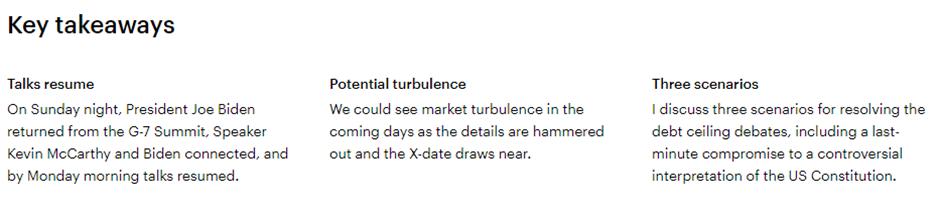
US debt ceiling negotiations are occupying an increasing amount of investor attention as we get closer to the “X-date” — the date that the US government is expected to run out of money to fully meet its financial obligations. Currently, the X-date is estimated to be June 1.

Late last week, the stock market moved from complacency to fervor around the debt ceiling situation – reports that the parties were getting closer to an agreement sent stocks higher. I was skeptical because there seemed to be such a significant gap between the Biden administration’s position and House Republicans’ position. Yes, Democrats and Republicans had agreed to a clawback of COVID-related stimulus that has not been spent yet. And yes, the Democrats had eased their position on work requirements for welfare-related benefits, saying they were open to some requirements. But that was the easy part. The far bigger issue is discretionary spending cuts, where the chasm between Democrats and Republicans is wide.

Both parties agreed to ringfence Social Security and Medicare with no cuts or even caps applied, and only focus on other types of discretionary spending. The Republicans’ bill, passed in April, would reduce discretionary spending to fiscal year (FY) 2022 levels and limit the growth of future spending to 1% annually over the next 10 years. The White House has proposed keeping spending at FY2023 levels into FY2024, but they want the defense discretionary spending to share in some of those cuts. And so my skepticism comes from the wide gap in bargaining positions: Republicans want 10 years of cuts on discretionary spending while Democrats want two years of caps.

And so it is no surprise to me that, in the last several days as the tough decisions on spending get hammered out, the negotiating parties have gotten more pessimistic. It’s just more realistic, in my opinion. And it suggests to me that we’ll see more market turbulence in coming days.

So where do we go from here?
 

Three scenarios for resolving the debt ceiling debate

Compromise. The most likely scenario is that the two parties arrive at a compromise. That probably wouldn’t happen until the 11th hour, as we have seen in past debt ceiling negotiations. And it will not be easy. In order to meet the X-date deadline, Speaker Kevin McCarthy says a negotiated draft bill must be received by the House Rules Committee by Wednesday the 24th, as it will not be able to receive a vote for 72 hours. After a Saturday vote, the Senate would then have four days to process the bill by regular order. There is a path in the which Senate can process the bill in a condensed timeframe, but that is a narrow strategy and less reliable.

One of the concessions McCarthy made in order to win enough votes to be elected Speaker of the House was restoring the ability for any single member to call for a “no confidence” vote on him. Such a vote would be unlikely to ever unseat McCarthy, but it injects one more possible headache into the negotiating process because there is no cooling off period after a “motion to vacate” vote, so another one can be called the following day, and so on. Suffice it to say it would be very disruptive.

Discharge petition. A second possible scenario is that Democrats utilize a discharge petition to raise the debt ceiling. This is not a layup, however. A discharge petition is a parliamentary procedure to bring a bill out of committee and to the floor for a vote without the committee’s approval to do so. This forces the House to take action on a bill even if the Speaker or the committee it originates from objects. On May 17, House Democratic leadership filed a discharge petition to move a bill for a clean debt ceiling increase out of committee, and 210 Democratic House members signed it. However, Democrats need 218 signatures to force a vote on the floor, which would require some Republicans to sign the petition — and thus far all Republican members of Congress have remained aligned with Speaker McCarthy. And even if Democrats could force a vote, the earliest date that could occur would be June 12 – almost two weeks after estimated X-date.

The 14th amendment. The third possible scenario is that the Biden administration invokes the 14th Amendment — an option they’ve been reluctant to use. The 14th Amendment of the US Constitution states that “the validity of the public debt of the United States, authorized by law…shall not be questioned,” which is widely interpreted to require the US government to meet its financial obligations. The idea here is that the White House and Treasury could decide to keep issuing debt in order to honor past obligations, no matter what happens with the debt ceiling. However, the US Constitution also allocates budgetary power to Congress, not the Executive Branch. Thus, using the 14th Amendment to keep issuing debt would certainly face a legal challenge from Republicans and could get caught in the courts for years. And so it seems the Biden administration is not interested in utilizing this to resolve the debt crisis unless the US arrives at the X-date without the debt ceiling being raised. Another interpretation of the 14th Amendment is that it rules out default, and since it’s part of the Constitution, it stands above the budget law — and this together with the need to maintain financial stability means that the Treasury would have to prioritize debt payments.

News around the world

While the US debt ceiling debate has captivated market observers, there have been plenty of notable developments around the world:

  • China. April economic data for China came in below expectations. For example, China retail sales rose 18.4% year over year, which was well below consensus.1 And manufacturing-related activity has been disappointing, although that is likely a reflection of the global economic slowdown. It seems that the Chinese economy is continuing to experience significant growth in services activity, but it is not generally as strong as expected. I continue to believe the China re-opening has very long legs – it’s just taking a breather.
  • Canada. Canada’s Consumer Price Index (CPI) print for April was higher than expected, and modestly higher than March. While it’s moving in the wrong direction, some of that increase can be attributed to the Bank of Canada’s rate hikes, which have driven up mortgage rates and increased the cost of shelter. More importantly, I continue to believe one print does not change the narrative. Canada is in a disinflationary trend; however, it is imperfect and lumpy. I don’t think it should force the Bank of Canada to abandon its conditional pause.
  • Japan. Japan also saw significant inflation in its most recent CPI print. The good news is that Japan is also experiencing strong growth, as first quarter gross domestic product came in well above expectations. It does beg the question of when the Bank of Japan will get less dovish.
     

Looking ahead

In terms of investment implications, we are getting conflicting reactions from the stock and bond market. The bond market is pricing in the risk of a technical default, with yields on T-bills maturing in early June rising dramatically. However, the stock market seems far more optimistic, and is not pricing in that risk; even the VIX is relatively low. My read is that the bond market usually errs on the side of greater pessimism while the stock market is often irrepressibly optimistic.

I think the bond market is the more accurate measure of risk right now, and that a brief technical default is a real possibility. Stock markets are likely to reflect that greater risk as we get closer to the X-date without an agreement in place. I just believe a technical default would likely be very brief, as it would provide the impetus for the parties to finally reach an agreement and end the standoff.

And so I have to say that I’m looking forward to reaching mid-June, a time when I feel confident that the debt ceiling impasse should be behind us, one way or another. Perhaps we should think of this spring’s debt ceiling crisis as just a financial form of allergy season: It’s going to get worse before it gets better, and we just need to ride it out until pollen counts go down and we can get back to normalcy. I think we’ll all be able to exhale by mid-June, although it will likely be an increasingly volatile market environment between now and then.

Once that drama recedes, I think all eyes will be back on central banks. I’m optimistic that the US Federal Reserve and the Bank of Canada will maintain conditional pauses, and that other Western developed central banks will draw closer to the end of their respective tightening cycles. I think markets will soon begin to discount an economic recovery, even though sentiment is very pessimistic right now.

Please continue to check our Blog content for advice and planning issues and the latest investment, markets and economic updates from leading investment houses.

Carl Mitchell – Dip PFS

Independent Financial Adviser

26/05/2023