Team No Comments

Brewin Dolphin – Markets in a Minute

Please see this week’s Markets in a Minute update below from Brewin Dolphin, received yesterday afternoon – 24/02/2026.   

Markets respond to political uncertainty

How continued U.S. tariff uncertainty and geopolitical tensions are affecting markets.

Key highlights

  • Iranian shadow looms over markets: Oil prices (and associated equities) rose as fears grew over potential supply disruptions.
  • U.S. Supreme Court rules against Trump tariffs: America’s highest court ruled that President Donald Trump’s emergency powers don’t include the authority to impose tariffs. Potential refunds could total as much as $170 billion.
  • UK economic data shows signs of weakness: Economic data, including unemployment, wage and inflation data, broadly underlined the case for further UK interest rate cuts.

U.S. Supreme Court rules against Trump tariffs

The week ended with a landmark ruling from the U.S. Supreme Court, which upheld the view expressed by lower courts that President Donald Trump’s authority under emergency powers does not extend to levying tariffs.

The decision, which was reached by a margin of six votes to three, was widely expected, but included no detail on whether the importers are entitled to refunds. This will now need to be addressed by a lower court.

If fully permitted, refunds could total as much as $170 billion – representing the biggest portion of President Trump’s tariff revenue – but the agonising wait for a decisive legal decision from America’s highest court has only presaged a further wait for the detail be resolved.

President Trump responded by imposing a 10% global tariff under powers designed to prevent large balance of payment deficits.

The immediate reaction is one of weakness from U.S. bond markets and the dollar, as public finances are further weakened and an accidental tax cut is being delivered to a very distinct sector of the economy – even though the risk is that the refund issue becomes a drawn out legal argument.

Iranian shadow looms over markets

Source: Bloomberg

The risk of U.S. military action against Iran remains materially elevated. This has led to gains in oil prices, and the associated equity sectors, on fears of potential supply disruption. So far, diplomatic negotiations have failed. U.S. military assets, including the world’s largest aircraft carrier, continue being deployed to the Middle East, posing a significant potential threat to Iran.

This constitutes a major test of the TACO (Trump Always Chickens Out) framework. The administration has already launched airstrikes on Iranian facilities, so the question is how willing it is to make a greater commitment, and what objective such a commitment might have.

At the end of the week, President Trump twice referenced a period of 10 to 15 days, during which Iran would need to reach a deal with the U.S. to avoid military action. That was less immediate than the build-up of military assets in the region might suggest.

However, unpredictability is one of President Trump’s hallmarks, and Iranians will remember that a previous 60-day window was cut short by last June’s U.S. air strikes against Iranian nuclear facilities (on that occasion, America’s hand was rather tilted by the earlier Israeli strikes).

The other factor that will be weighing on the Iranian regime’s minds is this year’s extraction of President Maduro from Venezuela, which may indicate that regime change would be the objective of any operation. However, President Trump is a pragmatist, and his stated aim is to end Iran’s nuclear and ballistic missile programs. To what extent that requires a regime change is open to question. There’s a strong desire to avoid the extended deployments that were required in Iraq and Afghanistan in the early 2000s. In the case of Venezuela, for example, elements of the regime were retained and subject to U.S. pressure, avoiding the chaos that comes from a complete removal.

So far, the impact on oil is assumed to be roughly $6 to $7 of risk premium reflected in the current oil price.

Helima Croft of RBC Capital Markets notes: “Regional observers warn that Iran would target energy facilities and economic assets to force Washington to stand down. Using naval bases in Bandar Abbas and Jask, Iran retains the ability to target tankers and mine the Strait of Hormuz, while the Houthis in Yemen and Iraqi militias maintain significant disruptive capabilities.”

The base case of a limited U.S. strike would likely see oil prices spike initially, then unwind as disruption fears fade. However, the rule of thumb is that a 1% loss of supply can cause a 4% increase in price, and with the potential for widespread disruption to transit, significant action could push prices up to $100 per barrel or more.

President Trump’s administration will be very conscious of the domestic political impact of a price spike. It would weigh on growth and compound cost of living pressures, particularly for lower income cohorts. The president’s net disapproval over his handling of inflation has improved in recent weeks, but an oil price spike would change that, and the public support for military intervention in Iran is low.

The U.S. midterm elections take place in November, and Republicans are expected to lose control of the House of Representatives, which will radically alter the balance of power in Washington. With this in mind, a de-escalation would seem to be in the president’s best interests.

UK economic data shows signs of weakness

The UK had a series of economic reports out last week. They broadly underlined the case for further interest rate cuts because the labour market in particular, appears to be quite weak. An important caveat is that the data quality is low, but the unemployment rate has continued to rise to a level not seen for about a decade outside of economic crises.
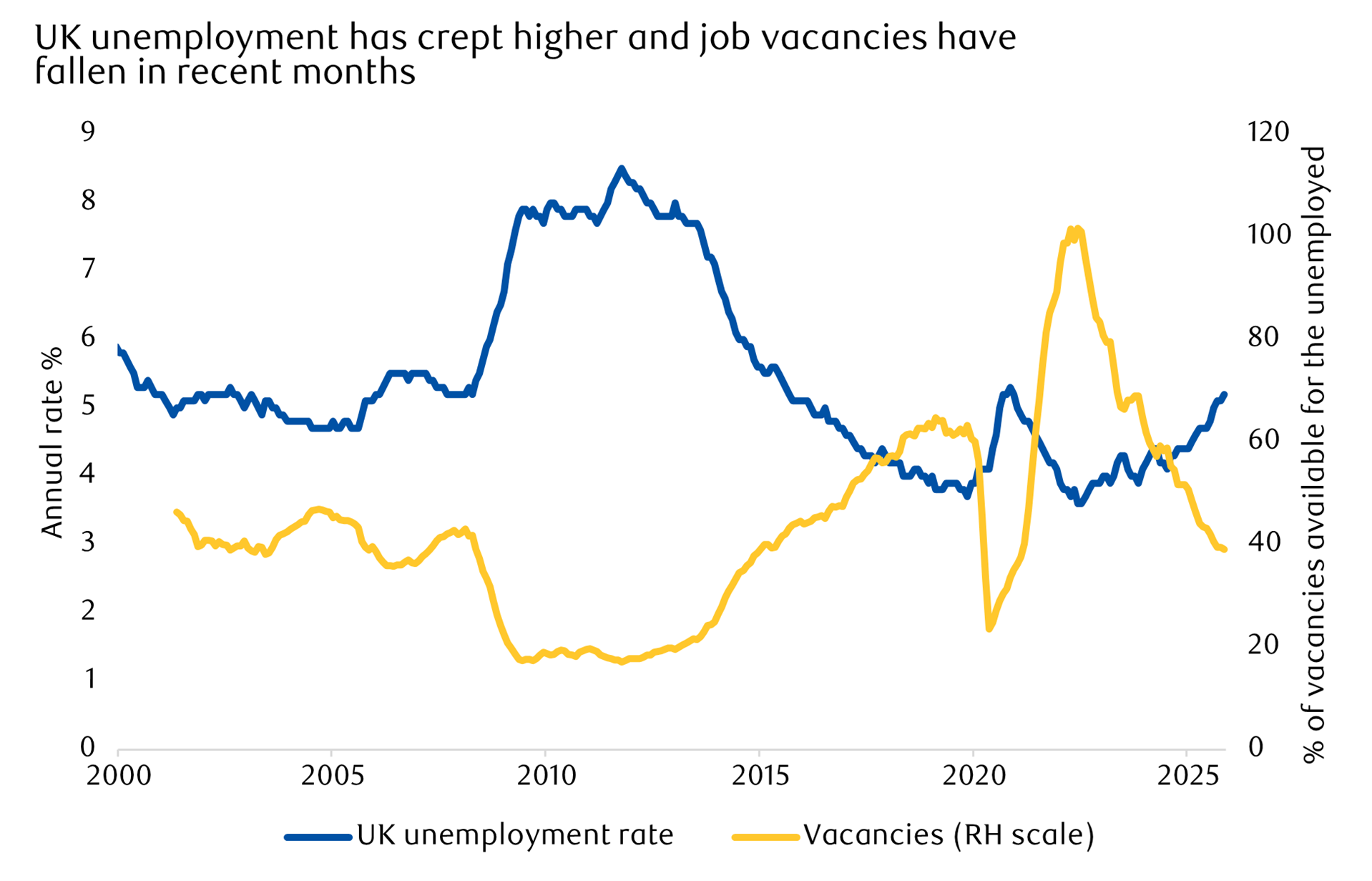
Source: LSEG Datastream

However, these levels of unemployment were quite commonplace prior to the global financial crisis of 2008. It’s easy to see this as a watershed moment. While we don’t know to what extent the weakness of employment is caused by the adoption of AI (it’s assumed to be modest for now) and how much is explained by the higher cost of employing UK workers, a longer-term trend seems likely.

The use of AI seems set to alter the constraint on increasing production; historically, this has been heavily tilted toward the shortage of workers, but it could be driven to a greater extent by resource and energy shortages in the future.

For now, the timeliest data comes from PAYE. It suggests employment is stable rather than collapsing – and employment surveys seem to suggest the same. The recent trend of public sector wages outstripping private sector pay abated somewhat.

Consumer price inflation slowed significantly from 3.4% to 3%, a considerable improvement but still well above target. Prices always fall in January, as some categories are discounted heavily. However, the change in the annual rate reflected the resilience of prices seen in January 2025, rather than any specific weakness earlier this year.

A way of looking through these seasonal factors is to consider median price increases. These also remain above the Bank of England’s target.

Friday saw strong retail sales, which we hoped would come, as consumers put the concerns of last year’s budget behind them. With that in mind, a measured approach to cutting interest rates remains warranted.

Please continue to check our blog content for advice, planning issues and the latest investment market and economic updates from leading investment houses.

Charlotte Clarke

25/02/2026


Team No Comments

Brooks Macdonald – The Daily Investment Bulletin

Please see the below article from Brooks Macdonald discussing their take on markets generally, fiscal stimulus and geopolitical factors affecting current market performance. Received this morning 24/02/2026.

What has happened?

US equities ended yesterday broadly flat, masking a volatile session that began with a sharp sell-off. The S&P 500 recovered from early losses to finish unchanged. IBM recorded its worst single-day performance since the bursting of the tech bubble in 2000, while the software sub-sector of the S&P 500 fell -3.82%, its lowest level since the ‘Liberation Day’ last year. European markets were mixed. The STOXX 600 declined a more modest -0.45%, though Germany’s DAX underperformed with a -1.06% drop, reflecting its greater sensitivity to global trade. In contrast, gold rallied strongly, rising 2.35% to $5,227 per ounce, its highest level since the record highs seen in late January.

Sentiment-driven pressure on software and AI names

The latest sell-off in AI-related stocks appeared to be driven more by sentiment than by new fundamental information. A widely shared research note from Citrini Research, ‘The 2028 Global Intelligence Crisis’, outlined a hypothetical scenario in which AI adoption leads to double-digit US unemployment by mid-2028. While explicitly speculative, the note gained significant traction on social media and was widely cited as a trigger for the sharp intraday sell off. Stocks perceived to be vulnerable to AI disruption bore the brunt of the move. The software sector fell sharply and is now almost 32% below its October peak. IBM was the worst performer in the S&P 500, dropping more than 13% after commentary suggested AI could modernise COBOL, a legacy language central to IBM systems. The risk-off tone spilled beyond tech, hitting several consumer and financial names referenced in the report, as well as private equity firms amid renewed private credit concerns.

Tariffs add to uncertainty

Section 122 tariffs came into force overnight at 10%, with officials signalling that a move to 15% remains under consideration. Reports late yesterday also pointed to potential new national security investigations into sectors including batteries, telecom equipment, and industrial chemicals. The EU has paused ratification of its trade agreement with the US, citing concerns that new Section 122 tariffs could stack with existing measures and push effective rates above the agreed 15% ceiling. EU officials have called for clarity on whether the US will fully respect the terms of the deal. The UK outlook is similarly unclear. Despite having previously agreed to a 10% tariff rate, there is now a risk it could face a higher global tariff. From the US side, President Trump warned that countries seen to be ‘playing games’ would face tougher outcomes.

What does Brooks Macdonald think?

Looking ahead, markets remain sensitive to both policy signals and shifts in sentiment. President Trump’s State of the Union address tonight will be closely watched for any clarification on tariffs and policies, particularly given the recent escalation. While narrative-driven volatility has dominated recent sessions, it is worth noting that many of the underlying concerns around AI disruption, and global trade are long-term in nature and unlikely to be resolved quickly. Elevated uncertainty can continue to drive sharp rotations across sectors and styles.

Bloomberg as at 24/02/2026. TR denotes Net Total Return.

Please continue to check our blog content for advice, planning issues and the latest investment, market and economic updates from leading investment houses.

Alex Clare

24/02/2026

Team No Comments

Tatton Investment Management: Monday Digest

Please see below, an article from Tatton Investment Management, analysing the key factors currently affecting global investment markets. Received this morning – 23/02/2026

Stable indecision

On Friday, the dollar weakened after the Supreme Court struck down Trump’s “reciprocal tariffs”. Initially, US stocks rose and bond prices fell but both have reversed those moves during Monday’s Asian market sessions. China’s extended new year period ending today (Monday) means it remains to be seen whether there will be an equal and opposite reaction in their markets.

It was notable over the past week, that individual stock-level volatility has gone from very high to quite low. UK stocks and bonds reacted well to some ‘Goldilocks’ data: lower inflation (from higher unemployment), but strong retail sales and record tax receipts.

Under-pressure Microsoft and Amazon stabilised, but investors didn’t quite buy the dip. Less stretched valuations mean markets driven by earnings fundamentals rather than liquidity. Q1 US corporate earnings forecasts have been downgraded, as AI capex inflation is proving a drag. That could reinforce the rotation out of big US tech – benefitting Asian chip manufacturers. Investor darling Nvidia – still at the centre of AI, should remain a winner.

JPM economists continue to forecast strong US growth (from AI capex and tax rebates) but their own nowcasts bely that bullishness. Even the Fed can’t make its mind up about US growth: the hawks expect stronger consumption, while the doves see productivity savings or job losses. In this context, we need to watch households’ savings rate, but we’re inclined towards the doves, especially once the impact of tax refunds wanes in H2 26. It’s also still unclear whether AI is displacing jobs. Higher UK youth unemployment might be about AI, or it might be about higher employment costs, for example.

Oil prices spiked after Russia trampled ceasefire hopes and Trump ramped up his Iran threats. Washington will probably favour a short sharp bombing campaign. Underneath this, oil supply is still rising faster than demand, so prices have room to fall if tensions calm.

Trump has already reimposed tariffs via a temporary measure and will seek to make them permanent by other means. This could be even more disruptive than the current tariff regime. No wonder, nations are pursuing “strategic under-implementation” of their Trumpian trade pledges, according to expert Sam Lowe, but they will still have to cough up something – like Japan’s $36bn oil and gas investment. Another episode of the Trump show might be coming.

Life in Europe’s fast lane

Despite EU leaders announcing the “One Europe, One Market” slogan, the most interesting comments from the recent summit on European competitiveness were about a supposed two-speed union. This comes after the so-called E6 finance ministers (Germany, France, Italy, the Netherlands, Spain and Poland) launched their coalition, focussed on passing the Savings and Investment Union (SIU – a rebrand of the stalled Capital Markets Union). European Commission president Von der Leyen effectively endorsed these moves as a way to stop nations like Hungary stifling legislation for the rest of the 27 nations.

Faster integration and limiting the blocking power of entrenched national interests will make the EU more responsive to collective economic needs. Passing the SIU could be a game changer, as the lack of a single financial market is seen as one of Europe’s biggest barriers to growth. We suspect nations in the slow lane will be incentivised to join the fast lane too. Just look at the fact once-peripheral Poland is now a major economy in the E6. But a closer inner circle doesn’t mean national interests won’t get in the way; it just means there’s fewer competing interests. If Germany and France disagree – like on Eurobonds – it doesn’t matter how small the circle is.

It’s good that leaders are being pragmatic. We see this in the ‘Made in Europe’ debate too: France is pushing for strict European preference in handing out contracts (potentially in violation of its trade agreements) while Germany wants a lighter ‘Made With Europe’ approach that includes trade allies like the UK. But all parties recognise that, in a regionalised world, something has to change. We said last year that structural changes, particularly around capital markets, could be the best thing to come out of Europe’s defence push. Those changes look closer than ever.

US does a sterling job of de-dollarisation

If you think dollar weakness is a crumbling empire story, sterling’s decline through the 20th century may the best precedent. The British Empire’s naval dominance, extensive trade and industrial production made sterling the lynchpin of global finance. Its reserve status declined rapidly after WWII, but the dollar already overtook sterling as a form of trade credit in the 1920s. Britain borrowed extensively from the US during and after WWI – which helped establish New York as a rival financial hub. Britain’s trade deficit was increasingly offset by its asset wealth. When the UK needed capital for the war effort, the realities of trade forced a reduction in demand.

The US is also a heavily indebted nation that relies on high asset valuations to fund trade and budget deficits, but there’s been no war-equivalent forcing a correction. We wrote last week, though, that Trump’s trade shock makes purchasing power parity (PPP) matter more. If the dollar adjusts to PPP levels, it will mean a long and steep fall. Trump wants to reduce the US trade deficit, but in the first instance he’s drawing attention to the fact the US is no longer the dominant trading nation (China trades more with the world).

Sterling’s decline is a precautionary tale, not an investment prediction. For all the talk of dollar debasement, investors are often dragged back into the US by its corporate earnings growth. And unlike with sterling, there’s no clear alternative (China’s markets aren’t trusted, Europe has structural problems, gold and cryptos are too volatile). But there are worrying signs for the dollar, like the increase in renminbi-denominated energy contracts. Ultra long-term trends don’t go in a straight line, and relief rallies for the dollar don’t prove the long-term decline isn’t happening. Investors need to see both the wood and the trees.

Please continue to check our blog content for the latest advice and planning issues from leading investment management firms.

Marcus Blenkinsop

23rd February 2026

Team No Comments

EPIC Investment Partners | The Daily Update

Please see below, an article from EPIC Investment Partners which discusses the recent revision to the US labour-market data release. Received this morning – 20/02/2026

Investors had an extra week to brace for January’s employment report after a partial government shutdown delayed its release until 11 February. The headline figure — 130,000 new non-farm payrolls — appeared to signal resilience, comfortably above expectations of around 70,000. Yet rates markets were conspicuously unmoved. Two-year Treasury yields barely shifted and fed funds futures continued to imply further easing later this year. The message from fixed income was clear: the headline was not the story.

The significance of this release lies in the annual benchmark revision incorporated into January’s report. The revision lowered the payroll employment level for March 2025 by 898,000 — the largest downward adjustment since 2009 — forcing a reassessment of labour-market performance over the past year. What had been presented as modest but steady expansion now appears considerably weaker. Cumulative job growth for 2025 was revised down from 584,000 to just 181,000, reducing the average monthly gain to 15,000. In retrospect, the labour market’s apparent resilience through 2025 was materially overstated.

That revision reshapes the policy narrative. Monetary settings through 2025 were calibrated against an economy believed to be generating steady employment gains. The revised data suggest labour demand had already cooled substantially. For bond markets, the question is not whether January beat expectations, but whether policy remains restrictive relative to a labour market that has been softer for longer than acknowledged.

The composition of January’s gains reinforces this interpretation. Of the 130,000 jobs added, 124,000 came from health care and social assistance. Health care alone accounted for 82,000. Outside these largely non-cyclical sectors, hiring was subdued. Financial activities contracted by 22,000 positions and federal employment declined by 34,000. Manufacturing and retail were broadly flat. The expansion, such as it is, appears concentrated in sectors supported by demographic trends and public expenditure rather than broad-based private demand.

The household survey adds a further layer of caution. The unemployment rate edged down to 4.3 per cent, yet remains close to levels that, under the Sahm Rule framework, have historically coincided with recession risk once sustained. Multiple jobholding continues to rise, with nearly 8.8m Americans working more than one job. Because the establishment survey counts positions rather than individuals, this dynamic can bolster payroll growth even as underlying household conditions tighten.

Technical factors may also have flattered the headline. Seasonal adjustments and revisions to the birth-death model complicate comparisons with prior months. Weather disruptions arrived after the survey reference week, limiting the drag typically seen in January data. None of these distortions invalidate the report, but they do caution against reading too much into a single print.

For the Federal Reserve, holding the policy rate at 3.50 to 3.75 per cent, the margin for manoeuvre is narrowing. Inflation remains above target, yet the benchmark revision implies that labour-market slack may be greater than previously assumed. The yield curve’s continued inversion reflects expectations of slower growth rather than renewed overheating.

January’s report therefore does not resolve the growth debate; it intensifies it. The headline suggests resilience. The revision suggests fragility. For fixed income investors, the central issue is calibration. If labour demand was already weaker in 2025 than believed in real time, the risk is not that the economy is accelerating — but that policy is still set for conditions that no longer exist.

Please continue to check our blog content for the latest advice and planning issues from leading investment management firms.

Alex Kitteringham

20th February 2026

Team No Comments

W1M Investment Barometer

Please see the below market update from W1M Waverton, received this morning, 19/02/2026:

What happened? 

While headlines were dominated by geopolitics, actions in Venezuela along with rhetoric towards Iran and Greenland, global equities had a positive start to the year as US economic data surprised on the upside, supported by resilient corporate earnings. Oil prices rose more than 10% in sterling terms amid rising Middle East tensions, while gold gained over 20% before selling off sharply towards the end of the month. UK government bond yields remain relatively high compared to American or EU peers, reflecting a degree of political uncertainty.

What did we do?

In fixed income, we retained a preference for UK government bonds (gilts) over corporate debt given a view, shared by the Bank of England, that inflation is moderating towards target levels and that means gilts can appreciate in value (assuming political stability). In equities, we hold around 50 stocks based on a  3-5 year thesis for each name. We continue not to hold all the biggest US technology stocks, being conscious of valuations but find good ideas around the world. During the month, we added a position in Grab Holdings which is the leading food delivery and ride hailing app in ASEAN (the “Uber of Southeast Asia”).

In real assets, after a very strong run in gold prices, we took some profits and introduced some derivative based protection strategies in case volatility increased; we remain positive on gold, and other metals such as copper and uranium, but as active investors, we take the opportunity to take profits when we think it is a good time to do so.

What do we expect now?

We remain positively positioned in the equities we select because the big picture, growth and interest rate trajectories, remain supportive. Real assets offer diversification and inflation resilience. Bond markets, expecting modest US and UK interest rate cuts in the next year, have upside and we retain a preference for UK government bonds (gilts) relative to corporate debt. Proprietary protection strategies are a valuable and distinctive component of our portfolios in an uncertain world. After a volatile 2025, given geopolitical events already this year but also the many opportunities which exist,  in our view the need is clear for investors to be properly diversified, global and active.

Please continue to check our blog content for advice, planning issues and the latest investment market and economic updates from leading investment houses.

Andrew Lloyd

19/02/2026

Team No Comments

Brewin Dolphin – Markets in a Minute

Please see this week’s Markets in a Minute update below from Brewin Dolphin, received yesterday afternoon – 17/02/2026. 

Three themes driving investor sentiment

Software sell-offs, U.S. inflation and U.S. labour market data, we break down the latest market drivers.

Key highlights

  • Markets flip from AI winners to ‘anti-AI’ stocks: Consumer staples, energy, and healthcare rally as investor anxiety peaks.
  • RELX results expose market confusion: Companies with proprietary data are AI enablers, not victims of disruption.
  • Political risks rise: U.S. tariff rebellion, UK leadership crisis, and Japan’s Liberal Democratic Party (LDP) supermajority reshape market dynamics.

To AI or not to AI? That is the question…

Source: LSEG Datastream

The equity market continues to exhibit bipolar tendencies and that was characterised last week by a continuation of the anti-AI trade (stocks which are seen as being immune to disruption by AI). Many of these, ironically, have been last year’s laggards: consumer staples, energy, healthcare.

It’s not unusual for out of favour areas to rebound quickly, this is the so-called ‘pain trade’, whereby the market seems prone to perform in a way that causes the maximum pain to the most people. This is why looking at investor positioning is particularly important. But the last few years seem to have experienced particularly abrupt waves of anxiety and euphoria.

Another factor explaining the ‘pain trade’ is changes in market structure: the rise of retail investors, more passive investors, and increased use of thematic investments create pools of money which then ebb and flow, seemingly on vague narratives.

And then there are coincidental factors − increasing tensions over Iran have contributed to a rising oil price. But still, uncertainty over the effect AI will have on the market for stocks, products, and people is vast.

OECD data shows economists are broadly bullish on AI’s productivity impact − McKinsey projects annual gains of 3.4% in optimistic scenarios. Yet we face a paradox: despite two years of U.S. productivity acceleration, growth remains modest and far below the internet boom era. This gap reflects the ‘Solow Paradox’ − innovations often take years to show up in official statistics due to adoption costs, learning curves, and implementation delays. The high productivity growth in the internet boom was coincidental, reflecting benefits from the 1990s growth of personal computers, office applications, and globalisation, rather than the rudimentary websites, which were just starting to generate revenues (and not profits).

However, it seems the AI benefits have arrived earlier than previous innovative waves and early market signals suggest they are already having real impact. Jobs data shows early career hiring collapsing in AI-exposed roles (software developers, customer service), and employer surveys reveal 32% expect workforce reductions from AI − double those expecting growth.

The tension is clear: markets expect major disruption, but productivity gains have not yet materialised at scale.

RELX results highlight the controversy

A company which was in the crosshairs and reported earnings last week was RELX.

The company reflects the market psychosis perfectly: an AI beneficiary a year ago, it has lately been seen as an AI loser, despite no change in operational performance or strategy. The broad potential AI benefits stem from automating certain workflows, many of which RELX facilitates and where hundreds of software companies compete, but RELX is positioned upstream of this disruption.

RELX controls the proprietary content and data that makes AI tools more valuable, not less. Their algorithms that have accumulated over decades, judgements, and interpretations are embedded into their 300+ specialised workflow tools. Its tool Protégé, for example, is distributed through twenty-five partner platforms like Harvey AI. It already runs on Claude, so if Claude gets better, Protégé gets better. RELX doesn’t compete in the crowded workflow software market; it enables it.

This is crucial. As AI drives productivity by automating repetitive tasks across law, publishing, and scientific research, demand for expert-curated, proprietary content increases. Large law firms using 100+ software tools still need RELX’s specialised data and judgement layers to make those workflows meaningful and defensible.

So, although Google’s search was initially seen as being disrupted by AI, instead Google search is now seen as an enabler of Google’s Gemini AI model. And just as DeepSeek was seen as a threat to AI model and hardware providers, instead it’s an enabler of greater use of AI.

The pace of change is extraordinary, and the uncertainty is high, but the market missteps will be many. Companies solving this productivity challenge need trustworthy, specialised content and interpretations that AI cannot easily replicate. So, companies like RELX should be attractive with 90% proprietary data accumulated and domain expertise giving them a moat as essential infrastructure for the AI productivity transformation, not victims of it.

Politics give and take from markets

There were some interesting political happenings last week which impacted markets. The least directly impactful was the House of Representatives (the House) joint resolution ending the emergency tariffs on Canada. It’s not directly impactful because nothing will come of it. The bill will likely be passed by the Senate and will then go to the president’s desk, where it will be vetoed.

The president can veto any piece of legislation coming from Congress. However, Congress can force the legislation through if it obtains a two thirds super majority. There’s no real prospect of that happening because the vote was largely along party lines and only managed to narrowly pass because six Republicans joined with the Democrats in an afront to the president.

These acts of self-harm with the ruling party are unhelpful in a mid-term year, but they reflect the way in which tariffs are unpopular in specific districts, something which will be reflected in November when the full House and a third of the Senate are up for election. Currently there is an estimated 84% chance that the Republicans lose the House to the Democrats, but the margin of loss matters, creating a huge incentive to keep the economy strong in this election year.

Japanese Prime Minister Sanae Takaichi enjoyed a much easier ride as her Liberal Democratic Party (LDP) and its coalition partner, the Japan Innovation Party (Ishin), achieved a strong victory in the lower house election with LDP alone securing the two-thirds supermajority. This allows them to override the upper house and initiate constitutional amendments.

Markets reacted positively to the election results with equities and the yen both rising. Nick Gwee of our Asia team says the two key pillars of Takaichinomics are: new measures against rising prices and strategic investment in select sectors.

Areas they expect to benefit under the strong LDP mandate include defence, AI semiconductors, and nuclear energy. Consumer stocks should also benefit as private consumption potentially improves as the government weighs in on inflation.

The UK leadership crisis

Source: Bloomberg

In the UK, the last fortnight has seen some volatility in gilts, which is due to the fragility of Prime Minister Sir Kier Starmer’s leadership.

There has been scandal surrounding his appointment of Peter Mandelson as ambassador to the U.S. The revelations − which centre around Mandelson’s links to Jeffrey Epstein, and leaks of sensitive government information − rattled sterling and gilt yields due to concerns a new Labour prime minister might increase fiscal spending. Though markets have retraced these moves, political risk remains elevated, and the prime minister’s position is precarious.

A leadership contest could still materialise following local elections in May, potentially reigniting volatility. Prediction markets still believe there is a high chance that the UK will have a new prime minister by the end of this year, and financial markets would prefer it to be Wes Streeting rather than Angela Rayner, who comes from the left of the party. But either option could be seen as a positive if the current financial framework remained and was adhered to, so the decision on whether to change the chancellor and if so who to, would be the key decision.

Please continue to check our blog content for advice, planning issues and the latest investment market and economic updates from leading investment houses.

Charlotte Clarke

18/02/2026

Team No Comments

The Daily Update| Extend, Pretend, and Tighten

Please see below article received from EPIC Investment Partners this morning.

The 2026 refinancing “maturity wave” represents a structural headwind for the US economy that many investors still mischaracterise as a contained commercial real estate problem. In reality, it is a system-wide credit recalibration. The bulk of these loans were originated in 2021, when policy rates were pinned near zero and capitalisation rates compressed to generational lows. Five-year maturities now collide with a radically different regime: higher base rates, wider credit spreads, and materially lower office and secondary retail valuations. Even modest declines in appraised values translate into significant loan-to-value breaches, creating a multi-billion-dollar equity gap that sponsors must bridge in a far less forgiving capital market.

Unlike prior cycles, the macro backdrop offers limited relief. The Federal Reserve cannot swiftly ease policy without risking renewed inflation pressures, meaning refinancing occurs at structurally higher coupons. Debt service coverage ratios that once looked conservative now screen as impaired. Extend-and-pretend is becoming policy by necessity, not choice.

The deeper risk is the gradual “zombification” of regional and community banks, which collectively hold a disproportionate share of commercial property exposure. This is not a 2008-style solvency shock; it is a profitability and confidence squeeze. Unrealised losses on securities portfolios, layered atop rising non-performing loans, constrain balance sheet flexibility. In response, underwriting standards tighten across the board. Credit that would otherwise fund small business expansion, inventory builds, or capex is rationed. The result is a crowding-out dynamic: local economic multipliers weaken even as headline equity indices such as the S&P 500 appear resilient, buoyed by asset-light mega-caps with limited reliance on bank lending.

Municipal finances compound the drag. Falling commercial assessments erode property tax bases in major cities, pressuring budgets already strained by post-pandemic migration trends. Service cuts and deferred infrastructure spending risk reinforcing vacancy cycles, embedding a negative feedback loop between real estate values and urban competitiveness.

Private credit has emerged as the marginal provider of liquidity, but at materially higher spreads and with tighter covenants. While this capital prevents disorderly liquidation, it effectively reprices risk across the corporate landscape, siphoning cash flow toward debt service rather than productivity enhancing investment. The 2026 maturity wall, therefore, is less a singular cliff event than a prolonged constriction, an incremental tightening of financial conditions, diverting resources from innovation to balance sheet repair, subtly but persistently capping US growth potential.

Please check in again with us soon for further relevant content and market news.

Chloe

17/02/2026

Team No Comments

Tatton Investment Management – The Monday Digest, Anxiety Under the Surface

Please see the below article from Tatton Investment Management detailing their discussions on what has happened in global markets over the past week. Received this morning 16/02/2026.

Anxiety under the surface

At a global index level, equities look calm but the AI winners and losers theme is raging below the surface. Last week, realized index-level volatility dropped, but single stock-level volatility stayed high.

Leveraged traders are targeting companies vulnerable to AI displacement. Those with high ‘price-to-book’ ratios were punished. UK wealth manager St James’s Place lost 13% after Altruist released an AI tax tool for investors. The big firms with large technical departments are under threat, but smaller firms have greater opportunity to compete. That’s good news for small business, but probably won’t affect small-cap stocks until the dust settles.

In the meantime, companies might react to share price falls with cost-cutting layoffs. That puts highly valued employees at risk, dampening a crucial source of consumer demand. The US labour market was surprisingly strong in January (130,000 jobs added) but that’s already out of date. Initial jobless claims spiked last week, and fear is that the old labour market stasis (little hiring but no firing) will tip into layoffs. That disrupts the strong US growth narrative.

Alphabet’s 100-year sterling bond issuance is encouraging, proving there’s demand for long-term debt in the UK market. UK growth data was mild for December but full-year growth (1.3%) was better than expected a year ago. Some fear that a change in Labour leadership might mean a loosening of the budget deficit, but bond markets still expect a tight fiscal policy with an emphasis on lower interest rates – as the BoE looks set to deliver.

The US Congressional Budget Office upped its long-term debt and deficit forecasts, partly due to Trump’s likely fiscal expansion this year. The need for tariff revenue will see the president veto congress’s anti-tariff bill on Canada, but there’s still a Supreme Court ruling dangling over the White House, putting further pressure on US bonds. We discuss the big non-US winners below.

The Takaichi Trade

Japanese stocks surged after Prime Minister Takaichi’s landslide election win. Both voters and investors appreciated her message of growth over caution and the continuation of Abenomics (fiscal and monetary stimulus alongside structural reform). The late Shinzo Abe’s eponymous reforms boosted long-term corporate profitability, which has now fed into wage rises, stronger domestic demand and higher growth. Even with US tariff headwinds, Japanese exports (particularly to the rest of Asia) are benefitting from a cheap yen, while the tech sector is booming. This will keep benefitting Japanese consumers, who have plenty of room to lower their savings rates.

Stocks have rallied under Takaichi, but Japanese Government Bonds (JGBs) and the yen have suffered. Amid last month’s JGB yield spike, we wrote that the JGB market has similar structural weaknesses to the UK gilt market before the Liz Truss episode (gilts are mainly held by pension funds; JGBs are mainly held by insurers), but this isn’t Japan’s Truss moment. Fiscal fears triggered the gilt selloff in 2022, whereas it’s actually strong Japanese growth pushing up JGB yields. Indeed, JGBs and the yen strengthened post-election because international investors want to buy into Japan’s long-term growth (and holding unhedged JGBs is a good way to do that).

Takaichi says her spending plans won’t raise Japan’s debt-to-GDP because GDP will rise – but the bigger risk is that the spending isn’t needed. Private sector growth is strong; extra government investment might just stoke inflation and force the BoJ to raise rates. This is a risk, but we think Takaichi’s spending will be milder than she says for this reason.

Asian trade is so important to Japan, so Takaichi’s antagonism toward China is another risk. But both Japan and China have often favoured economic pragmatism in recent decades, so we still think Japan’s long-term prospects are bright.

Emerging markets benefit from regionalisation

EM stocks have outperformed all others in the last year, despite Donald Trump’s trade disruptions.

EMs altogether account for more than half of global GDP in Purchasing Power Parity (PPP) terms. That doesn’t guarantee economic power, though, as currencies rarely converge to PPP rates even in the long-term. There’s two broad reasons for this: the lack of arbitrage and the dominance of financial markets. Arbitrage is limited by trade barriers and general non-equivalence (how do you compare a Himalayan tea house with a central Manchester hotel?), while financial market dominance means that countries with higher valued assets (e.g. developed countries) have higher valued currencies.

Trump’s policies arguably make PPP matter more. A weaker dollar always helps EM companies with dollar debts, but the general sense of riskier US assets makes EM assets less risky by comparison. Plugging the US trade deficit also stops the outflow of dollars, which stops the retuning inflow into dollar assets. Meanwhile, Trump’s desire to rebuild manufacturing capacity means a greater equivalence of goods: If American and Chinese manufacturers are selling the same cars, the main difference will be the price.

Regionalisation in the last decade has created regional trading blocs – and by far the biggest, in PPP terms, is Asia. Its growing importance is driving new politics: China is now trying to present itself as a reliable alternative to the US, and is showing a little more restraint against Taiwan and the South China Sea.

Beijing has a strong incentive to make its financial markets more attractive to foreigners (more transparency and fewer interventions), but you don’t have to buy Chinese assets to invest in Asia’s growth story – as Japan and Korea have shown. We think regionalisation will make EM assets more attractive in the long-term.

Please continue to check our blog content for advice, planning issues and the latest investment, market and economic updates from leading investment houses.

Alex Clare

16/02/2026

Team No Comments

Brooks Macdonald Daily Investment Bulletin

Please see below article received from Brooks Macdonald this morning.

What has happened?

Equity markets fell sharply, led once again by technology. The S&P 500 dropped -1.57% in its third straight decline, while the NASDAQ (-2.03%) and the Magnificent 7 (-2.24%) also saw meaningful losses. Investors continued to focus on the potential scale of AI‑driven disruption, which contributed to a series of pronounced single‑stock moves. Cisco (-12.32%) was among the worst performers following earnings, and several other names across the index posted double‑digit declines—an unusually broad reaction. The selloff extended into financials, with the KBW Bank Index down -3.21%, and even traditionally defensive assets such as gold (-3.19%) and silver (-10.67%) came under pressure. Bitcoin also fell (-2.92%), adding to a generally risk‑off tone.

AI concerns intensify across industries

Fears around the impact of AI continued to ripple through multiple sectors. CH Robinson Worldwide (-14.54%) declined sharply after a small AI logistics company claimed it had helped customers scale freight volumes by several hundred percent without additional staff, triggering a -6.64% drop in the Russell 3000 trucking index. Commercial real estate faced renewed pressure as CBRE (-8.84%) fell for a second day following comments from its CEO that fewer office workers in an AI‑enabled future could reduce long‑term office‑space demand. The weakness broadened beyond tech and AI‑exposed segments. S&P Financials fell -1.99%, while the equal‑weighted S&P 500 dropped -1.31% from a record high. Europe’s STOXX 600 (-0.49%) also edged back from recent peaks.

Europe’s leaders debate economic direction

In Europe, attention centred on the leaders’ summit in Belgium, where policymakers discussed competitiveness, industrial strategy, and the balance between regulation and support. President Macron backed a ‘Buy European’ approach for strategic sectors, while Germany’s Merz and Italy’s Meloni emphasised deregulation to boost growth. Appetite for additional joint borrowing remained limited, with Merz reaffirming that shared debt should be reserved for exceptional circumstances. In the UK, gilts outperformed after Q4 GDP came in softer than expected at +0.1% (vs. +0.2% expected), leaving annual growth at +1.3% for 2025. Markets responded by pricing in a slightly more dovish Bank of England path, with the 2‑year yield falling to 3.60% and the 10‑year yield moving down to 4.45%.

What does Brooks Macdonald think?

Market attention now turns to today’s US CPI release, which arrives at a delicate moment for rate expectations. Investors still anticipate further cuts under the new Fed Chair, but recent stronger‑than‑expected data (including the robust jobs report earlier this week) has introduced fresh uncertainty. A hotter inflation print today would add to those doubts, especially given that the current quarter is already benefitting from the fiscal impulse of the Trump tax cuts. The CPI data could play a bigger role in shaping near‑term market sentiment, as it will help determine whether recent volatility reflects a temporary adjustment or the beginning of a more sustained reassessment of inflation risks and policy trajectories.

Bloomberg as at 13/02/2026. TR denotes Net Total Return.

Please check in again with us soon for further relevant content and market news.

Chloe

13/02/2026

Team No Comments

EPIC Investment Partners Daily Update – Phantom Miles

Please see today’s Daily Update from EPIC Investment Partners below:

The combination of current global vehicle oversupply and increasingly sophisticated balance-sheet management has reshaped the economics of the automotive sector. As demand cools and electric vehicle production continues to outpace absorption in several major markets, manufacturers are under growing pressure to defend margins, protect brand positioning and maintain headline pricing.

One response has been the expanded use of pre-registration and cross-border redistribution strategies. Vehicles are registered domestically, reclassified as “used” despite minimal mileage, and removed from new inventory tallies. This supports reported production-to-sales ratios and helps sustain advertised Manufacturer’s Suggested Retail Prices (MSRPs). However, it can also widen the gap between reported sales and genuine retail demand. In the United States, for example, light-vehicle sales are forecast at approximately 15.8 million units this year, yet industry registration data indicate that a meaningful portion of those units may never reach private buyers in the conventional sense. Instead, they are redirected to fleet channels, overseas markets or other secondary outlets to relieve domestic stock pressure.

When export and fleet channels become constrained, inventory concentration becomes a more acute financial issue. Large pools of unsold vehicles require storage, often in logistics hubs exposed to seasonal weather risk. While insurance cover against catastrophic damage is standard industry practice, the scale of surplus inventory has increased the financial sensitivity of such events. Losses arising from verified weather incidents are processed through established insurance mechanisms, sometimes providing faster cash recovery than prolonged discounting campaigns in a soft retail market. This dynamic underscores how closely operational decisions, geography and risk transfer have become intertwined.

For consumers, the broader consequence is pricing rigidity at the new-vehicle level and volatility in the used market. With average transaction prices in the US approaching $50,000, negative equity has become more prevalent; recent data suggest that roughly 29% of trade-ins carry outstanding finance exceeding the vehicle’s value, with an average shortfall of just over $7,000.

The key insight is that reported sales volumes alone no longer capture underlying market health. Inventory composition, pre-registration trends, export flows and insured asset exposure now play an equally critical role in assessing the sector’s true equilibrium.

Please continue to check our blog content for advice, planning issues and the latest investment market and economic updates from leading investment houses.

Andrew Lloyd

12/02/2026