Team No Comments

EPIC Investment Partners – Daily Update

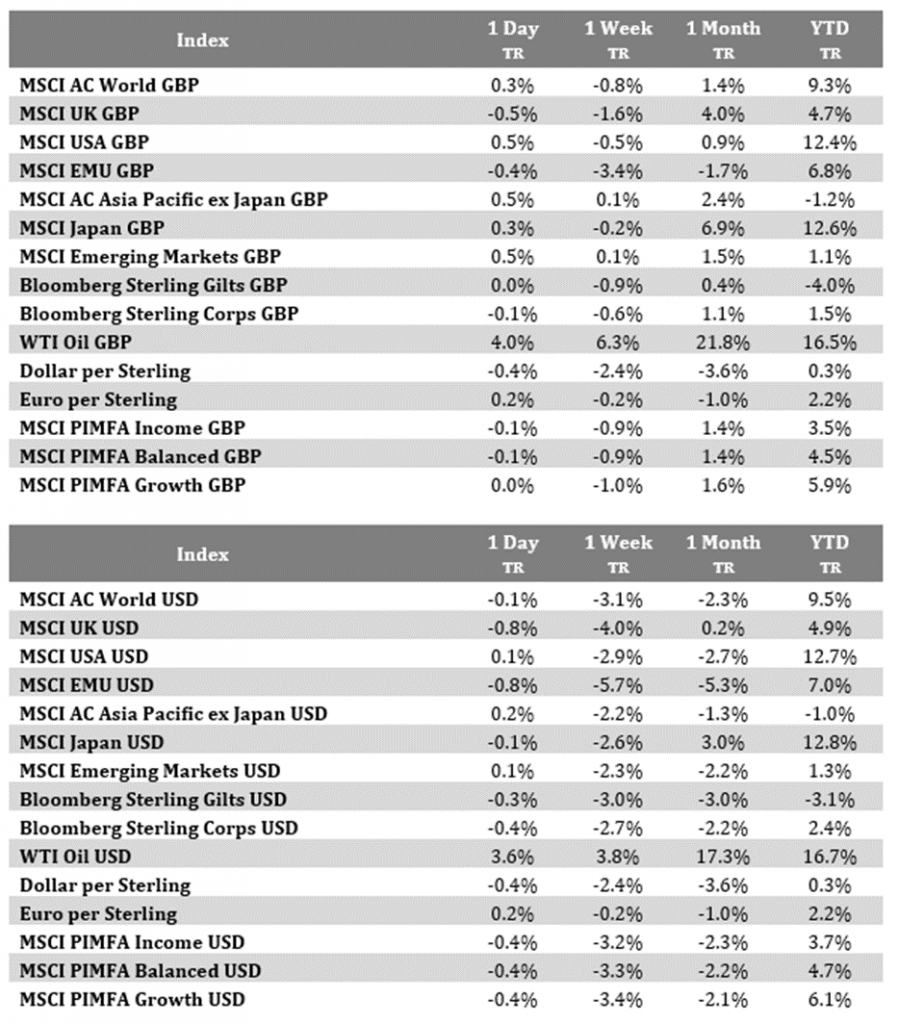
Please see below the latest ‘Daily Update’ from EPIC Investment Partners, which covers their views on recent events in markets and was received this afternoon (05/10/2023):

In what may be the first signs that the US’s tight labour market could be loosening, companies on the other side of the pond added the fewest number of jobs since the start of 2021 last month, along with pay growth slowing. Private payrolls rose 89k in September after climbing 180k the month before, versus a market consensus of 150k, according to figures by the ADP Research Institute in collaboration with Stanford Digital Economy Lab. Annual wage growth slowed to 5.9%, the 12th consecutive monthly decline.

Nela Richardson, chief economist at ADP said: “We are seeing a steepening decline in jobs this month. Additionally, we are seeing a steady decline in wages in the past 12 months”. Within the numbers virtually all jobs added came from leisure and hospitality, whist there were job losses in professional and business services, transportation and utilities, along with manufacturing. ADP’s performance as a predictor of the overall economy is patchy, however, it’s one to be aware of.

It has also been reported that US 30-year fixed mortgages topped 7.5% for the first time since the turn of the century. According to the Mortgage Bankers Association, fixed rate mortgages rose 12bp to 7.53% at the end of September. From there, borrowing costs have continued to rise this week, with the Mortgage News Daily, which updates more frequently, putting 30-year fixed deal at 7.72% on Tuesday. Of course, this has a knock effect and consumer demand is starting to dry up. The purchase index which measures mortgage applications for the purchase of a home fell 5.7% from a week ago, with purchase applications at their lowest level since Apollo 13 was released.

One market that is moving in the opposite direction from its recent highs is oil, which dropped sharply again today, with West Texas now trading below $85 per barrel, down from over $93pb last week. As we have recently discussed, oil has been grinding higher since its near $70pb low in June on continued supply side deficiencies, particularly on the back of OPEC supply cuts. However, the selling has been driven by a change in demand side dynamics. The US Energy Information Administration (EIA) released their crude oil inventory report yesterday, which showed the four-week average of implied gasoline demand fell to the lowest level in 25 years for this time of year, whilst oil exports from the US soared. There were also supply-side drivers as well, as Cushing Oklahoma crude stockpiles rose slightly after seven straight weeks of decline.

Please continue to check our Blog content for advice and planning issues and the latest investment, markets and economic updates from leading investment houses.

Carl Mitchell – Dip PFS

Independent Financial Adviser

05/10/2023

Team No Comments

Brewin Dolphin – Markets in a Minute

Please see the below article from Brewin Dolphin which covers their views on recent events in markets. Received 03/10/2023.

Higher Oil Prices Weigh on Financial Markets

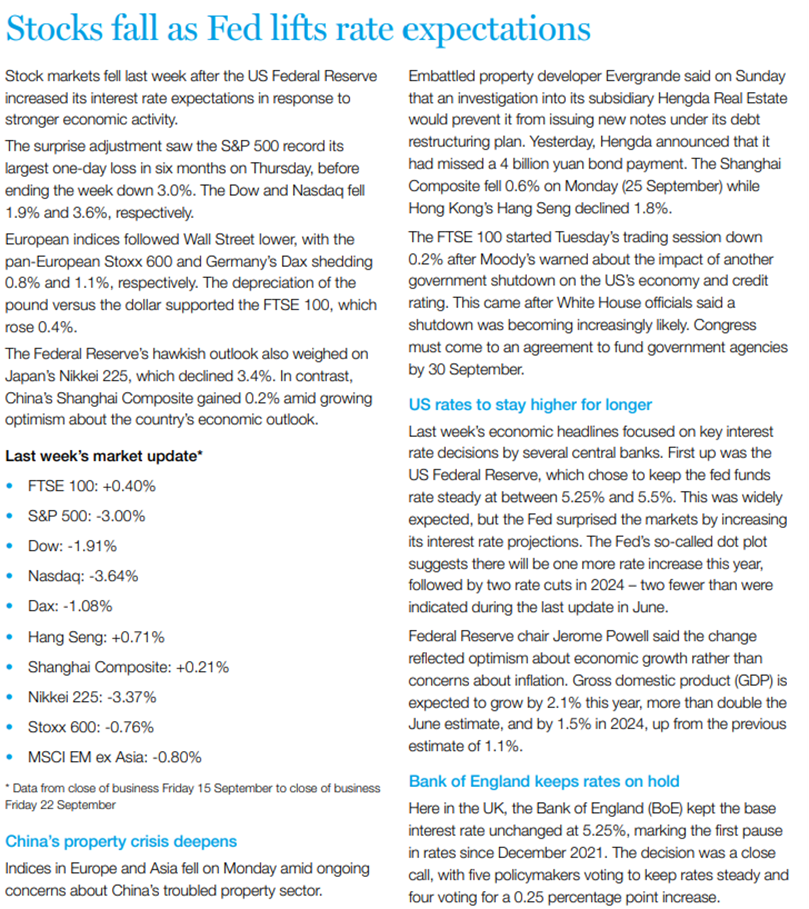
Stocks and bonds fell last week as higher oil prices added to concerns about interest rates staying higher for longer. In the US, the S&P 500 fell 1.1%, its fourth-consecutive week of declines, while the Dow and Nasdaq slid 1.5% and 0.4%, respectively. Concerns about a US government shutdown also weighed on investor sentiment.

In Europe, the Stoxx 600 and Germany’s Dax both slipped 0.1% after central bank officials indicated that monetary policy would need to stay restrictive for some time. The FTSE 100 fell 0.2% despite better-than[1]expected UK economic growth in the first quarter.

Rising oil prices and US interest rate woes also weighed on stocks in Japan, where the Nikkei ended the week down 2.5%. The yen hit an 11-month low against the dollar, adding to speculation that Japanese authorities could intervene to prop up the yen. China’s Shanghai

Composite fell 0.2% ahead of a ten-day holiday for Mid-Autumn Festival and China’s National Day.

UK manufacturing data disappoints

The FTSE 100 slumped 1.3% on Monday (2 October) following the release of disappointing UK manufacturing data. The S&P Global/CIPS manufacturing purchasing managers’ index (PMI) showed a marginal increase from 43.0 in August to 44.3 in September, which is still well below the 50.0 mark that separates growth from contraction. The headline manufacturing PMI for the eurozone also painted a gloomy picture, declining from 43.5 to 43.4. This weighed on the Stoxx 600, which fell 1.0%.

US stocks were largely flat on Monday despite a last[1]minute deal to avert a government shutdown. The Institute for Supply Management’s manufacturing PMI for the US rose from 47.6 in August to 49.0 in September, the highest reading since November 2022. The encouraging data added to concerns about US interest rates staying higher for longer and resulted in last week’s global bond rout resuming on Monday. The yield on the benchmark ten-year US Treasury note rose to 4.7%, the highest level since 2007.

Oil prices near $100 per barrel

Last week saw the price of Brent crude oil top $96 per barrel. The latest data showed a decline in oil inventories and critically low stockpiles at the Cushing hub in the US. Oil prices have gained 30% in the third quarter alone.

The latest rally has been driven by extended production cuts caused by Saudi Arabia keeping supply tight. The Energy Information Administration’s estimate for oil demand for this year has also been revised up.

Fed’s preferred inflation measure eases

Higher oil prices are adding to investors’ fears about persistent inflation in the US and Europe, although these concerns abated somewhat following the release of encouraging US inflation data on Friday. The core personal consumption expenditures (PCE) price index – the Federal Reserve’s preferred measure of inflation – rose by just 0.1% in August. This was lower than the 0.2% gain forecast by economists and the smallest monthly increase since November 2020. On an annual basis, core PCE measured 3.9%, the first sub-4% reading in around two years.

Less positively, the Conference Board’s gauge of consumer confidence fell again in September to 103.0 from 108.7 in August. This was driven by a steep decline in the ‘expectations’ sub-index to 73.7 from 83.3. The Conference Board said that a reading below 80.0 historically signals a recession within the next year.

Eurozone inflation at lowest level in two years

In the eurozone, consumer prices rose by 4.3% year-on[1]year in September, which was below forecasts and the slowest pace in two years, according to Eurostat’s flash reading. Core inflation (excluding food, energy, alcohol and tobacco) fell to 4.5% year-on-year from 5.3% year[1]on-year the previous month.

The data was published a few days after a speech by European Central Bank (ECB) president Christine Lagarde, in which she said that while borrowing costs may have reached their peak, they will remain high for as long as it takes to get inflation down to the 2% target. Her comments were echoed by ECB chief economist Philip Lane, who said interest rates would be “set at sufficiently restrictive levels for as long as necessary”.

UK economic growth better than expected

Here in the UK, figures from the Office for National Statistics (ONS) showed gross domestic product (GDP) grew more strongly than expected in the first quarter of the year. GDP expanded by 0.3% in the first quarter, up from the ONS’s previous estimate of 0.1%. Second[1]quarter GDP is estimated to have grown by 0.2%, in line with the ONS’s previous estimate. The data also showed that by the end of the second quarter, the UK economy was 1.8% larger than in the final quarter of 2019 (the last full quarter before the pandemic struck). This puts its growth ahead of Germany (0.2%) and France (1.7%) over the same period, but below Italy (2.1%), Canada (3.5%), Japan (3.0%) and the US (6.1%).

Meanwhile, data from the Bank of England showed the UK property market continued to slow in August. Net mortgage approvals for house purchases fell to 45,400, the lowest level in six months. Net approvals for remortgaging dropped to 25,000, the lowest since July 2012.

Please check our blog content for advice, planning issues and the latest investment, market and economic updates from leading investment houses.

Alex Clare

04/10/2023

Team No Comments

Weekly market commentary: Q3 saw significant rises in oil prices which impacted market inflation expectations

Please see below article received from Brooks Macdonald yesterday afternoon, which provides a global market update and a review of the third quarter of 2023.

  • The 3rd quarter of 2023 saw significant rises in oil prices which impacted market inflation expectations
  • While a US government shutdown has been avoided, negotiators only have six weeks to forge a new deal
  • The US jobs report on Friday will be vitally important given the Fed’s focus on labour market data

Markets have now closed out the third quarter of 2023, a quarter which saw oil prices rise by almost one third and 10-year US Treasury yields rise by more than 0.7%. At the same time, US equities lost ground with the index off almost 5% in September. Last week was challenging for risk assets however some positive inflation data on Friday helped mitigate the negative tone with the US personal consumption expenditures (PCE) inflation measure coming in below market expectations.

Another factor driving the risk off tone from last week was fears over an imminent US government shutdown. Just before the deadline on Saturday night, a deal was agreed which will keep the government operating until mid-November. This is a stop-gap measure which allows both sides to continue negotiations without the economic impact of a temporary shutdown. The news has supported equity indices today with the US futures market pointing to gains when the market opens. The avoidance of a shutdown also means we will receive US economic data on time this week with the most important of these being the US employment report on Friday.

The US jobs report on Friday arrives as markets debate the future path of inflation given signs of slowing economic growth but still robust US labour data. The market is expecting a slowdown in the number of new jobs created with September showing gains of 156.5k new jobs compared to 187k in August. Before we get to this data, today’s Institute for Supply Management (ISM) manufacturing data, followed by the services equivalent on Wednesday, will focus market attention. The market is expecting a slight improvement in the manufacturing survey which remains stubbornly in contractionary territory, but for the pace of US services sector expansion to moderate slightly.

With much of the volatility of the last few weeks stemming from bond markets, this week’s range of central bank speakers will be closely watched. With US Treasury yields surging recently, the question is whether the US Federal Reserve (Fed) speakers look to calm the bond market and imply that there is a certain level of bond yields which the Fed is uncomfortable with. The longer yields remain at elevated levels, the higher the likelihood that ‘something breaks’ and the Fed will be keenly aware of this risk after the Silicon Valley Bank (SVB) saga earlier in the year.

Please check in again with us soon for further relevant content and news.

Chloe

03/10/2023

Team No Comments

Tatton Investment Management – Monday Digest

Please see the below article from Tatton Investment Management providing a brief analysis of the key factors affecting global markets received this morning:

Overview: Economic resistance is about to be tested

September is rarely a great month for investors, and last month proved no exception. Broadly, both equities and bond values declined and there is increasing sentiment that the 2023 market recovery is running out of steam or may even be turning. This may seem surprising to investors as earnings have been more resilient than many economists had thought possible.

In addition, US government subsidy programmes like Creating Helpful Incentives to Produce Semiconductors (CHIPS) and the Inflation Reduction Act (IRA) have added to near-term economic activity, surprising economists and central banks and causing them to wonder whether the resilience might be all due to the time lag in the effect of their rate rising efforts, rather than lasting strength. However, the nature of lags is such that the next quarter’s US earnings are more likely to continue to show resilience than weakness. Employment has clearly remained strong through the summer and that should mean that consumer spending also remained fairly stable. This makes us expect a generally solid third quarter – but company outlooks looking further out may be less so.

While investment grade companies had recently been raising finance (at least in the earlier part of the third quarter), smaller, less credit-worthy companies decided to wait for lower rates and quite a few have been waiting since rates started to rise early last year. Now though, with rates at new highs (instead of falling as many had expected), and with the ‘higher for longer’ narrative, the cost of refinancing is likely to become more pressing for growing numbers of businesses around the developed world. All-in-all, this latest round of increased interest rate costs has the potential to have a quicker impact than previous rounds, because it has been so unexpected and because it leaves less time for those awaiting refinancing. Stress levels could reach breaking point, especially where it becomes paired with revenue weakness. None of this implies economic disaster looming over the last quarter of 2023. What it does mean though is that the ‘Goldilocks’ environment of the past two quarters is likely to end. This may result in an uptick in market volatility and a return of the same ‘between hoping and dreading’ narrative of autumn last year. It also raises the probability that long-term bonds at the yield levels they touched last week may prove rather good value for investors with a longer-term perspective.

US narrowly avoids another government shutdown

For much of last week, another US government shutdown looked inevitable. Current funding for federal operations was due to end on Sunday and federal employees were unsure when their next paychecks would come. But on Saturday night, both houses of Congress voted in favour of a last-minute measure to keep the government funded until mid-November, although they left out billions of dollars of aid for Ukraine. President Joe Biden signed the stop-gap deal just minutes before the midnight deadline. Arguably the biggest loser from the deal could be House of Representatives’ Speaker Kevin McCarthy, as working with Democrats across the floor has inflamed the Republicans on the right of his party, and look like resulting in a no confidence vote that sees McCarthy lose his job.

For investors, concerns about US finances are mostly short-term fears about politics. Shutdowns and debt scares are regular occurrences in the world’s largest economy, but capital markets do not generally move too much in response. But the threat is symptomatic of a larger problem that fraught US politics poses to its economy. Extended shutdowns in the past – most famously in 2011 – have led to measurable drags on US growth, and ratings agency Moody’s emphasised a shutdown would “underscore the weakness of US institutional and governance strength”. Of course, the agreement reached at the weekend only offers temporary respite from the political posturing. In November another deal will need to be reached, or the shutdown spectre returns. The key question is therefore, will Kevin McCarthy still be House Speaker by then, and if not, will a less conciliatory replacement make good on Republican shutdown threats?

US mega techs vs. modern antitrust law

US tech giants beware; there’s a new sheriff in town. Last week, the Federal Trade Commission (FTC) brought a long-anticipated case against Amazon, suing the e-commerce behemoth for alleged violations of antitrust law. The case is a passion project for FTC chair Lina Khan, who believes anti-competitive behaviour is about broad market influence, rather than just narrow price rises coming from provider consolidation. The FTC’s complaint against Amazon is how it treats third-party sellers – which account for around 60% of all products sold on its platforms. The platform’s algorithms promote sellers that store goods in Amazon warehouses and use Amazon delivery trucks, but the fees to do so have gone up an estimated 30% in the last three years. Research firm Marketplace Pulse estimates third-party sellers pay around half of their revenues directly to Amazon.

Of course, it can be hard to convince people that Amazon is making things more expensive for consumers when it seems cheaper than the alternatives. The company is naturally trying to argue that its preferential practices are solely based on price and ease for consumers – these being often tied to Amazon’s own logistics simply because of their wider efficiency. And while the company has around 37.6% of all US online retail, according to Insider Intelligence, this is only 3.5% of total retail. It has already started a PR campaign claiming that any of the FTC’s recommended remedies will reduce choices and harm consumers.

As Khan herself noted some years ago, the deeper problem with US antitrust law is that it is based on policing old-fashioned companies that behave nothing like the tech giants we have now. The speed of tech innovation – particularly in the age of artificial intelligence – makes it a political necessity to modernise our understanding of monopolies. It is one of the reasons that constraining the power of the big tech companies is a rare point of bipartisan agreement in Washington DC. Even if Khan fails in her latest charge, the policy tide is clearly turning against big tech – with likely longer-term implications for the willingness of investors to extrapolate their past growth rates into the future to justify extended valuations.

Please check our blog content for advice, planning issues and the latest investment, market and economic updates from leading investment houses.

Andrew Lloyd DipPFS

02/10/2023

Team No Comments

Brooks Macdonald: Daily Investment Bulletin

Please see below, Brooks Macdonald’s ‘Daily Investment Bulletin’ which provides a brief update on global investment markets. Received this afternoon – 28/09/2023

What has happened?

US bond yields continued their grind higher yesterday with the US 10-year Treasury yield now at 4.61% after another rise in oil prices stirred fears of a higher for longer inflationary backdrop. With these moves the US dollar has also been appreciating further, with the dollar index almost back to levels seen in November last year. US equities managed to stay flat for the day, but this conceals a high level of intraday volatility and general uncertainty.

Bond moves

Bond markets are certainly leading broader financial markets now with bonds seeing another heavy selloff yesterday. The Bloomberg aggregate global bond index, a widely used measure of the broad bond market, reached its lowest price level of 2023 as the benchmark 10-year and 30-year Treasury prices fell. These moves are quickly moving into the real economy with the US 30-year mortgage rate now at 7.41%, the highest level since December 2020. While the lag is relatively short, mortgage rates do act with a delay so there is likely further upside to these rates in the coming weeks. European bonds were also under pressure with 10-year bund yields hitting a 10-year high and Italian bonds underperforming after the Italian government unveiled a 4.3% expected deficit for 2024.

Oil Prices

The latest move higher in bond yields, which move inversely to prices, has been catalysed by growing inflation expectations caused by the uptick in energy prices. Brent crude closed above $96 per barrel yesterday, a fresh high for 2023. The US oil benchmark, WTI, saw an even greater percentage climb yesterday with the price moving to a one-year high of $93.68. While recent moves have been spurred by supply cuts, yesterday’s moves reflected lower-than-expected storage levels in the Cushing oil reserves.

What does Brooks Macdonald think?

Robust US economic data has been a key pillar of the soft-landing narrative in recent months however the recent consumer confidence data, and yesterday’s card spending data, suggests that the US consumer is showing signs of slowing. The US consumer discretionary sector has declined by almost 10% over the last fortnight as investors start to price in a heightened risk of a hard landing.

Please continue to check our blog content for advice and planning issues and the latest investment, markets and economic updates from leading investment houses.

Alex Kitteringham

28th September 2023

Team No Comments

Brewin Dolphin – Markets in a Minute

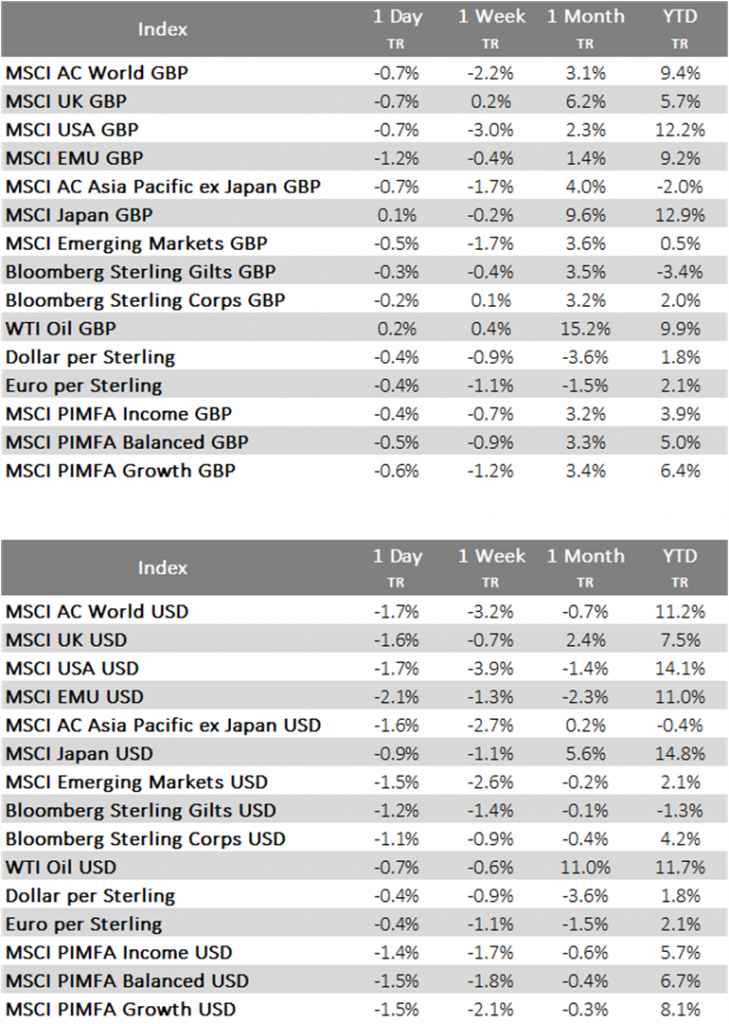
Please see below the latest ‘Markets in Minute’ update from Brewin Dolphin, which covers their views on recent events in markets and was received late yesterday (26/09/2023) afternoon:

Please continue to check our Blog content for advice and planning issues and the latest investment, markets and economic updates from leading investment houses.

Carl Mitchell – Dip PFS

Independent Financial Adviser

27/09/2023

Team No Comments

Brooks Macdonald Weekly Market Commentary

Please see below Brooks Macdonald’s Weekly Market commentary, received yesterday afternoon – 25/09/2023

Brooks Macdonald Weekly Market Commentary  

  • Bond yields rose last week after a hawkish Federal Reserve meeting combined with strong labour market data
  • This week sees the US revise its gross domestic product (GDP) estimates from as early as Q1 2005 which will inform future GDP expectations
  • Inflation will be in focus this week with the US, Euro Area and Japan all releasing important data

Risk appetite improved yesterday with the US equity market enjoying its broadest rally of September so far. Small cap US equities, which have underperformed their larger cap equivalents in 2023, outperformed on the day. European equities and UK equities also posted strong returns.

These rallies within equity markets happened despite the oil price continuing to grind higher. Brent Crude, the international oil benchmark, hit another year to date closing high of US$93 with the price now above US$94 today. The first order impact of this will be US gasoline prices which will continue to make the September month-on-month headline inflation numbers challenging. Other commodity prices may also be impacted by the El Nino event which is now expected to be more severe. The dramatic temperature fluctuations disrupt crop cycles and therefore put pressure on global food supply alongside the current grain supply issues from Ukraine.

The market implied probability of an interest rate hike from the European Central Bank (ECB) yesterday had been edging up in the last week and ultimately proved correct as the ECB hiked by 25bps. The ECB deposit rate is now at its highest level since the ECB’s creation and the last 15 months of hikes also represent the fastest pace of hikes in its history as well. It was however a closer call than previous meetings with President Lagarde pointing to a ‘solid majority’ within the committee backing the hike which feels softer than the traditional ‘overwhelming’ majority for other hikes. The ECB also raised its inflation projections for this year and 2024 with higher energy prices the main justification for this. Economic growth forecasts were revised lower with hopes for a Euro Area recovery pushed into 2024.

With the ECB revealing this incremental hike yesterday, the key question is whether this is now the peak interest rate for the cycle. President Lagarde was asked this specifically, replying that ‘we can’t say that’ given the economic and inflation uncertainties. The market is pricing in a 45% chance of a further hike from the ECB before the end of the year but whether this transpires will be highly dependent on the evolving inflation picture.

Please check our blog content for advice, planning issues and the latest investment, market and economic updates from leading investment houses.

Charlotte Clarke

26/09/2023

Team No Comments

Tatton Investment Management – Monday Digest

Please see the below article from Tatton Investment Management providing a brief analysis of the key factors affecting global markets. Received this morning – 25/09/2023.

Overview: to yield or not to yield?

Last week, stocks and bonds ended up bruised following the ‘hawkish pause’. The US Federal Reserve (Fed) announced on Wednesday it would hold interest rates steady at 5.25-5.5%, but threw in some stern forward guidance to dispel doubts it might be easing off. Fed Chair Jay Powell’s talking points were much the same as they have been for the better part of two years: the US economy is still strong, inflation is too high, and consistently tighter monetary policy will be needed for the foreseeable future. The Fed backed up its words with a ‘dots plot’ projection that showed another rate rise this year, then holding steady in 2024. It was a reaffirmation of Powell’s commitment to keeping rates higher for longer.

Bond yields spiked on the back of the news. Ten-year US Treasury yields touched above 4.5% during early Friday trading – the highest level in 16 years. The move up in risk-free rates naturally makes equities look less attractive by comparison, sparking a sharp drop off in the S&P 500. There are concerns that equity valuations in terms of price-to-earnings multiples look vulnerable, especially after such strong stock performance without earnings growth for most of this year. Longer-term growth assets – typically more sensitive to interest rate moves – are therefore under threat again. With sluggish global growth all limiting the upside of company earnings and a ‘higher for longer’ monetary policy, investors are starting to wonder whether fixed income assets like bonds, with their now attractive yields, are better value than stocks. This ‘negative carry’ is a headwind to equities in the short term and re-establishes bonds as a value adding portfolio diversifier, however, long term investors know that only risk assets have historically been able to outperform inflation meaningfully.

Are oil price rises an inflation comeback or just a blip?

International oil benchmark Brent hit $94 per barrel (pb) during trading last Tuesday, the highest level since October last year, when markets and the world economy were still reeling from the Russian war. Higher oil prices can be tough at the best of times but are a major headache for central bankers fighting stubbornly high inflation – referenced by Christine Lagarde when the European Central Bank (ECB) raised interest rates recently. But higher oil prices are difficult for markets as well as policymakers, lifting headline inflation at a time when it is still uncomfortably high and acting as a tax on consumers and businesses unable to pass on costs. Morgan Stanley estimates the inflationary effect of a $20pb increase like the one seen since June would be a 0.5% addition to eurozone inflation. Not an astounding figure after the year we have had, but still an uncomfortable contribution.

With labour markets tight and inflation expectations (up to recently) high, consumers and businesses are now quick to react to higher price signals. Fuel prices are the most visible of these signals. Tight capacity – not just in oil and commodity markets but throughout the economy – means second-round inflation effects are now much more likely. As central bankers are keenly aware, the inflation genie is only just now getting back into the bottle, and hence higher oil prices are keenly noticed. On the other hand, should higher oil prices dampen consumer spending, this could lessen the Fed’s impetus to raise rates or keep them high. The Fed’s own research suggests an oil price increase of 10% takes 16 basis points (0.16%) off consumption and 14 from GDP. Compressing consumption and economic activity is the goal of rate rises, so in that sense higher oil prices may be doing the Fed’s job for it.

Again though, we should be cautious about jumping to conclusions. Core US inflation came in at 4.3% in August, which would still be well above the Fed’s 2% target if it translated directly into future inflation. While the trend is pointing down, the Fed will not want anything to disrupt this – as higher fuel prices surely could. The key point to watch is whether higher oil prices have a bigger effect on consumption and activity, or as a price signal for consumers. Markets nervously await the answer.

Trojan Horse tech

The artificial intelligence (AI) theme is hard to get a handle on from an investment perspective. Are these new technologies a revolution waiting to happen, or a bubble waiting to burst? We are not at dotcom levels of hype (yet), but ‘machine learning’ and ‘language models’ have reached corporate buzzword status. From a business perspective, the obvious benefits come from productivity growth. This has been one of the hardest things to find for more than a decade, low productivity being one of the key reasons behind the period of low growth following 2008’s Global Financial Crisis. Even in big tech, which has long been home to eye-watering stock valuations, there was a feeling some time ago that genuine innovation was lacking – particularly in stagnating markets like smartphones. The AI excitement changed all of that, even if productivity improvements take time to filter through.

Companies have been working on AI for decades and its potential was never exactly a secret, quite the opposite in fact, given that most of the building blocks are open source. Yet it took the release of ChatGPT with its generative language model to really kickstart the financial push in AI’s direction. What changed then was not the technology itself, but the perception of what it could do and how close we might be to world-altering changes.

Of course, entering a new market to fund a longer-term objective of changing the market altogether is a ‘Trojan Horse’-style strategy, and the fact that AI technologies will almost certainly create lots of new revenue streams in the future does not mean all the market valuations, especially on a stock level, are justified. To be sure, the words ‘generative AI’ are certainly good for certain share prices, but overall market appetite is fairly contained, historically speaking. This has surely something to do with the wider financial backdrop too. Interest rates have risen at the fastest pace in a generation, while global growth and near-term demand prospects look weak. In a way, perhaps this forces markets to make a longer-term evaluation.

The question, as ever, is how businesses will turn the current technologies into future earnings. And of course, knowing which companies might do so best would be nice too. Time will tell who the winners will be, and especially whether incumbents will reap the benefits, or whether newcomers can shake up the equity market. For now, though, having a ‘beacon of hope’ for what may generate real growth over the next decade is to be welcomed by investors.

Please check our blog content for advice, planning issues and the latest investment, market and economic updates from leading investment houses.

Alex Clare

25/09/2023

Team No Comments

Brooks Macdonald: Daily Investment Bulletin

Please see below, Brooks Macdonald’s ‘Daily Investment Bulletin’ which provides a brief analysis of global investment markets. Received this morning – 22/09/2023

What has happened?

Both equity prices and bond prices sold off yesterday – the weakness driven by a higher-for-longer interest rate message from central banks this week, as well as better US weekly jobless claims data on Thursday pointing to a still-resilient US jobs market. US longer-dated bond yields hit new highs for the cycle, with the US-10year Treasury yield at one point over edging above 4.5% in trading overnight, which is the first time that has happened since 2007. Meanwhile the US 10yr real yield, up 6.6bps yesterday hit a post-2009 high of 2.11%. Earlier on Thursday, the Bank of England (BoE) narrowly voted 5-to-4 in favour of keeping rates on hold. Of the 9 MPC (Monetary Policy Committee) members, 5 voted for a pause, versus 4 voting for a 25bps hike. This marked the first time the BoE has left rates unchanged in almost 2 years, since November 2021. With markets reading the BoE decision as effectively supporting a higher-for-longer rate outlook as opposed to an even-higher-but-shorter peak, yields on UK government bond gilts rose across the maturity curve, with bond prices falling. In interest-rate derivative markets yesterday afternoon, peak rates were expected to only be around 18bps higher than now, so markets were no longer fully pricing in any more UK rate hikes this cycle.

Bank of England calls time on its 14-meeting rate hike streak

While the BoE’s pause mirrored the US Federal Reserve (Fed) the day before, there the similarity ends. While the Fed delivered a hawkish pause, it did so from a relatively more constructive backdrop, having doubled its real (constant prices) GDP outlook for 2023, while cutting its unemployment rate forecasts. For the BoE, its own pause arguably reflected having to balance inflation risks versus a more cautious economic picture – the BoE on Thursday cut its estimate for UK real Q3 GDP quarter-on-quarter growth from 0.4% to just 0.1% and said that ‘underlying growth was also likely to be weaker’ for the 2H of 2023. Perhaps a little ominously, the BoE also noted that ahead of its rate decision, it had had an early look at the flash UK PMIs (purchasing manager indices) for September which have only just come out this morning at the time of writing – as it turns out, both UK manufacturing and services remain in contractionary territory (with readings under 50), although services is weaker month-on-month, whereas manufacturing is a little better.

Bank of Japan keeps policy unchanged

As largely expected, the Bank of Japan (BoJ) used its latest meeting earlier this morning to keep all its policy settings unchanged. By a unanimous vote, there was no change to its short-term -0.1% negative interest rate policy setting, and no change to its guidance for the 10-year government bond yield target at ‘around zero’. As BoJ Governor Ueda said at the subsequent press conference earlier, “We have yet to foresee inflation stably and sustainably achieve our price target. That’s why we must patiently maintain ultra-loose monetary policy”, adding that “since we published the July outlook report, inflation isn’t overshooting sharply, but it’s not slowing as much as we expected.” Not surprisingly, in currency markets the Japanese Yen has weakened versus the dollar post the announcement. Earlier, the latest Japan all-items CPI (Consumer Price Index) annual inflation print for August came in at 3.2%, the lowest reading for 3 months, down slightly from 3.3% in July, and versus markets which had been expecting a flat 3.3% number. Meanwhile, core CPI (measured in Japan by excluding fresh food but still including energy) was 3.1% year-on-year.

What does Brooks Macdonald think?

The narrowness of the Bank of England vote to pause interest rates highlights the uncertainty around the economic outlook. We have yet to see the full impact of the cumulative 515bps of UK central bank rate hikes since December 2021, given interest rates work with around a lag of 18months or so for the full impact to reach the wider economy. That the BoE again used the phrase for keeping interest rates “sufficiently restrictive for sufficiently long” suggests that it is still keen to temper rate cut hopes anytime soon. All in all, the BoE’s communications seem to be in line with other central banks in distinguishing between an interest rate ‘pause’ and an outright ‘pivot’.

Please continue to check our blog content for advice and planning issues and the latest investment, markets and economic updates from leading investment houses.

Alex Kitteringham

22nd September 2023

Team No Comments

Evelyn Partners Update – September Bank of England MPC Decision

Please see below article received this afternoon from Evelyn Partners, which reports on the Bank of England’s holding of the base rate at 5.25%.

What happened?

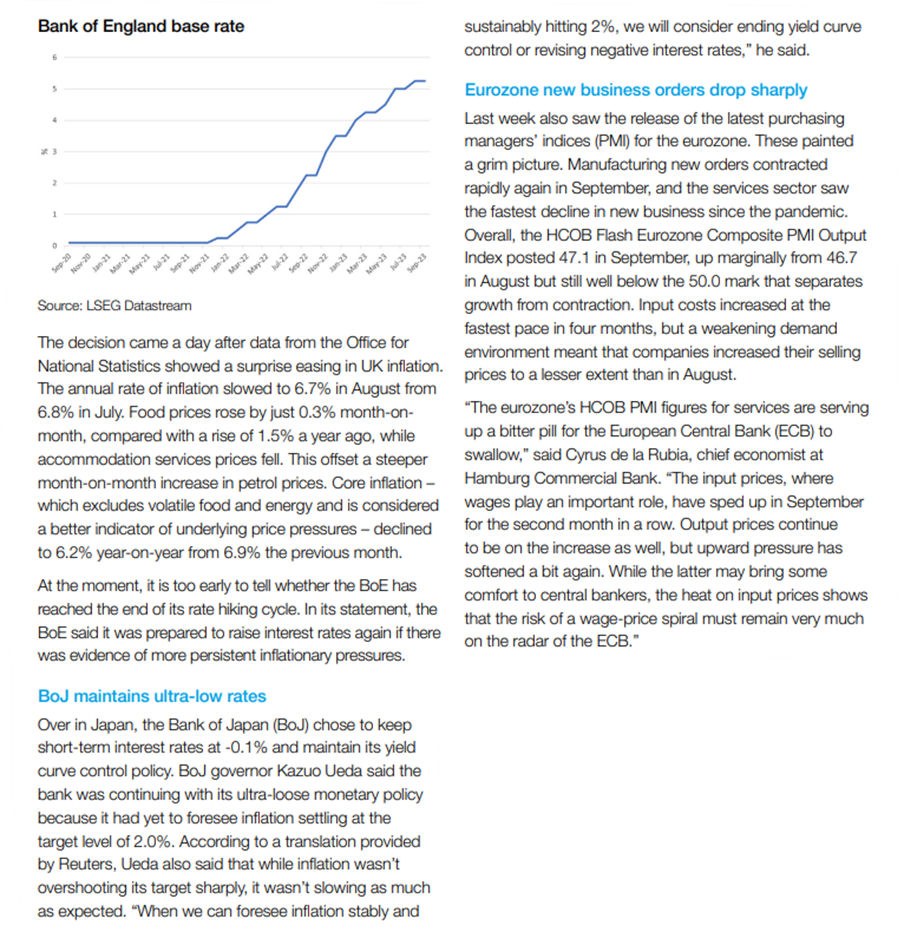
The Bank of England held the base rate at 5.25% at their meeting today. This ends the run of 14 consecutive interest rate increases.

The committee vote was split, with 5-4 members voting in favour of maintaining interest rates.

What does it mean?

Going into today’s meeting, money markets were split 50:50 on whether the Bank of England would raise interest rates. In the end the MPC voted to hold the base rate at 5.25%. Notably, the Bank also said that policy must be restrictive for ‘sufficiently long’, indicating that interest rates will be held higher for longer.

The decision follows some good progress on the inflation front over recent months. Annual headline CPI inflation reached 11.1% in October last year, but it has since fallen by over 4 percentage points. August’s data saw headline inflation surprise on the downside, printing 6.7% year-on-year (vs the consensus expectation of 7.0%). The Prime Minister’s pledge to halve inflation this year, from 10.1% in January to approximately 5% in December, looks to be on track; economists expect inflation to average 4.5% in the fourth quarter of this year.

A key threat, however, comes from the energy sector. The price of oil has increased in recent months as Saudi Arabia and Russia extended voluntary supply cuts to the end of this year. This comes on top of cuts agreed by OPEC+, a group of oil exporters, to the end of 2024. Higher oil prices typically take around one-month to feed through to petrol prices, so we can expect to see higher prices in the coming weeks and months. Another lingering source of inflation in the UK comes from rents, which have yet to peak. Having said that, we still expect inflation to ease in Q4; lower energy costs following the October change to the Ofgem price cap will help households across the country.

In the absence of further shocks, it looks like the BoE is now at, or very close to, the end of its hiking cycle. Attention will now turn to rate cuts, although markets are only pricing one 25 bps cut by the middle of 2024. This is consistent with our expectation that the Bank will keep policy tight through 2024 as they continue to fight inflation.

A continuation of its restrictive policy is supported by the empirical evidence. A recent paper by International Monetary Fund analysed over 100 inflation shock episodes in 56 countries since the 1970. It finds that ‘Countries that resolved inflation implemented restrictive policies more consistently over time’. The BoE and other CBs will be well aware of these findings and will not want to repeat the mistakes of their predecessors by easing policy too early.

In response to the decision, the pound sold-off, hitting its lowest level in six months. While UK equities rallied on the news.

Bottom Line

A close vote saw the Bank of England decide to hold the base rate at 5.25%. We are now at, or very close to, the end of the hiking cycle, but we expect monetary policy to remain restrictive for the foreseeable future.

Please check in again with us shortly for further relevant content and market news.

Chloe

21/09/2023