Team No Comments

Evelyn Partners Update – UK August CPI inflation

Please see the below update from Evelyn Partners sharing their thoughts on this morning’s UK inflation announcement for August:

What happened?

UK August annual headline CPI inflation was reported at 6.7% (Bloomberg consensus: 7.0%), versus 6.8% in July. In monthly terms, CPI was 0.3% (consensus: +0.7%), compared to a fall of -0.4% in July.

What does it mean?

The broad downward trend in inflation is still intact. Back in October last year, annual headline CPI inflation had reached 11.1%, but it has since fallen by over 4% points since then. Much of that deceleration has come from lower energy prices in the transport (i.e. fuel) and housing and household services (i.e gas and electricity) categories.

However, it could be argued that the decline seen in energy prices are in the rear-view mirror. Looking forward, the risk of another leg up in inflation from energy prices has increased a little following the August decision by the Saudis and Russians to implement new crude oil supply cuts into year end. This tightening in supply, along with solid economic growth in the US driving demand, has been behind the 30%-plus surge in Brent crude oil prices since June. UK petrol prices at the pump are edging up to reflect higher crude oil prices. The good news for households is that wholesale natural gas prices have barely budged: though peak winter demand has yet to come. For the moment, there is no evidence of a sharp acceleration in natural gas (or electricity) prices that could impact future inflation data.

Another lingering source of inflation comes from rents within the services category, which has yet to peak. Landlords are probably using a tight labour market lifting wages, higher mortgage rates and increased demand from record net immigration as an opportunity to raise rents.

Nevertheless, surveys of inflation expectations have come down from peaks. The YouGov household survey of one-year UK inflation expectations is currently 4.4%, compared to a peak of 6.3% in August 2022. This suggest that the risk of inflation becoming entrenched in the economy is contained and should reduce pressure on the Bank of England to raise interest rates significantly from here. As it stands, money markets have priced one more 0.25 percentage point rate hike when the BoE’s Monetary Policy Committee next meets on 21 September, and then a pause from there. 

Bottom Line

Despite pockets of inflationary pressures (i.e rents), the broad deceleration trend in inflation is intact and this increases the likelihood that the BoE is close to the end of its interest rate-hiking cycle.

Please continue to check our blog content for advice and planning issues and the latest investment, markets and economic updates from leading investment houses.

Andrew Lloyd DipPFS

20th September 2023

Team No Comments

Brewin Dolphin: Markets in a Minute

Please see below, Brewin Dolphin’s ‘Markets in a Minute’ which provides a brief analysis of the key news from markets and global economies over the past week. Received yesterday evening – 19/09/2023

Stocks mixed as US inflation accelerates

Stock markets were mixed last week as an uptick in US inflation raised concerns that the Federal Reserve may be further away from its 2% target than initially thought.

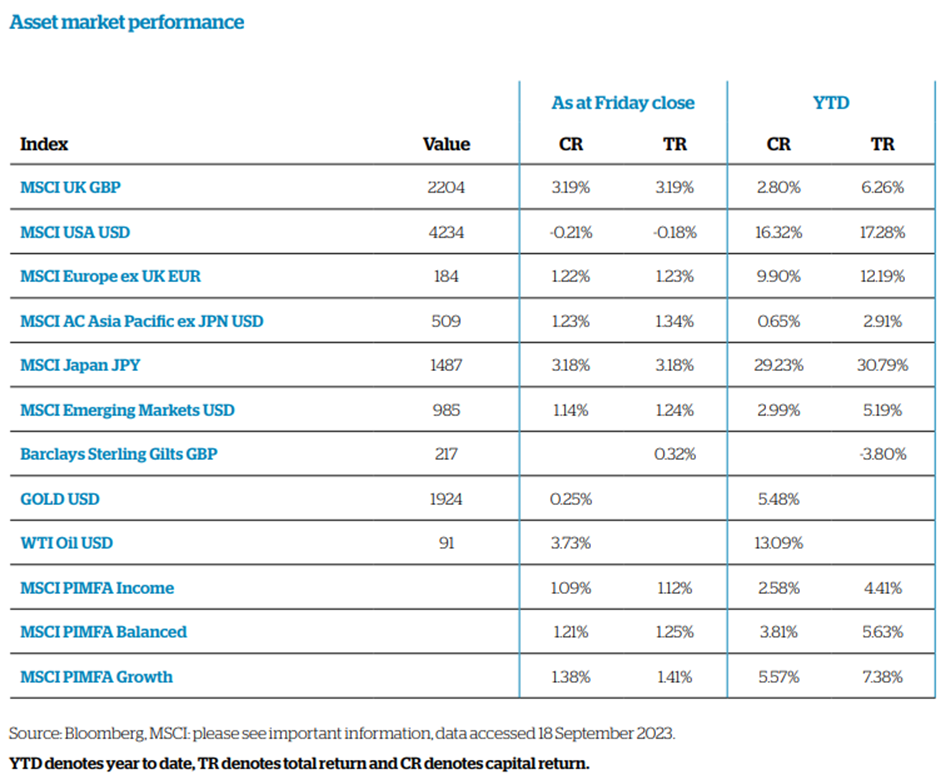
In the US, the S&P 500, Dow and Nasdaq fell 0.8%, 0.1% and 1.5%, respectively. Technology stocks lagged after Apple’s new iPhone 15 received mixed reviews.

In Europe, the Stoxx 600 added 1.3% after the European Central Bank (ECB) hiked interest rates but raised hopes that it could be nearing the end of its monetary tightening campaign. The FTSE 100 surged 2.9% as the pound depreciated against the dollar. A weaker pound helps to support the index because around 70% of FTSE 100 company revenues come from overseas.

In China, the Shanghai Composite ended the week down 0.8% as investors weighed ongoing weakness in the property market against signs of stabilisation in the broader economy.

Investors await key interest rate decisions

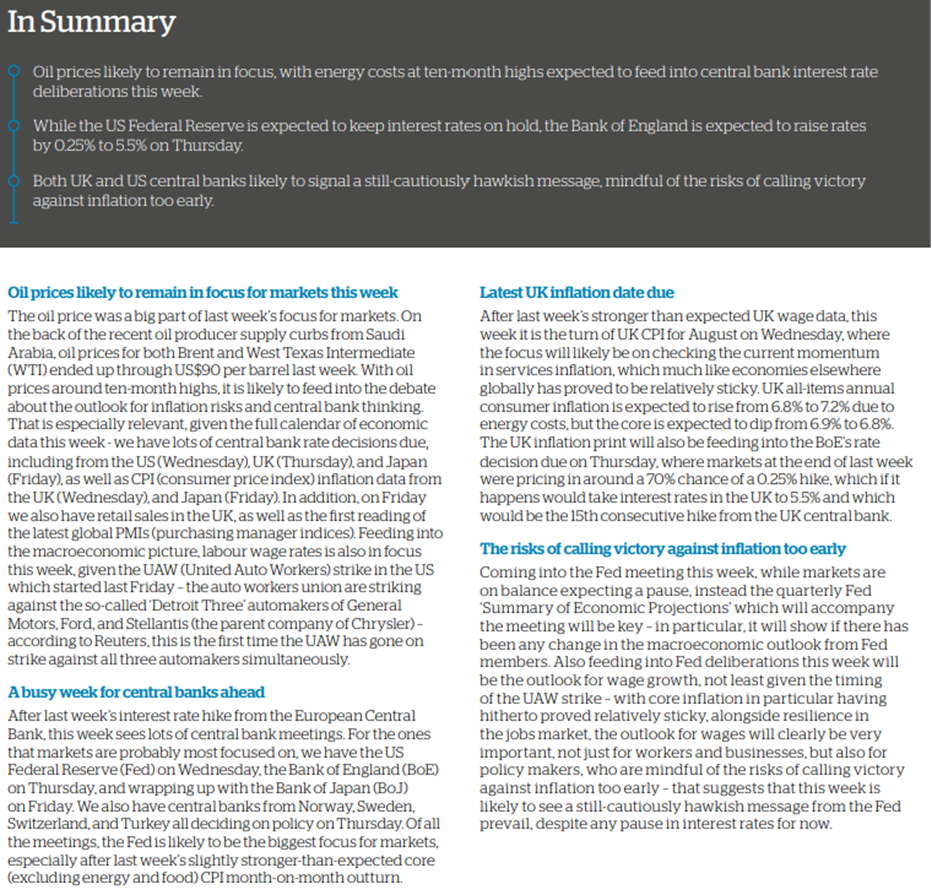
Stock markets were mixed on Monday (18 September) ahead of this week’s key interest rate decisions. The impact of rising oil prices on inflation data also weighed on investor sentiment. The FTSE 100 retreated from a four-month high to finish the day down 0.8% at 7,653. The pan-European Stoxx 600 declined 1.1%, while Wall Street indices managed fractional gains.

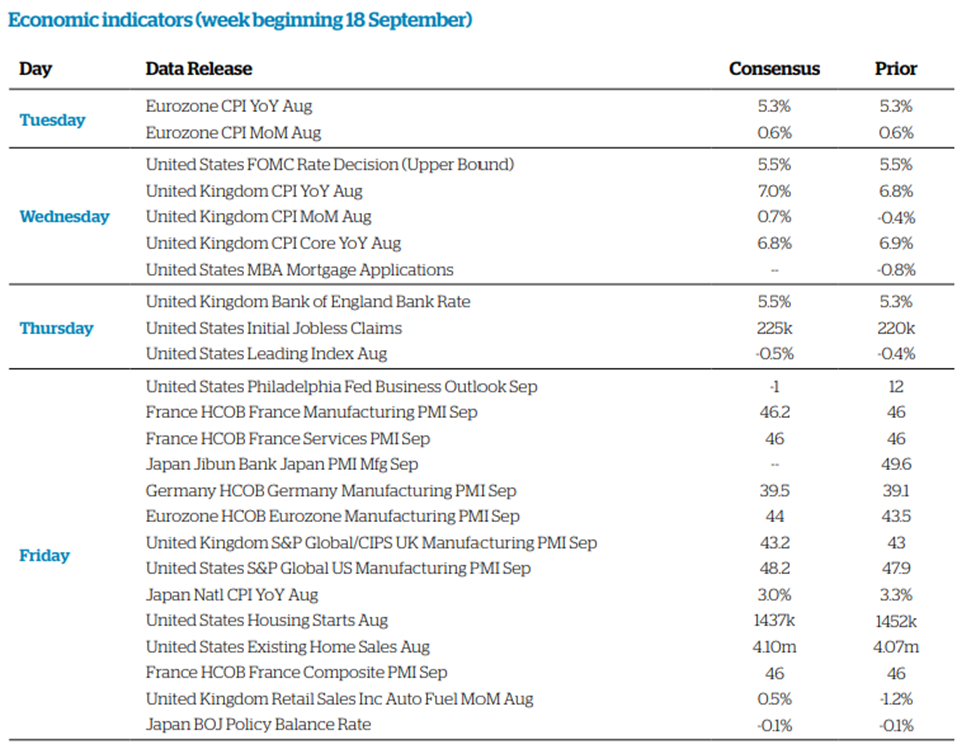
The Federal Reserve is expected to keep interest rates on hold when it meets this week. However, stronger-than-expected economic data has led to heightened uncertainty about the future path of interest rates. The BoE is expected to hike rates by another 0.25 percentage points to 5.5%. This week will also see policy decisions from central banks in Japan, Brazil and Turkey.

US inflation rate rises to 3.7%

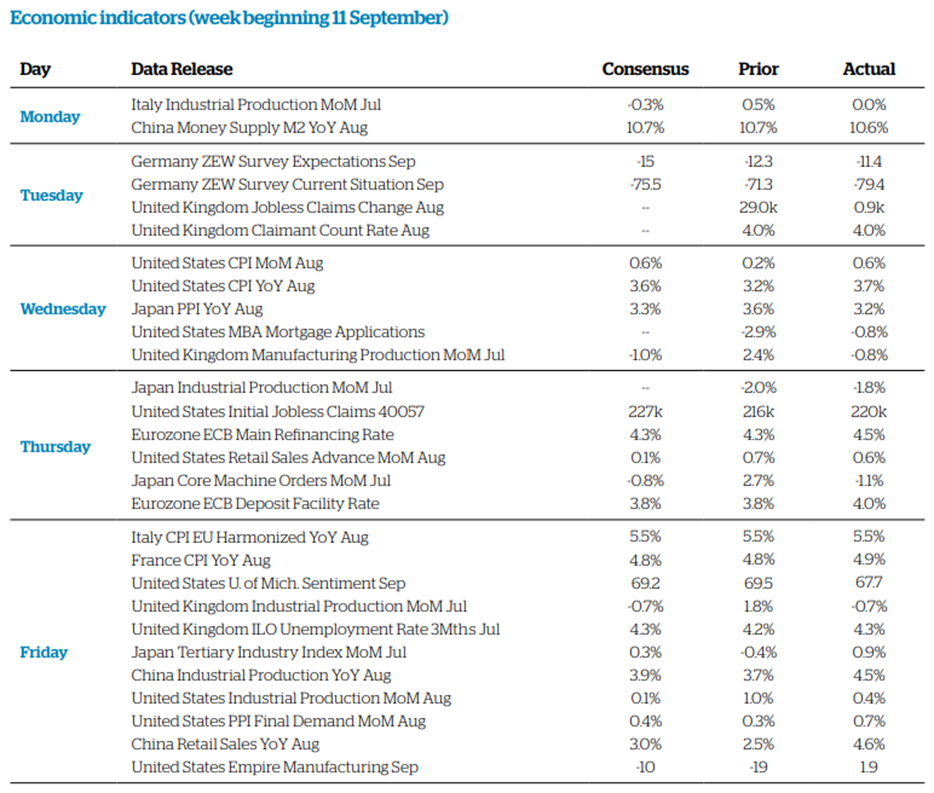
Last week saw the release of the closely watched US consumer price index (CPI) report, which showed inflation rose by more than expected in August, largely because of higher energy prices. The annual rate of inflation edged up to 3.7% from 3.2% in July.

On a monthly basis, prices rose by 0.6% in August, the biggest monthly gain of 2023 so far. Energy prices rose by 5.6% month-on-month, including a 10.6% surge in gasoline prices. Even when volatile energy and food prices were stripped out, ‘core’ CPI rose by 0.3% month-on-month, up from 0.2% in July. This marked the first acceleration in core inflation for six months.

ECB lifts key deposit rate to 4.0%

In Europe, the ECB defied calls for a pause in interest rate hikes, and instead chose to lift its key deposit rate to a record high of 4.0%. There had been speculation that the central bank would keep rates on hold amid signs of a weakening eurozone economy. However, the ECB said inflation was still expected to remain too high for too long, and it was “determined to ensure that inflation returns to its 2% medium-term target”.

The ECB also said rates had reached levels that would “make a substantial contribution to the timely return of inflation to the target”. Commentators interpreted this to mean that the ECB had made its final hike of the current cycle, with some suggesting that rates could be cut in the first half of next year. However, ECB president Christine Lagarde responded by saying: “We have not decided, discussed or even pronounced cuts.”

UK economy shrinks more than expected

Here in the UK, data from the Office for National Statistics (ONS) showed gross domestic product (GDP) contracted by 0.5% in July, which was worse than analysts had predicted. Industrial action by NHS workers reduced health service activity, while extremely wet weather weighed on retailers and the construction sector. For the first time since summer last year, all three major sectors – manufacturing, services and construction – contracted. Nevertheless, Darren Morgan, ONS director of economic statistics, said the broader picture looked positive, with growth in all three major sectors over the past three months.

Chinese retail sales pick up pace

Last week saw some signs of a stabilising Chinese economy, with both retail sales and industrial production growing by more than expected in August. According to the National Bureau of Statistics, retail sales grew by 4.6% year-on-year, up from 2.5% in July and much higher than forecasts of 3.0%. Industrial production also grew by a better-than-expected 4.5% year-on-year, up from 3.7% in July.

On the flipside, fixed asset investment, the historic driving force of China’s growth, missed forecasts, expanding by just 3.2% year-on-year, down from 3.4% in July. This was driven by a deepening slump in real estate investment in China.

Please continue to check our blog content for advice and planning issues and the latest investment, markets and economic updates from leading investment houses.

Alex Kitteringham

20th September 2023

Team No Comments

Brooks Macdonald – Weekly Market Commentary

Please see below the latest ‘Weekly Market Commentary’ update from Brooks Macdonald, which covers their views on events in markets over the last week and was received late yesterday (18/09/2023) afternoon:

Please continue to check our Blog content for advice and planning issues and the latest investment, markets and economic updates from leading investment houses.

Carl Mitchell – Dip PFS

Independent Financial Adviser

19/09/2023

Team No Comments

Tatton Investment Management – Monday Digest

Please see the below article from Tatton Investment Management providing a brief analysis of the key factors affecting global markets. Received this morning – 18/09/2023.

Overview: Central bank hawks still determined to defang inflation

This time last week, it still seemed as if European Central Bank (ECB) policymakers would hold off on another rate hike, following some dire economic data. But on Thursday, the ECB raised its deposit rate once again by 0.25% to an all-time high of 4%. Markets took the somewhat unexpected news in their stride, with only the yields on short-dated money market paper increasing. The tone adopted by ECB President Christine Lagarde reinforced investor sentiment that this begins a period of rate stability that would last for a few months before rates come down again after next spring. Indeed, euro-denominated bond yields fell with increased pessimism about the domestic economy.

Across the pond, US retail sales and inflation showed more strength than expected. Generally, US actual activity data has exceeded expectations for a few weeks as opposed to sentiment data which has been more mixed. And China’s credit growth data (which we discuss in the second article below) has shown a glimmer of light, as did retail sales and industrial production, perhaps the sign of another economic bounce after the myriad of policy announcements.

As we head towards the end of the third quarter, US earnings expectations for next year continue to push higher, which is leading to a relatively broad sense of optimism. It has also been notable that stocks with good earnings expectations momentum have recently turned to being the leading performers rather than ‘thematic’ stocks like those associated with artificial intelligence. In general, institutional investors feel a lot more comfortable when earnings are what is causing equity price rises. Overall, it’s noticeable across the board that volatility and associated risk has continued to edge lower, perhaps signalling a period of steady calm. The strength of the Arm Holdings NASDAQ debut (which climbed 25% after the IPO priced it at $51 per share) has helped as well. The positivity seemed enough to offset another week of oil price rises.

Europe and the UK face some stiff headwinds compared to the Americas and Asia at the moment, and that is feeding through, particularly into the currencies. Both the GBP and the EUR have slid another notch against the USD and, reversing the trend of the previous weeks, are now weakening relative to RMB and stable against the JPY. Without the prospect of near-term fiscal or monetary policy action, this may continue for some time.

The ECB plays its hand, but what will the Bank of England do?

We await the Bank of England’s (BoE) rate decision on Thursday, and many investors are wondering whether it will pause its rate hiking cycle after 14 consecutive hikes. Less-than-encouraging data releases last week have only heightened the tension. The UK’s gross domestic product (GDP) shrank by 0.5% in July, as the double impact of a soggy month and industrial strikes took a toll on growth. Perhaps the ECB’s deliberations after poor data releases offer us a clue to the BoE’s thinking. Catherine Mann, one of the external members of its Monetary Policy Committee (MPC), has already signalled her vote for another rate rise, although other committee members seem more reluctant.

The August survey from the Royal Institute of Chartered Surveyors (RICS) suggested housing sentiment has become notably darker following some mid-summer lightness. They see little house-selling activity and expect prices to go lower in the coming months. This echoed Nationwide’s House Price Index for August, which showed a drop of 0.8% from July. Often, a weaker housing market feeds into the wider economy and lowers inflationary pressures. But we are not really seeing this at the moment. Transaction volumes have been low, and landlords are opting to pass on higher costs (interest rates and possibly energy and maintenance) to their tenants.

The UK’s situation feels oddly similar to the recent problems in China. Xi Jinping chose to deal with the problem of affordability which has had a substantial impact on the domestic economy. Our government has to grapple with the impact on affordability of long-term housing undersupply for both buyers and renters. Elevated tenant demand relative to supply allows landlords to keep rents high or increase them – and that is occurring during this period of change. Meanwhile, the average cost of a house is now about 7.5 times the average annual wage (our calculation from the Nationwide data and Office for National Statistics data), down from 8.5 one year ago. It still has a long way to go before we get close to the pre-2000 level of below 5 times, when interest rates were at similar levels. Either wages will have to keep rising at a reasonable clip for a long time (which comes with inflationary tendencies) or house prices have to fall further, or both.

Chinese growth: no bazooka but lots of bullets

Following its reopening late last year, Beijing has kept up a steady stream of policy supports coming to the sluggish Chinese economy. But these have not been enough to persuade investors of Chinese prospects – least of all foreign investors. Much of the market commentary has focused on whether Beijing will use its ‘bazooka’, a reference to full-throttle stimulus used in previous difficult periods like 2008 and 2015. There is little indication that the government will fire its big gun, but the received view is that investors will not be tempted back unless they do. The short-term growth forces are gathering in China and, with foreign investors already having dumped so much of their stock of Chinese assets (short Chinese equity has become a crowded trade), this is an ‘easier’ base from which to get a rebound in stock prices. The big question for western investors, though, is what all this means for the long term, and whether a longer-term reassessment of how China fits into the global economic and financial picture may be necessary.

The so-called ‘Japanification’ of China – long-term stagnation fuelled by aging demographics and historic asset bubbles – is an increasingly popular narrative, and renowned economist Mohamed El-Erian opined last week that China might not become the world’s largest economy after all. Some commentators have even suggested not stagnation but acute crisis, thanks to a property-inspired financial implosion. We suspect that might be overly pessimistic. While we see the ‘Japanification’ narrative as a little oversimplified, it is fair to say that China’s assets have become much more difficult to call beyond a certain timeframe, predominantly as domestic and international policies have become more influential. Short-term bounces are possible, but we expect the unenthusiastic attitude displayed among foreign investors will continue.

Please check our blog content for advice, planning issues and the latest investment, market and economic updates from leading investment houses.

Charlotte Clarke

18/09/2023

Team No Comments

Evelyn Partners Update – August US CPI Inflation

Please see below article received from Evelyn Partners yesterday evening, which conveys their thoughts on yesterday’s US CPI inflation announcement.

What happened?

US August annual headline CPI inflation rose 3.7% (consensus: +3.6%), compared to 3.2% in July. In monthly terms, CPI rose 0.6% (consensus: +0.6%), compared to a gain of 0.2% in July.

August annual core inflation (excluding food and energy) rose 4.3% (consensus: +4.3%), versus 4.7% in July. In monthly terms, core CPI rose 0.3% (consensus: +0.2%), compared to a gain of 0.2% in July.

What does it mean?

August’s inflation report saw the monthly headline rate jump to 0.6%, its highest rate since June 2022. Much of this upward pricing pressure came from energy, with the monthly inflation rate for the sector accelerating to 5.6%. A significant driving factor of this was the recent surge in crude oil, which prompted gasoline prices at the pump to rise during August. The index for gasoline was the largest contributor to the monthly all items increase, accounting for over half the increase.

In a repeat of July, unfavourable base effects continued to put upward pressure on the annual headline rate, with a favourable 0.1% monthly reading from August 2022 dropping out of the annual comparison. In Contrast, the next two prints for September and October have more constructive starting points, so should allow room for the annual rate to begin to decelerate again from next month.

Core goods continues to remain soft with the annual rate for the sector now at 0.2%. Used cars and trucks were once again the main driver of this category with prices having fallen now for three consecutive months. However, core services remain stickier, but have been slowly decelerating. Shelter continues to put upward pressure on the index, accelerating 0.3% on the month.

Combining these core sectors paints a very promising picture for the overall core inflation rate which decelerated to 4.3% on an annual basis in August. Calculating core inflation in a 3-month annualised basis yields an encouraging 2.2%, which should instil the Fed with confidence that their battle against inflation is approaching its final stages.

Despite the labour market showing signs of easing, with non-farm payrolls adding less than 200k jobs in each of the last three months, persistent wage growth could prove problematic for this goldilocks inflation story. Average hourly earnings continue to remain resilient, gaining 4.3% for the year in August, which remains too high to be consistent with the Fed’s 2% inflation target. With real wage growth in positive territory, this could prompt an increase in consumption, rendering the Fed’s task of bringing inflation back to target more challenging.

Bottom Line

With two months of reassuring new data under their belts, the FOMC committee members should feel they have enough evidence of easing inflation and a softening labour market conditions to resist hiking at next week’s monetary policy meeting. However, with the US economy continuing to expand, it is likely the FOMC will be able to keep rates higher for longer, so rate cuts are likely not yet on the horizon.

Please check in again with us soon for further relevant content and news.

Chloe

14/09/2023

Team No Comments

Brewin Dolphin: Markets in a Minute

Please see below, Brewin Dolphin’s ‘Markets in a Minute’ update which provides a brief analysis of the key events in global markets over the past week. Received yesterday evening – 12/09/2023

Positive economic data weigh on stock markets

Positive data from the world’s largest economy proved to be bad news for stock markets last week, as investors fretted about further interest rate hikes.

The S&P 500, Dow and Nasdaq slipped 1.3%, 0.8% and 1.9%, respectively, after the US services sector unexpectedly picked up steam in August. Indices were also dragged lower by a slump in Apple shares and an uptick in oil prices.

In Europe, the Stoxx 600 fell 0.7% after gross domestic product (GDP) in the eurozone grew by just 0.1% in the second quarter, down from initial estimates of a 0.3% expansion. Germany’s Dax declined 0.5% as industrial production fell for a third consecutive month.

In China, the Shanghai Composite fell 1.9% after a slowdown in services sector activity added to concerns about the country’s economic outlook. Hong Kong’s Hang Seng finished its four-day trading week 3.4% lower, with markets closed on Friday due to extreme rain.

Germany’s economy to contract this year

Stocks started this week in the green as investors looked ahead to the release of the US consumer price index (CPI) inflation report and the European Central Bank’s interest rate decision later this week. The pan-European Stoxx 600 managed a 0.3% gain on Monday (11 September), despite the European Commission forecasting a 0.4% decline in Germany’s economic activity this year, compared with its previous forecast of 0.2% growth. The commission also cut its growth expectations for Germany in 2024 from 1.4% to 1.1%, and warned of a general slowdown across the EU as a whole.

The FTSE 100 was up 0.6% at the start of trading on Tuesday as investors digested the latest UK jobs data. The unemployment rate rose to 4.3% in the May to July quarter, up from 3.8% the previous quarter. Regular pay (excluding bonuses) grew by 7.8% year-on-year, the same rate as the previous quarter and the highest since comparable records began in 2001.

US services activity hits six-month high

Last week’s economic data indicated that parts of the US economy are performing better than expected and that inflationary pressures are persisting. Concerns that interest rates may need to stay higher for longer weighed on stock and bond prices last week.

Figures from the Institute for Supply Management (ISM) showed US services sector activity unexpectedly rose to a six-month high in August. ISM’s non-manufacturing purchasing managers’ index (PMI) measured 54.5, up from 52.7 in July and well above the 50.0 mark that separates growth from contraction. A gauge of prices paid by services businesses jumped sharply to 58.9 from 56.8, indicating ongoing inflationary pressures.

Elsewhere, weekly jobless claims were lower than expected, suggesting the US labour market remains tight despite previous data showing an increase in the unemployment rate. Initial jobless claims fell to 216,000 in the week ending 2 September, the lowest since February and the fourth consecutive weekly decline.

Eurozone GDP growth revised lower

Figures from Eurostat showed eurozone GDP grew by only 0.1% in the second quarter compared with the previous three months. This was worse than the initial estimate of a 0.3% expansion. Exports fell by 0.7% due to a slowdown in trade with China and a sharp decline in the German car making industry. German industrial production fell by 0.8% in July, driven by a 9% decline in auto manufacturing.

Separate data showed retail sales volumes in the eurozone dropped 0.2% in July, worse than the 0.1% decline forecast by analysts. In Germany, the eurozone’s biggest economy, sales were down 0.8% month-on-month.

UK interest rates ‘nearing peak’

Here in the UK, Bank of England (BoE) governor Andrew Bailey told MPs last week that interest rates were “much nearer now to the top of the cycle”. He said that while there had previously been a period when “it was clear that rates needed to rise”, the Bank was “not in that place anymore”. Bailey also reiterated his prediction that inflation will fall significantly this winter. The Bank is expected to raise interest rates to 5.5% when it meets again on 21 September.

The BoE’s latest survey of businesses indicated that underlying price pressures might be easing. Companies polled in the three months through August expect output prices to increase by 4.9% over the next 12 months, down from 5.2% in the three months to July. CPI inflation expectations for the year ahead also eased to 4.8% from 5.4% in July.

Please continue to check our blog content for advice and planning issues and the latest investment, markets and economic updates from leading investment houses.

Alex Kitteringham

13th September 2023

Team No Comments

Brooks Macdonald – Weekly Market Commentary

Please see this week’s weekly market commentary from Brooks Macdonald providing their commentary on global markets:

  • Bonds and equities sold off last week as an oil price rally stoked inflationary concerns
  • US inflation is in the spotlight this week as the US releases the latest CPI and PPI numbers
  • The ECB is likely to pause its interest rate hikes this week but leave the door open for future rises

Bonds and equities sold off last week as an oil price rally stoked inflationary concerns

While there was relatively little economic data last week, it did not prevent a risk off tone from gathering momentum. Equities fell over the week at the same time as bond yields rose. This week sees a bumper collection of economic data releases as well as the European Central Bank (ECB) meeting.

Inflation is the focus this week with the US Consumer Price Index (CPI) release on Wednesday, eagerly awaited. Whatever the outcome of the release, we will not hear immediately from US Federal Reserve (the Fed) speakers as they are now in a communication blackout. Any deviation from market expectations will, however, play into the Fed’s monetary policy decision next week. After a recent run of disinflationary readings, the headline US CPI is expected to rise from 0.2% month-on-month to 0.6%, with this increased largely attributable to higher natural gas prices. Those higher gas prices will be excluded from the core inflation reading, which is expected to be relatively subdued, but if energy prices remain elevated they will drive second-order inflation in goods and services over time.

US inflation is in the spotlight this week as the US releases the latest CPI and PPI numbers

The Producer inflation number will also be an input into the Fed’s interest rate decision with investors looking closely at the healthcare sub-component which is an important part of Personal Consumption Expenditures (PCE) inflation, the Fed’s preferred measure. Healthcare wage inflation is the concern here as wage growth could increase broader healthcare inflationary pressures after the recent falls. Lastly, we will see a gauge of consumer demand through the US retail sales release which follows a strong July reading. Economists are expecting a degree of mean-reversion after July, with retail sales falling back from 0.7% month-on-month to a less exciting 0.1%. The Fed will also be highly sensitive to this reading as it weighs up the probabilities of a US recession versus a soft landing.

The ECB is likely to pause its interest rate hikes this week but leave the door open for future rises

It is a major week for inflation and economic growth indicators in the US which will set up expectations for the Fed’s meeting next week. This week the ECB will also meet, with the balance of probabilities pointing towards a pause in their interest rate hike cycle. Given inflation still remains sticky in the Euro Area, we expect the ECB to continue with a hawkish tone and frame a pause as a sensible step given the region’s stagnating Gross Domestic Product (GDP) growth, but for the central bank to caution that further interest rate rises are still likely.

Please check our blog content for advice, planning issues and the latest investment, market and economic updates from leading investment houses.

Andrew Lloyd DipPFS

12/09/2023

Team No Comments

Tatton Investment Management: Monday Digest

Please see below the Tatton ‘Monday Digest’, which was received this morning (11/09/2023) and provides their views on global economic news from the past week:

Overview: oil prices up and an ill wind for renewables

So far Markets have been generally quiet during September, but energy is again becoming an issue. Oil prices have risen since the start of the summer, with Brent crude having bounced along a bottom of $73 per barrel for the first half of 2023. Compared with the wild swings of 2019 to 2022, it doesn’t feel like much, however, it has been a factor in pushing bond yields back above 4.2% in the US and German yields to 2.6%. Much of the rise in near-term prices is driven by the seasonal variation in prices, with the passage into autumn meaning the nearer contracts now cover cooler months. The rise in oil prices is not enough to seriously create disturbance by itself, but US government bond yield levels are close enough to their recent highs to suggest a build-up of market tension. In a sense, the risks for government bonds are higher because risks are lower elsewhere. Credit spreads rose slightly on the week, but the extra return from higher coupons allows higher yielding bonds to outperform.

Returning to energy, no offshore wind projects won contracts in this year’s annual auction for UK Government subsidies last week, a significant setback for increasing capacity to 50 gigawatts by 2030. Keith Anderson, chief executive of offshore wind developer Scottish Power, said the “economics simply did not stack up” and the results were a “wake-up call for the government”. It’s not just the UK. There has been a marked change in sentiment towards the developed world’s renewable energy companies. Orsted (previously Danish Oil and Natural Gas), which is a leading player in wind power development, announced it was seriously considering abandoning its US wind power development projects unless the US government guarantees more support. Mads Nipper, Chief Executive of Orsted said that future projects need consumer prices for energy to increase. He said. “And if they don’t, neither we nor any of our colleagues are going to build more offshore. It’s very simple”, sounding just like Keith Anderson.

Offshore farms may be critical to environmental goals but are capital and labour-intensive. At the same time, input costs have shot higher, partly because of the large size of the IRA. Similar large projects run by Vattenfall AB and Iberdrola SA have also been scrapped. This is putting some supply chain companies under substantial pressure, and one potentially difficult consequence is that the companies facing problems are the ones widely owned by ESG investors. Many recognise that their ESG principles are more important than any near-term investment return problems, but many also thought that the inevitable demand forced through climate change would ensure these companies would be winners. ESG investors, perhaps more so than others, will need to be prepared to stick it out for the long term.

It’ll cost an Arm and an IPO

Last Tuesday, Japan’s SoftBank unveiled initial public offering (IPO) plans which would bring microchip designer Arm, one of Britain’s biggest tech companies, to public markets with a valuation of around $52 billion. The tech sector’s big hitters have already lined up to buy a big chunk. Cornerstone investors including Apple, Google, Nvidia, Samsung, Intel and TSMC have indicated they will purchase up to $735 million in Arm shares. Since SoftBank plan to list only around 10% of the tech company’s stock in New York, analysts estimate that around 15% of the IPO’s demand is already accounted for, although not date is confirmed.

Some analysts and commentators think the price is too high. Arm designs key parts of the microchips that feature in most of the world’s smartphones. The crux of the issue is how Arm relates to the artificial intelligence (AI) growth story that has captivated the tech sector. Arm’s designs are currently indispensable to global tech, their role in the next decade’s predicted AI-related boom is considered fairly small (of course, this is disputed by the company itself).

Untangling the tech and chip sector noise for Arm specifically is difficult, so a valuation based on industry fundamentals is hard to gauge. From our perspective, it makes it a great test case for the mood in wider capital markets and on that front, it looks like investors have a big appetite for equity. Things may change, but the fact that so much capital is already lined up from cornerstone investors shows that there is certainly money and demand. Even if SoftBank fall short of their $4.9 billion target to raise, the fact so much can be raised for an IPO when interest rates are so high is quite something.

The failure of significant IPOs was one of the big factors underlying the change in market sentiment in the run up to the dotcom bubble bursting in 2001. Back then, it became apparent that there was no demand for investment, and investors got valuation vertigo. It seems quite apt that, in the midst of another tech investment craze, there should be another stern test of market resolve. Anything close to SoftBank’s valuation would be a sign that confidence is still high, and we will be watching closely to see if investors are still willing to pay an Arm and a leg.

Please continue to check our Blog content for advice and planning issues and the latest investment, markets and economic updates from leading investment houses.

Carl Mitchell – Dip PFS

Independent Financial Adviser

11/09/2023

Team No Comments

EPIC Investment Partners – The Daily Update

Please see the below article from EPIC Investment Partners outlining the key takeaways from the Beige Book that gathers anecdotal information on current economic conditions. Received this morning 08/09/2023.

The Beige Book gathers “anecdotal information on current economic conditions” from each Federal reserve Bank. The key takeaways from the edition released on Wednesday were: Modest growth in July and August; strong consumer spending on tourism, but other retail spending, particularly non-essential, slowed; new auto sales expanded, however, this appeared to result from increased inventory rather than higher consumer demand; improvement in supply chain delays reported by manufacturing contacts across several districts; stable or declining new orders, with shorter backlogs; there remains a shortage of homes for sale;  higher consumer credit line delinquencies; and subdued job growth across the country.

As we have discussed, the report suggested that consumers have exhausted their savings and are relying evermore on borrowing to support spending. Nearly all Districts indicated businesses renewed their previously unfulfilled expectations that wage growth will slow broadly in the near term. Finally, most Districts reported a slowdown in price growth, with a faster decline in manufacturing and the consumer-goods sector.

The report followed a strong ISM Services Index print. Prices paid, employment and new orders all jumped higher in August. Markets appeared jittery over the figures, which they interpreted as interest rates may have to remain elevated for an extended period. Unlike the manufacturing sector which has contracted for 10 consecutive months, the services sector has expanded during 38 of the last 39 months. The boost in services is most likely due to the summer spending on entertainment and ancillary activities; for inflation to fall further, the services sector needs to contract.

As we approach the 19-20 FOMC meeting, we heard from the Fed’s Waller, who is amongst the most hawkish members, who intimated that the Fed may hold rates this month. He said recent economic prints are “going to allow us to proceed carefully,” adding that “there’s nothing that is saying we need to do anything imminent anytime soon, so we can just sit there, wait for the data, see if things continue” on their current trajectory. Meanwhile, Boston Fed president Collins, said she expects the Fed will hold rates at restrictive levels for some time. She added that “we may be near, or even at peak for policy rates”, however, further tightening may be necessary depending on incoming data such as too tight a labour market or inflation that is not slowing enough towards target.

It appears financial markets are not poised for upside risks to inflation, a concern given that oil is trading at year highs, following a collaborative supply cut by Saudi Arabia and Russia. Be prepared for further volatility.

Please check our blog content for advice, planning issues and the latest investment, market and economic updates from leading investment houses.

Alex Clare

08/09/2023

Team No Comments

Brooks Macdonald Daily Investment Bulletin

Please see below article received from Brooks Macdonald this morning, which provides a succinct but detailed update on global markets.

What has happened

Equities had another poor day after investors reacted negatively to a stronger-than-expected US ISM services reading. Good economic news remains bad news for markets as it suggests a stronger economy which is likely to keep inflationary pressures sticky. Both European and US equity indices lost more than half a percent yesterday with technology shares particularly poorly impacted by the risk of higher interest rates to tackle the robust economic backdrop.

US ISM

The ISM services survey not only remained in expansion territory but saw a very strong result, against market expectations for a more subdued reading. The ISM survey provides an alternative narrative to some of the more recent economic data that suggests the US economy is losing some momentum. Within the data, the employment component hit a 21-month high implying strong hiring intentions and job security, by extension the market interprets this as a tight labour market which will keep wage growth pressures high. The chances of a further Fed rate hike has come back again and is currently hovering around a 50:50 chance. The US interest rate pricing in for December 2024 hit a new high for this cycle, sitting at 4.45% as the bond market positions for a ‘higher for longer’ interest rate outcome.

European central bank

With the ECB meeting next week, European monetary policy remains in focus with bond markets now implying a one-third chance of an additional ECB interest rate cut at the upcoming meeting. A few of the more hawkish ECB speakers yesterday described the meeting as a ‘close call’ while one said that the central bank should ‘take one more step’. There was some dissent to this hawkish drumbeat however with Italy’s Visco saying that he believed ‘we are near the level where we can stop raising rates’.

What does Brooks Macdonald think

UK monetary policy was also a source of currency volatility yesterday after Bank of England Governor Bailey said that monetary policy was ‘near the top of the cycle’. This catalysed a further weakening of Sterling vs the US dollar, an exchange rate that has seen increased dollar strength since the middle of the summer. UK inflation remains stubbornly high, however the Bank of England appear keen to pose a dovish counterweight to a market narrative that sees UK interest rates remain at elevated levels well into 2025.

Index 1 Day1 Week1 MonthYTD 
 TRTRTRTR 
MSCI AC World GBP 0.0%0.6%1.1%10.1% 
MSCI UK GBP -0.1%-0.6%-1.0%2.0% 
MSCI USA GBP -0.1%0.7%2.1%13.9% 
MSCI EMU GBP -0.1%-1.8%-2.4%8.8% 
MSCI AC Asia Pacific ex Japan GBP 0.2%1.5%-1.1%-0.9% 
MSCI Japan GBP 1.3%4.0%3.0%11.3% 
MSCI Emerging Markets GBP 0.2%1.0%-1.3%1.3% 
Bloomberg Sterling Gilts GBP -0.1%-0.9%-1.1%-5.1% 
Bloomberg Sterling Corps GBP -0.2%-0.6%-0.8%0.1% 
WTI Oil GBP 1.6%9.1%8.1%5.5% 
Dollar per Sterling -0.5%-1.7%-1.9%3.5% 
Euro per Sterling -0.5%0.1%0.7%3.2% 
MSCI PIMFA Income GBP 0.0%0.0%-0.1%3.0% 
MSCI PIMFA Balanced GBP 0.0%0.1%0.1%4.1% 
MSCI PIMFA Growth GBP 0.0%0.3%0.3%5.8% 
 
Index 1 Day1 Week1 MonthYTD 
 TRTRTRTR 
MSCI AC World USD -0.6%-1.1%-1.1%13.8% 
MSCI UK USD -0.7%-2.2%-3.2%5.4% 
MSCI USA USD -0.7%-1.0%-0.1%17.7% 
MSCI EMU USD -0.7%-3.5%-4.6%12.4% 
MSCI AC Asia Pacific ex Japan USD -0.4%-0.2%-3.3%2.4% 
MSCI Japan USD 0.7%2.3%0.7%15.0% 
MSCI Emerging Markets USD -0.4%-0.7%-3.4%4.7% 
Bloomberg Sterling Gilts USD -0.6%-2.8%-3.2%-1.4% 
Bloomberg Sterling Corps USD -0.7%-2.5%-2.9%3.9% 
WTI Oil USD 1.0%7.2%5.7%9.1% 
Dollar per Sterling -0.5%-1.7%-1.9%3.5% 
Euro per Sterling -0.5%0.1%0.7%3.2% 
MSCI PIMFA Income USD -0.6%-1.7%-2.3%6.4% 
MSCI PIMFA Balanced USD -0.6%-1.6%-2.1%7.6% 
MSCI PIMFA Growth USD -0.6%-1.3%-1.9%9.4% 
   Bloomberg as at 07/09/2023. TR denotes Net Total Return    

Please check in again with us shortly for further relevant content and news.

Chloe

07/09/2023