Team No Comments

Brewin Dolphin – Markets in a Minute

Please see this week’s Markets in a Minute update below from Brewin Dolphin, received yesterday afternoon – 10/03/2026.   

What next for oil prices?

Energy prices fluctuated at the start of the week on the back of continued geopolitical tension between the U.S. and Iran.

Key highlights

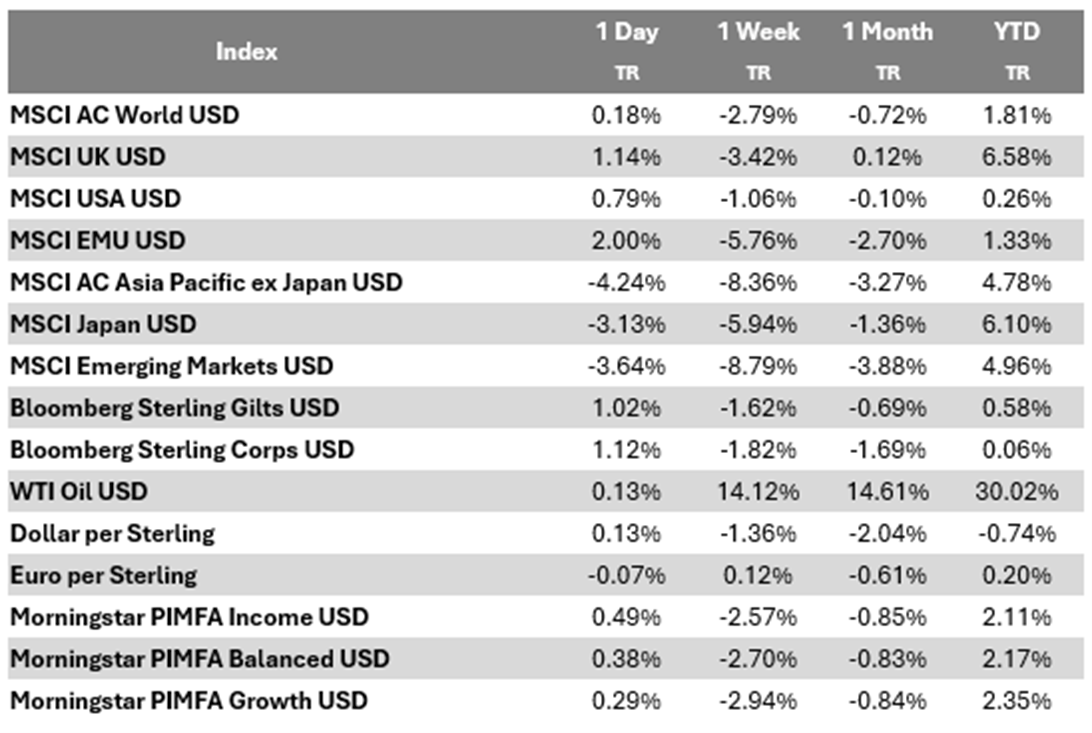
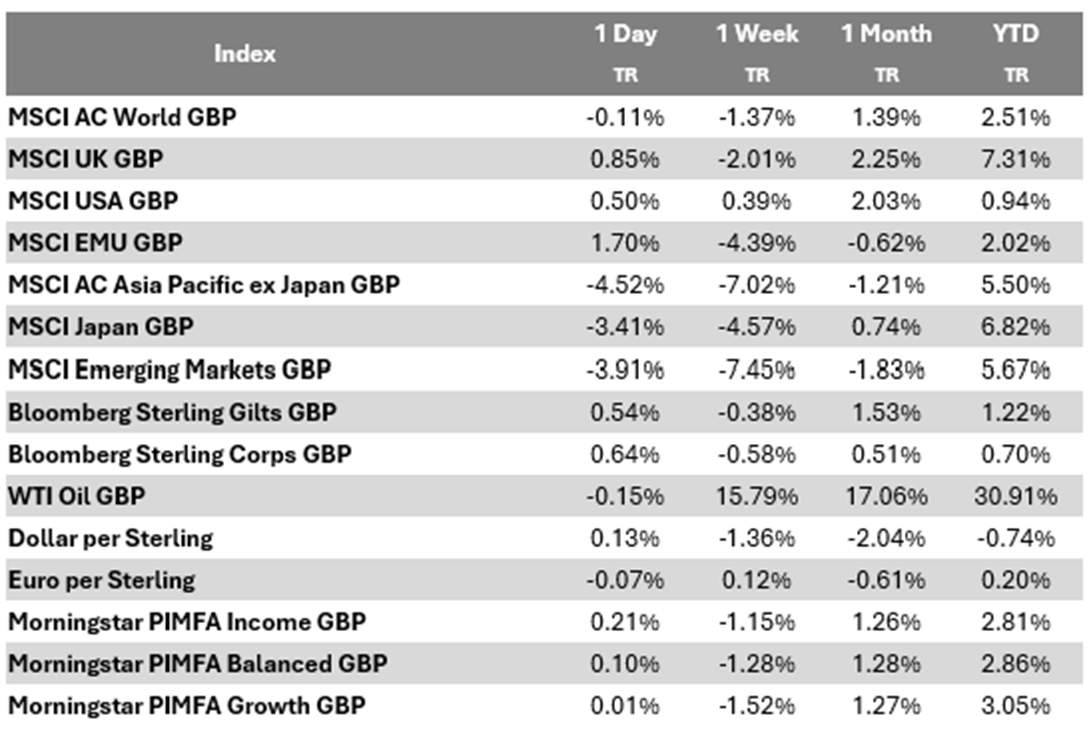
  • Iran conflict takes centre stage: Oil prices rose sharply on the back of U.S.-Israeli strikes on Iran, with West Texas Intermediate (WTI) crude oil jumping significantly last week. The oil price has since fallen sharply, after President Trump announced the war in Iran “would be over soon.”
  • Bank of England manages interest rate expectations: European natural gas prices doubled in the early part of the week, approaching levels not seen since early 2023. This was sufficient to shift Bank of England rate expectations from two cuts over the coming year to just one.
  • Broadcom delivered during earnings season: Broadcom delivered a strong beat driven by its AI semiconductor business, which more than doubled year-on-year. The company now expects to make $100 billion in AI semiconductor revenue for 2027.

Iran conflict takes centre stage

The end of February saw U.S. and Israeli strikes on Iran, which immediately sent oil prices sharply higher. WTI crude oil jumped significantly last week, as markets digested the implications for global energy supply.

Since then, we’ve seen the power over Iran move to Mojtaba Khamenei. As the son of the previous Ayatollah, this signals a continuation of Iran’s previous policy of resistance. Given that he’s lost parents, siblings and children in the attacks, there doesn’t seem to be an obvious path to de-escalation.

This sent oil prices well over the psychologically important $100 per barrel mark, before falling alongside a broad market rally on confidence from President Donald Trump that the war would be completed soon.

Source: Bloomberg, RBC Brewin Dolphin

Notably, the market was somewhat flat-footed. Positioning data suggested limited long exposure to crude oil heading into the weekend, implying traders hadn’t meaningfully positioned for what could be a significant supply shock.

The key concern isn’t Iran’s own production – at roughly 3.2 million barrels per day, it represents just over 3% of global supply. Rather, it’s the potential disruption to the Strait of Hormuz, through which approximately 20% of the world’s oil passes. Iran’s Revolutionary Guards have warned that passage through the Strait of Hormuz isn’t permitted, and traffic has already dried up as insurers either raise premiums or cancel coverage altogether.

However, with Iran facing the world’s dominant military force, surrounded by regional enemies, and with Russia incapable of providing meaningful assistance, the base case among market participants is for a relatively short conflict. This is despite several challenges that make a decisive victory difficult.

There’s speculation that Iran may become rapidly overwhelmed in the current direct conflict, and could resort to an asymmetric phase, in which the goal isn’t to defeat but rather to frustrate their opponents through, amongst other things, maritime disruption of the Strait of Hormuz.

This would be accomplished through Iran’s ‘mosaic’ strategy of using decentralised provincial units that have been pre-authorised to harass shipping through surface-to-sea missiles and drones. A major concern is Iran’s remaining capacity to deploy mines in the Strait, which wouldn’t require its largely disabled naval fleet.

Conversely, Iran’s economic situation was dire heading into this crisis. Official inflation stands at 68% year-on-year, though this almost certainly understates the problem given shortages and the collapse of the Iranian currency. Compare this to wage growth of just 45% over the same period, and the pressure on ordinary Iranians becomes clear. The longer the conflict continues, the more this economic strain may force the regime towards negotiation – especially as closure of the Strait cuts off Iran’s own oil income.

How are energy markets and portfolios impacted by the conflict?

For energy stocks, the picture is nuanced. For example, the two major UK oil producers – BP and Shell – naturally benefit from higher crude oil prices and elevated volatility as their trading operations tend to thrive in dislocated markets. BP’s oil trading earnings rose by roughly $1 billion in a single quarter when conflict last flared in the region two years ago.

BP benefits from having limited direct Middle East upstream exposure (around 8% of volumes, none of which are from Iran) and superior trading optionality. Shell benefits from greater sensitivity to the more significant liquefied natural gas price rises.

Bond markets react to inflation concerns

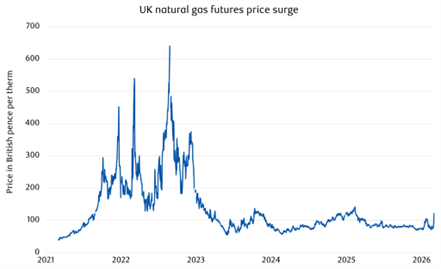
The conflict’s impact on UK inflation expectations has been swift. European natural gas prices doubled in the early part of the week, approaching levels not seen since early 2023. This was sufficient to shift Bank of England (BoE) rate expectations from two cuts over the coming year to just one.

Gilt yields have risen more sharply than in other markets. This partly reflects positioning after a solid rally in recent months, but also the UK’s particular vulnerability to energy price shocks as a net importer. With current yields approaching 4.5%, gilts offer attractive value relative to global sovereign bonds.

Chancellor Rachel Reeves delivered the Spring Statement earlier in the week. She resisted the temptation to adjust tax policy as the Office for Budget Responsibility forecasts implied that headroom against fiscal rules has improved. However, those forecasts have been overtaken by events in the Middle East.

Dollar strength and currency dynamics

The differences in energy competitiveness between the self-sufficient U.S. and Europe and Asia, which are reliant upon imports, drive divergences in asset class performance across equities, bonds and currencies. The clearest representation of this is in gas prices, which are more sensitive to local supply than oil, which trades globally.

U.S. gas prices were unmoved by conflict in the Middle East, whereas UK and European futures prices soared, undoing a lot of the improvement in relative competitiveness that European futures had enjoyed since July last year.

Source: Bloomberg, RBC Brewin Dolphin

Precious metals: Gold under pressure

Gold continued to be under pressure last week. This was due to the strength of the dollar and generally weaker sentiment amid Middle East tensions from both retail and institutional buyers. After having such a strong run over the last two years, led largely by central bank buying, we’ve now seen the first public hints of a possible sale by this group of investors.

Thursday saw the Polish central bank chief lay out a proposal to generate as much as $30 billion from the sale of the country’s gold reserves to finance defence spending. While it’s legally prohibited for Poland’s central bank to fund the government directly, the mere fact that one of the most aggressive central bank buyers of gold is considering such action given current gold prices is telling, and something that needs to be monitored going forward.

Economic data: U.S. payrolls

The U.S. economy unexpectedly shed 92,000 jobs in February, falling far short of forecasters’ expectations of a 55,000 gain. The unemployment rate rose to 4.4%, up from 4.3% in January. Adding to the weak headline, December and January payrolls were revised down by a combined 69,000 jobs.

The data signals the U.S. labour market remains in a ‘low-hire, low-fire’ mode as employers navigate tariff-related inflation pressures, AI adoption, and geopolitical uncertainty. Thrivent’s David Royal noted that while AI may be contributing to productivity gains – which helps explain why economic output has grown even as hiring has slowed – companies remain uncertain about their future workforce needs.

The healthcare sector lost 28,000 jobs (largely due to a Kaiser Permanente strike during the survey period), while the information sector shed 11,000 jobs, and the federal government cut 10,000 jobs. Social assistance was a rare bright spot, adding 9,000 jobs.

Wage growth also ticked higher, with average hourly earnings rising 0.4% to $37.32 in February and annual growth coming in at 3.8%.

As with the BoE, markets have already scaled back Federal Reserve (Fed) rate cut expectations, from over two cuts to just over one by year end. Friday’s data crystallises the key risk: a sharp employment slowdown coinciding with persistent inflation concerns could back the Fed into a difficult corner and create a substantial headwind for markets.

Corporate earnings: Broadcom delivers

Amid the geopolitical noise, Broadcom delivered a strong beat driven by its AI semiconductor business, which more than doubled year-on-year. The company now expects to make $100 billion in AI semiconductor revenue for 2027 – a remarkable figure that provides considerable comfort around the durability of AI-related capital expenditure.

Importantly, Broadcom has secured its supply chain – wafers, packaging, high-bandwidth memory – at a time of rising costs and industry-wide shortages. Concerns around gross margin dilution from the AI business appear overdone, with management signalling improved yields and scaling cost structures.

The stock now trades on 20 times 2027 earnings and is therefore priced for a significant slowdown in growth, with scope for further upgrades. This provides a constructive read-across for the broader AI supply chain – as do comments from Alphabet’s CFO, Anat Ashkenazi, at Morgan Stanley’s Tech, Media and Telecom conference, which reiterated that demand exceeds supply for cloud services. Meanwhile, AMD’s CEO, Dr. Lisa Su, expressed that the cycle “continues to feel very durable”.

Please continue to check our blog content for advice, planning issues and the latest investment market and economic updates from leading investment houses.

Charlotte Clarke

11/03/2026
Team No Comments

Tatton Investment Management: Middle East Investment Update

Please see below, an article from Tatton Investment Management analysing the recent developments in the middle east and the implications for investors. Received yesterday – 09/03/2026

Since our last note on the subject a week ago US-Israeli strikes on Iranian military-related targets have intensified but not stopped Iran from terrorizing its immediate neighbours with less discriminate and often seemingly random attacks on civilian targets.

Over the past days the conflict has widened, into Lebanon with Israel responding to rocket attacks from Hezbollah, and into other Arab states around the wider Gulf with Iran’s attacks on infrastructure and tourist areas. These were predicted to last for some days, but show no signs of ending as of yet, even if the volume of missiles and drones launched from Iran have declined.

What has had much bigger impact on the global economic outlook than Iran’s reckless attacks on its neighbours, has been their apparent success in stopping commercial shipping through the Strait of Hormuz, particularly threatening the important oil and gas ports of Saudi Arabia and the UAE. As a consequence, near-term prices have now risen sharply while long-term energy futures have also moved up somewhat. However, it remains too early to predict what will happen even in the near to medium term because much depends on the success or failure of the US-Israeli forces in the destruction of Iran’s airborne military capabilities, as well as potential leadership changes in Iran.

From an investment perspective, geopolitical upheaval of this nature creates a short-term market shock because of the sudden increase in uncertainty. Markets have reacted with a wide margin of error in their attempt to price in an array of possible outcome but still in the way most would have expected based on historical precedence.

  • Spot Brent crude (as of Monday morning at 10am) is trading around $105 per barrel, up from around $85-90 in Friday’s day trading and well above January’s $65 average: Natural gas prices are also higher by a similar proportion.
  • The US Dollar is about 2% higher against major currencies and 3% higher versus emerging market currencies.
  • Equities (in sterling terms) have fallen; US about 3%; European and UK equity futures are now lower by about 6%; Japan is down more than 8%.
  • China has fared better than most, down 3%. However other emerging market equities have been hardest hit, down an average of 10% since their peak at the end of February.
  • Longer maturity bonds were initially relatively stable but have turned more negative. This is especially so for UK Gilts. Overall, 10-year bond yields have risen by an average of 0.2% with US treasury yields up to 4.2%. However, UK 10-year yields have spiked higher by 0.5% to 4.75%.

Oil prices of course matter, but investors will especially watch the forward looking futures contracts beyond six months for signals on whether there could be a wider impact on global growth and inflation. Compared to the $40 pb increase in the spot markets, oil is $10 pb higher for next March, $5 pb in 2 years and less than $3 pb beyond 3 years.

The Gulf’s oil exporters are currently exploring how their bypassing pipeline network may be used to narrow the 20mn bpd gap (against over 100mn bpd global production) the blockade of the Strait of Hormuz has caused. There are also various military and political considerations in flux that aim at reopening of the Strait in the near term.

We said last week that equity markets are better positioned for a higher risk environment than a month ago, because of cheaper valuations and less optimism. This remains the case and while stock markets around the world have continued to price an ever worsening outcome of the oil blockade, others will recognise the discount markets are trading on compared to the pre-war outlook and are therefore looking for buying opportunities as they arise. This explains some of the extreme volatility gyrations in both directions investors will have observed over the course of the past week.

Please continue to check our blog content for the latest advice and planning issues from leading investment management firms.

Alex Kitteringham

10th March 2026

Team No Comments

Tatton Investment Management: Monday Digest

Please see the below article from Tatton Investment Management discussing the market uncertainty caused by the Iran war, rising oil and gas prices, and the resulting impacts on global markets and inflation expectations, received this morning – 09/03/2026.

Known Unknown returns
The Iran war has plunged markets into uncertainty with spot Brent crude oil above $105 per barrel (and having touched $120 pb) and European natural gas prices now more than doubled. European and Asian stocks have been hit harder than the US, and the dollar has risen – reversing recent trends.

Bonds are also under pressure, with the UK Gilt market especially impacted. UK 10-year yields have risen above 4.75% this morning and traders are now expecting that the Bank of England will raise rates this year rather than cutting.

Perhaps an oddity is that the US dollar is not higher by much, with the DXY index up only about 2% since the start of the conflict. Gold has also barely moved from last week’s levels. Investors may take some heart from this.

Korean stocks went on a wild ride, partly because East Asia is dependent on oil and gas imports, but also because of Korea’s popularity with speculative leveraged traders. Speculative positions are being shaken out – but overall the reaction wasn’t as bad as history would suggest. Maybe markets are desensitised to repeated shocks; the last oil and gas shock in 2022 didn’t destroy the world economy. Many suspect this won’t either.

Markets are no longer ignoring the risks. The ‘known unknowns’ are the war’s length, outcome and collateral damage. Inflation is projected higher everywhere, but economists’ projected growth impacts are mild and variable compared to the market’s fears. The US, a net oil exporter, could benefit while Europe and Asia suffer. That also depends on the end state: will it be regime shift (Venezuela), regime replacement (Iraq) or state collapse (Libya)? We suspect the attacks were opportunistic rather than geostrategic (i.e. starving China of oil) but that doesn’t mean things can’t escalate. Markets are focussed on oil and gas, but all sorts of trade ships through the Persian Gulf.

Ironically, war has distracted markets from previous worries (AI disruption, private credit, tariffs). The global economy has hummed in the background: growth indicators have improved for Europe, North America and Australasia, though China set its lowest growth target since 1991. China (and its trading partners) will at least benefit from the focus on demand. The UK spring statement barely registered, rapidly becoming irrelevant. Investors were ambivalent to economic data before the war, but business surveys were better than expected in the US and Europe. US employment came in weaker on Friday, but not because of AI.

If things calm, markets could easily turn positive, and investors that panic-sell often miss out on the broad recovery that follows.

February asset returns review
Despite negativity around AI, private credit and Iran, global stocks climbed 3.4% in sterling terms last month, while bonds added 1.4%. The US lagged the world at 1.3%, dragged down by a -1.3% return for its tech stocks. Predictions of the ‘SaaS-pocalypse’ (AI obsolescence for software-as-a-service firms) grew and Citrini Research put out an AI doomsday hypothetical think-piece that rocked markets. Nvidia’s stellar results weren’t enough to spur a recovery, and US corporate earnings overall for the current quarter were downgraded. Tighter liquidity hurt private credit firms, prompting Blue Owl to halt some fund redemptions. But private credit woes seemed contained and didn’t spread to public bonds.

AI investment helped Asian shares – particularly Korea and Japan (the latter up 10.8%, also helped by Takaichi’s election victory). China couldn’t take advantage and slipped 2.2%, due to continued economic weakness. The renminbi kept strengthening, though, which is more about status than economics. Emerging market (EM) currencies were strong generally, resulting in a 7.7% gain for EM stocks. We suspect this is part of a long-term adjustment to purchasing power parity (PPP) levels, benefitting EMs.

Bond yields fell thanks to lower inflation – particularly in the UK, helped also by a higher tax take. UK stocks’ 7% return came from better productivity and lower inflation. A similar story was behind Europe’s 4.9% gain (also thanks to tariff relief over Greenland). Commodities jumped 4.5% in anticipation of the Iran war, with oil up 7.3% and gold up 4.3%. The start of war in March has plunged markets into uncertainty and reversed many of February’s improvements (especially on inflation and Asian stocks). But like with markets’ other anxieties, we should remember that the fundamental outlook for global growth is solid.

How inflationary is the oil shock?
The massive spike in oil prices is pushing up inflation expectations. US-Israeli strikes against Iran were telegraphed in advance, but the scale of the war and disruption to traffic through the Strait of Hormuz still surprised markets. Oil futures markets suggest the problems are short-term. Short-term prices are sharply up but prices out to two years have barely moved. The consensus seems to be that the war will last a month or two, followed by a resumption of Iranian oil flow. If that’s right, the long-term oversupply in global oil markets should resume. But that doesn’t mean energy prices are all fine: a $10 per barrel oil premium for a year would still add 0.1 percentage points to global inflation.

Bond yields moved up on expectations of higher inflation and interest rates. But the inflation breakeven rates (the residual between nominal and inflation-linked yields) show that US inflation expectations have barely moved, Europe’s have moved a little and the UK’s have spiked. Maybe that’s about energy security – but the odd one out is Japan. Japanese breakeven rates moved down, despite being car more dependent on oil and gas imports. It’s unclear why UK inflation should be higher than Japan, considering Prime Minister Takaichi’s dovish BoJ appointments. You might think it’s about a long-term demand shock, but again that would presumably apply to the UK too.

We think the disparity is more about bond market inefficiencies than inflation. If that’s right, UK inflation-linked bonds are underpriced relative to Japan – but it’s not always possible to arbitrage these differences. Perhaps markets are underestimating the inflationary impacts, from either a drawn out war or the cumulative impacts of recent inflation shocks. But even if that’s right, it’s hard to justify that being a UK specific problem.

Please continue to check our blog content for the latest advice and planning issues from leading investment management firms.

Marcus Blenkinsop

9th March 2026

Team No Comments

EPIC The Daily Update | The Hormuz Tax: Why this supply shock ends in recession, not inflation

Please see today’s Daily Update from EPIC Investment Partners:

Financial markets have responded to the outbreak of hostilities in the Strait of Hormuz in familiar fashion. Oil has firmed, equities have wobbled and US Treasuries have sold off. The 10-year yield has climbed to around 4.16%, its fifth consecutive daily rise, as traders price the risk that higher energy costs could delay the Fed’s easing cycle.

At first glance the reaction makes sense. Any disruption to the Strait of Hormuz, the route for roughly a fifth of global oil shipments, raises the prospect of renewed inflation pressure. Even though Brent crude remains well below the levels that would normally trigger panic in energy markets, the logistical disruption is already becoming visible elsewhere.

Shipping companies have begun rerouting vessels around the Cape of Good Hope to avoid the Gulf, adding as much as two weeks to journeys between Asia and Europe. The additional distance sharply increases ton-mile demand, the shipping industry’s core measure of capacity, pushing freight rates higher. Maritime insurers have also raised war-risk premiums sharply, embedding additional costs into global trade.

The immediate market reaction has therefore been straightforward. Higher energy prices feed into headline inflation, prompting investors to push back expectations for interest-rate cuts. Futures markets have already shifted the likely timing of the Fed’s first move from July towards September.

Yet this inflation narrative captures only the first stage of the shock. The deeper issue lies in the interaction between energy prices and trade policy.

The Trump administration’s newly announced 15% global tariff regime arrives at the same moment energy prices are rising. Oil increases the cost of producing and transporting goods; tariffs raise the price at which those goods enter markets. Together they function less as a driver of inflation than as a tax on global growth.

Higher oil prices function as a tax on households and industry. When combined with the tariff regime, the result is a tightening of financial conditions independent of central bank policy. Consumers face higher fuel and transport costs while companies see margins squeezed by tariffs and rising input prices.

Previous energy shocks offer a useful guide to how markets process this adjustment. During the early stages of the 1990 Gulf War and again after Russia’s invasion of Ukraine in 2022, Treasury yields initially rose as markets focused on the inflation risk associated with higher oil prices.

Those moves proved temporary. As the economic consequences became clearer, weaker consumption, slower trade and declining industrial activity, investors returned to government bonds. The narrative shifted from inflation risk to growth risk, reflecting the reality that central banks cannot eliminate supply shocks by maintaining high interest rates indefinitely. What monetary policy eventually responds to is the demand destruction those shocks create.

The difference today is scale.

The Iranian revolution of 1979 removed roughly 5% of global oil supply from the market. Russia’s invasion of Ukraine disrupted trade flows but did not eliminate comparable volumes of production; oil was largely rerouted rather than removed.

A sustained disruption to shipping through the Strait of Hormuz would be far more severe. The passage carries roughly a fifth of global oil shipments and a substantial share of LNG exports. Even a partial closure therefore represents a supply shock several times larger than the historical episodes markets typically reference.

If the disruption to Gulf shipping proves prolonged, the global economy would be forced to absorb a shock affecting roughly 20% of seaborne energy flows; a scale of disruption historically associated not with inflationary booms but with recessions.

Bond markets tend to respond accordingly. Once the slowdown becomes visible in labour markets and industrial output, investors shift rapidly from pricing inflation risk to pricing economic contraction.

In past downturns, long-term Treasury yields have fallen by several hundred basis points from their pre-crisis levels. If the current shock were to trigger a comparable global slowdown, the move from today’s 4.16% 10-year yield could replicate a change of similar magnitude.

Please continue to check our blog content for advice, planning issues and the latest investment market and economic updates from leading investment houses.

Andrew Lloyd

06/03/2026

Team No Comments

Brooks Macdonald – Daily Investment Bulletin

Please see the below article from Brooks Macdonald detailing their discussions on US policy and Geopolitical risk. Received this afternoon 05/03/2026.

What has happened?

Yesterday, investor sentiment improved on the back of strong US economic data and the absence of any immediate escalation in the Middle East. Equity markets rebounded across regions. The S&P 500 rose +0.78%, moving back to within 2% of its record high, supported by a strong rally in tech stocks, with the Magnificent 7 up +1.52%. In Europe, the STOXX 600 gained +1.37%, alongside solid advances in the DAX (+1.74%) and FTSE 100 (+0.80%). The recovery extended into Asia this morning, where South Korea’s KOSPI surged +11.02% following the previous day’s sharp sell off. That said, the calm remains fragile. Oil prices have moved higher again overnight, with Brent up 3.18% to $83.99/bbl, reflecting the fast-moving geopolitical backdrop.

Energy market volatility amid geopolitical risk

While broader stress eased, there has been little evidence of de escalation in the Middle East. Comments from Iran’s IRGC suggested an intensification of strikes, alongside confirmation from the US that it had sunk an Iranian warship in the Indian Ocean. Markets have remained highly sensitive to headlines, with oil prices swinging sharply intraday on incremental reports. European natural gas prices fell more than 10% yesterday, reversing part of their sharp gains earlier in the week. This pullback helped ease immediate inflation concerns in Europe and pushed back speculation around an ECB rate hike, with 10 year government bond yields edging lower across core and peripheral markets.

Strong US data challenges the rate cut narrative

Away from geopolitics, US economic data provided reassurance on growth and undercut near term stagflation fears. The ISM services index rose to 56.1 in February, its highest level since 2022, driven by a surge in new orders, while the prices paid component fell to its lowest level in almost a year. The ADP private payrolls report also surprised modestly to the upside, reinforcing the picture of still-resilient labour demand ahead of the official jobs report. As such, markets further reduced the probability of a June Fed rate cut, with investors increasingly sceptical that a new Chair would move quickly in the face of firm activity data. US Treasury yields moved higher across the curve, with the 2 year yield rising to 3.55% and the 10 year yield climbing above 4.10%.

What does Brooks Macdonald think?

Trade policy also remains an important area to watch. Bloomberg reported that the EU has received assurances from the US that the current 10% universal tariff rate will be maintained for now, rather than increased to 15%, following the Supreme Court ruling against the previous IEEPA tariffs. At the same time, attention has turned to the potential for tariff refunds, after a US judge ordered Customs and Border Protection to halt the calculation of IEEPA tariffs on import paperwork. With the administration indicating that interest will be paid on any refunds, the timing and scale of repayments could have implications for the fiscal outlook.

Bloomberg as at 05/03/2026. TR denotes Net Total Return.

Please continue to check our blog content for advice, planning issues and the latest investment, market and economic updates from leading investment houses.

Alex Clare

05/03/2026

Team No Comments

Brewin Dolphin – Markets in a Minute

Please see this week’s Markets in a Minute update below from Brewin Dolphin, received yesterday afternoon – 03/03/2026.   

Conflict in the Middle East: Understanding the market response

With conflict in the Middle East escalating, Chief Strategist Guy Foster breaks down what’s happening across investment markets – from immediate volatility to long-term positioning.

Key highlights

  • Historical perspective: While current oil price fluctuations are notable, they remain significantly lower than the structural shocks of the 1970s and 90s, suggesting a more resilient global energy market.
  • Modern diversification: The global economy’s reduced reliance on Middle Eastern oil, coupled with the UK’s shift toward U.S. liquified natural gas (LNG) supplies, can provide a buffer against traditional energy-driven inflation.
  • Strategic resilience: Heightened volatility often unearths unique investment opportunities; we continue to manage your portfolio with a focus on long-term stability and proactive adjustments.

With the U.S. and Israel having launched meaningful attacks on Iran and counterattacks underway, it’s a time of significant uncertainty. While there are many important dimensions to these events, we want to share what they mean for investment markets and your portfolio.

The immediate market response

The immediate impact of the strikes has seen most equity prices drop lower on Monday morning. This is quite a normal reaction and reflects a primary concern: that conflict in the Middle East will drive energy prices higher. Any increases would be reflected in higher inflation, which raises costs for businesses and households, reducing economic growth and profits. But how severe might this impact be?

Oil shocks: Then vs. now

Investors with long memories will remember when the oil price rose sharply in response to conflict in the Middle East in the 1970s, and then again in 1990 due to the Gulf War. For context, those price surges were far more severe than what we’ve seen so far. In early trading, oil prices rose 10% – whereas previous shocks have tended to see increases of at least 100%.

Could prices rise much further? That’s the most difficult thing to forecast. Iran’s oil production comprises about 3-4% of global supply. Although it’s heavily sanctioned by Western powers, there are still buyers – of which China is by far the largest – which means that Iranian oil still affects global prices.

Iran’s geopolitical isolation also limits its ability to sustain major supply disruptions. Even China, its key ally, needs Iranian energy to keep flowing.

The Strait of Hormuz: A critical passage

Iran’s influence on the global oil and gas market extends beyond its own production. The most sensitive factor is the ability of tankers to navigate the Strait of Hormuz – a narrow maritime passage that serves as the world’s most critical energy chokepoint. Bordered by Iran’s coast, prolonged disruption to shipping here would cause oil prices to spike.

While disturbing the Strait might be Iran’s most potent means of harming its aggressors, it will come at the cost of lost oil revenue and that cost will be borne by all the Gulf states who currently export via the Strait. The other party losing out is China.

While U.S. confidence in keeping the Strait navigable remains unknowable, we can be certain they’ve considered the implications if it remains closed. Polls of U.S. registered voters suggest that military action against Iran was only supported by around a third of respondents and that inflation remains the most important issue¹ during this mid-term election year.

Crucially, the global economy is becoming less dependent on oil in general and Middle Eastern supplies in particular. As oil consumption relative to GDP steadily declines, the market is showing greater resilience; while prices exceeded $120 per barrel in 2022, they remain below $80 even after the latest jump (correct at the time of writing).

Impact on your energy bills

Nobody likes paying a lot to fill their car with fuel, but Europeans tend to be less sensitive to oil price changes because the impact is dulled by fuel duties. They are, however, more sensitive to changes in utility bills and will remember the dramatic changes following Russia’s invasion of Ukraine.

In fact, inflation is expected to decline this year as falling natural gas prices slowly filter through to consumers – the UK’s energy price cap policy delays the passthrough of energy prices into household bills.

As a rule of thumb, if wholesale gas prices rise on a sustained basis by 10%, that could increase headline consumer price inflation by around 0.5%. Recent sustained price declines mean that inflation is likely to fall in April by 0.4%. However, Iranian drone attacks on the Qatari LNG export facility have caused its closure, leading to a sharp rise in LNG prices. If those higher prices were to be sustained, then UK-regulated prices would eventually increase. Although for context, prices after the closure have returned to the level they were at a year ago, and remain a fraction of those seen during 2022. Importantly, the UK has reduced its Middle Eastern LNG dependence in recent years, increasingly relying on U.S. supplies instead.

Bond market implications

Bond markets have reflected the potential increase in inflation to a small extent. They would be most concerned if there was any expectation that it would mean higher interest rates. Before the attacks, two UK rate cuts were expected over the coming year, after those, that second cut hangs in the balance.

Whilst energy prices could generate upward inflationary pressure, it would also dampen consumer spending on other goods and services. So whilst the impact on most bonds is mixed, the prospect of higher inflation has helped the performance of inflation-linked bonds.

Spending on defence will add to pressure on the U.S. public finances. This is one reason why gold – rather than traditional bonds – is currently serving as a more effective hedge against geopolitical risk. We are also seeing the U.S. dollar strengthen as global risks rise, following a familiar historical pattern.

The resilience of your portfolio

The main impact of these events on financial markets is the uncertainty they create. We manage diversified portfolios to help protect against volatility. While uncertainty is elevated, some assets rise in value and, if the moves are sharp, it can be worth taking profit on them.

The history of financial markets shows volatility increasing, and then ebbing again. The best investment opportunities often come at times when uncertainty is at its highest. An example of this was the market falls after the global tariff announcements last year, which marked the start of a strong market rally.

We don’t yet know whether the current violence will last days, weeks or longer. However, as always, we’ll be following events closely to see what opportunities they produce.

Please continue to check our blog content for advice, planning issues and the latest investment market and economic updates from leading investment houses.

Charlotte Clarke

04/03/2026

Team No Comments

Brooks Macdonald Daily Investment Bulletin – From Geopolitical Headlines to Markets: What Investors Should Consider

Please see below article received from Brooks Macdonald this morning. 

Recent developments in Iran and the wider Middle East region have led to a rise in geopolitical risk and market unease. Periods like this tend to generate intense news coverage, but for investors it is important to distinguish near term developments from the forces that shape long term investment outcomes.


What has happened?

Over the weekend, geopolitical tensions in the Middle East escalated following United States and Israeli air strikes against Iran. Iran subsequently responded with missile strikes targeting US military facilities in the region. Alongside this, concerns have emerged around commercial shipping through the Strait of Hormuz, which is the narrow stretch of water between Iran and Oman that represents the only sea passage from the Persian Gulf to the open ocean and one of the world’s most strategically important energy transit routes. Following attacks on oil tankers, tanker traffic through the strait has slowed, although Iranian officials have indicated they are not seeking a full closure. As is typical in situations of heightened geopolitical tension, developments are evolving quickly and the range of possible outcomes remains wide.


How markets are reacting and the key implications

  1. Energy markets: The Middle East plays a central role in global energy supply and transportation. Heightened tensions often lead to higher oil prices as markets price in additional risk, even in the absence of an immediate disruption to supply. Over the weekend, oil prices have risen by more than 7%, reflecting this increase in risk premia rather than confirmed changes to supply or demand.
  2. Inflation considerations: Energy prices feed into inflation, particularly if higher prices persist. However, global central banks generally focus on whether such moves are sustained and broad‑based, rather than responding to short‑term price volatility driven by geopolitical events.
  3. Market sentiment: Periods of uncertainty can lead to short-term market volatility as investors reassess risks and exposures. These moves often occur even when underlying economic fundamentals have not materially changed.


Market reactions to geopolitical developments are often rapid and uneven and can quickly reverse as new information emerges. Historically, early price movements have often reflected uncertainty and investor risk reduction rather than a settled view on long-term economic impact, with markets ultimately moving back to focusing on fundamentals.


What this means for diversified portfolios

Diversified portfolios are constructed with the expectation that periods of uncertainty and volatility will occur. By spreading exposure across different asset classes, regions and sectors, portfolios are better positioned to absorb the impact of individual events, including geopolitical shocks. In practice, this means that while some assets may be more sensitive to rising geopolitical risks, others are designed to provide resilience during periods of stress. Attempting to respond to rapidly changing headlines or to time markets during uncertain periods can increase the risk of poor long-term outcomes. Over time, investment returns have tended to be driven primarily by underlying economic fundamentals rather than short-term geopolitical developments.


Our approach

We remain focused on long-term investment objectives, supported by well-designed asset allocation and proactive risk management with proper diversification. We continue to monitor relevant economic and market indicators (including developments in energy markets and inflation) while avoiding kneejerk positioning.


Periods of geopolitical tension are not new, and markets have navigated similar episodes many times in the past. While uncertainty is currently elevated, multi-asset portfolios are designed with this in mind. History suggests that maintaining discipline and a long-term perspective is more effective than reacting to periods of heightened uncertainty.


Please check in again with us soon for further relevant content and market news. 

Chloe 

03/03/2026


Team No Comments

Tatton Investment Management: Monday Digest

Please see the below article from Tatton Investment Management, discussing the market impact of rising geopolitical tensions, shifting energy dynamics, and contrasting narratives around AI’s economic outlook, received this morning – 02/03/2026.

Outright war on Iran’s leaders begins
In response to the US-Israeli military strikes and Iran’s responses, markets have reacted in the way most would have expected.

  • Spot Brent crude is trading at $80 per barrel, up from around $70-72 in Friday’s day trading and well above January’s $65 average: Natural gas prices are about 4% higher.
  • Gold is above $5,400: Other metals are a little higher.
  • The US Dollar is about 0.5% higher against major currencies and 1% higher versus emerging market currencies.
  • US and European equity futures are about 1% lower while Japan and China are down more than 2%. The Turkish market is down over 5%.
  • US 10-year treasury yields have actually risen slightly but remain below 4% after last week’s global government bond rally. Japan bond markets have seen slight yield falls, Europe and UK yields are also likely to open lower.

Spot oil prices will matter but investors will especially watch the futures contracts beyond six months for signals on whether there could be a wider impact on global growth and inflation.

Engineering a path to a new and stable Iranian political leadership will be neither easy nor quick. Investors will spend this week forming a view on how and when it ends. An important question regards China’s attitude and involvement. Can the US convince China that this conflict is not part of a strategy to further constrain its ambitions?

As we discuss below, risk markets are better positioned for a higher risk environment than a month ago, with cheaper valuations and less optimism. As such, at least we start the week with the sense that while there is obvious downside, many will look for an opportunity to buy if it becomes extended.

AI boom or doom
February was filled with polarising narratives but little price movements. The AI bubble talk has disappeared and, if anything, investor positioning might be negatively biased.

Blue Owl halting fund redemptions sparked fears of a private credit liquidity crisis – amplified by UBS research suggesting defaults could jump up if software companies are displaced by AI. Private credit firms invested big in tech companies. This is a risk scenario rather than a base case, but its probability has increased. Blue Owl halted redemptions out of investor fears, not actual defaults (which have fallen). People are understandably worried about a 2008-style contagion, but junk bonds in public markets haven’t been affected. There’s less leverage in the system than in 2008 (private credit firms can’t create money like banks) and for the firms that survive this could increase transparency for underlying assets.

Citrini research put out a hypothetical piece about a 2028 economy ravaged by AI, with service companies investing in their own obsolescence and collapsing the knowledge economy. The piece rocked markets despite containing no new data – showcasing the power of narratives. The competing narrative says adoption will be slower, allowing productivity growth to feed back into job creation. AI isn’t eating jobs yet (software engineer postings are up) but even if it does, it won’t show up in the data for a while. If the futurists are right about AI development, the backward looking data is immediately obsolete.

Global growth is still robust (2.1% in the US, 2% in the UK) and equity valuations are less stretched. The fact Nvidia shares fell, despite stellar earnings, means it is trading at a lower premium. Overly negative investor positioning should mean even mild relief squeezes up prices. Japan looks particularly strong – the only question being whether growth will be inflationary. Investors shouldn’t lose sight of the fact that the global economy keeps churning.

Where Europe now gets its gas
Ofgem’s 7% reduction in the energy price cap was made possible by falling UK and European natural gas prices, to £25/MWh in December, from nearly £50/MWh a year ago. Prices have bumped up more recently, due to colder US weather and concerns about EU gas storage dropping lower than usual for this time of year. A European cold snap drew on supplies at the start of 2026, but milder temperatures since have tapered demand. UBS analysts now expect storage to trough not much lower than current levels ahead of the summer restocking. Summer futures prices are still below current prices: traders are worried about current gas supplies (partly due to Iranian tensions) but calmer about future supplies.

Europe’s energy market has fundamentally changed in the last four years. Its biggest gas supplies are now Norway (31%) and the US (26.4%), though 12.1% still comes from Russia (mainly into Hungary and Slovakia). Most gas imports are LNG, over half of which comes from the US. Gas suppliers have invested heavily in port infrastructure to ship LNG across the Atlantic, which is tying our prices tighter to US gas prices. This is also why the EU is more comfortable running lower ‘just in time’ gas storage levels.

UK and European gas supplies are finally stable, and the EU has expanded its renewables capacity too (renewables overtook fossil fuels for the first time in 2025). There are still security concerns around gas: Norwegian pipelines could become targets in a hypothetical arctic theatre, and reliance on the US isn’t ideal in the age of Trump. Surging energy demand from AI datacentres poses a risk for energy prices (for the world) but the risks don’t detract from a supportive energy outlook.

Is the ‘Donroe Doctrine’ good for LatAm?
You’d think Donald Trump’s “Donroe Doctrine” (interventionist US dominance in the Western hemisphere) would be bad for Latin American companies, but Bloomberg’s LatAm index has surged 77% in sterling terms since January 2025. Morgan Stanley think the LatAm bull market will continue, mirroring the 2003-2007 surge, powered by AI infrastructure spending. This should benefit the ‘old economy’ of raw materials and manufacturing. Chile, a copper and lithium exporter, could particularly benefit. Morgan Stanley also think geopolitical shifts and falling interest rates will benefit LatAm stocks with historically low valuations, as the US shifts its demand to regional partners.

In a multipolar world, LatAm governments could actually move closer to the US, creating investment opportunities – like Mexico renegotiating the USMCA or Brazil enacting fiscal reforms. Commentators talk about US ‘friendshoring’, but that relies on being friends with Washington. Argentina’s $20bn currency swap line loan shows how lucrative friendship can be for Trump’s allies, but US patronage isn’t as personal as it sometimes seems. Washington will likely give tariff relief to Mexico if Mexico agrees to stem trade with China, and it already exempted Brazil from some tariffs when left-wing president Lula refused to budge. In a multipolar world, the US has a strong interest to attract LatAm to its pole.

We shouldn’t discount Trump’s tirades against drug cartels either. These have blighted LatAm governance, especially since the pandemic, and even those against US interventionism want the cartels gone. Stable institutions will benefit LatAm markets. Inflation has fallen across the region, partly thanks to post-pandemic monetary reforms. Lower interest rates could help LatAm markets expand. We wrote about the increasing importance of purchasing power parity (PPP) in the Trump era, and a PPP adjustment would also likely benefit. Yet again, Trump’s policies don’t always have the assumed impact.

Please continue to check our blog content for the latest advice and planning issues from leading investment management firms.

Marcus Blenkinsop

2nd March 2026


Team No Comments

EPIC Investment Partners: The Daily Update – Accounting for Chaos

Please see the below article from EPIC Investment Partners discussing the policy-driven factors behind America’s Q4 2025 economic slowdown, received this morning – 27/02/2026.

The most arresting number in America’s fourth-quarter slowdown was not the growth rate. It was the payroll count.

When output expanded at an annualised 1.4 per cent in the final three months of 2025, down from 4.4 per cent in the third quarter, the headline suggested a sharp loss of momentum. In reality, much of the deceleration was mechanical. A 43-day partial federal government shutdown, from 1 October to 12 November, forced roughly 650,000 federal employees into furlough while another 600,000 were required to work without immediate pay.

In the national accounts, public-sector output is largely recorded through the labour services provided by government employees. When those hours disappear, measured output falls automatically. Federal activity contracted at a 16.6 per cent annualised rate in the quarter, subtracting around one percentage point from overall GDP growth. What looked like broad economic weakness was, in large part, an accounting reflection of political paralysis.

The income shock was immediate. By mid-November, an estimated $16bn in wages had been withheld. Although back pay was eventually guaranteed, the interruption in liquidity curtailed discretionary spending in regions with a heavy federal presence. Restaurants near government offices emptied. Contractors delayed hiring. The drag was concentrated but visible.

Yet the shutdown alone does not explain the quarter’s softness. At the same time, America’s external imbalance widened to historic levels. The December monthly trade deficit exceeded $70bn. For the full year, the combined goods and services shortfall approached $900bn. More striking still was the goods deficit alone, which surpassed $1.2tn — the largest on record.

That distinction is crucial. The United States runs a surplus in certain high-value services, including finance and intellectual property. But the merchandise gap continues to widen even under an aggressive tariff regime intended to narrow it. The country is importing more physical goods than ever despite protectionist policy.

In GDP accounting, exports add to growth while imports are subtracted to avoid counting foreign output as domestic. When imports rise faster than exports, the trade balance turns negative and weighs on measured GDP. That dynamic was evident in the fourth quarter. Businesses had spent much of 2025 front-loading orders ahead of tariff increases. By year-end, inventories were being drawn down. Imports remained elevated while exports softened, reflecting weaker global demand and a firm dollar. The widening goods deficit therefore amplified the slowdown.

Tariffs added distortion without resolving the imbalance. Higher effective rates lifted the cost of consumer goods and intermediate inputs, contributing to price pressures in sectors such as autos and apparel. Yet they largely reshuffled trade flows rather than shrinking the aggregate gap.
Strip away government outlays and volatile inventories, and the private sector appears more stable than the headline suggests. Business investment, particularly in equipment and intellectual property linked to artificial intelligence, held up better than expected. The economy absorbed a self-inflicted shock rather than succumbing to recession.

The fourth quarter of 2025 reads less like a conventional downturn than a policy-induced bypass. Output slowed not because private demand collapsed, but because the state temporarily withdrew its own labour and the external sector deteriorated simultaneously. Growth will likely rebound as federal hours are restored and back pay circulates.

The deeper signal lies in the external accounts. A goods deficit exceeding $1.2tn reflects a structural imbalance between domestic consumption and tradable production, reinforced by a strong dollar and persistent fiscal deficits. Political turbulence may support the currency in the short term as global capital seeks safety. Yet that very strength suppresses export competitiveness and perpetuates the merchandise gap.

The United States can sustain large deficits so long as the world is willing to finance them. The fourth quarter suggests that willingness increasingly rests on confidence rather than inevitability. Growth will recover. The more delicate question is how long credibility remains unquestioned.

Please continue to check our blog content for the latest advice and planning issues from leading investment management firms.

Marcus Blenkinsop

27th February 2026

Team No Comments

The Daily Update | Value Hiding in Plain Sight: NVIDIA may be cheaper than you think

Please see today’s Daily Update from EPIC Investment Partners below:

Value in NVIDIA may be hiding in plain sight. The company’s exponential revenue expansion may be causing the market to underestimate the cash flow generation potential of the business over the next few years as it remains the dominant infrastructure provider within the artificial intelligence megatrend.

The company reported record fiscal fourth-quarter revenue of $68.1 billion, representing 73% year-over-year growth and 20% sequential growth, exceeding prior guidance. The results reflect sustained global investment in high-performance AI computing across hyperscale cloud platforms, enterprise workloads, and government infrastructure programs.

Forward guidance signals continued momentum. NVIDIA expects $78 billion in April-quarter revenue, implying 77% year-over-year growth and approximately $11 billion in sequential revenue expansion. Between 2023 and 2025, data centre revenue increased by roughly $4 billion in most quarters. Current guidance suggests deployment velocity is accelerating as supply constraints gradually ease.

The company had highlighted a combined revenue opportunity of approximately $300 billion associated with Blackwell and Rubin architectures in calendar 2026. Management is now indicating this estimate may be conservative based on current order visibility.

Government and sovereign demand are emerging as a structural growth pillar. Revenue from sovereign customers reached $30 billion in fiscal 2026, tripling year over year, as nations accelerate investment in domestic AI computing capacity for strategic security, technological independence, and digital infrastructure development.

Growth is also extending beyond accelerator hardware. Networking revenue reached $11 billion, expanding 263% year over year and 34% sequentially. The company believes it has become the largest Ethernet networking vendor globally, competing indirectly with infrastructure specialists such as Cisco Systems and Arista Networks.

The industry shift toward rack-scale and cluster-scale AI architectures is increasing system-level content per deployment. NVIDIA is increasingly monetising integrated compute, networking, and software-enabled infrastructure rather than selling discrete components, allowing the company to capture a larger share of total AI system spending.

In other words, NVIDIA remains a dominant supplier as customers continue to rely on its technology for large-scale artificial intelligence deployment. While there are market concerns that hyperscale cloud providers are investing in custom silicon to reduce long-term supplier dependence, the overall market for AI compute is expanding at such a rapid pace that competitive substitution is unlikely to offset industry-wide growth.

As a result, NVIDIA appears to be materially underestimated by the market. We see further upside ahead.

Please continue to check our blog content for advice, planning issues and the latest investment market and economic updates from leading investment houses.

Andrew Lloyd

26/02/2026