Team No Comments

EPIC Investment Partners: The Daily Update

Please see the below article from EPIC Investment Partners, discussing the recent concerns around liquidity within private credit and how current market volatility may impact investors, received today – 27/03/2026.

Private credit’s liquidity illusion

Financial markets are beginning to hint at something more troubling than a simple inflation scare.

The first explanation for the pressure on short-dated US Treasury yields is obvious enough. Higher oil prices raise inflation fears, make central banks less willing to cut rates quickly and push the front end higher. That much is entirely reasonable.

But it is not the whole story.

If the move were only about inflation and a later path for rate cuts, it would feel cleaner than it does. Instead, volatility has risen, liquidity has worsened and the front end has remained under pressure in a way that suggests something more than a straightforward macro repricing. The market is not just adjusting to higher inflation risk. It also appears to be adjusting to a lower tolerance for leverage, illiquidity and risk.

That matters because once volatility rises and stays high, the consequences spread quickly. Risk models tighten. Leverage looks less comfortable. Positions that seemed manageable in a calmer market suddenly appear too large. At that point, portfolios do not adjust elegantly. Investors sell what they can sell.

That is where private credit comes in.

Private credit has long been sold as a calmer corner of finance: higher income, fewer daily price swings and a patient investor base. But that calm has always depended on an awkward fact being ignored. The assets are illiquid, while the investors still need cash. Pensions have liabilities. Insurers have capital to manage. Wealth managers and family offices may need liquidity precisely when markets are under pressure.

This is why gating matters. Gating is simply the industry’s term for limiting withdrawals when too many investors ask for their money back at once. In practice, it means a fund can tell investors they may receive only part of their cash, and not necessarily when they want it.

The important point is that the need for cash does not disappear. If investors cannot raise money from private credit, they have to raise it somewhere else. That usually means selling listed assets instead. Seen that way, private-credit gates are not a niche sideshow. They are the illiquid mirror image of the same de-risking already visible in more liquid markets.

The problem deepens because private assets are slow to reprice. When public markets fall but private credit is still carried at stale valuations, the illiquid allocation can suddenly look too large and use up more of the portfolio’s risk budget than intended. Investors who might otherwise buy cheaper public assets are then unable to do so. If they need liquidity or need to cut risk, they are forced to sell what they can sell instead — often more liquid risk assets such as high-yield bonds or equities. The diversifier does not absorb the shock; it displaces it.

That is why this matters beyond the world of alternatives. Ultimately, a gate is an admission that a fund’s stated value and its true clearing price are no longer the same thing. So long as the Treasury market remains trapped in this bear-flattening stress, the pressure on those gates is likely to intensify. Private credit may not be the next subprime, but it is becoming the next place where the system discovers its true liquidity limits.

Please continue to check our blog content for the latest advice and planning issues from leading investment management firms.

Marcus Blenkinsop

27th March 2026


Team No Comments

Brooks Macdonald – The Daily Investment Bulletin

Please see todays Brooks Macdonald Daily Investment Bulletin received this morning, 26/03/2026:

What has happened?

Iran continued to reject messages from the US aimed at de‑escalation, raising doubts over whether a credible off‑ramp to the conflict exists in the near term. That uncertainty pushed oil prices sharply higher, with Brent crude rising from around $97.30/bbl during the European session to close at $102.22/bbl in the US, before extending gains this morning to over $104/bbl. Despite higher energy prices, broader risk sentiment was relatively resilient. US equities advanced, with the S&P 500 up +0.54%, leaving it on track for its first weekly gain since the strikes began and up +1.31% over the past three sessions. Gains were supported by strength in the Mag-7, while smaller companies also performed well, with the Russell 2000 reaching a two‑week high. European equities posted similarly strong returns, with the STOXX 600 rising +1.42% to record its third consecutive daily gain and its highest level in a week.

Mixed diplomatic signals keep volatility elevated

Markets are weighing up mixed signals on the prospects for de‑escalation. US officials have pointed to ‘productive’ discussions and possible engagement via regional intermediaries, supporting hopes that diplomatic channels remain open. It has also been widely reported that the US has outlined a 15‑point plan, which could include dismantling Iran’s nuclear facilities and reopening the Strait of Hormuz. However, this has been met with pushback from Tehran. Iranian officials and state‑linked media have rejected indirect talks, reiterating that any end to hostilities would depend on Iran’s own terms, including security guarantees and recognition of its authority over the Strait of Hormuz. This mismatch in rhetoric has left oil prices highly sensitive to headlines and prone to sharp moves.

UK data reinforces a fragile mood

Away from geopolitics, UK economic data continues to point to a fragile domestic backdrop. Consumer confidence deteriorated sharply in March, with the British Retail Consortium’s expectations indicator falling to its weakest level since the survey began. Perceptions of the economic outlook over the next three months worsened notably, reinforcing signs that households remain cautious. Forward‑looking PMIs also slipped to six‑month lows, pointing to slowing activity alongside persistent cost pressures. Given that household consumption accounts for around two‑thirds of UK GDP, these indicators suggest demand may remain subdued in the near term.

What does Brooks Macdonald think?

Market attention is increasingly focused on the approaching end of President Trump’s five‑day deadline, announced on Monday, to delay potential strikes on Iranian power and energy infrastructure. With that window set to close in the coming days, and reports of an increased US military presence in the region, the risk of further escalation remains firmly on investors’ radar. At the same time, yesterday’s market behaviour highlights a degree of resilience, with equities holding up despite rising energy prices and geopolitical uncertainty.

Please continue to check our blog content for advice, planning issues and the latest investment, market and economic updates from leading investment houses.

Andrew Lloyd

26/03/2026

Team No Comments

Brewin Dolphin – Markets in a Minute

Please see this week’s Markets in a Minute update below from Brewin Dolphin, received yesterday afternoon – 24/03/2026.   

Central banks stand ready to act

We analyse how the extended Iran war is driving energy shocks and forcing central banks worldwide to reassess rate cuts.

Key highlights

  • Energy infrastructure attacks escalate Middle East tensions: Strikes on Qatar’s LNG facilities and Iran’s South Pars gas field have severely disrupted the Strait of Hormuz tanker traffic.
  • Central banks shift to hawkish stance in unison: The Federal Reserve, Bank of England, and the European Central Bank have all revised inflation forecasts upward and effectively ruled out near-term rate cuts.
  • UK gilt yields approach 5% amid fiscal concerns: The 10-year gilt has reached post-financial crisis levels as markets price in persistent inflation and fiscal sustainability risks.

The Iran war: Duration, energy prices and market implications

The current overarching theme is the evolving Iran war and its impact on global energy markets. Market participants have materially pushed out their expectations for the duration of the crisis. RBC Capital Markets commodity strategist Helima Croft, following meetings in Washington, extended her estimated timeline for the conflict and associated energy disruption. Even if the White House seeks an early exit due to rising economic costs, an emerging consensus suggests Iran would likely continue fighting for some time to deter future Israeli and U.S. strikes.

Energy prices have fluctuated in rhythm with the ebb and flow of attacks on energy assets. Israel struck Iran’s South Pars gas field – the world’s largest natural gas reserve – prompting Iran to intensify attacks on Qatari LNG facilities. Qatar Energy confirmed missile strikes on several facilities early last Thursday morning, with sizeable fires reported (since contained) and extensive further damage. Attacks on energy assets seemed to reduce after intervention from President Trump.

The Strait of Hormuz remains a focal point. Reports suggest Iran may have begun laying mines, though this is unconfirmed. Notably, Iran appears willing to negotiate safe passage with individual countries – India, Turkey, France, and Italy have all reportedly opened discussions – suggesting the Strait hasn’t been aggressively blocked at this stage. Tanker traffic, however, remains severely disrupted.

How central banks are responding

As war continues, the big development was hearing from all the major central banks about how it’s affecting their thinking.

Source: Bloomberg

The Federal Reserve (Fed)

The Fed held rates steady for the second consecutive meeting, as widely expected. The real substance came from updated projections and Chair Powell’s press conference, which together amounted to a hawkish hold.

Core personal consumption expenditure (PCE) inflation forecasts for 2026 and 2027 were both revised upward, reflecting sticky inflation and energy price pressures, with the target now not expected to be reached until 2028.

Long-run gross domestic product (GDP) growth was upgraded to 2% – the highest on record – and the long-run neutral rate rose to 3.1%, the highest since 2016, both signalling optimism around AI-driven productivity gains.

The median Federal Open Market Committee (FOMC) member still projects one rate cut this year, but Powell stressed this hinges on inflation progress that looks increasingly uncertain. Notably, he declined to call the current energy shock transitory, given the succession of supply shocks in recent years – a theme echoed across central banks globally.

The productivity upgrade aligns with the views of Kevin Warsh, Trump’s nominee for the next Fed chair, who argues AI will act as a disinflationary force. However, several FOMC members have cautioned that such gains could raise the neutral rate rather than facilitate cuts. With core PCE at 3.1% and above target for nearly five years, the bar for easing remains high.

The Bank of England (BoE)

The BoE held rates in a unanimously hawkish decision – a surprise, as markets had expected two dissenting votes in favour of a cut. Even the typically dovish Swati Dhingra acknowledged that a prolonged supply shock could warrant tighter policy.

Mechanical estimates suggest even a modest 10% rise in gas and petrol prices would add roughly half a percentage point to the consumer price index including owner occupiers’ housing costs (CPIH), with larger increases producing proportionally greater effects. These are the direct effects on prices, but if they should push inflation to the psychologically important 4% threshold, history suggests more aggressive household inflation expectations would follow.

The labour market offers some comfort, with the vacancy-to-unemployment ratio below the BoE’s equilibrium estimate and surveys pointing to relatively loose conditions. Ironically, the early signs of stabilisation in unemployment earlier this year and the strongest payrolled employee growth since October 2024, could end up tipping the BoE’s hand towards tighter policy.

Source: Bloomberg

The 10-year gilt yield has approached 5% – levels not seen since the financial crisis. The move in gilts has been larger than in most major eurozone sovereign markets, reflecting both inflation concerns and heightened anxiety around UK fiscal sustainability. There’s a clear relationship between the rise in a country’s 10-year yield and its debt-to-GDP ratio. The UK’s persistent inflation problem – worse than the eurozone’s – and expectations that the government may respond to the crisis with more deficit-spending (both potentially inflationary policies), are compounding the sell-off.

The European Central Bank (ECB)

As expected, the ECB held rates steady for a sixth consecutive meeting.

President Lagarde highlighted the Iran conflict as creating upside risks to inflation and downside risks to growth and notably avoided repeating that the ECB is in a “good place,” instead describing it as “well positioned” to navigate uncertainty.

Staff economists significantly raised their 2026 inflation forecast to 2.6%, although they still expect a return to target by 2027–28. The ECB also published alternative scenarios given the uncertain outlook, with the worst case projecting a euro-area recession accompanied by a sharp spike in inflation.

The Bank of Japan (BoJ)

The BoJ held its key rate at 0.75% in an 8:1 decision, with the sole dissenter in favour of a hike to 1%.

The bank cited the Middle East situation and rising oil prices as a new risk, though Governor Ueda said he needed more time to assess the impact. He noted that spring wage talks are expected to yield solid results, with attention now on whether higher wages spread to smaller businesses.

Unlike other major regions, there has been little change in Japanese interest rate expectations.

Please continue to check our blog content for advice, planning issues and the latest investment market and economic updates from leading investment houses.

Charlotte Clarke

25/03/2026

Team No Comments

Tatton Investment Management: Monday Digest

Please see the below article from Tatton Investment Management, discussing recent developments in the Iran conflict and how these are affecting global markets, received this morning – 23/03/2026.

Escalation precedes de-escalation
The marked escalation in the Iran conflict, which began with Israeli-US strikes against the Iranian Pars gas field followed by reprisals against Qatari gas sites and other neighbours’ key oil producing assets, has now become even hotter. This weekend has seen both threats of a yet worse escalation and an increase in actual strikes, with Iran firing ballistic missiles at an Israeli Nuclear power plant. Trump has set a deadline of Monday night for Iran to cease blocking the Straits of Hormuz. Iran has made no sign of complying and threatened a devastating and long-lasting cost on its neighbours.

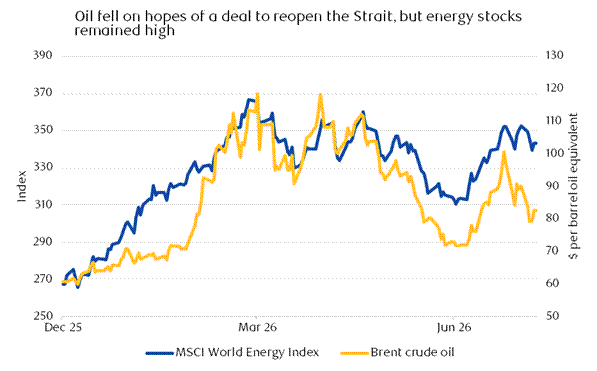
Interestingly, spot Brent crude oil is opening this morning still below Wednesday’s high although European and Asian natural gas prices are making new highs since the peak of the Ukraine invasion.

This has forced markets to reconsider their optimism about the extent of the war. Both stocks and bonds are struggling. This is a disruptive phase for markets, but there are reasons to be hopeful. The subtext of Trump’s threat to “blow up” South Pars was disapproval of Israel’s initial strike – backing up the idea that Trump wants an off-ramp, and further evidenced by a Friday White House briefing that the objectives were nearly achieved and they wanted to reestablish diplomatic dialogue. Israel has its own objectives – potentially conflicting with the US and Arab allies – but the US has a strong incentive to de-escalate. It’s nervy for markets regardless; every day without resolution looks like a bigger economic threat.

The fear factor is having strange effects on currencies and gold. Prices for the stereotypical ‘safe haven’ have dropped 10% since the war. Recent speculative gold buyers might wonder what’s going on, but we suspect it’s a liquidity grab: if gold is an insurance policy, you cash it in in emergencies.

Bonds have been mixed. Government yields are up – consistent with an inflation spike but inconsistent with a growth scare. Credit spreads are not faring badly, again inconsistent with a growth scare (excepting worse-hit Europe). It looks like some of the weaker credits were already squeezed out ahead of the oil shock.

The Fed, the BoE and the ECB all issued inflation warning – the BoE even suggesting it could raise interest rates. That’s probably more inflation expectation management than actual policy signal. The BoE will welcome marginally higher wages from February, but past data is basically irrelevant now. The Fed is projecting stability (and one rate cut this year) despite the fact the US looked more inflationary than expected even before the war.

Higher risks and tighter monetary policy mean a market liquidity squeeze, even if geopolitics improve. But underlying growth still gives reason for optimism. If energy infrastructure avoids extensive damage – and countries invest in closer and cleaner energy – it could reverse the current stagflation narrative.

China projects stability
China’s new five-year plan, unveiled at this month’s National People’s Congress (NPC) set a national growth target of 4.5%-5%, meaning 4.5%. That’s the lowest since 1991, but if the world’s second-largest economy achieved it amid population decline, it would be impressive. The NPC recognised a need to better stimulate domestic demand with a ¥100 billion “fiscal-financial coordination fund” and “appropriately accommodative” monetary policy (deficit spending is still capped at 4% of GDP). Alongside consumption support, the NPC committed to growing R&D spending 7% annually over the next five years, as Beijing accelerates its “AI+” initiative for widespread AI adoption.

We shouldn’t doubt Beijing’s commitment to boosting demand, but its ability to do so is still debatable. Its typical growth lever – production – has only worsened China’s oversupply, and an R&D push could do the same if it doesn’t change the excess savings problem. The property market overhang looks like it’s clearing up at least (back orders being completed and prices projected to stop falling) and company pricing power is finally improving. Beijing’s fiscal support is a welcome addition, but we shouldn’t overstate the spending. Much of the recent debt expansion has just been the central government taking over local government ‘shadow loans’.

Overall, the five-year plan is about stability: consumption support but no ‘bazooka’; monetary accommodation but no 2010s credit bubble. Stable is how China presents itself internationally too, amid erratic US policy. Beijing keeps talking about Taiwan, but an invasion in the medium-term would degrade China’s ‘adult in the room’ image. A strong renminbi is part of this. Beijing has guided it higher for a while, and it’s now clear that the pressures on the currency to fall are dropping away. That lessens deflationary pressures and ‘dumping’ allegations from the west. That’s helping capital inflows. Beijing will want this to continue.

Structural weakness in UK government debt
UK government bonds (gilts) are seen as more inflation-sensitive. That’s largely about the gilt market’s structural weakness: historical pension fund demand for long-dated gilts caused the government to shift issuance long-term (exacerbated by quantitative easing), leaving the UK with one of the highest average weighted maturities of any big economy. The decline of defined-benefit pension schemes lessened demand for long-term gilts, setting the scene for the ‘Liz Truss episode’ (exacerbated by quantitative tightening). The imbalance pushed the government to issue more at the short end, but that increased the refinancing risk – making government finances more sensitive to interest rates and inflation.

Then there’s the fact that around a quarter of outstanding gilts are inflation-linked – much higher than other countries. The feed-through from inflation to inflation-linkers is complicated. A short-term inflation shock doesn’t actually increase short-term debt repayments too much (they are smoothed to maturity) but it does push up the current accounting value of those repayments. An inflation shock in 2026 would be recorded, by the OBR, as a big increase in UK debt repayments, even though extra cash payments in 2026 would be small.

Volatility in reported debt repayments increases the sense that UK finances are fragile. The UK’s actual debt metrics are relatively favourable compared to other economies, but volatile perceptions mean volatile gilts. Of course, gilt pessimists might tell you it’s about flawed government policy (indeed, our measure of implied credit risk is higher for the UK than elsewhere) or propensity to increase debt amid an energy crisis. But that doesn’t make much sense when you compare likely UK policy to France or Japan, whose bonds haven’t swung as much.

Basically, the underlying metrics suggest that gilt traders overreacted to the oil shock – compared to other bond markets. You’d expect gilts to calm down, but the market is undeniably fragile.

Please continue to check our blog content for the latest advice and planning issues from leading investment management firms.

Marcus Blenkinsop

23rd March 2026

Team No Comments

EPIC Investment Partners: The Daily Update | Crude Realities

Please see below, an article from EPIC Investment Partners on the current military conflict in the Middle East and the effect on oil prices. Received today – 20/03/2026

The Federal Reserve’s meeting on Wednesday was meant to impose clarity. Instead, it left markets poorly placed for what followed the next day. By holding rates steady while signalling scant appetite to ease, policymakers set a hawkish baseline. Then came Thursday’s oil shock. As Brent crude briefly surged above $119 a barrel after attacks on Gulf energy infrastructure deepened fears of a fresh supply disruption, the Treasury market was forced to confront a more uncomfortable question: not simply whether headline inflation would rise, but whether the Fed could remain on hold as the growth outlook softened. The answer began to appear in the yield curve.

Short-dated Treasury yields rose sharply, while the long end moved far less. The curve flattened, and that matters. If inflation were the only story, the long end should have sold off much harder too. It did not. Instead, the move suggested that investors were already weighing a second reality alongside the oil shock: not just higher prices in the near term, but weaker growth further out. The message from the curve was not simply that inflation risk had risen. It was that the market was beginning to price the drag that such a shock would eventually impose.

That now looks like the more plausible interpretation. The Fed’s problem is not classic overheating. It is that inflation is once again being driven by energy rather than domestic demand. This is the least convenient kind of supply-side shock for a central bank. Higher oil lifts headline inflation and raises input costs, but it does not signal a healthier economy. It acts more like a tax on households and on corporate margins, draining spending power while undermining real activity. For the Fed, that creates a trap: inflation strong enough to delay cuts, but growth weak enough to make a prolonged period of restrictive policy steadily more uncomfortable.

This is why Thursday’s flattening should be read not as a straightforward inflation repricing, but as evidence of a policy trap. The front end repriced because investors accepted that the Fed could not credibly signal near-term cuts while oil was surging and Gulf supply risk remained unresolved. The long end, however, did not keep pace. If inflation were the dominant theme, it should have sold off more aggressively too. That it did not suggests markets were already looking beyond the immediate price shock towards its more damaging consequence: a Fed stuck on hold even as growth weakens.

That, in turn, raises the prospect that the current bear flattener is merely the prologue. If the oil shock persists, the market’s next move may not be a parallel shift higher across yields everywhere. More likely, the market eventually pivots towards a bull flattener, in which longer-dated yields fall as investors begin to price the growth damage more aggressively, even as the front end remains anchored by a Fed reluctant to ease.

For investors, the temptation is to focus on the apparent comfort of short-duration paper. Yields there look respectable again. But that comfort is conditional. It rests on the assumption that the Fed can stay on hold without inflicting greater damage on the cycle. History offers limited support for that hope when the underlying shock comes from oil rather than excess demand.

The curve, then, is saying more than the immediate reaction to a hawkish hold. The Fed set the constraint on Wednesday. Thursday’s oil shock made it binding. What the market began to price was not simply higher inflation, but a harsher combination: delayed easing in the near term and weaker growth further out.

Please continue to check our blog content for the latest advice and planning issues from leading investment management firms.

Alex Kitteringham

20th March 2026

Team No Comments

EPIC Investment Partners – The Daily Update

Please see the below article from EPIC Investment Partners detailing their discussions on stability in Japan amidst oil volatility. Received this morning 19/03/2026.

Japan’s market rally has gained significant momentum in 2026, driven by Prime Minister Sanae Takaichi’s pro-growth agenda, an overhaul of corporate governance, and a surge in foreign investment. This growth comes at a critical time as Japan navigates geopolitical energy challenges, particularly with the ongoing tensions surrounding Iran’s energy sector. Three Japanese firms now lead the MSCI World Index year-to-date.

Following the Liberal Democratic Party’s decisive election win, the Topix and Nikkei 225 reached new all-time highs, with the Topix climbing approximately 13% this year, significantly outperforming the S&P 500’s modest gains. In the wake of Takaichi’s victory, foreign investors rapidly increased their stakes, buying a net ¥1.78 trillion ($11.5 billion) in Japanese shares and index futures during the week ending February 13.

This marks the largest inflow since November 2014, indicating a significant shift toward Tokyo as global investors look for more reliable returns amidst uncertainties, including those related to energy supplies from Iran.

Sector winners reflect this new policy mix: technology, defence, energy, and construction are poised to benefit from anticipated government spending. Japanese firms like JX Advanced Metals and miners such as Sumitomo Metal Mining have seen gains due to rising metal prices, driven in part by AI demand and the need for materials critical for energy infrastructure.

As Japan seeks to diversify its energy sources and reduce dependency on Middle Eastern oil, the focus on domestic energy production becomes increasingly relevant. However, risks remain. Valuations are elevated in parts of the market, with the price-to-book ratio at a post-2008 high of 1.7x. Japan-China relations remain delicate, and US political dynamics, including limited support from President Trump for Takaichi, add to geopolitical uncertainty—especially as tensions with Iran could disrupt global oil supply chains. Bottom line: Japan has re-emerged as a compelling, policy-backed investment destination—stimulus-ready, structurally improving, and delivering standout equity performance across high-impact sectors—while necessitating careful monitoring of valuations and geopolitical risks.

Here are three concise reasons why Japan in 2026:

  • Political stability under Prime Minister Takaichi, bolstered by a ¥17.7 trillion fiscal package (part of a ¥21.3 trillion stimulus), has fuelled a domestic reflation narrative. Financials and real estate have led the market, offering a credible alternative for investors if sentiment shifts away from the US.
  • Corporate governance has progressed from mere window dressing to meaningful reform: companies are divesting non-core assets, unwinding cross-shareholdings, and implementing capital return plans. Return on equity (ROE) has improved (from approximately 8.4% to about 9%), with around 80% of prime market firms submitting improvement plans. A significant revision of the Governance Code is expected in mid-2026, indicating long-term, stock-specific uplifts.
  • The Bank of Japan (BoJ) has commenced tightening, raising rates to 0.75% in December 2025 while signalling cautious, data-driven moves.

While an oil crunch poses challenges, it can also create opportunities for growth in various sectors of the Japanese economy. Companies that adapt to the changing energy landscape and invest in innovative solutions are likely to see positive stock performance, contributing to the overall strength of the market.

Please continue to check our blog content for advice, planning issues, and the latest investment, market and economic updates from leading investment houses.

Alex Clare

19/03/2026

Team No Comments

Brewin Dolphin – Markets in a Minute

Please see this week’s Markets in a Minute update below from Brewin Dolphin, received yesterday afternoon – 17/03/2026.   

Economic impacts intensify amid conflict

We analyse how the Iran conflict is reshaping energy markets and putting anticipated interest rate cuts at risk.

Key highlights

  • Economic impacts of Iran conflict intensify: As the conflict enters an asymmetric phase, reduced tanker traffic in the Strait of Hormuz has seen oil prices cross the $100 threshold.
  • Consumer energy prices set to rise: The knock-on effects of oil price rises are already being felt in the energy sector, with consumers set to see increases in the coming months.
  • Interest rate cuts could go into reverse: Wider markets are starting to feel the impact of the conflict and interest rates, which were expected to fall, may well now rise.

Iran conflict: Asymmetric phase begins

With the conflict entering its third week, the nature of the fighting appears to be shifting along the lines we had expected. While initial U.S. and Israeli strikes successfully degraded Iran’s conventional missile and launcher stockpiles, the country’s Islamic Revolutionary Guard Corps (IRGC) has transitioned to an asymmetric campaign designed to inflict maximum economic pain rather than achieve conventional military objectives. In extremis, this can take the form of the threatened ‘decentralised mosaic defence strategy’ – a response to invasion where resistance wouldn’t require central organisation.

The current asymmetric phase involves the deployment of low-cost drones in large swarms; GPS-spoofing of tankers; small, fast boats packed with explosives; and – most critically – the reported laying of mines in the Strait of Hormuz. U.S. intelligence reports confirmed that at least some mines have been deployed; a significant escalation given that mine clearance operations can take weeks or even months. The White House also confirmed the destruction of small boats suspected of belligerence.

The economics of this asymmetric approach are striking. Iran’s Shahed drones cost less than $30,000, yet it can require multimillion-dollar interceptors to repel them. Stocks of U.S. and Israeli interceptors are starting to run low, and there is limited capacity to replenish those stocks due to what we understand to be a two-year production lead time. So, the risk is that U.S. and Israeli resilience to counter measures could eventually be degraded.

Tanker traffic effectively grinds to a halt

Tanker traffic through the Strait of Hormuz has halted, except for a limited number of vessels identified as part of Iran’s shadow fleet or those spoofing Chinese ownership. The Financial Times reported previously that some vessels are falsifying Chinese crew or ownership documentation to achieve safe passage. The market briefly swung on a false report that the U.S. navy had escorted a tanker through the Strait, although the feasibility of such a plan is believed to be very limited.

Source: Bloomberg

According to RBC Capital Markets’ Washington contacts, the White House had expected a shorter and more decisive conflict with less economic fallout. As such, U.S. and Israeli objectives remain fluid, with the possibility of ground forces apparently under consideration to recover Iran’s enriched-uranium stocks.

Israel again expressed its hope that the Iranian people would use this opportunity to rise up against the unpopular regime and that the succession of Mojtaba Khamenei as Supreme Leader – a dynastic transition widely loathed even among regime sympathisers – might increase factional opposition within Iran. However, the imposition of martial law is containing domestic unrest for now.

Will consumer energy prices rise?

Most oil coming from the Gulf would typically head to Asia, but crude oil is a global market, and prices have risen fairly uniformly. However, consumer prices of oil-based products such as petrol have very different rates of taxation, with European prices routinely far higher than in the U.S. So, while the response to the jump in crude prices will be similar, it will feel proportionally larger for U.S. consumers.

Source: IEA

While the crude price impact is unwelcome, the more worrying impact has been felt most forcefully in gas prices. Domestic gas prices in the U.S. have been barely affected but Asia and Europe are highly reliant upon liquefied natural gas where prices are more global, and these prices have risen sharply.

Consumer gas and electricity prices will reflect these moves but often with a lag. So, the UK, for example, won’t reset the utility bill price cap to incorporate current gas costs until July. And while the jump in gas prices is dramatic it still falls considerably short of the increases suffered during 2022. Should prices continue to rise, however, then governments may, as they did then, consider subsidising utility consumption. If so, that would put greater pressure on already stretched public finances.

Continued impact on bond markets and interest rates

This has been one of two factors putting pressure on bond prices, the second being interest rate expectations. Before the conflict, the UK was expected to cut interest rates twice more this year. That expectation has now morphed into an expected rate increase and, critically, mortgage rates have begun to adjust in anticipation.

This is frustrating, because data released last Friday suggests the UK economy didn’t grow during January, despite the helpful tailwinds of lower (and slowing) inflation and recent cuts to interest rates. Weakness was quite broad, but it will be the stagnation of the large service sector that causes the most angst. Ordinarily, this wouldn’t be too concerning, given the data can be revised and other indicators suggest that UK economy has been robust. However, in the context of a more challenging global environment, due to conflict in Iran and the wider Middle East, this evidence of a weak start to the year will add to concerns about the UK’s outlook for 2026.

The prevailing beneficial decline in inflation is at risk from the sharp rise in energy prices. The UK is vulnerable to rising gas prices, although it will take until July for the direct impact to reach households. Higher energy prices are likely to drain household incomes that could otherwise be used for discretionary spending. The two anticipated interest rate cuts have evaporated, and some of the impact of that is already being felt with higher swap rates, which are translating into elevated mortgage rates and providing a second dampener on domestic demand.

Please continue to check our blog content for advice, planning issues and the latest investment market and economic updates from leading investment houses.

Charlotte Clarke

18/03/2026


Team No Comments

Tatton Investment Management: Monday Digest

Please see the below article from Tatton Investment Management, discussing capital markets’ fragile optimism in the face of rising oil prices, war escalation, higher bond yields, and pressure on small‑cap stocks and private credit, received this morning – 16/03/2026.

Capital markets’ fragile optimism
Stocks pulled back into the end of last week but, given war escalation and oil prices breaking above $100pb, equities still look surprisingly sanguine. That continues to be the case as we open this week’s trading, with spot Brent crude oil above $105pb.

The move into big tech stocks could be a ‘safe haven’ move, but the bigger scare was higher bond yields – particularly the UK. Higher ‘risk free’ yields but comparatively little movement in stock prices means the bond-adjusted equity risk premium fell. Remarkably, investors see stocks as less risky, compared to bonds.

That only makes sense as a TACO trade. Trump has an incentive to end the war quickly (he’s already declared it “pretty much” over) but that doesn’t mean he can. Iran still has retaliatory capabilities, so it takes two to TACO. If the war drags on, equities look vulnerable.

Small-cap stocks are at risk from higher-for-longer interest rates. Small-cap was doing well in 2026, but even before the war, small-cap earnings growth was starting to flounder. Large cap earnings looked better, but existing problems around private credit and AI make investors nervous.

Bond yields are key. If they come down, investors will be more at ease. The standard explanation for higher bond yields is that the oil shock pushes up inflation and interest rates – but we see it more as a rise in bond risk. A long oil shock forces governments to spend more, worsening already-stretched fiscal metrics. At the start of the year, it looked like the decades-long trend of rising government debt, relative to private sector debt (a bad sign for private sector growth) might reverse. The oil shock has dashed those hopes, for now.

For bond yields to fall, oil prices need to drop back. We will have to wait and see, but in the meantime, long-term investors can arguably pick up stocks at a relative discount (given rising earnings expectations from Christmas but static prices). As Warren Buffett says, “Whether we’re talking about socks or stocks, I like buying quality merchandise when it is marked down.”

Oil price scenarios
Oil prices swung wildly last week, as Iranian strikes closed off the Strait of Hormuz and western leaders promised to release emergency oil reserves. Capital Economics wrote a useful piece outlining three different scenarios for Brent Crude prices: a two-week war and $65pb Brent by the end of 2026; a three-month war with a closed Strait but minor long-term oil production damage, with Brent peaking at $130pb but back to $90pb by the year end; and a three-month war with long-term production damage, leaving Brent around $150pb for six months. The ‘trouble now, supply later’ narrative is in line with market expectations, but we would add one unlikely worst-case scenario: the US using Iran as a long-term chokehold on Chinese energy supply, effectively dissolving the globally traded oil market.

Nothing that’s happened suggests that worst-case scenario. Iranian oil keeps flowing to China undisturbed by the US and, if anything, Washington has signalled it wants to protect tankers bound for Asia. The US also hasn’t targeted any Iranian oil production and has discouraged Israel from doing so. Iran’s strikes haven’t materially damaged Middle Eastern production either (though they hit transportation), possibly more due to regional defences than lack of desire. In any case, neither side looks likely to damage long-term production, backing up ‘trouble now, supply later’ narrative.

That’s not to downplay the disruption. We are likely to see price swings even if the Strait opens – as refineries shut down once storage tankers fill. Major oil producers like the US won’t want a sudden postwar price drop either, which is another reason why Russian sanction relief will be temporary. In the meantime, the downstream inflation impacts – on freight shipping, semiconductor manufacturing and much more – have quashed chances of global interest rate cuts. Even if the oil shock is short-lived, the supply chain shock could last longer.

Private credit crunch, not credit crisis
More and more private credit (PC) funds are halting redemptions, and last week JPMorgan said it would reduce its lending to PC firms after marking down their loan values. Retail-focussed PC funds have been the most under pressure due to their liquidity mismatch: spooked investors demand money that fund like Blue Owl can’t pay all at once, predictably spooking more investors. The inciting factor this time was AI-threatened software companies, which PC lent to more than public credit markets (which is why initially there was little knock-on to junk bonds). Illiquidity isn’t a problem in itself, but it’s a risk that is so often underplayed by investment providers and, hence, underappreciated by investors.

Many worry about a 2008-style contagion – that Blue Owl might be the next Bear Stearns. The rise in corporate credit spreads last week certainly raised the temperature, but we still don’t think it’s 2008. That’s because PC can’t create money in the way banks can; they can only redirect money that’s already in the system. So even if PC loans default, it doesn’t destroy money. Banks lend to PC of course, but banks are already exercising financial prudence by tightening this lending, as JPM showed.

That doesn’t mean everything’s fine. PC might not be the source of trouble, but they are certainly an early sign of, for example, AI disruption to software firms. The FT’s Robert Armstrong noted last week that it’s not just illiquidity, PC has a problem of low quality loans. Then there’s the fact that PC has itself become a vital source of capital for many companies. Those companies could have weathered this credit hiccup if interest rates kept falling – but the oil shock has now thrown that in serious doubt. It will be crucial to watch credit spreads in public markets from here.

Please continue to check our blog content for the latest advice and planning issues from leading investment management firms.

Marcus Blenkinsop

16th March 2026

Team No Comments

EPIC Investment Partners – The Daily Update| The Stena Imperative: Why oil will not flow the day after

Please see below article received from EPIC Investment Partners this morning.

Markets still seem inclined to believe in what might be called the day-after fallacy: the notion that once a ceasefire is agreed in the Gulf, oil flows through Hormuz will quickly normalise. That is not how shipping works. Diplomacy can stop an exchange of fire. It cannot by itself restore insurability, crew confidence or the willingness of owners to send expensive hulls through a still-contested corridor.

That is why the Stena Imperative matters. The vessel, hit by projectiles while docked in Bahrain on March 2, is not merely another products tanker caught up in regional disorder. It is part of the US Maritime Administration’s Tanker Security Program, under which a small fleet of US-flagged commercial tankers remains available to support defence fuel logistics when needed. Reuters reported after the strike that it remained in port.

More importantly, the ship has a capability that makes it strategically more useful than a standard tanker. In August 2025, after completing replenishment-at-sea operations, Stena Imperative earned CONSOL certification from Military Sealift Command. That allows it not simply to carry fuel, but to transfer fuel and cargo while underway to combat logistics vessels at sea. The American Maritime Officers union said this made it one of only three Tanker Security Program tankers to have earned that certification. Military Sealift Command describes CONSOL as a process used for underway refuelling and cargo transfer to combat logistics force ships.

That is not a trivial distinction. In a theatre where fixed infrastructure is vulnerable and operational endurance matters, a tanker able to support at-sea replenishment is more valuable than one that merely shuttles between ports. It gives planners more flexibility, reduces dependence on secure berthing and helps keep naval assets on station for longer. The incentive to restore such a vessel to service is therefore unusually high.

Which is precisely why it is such a useful signal for investors. If a ship with that degree of strategic utility is still sidelined, the market should hesitate before assuming the broader commercial fleet is on the cusp of normal passage. The binding constraint is not the text of any future diplomatic formula. It is the slower, more conservative process by which naval risk becomes commercially underwritable again. Safe transits have to occur. Escorts have to look credible. Insurers have to see evidence, not promises.

This is where the macro question becomes more interesting. Markets remain trapped in the first-round logic of an oil shock: higher crude lifts headline inflation, so central banks stay cautious and bonds struggle. But that is only the opening chapter. If Hormuz remains functionally impaired, the effect is not limited to the spot oil price. Freight costs rise, insurance premia rise, delivery times lengthen and energy becomes a broader tax on activity. Consumers lose spending power and corporate margins narrow.

That is why the more important market effect may yet be disinflationary rather than inflationary. An oil shock always looks inflationary first. What matters later is whether it also destroys demand. In an economy without strong wage indexation, that second-round growth effect can dominate. Fixed income markets have been reluctant to embrace that possibility, still treating expensive oil as though it were automatically a reason for yields to stay higher for longer.

The Stena Imperative, then, is not just an interesting shipping story. It is a test of how quickly Gulf logistics can move from military urgency to commercial normality. If even a strategically valuable tanker with rare at-sea refuelling capability cannot yet be restored to useful service, investors should be wary of assuming that Hormuz is one diplomatic headline away from reopening in any meaningful sense. The market may be focused on the ceasefire. It should spend rather more time watching the ships.

Please check in again with us soon for further relevant content and market news.

Chloe

13/03/2026


Team No Comments

EPIC The Daily Update | CATs Out The Bag

Please see today’s Daily Update from EPIC Investment Partners:

The growth of Catastrophe (CAT) bonds and the wider Insurance-Linked Securities (ILS) market reflect an evolving approach within global financial centres, including London, to managing risks that are difficult to hedge through conventional markets. Unlike traditional equities or corporate bonds, whose performance is closely linked to economic growth, interest rates and earnings cycles, CAT bonds are tied instead to specific external events; most commonly natural disasters or operational disruptions. This characteristic has drawn increasing attention from institutional investors seeking assets whose returns are largely uncorrelated with broader financial markets, particularly during periods of heightened volatility.

At a basic level, a CAT bond is a form of high-yield debt issued by an insurer or reinsurer to transfer the financial risk of a large-scale loss event to capital market investors. These events might include severe flooding, major storms, earthquakes or, increasingly, systemic cyber incidents affecting critical infrastructure. Investors receive periodic coupon payments during the life of the bond, but if the predefined disaster occurs, some or all of the principal may be written down and redirected to help the insurer meet claims. In essence, investors assume the risk of the event in exchange for the potential return.

One of the more notable developments in recent years has been the gradual shift in how these risks are structured. Historically, many CAT bonds relied on indemnity triggers, meaning payouts were based on the insurer’s realised losses after an event. More recently, there has been growing use of parametric triggers, where a payout is automatically activated once a measurable parameter, such as wind speed, rainfall levels, or the duration of a power outage, exceeds a predetermined threshold. Because these triggers rely on objective data rather than post-event loss assessments, they can enable quicker access to funds following a qualifying event.

The UK has also taken steps to support the development of this market through its Risk Transformation Regulations, which were designed to make London a competitive domicile for ILS structures. This regulatory framework has facilitated the creation of more streamlined vehicles that allow insurers, reinsurers and specialist syndicates to transfer specific risks to capital markets.

Taken together, these developments illustrate how capital markets are increasingly being used to distribute large-scale catastrophe risk more broadly across investors. Rather than replacing traditional insurance, instruments such as CAT bonds represent another mechanism through which financial systems attempt to absorb and manage the growing costs associated with environmental and technological disruption.

Please continue to check our blog content for advice, planning issues and the latest investment market and economic updates from leading investment houses.

Andrew Lloyd

12/03/2026