Team No Comments

Brewin Dolphin – Markets in a Minute

Please see this week’s Markets in a Minute update below from Brewin Dolphin, received yesterday afternoon – 18/03/2025.

Why are U.S. equity markets declining?

We examine the impact of the Trump administration’s trade policies on the equity markets and businesses.

Last week saw dramatic escalation and then de-escalation in U.S. President Donald Trump’s global trade war.

After the imposition of 25% tariffs on steel and aluminium imports—measures that will severely hurt Canada’s metal production sector and mean higher metals prices for American manufacturers—Canada’s Ontario premier Doug Ford announced he would impose a 25% surcharge on electricity supplied by Canada to America’s northern states. The response? President Trump declared he would double the tariff on Canadian steel.

Both sides have since withdrawn. The 25% tariffs remain in place.

The European Union announced its retaliatory tariffs, which will come into effect in April should the U.S. import taxes remain in place. President Trump again signalled he would retaliate if the EU implemented these tariffs.

By April, there may be more tariffs on EU exports to the U.S. This will depend on U.S. investigations into the need for reciprocal tariffs to counter any trade restrictions that other countries are deemed to have put in place, including value added tax (VAT).

From ‘Trump bump’ to ‘Trump slump’

Trump Election Markets effect

Source: LSEG Datastream

There have been two distinct phases to the market action since last year’s U.S. election.

The first was a repeat of the ‘Trump bump’ experienced in his first term. This took place after the election result confirmed there would be a second Trump term. Investors reacted to the prospect of a Trump presidency, anticipating benefits such as reduced regulation and the possibility of tax cuts.

However, even during the last stages of the Trump bump, European equities had begun to pick up steam and following his inauguration, the Trump bump has become a Trump slump! European equities have broadly managed to continue rising despite a sharp sell-off for global equities, which is almost entirely driven by the U.S.

U.S. exceptionalism has been a remarkable trend over a long period. The U.S. began outperforming following the great financial crisis in 2007-2008. Several stars had aligned for this. The U.S. tech sector finally emerged from the shadow of the tech bubble. Meanwhile, Europe suffered from a debilitating debt crisis and saw a slowdown in China and other emerging markets, which had been strong markets for European exports for many years.

As the economy continued to digitise, America’s economy outperformed. It was aided by more favourable demographics, fortuitous natural resource wealth, a dynamic business environment, and capital inflows from other countries, which kept borrowing costs low despite constant budget deficits.

Global Trade effect from American markets

Source: LSEG Datastream

Many of the conditions that have allowed the U.S. to rise to the top of the pack are being challenged by the Trump administration’s unironic pledge to Make America Great Again. Could populism force the world’s biggest economic success story to give up its crown?

The odds still seem strong for America to remain exceptional.

Its geographic benefits are outstanding from a geopolitical and economic perspective because it’s easily defensible and accessible to trade, with incredible natural resource wealth. Europe, on the other hand, is fragmented, with a Russian aggressor on its doorstep.

The largest U.S. companies have remarkable monopoly power and an unrivalled position in the coming artificial intelligence revolution. There’s controversy about how highly their leadership position should be valued, but the fact they’re the leaders is beyond debate.

How are tariffs affecting business sentiment?

Trump government small business effect

Source: LSEG Datastream

There has been a meaningful sell-off in U.S. equities despite there being little evidence of economic weakness from companies and economic statistics. However, surveys hinted that change is afoot.

A couple of weeks ago, anecdotal comments within the purchasing managers indices (PMIs) indicated a more nervous business community.

Last week, this sentiment was reflected by the National Federation of Independent Businesses (NFIB), which had originally cheered the arrival of a new Republican administration. It still considers now a better time to expand its businesses than at most points during Joe Biden’s presidency, but it’s noticeably less ebullient about it now than just weeks ago.

That’s because the threat of tariffs is likely to mean higher costs, with the risk of disrupted supply chains and, for those who export, the possible imposition of retaliatory tariffs. For many companies, there’s no choice but to pass those additional costs on to clients.

In the long term, some companies have pledged to move manufacturing into the U.S. as President Trump wants. But building new plants for manufactured goods typically takes years, so there’s no quick fix to this threat if the tariff is going to remain until companies have genuinely shifted their production.

The potential impact of tariffs is difficult to quantify, especially as the specific targets, levels and duration of the measures remain uncertain, but we shouldn’t be too concerned by dramatic shifts in survey data. There have been instances of surveys suggesting very pessimistic economic outcomes only to rebound when respondents have a better idea of what the new business environment is going to be like. Brexit would be a good example of this.

The immediate impact of these tariffs will be far more material than the years of inaction over Brexit, but that doesn’t prevent people from overreacting in surveys.

Peak bearishness – prime buying opportunities?

Investor Anxiety Levels

Source: LSEG Datastream

The American Association of Individual Investors (AAII) business sentiment survey has been a terrific barometer of stock market overreaction in the past. It has now risen to levels that have been associated with some of the most timely ‘bottoms’ in the stock market over recent decades.

Peaks in bearishness, as per this measure, that were recorded in March 2003, March 2009 and September 2022, were all tremendous buying opportunities for the coming years. In each of those instances, the market was considerably more depressed than it is at the moment, so we probably can’t expect the dramatic gains they offered. But it does indicate that the tariff message has hit investors hard, which sets up the potential for a rebound.

Please continue to check our blog content for advice, planning issues and the latest investment market and economic updates from leading investment houses.

Charlotte Clarke

19/03/2025

Team No Comments

Brooks Macdonald – The Daily Investment Bulletin

Please see the below article from Brooks Macdonald detailing their discussions on Equity markets and current geopolitical affairs with Trump and Putin. Received this morning 18/03/2025.

What has happened

Equity markets carried over Friday’s bounce for a second day yesterday. Encouragingly, there was a broadening-out across industry sectors – the US S&P500 equity index was up +0.64% but the equal-weighted version was up by more, rising +1.32%, while the pan-European STOXX600 equity index was up +0.79% on the day, all in local currency, price return terms. In commodity markets, Brent crude oil prices are currently up +1.15% this morning at US$71.89 per barrel on Middle East news that Israel has launched a series of airstrikes against Hamas targets in Gaza overnight, ending the two-month long ceasefire.

Geopolitics sees today’s date loaded with symbolism

Russia President Putin and US President Trump are set to hold telephone talks later today, aiming at ending the Russia-Ukraine conflict. Trump has held out hope that there is “a very good chance” for a deal, with the US still pressing Russia to agree to a 30-day ceasefire, while Russia appears to be holding out on a number of conditions to accompany any agreement. For context, today’s date is significant for Russia – loaded with symbolism, 18 March is the annual date that Russia celebrates its 2014 “reunification” with Crimea.

US retail sales data is just about-good-enough

US retail sales data yesterday was just-about-good-enough to assuage investors’ worries that Trump’s trade-tariffs might already be curbing economic activity. While the headline all-items print was a bit disappointing, excluding automobiles, gasoline, building materials and food services, a “control group” core retail sales sub-index was up +1.0% in February month-on-month. That was better than the consensus market forecast which had been looking for a rebound of +0.4% – it also brings the three-month annualised growth of this core retail “control group” to +3.8%.

What does Brooks Macdonald think

Hopes for a successful Russia-Ukraine peace-deal led to a fall in European natural gas prices on Monday, down more than -3% at one point intraday. That price action makes sense – if the war in Ukraine ends, it raises chances that Russia could come back into the western energy-supply mix and help fill European Union (EU) gas reserves which are currently only around 35% full. Falling energy prices could also help to lower broader inflation pressures, a possibility likely not lost on the minds of central bank officials this week as they think about where to set interest rates.

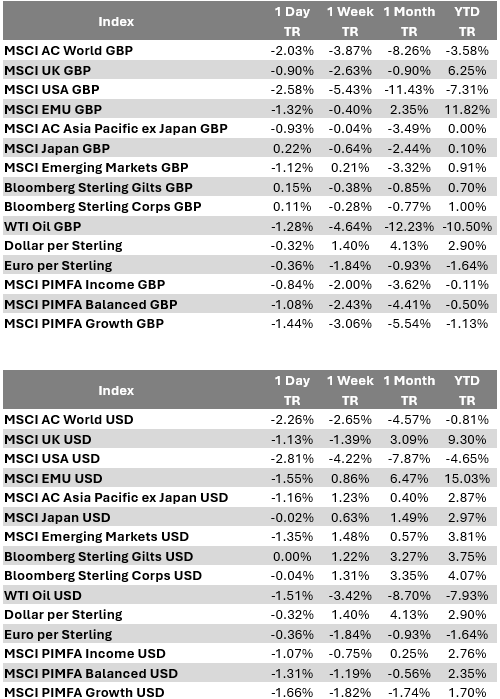
Bloomberg as at 18/03/2025. TR denotes Net Total Return.

Please continue to check our blog content for advice, planning issues and the latest investment market and economic updates from leading investment houses.

Alex Clare

18/03/2025

Team No Comments

Tatton Monday Digest – Just Another Growth Scare, or More?

Please see below, this weeks Monday Digest from Tatton Investment Management – Received 17/03/2025

Just another growth scare, or more?
The stock market sell-off has resumed and US equities are officially in correction (-10%). US inflation was lower than expected, which usually pushes down bond yields, but the opposite happened – demonstrating that capital is flowing out of the US. The rapid sentiment shift from a month ago suggests we could see a bounce – but ‘buy the dip’ will only prevail if investors think the US outlook hasn’t fundamentally changed. We must stay level-headed. Companies themselves aren’t yet signalling earnings deterioration, even if macroeconomists are.

European stocks sold off too, having previously been unscathed. It’s a recognition that a slowing US and sharp Trump tariffs hurt everyone – regardless of the growth boost from defence spending. The previous European rally still has room to run (the dollar is still historically expensive) but there may not be as much room for fiscal expansion outside Germany as hoped. The UK is a case in point: Downing Street is signalling spending cuts to fund defence, rather than new borrowing. We also shouldn’t be surprised if the Spring statement includes extra tax rises. 

Markets are still focussed on the US and Trump, not just his tariffs but his spending cuts – which are now clearly impacting Americans’ confidence. We argued before that Trump is likely respond with stimulative policies, and progress is being made on his “big, beautiful bill” of tax cuts. But things could get worse before they get better, if Trump picks an unnecessary fight with the Federal Reserve. Still, the US fundamentals are still strong, even if the sequence of policies has damaged confidence. 

At the bottom-up level, analysts think profits will be strong, and these should be helped by tax cuts and deregulation. In these challenging times, investors should focus on the fundamentals. This is especially so for investors buying in now at a discount. To quote Warren Buffett on stocks and bonds: I like buying quality merchandise when it is marked down.  

Trump’s best laid tariff plans
With Trump’s tariffs now in place, the media spotlight has focussed on a paper from White House economic adviser Steven Miran, which explains their rationale: “A User’s Guide to Restructuring the Global Trading System”.

Miran’s central point is that the dollar’s reserve status makes it unnaturally strong, rendering US exports uncompetitive and destroying American industry. He thinks tariff threats can get concessions from other nations because of this. But Miran also argues that tariffs wouldn’t cost consumers because they make the dollar stronger (as money goes into the US to build production) and neutralise costs. That’s the first stage of the plan, but the endgame (once short-term cost impacts have worn off) is a “Mar-a-Lago Accord” to artificially weaken the dollar and address what Miran thinks is the underlying cause of the US trade deficit.

The plan has so far tripped at the first hurdle: the dollar is weaker, not stronger, because exchange rates are more about capital markets (who are scared of Trump’s restrictive policies) than trade. Miran assumes American economic and currency supremacy is fixed – but the US’ economic strength comes from the very openness that his administration is now trying to close. This isn’t just a Trump phenomenon; global central banks have been diversifying away from the dollar since Biden froze Russia out of the dollar payments system.

Miran’s theory is debatable, but the biggest problem is its implementation. The paper explicitly says that a tariff plan needs transparency and consistency, but Trump’s will-he-won’t-he approach is the exact opposite. Tariffs are just one part of Trump’s agenda, and the other parts (deportations, forcing Europe to build its military, cutting off China) plausibly work against the tariff plan. Unpredictability is a feature of Trump’s “art of the deal”, not a bug. But complicated trade plans and short-term manoeuvring do not mix.

Will private equity problems stay private?
It hasn’t got much attention amid the current US market sell-off, but the big private equity (PE) firms are doing very badly. PE has always been correlated with small and mid-cap stocks – since PE firms usually buy up those size companies and sell them on years later. US growth expectations (and hence earnings expectations) have deteriorated, so you would expect PE to have a harder time. But the interesting thing is that PE firms’ price-to-earnings valuations have fallen sharply – by a similar margin to the technology mega-caps. This suggests that markets’ fears about US growth are even more pronounced in PE than listed equity.

This seems to be about liquidity troubles, not just growth fears. Monetary policy is still historically tight, and PE’s assets under management contracted in 2024 for the first time since 2005. PE managers are now branching out to retail-oriented sources like ourselves to offer their products, because the traditional PE money (wealthy families and pension funds) is harder to come by. The liquidity squeeze isn’t huge, but it has been enough to stifle PE activity – and it is now hurting the share prices of the biggest firms. 

The important thing to watch will be whether these problems spread beyond the PE sector. PE’s growth over two decades has distorted stock markets by buying up small and mid-cap companies at high valuations – and the process has been largely debt-fuelled. The PE expansion has been able to continue for so long because the money has kept flowing in – but that is no longer true. The contraction could just be a blip, but we have been concerned about the risks PE poses to the broader system for a while. The fall in PE firms’ shares isn’t an alarm bell, but it’s a warning. We hope private equity’s problems stay private.

Please continue to check our blog content for the latest advice and planning issues from leading investment management firms.

Marcus Blenkinsop

17th March 2025

Team No Comments

Brooks Macdonald Daily Investment Bulletin

Please see below article received from Brooks Macdonald this morning, which provides a global market update for your perusal.

What has happened

Markets had a better day yesterday despite ongoing trade tariff worries, helped by a lower US consumer inflation print. The US S&P500 equity index rose +0.49%, the ‘Magnificent 7’ megacap tech group bounced +2.27% to their best day in 6 weeks, and the pan-European STOXX600 equity index gained +0.81%, all in local currency price-return terms. The VIX ‘fear’ index (a US S&P500 equity-options-derived volatility gauge) registered its biggest one-day drop so far this year.

Weakest US core inflation in almost 4 years

The latest US Consumer Price Index (CPI) monthly report for February landed yesterday, buoying risk assets. Both headline (all-items) and core (excluding energy and food) numbers surprised on the downside. The annual headline CPI rate of +2.8% (below +2.9% expected, and versus +3.0% in January) was the weakest since November, while the core CPI annual rate of +3.1% (below +3.2% expected, and versus +3.3% in January) was the weakest print in almost 4 years – since April 2021.

Bank of Canada cuts interest rates

The Bank of Canada (BoC) cut interest rates by 25 basis points yesterday, taking rates down to 2.75%. The move was in line with market expectations and brings the tally of cumulative cuts to 225bps in less than a year since the first BoC cut back in June 2024, when rates were at 5%. Referencing the latest US-Canada trade tariff uncertainty, the BoC said that “heightened trade tensions and tariffs imposed by the United States will likely slow the pace of economic activity and increase inflationary pressures in Canada”.

What does Brooks Macdonald think

There is a tug-of-war around the outlook for the US going on in markets currently. On the one hand, the latest economic data all suggest a US economy which is still far from stagflation: S&P’s US Manufacturing PMI (Purchasing Managers’ Index) survey saw the strongest reading in almost 3 years, since June 2022; the JOLTS’ (Job Openings and Labour Turnover Survey) US worker voluntary ‘job-quits’ were the highest since July 2024; and US annual core CPI inflation was the weakest in almost 4 years, since April 2021. Against this, US president Trump’s continued trade tariff headlines are clearly sapping investor confidence and causing sizeable market jitters – the risk is that the longer this goes on, the greater the likelihood that it could start to show up in economic activity data. For now, predictions of an imminent US recession are, thankfully, still wide of the mark.

A table with numbers and text

AI-generated content may be incorrect.
A table of currency exchange rate

AI-generated content may be incorrect.

Please check in again with us soon for further relevant content and market news.

Chloe

13/03/2025

Team No Comments

Brewin Dolphin – Markets in a Minute

Please see this week’s Markets in a Minute update below from Brewin Dolphin, received yesterday afternoon – 11/03/2025.

On Tuesday last week, the U.S. imposed 25% tariffs on most imports from Mexico and Canada. The exceptions to this were potash (a fertiliser used in farming) from both countries and energy products from Canada, which would be tariffed at a reduced rate of 10%.

Canada, however, has been quick to react with retaliatory tariffs, including an export tariff on the electricity it provides to northern U.S. states, which is designed to impose a real cost on U.S. consumers. Over the weekend, former governor of the Bank of Canada Mark Carney successfully contested the leadership of the Liberal party and will soon become prime minister. 

Referring to the trade war, Carney said “We didn’t ask for this fight, but Canadians are always ready when someone else drops the gloves.”

Earlier today, in response to those retaliatory measures, U.S. President Donald Trump announced that tariffs on Canadian aluminium and steel would be increased to 50% on 12 March.

By last Wednesday, it seemed there would need to be an exemption for the car industry, because many products cross the border several times during the manufacturing process. Car makers argued that subjecting their cross-border supply chain activity to tariffs that European and Asian carmakers don’t suffer from puts America at a disadvantage. It’s unclear why this took until Wednesday to recognise because it had been widely discussed during the presidential campaign.

An exemption was granted on Thursday for goods traded under the United States-Mexico-Canada Agreement (USMCA) – the agreement negotiated by President Trump’s first administration.

Investors are bracing for the impact of President Trump’s erratic trade policy. This U-turn on Mexican and Canadian tariffs follows an eleventh-hour decision last month to defer their implementation until 4 March. The president lauded the progress made in the fight against fentanyl imports since the tariffs were first threatened. However, he promised there won’t be another deferral in April, when reciprocal tariffs on Mexico and Canada are due to come into effect following a review.

The seemingly endless stream of deferrals and modifications to the Canadian and Mexican tariffs follow February’s attempt to end the tariff exemption on small packages (which had to be temporarily halted due to logistical challenges related to enforcement).

It’s surprising that these challenges hadn’t been foreseen. However, the Trump administration has seemed to be in a state of disillusionment over the effect of tariffs and trade. President Trump believes companies in another country selling goods to Americans are effectively ripping America off, and that producers pay tariffs; overwhelmingly, it’s consumers who pay them. This is not a widely held opinion.

The art of the deal war

Perhaps what’s most surprising about his approach is his apparent desire to go after all other countries at once (assuming he follows through with promised reciprocal tariffs in April).

Analysts acknowledged ahead of the election that the U.S. would be in a strong position to negotiate with other countries under the threat of tariffs because trade doesn’t actually make up a particularly large share of the U.S. economy. However, it seems this position of strength is being squandered.

Other countries may trade more, but if the U.S. imposes tariffs on all trading partners simultaneously, as President Trump seems to be suggesting, and if those trading partners impose counteracting tariffs, this raises the amount of U.S. trade subject to tariffs relative to peers, who’ll be trading largely tariff free between each other.

Thousands of years of military strategy, dating back to Sun Tzu’s text ‘The Art of War’, contains variations of the idea that the best path to success is to ‘divide and conquer’. Whilst not a warrior, the Trump administration seems more willing to unite its rivals. Perhaps it’s telling that in his negotiating guide ‘The Art of the Deal’, Trump never really addresses the power dynamics that come from collective or individual negotiations (despite this being a tried and trusted path to negotiating success).

The effects seem telling. Business surveys have shown a marked deterioration in confidence. In some cases, this has been reflected in less activity. In others, the shoe seems likely to drop in coming months. Companies struggle to explain how they’ll react to tariffs because they don’t know what these tariffs will be.

It seems reasonable to believe that a company might be more willing to invest in a new U.S. plant than a non-U.S. plant given the threat of tariffs. However, the decision to invest at all might be in question if you don’t know what tariff you’ll pay on imported components, or how much of a tariff advantage there is to invest in the U.S., relative to the much higher labour costs.

The only certainty is uncertainty

Some business surveys include anecdotal comments from submitters. Almost all of them are negative at the moment, and most of them cite tariffs as the reason for anxiety. An example that stands out from the Institute for Supply Management (ISM) manufacturing survey says: “Management now has us running scenarios to project tariff impacts to our business. They want numbers in 24 hours on variables that equate to a wild guess. Interesting times we live in.” This shows how difficult it is for companies to make decisions when the taxation of imports changes almost by the day.

A number of retailers reported earnings last week, and so the topic of tariffs came up with management. Very few companies have anything significant to say in terms of their mitigation strategies. Commentary tends to make trite references to leveraging global buying power and focusing on value for customers. Very few know exactly what the impact will be or can do much about it in the short term.

There has been some evidence of a slowing U.S. economy. The Citigroup Economic Surprise Index edged below zero, suggesting the economy was performing worse than expected.

Perhaps most extraordinarily, the Federal Reserve of Atlanta’s current estimate of gross domestic product (‘nowcast’), known as GDPnow, fell sharply at the beginning of last week. The biggest detractor came from the sharp increase in imports. Imports reduce GDP while exports increase it, but as businesses anticipate an increase in tariffs, they try and buy ahead of the tax increases. That effect should reverse in coming months, notwithstanding the constantly moving tariff environment.

U.S. consumer confidence drops

However, beyond this, there also appears to have been a more pronounced drop in consumption. This seems likely to reflect an increase in economic caution.

Reduced retail sales and weaker confidence surveys have been the clearest indications that the economy is turning. The U.S. labour market broadly held firm. The non-farm payroll report showed employment creation was weaker than expected and the unemployment rate rose unexpectedly. However, some of that impact is due to a higher-than-average number of workers being unable to work due to bad weather.

Government employment will receive lots of scrutiny as the impact of the Department of Government Efficiency builds. So far, federal government employment was only down by 10,000 jobs in February, but next month will be a better test.

There was some reassuring news on inflation, with lower-than-expected wage growth. Given the weak economic data momentum recently, this firmed up bond markets’ expectations of three rate cuts from June this year.

Forget MAGA and get MEGA

Whilst President Trump’s activities may be dampening economic activity in the U.S., they seem to be accelerating it in Europe.

An acrimonious meeting between President Trump and Ukrainian President Volodymyr Zelenskyy saw the U.S. halting aid and ending intelligence sharing with Ukraine. The move was a devastating blow to Ukrainians and a boost to Russia. It had a galvanising effect on Europeans.

On Tuesday evening, German leaders announced their intention to reform the constitutional debt brake to essentially allow for open-ended borrowing for defence. It would also allow for the creation of a €500bn special purpose vehicle for infrastructure investment. 

The announcement came on the same day that European Commission President Ursula von der Leyen proposed her ‘ReArm Europe’ plan. The plan includes providing loans to member states to buy military equipment and, more importantly, a commitment to trigger the European Union (EU)’s national escape clause. This would prevent military expenditure from being counted in the bloc’s punishment mechanism for countries breaching EU spending limits. 

So, while Trump is trying to Make America Great Again, it’s also time to Make Europe’s Guns Again. Hardly a reassuring thought but one that has boosted the equity market and pushed down European bond prices.

There are immense challenges around increasing defence spending at a time when European countries have very stretched public finances. France’s government fell last year after struggling to pass tax increases to try and restore its fiscal poise.

Aerospace and defence companies can be challenging investments as they are inherently unpredictable, have complicated accounting, and rely on government orders. Following the recent rally, European defence stock valuations appear generous and are vulnerable to headline risk, so we’re not inclined to chase this rally.

However, stepping back, increased European defence and infrastructure spending may have longer-term benefits for European indices beyond the defence sector, so we’ve raised our allocation to European equities.

We also cut our gold weighting slightly, remaining overweight. The conditions supporting gold remain broadly in place. It could be sensitive to a further rise in bond yields, but recently, gold has been relatively resilient in the face of yield movements. Instead, it seems to be driven more by being bought by central banks seeking to reduce their dependence on U.S. dollars.

There’s little indication of that trend changing, but in recognition of the extremely strong performance from gold, we thought it was prudent to take some profits.

What’s coming in the week ahead

This week, the economic landscape will be filled with key events that will likely shape market expectations and investor sentiment.

We’ll see the release of several significant economic indicators, including China’s inflation rate, Germany’s balance of trade, and the U.S. Job Openings and Labor Turnover Survey, inflation rate, and producer price index. These data points will provide valuable insights into the current state of the global economy and will likely influence monetary policy decisions and market trends.

The Bank of Canada’s interest rate decision and the UK’s GDP growth rate will also be closely watched. 

In terms of corporate earnings, this week will see reports from several major companies, including Oracle, Ferguson, Adobe and Inditex. Investors will be watching these reports closely for signs of growth and guidance – although for some companies, the tariff confusion will complicate this.

If recent weeks are anything to go by, scheduled releases from companies and statisticians will be overshadowed by the latest erratic action from President Trump. 

Please continue to check our blog content for advice, planning issues and the latest investment market and economic updates from leading investment houses.

Charlotte Clarke

12/03/2025

Team No Comments

Brooks Macdonald: Daily Investment Bulletin

Please see below, an article from Brooks Macdonald providing a brief analysis of the key factors currently affecting global investment markets. Received this morning – 11/03/2025:

What has happened

Continued uncertainty in markets around US president Trump’s global trade tariff plans came home to roost on Monday. With fears that tariffs might curb economic growth yet stoke inflation pressures, equity share prices dropped, and government bond prices rose. However, rather shaping up as blanket risk-off move, there was some rotation into the more defensive parts of the market in evidence: global equity defensive sectors including Healthcare outperformed the wider market on the day, beating Technology stocks.  In fixed-income markets, credit spreads saw a noticeable widening, with US high-yield spreads (versus US government bonds) posting their widest levels in six months.

US megacap technology stocks lead the day’s losses

The US megacap technology ‘Magnificent Seven’ group (made up of Alphabet, Amazon, Apple, Meta Platforms, Microsoft, NVIDIA and Tesla) were among the biggest falls on Monday. Falling -5.41%, the group fell into bear market territory, defined as a fall of -20% or more versus the previous peak in December, now down -21.75% in dollar price return terms. More broadly, however, markets have seen some rotation into defensive sectors in recent weeks – indeed, so far this year in sterling total return terms across MSCI World (developed markets) sectors, while Technology is down -13.15%, Healthcare is up +4.02%.

A setback for German fiscal plans

Germany’s latest plans for releasing the country’s fiscal ‘debt brake’ in order to allow for infrastructure and defence spending got a setback on Monday. The Green Party yesterday said they would not support amending the constitutional debt brake – that matters as given the share of the various parties’ seats in the current German parliament, the Green’s votes are needed to secure the two-thirds vote majority required to overturn the rule. Rather than a hard ‘no’ however, this appears more a negotiating tactic, as the Green Party left the door open to further talks and added that they would introduce their own legislation, expected to ensure that any spending also includes a share for climate change projects.

What does Brooks Macdonald think

Megacap technology stocks have played a big part of the broader US and global equity market rally in recent years, but as a result it has led to some uncomfortable concentration risks with equity indices dominated by just a few tech giants. We have been mindful of this for some time – at the beginning of last year our asset allocation committee added to US small and mid-cap stocks rather than increase our allocation to larger capitalised stocks and megacap tech names in particular. While Technology is one of our two key global equity themes (alongside Healthcare), given our preference for diversification we are underweight the ‘Magnificent Seven’ group of stocks relative to our PIMFA benchmarks across all five of our client-risk band models.

A table with numbers and symbols

AI-generated content may be incorrect.

Bloomberg as at 11/03/2025. TR denotes Net Total Return.

Please continue to check our blog content for the latest advice and planning issues from leading investment management firms.

Andrew Lloyd DipPFS

11th March 2025

Team No Comments

Tatton Monday Digest – The Return of Regional Divergence

Please see below, this weeks Monday Digest from Tatton Investment Management – Received 10/03/2025

US stocks fell once again last week, while European and Chinese shares did well. The background to this was a spike in European bond yields and more political uncertainty from the Trump administration.  

European stocks jumped on Germany’s larger-than-expected defence spending package, because European manufacturers have struggled for years and have spare capacity. Firing up the factories will boost growth, even if the goods don’t get used. The real hope, though, is developing economically productive tech and ensuring genuine European cooperation (discussed below). The fiscal boost sent European bond yields sharply higher, which may be uncomfortable for fixed-income investors, but this is ultimately more a growth story than a debt scare. 

Elsewhere, Trump imposed tariffs, then took them off again. The administration’s tariff rationale is that they reduce US demand for imports and draw in capital to build US based factories – boosting the dollar and neutralising the impact on consumers. But in reality, the dollar has weakened, because of the impact on market sentiment (and hence capital outflows). The only way to reduce the US trade deficit (Trump’s stated aim) in the short-term is to reduce US demand, but strong demand is what makes the US economy strong. More generally, the White House’s tariff plan requires consistency and forward-planning – the opposite of Trump’s volatile policymaking. 

Trump has always been politically volatile, but his economic policies used to be reliably market-friendly, which no longer seems to be the case. This makes US stocks more risky, but it doesn’t mean you should put all your money in European defence. A few months ago, the story was about US outperformance – and that could come back if Trump decides to make good on his tax cut and deregulation promises.  

In an uncertain and fragmented world, diversification is your friend. That has always been central to our long-term investment strategy, and it’s important now more than ever. For want of a better phrase, keep calm and carry on.  

February asset returns review 

February saw a notable change of fortunes for investors. Global stocks dropped 1.9% in sterling terms, while bonds gained 1.2%. The equity fall was largely about US underperformance, while British, European and Chinese stocks meaningfully gained. Last year, investors were excited about Trump’s tax cut and deregulation agenda. Those haven’t come, but tariff threats and disruption have. US stocks fell 2.6% in response, and the dollar sank. Gold prices rose on a mixture of geopolitical fears and supply imbalances. 

Despite political fears, European stocks gained 2.3% last month – concentrated on defence stocks expected to benefit from Europe’s rearmament. European bullishness was not just about defence, but second round growth impacts and capital flows from US markets. UK stocks also rose 2% in February, and are well-placed to benefit from European defence spending. Impressively, UK equity has now outperformed the US on a 12-month basis.  

China was February’s best performing region, up 9.9% in sterling terms. Growth is improving, thanks to government stimulus – and the release of low-cost AI model DeepSeek suggested their may be more to come. Chinese stocks are, remarkably, now the best performers on a 12-month basis, but investors should be wary of overexposure. Chinese assets are still down on a five-year basis, and Beijing’s fondness for intervention makes them fundamentally risky.  

Global bonds performed well in aggregate, with the biggest contribution coming from a fall in long-term US yields, while UK and European yields remained stable. But we should note that the beginning of March has seen more bond volatility.  

Commodity prices fell 2.6% in February, due to tariff risks and lower oil prices. Oil’s fall is not just about trade wars but Trump’s plan to boost US oil production. By contrast, industrial metals like copper performed relatively well, due to Chinese growth expectations.  


Can guns generate growth for Europe? 

Europe’s historic defence spending agreements are expected to boost the continent’s growth. German Chancellor-in-waiting Friedrich Merz announced a plan to exempt military spending from the country’s constitutional debt limit last week, along with a €500bn infrastructure fund. This was followed by 26 EU countries (excluding Russian-allied Hungary) agreeing the European Commission’s €800bn plan.  

Defence companies will see the biggest upside – showcased by Rheinmetall shares nearly doubling year-to-date – but the fiscal spree is forecasted to boost the economy overall (by 0.6 percentage points per year, according to the Kiel institute). That’s why broad European stocks have outperformed the US this year. 

Growth benefits can only come if the defence spending stays in Europe – rather than just buying American equipment. That’s true for both short-term revenues and any long-term gains from technological developments, but the rise in US defence stocks suggests investors aren’t fully convinced that will happen. Nonetheless, we suspect European leaders will be desperate to spend the money on domestic industries.  

The UK has an established defence industry so is well-placed to benefit – but it clearly doesn’t have the same production capacity as the US. Defence spending could therefore be inflationary, as rapidly increasing demand for limited supply is a recipe for price rises. This could lead to a tighter European Central Bank – potentially undermining the growth upside. Politically, though, the ECB will not want to undermine the war effort, so we should expect some leeway. 

The real long-term benefit for Europe could be closer cooperation. The EU’s lack of common fiscal policy has long been a barrier for the economy. But once nations agree on joint defence funds, agreeing on other spending might get easier. Germany’s infrastructure fund is a case in point. This is a unifying event for a continent that has sorely lacked unity. We hope that spirit can continue.

Please continue to check our blog content for the latest advice and planning issues from leading investment management firms.

Marcus Blenkinsop

10th March 2025

Team No Comments

EPIC Investment Partners: The Daily Update – Reality Check: Payrolls and the Fed’s Next Move

Please see the below article from EPIC Investment Partners detailing their thoughts following the release of the ADP Employment Report published earlier this week. Received this morning 07/03/2025.

Today’s non-farm payroll report could play a pivotal role in influencing the future path of US interest rates. The ADP employment report, published earlier this week, revealed private-sector employment rose by only 77,000 in February—significantly below the forecast of 148,000. This stark shortfall, particularly if replicated in today’s payroll release, could raise serious questions about hiring momentum and overall economic resilience. While the decline in yesterday’s initial jobless claims might suggest some stabilisation in the labour market, these figures have yet to capture the anticipated government layoffs tied to the DOGE incentive scheme, leaving the true state of employment somewhat obscured.

Trade policy remains an additional concern. Structural imbalances are evident in the US trade deficit, which reached $131.4 billion in January and has exceeded $100 billion in several months over the past year. While some of this deficit stems from front-running of tariffs, it also reflects an overvalued dollar and declining competitiveness, compounded by China’s manufacturing dominance and persistent US energy dependence. Tariffs, rather than directly reducing imports, tend to shift supply chains and act as an additional cost burden, thereby constraining economic growth.

The convergence of weak ADP figures, a sharply lower forecast for GDPNow—which currently predicts the US will contract by 2.4% in Q1 2025—and rising tariffs and geopolitical concerns all point to a weakening economic environment. Even if today’s payrolls do not show the sharp slowdown evident elsewhere, it will not alter the fact that growth expectations are weakening significantly across many sectors of the US economy.

For the Federal Reserve, these intertwined signals—weak job growth, evolving GDP projections, higher than desired inflation and trade imbalances—complicate the policy outlook. Should further data confirm a weakening labour market, especially with delayed government job cuts finally showing up, the pressure for additional rate cuts could mount. Conversely, if employment data proves more resilient, the Fed may opt for a more cautious approach.

Contrary to the expectations of many, the recent surge in US Treasury yields has proven to be short-lived, confounding many market participants. The 10-year yield, which reached 4.79% in mid-January, has since retreated to 4.25%. This rally in Treasuries traditionally signals an expectation of slowing economic growth and a potential shift in monetary policy. However, an additional dynamic is at play. During economic slowdowns, reduced demand for cash from corporations and consumers can lead to a surplus seeking yield in the bond market, increasing demand for safe-haven assets like Treasuries.

Therefore, while the labour market is a lagging indicator, any weakness revealed in today’s non-farm payroll report would reinforce the evidence of a slowdown observed in other economic indicators. Although concerns over tariff-induced inflation may have previously delayed policy adjustments, we believe the bond market has yet to fully price in the extent of the economic softening now becoming apparent.

Please continue to check our blog content for advice, planning issues and the latest investment, market and economic updates from leading investment houses.

Alex Clare

07/03/2025

Team No Comments

Brooks Macdonald Daily Investment Bulletin

Please see below article received from Brooks Macdonald this morning, which provides a global market update.

What has happened

Yesterday saw more tariff headlines, and with it, more tariff-whiplash for markets. Investors have been struggling to keep pace with the policy-pivots from US president Trump, often in the space of hours, let alone days, and that tariff volatility and uncertainty continued through yesterday. In equity markets, the US S&P500 index finished up +1.12%, and the pan-European STOXX600 index gained +0.91%. The biggest gains (and headlines) however, were over in Germany where its plans to ramp up defence and infrastructure spending has lit a fire under the German stock market, with the country’s DAX30 index up +3.38% yesterday, all in local currency terms.         

Tariff watch latest

Just a day after the US imposed 25% trade tariffs on Canada and Mexico on Tuesday, Trump announced yesterday that he has was suspending for one month those tariffs for auto makers – it looks like Trump blinked first, bowing to lobbying from the big US auto companies – Ford, GM, and Stellantis (which includes Chrysler). That said, the US Trump administration continued to stress the coming 2 April implementation date of ‘reciprocal’ trade tariffs with countries around the world that levy US trade currently.

Germany’s fiscal plans are a big deal

More details are shaping up around Germany’s hastily-drawn up plans for possibly as much as EUR 900 billion worth of fiscal spending, which will be split between two funds, one for defence, and one for infrastructure. The sudden zeal of German politicians is being driven by two factors: (1) the unprecedented US withdrawal from providing defence guarantees to Europe going forwards; and (2) the need for German politicians to ram this legislation through the old parliamentary term which has around two weeks left, as there is much less likelihood of securing the two-thirds vote needed to overturn the country’s fiscal debt-brake rule when the new parliament (with different party seat-numbers post the recent German Federal election) takes over later this month.

What does Brooks Macdonald think

Our Brooks Macdonald Asset Allocation Committee guides to a neutral outlook on Developed Europe ex-UK equities, with a broadly in-line-weight across our risk bands relative to our PIMFA benchmarks. While Germany has the debt-to-GDP ratio headroom to allow for this huge ramp in fiscal spending, the same cannot be said of the other major European countries. Supporting this neutral outlook, there are also still significant headwinds for the region, including US tariff risks, increased export-competition from China in autos in particular, and fragile regional economic growth risks more broadly.

Please check in again with us soon for further relevant content and market news.

Chloe

06/03/2025

Team No Comments

Brewin Dolphin – Markets in a Minute

Please see this week’s Markets in a Minute update below from Brewin Dolphin, received yesterday afternoon – 04/03/2025.

How are tariff threats impacting the economy?

We explain how President Trump’s recent trade tariff announcements have impacted consumer confidence.

Another week passed with geopolitics firmly at the top of investors’ minds. U.S. President Donald Trump was his usual vocal self, but did also signal some decisive action.

President Trump sewed some confusion when he said on his app, Truth Social, that trade tariffs on Canada and Mexico would come into effect in April. It seems likely he was actually referring to his planned reciprocal tariffs, which are due to be decided in April following investigations.

25% tariffs on Canada and Mexico were imposed today. This is due to President Trump stating he wasn’t happy with the efforts made to reduce the inward flow of the addictive substance fentanyl through America’s neighbours. Of course, that could change. However, it’s hard to see how Canada can significantly reduce its share of fentanyl flow into America – it’s estimated that far less than 1% comes in via the northern border.

While tariffs had been threatened against Canada and Mexico, Chinese tariffs were already imposed in February over fentanyl flowing into the U.S. from China. So, it was a shock when President Trump announced that he would increase those Chinese tariffs by an additional 10%. China tends to respond with its own counter measures when tariffs become effective (a wise move given the U.S. president’s tendency to withdraw them at the last minute).

On this occasion, with the Chinese economy still struggling, there’s speculation that this latest challenge could prompt explicit measures to boost economic activity, such as fiscal stimulus or even a currency depreciation. China has recently seen its consumer prices start to pick up, but inflation remains disconcertingly low. For that reason, China wouldn’t need to worry about the inflationary impact of a currency depreciation.

President Trump also discussed potentially selling gold cards to wealthy prospective immigrants. For the sum of $5m (paid to the U.S. Treasury), these would grant the benefits of a green card.

Will Germany loosen its brakes?

The German election results were announced last week. The Christian Democratic Union (CDU) emerged as the largest party, with the previous leaders, the Social Democratic Party (SPD), slipping to third place.

While the results were largely in line with polling predictions, the victory gave the CDU (and its usual electoral partners the Christian Social Union [CSU]) and SPD enough votes to form a governing coalition with a narrow majority of 13 seats. Even if that group worked together with the Greens to relax the debt brake that limits Germany’s ability to borrow, they would fall marginally short of the 66% majority required to achieve the constitutional change.

The importance of this is a matter of debate, because the CDU and Greens would both like to borrow more money, but they would always struggle to agree what it should be spent on. The CDU favours defence, whereas the Greens place more importance on infrastructure.

With constitutional reform seemingly off the table, there are ways to increase spending a little by using loopholes or by declaring an emergency. The looming threat of an antagonistic Russia and/or the weakening of America’s commitment to NATO (without further spending from European peers) under President Trump seem reasonable arguments for an emergency.

Chancellor-elect Friedrich Merz spent the week trying to negotiate for greater defence spending. This was met by howls of protest from other party heads over what they suggested were double standards; Merz has previously held former Chancellor Olaf Scholz to account over borrowing plans and now wants to raise borrowing himself once elections have been concluded.

Nvidia shares its company results

One of the most significant events last week was Nvidia’s earnings results.

It’s late in the earnings season but Nvidia’s results have become an important market gauge for the strength of demand for artificial intelligence and its associated infrastructure. The results were strong, with revenue growth of 78% year-on-year, which was technically well above expectations.

The company’s guidance for the next quarter was also positive, with expected revenue growth of 6% to 8%, which was good, but it didn’t inspire the market. 74% of companies have beaten earnings estimates this year, so sometimes just beating estimates isn’t enough – instead, they must far exceed expectations.

Berkshire Hathaway’s recent results showed strong performance, with operating earnings up 45% for the quarter and 25% for the year. The company’s cash position has increased, and while there were no share buybacks, the valuation isn’t seen as particularly demanding. Warren Buffett’s unwillingness to buy back either his own shares or to make further investments in the market provides an indication that valuations aren’t currently wildly attractive.

Looking ahead

This week, investors will be bracing themselves for a slew of economic events that could significantly impact the markets. Key releases, including manufacturing and services purchasing managers indices (PMI) data, inflation rates, gross domestic product (GDP) growth, and employment numbers from major economies are all set to feature.

Chinese indices, the NBS Manufacturing PMI and the Caixin Manufacturing PMI will provide insights into the country’s manufacturing sector, with expectations of a modest recovery. In the U.S., the Institute for Supply Management (ISM) Manufacturing PMI is expected to show a decline in manufacturing activity, while Japan’s Consumer Confidence Index may indicate a slight improvement in consumer sentiment. 

In addition to these economic events, several major companies are scheduled to report their earnings this week, including Broadcom Inc, Ashtead Group, Admiral Group, and Costco Wholesale Corporation. These reports will provide valuable insights into the performance of these companies and their respective industries. Investors will be watching these releases closely for signs of strength or weakness in economic recovery, which could impact market sentiment and direction.

Please continue to check our blog content for advice, planning issues and the latest investment market and economic updates from leading investment houses.

Charlotte Clarke

05/03/2025