Team No Comments

Brooks Macdonald – Daily Investment Bulletin

Please see below, an article from Brooks Macdonald providing a brief analysis of the key factors currently affecting global investment markets. Received today – 04/03/2025

What has happened

In a measure of how investors are responding to the unprecedented geopolitical developments around Ukraine, yesterday saw another big gain for European defence stocks in particular. The pan-European STOXX Aerospace & Defence Index jumped +7.7% yesterday, recording its strongest daily gain in over four years, since November 2020. Among the companies leading those gains, UK-listed BAE Systems closed up +14.6% yesterday, and is now up +40.3% this year alone, all in local currency price return terms.

US pauses military aid to Ukraine

The White House yesterday confirmed that US president Trump has ordered a pause on all fresh military aid to Ukraine not yet drawn down by the outgoing Biden administration. The order applies to all US military equipment not currently in Ukraine, including weapons in transit on aircraft and ships or waiting in transit areas in Poland. While the extent of the affected weapons is not public knowledge currently, Trump had inherited an authority from Biden’s administration to deliver some US$3.85 billion’s worth of weapons from US stockpiles.

Trump tariffs arrive, and trade retaliation comes quickly

There was no last-minute reprieve for US president Trump’s tariffs on Canada, Mexico and China which have come into force in the last few hours. There are now 25% trade tariffs on Canada and Mexico, as well as a second 10% hike in tariffs on China trade on top of past China tariff measures – according to Bloomberg, this collectively impacts around US$1.5 trillion worth of annual US imports. Canada has retaliated with a first wave of 25% tariffs on some US exports while China has added tariffs of up to 15% on US exports.

What does Brooks Macdonald think

Yesterday’s latest US economic data did nothing to ease stagflation fears that have been stalking markets lately. The US Institute for Supply Management (ISM) manufacturing survey headline was weaker than expected (at 50.3), and only just expansionary month-on-month, versus the 50-halfway mark that separates economic expansion and contraction. Within the data, new orders (at 48.6) and employment (at 47.6) were both weaker than expected and in contraction territory, while Prices Paid jumped 7.5 points (to 62.4), and now at the highest level in almost 3 years, since June 2022.

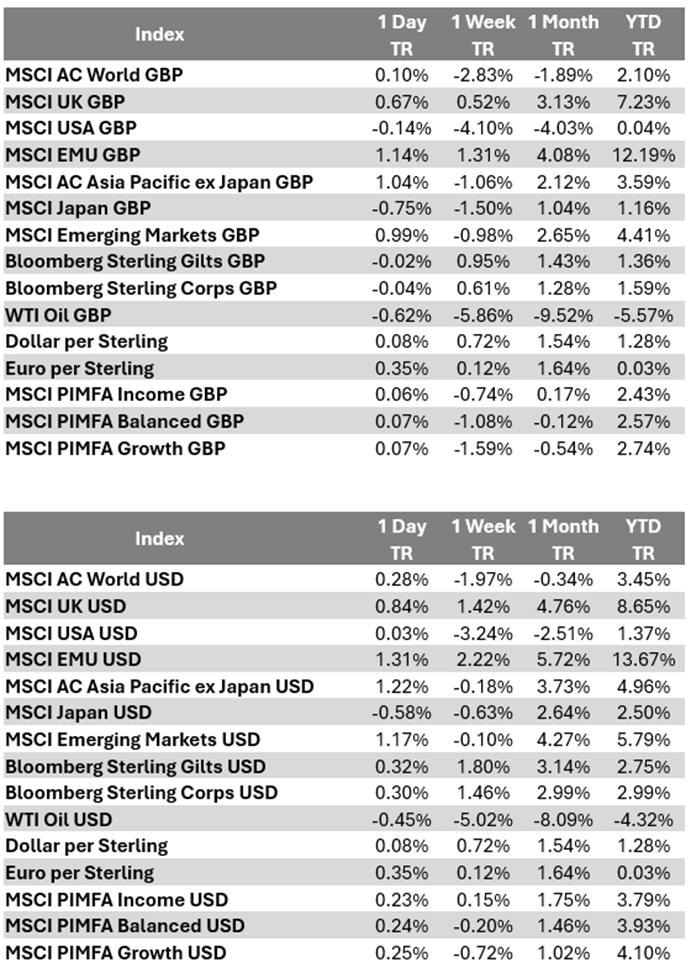
Index 1 Day1 Week1 MonthYTD
 TRTRTRTR
MSCI AC World GBP -1.81%-2.26%-2.83%0.31%
MSCI UK GBP 0.71%2.63%3.94%9.12%
MSCI USA GBP -2.75%-2.86%-5.10%-1.98%
MSCI EMU GBP 1.29%1.24%5.60%12.28%
MSCI AC Asia Pacific ex Japan GBP -0.95%-3.89%-0.18%0.04%
MSCI Japan GBP 1.13%-1.67%0.76%0.75%
MSCI Emerging Markets GBP -0.98%-3.91%-0.26%0.71%
Bloomberg Sterling Gilts GBP -0.56%0.16%-0.12%1.08%
Bloomberg Sterling Corps GBP -0.37%-0.07%-0.13%1.29%
WTI Oil GBP -2.96%-3.87%-8.91%-6.15%
Dollar per Sterling 0.99%0.60%2.02%1.48%
Euro per Sterling -0.12%0.40%0.62%0.21%
MSCI PIMFA Income GBP -0.68%-0.48%-0.52%1.93%
MSCI PIMFA Balanced GBP -0.79%-0.68%-0.71%1.97%
MSCI PIMFA Growth GBP -0.96%-0.99%-1.01%1.98%
Index 1 Day1 Week1 MonthYTD
 TRTRTRTR
MSCI AC World USD -0.82%-1.67%-0.31%1.89%
MSCI UK USD 1.72%3.24%6.64%10.84%
MSCI USA USD -1.78%-2.27%-2.63%-0.44%
MSCI EMU USD 2.30%1.85%8.34%14.05%
MSCI AC Asia Pacific ex Japan USD 0.04%-3.31%2.41%1.62%
MSCI Japan USD 2.14%-1.08%3.37%2.33%
MSCI Emerging Markets USD 0.01%-3.33%2.33%2.29%
Bloomberg Sterling Gilts USD 0.30%0.81%2.22%2.50%
Bloomberg Sterling Corps USD 0.50%0.57%2.21%2.72%
WTI Oil USD -1.99%-3.30%-6.55%-4.67%
Dollar per Sterling 0.99%0.60%2.02%1.48%
Euro per Sterling -0.12%0.40%0.62%0.21%
MSCI PIMFA Income USD 0.31%0.11%2.06%3.53%
MSCI PIMFA Balanced USD 0.21%-0.08%1.87%3.58%
MSCI PIMFA Growth USD 0.03%-0.40%1.56%3.59%

Bloomberg as at 04/03/2025. TR denotes Net Total Return.

Please continue to check our blog content for the latest advice and planning issues from leading investment management firms.

Marcus Blenkinsop

4th March 2025

Team No Comments

Tatton Monday Digest – Honeymoon Ends Early

Please see below, this week’s Monday Digest from Tatton Investments Management:

Honeymoon ends early

No meaningful recovery for US stocks last week – but a slight warming for European shares. Encouragingly, Keir Starmer’s charm offensive resulted in President Trump saying “tariffs wouldn’t be necessary” for the UK – but Emmanuel Macron’s earlier experience (warm words followed by a 25% EU tariff) shows we shouldn’t get too comfortable. 

Investors are no longer excited about Trump 2.0: the tax cuts and deregulation haven’t happened, but tariff threats and government disruption have. US consumers are similarly disillusioned, judging by sentiment surveys and (slight) signs of corporate stress. But we should expect avid stock market watcher Trump to react with economic support, including the $4.5tn tax cut plan outlined by Congress last week.

Worryingly, German Chancellor-in-waiting Friedrich Merz seemed to suggest US-European negotiations are now futile, but European stock valuations actually improved relative to the US. European bullishness is based on domestic improvement, and the need for defence spending amplifies that. The real long-term benefit for Europe would come from genuine policy cohesion, but that requires strong and unified leadership. We will see if Merz can provide that as his coalition attempts to reform Germany’s constitutional debt brake. 

It’s notable that capital is now flowing out of the US, and even Nvidia’s stellar profits weren’t enough to stem the tide. We wrote before that this could be related to Trump chipping away at the US-led global order that underlies international finance, and the White House’s restrictive “America First Investment Policy” announced last week doesn’t help. 

Now that investors are allocating assets away from the US, you would bet on Trump changing tack. The current market rotation isn’t as pronounced as the one we saw last summer, and US policymakers (both the government and the Fed) have enough manoeuvrability to correct. If they don’t, US exceptionalism will continue to be undermined. In that case, the 100-day honeymoon period for new US presidents could end abruptly.

Higher price caps don’t mean higher prices

Ofgem’s energy price cap will rise 6.4% in April, raising the typical UK household’s energy bill to £1,849 per year. That’s much lower than at the peak of the natural gas crisis, but it does mark a third consecutive quarter of price hikes. This is a concern for the Bank of England (BoE), whose struggle to reach 2% inflation is proving harder than expected.

Ofgem’s price cap limits the rate energy companies can charge rather than overall bills – which is why it’s expressed in terms of the ‘typical’ household. The energy regulator sets it based on wholesale gas prices, for which natural gas is the biggest swing factor.

Gas prices are volatile – down sharply this month but well above levels from a year ago. The interesting thing is that futures contracts for gas are significantly below current prices, suggesting prices will fall over the long-term. That’s why analysts the cap will fall in July – but it could also mean energy companies charging below the upper limit. What’s important is what people are paying, not the official price. Ofgem itself, for example, recommends consumers lock in current rates for the fixed term – and many consumers are doing so.The 6.4% cap hike isn’t really inflationary if people aren’t paying more (by locking in lower rates or by cutting down usage) and that has implications for how inflation is measured. The price index is supposed to capture aggregate costs, but this based on the going market rate. Ofgem’s price hike will impact that, but measuring how much consumers are out of pocket is harder. We see this another reason the BoE should look through current stated inflation and focus on weak UK growth. The bank will be cautious, but shouldn’t overinterpret a one-off hike.

How will the US budget resolution resolve?

The Republican-controlled US House of Representatives passed Donald Trump’s “big, beautiful” budget resolution bill by the narrowest of margins. This non-binding budget blueprint contains $4.5 trillion in tax cuts (though most of these are extensions of Trump’s ‘temporary’ 2017 tax cuts) and $2tn in spending cuts – with government debt plugging the gap. The Senate is now under pressure approve the same resolution (though they passed their own separate version last week), or else opposition Democrats will be able to stifle the bill’s progress. This has to happen before 14 March, or the US government will face one of its frustratingly common shutdowns. 

The bill was touch-and-go; resistance came from both fiscal conservatives worried about excessive debt and moderates worried about punishing spending cuts. The danger for Republicans is that cutting vital public services (like Medicaid health insurance) could upset the populist MAGA base that delivered them power.

We warned before Trump’s inauguration that enacting the disruptive policies before the supportive ones would undermine the economy, and the latest data suggest that is happening. The budget resolution could be a sign that the White House is changing tack in response – though more support will be needed, as most of the tax cuts are just extensions of old measures.

We warned last year that Trump’s tax-cutting plans could worsen the US’ already stretched fiscal position. Fiscal deterioration has felt like a non-issue recently, due to the White House slashing federal spending and the economy starting to weaken in response – but the latest budget reminds us that government borrowing is still a concern. Bond yields have fallen, but that could change, especially if accompanied by the current trend of global central banks selling dollar assets. A sell-off in the world’s biggest bond market is still unlikely, but it’s a risk we have to monitor.

Please continue to check our blog content for advice, planning issues and the latest investment market, and economic updates from leading investment houses.

Andrew Lloyd

03/03/2025

Team No Comments

Brooks Macdonald – Daily Investment Bulletin

Please see below article received from Brooks Macdonald this morning, which provides a global market update for your perusal.

What has happened

A good-but-not-great set of results from Nvidia on Wednesday evening plus more trade tariff comments from US President Trump in the past 24 hours collectively weighed on sentiment yesterday. The US technology megacap ‘Magnificent Seven’ group fell -3.03% on Thursday, with Nvidia down -8.48%. That pushed the US S&P500 equity index down -1.59% yesterday, and on course for its worst week since September, while the pan-European STOXX600 equity index dropped around -0.46%, all in local currency price return terms.

More Trump tariff headwinds for markets

Markets had to weather more Trump tariff headwinds on Thursday. Yesterday saw US President Trump announce an additional 10% trade tariff hike on China, as well as pushing ahead with 25% tariffs on Canada and Mexico, all due to be effective from Tuesday next week, 4th March. In addition, Trump said his plan for “reciprocal” tariffs on those countries that currently tariff US trade would still go ahead as planned in just over a month’s time on 2nd April.

A mixed US economic and inflation picture

Yesterday saw a second update on calendar Q4 2024 US economic growth and inflation. In the mix, US Gross Domestic Product (GDP) rose by an unrevised +2.3% quarter-on-quarter annualised – still a decent number versus the US Federal Reserve’s longer-run US economic growth estimate of +1.8%. However, as regards underlying inflation, according to the US Personal Consumption Expenditures (PCE) price index, core prices (excluding energy and food) rose to +2.7% quarter-on-quarter annualised, faster than the +2.5% initially reported and expected.

What does Brooks Macdonald think

Trump’s tariffs hold a stagflationary tilt-risk for markets, in that, at the edges, such trade levies would dampen economic growth, while buoying inflationary pressures. Of course, it is worth bearing in mind that we have potentially seen this movie before so-to-speak .. at the start of February, Trump’s proposed tariffs against Canada and Mexico were extended by a month with just hours to spare until they had been due to come into force. As the late British historian A.J.P. Taylor, who specialised in 19th and 20th century international diplomacy, reminds us, “nothing is inevitable until it happens.”

Bloomberg as at 28/02/2025. TR denotes Net Total Return.

Please check in again with us soon for further relevant content and market news.

Chloe

28/02/2025

Team No Comments

Brooks Macdonald: Daily Investment Bulletin

Please see below, an article from Brooks Macdonald providing a brief analysis of the key factors currently affecting global investment markets. Received today – 27/02/2025

What has happened?

Markets were positive for the most part yesterday ahead of US technology megacap Nvidia’s results out after the US close, while tariff remarks from US President Trump late in the day weighed on sentiment. The US S&P500 equity index finished largely flat, while the pan-European STOXX600 and the UK FTSE100 equity indices which had closed earlier did better but were both up by less than +1%, all in local currency price return terms. When Nvidia results did arrive, the tech giant delivered good-but-not-great quarterly results, in turn drawing a muted response from investors which have hitherto grown accustomed to blowout numbers.

Nvidia results

The main focus for global investors yesterday was Nvidia’s results which landed after the US stock market close. In the event, the world’s second biggest company by market value (at around US$ 3.2 trillion) and the poster child for the Artificial Intelligence(AI) spending boom, delivered good-but-not-great quarterly results. The company said revenues would be around US$43 billion over the current fiscal quarter (February-April), just ahead of a market consensus estimate of US42.3 billion, but below the upper end of the range at around $48 billion. Nvidia’s CEO Jensen Huang said that the company would “grow strongly in 2025”, while the demand for its latest ‘Blackwell’ AI chip was “amazing” and the “fastest product ramp in our company’s history”.

Trump’s trade tariff comments knock EU sentiment

Shortly after European stock markets had packed-up for the day, US President Trump threw another tariff-sized spanner in the works for European Union (EU) trade. Trump announced that he was proposing a potential 25% tariff against the EU on “cars and all other things” and coming “very soon”. Given Trump’s comment yesterday that “the European Union was formed in order to screw the United States”, it suggests these tariffs could be widespread across sectors. Furthermore, asked if the EU might retaliate, Trump said “they can’t I mean they can try, but they can’t.” The pan-European STOXX600 equity index opened down -0.7% earlier this morning.

What does Brooks Macdonald think?

Nvidia’s results and share price reaction are a reminder that expectations matter. No one doubts that Nvidia is a great success story and has some amazing products at the heart of the AI boom. The question is: what is the right value to ascribe to Nvidia? With even just the smallest change to Nvidia’s gross margins (currently up in the 70’s%) for example, this can make huge differences to long-term modelling outputs and its share price. What should investors do? At the end of the day, Nvidia is a widely-researched company so outsmarting the market is very difficult – arguably the easiest solution from a portfolio perspective therefore is to be diversified, keeping some but not too much exposure to any one stock to avoid concentration risk, and especially so when it comes to gigantic-sized stocks like Nvidia.

Bloomberg as at 27/02/2025. TR denotes Net Total Return.

Please continue to check our blog content for the latest advice and planning issues from leading investment management firms.

Alex Kitteringham

27th February 2025

Team No Comments

Brewin Dolphin – Markets in a Minute

Please see this week’s Markets in a Minute update below from Brewin Dolphin, received yesterday afternoon – 25/02/2025.

What’s next for UK interest rates?

We explain how sticky inflation could impact the Bank of England’s interest rate decisions.

The start of 2025 has seen last year’s equity laggards making the early running. Notably, European equities have performed well following a tough 2024. They were perceived as victims of President Trump’s interventionist economic trade policy and as such, they were unloved and under-owned, but have bounced back firmly.

Like all regions, European companies generate a lot of their revenue globally, but unsurprisingly, they’re the most exposed to European economies. Around 30% of the revenue generated by European companies comes from the region, so when a domestic economy struggles, it has a market impact.

Has the outperformance of European equities reflected a less antagonistic stance from the Trump administration? Far from it. If anything, investors might be more concerned about the challenges posed by President Trump’s actions now than they were before the U.S. election. His tone has been strangely antagonistic towards Europe.

U.S. geopolitical focus adds pressure on Europe

A couple of weeks ago, we discussed the suggestion that the U.S. administration might consider value added tax (VAT) as a barrier to trade – despite logic and research arguing otherwise. Last week, the pressure on Europe shifted to geopolitics, with Secretary of Defence Pete Hegseth telling the Munich Security Conference that Europe should foot most of the bill for Ukraine’s defence against Russia.

Hegseth said returning to pre-2014 Ukrainian borders (when Russia annexed Crimea) was unrealistic, and that NATO membership for Ukraine was also an unrealistic prospect. To underpin the weakness of Ukraine’s negotiating position, President Trump seemed to parrot Russian propaganda by referring to Ukrainian President Volodymyr Zelenskyy as a “dictator” (Ukraine has not held wartime elections).

The Trump administration continues to emphasise that European defence spending should reach 5% of gross domestic product (GDP), a level above the current NATO pledge of 2%. That may be bluster, but the pressure on European countries to meaningfully increase defence spending is real. The difficulty is that most have very limited fiscal scope to do so.

The economic situation in Europe

Some countries, such as France, were already struggling to rein in their borrowing, after having toppled Michel Barnier’s government due to its attempts to take tough choices and reduce borrowing.

The twin needs of higher defence spending and restored public sector balances imply the need for some very difficult political choices, and a net contractionary fiscal policy.

It’s an unwelcome situation for France, which has been struggling economically. France and Germany have substantial manufacturing sectors, which have been experiencing difficulties through a global downturn. Recently, the services sector has also been looking fragile. Friday’s flash estimate of French economic activity from the purchasing managers indices (PMIs) was strikingly weak, driven by a marked deterioration in the services sector. The data may be anomalous.

Neighbouring Germany’s equivalent results were much less stark, as was the broader Eurozone PMI. France’s political and debt situation is distinctly worse than that of many of its European peers. This might be unsettling to its shoppers, but consumers are generally insensitive to these things – until they feel the cost of them in terms of wages, job losses, or inflation. Economic pressure therefore remains for Europe.

However, the prospect of an end to hostilities in Ukraine does bring potential economic benefits. Moscow could increase the gas flow to Europe if peace talks are successful. That would be welcome because replenishing gas storage for next winter is another worry for European leaders. There should also be huge opportunities for construction and redevelopment activity in Ukraine once the conflict has ended.

Like France, the UK saw an implied contraction in its manufacturing and services sectors but that contrasted with a lot of other data out last week. Employment data, whilst notoriously unreliable, suggested that employment numbers weren’t dropping. Wage growth was fast and, even though inflation data was strong, the implication was that UK wages are rising faster than inflation, contributing to stronger-than-feared retail sales growth.

Interest rates have been coming down recently, which provides further support, and the shock of high mortgage rates is beginning to ebb. Consumer sentiment edged higher, begging the question: why are the business surveys so weak?

Some of this could simply be temporal. Consumers are enjoying the decline in inflation over the last two years, cuts to National Insurance contribution rates, and rising house prices. Businesses, however, are planning on how to address the steep increases in employers’ National Insurance contribution rates.

Europe’s next move

The results of this weekend’s German elections have landed, showing centre-right Christlich Demokratische Union (CDU) and centre-left Sozialdemokratische Partei (SDP) winning a majority of the seats in the Bundestag. The new coalition will have big implications for the German economy and beyond. It’s likely it will want to reform the strict national debt brake enshrined within the German constitution – however, this requires a two thirds majority, which it didn’t receive.

The results were in line with pre-election polling and suggest that a two-party coalition can be formed. Whilst that will require cooperation from the centre-left and centre-right parties, it’s considerably more manageable than a three-party government including the Greens.

Tariffs a source of uncertainty for U.S. businesses and citizens

The stream of announcements on U.S. trade tariffs, and subsequent delays or amendments, makes for an unusually opaque economic policy environment, which must be weighing on companies to some extent. There’s some limited evidence that it’s also affecting the U.S. public.

President Trump’s approval rating has been dropping since he took office, which isn’t unusual. Although the economy has remained strong, and the President has been proactive, this suggests that some of his actions are jarring with segments of the public. A majority believe he should have done more to bring down prices. Whilst that’s an unrealistic expectation, it’s one he did little to dispel on the campaign trail and the landmark policies of imposing tariffs and limiting inward migration are inflationary in nature.

Federal employees in particular will be concerned about their futures given the actions of Elon Musk and the Department of Government Efficiency. A recent poll found that just 39% of the public approved of the President’s handling of the economy. This is a decline of 4% from the end of January, after which we’ve had a flurry of confusing announcements on tariffs.

As a reminder, trade tariffs affect many U.S. businesses because they import components, and they affect consumers because ultimately, the cost of import tariffs will typically be paid by U.S. consumers.

At the end of last week, the University of Michigan Consumer Sentiment Survey seemed to underpin this. It showed consumer expectations for inflation in the coming five to 10 years increased to the highest level in nearly 30 years. Meanwhile, the S&P Global Purchasing Managers Index noted a significant shift in business activity in February from just a couple of months previously, which it attributed to “widespread concerns about the impact of federal government policies, ranging from spending cuts to tariffs and geopolitical developments.”

Please continue to check our blog content for advice, planning issues and the latest investment market and economic updates from leading investment houses.

Charlotte Clarke

26/02/2025

Team No Comments

EPIC Investment Partners – The Daily Update: Gold – Bitcoin characteristics and more

Please see the below article from EPIC Investment Partners detailing their thoughts on Bitcoin and the market for Gold. Received this afternoon 25/02/2025.

Bitcoin remain the bell weather of the crypto world. We do not pretend to be experts on crypto currencies. The key characteristic of Bitcoin is the halving of payments to miners every four years. This means the number of Bitcoins outstanding cannot exceed a finite number (21 million). There are currently 19,969,375 Bitcoins outstanding with a further 1,030,625 Bitcoins left to be mined.

We saw a fabulous chart the other day. A chart from Minex Consulting was used by Rupert Resources, a listed Australian company, in their most recent presentation material. The chart tracks annual Gold discoveries (in millions of ounces) against global exploration (in billions of Dollars) from 1975 to 2023.

In 2005, 300 million ounces were discovered, a record high. Prior to that in the 1980 to 2005 period, discoveries averaged circa 150 million ounces per annum. Global exploitation expenditure has averaged circa $5bn pa over the past fifty years. It peaked in 2012 at $14bn but has since retreated to a range to $5-7.5bn annually.

What interests us is the sharp decline in Gold discoveries since 2005. Discoveries halved between 2005 to 2010 to roughly 150 million ounces. They then halved again to circa 75 million ounces by 2015. Discoveries remained at that level during the period 2015 to 2020 but have fallen off a cliff since.

You can buy things with Bitcoin but you cannot make anything with it. Thanks to its supreme conductivity, Gold continues to play a key role in the global electronics industry while the global jewellery industry is the other obvious significant consumer. Central Banks can be significant buyers or sellers (Thanks Gordon, we have not forgotten) but, equally (if not more importantly) those living in countries where currency depreciation has been an annual event for decades have a healthy respect for the metal’s ability to hold its value in real terms over time.

India comes to mind. On this author’s first visit to India in 1989 16 Rupees would purchase 1 Dollar.  Today, 36 years later, one needs 86 Rupees to purchase 1 Dollar. Over five times as many Rupees.

With its practical uses, as well as a proven ability to hold its value over time, Gold looks the better bet despite its recent run. Particularly if the halving continues.

Please continue to check our blog content for advice, planning issues, and the latest investment, market and economic updates from leading investment houses.

Alex Clare

25/02/2025

Team No Comments

Tatton Monday Digest

Please see below, this week’s Monday Digest from Tatton Investments Management detailing their outlook on global politics impact on business – 24/02/2025

Global politics turn business
Capital markets ended last week on a slightly downbeat note. That was more about the US economy than its astounding shift in foreign policy – but here everyone is focussed on Donald Trump’s recasting of Russia as an ally and Europe as an antagonist. The most immediate impact was a rise in European defence stocks, which will benefit from the inevitable rise in European military spending. Spending will almost certainly be funded by government borrowing, which is why European yields increased more than the US. This should help short-term European growth, but it could also be inflationary. Interestingly, Britain is perhaps the best placed of any European country to benefit from the continent’s defensive shift.

Beyond those moves, markets seem unsure what to make of Trump’s tectonic shift – with most indices unmoved from a week ago. Under the surface, we see signs of falling risk appetite. What happens to markets next will depend more on US market sentiment than politics. Business sentiment disappointed in the world’s largest economy (and in Europe) and now points towards mild contraction. That might reflect previous overconfidence during Trump’s honeymoon period, rather than how bad things are now, but it’s a notable change from the start of the year nonetheless.

We shouldn’t overreact to the US’ political pivot, but we shouldn’t underestimate its market impacts either. The international financial system is built upon the very US-led world order that the president is chipping away at – by focussing on short-term transactional gains rather than long-term stability. A mild outcome would be worsening risk appetite; a terrible outcome would be global financial fragmentation. 

Asset allocation decisions need to be based on a holistic analysis of how these factors will play out. Despite the noise, none of the major global risk signals are flashing red. Markets have dealt with Trump’s disruption well, but we should keep an eye on confidence indicators and Europe’s response will also be crucial. With a new government in Germany being formed by CDU leader Friedrich Merz already saying his “absolute priority” would be to “strengthen Europe as quickly as possible so that we can achieve real independence from the US step by step” more change is coming. 

Risks are rewards for gold
Gold prices are still surging. Bullion is approaching $3,000 per ounce and has become divorced from historical valuation metrics. Historically, real (inflation-adjusted) gold prices have closely tracked real US bond yields, as it’s often considered a currency alternative, but that correlation broke a few years ago. Emerging market central banks started buying the precious metal after Russia was frozen out of the West’s financial system. Net central bank purchases have reignited in the last few months after seemingly plateauing in the autumn. Given the global geopolitical risks around, you would bet on this continuing.

People buy gold when there are global political or financial risks – and Donald Trump’s second term as US president is full of them. On top of that, gold is benefitting from a technical momentum trade. Technical squeezes can be particularly pronounced for an asset like bullion, which has a small physical supply and a comparatively huge market for its derivatives. For example, the cost of short-term gold borrowing has shot up due to a shortage of physical gold, seemingly due to increased demand from New York and subsequently drained supply in London (the world’s largest market for gold trading). 

The long-term trends are hard to untangle from the short-term technical factors. Short squeezes always loosen, and perhaps Donald Trump’s détente with Russia could lessen central banks’ desire to buy bullion. They are unlikely to buy back into the dollar, though, as faith in the world’s reserve currency is based on long-term institutional stability rather than policy whim. It’s hard to see gold demand falling while the political temperature stays high. 

This uncertainty and volatility is why we don’t consider gold a suitable long-term investment. It is the purest store of value there is – but that fact itself affects how we value it. As the old saying goes, “Gold is the currency of fear”.

Commodities point to growth
Commodity prices are a good indicator of global trade – which has been threatened this year by Donald Trump’s tariff threats. The Goldman Sachs Commodity Index (GSCI) is up more than 5% since the start of the year, with copper a particular standout (about 14.7% up year-to-date). The metal is strongly related to green tech, which China is still developing in full force despite US environmental rollbacks. Trump’s tariffs threaten global trade, but commodity prices suggest the underlying fundamentals are holding strong.

The exception has been oil, which has largely traded sideways in 2025. Even if global growth is improving, Trump’s “drill baby drill” policies will keep crude supplies high.

Commodities were weak last year due to the global manufacturing downturn. That was down to China’s weak economy and overproduction, which only started turning in September, after Beijing’s stimulus announcements. Overproduction might sound like a positive for commodities – and in periods it was – but it also means inventories fill up, leading to the peaks and troughs we saw through 2024. Notably, GSCI’s recent spikes (in September and at the start of this year) have coincided with the times when investors feel most confident about Chinese growth.

Improving demand will benefit global trade, even if trade wars pose a risk. The recent commodities rally suggests investors recognise this. The flipside of this, however, is potentially more inflation. Chinese overproduction hurt global growth last year, but it also gave western central banks a helping hand by reducing input costs. A reversal of that trend could be problematic, especially if it coincides with tariffs. That could be worse for the US (with its stubbornly tight labour market) than Europe (with its weak domestic economy). Higher commodity prices are ultimately a good sign for global growth, but there is a nagging feeling that the last leg of the post-pandemic spike in global inflation is the hardest to beat.

Please continue to check our blog content for the latest advice and planning issues from leading investment management firms.

Marcus Blenkinsop

24th February 2025
Team No Comments

Brooks Macdonald: Daily Investment Bulletin

Please see below, an article from Brooks Macdonald providing a brief analysis on the key factors currently affecting global investment markets. Received this morning – 21/02/2025

What has happened?

It seems that bullish markets have taken a pause after the MSCI All Country World Index hit a fresh record closing high on Tuesday this week in total return US dollar terms. A few things are driving that perceived pause in sentiment – among them is the upcoming German federal election on Sunday – though a weaker-than-expected growth outlook from US retailer Walmart also dampened the mood yesterday. Of note, yesterday also saw Gold close at a fresh record high of US$2,939 per ounce.

German election expectations

The first exit polls will land on Sunday afternoon at 5pm UK time. Currently, political website Politico’s polling average has the conservative CDU/CSU bloc in the lead on 30%, followed by the far-right AfD on 21%, with Chancellor Scholz’s centre-left SPD on 16%, the Greens on 13%, and smaller parties below that, such as the free-market FDP on 5%. A coalition between parties of some description is all-but-certain to be needed to form a working government majority, but as for whether the far-right AfD might be included remains long-odds for now.

Japan inflation

Data out earlier this morning showed Japan’s Consumer Price Index (CPI) annual inflation rate hitting a two-year high of 4% in January, and up from +3.6% in December. So-called annual “core-core CPI” (which in Japan excludes both fresh food and energy) was up at 2.5%. Markets are now pricing in an 84% chance of a 25-basis points interest rate hike at the Bank of Japan’s July meeting, up from a 70% chance at the start of the month.

What does Brooks Macdonald think?

There is a lot riding on the German election result this weekend. German government spending in particular is the focus for markets, and whether the next government can eventually muster the necessary two-thirds parliamentary vote majority to overturn the country’s so-called fiscal ‘debt brake’ (referring to a rule agreed in 2009 which restricts German annual structural deficits to 0.35% of Gross Domestic Product). Whether or not that is achieved, will have a bearing on expectations around economic growth and the wider outlook for risk assets, not just for Germany but for the wider European region as well.

Bloomberg as at 21/02/2025. TR denotes Net Total Return.

Please continue to check our blog content for the latest advice and planning issues from leading investment management firms.

Alex Kitteringham

21st February 2025

Team No Comments

EPIC Investment Partners – The Daily Update | Fed Holds Firm While Consumer Credit Crumbles

Please see below article received from EPIC Investment Partners, which provides an economic update on the US.

In the minutes from the January FOMC meeting, released yesterday, Fed officials expressed their confidence in maintaining steady interest rates amidst persistent inflation and economic policy uncertainty. “Many participants noted that the committee could maintain the policy rate at a restrictive level if the economy remained robust and inflation remained elevated.” The meeting minutes highlighted the cautious approach Fed policymakers have adopted following their decision to reduce interest rates by a percentage point in the latter months of 2024. 

Several officials voiced concerns regarding risks posed by the prospect of another debt ceiling confrontation in Washington. “Participants cited the possible effects of potential changes to trade and immigration policy, the potential for geopolitical developments to disrupt supply chains, or stronger-than-expected household expenditure.” Counterbalancing concerns over tariffs and inflation, the minutes noted “substantial optimism about the economic outlook, stemming in part from an expectation of a loosening of government regulations or changes to tax policies.” 

Meanwhile, the US consumer’s financial health is deteriorating at an alarming pace, according to both The New York Fed’s “Household Debt and Credit” report and industry data from BankRegData, with credit card defaults surging to levels not seen since the aftermath of the GFC. In just the first nine months of 2024, lenders were forced to write off a staggering $46bn in seriously delinquent credit card debt – a 50% jump from the previous year. 

This troubling development is particularly acute among lower-income households, with Moody’s Analytics chief Mark Zandi noting that “the bottom third of US consumers are tapped out” with a savings rate of zero. The situation appears set to worsen, with $37bn in credit card debt already at least one month overdue. 

This distress stems from a perfect storm of factors: aggressive lending during the post-pandemic spending boom pushed total credit card debt above $1tn, while persistent inflation and elevated interest rates have left consumers paying $170bn in annual card interest (yoy to September 2024). With the Fed indicating fewer rate cuts than previously expected for 2025, and Donald Trump’s proposed tariffs threatening to drive inflation even higher, the outlook for stretched US consumers appears increasingly grim. 

Please check in again with us soon for further relevant content and market news.

Chloe

20/02/2025

Team No Comments

Evelyn Partners Update – UK January CPI Inflation

Please see the below article from Evelyn Partners which details their thoughts on this morning’s UK inflation announcement for January, received this morning – 19/02/2025.

What happened?

UK annual headline CPI inflation for January was reported at 3.0% (consensus: 2.8), which was higher than December’s reading of 2.5%. In monthly terms, CPI was -0.1% (consensus: -0.3), compared to 0.3% in December.

Core inflation (excluding food, energy, alcohol, and tobacco) was 3.7% (consensus: 3.4%), which was above the prior reading of 3.2%.

What does it mean?

The UK continues to face stickier inflationary pressures compared with other advanced economies. This is arguably reflected in the bond market with gilts yields remaining considerably higher than their European counterparts, despite the UK facing a similarly weak growth profile.

Both the headline and core CPI measures ticked up this month, driven higher by transport, food & non-alcoholic beverages, and education as VAT on private education shows up in the inflation data. Prices also increased in the recreation sector, which could have been driven by companies getting ahead of the rise in National Insurance contributions. Services inflation, which represents a better gauge of domestically generated inflation than headline CPI, also accelerated from 4.4% to 5%. Although it was slightly softer than the 5.1% estimated by consensus.

This CPI print undoubtedly complicates the Bank of England’s job. Last week’s GDP data confirmed the UK economy is barely growing, and the Bank increased its CPI forecast on the back of higher global energy prices. This combination of low growth and above-target inflation is a challenging mix for the Bank to navigate. They will be hoping that higher energy costs and tax rises will not lead to new inflationary spiral. It’s likely they will look to maintain restrictive policy to reduce the probability of this scenario materialising. The risk is that they further weaken the already fragile domestic demand. In our view, the growth risks will outweigh the inflation risks over the coming quarters, and the Bank will continue its interest cutting cycle.

As the gilt market opened there was a bit of pressure on front end yields. There was a limited reaction in foreign exchange markets, with the pound slightly weaker against the dollar. Similarly, money markets took the news in their stride, continuing to expect two interest rate cuts in 2025.

Bottom Line

January’s CPI inflation print came in higher than expectations. With higher energy prices forecast over the coming quarters, the Bank will have to balance the risks of low growth and above-target inflation. In our view, the growth risks outweigh the inflation risks, and the Bank will continue its interest cutting cycle over the coming quarters.

Please continue to check our blog content for advice, planning issues and the latest investment market, and economic updates from leading investment houses.

Charlotte Clarke

19/02/2025