Team No Comments

Brooks Macdonald – The Daily Investment Bulletin

Please see the below article from Brooks Macdonald detailing their views on the impact of Trump Tariffs on the macro economy. Received this morning 03/04/2025.

What has happened

US markets started Wednesday on a positive note, with the S&P 500 climbing 0.67%—marking its third straight day of gains. Investors seemed optimistic during regular trading hours, but that mood shifted dramatically after the close. In after-hours trading, markets took a sharp dive following news of President Donald Trump’s latest tariff announcements, dubbed ‘Liberation Day.’ The S&P 500 futures dropped over 2%, while the Nasdaq futures fell more than 4% at their peak. Big-name stocks felt the heat too, with the Magnificent 7 group (including Apple, down over 6%, and Amazon and Tesla, both off more than 5%) leading the decline.

Trump’s tariffs plan – US vs the world

The centrepiece of Trump’s announcement is a new tariff structure aimed at levelling the playing field for US trade. Here’s how it works:

  • Baseline Tariff: Starting this Saturday, all countries will face at least 10% on tariff on goods shipped to the US. The UK is one of the few ‘lucky’ ones subject only to this baseline 10%
  • Higher Rates for Key Partners: On April 9, many major trading partners will see much steeper tariffs. For example, the European Union faces 20%, Japan 24%, and Vietnam a hefty 46%. China gets hit hardest with a 34% tariff – on top of a 20% increase announced earlier this year

Not everyone is in the crosshairs, though. Canada and Mexico are exempt for now (though some goods already face a 25% tariff due to separate fentanyl and migration policies). Critical items like pharmaceuticals, semiconductors, lumber, copper, and gold are also off the hook, but they’re under review in separate trade investigations. Steel, aluminium, and auto imports, however, will still face 25% tariffs as recently outlined.

What does Brooks Macdonald think

Trump’s tariff plans raised concerns about higher costs, disrupted trade, and economic uncertainty. If fully implemented, these reciprocal tariffs could push the average levy on US imports to over 25%—a level not seen since the early 1900s and nearly 20% higher than today’s rates. Economists are already sounding the alarm. Early estimates suggest these tariffs could shave 1–1.5% off US economic growth this year while pushing up inflation (measured by core PCE) by a similar amount. Higher costs for imported goods could squeeze consumers and businesses alike, especially if trading partners retaliate with tariffs of their own. For investors, the big unknown is what happens next. Will other countries strike deals to lower these rates, or will they accept this as the new normal and adjust their supply chains? Trump’s openness to negotiation offers some hope, but his warning of potential escalation keeps the risk of a trade war alive.

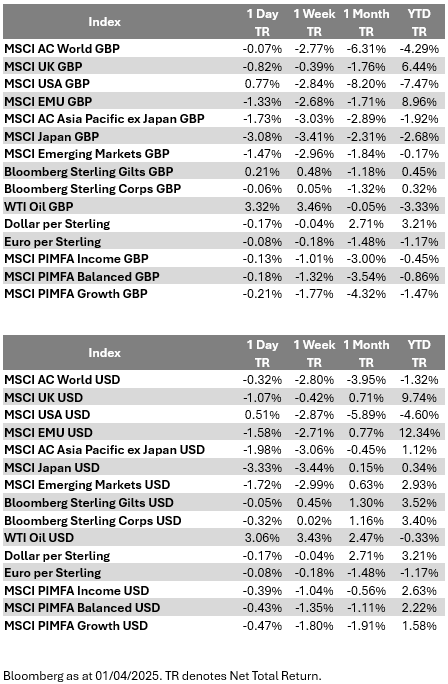
Bloomberg as at 03/04/2025. TR denotes Net Total Return.

Please continue to check our blog content for advice, planning issues and the latest investment, market and economic updates from leading investment houses.

Alex Clare

03/04/2025

Team No Comments

Brewin Dolphin – Markets in a Minute

Please see this week’s Markets in a Minute update below from Brewin Dolphin, received yesterday afternoon – 01/04/2025.

What’s next for U.S. trade tariffs?

We take a closer look at the latest tariff announcements as the world waits for President Trump’s ‘Liberation Day’.

Last week was supposed to be the calm before the storm of U.S. President Donald Trump’s self-styled ‘Liberation Day’, when tariffs will be imposed on a range of the country’s trading partners.

The week saw plenty of information and disinformation over when the tariffs will come, before seeing a surprise announcement on Wednesday relating to taxes on car imports.

U.S. announces 25% tariffs on cars

President Trump imposed 25% trade tariffs on vehicles and car parts last week. According to the White House, the move was made in the interest of national security, for which the automotive industry is a vital component. The tariff on finished vehicles will apply from 3 April, while the tariff on parts will be imposed a month later.

President Trump has consistently expressed his frustration over the practice of building cars in other countries before selling them in the U.S. This new policy aims to encourage more car manufacturing in the U.S. instead. The president hopes this will increase U.S. employment and reduce the U.S. trade deficit.

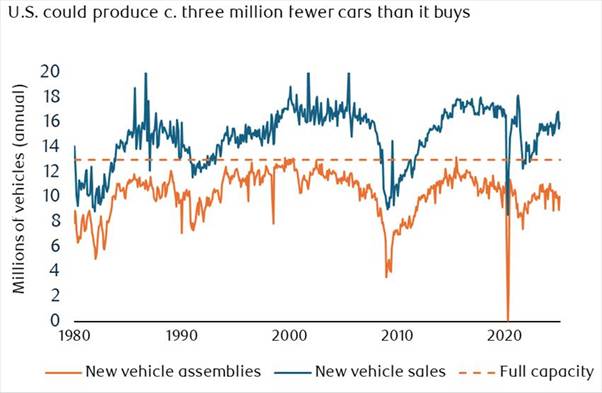
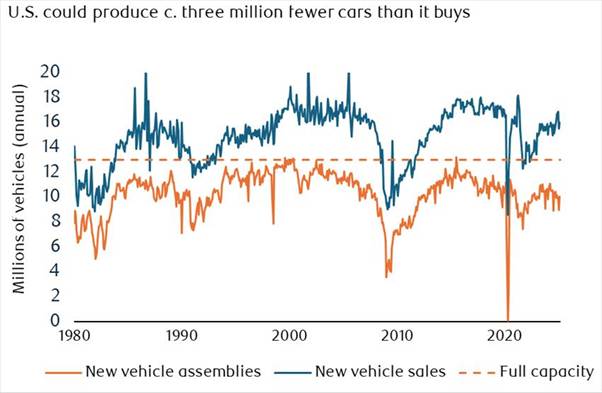
A graph showing the price of a vehicle sales

AI-generated content may be incorrect.

Source: LSEG Datastream

The U.S. sells around 15 million vehicles per year, with some demand having probably been brought forward in anticipation of tariffs.

The U.S. currently produces around 10 million vehicles annually and, at a stretch, it appears to have capacity for 13 million. Over time, the shortfall can be met through additional investment in auto plants, which take a couple of years to build.

There are two important questions to be asked:

  • How long will the tariffs need to remain in place to make executives willing to commit to expensive new plants in the U.S.; and
  • By the time the plants are erected, how long will be left of President Trump’s term, at the end of which policies may be different?

Japan ponders retaliation against auto tariffs

Around 28% of Japan’s exports to the U.S. are cars, so the country will be impacted by this latest tariff announcement. Japanese Prime Minister Shigeru Ishiba insists that all options are on the table when it comes to retaliation.

However, Japan has moved a lot of its car manufacturing to America, and so a portion of its sales will be protected. Economic consultant Capital Economics estimates that around 70% of sales by Japanese firms to U.S. companies are already manufactured in the U.S.

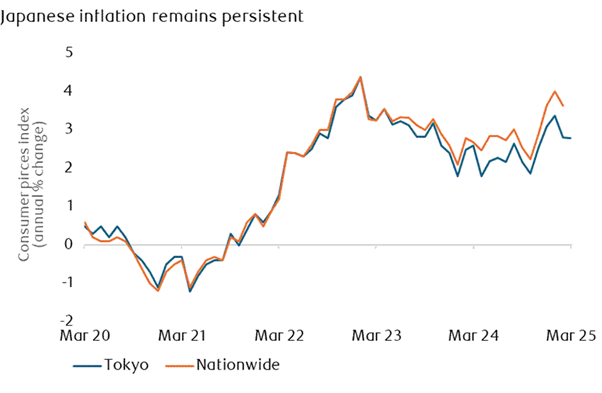
So, despite the considerable threat from the imposition of tariffs, interest rates are still expected to rise in Japan. Members of the Bank of Japan’s Monetary Policy Board seem concerned that food price inflation could be persistent, and there have been signs from the latest shunto (annual spring wage negotiations) that companies are willing to countenance higher payments.

A graph of a graph with numbers and lines

AI-generated content may be incorrect.

Source: LSEG Datastream

At a time when other countries are pondering how fast to cut their interest rates, Japan is poised to continue hiking, especially since consumer prices in Tokyo on Thursday remained stronger than anticipated, which will therefore be true of the equivalent nationwide inflation measure, too.

UK economy gives mixed signals

Friday saw the full release of the UK’s 2024 gross domestic product (GDP) numbers. The economy grew by just over 1% last year, despite some pre-election giveaways by the outgoing administration. The new government shone a light on the fiscal situation, and in doing so cast a shadow over UK consumer confidence. 

A graph showing the price of a vehicle sales

AI-generated content may be incorrect.

Source: LSEG Datastream

Whilst Friday’s numbers show just how turgid the second half of 2024 was, they do reveal that during the final quarters, the combination of growing real wages and cautious spending led the saving rate to reach nearly 12%—the highest figure since 2010—indicating that UK consumers have been saving.

The benefit of that was felt in January and February; retails sales figures seem to suggest that the UK consumer headed back to the shops in the first months of the year. The benefit was also seen in the UK services purchasing managers index (PMI), but below the surface of a strong rebound lies some gloom in the form of contracting employment, which is a response to rising employment costs.

The increase to Employers National Insurance contributions, which was announced in the 2024 Autumn Budget, will take effect from this April. The new tax year will also see first-time buyers paying Stamp Duty Land Tax (SDLT) when buying a home, ending a preferential treatment that saw them exempt from paying any SDLT on properties worth up to £425,000.

Inflation was below forecasts, but this was mainly due to a few volatile items. We know that utility bills will be back on the rise in April, which means inflation will be back above 3% for the rest of the year.

The economy seems stronger in the first quarter of 2025, but inflation is persistent. The Bank of England’s Monetary Policy Committee seems keen to cut interest rates at least twice over the next year, but it will be banking on a slowdown in inflation (excluding utility bills).

In the Spring Statement on Wednesday, the chancellor confirmed that government spending was on track to break one of her fiscal rules. The government had been on track to spend £9.9bn less than it was receiving in 2029/30, but rising interest rates meant that this headroom had been lost.

Over the previous week, the government announced welfare cuts that will take effect from April next year, in addition to further economic measures. By extraordinary coincidence, the £9.9bn headroom was restored but as the last six months have shown, such a small margin means that every time interest rates seem to rise, the prospect of more taxes or spending cuts in autumn will rise.

Please continue to check our blog content for advice, planning issues and the latest investment market and economic updates from leading investment houses.

Charlotte Clarke

02/04/2025

Team No Comments

Brooks Macdonald: Daily Investment Bulletin

Please see below, an article from Brooks Macdonald providing a brief analysis of the key factors currently affecting global investment markets. Received this morning – 01/04/2025:

What has happened

Yesterday wrapped up a mixed quarter for markets. With global tariff risks rising in Q1, investors rotated into previously unloved parts of the global equity market and challenging hitherto megacap tech leadership. During the quarter, the US ‘Magnificent Seven’ tech group fell -16.0%, weighing on US (and by extension global) equity markets with the US S&P500 equity index falling -4.6%. By contrast, over in Europe, the UK FTSE100 was up +5.0% and the pan-European STOXX600 equity index gained +5.2% in Q1, though investors here were not immune from tariff concerns, with the latter index losing over half of its cumulative year-to-date gains by quarter-end. China’s equity performance meanwhile was sandwiched between US and Europe, with the China CSI300 equity index down -1.2% in Q1 (all in local currency price return terms).

More tariffs coming but tax cut news too maybe?

We have just one more day to wait until US President Trump’s reciprocal tariffs are announced tomorrow, Wednesday 2 April at 3pm US Eastern Time. Yesterday, White House Press Secretary Leavitt said that there would be “country-based” tariffs, with further sectoral duties to come later. Separately on tax cuts, there were comments yesterday from US Treasury Secretary Bessent who said that he was working with Republicans in Congress to deliver Trump’s fiscal campaign promises, including “no tax on tips, no tax on Social Security, no tax on overtime” – meanwhile Republicans are reportedly seeking to formulate a tax cut package in Congress that permanently extends Trump’s 2017 tax cut provisions.

Australia’s central bank keeps interest rates on hold

As expected by markets, the Reserve Bank of Australia (RBA) earlier today left interest rates unchanged (at a cash rate of 4.1%). In their statement, the RBA highlighted an uncertain economic outlook for both domestic activity and inflation, while global risks remain significant driven by geopolitical and policy uncertainties, including US tariffs. For context, the RBA’s 25 basis points interest rate cut back in February this year was its first rate cut since late 2020.

What does Brooks Macdonald think

Markets have been bruised by Trump’s tariff escalation in recent weeks and the impact that they might have on economic growth and inflation – yet these trade levies (in principle) were always part of Trump’s November 2024 election manifesto, alongside his promises to deliver tax cuts and deregulation. So far, there has been an adverse timing mis-match of these two policy strands, with lots of negative tariff news, but precious-little in the way of new news on tax cuts in particular. Given the latest comments from the US administration yesterday around tax cuts, that sequencing of policy news and action could be about to change – it that is the case, a renewed focus on Trump’s market-friendly policies could bring a welcome positive distraction for investors and offer some support for risk assets more broadly.

A table with numbers and symbols

AI-generated content may be incorrect.

Please continue to check our blog content for the latest advice and planning issues from leading investment management firms.

Andrew Lloyd DipPFS

1st April 2025

Team No Comments

Tatton Investment Management: Monday Digest

Please see below, an article from Tatton Investment Management, providing a brief analysis of the key factors currently affecting global investment markets. Received this morning – 31/03/2025

Tariff ‘stick’ to be followed by fiscal ‘carrot’?

Markets have been fluctuating, initially with some positivity due to Trump’s planned phased and toned down tariff “Liberation Day” announcement. However, Trump’s unexpected permanent 25% tariffs on autos and threats of further tariffs swiftly reversed the market mood.

For the Trump administration, tariffs are about trade, domestic jobs, and tariff revenue, though it’s unclear which aim dominates. While tariffs are headline news in Europe, most Americans are only marginally aware. Fox News has no mention of tariffs, while CBS covers it as a secondary story.

Fox’s omission suggests it recognises that tariffs can raise prices for consumers, increase inflation and are generally unpopular. More attention is now on the administration’s first budget bill, which are created by Congress, not the President. The interim budget must pass before September, with the debt ceiling expected to be reached in August. Counterintuitively, Trump requested an amendment to increase the debt ceiling, facing opposition from Republican fiscal hawks.

This may well imply that the focus on spending cuts and tariffs (the ‘sticks’) may be overtaken by larger tax cuts (the ‘carrots’). US equities were supported by thoughts of larger tax cuts, but rising bond yields could harm growth more than tax cuts help.

For the UK and its chancellor Rachel Reeves, there is a similar problem. Trump plans to cut taxes, and Reeves has said she won’t raise them. Investors are sceptical that the Labour government can maintain its hawkish stance if growth undershoots. Despite sticking to its rules, gilt yields have risen, meaning investors doubt the UK economy can be remedied without dramatic expenditure cuts.

To build fiscal credibility, the Chancellor needs to navigate the 2025 slowdown while displaying fiscal hawkishness. Productivity improvements and global economic resilience are crucial. Institutional portfolio rebalancing and economic data releases will influence market movements.

Next week marks the end of a quarter, prompting institutional portfolio rebalancing and against the recent market movements would point to selling bonds and buying back of equity allocations. Important economic data, such as US payrolls, will be released and with Trump’s April 2nd tariff announcements we could have another climactic week, with markets expecting stop-and-start action and little policy clarity. It takes a brave observer to say they know how it will pan out.

Who are the Magnificent Seven?

America’s technology giants – Apple, Amazon, Alphabet, Meta, Microsoft, Nvidia, and Tesla – dominated market returns the last two years but are struggling in 2025. It’s time to reassess whether grouping these “Magnificent Seven” companies together makes sense for investors. Their fundamentals differ significantly, but their grouping has reinforced their similarities.

Investors group the Magnificent Seven (Mag7) together because they are all technology companies with revenue streams from tech innovation, displaying strong earnings growth and healthy balance sheets. For investors they have been top performers, unrivalled earnings growth and very healthy balance sheets with plenty of available cash. However, growth prospects differ markedly. Nvidia is expected to post 22% annual revenue growth until 2028, while Apple is projected at 8%. These differences are not surprising when in market terms Apple and Microsoft already dominate well-established markets, while Nvidia and Tesla are geared towards new and growing markets.

Mag7 companies face different challenges requiring varied business plans. Apple and Nvidia need little capital expenditure, while Meta, Amazon, and Tesla are more capital intensive. These differences mean the risk-reward trade-offs vary across the group and on that basis the Mag7 is not a coherent investment thesis.

Tesla exemplifies why the Mag7 is no monolith. As a car manufacturer it is not a purely a tech firm. Yes, it is the largest carmaker by market cap but not by revenue. Its high valuation relies on rapid sales growth backed by high paced tech innovation, which is uncertain. Tesla markets itself as pioneering new technology, creating a new industry of electric, self-driving cars. This approach is uncertain, making Tesla a different investment proposition compared to Apple.

Tesla’s share price is also tied to the political fortunes of CEO Elon Musk. It soared with Trump’s election win but fell due to backlash against Musk’s politics. Investors struggle to quantify these political benefits when valuing Tesla.

Despite differences, the Mag7 grouping is not entirely incoherent. Their size and correlated share prices mean the correlation will persist. Mag7 funds reinforce this correlation. Grouping in financial products impacts the companies, giving them easier access to capital and higher valuations. Their size also provides political influence, allowing them to collectively lobby for favourable regulation.

Grouping winners together makes sense in a winner-takes-all capitalism. Arguments against grouping the Mag7 apply to other stock indices. Investment themes evolve; the BRIC countries were once a popular theme 20 years ago but are now rarely grouped together. The Mag7 stocks may not be as correlated in 20 years, but for now, there is little reason to think they will split up.

The Rise of Sovereign Wealth Funds

One notable Trump Executive Order from February was to create an American Sovereign Wealth Fund (SWF). Trump claimed it would be one of the largest funds in the world. But why do SWFs matter?

SWFs are state-owned investment funds, often established by countries with government surpluses from natural resources like oil and gas. Trump’s announcement sparked out interest because the US, with a deficit of over $35 trillion, would need significant disruption to create a government surplus for its SWF.  To take a step back, the term “Sovereign Wealth Fund” was coined in 2005, but the concept dates back to state funds in the US, like Texas’s fund for schools, while the first national SWF was Kuwait Investment Authority in 1953.

Energy price rises created government surpluses which led to the creation of SWFs by other oil producers. Norway’s Government Pension Fund Global, established in 1990, is the largest SWF. Nations with wealth from other sources have also created funds, like the Korea Investment Corporation (2005) and Australia’s Future Fund (2006). By 2008, there were 23 SWFs, and the International Forum of Sovereign Wealth Funds was formed.

SWFs have grown significantly, managing over $13 trillion by 2025, up from $1.2 trillion in 2000. Their investments have performed well, better than Public Pension Funds and Central Banks. The IFSWF sets standards for governance and investment practices, defining SWFs as special purpose investment funds owned by the government for macroeconomic purposes.

SWFs have diverse investment strategies. Some, like Abu Dhabi Investment Council, invest in alternative unlisted assets, while others, like Norway’s GPFG, invest in listed securities. SWFs aim to invest proceeds from current account surpluses for the future, anticipating that the source of the surplus may diminish.

Some SWFs exploit their sovereign-like reputations to borrow money at cheap rates, like Singapore’s Temasek. Despite generally being well-run, there have been failures, such as 1 Malaysia Development Berhad (1MDB). Established in 2009, 1MDB faced allegations of misappropriated funds and amassed over $10 billion in debt, leading to political downfall and legal actions.

SWFs have improved governance and, despite some sceptics, have improved their image. Next week, we will explore President Trump’s proposed US SWF, its funding challenges and its ramification on the US and global economy.

Please continue to check our blog content for the latest advice and planning issues from leading investment management firms.

Alex Kitteringham

31st March 2025

Team No Comments

The Daily Update – The Looming US debt crisis

Please see below article received from EPIC Investment Partners this morning, which provides an update on the US economy.

Last year, Jerome Powell emphasised the need for an “adult conversation” about US debt. Yesterday’s Congressional Budget Office (CBO) release highlights why this was so. 

The CBO projects federal debt held by the public will hit 100% of GDP in fiscal 2025, escalating to 156% by 2055, surpassing historical peaks. Such debt levels threaten economic growth, increase interest payments to foreign debt holders, and risk fiscal instability, significantly limiting policymakers’ options. 

Economic growth is expected to slow markedly in the coming decades. Real GDP growth is forecasted to decline from 2.3% in 2024 to 1.8% by 2026, averaging 1.6% annually through 2055. Factors such as an ageing population, declining birth rates, and reduced immigration drive this slowdown. Without immigration, the US population would shrink from 2033, directly impacting labour force growth, economic productivity, and tax revenues, ultimately affecting living standards. 

The federal budget deficit remains substantial, with a projected $1.865 trillion shortfall in fiscal 2025, averaging 6.3% of GDP over the next 30 years. Persistent deficits, driven by rising interest payments and primary deficits, amplify the debt crisis, creating a challenging cycle to escape. Federal spending is projected to rise to 26.6% of GDP by 2055, fuelled by interest payments, healthcare costs, and increased Social Security obligations due to demographic pressures. 

Federal revenues will temporarily increase due to the expiration of certain 2017 tax act provisions, then gradually rise to 19.3% of GDP by 2055. This growth primarily stems from rising real incomes and “real bracket creep,” as taxpayers increasingly move into higher tax brackets. 

Policymakers face critical decisions, including entitlement reforms, tax adjustments, and strategic investments to enhance productivity. While the CBO projections assume existing laws remain unchanged, decisive actions could significantly alter this fiscal trajectory, resonating with Powell’s call for responsible governance. 

The interaction between deficit reduction, economic growth, and interest rates is intricate. Meaningful deficit reduction could temporarily dampen demand, prompting the Federal Reserve to lower interest rates to stimulate growth. However, persistent high debt levels, typically hinder economic growth and reduce private investment. 

Research indicates that economies with debt around 100% of GDP may require near-zero interest rates to achieve fiscal sustainability. Attaining this equilibrium involves a combination of fiscal consolidation, structural reforms, and monetary policy adjustments. Addressing the US debt challenge is crucial for long-term economic stability, avoiding future scenarios where debt severely limits economic potential and raises the spectre of possible default. 

Nevertheless, economic pressures suggest a likely return to zero interest rates, creating a highly favourable environment for fixed income investments in the coming years. 

Please check in again with us soon for further relevant content and market news.

Chloe

28/03/2025

Team No Comments

Brewin Dolphin – UK Spring Statement 2025: What it means for your money

Please see the below article from Brewin Dolphin analysing the key measures announced in the UK Spring Statement and how they could impact personal finances, investments, and the wider economy. Received – 26/03/2025

UK Chancellor Rachel Reeves has unveiled the 2025 UK Spring Statement, aiming to balance public finances and “secure Britain’s future in a world changing before our eyes”.

The Spring Statement follows a significant Autumn Budget, in which tax rises totalling £40 billion were announced. Despite a shifting geopolitical scene since that announcement, the Chancellor is resolute in reserving major fiscal decisions to once annually in the autumn, leading to a restrained Spring Statement that zeroed in on expenditure reductions and a boost in defence spending.

Our analysis examines the Spring Statement’s relatively limited measures affecting personal wealth and investments, with Guy Foster, chief strategist, evaluating the UK’s economic prospects in light of the Office for Budget Responsibility (OBR)’s projections.

Financial planning highlights

Tax

The Chancellor’s Spring Statement eschewed further tax rises, maintaining the status quo on income, capital gains, inheritance tax (IHT), VAT, and National Insurance.

Instead, there was a heavy focus on enhancing HMRC’s debt management, targeting promoters of tax avoidance, and intensifying efforts to clamp down on tax evasion. This includes action to prosecute more tax fraudsters, reform the rewards for informants, increase penalties, and tackle advisers facilitating non-compliance.

Looking ahead, the UK’s substantial debt burden and limited fiscal leeway mean that expectations for a more lenient personal tax regime in the upcoming budget are muted. Meanwhile, the current stability in tax legislation provides a window for individuals to review their financial planning strategies in anticipation of possible changes in autumn. Engaging with your wealth planner and professional advisers can help you understand what options are available to you.

Business Relief

Business owners face an increased IHT liability starting April 2026 due to a previously announced £1 million cap on relief. However, a recent HMRC consultation suggested there could be the potential to benefit from the £1 million allowance multiple times.

Any gifts of Business Relief assets between 30 October 2024 and 5 April 2026 will count towards the £1 million allowance, with the reset period for Agricultural and Business Relief set at every seven years from the date of each gift of the assets. It’s important to note that Business Relief investment allowances cannot be shared between spouses, which differs from some other IHT allowances.

With careful planning considering existing IHT strategies, business owners could benefit several times by making multiple gifts on a rolling seven-year basis. Note that it’s vital to consider the suitability of the alternative investment market or other schemes for IHT planning, considering how Business Relief assets are divided between spouses and their eventual distribution upon death. Keeping detailed records of all Business Relief assets transferred since 30 October 2024 is imperative. Currently, this area remains without draft legislation and consultation continues.

The outlook for the UK economy

In the autumn, the government announced significant tax hikes and increased borrowing to fund major investments in public services. The Spring Statement would ideally be an update on how those policies were affecting the economy.

Firstly, it’s important to remember that the government must abide by rules which limit how much it can borrow in the future. These rules are designed to prevent governments from being tempted to take risks now, which could have significant costs later. The OBR’s role is to estimate whether the government abides by these rules.

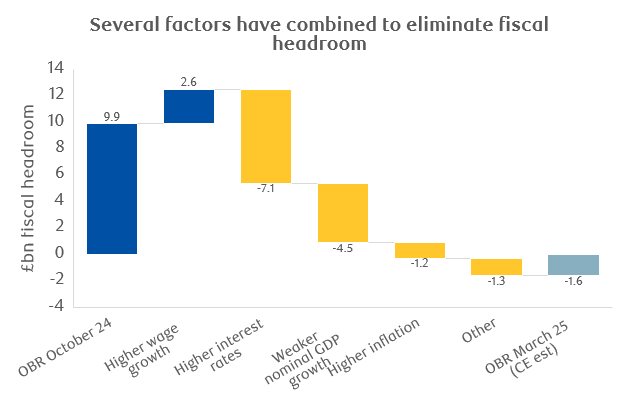
For the Chancellor, the most challenging thing is to ensure that the current budget (that means day-to-day spending but does not restrict investment) is on course to be in balance by the 2029/30 financial year. At the last budget, the OBR estimated that the government would meet this restriction by £9.9bn — although such forecasts are inherently uncertain.

Ideally, chancellors would like more margin for error, or scope to spend. As it turns out, the forecast has deteriorated due to a combination of weaker economic growth and higher interest rates, leaving the government on course to break its fiscal rules.

This has led to a series of pre-Spring Statement announcements, including welfare reductions and public sector efficiency measures. However, the government intends to increase borrowing, but to use more of that money to invest, particularly in defence.

Whilst few would doubt the necessity of investing in defence, it doesn’t help the Chancellor meet her fiscal rules. For each pound invested in defence, the additional economic activity is relatively modest. By contrast, housebuilding generates a lot of additional economic activity, which is why promising to reduce planning hurdles can improve growth overall, despite carrying no fiscal cost.

The net result is that despite the deterioration in revenue growth assumptions, the OBR judgement once again predicts that the Chancellor will meet her current spending rule at £9.9bn. If that number seems familiar it’s because it restores exactly the same headroom the Chancellor had last autumn. 

Clearly £9.9bn is better than nothing, but the last few months have shown just how easy it is for economic performance to change and for perceived headroom to disappear. So far, most of the current parliament has seen a constant debate over whether tax increases and spending cuts might be required, and retaining this modest headroom invites that to continue. The real risk is that this uncertainty leads to companies feeling too unsure to invest. This is particularly relevant given the existing economic uncertainty that stems from the new U.S. government and its plans to introduce an uncertain range of tariffs.

At a time when the economic outlook is even more uncertain than normal, the Chancellor would ideally have more margin for error.

The other nuance about the fiscal rules is that they allow for the government to meet its targets by forecasting austere measures in the coming years. We share some scepticism about the extent to which spending growth will slow in some departments as the current parliamentary term concludes.

The fiscal rules are just one constraint that the government is under. The other, arguably more meaningful constraint, is the bond market reaction.

If governments are expected to borrow more money or if their actions are expected to boost inflation, then the cost of issuing new government debt will rise. With relatively few announcements made in the Spring Statement, and with recent days having seen reductions in welfare costs, the bond market has been relatively stable. This has been helped by the news indicating that UK inflation slowed slightly during February.

Overall, the Chancellor has reiterated the government’s commitment to its manifesto pledge against raising core personal taxes, taking a more cautious approach after earlier bond market jitters.

Much will now depend on how the economy fares between now and autumn’s budget.

Last night, Trump announced a 25% tariff on all car imports, which could escalate the ongoing tariff war. This could have a global impact on markets and undermine Rachel Reeves Spring Statement yesterday.

Please continue to check our blog content for the latest advice and planning issues from leading investment management firms.

Marcus Blenkinsop

27th March 2025

Team No Comments

Brewin Dolphin – Markets in a Minute

Please see this week’s Markets in a Minute update below from Brewin Dolphin, received yesterday afternoon – 25/03/2025.

U.S. equities start to stabilise

We explore the driving factors behind U.S. equities showing some signs of stabilising over recent weeks.

We’ve seen a fragile recovery in U.S. equity markets, with surveys suggesting trade uncertainty has made consumers and businesses wary (though surveys around politicised events can be unreliable). Weak sentiment indicated a potential rebound. However, several factors conspired to slow economic activity in early 2025.

Trade pain and the pain trade

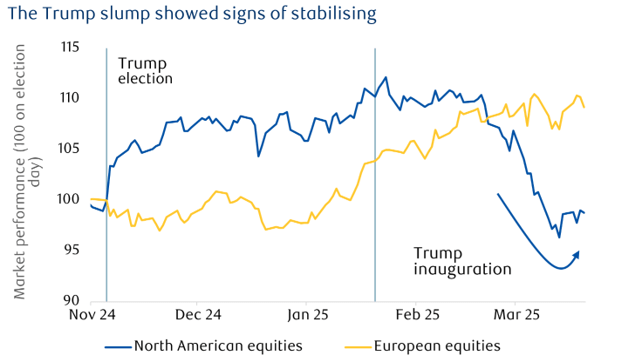
The so-called ‘Trump slump’ paused for breath last week, and the performance of regional equity markets became generally more uniform.

North American Equities post trump

Source: LSEG Datastream

The ‘pain trade’ is the tendency of the market to move in a way that causes the maximum possible pain to the largest possible number of investors. It happens when there’s a very widely and strongly held consensus, such as the belief that U.S. President Donald Trump’s second term would bring a boost to growth from deregulation and tax cuts, and that the artificial intelligence (AI) boom would continue.

In 2008, the U.S. equity market was around 1.5 times as big as the European equity market. By the end of 2024, it had ballooned to more than five times the size. That means any rebalancing from the U.S. to Europe can have a disproportionate impact on the latter. It pays to be aware of these technical factors in order to distinguish them from fundamentals.

Over the same period, U.S. earnings outpaced European earnings by a similar amount. Fundamentally, U.S. companies continue to be much more profitable than European companies and so demand a premium valuation.

Although there has been some deregulation, the market’s focus has been on surprisingly aggressive U.S. trade policy (which seems to have few winners and many losers) and the sudden realisation in Europe that the region would need to re-arm itself.

Are U.S. consumers spending less?

The most obvious rationale for the sell-off in U.S. equities has been the onset of trade tariffs. They seemed to be the trigger, but so far, their impact on the economic data has been restricted to surveys. It will be some time before tariffs show up in the wider economic data, but we can see some evidence of weaker economic activity that pre-dated any tariff announcements.

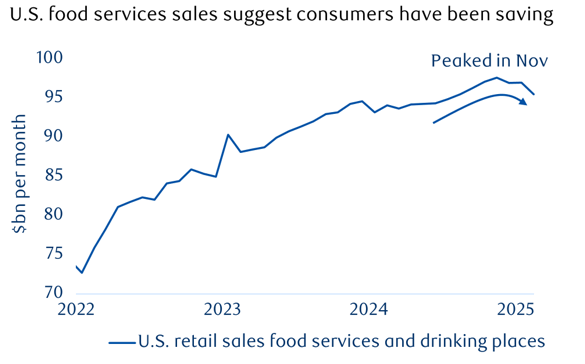
One example of this is U.S. retail sales data, which suggests a decline in consumer spending.

U.S Food Services

Source: LSEG Datastream

U.S. retail sales data has generally underwhelmed, and last week’s announcement did show a further decline in sales at food services and drinking establishments. This could suggest that consumers are going out less—although during the winter, we do see occasional lulls in eating out due to adverse weather conditions.

It looks like the U.S. consumer has been cutting back over the last four months or so. The onset of tariffs may cause them to do so more. Certainly, those who might be reliant upon the state for salary or welfare will be anxious over efforts to rein in government spending. But the U.S. economy has been growing comfortably, at more than 2% a year for the last two years, so there’s plenty of scope for a slowdown without it triggering a recession.

UK announces public spending reductions

Last week, the UK’s Work and Pensions Secretary Liz Kendall announced planned reforms to disability benefits. The government believes the measures will save more than £5bn per year by the end of the decade. The measures are being consulted on but have drawn sharp criticism from Labour backbenchers.

The government hasn’t given figures, but independent assessments suggest the reforms could strip over a million people of their benefits. The measures coincide with the UK’s pledge to increase defence spending and come ahead of the Spring Statement this Wednesday.

Over the weekend, Chancellor Rachel Reeves announced civil service costs will be cut by 15%. The cuts will come from back office and administrative functions and will be achieved through greater use of technology and productivity tools.

It’s expected that the Office for Budget Responsibility (OBR) will reveal that the government is in breach of its fiscal rules due to a combination of factors. Data released on Friday showed a continued shortfall in the UK budget, with borrowing during February exceeding OBR estimates. The shortfall could be £1.6bn according to estimates by Capital Economics.

Fiscal Headroom

Source: Capital Economics

The government has said that it won’t be increasing taxes in the Spring Statement, so it will need to announce more spending cuts (assuming it doesn’t loosen the fiscal rules).

The fiscal rules are one constraint but they can be fudged. Cuts in the future can be endlessly deferred, but the chancellor must also convince the lenders (i.e. the bond market) that the government is on a fiscally sustainable track.

The less fungible constraint is the impact that increased borrowing would have on market interest rates. As the UK’s fiscal position deteriorated earlier in the year, we saw a sharp rise in bond yields, and the UK remains in the focus of the bond markets.

UK interest rates were kept on hold last week as the Bank of England balanced the competing pressures of too high wages, an apparently slowing jobs market, and the probability of some form of modest fiscal tightening.

Please continue to check our blog content for advice, planning issues and the latest investment market and economic updates from leading investment houses.

Charlotte Clarke

26/03/2025

Team No Comments

Tatton Investment Management – The Monday Digest

Please see the below article from Tatton Investment Management detailing their key takeaways from markets over the past week. Received this morning 24/03/2025.

Bracing for tariff “Liberation Day”

Capital markets were calmer last week. We said before that US investor sentiment had swung too far and could bounce back – and so it proved. This was helped by the Federal Reserve holding interest rates steady and reducing its quantitative tightening (QT) bond sales. The QT reduction is a good sign for market liquidity, and markets interpreted the Fed as dovish. US bond yields fell, which would usually weaken the dollar but, for reasons that aren’t clear, the dollar strengthened – making US stocks one of the best performers in sterling terms.

The biggest help was a quieter White House, and no new government layoffs. Even Trump’s criticism of the Fed (for not cutting rates) was tame by his standards. Simply ending the disruption won’t be enough to get markets back on side, however; Trump needs to make good on his market-friendly policies. If jobs data weakens, he just might.

The biggest geopolitical scares were outside of the US: Turkish president Erdogan imprisoned Istanbul mayor Ekrem Imamoglu, a political rival. This is a problem for Europe, which sources military hardware from Türkiye and needs stability more than ever.

We get the feeling that markets are bracing for Trump’s tariffs on 2 April – his “Liberation Day”. Tariffs could well be avoided through last-minute deals, but it’s hard to see how US demands can be met. The White House wants “reciprocal” tariffs, where this is based on its own estimate of tariff costs. But estimates will vary across countries due to different regulations and economic factors. Insisting on Trump’s version of “reciprocity” will inevitably lead to tit-for-tat.

We await to see how these will play out, but before then we have next week’s US business confidence numbers, and the UK government’s Spring Statement. If confidence numbers are bad, “Liberation Day” could be delayed.

Central Bank Update

Two central bank meetings last week, and no interest rate changes in either. The Federal Reserve held rates steady but predicted worse growth and higher inflation for 2025 – explicitly tied to Trump’s tariffs. However, this didn’t materially shift the Fed’s “dots plot” (a graph of members’ rate expectations), since chairman Powell expects tariff inflation to be “transitory”. That’s because sales tax hikes usually act like one-off cost hits, which don’t impact inflation figures beyond a year.

But it’s a big assumption to think that Trump’s tariffs will be one-offs; he’s already engaged in tit-for-tat with trading partners. Chairman Powell’s comments also avoided any mention of recently weaker employment numbers – which could become a problem if growth slows further.

The Bank of England’s (BoE) 8-1 vote to hold rates was surprisingly emphatic. The UK economy doesn’t look as weak as it did – with the expected drop in employment (in reaction to the national insurance hike) not coming through. However, fiscal policy will remain tight, with the government favouring spending cuts to fund defence, rather than new borrowing. The BoE won’t react until after the spring budget. With hawkish fiscal and monetary policy, UK bond yields could fall.

Japan held rates steady last week in a dovish move – but bond yields counterintuitively rose. This bears closer inspection, as we know from last summer that Japan’s market dynamics can quickly become everyone’s problem.

The ECB is the only central bank not in “wait and see” mode, and we expect it to remain accommodative even after historic defence spending deals on the continent. This is mainly because none of the bonds for the fund raising have actually been issued or spent yet, leaving the economy in an awkward limbo. The financial market impacts of defence spending have already happened but the economic benefit will take a while.

Markets now believe China’s demand promise

Despite Chinese stocks falling into the end of last week, investors on the whole feel good about Beijing’s stimulus plans. The government unveiled a “special action plan” for boosting consumption, rather than industrial production, which has historically been the policy target. The shift since last year has made the Hang Seng index the best performer in 2025 – though the index was also boosted by the release of low-cost AI DeepSeek. Mainland Chinese stocks (less owned by international investors and more sensitive to the domestic economy) have been less impressive.

They are still up year-to-date, however, as investors and consumers have realised Beijing’s consumption support is genuine. That’s impressive, given the global trade context: China is the only country to be consistently piled with Trump tariffs, despite the US president threatening all trading partners. Tariffs pushed down Chinese growth expectations into the start of this year, but these have recently improved. We can see this in bond yields falling then recovering. The net result is that the world’s second-largest economy is in a strong position – just not a spectacular one.

While we are positive about Beijing’s demand-side stimulus, we have always said the government’s penchant for cracking down makes China a fundamentally risky place to invest. That perception created volatility last year, but volatility is much lower this year. This is partly about Beijing’s consistent policy, but also about inconsistent policy in the US. China has historically been risky because you do not know what the policies will be tomorrow – but at the moment that sentiment arguably applies more to the US.

We shouldn’t overstate this, as perceptions could easily change. But Chinese officials are going out of their way to emphasise the nation’s consistent focus on technological and economic progress. Beijing is currently saying all the right things – and investors currently believe them.

Please continue to check our blog content for advice, planning issues and the latest investment, market and economic updates from leading investment houses.

Alex Clare

24/03/2025

Team No Comments

Brooks Macdonald – The Daily Investment Bulletin

Please see the below article from Brooks Macdonald detailing their discussions on Equity markets, current geopolitical affairs with Trump and the Bank of England hold on interest rates. Received – 21/03/2025.

What has happened

Yesterday saw investors circle-back on tariff worries, pulling equity indices lower after what had been a decent session the day before. The US S&P500 equity index edged down -0.22%, while the pan-European STOXX600 equity index underperformed, down -0.43%. Relatively speaking, the UK equity market led US and European markets on Thursday, with the MSCI UK equity index finishing almost flat on the day down just -0.05%, all in local currency price return terms.

Bank of England takes a relatively hawkish turn

With interest rates on hold at 4.5% as expected, yesterday’s surprise from the Bank of England instead came from the split in the votes of the Bank’s Monetary Policy Committee (MPC): of the 9 voting members, 8 voted for no change, with only 1 vote (MPC external member Swati Dhingra) for a 25 basis points cut. That vote split was more hawkish than the expected 7-2 hold-versus-cut split going into the meeting. Meanwhile the Bank said it continued to favour “a gradual and careful approach” to any further interest rate cuts, not least given “an intensification of geopolitical and trade policy uncertainty”.

Canada expected to hold snap election

News reports from Canada’s Globe&Mail have said that Prime Minister Mark Carney is expected to call a snap federal election, expected to take place late April. It appears Carney might be looking to take advantage of a bump in opinion polls for his ruling Liberal Party, following Carney replacing former leader Justin Trudeau. Rather than domestic issues, it is likely to be the ongoing tariff-spat between Canada and US that will dominate the minds of voters running into the election.

What does Brooks Macdonald think

Investors are finishing the week thinking about tariffs again – it is now less than two weeks to go till US President Trump’s Wednesday 2 April “Liberation Day” reciprocal tariff announcement. This is when the US will announce reciprocal tariffs on trade with an as-yet-unknown number of countries around the world and at as-yet-unknown tariff rates. Investors crave certainty, but it seems for the next couple of weeks, that is going to be in short supply – it suggests markets may continue to be volatile for a while yet.

Index 1 Day1 Week1 MonthYTD
 TRTRTRTR
MSCI AC World GBP -0.19%2.52%-6.71%-2.91%
MSCI UK GBP -0.05%1.82%1.29%7.68%
MSCI USA GBP -0.19%2.51%-9.81%-6.96%
MSCI EMU GBP -1.17%1.96%1.91%12.81%
MSCI AC Asia Pacific ex Japan GBP -0.06%2.86%-2.17%1.10%
MSCI Japan GBP 0.81%2.74%-0.38%1.75%
MSCI Emerging Markets GBP -0.19%3.04%-1.45%2.87%
Bloomberg Sterling Gilts GBP -0.24%0.41%0.27%0.60%
Bloomberg Sterling Corps GBP -0.13%0.10%-0.35%0.60%
WTI Oil GBP 1.66%2.40%-8.18%-8.08%
Dollar per Sterling -0.02%0.17%2.44%3.54%
Euro per Sterling 0.22%0.25%-0.91%-1.20%
MSCI PIMFA Income GBP -0.13%1.32%-2.44%0.30%
MSCI PIMFA Balanced GBP -0.14%1.57%-3.10%0.04%
MSCI PIMFA Growth GBP -0.17%1.93%-4.09%-0.41%
Index 1 Day1 Week1 MonthYTD
 TRTRTRTR
MSCI AC World USD -0.22%2.70%-4.43%0.52%
MSCI UK USD -0.07%2.00%3.76%11.49%
MSCI USA USD -0.21%2.68%-7.61%-3.66%
MSCI EMU USD -1.19%2.14%4.40%16.80%
MSCI AC Asia Pacific ex Japan USD -0.09%3.03%0.21%4.68%
MSCI Japan USD 0.79%2.91%2.05%5.35%
MSCI Emerging Markets USD -0.21%3.22%0.96%6.51%
Bloomberg Sterling Gilts USD -0.20%0.63%2.91%4.20%
Bloomberg Sterling Corps USD -0.09%0.32%2.27%4.20%
WTI Oil USD 1.64%2.57%-5.94%-4.82%
Dollar per Sterling -0.02%0.17%2.44%3.54%
Euro per Sterling 0.22%0.25%-0.91%-1.20%
MSCI PIMFA Income USD -0.15%1.49%-0.06%3.85%
MSCI PIMFA Balanced USD -0.16%1.74%-0.73%3.58%
MSCI PIMFA Growth USD -0.19%2.10%-1.75%3.12%

Bloomberg as at 21/03/2025. TR denotes Net Total Return.

Please continue to check our blog content for the latest advice and planning issues from leading investment management firms.

Marcus Blenkinsop

21st March 2025

Team No Comments

Brooks Macdonald: Daily Investment Bulletin

Please see below, an article from Brooks Macdonald providing a brief analysis of the key factors currently affecting global investment markets. Received this morning – 20/03/2025:

What has happened

Equity markets rebounded on Wednesday, with the UK FTSE100 equity index notching up its sixth day of gains in a row, its best run since May last year. But it wasn’t until European markets had gone home for the day that investors really found their mojo with US equity markets on a tear – the bulls were back in force following US Federal Reserve (Fed) Chair Powell signalling that the Fed still sees room to cut interest rates later this year, judging any increase in inflation due to tariffs as only “transitory” – the US S&P500 equity index had its best Fed-day since July last year, the US Dow Jones equity index had its best Fed-day in a year.

US recession risks are “not high”

Referring to external forecasts, Fed Chair Powell yesterday said “a number of them have raised their possibility of a recession somewhat, but still at relatively moderate levels. They were extremely low. If you go back two months, people were saying that the likelihood of recession was extremely low … so it has moved up, but it’s not high”. Powell said that “the economy is strong overall” and added that “labour conditions are solid”. Providing useful context around recession fears, Powell pushed back – “there’s always an unconditional possibility of a recession; it might be broadly in the range of one in four at any time”.

Bank of Japan

The Bank of Japan (BoJ) left interest rates unchanged at its latest meeting yesterday, as expected. Instead, BoJ Governor Ueda focused on uncertainty around US President Trumps’ tariff plans. Ueda noted the impact was “difficult to judge” and that “tariffs could directly affect the economy and inflation … [but] there might be factors we may not find out until much later”.

What does Brooks Macdonald think

“The good ship Transitory” (as Fed Chair Powell called it in August last year) sails again – yesterday’s use of the word “transitory” by Powell was deliberate and comes despite the chequered history of that word in recent years. With interest rates left unchanged as expected, Powell roundly dismissed any fears that trade tariffs might lead to sustained inflation pressures – it suggests that should any economic growth weakness emerge later this year (although Powell said the risk of a US recession was “not high”), the Fed will not hold back in cutting interest rates. For investors, maybe there is still a Fed “put” after all.

A table with numbers and text

AI-generated content may be incorrect.

Bloomberg as at 20/03/2025. TR denotes Net Total Return.

Please continue to check our blog content for the latest advice and planning issues from leading investment management firms.

Andrew Lloyd DipPFS

20th March 2025