Team No Comments

Brewin Dolphin – Markets in a Minute

Please see this week’s Markets in a Minute update below from Brewin Dolphin, received yesterday afternoon – 13/05/2025.

Markets rally on positive trade new

We examine how easing trade frictions have helped boost equity markets.
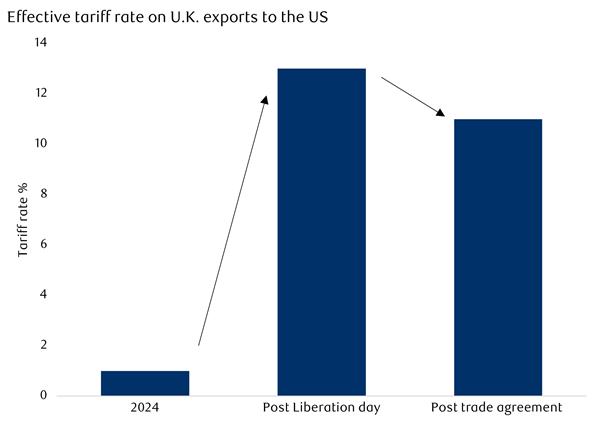
Tariffs on UK exports

Source: LSEG DataStream

If the onset of tariffs was a major headwind for the markets, then the easing of them should be seen as a tailwind. Globalisation allows countries to specialise in activities in which they have a comparative advantage; doing so increases global economic growth, allowing each country a larger individual share of that growth.

With that in mind, the news last week was dominated by the lifting of trade restrictions. After ‘Liberation Day’, it’s become increasingly clear that the Trump administration is seeking deals that lower tariffs, but questions remained over which countries it dealt with first, when this was done and how much tariffs would be lowered by.

We got a partial answer last week when U.S. President Donald Trump announced a “full and comprehensive” trade agreement with the UK. For context, this isn’t a traditional free trade agreement, which would take the form of an international treaty and would usually need to be implemented by legislation. Instead, this is President Trump agreeing to amend the trade tariffs that he placed on UK exports by executive order under emergency powers.

As far as we can tell, the agreement is verbal at this stage, and details will be agreed over the coming weeks.

America had placed 25% tariffs on steel, aluminium, cars and car parts from all countries, but the UK has achieved a partial exemption from that, with steel and aluminium being potentially zero tariffed. The UK has also been promised preferential treatment when President Trump applies tariffs to the pharmaceutical sector. In both these instances, details remain unclear.

Most UK car exports to the U.S. will be tariffed at 10% and there were some agreements on aeronautical deals (the U.S. buying engines from the UK and the UK buying planes from the U.S.). The cost of these easements is that the UK has had to drop some agricultural tariffs – it will probably adjust its digital services tax, too.

The overall impact of these measures is likely to be very small, though. This is partly because the most significant measure, the 10% universal tariff rate on all (now most) exports to the U.S., will remain in place, so the average tariff rate has only come down a little bit. Moreover, the UK runs fairly balanced trade with the U.S. anyway, and so the initial measures didn’t really affect us that much. Achieving big gains from trade is now much harder than it used to be, since the most significant barriers have already been dismantled.

Declining tariffs are generally good news, but the UK deal suggests that trade with the U.S. is likely to be subject to a minimum tariff level of 10% on most goods. As discussed a couple of weeks ago, the U.S. seems very ready to reduce tariffs with China. President Trump reiterated last week that he won’t do so pre-emptively, but it’s clear that the current rate of 145% tariffs won’t remain in place.

The UK also agreed a more conventional trade deal with India after three years of negotiation. The government says this deal will boost the UK’s gross domestic product (GDP) by £4.8bn by 2040. To put this into context, that’s only 0.19% of the UK’s current GDP. So, however things play out, this isn’t likely to be something that really moves the needle for the economy.

Overall, tariffs remain a force that’s likely to depress growth and increase inflation – but they’re set to decline from their current levels.
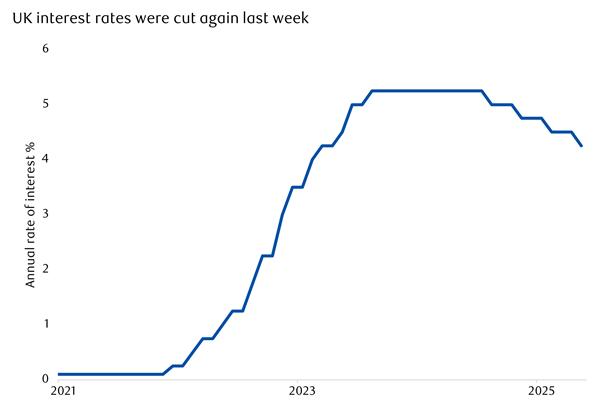
UK Interest rate cuts

Source: LSEG DataStream

The Bank of England’s Monetary Policy Committee (MPC) probably had relatively little notice of the trade deal, and its effect was marginal anyway. Instead, the MPC has been focusing on an economy which has experienced relatively little growth momentum and a cooling inflation picture.

As an important caveat, there will be an increase in inflation over the coming months due to gas and electricity bills, but beyond that, disinflationary pressures seem set to bring the inflation rate back down towards target. Jobs growth has been softening and job postings have been declining. The cost of employees has risen due to the increase to Employers National Insurance contributions, and companies now have the options of absorbing the costs in their profit margins, passing them on in higher prices (inflation), or reducing their staff numbers.

This creates a lot of uncertainty, which was reflected in a three-way split when the MPC voted on whether to cut interest rates last week; two members wanted to cut interest rates faster and two wanted to stay on hold.

In the end, the majority decision was a 0.25% cut, but that uncertainty meant that markets reduced their expectations for future cuts for the time being. Interest rates are currently expected to fall from 4.25% to 3.5% or 3.75% by the end of the year.
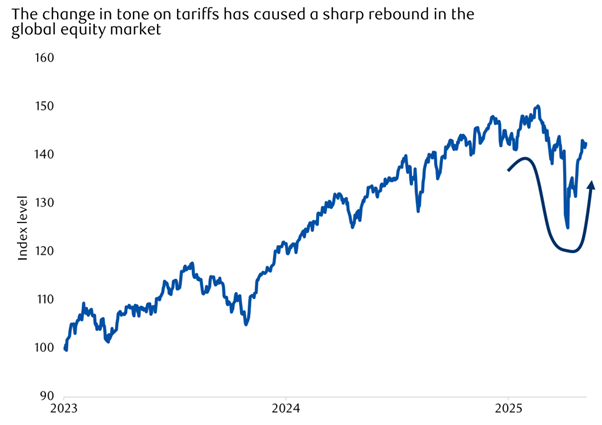
US Tariffs effect on global markets

Source: LSEG Datastream

As we’ve seen so often before, the markets are climbing the wall of worry that was built by President Trump’s erratic behaviour during the first few months of his second term.

Interest rates have been falling in the Eurozone, have started to fall in the UK, and will likely fall in the U.S. too (eventually).

Last week, the U.S. Federal Reserve left interest rates unchanged (as expected) as the outlook for inflation is difficult to gauge due to the erratic trade policy environment. However, with equity sentiment quite depressed, the conditions for markets to continue climbing that wall of worry seem quite supportive in the short term.

Please continue to check our blog content for advice, planning issues and the latest investment market and economic updates from leading investment houses.

Charlotte Clarke

14/05/2025

Team No Comments

Brooks Macdonald – The Daily Investment Bulletin

Please see below, Brooks Macdonald’s Daily Investment Bulletin which summarises the key factors currently affecting global investment markets. Received today – 13/05/2025

What has happened

Yesterday saw a massive rise in US equities, but other equity markets rose too, as news landed that US and China had agreed to a temporary climb-down in trade tariffs. US equity markets (which had previously seen some of the biggest daily falls following US President Trump’s 2 April tariff ‘Liberation Day’), rocketed higher. The US S&P500 equity index was up +3.26%, its third best day in the last five years,  as megacap tech led with the ‘Magnificent Seven’ group (Alphabet, Amazon, Apple, Meta, Microsoft, Nvidia, and Tesla), up +5.67%. In contrast, the gains across other equity markets yesterday were smaller in comparison: the pan-European STOXX600 equity index was up +1.21%, while the FTSE100 equity index was up +0.59%. All in local currency price return terms.

Tariff relief might be only temporary

Yesterday saw a huge climb-down in US-China tariff rates, and much more than had been hoped for in markets. Both sides reduced tariffs by 115 percentage points for a 90-day period, with US tariffs on Chinese exports coming into the US down to 30% from 145% (and China tariffs on US exports going into China down to 10% from 125%). But a note of caution that this tariff relief might be only temporary – keep in mind that as recently as last week, US President Trump had said that he felt that a “80% tariff on China seems right”, while previously he had talked about a 60% tariff rate during last year’s US Presidential election campaign.

Did China just agree to open up its economy?

Without offering any specifics, Trump yesterday said that as part of the US-China temporary tariff relief measures, he heralded “a total reset with China”, with China agreeing to “suspend and remove all of its non-monetary barriers”, and that “China agreed to open itself up to American business.” While Trump conceded that “it’s going to take a while to paper it, you know, that’s not the easiest thing to paper”, he said that this was “the best part of the deal .. maybe the most important thing” to have come out of the trade talks. If confirmed, this would be in line with the US Trump administration’s push for more market access in China for US businesses as part of resetting the balance of trade between the two countries.

What does Brooks Macdonald think

Yesterday’s better tariff news impacts bonds as well as equities. With the US-China tariff climb-down, that has quashed for now fears of an imminent US recession. However, the flipside of this relief around the economic growth outlook, is that there are now less interest rate cuts expected – that has driven government bond yields, both in the US but also elsewhere including UK and European yields, materially higher over the past 24-hours. While this has negatively hit bond prices across the bond maturity curve, relative-to-benchmark shorter duration bonds do provide a degree of insulation from such bond market volatility, given their relatively smaller interest rate sensitivity.

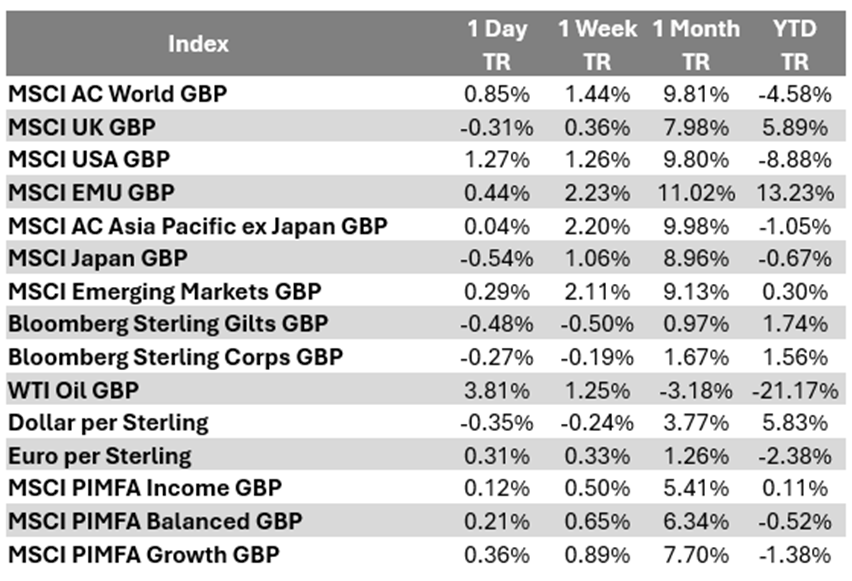
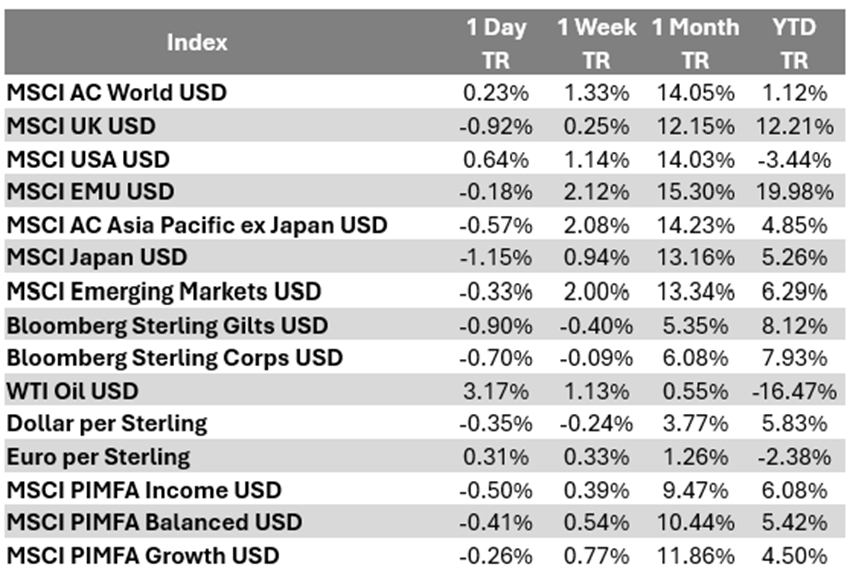
Bloomberg as at 13/05/2025. TR denotes Net Total Return.

Please continue to check our blog content for the latest advice and planning issues from leading investment management firms.

Marcus Blenkinsop

13th May 2025

Team No Comments

Tatton Investment Management: Monday Digest

Please see below, an article from Tatton Investment Management analysing the key factors currently affecting global investment markets. Received this morning – 12/05/2025

Markets calm but trouble still bubbles

Despite India-Pakistan hostilities, markets remained calm – thanks to trade deal progress and a sense that global growth will resume. Friedrich Merz’s failure to get first-round confirmation of his chancellorship was embarrassing but proved a market irrelevance at the end of the week. An India-Pakistan war certainly wouldn’t be irrelevant, but markets don’t think it will come to that and are more interested in the triangle of trade deals: UK-India (signed), UK-US (announced), US-India (in the works).

Trump proudly portrayed the UK-US ‘deal’ as unfair to UK goods exporters, but given it doesn’t include services (which the UK sells much more to the US) Starmer is probably right that this is the best for now. The broader narrative is once again that Trump tariffs are just “the art of the deal”. We see economic headwinds increasing, but can’t deny tariffs have brought leaders to the table.

Meanwhile, the Bank of England cut interest rates – though not as decisively as hoped – and the Federal Reserve held steady, to Trump’s displeasure. UK rate cut expectations dropped, but Britian is still on course for lower rates. The Fed’s situation is tougher: Trump called chairman Powell “Too Late” to cut rates and support US economy, and he’s right. What he’s missing is that tariff uncertainty and a tightening labour market from immigration prevention are causing the delay.

The EU’s retaliatory tariffs and Trump’s film industry tariffs don’t fit the “art of the deal” narrative. Investors consider these idle threats – and they might be. But threats themselves can be enough to stifle business activity, as we’re already seeing.

This suppression of activity is a problem for the precariously balanced US jobs market and its tightening credit conditions. Next week’s senior loan officers survey will be telling, but debt financing for small companies is already burdensome. These problems can be avoided if Trump relents or the Fed cuts – but the president seems unwilling and the central bank unable. If nothing changes, things could get nasty.

Markets are pricing in a positive resolution – but, like in January they may be underestimating the risks.

India’s art of the trade deal

Despite conflict with Pakistan, Indian stocks are significantly up from a month ago. Markets are more focussed on India’s trade deals – one signed with the UK and another in the works with the US. The former has been brewing for three years, but was clearly hurried over the finish line by Donald Trump’s trade wars. This probably helped New Delhi get concessions from the UK (the politically unpopular national insurance exemption) in exchange for a relatively moderate, though still meaningful, lowering of its high import tariffs.

Removing the US’ 26% “reciprocal” tariff on India is the bigger prize, and a deal suits both governments. India gets to keep one of its biggest customers, and Washington gets access to one of the world’s fastest growing economies. Ironically, negotiations are made easier by India’s currently sky-high tariffs. They have plenty of room to fall and Prime Minister Modi wants to open up India’s economy anyway. Over the long-term, this could be the ‘beautiful win’ President Trump claims, but the short-term impact for Americans will be small, as the US trades much less with India than Europe or China.

The fact higher tariffs give you an easier start in negotiations is one of the main reasons Trump likes them in the first place – as the US-UK deal shows. But that ‘hard bargain’ approach perversely punishes regions where trade is significant and relatively open, and might therefore give the US’ most important trading partners a bigger incentive to retaliate, as we see with China and the EU.

It’s also incompatible with Trump’s other tariff aims. Tariffs that go up just to come down don’t provide stable tax revenues or incentives for business investment. India’s experience shows the tactical approach is currently winning out, but those other goals could come back to the fore.

Are US small caps facing a credit crunch?

Small cap US stocks suffered after “Liberation Day” tariffs, but the impact on their debt financing has gone under the radar. The total interest paid by US small caps, as a percentage of earnings, is now at its highest level since the early 2000s – thanks to the lagged effect of sharply higher interest rates since 2022. Smaller companies tend to have higher debt-to-earnings ratios, but total debts aren’t growing especially fast. Rather, more of that debt is having to be refinanced at sharply higher rates than many locked in pre-2022.

Smaller companies started the year thinking that Trump would cut taxes and regulation, while the Federal Reserve would keep cutting interest rates – which made them seem like safer borrowers and thereby lowered credit spreads (the difference between corporate and government bond yields). But Trump’s disruptive policies have instead rocked business and consumer confidence, dampened growth expectations and hence raised credit spreads once more. The real kicker, though, is that uncertainty around tariffs is preventing the Fed from cutting rates – even though there is an argument the US economy needs it.

A credit crunch could still be averted, if the Fed does cut fast or if Trump enacts his pro-growth promises – and both those scenarios become more likely the worse the economy gets. Without that relief, though, small caps will eventually come under stress. JPMorgan predict that default rates for the worst-rated companies will climb to levels seen after the dotcom bubble.

Defaults are a clear sign of recession – which many are now predicting for the US. If the squeeze on small cap credit continues, we will get dangerously close to that point. The Fed will no doubt watch what happens to small cap credit closely. They may be forced to act – regardless of what happens to tariffs.

Please continue to check our blog content for the latest advice and planning issues from leading investment management firms.

Alex Kitteringham

12th May 2025

Team No Comments

Brooks Macdonald – The Daily Bulletin

Please see the below article from Brooks Macdonald detailing their discussions on key economic events that occurred yesterday. Received this morning 09/05/2025.

What has happened

US equity markets on Thursday were riding higher on optimism that following a UK-US trade deal announced yesterday, there might be more US deals to follow, including even perhaps between the US and China. Elsewhere the picture was more nuanced with the UK FTSE100 equity index falling, perhaps reflecting the reality that the UK is still facing tariffs across most sectors – indeed, while UK Prime Minister Starmer referred to yesterday’s agreement as a “historic deal”, as it stands the UK is actually in a worse-off position than before the 2 April US tariff ‘Liberation Day’ Trump announcement.

UK-US trade deal … there are still tariffs for UK

Despite yesterday’s UK-US trade deal, there are still tariffs for UK. In autos, the latest 27.5% total tariff rate (made up of US President Trump’s extra 25% on top of the 2.5% that was originally in place) will now be 10% (so still 4x higher than before Trump took office in January), and only for a quota of 100,000 cars (above that volume, a 27.5% total auto tariff rate would kick back in – for context last year the UK exported around 102,000 cars into the US, so while the deal largely covers existing production for autos, in effect, there is an additional tax on any UK hopes to grow car exports into the US). Elsewhere, aluminium and steel tariffs were cut to zero. Crucially however, for most other sectors the universal base line 10% tariff rate that Trump has levied on all countries globally will also remain in force for the UK as part of this deal as it stands currently.

Bank of England

The Bank of England yesterday wrong-footed, for now at least, dovish hopes that they might accelerate the pace of interest rate cuts going forwards. While yesterday’s 25 basis points (bps) cut in the UK interest rate to 4.25%, from 4.50% previously, was considered by markets to be a foregone conclusion, the Bank was determined to be more balanced around the rate outlook – that was reflected in the split of votes among the Bank members behind yesterday’s cut – there was a 3-way split, with 2 votes for no change, 2 votes for a bigger 50 bps cut, and 5 votes for a 25bps cut, the latter which is what the Bank did.

What does Brooks Macdonald think

Even though UK government bond gilt yields rose on Thursday, the Bank of England probably has more interest rate cuts still to come. From the Bank’s own latest forecasts published yesterday, UK economic growth is mixed (with next year revised lower), unemployment rate projections are higher, private sector wage growth forecasts are flat to lower, and consumer inflation is now expected to be lower than previously assumed for every year of the Bank’s forecast horizon through to 2027. Drilling down to an interest rate forecast is tricky, but Bank governor Bailey yesterday said that market expectations for a terminal interest rate of 3.5% was “not unreasonable” – whether that level is hit later this year is probably the big question now, with markets appearing to be split on whether the Bank delivers 2 or 3 more 25 bps-cuts in 2025.

Please continue to check our blog content for advice, planning issues and the latest investment, market and economic updates from leading investment houses.

Alex Clare

09/05/2025

Team No Comments

Evelyn Partners Update – May Bank of England MPC decision

Please see the below update from Evelyn Partners regarding today’s Bank of England Monetary Policy Committee’s decision to cut interest rates by 0.25% to 4.25%:

What happened?

As expected by economists, the Bank of England (BoE) cut its base interest rate by 25 bps to 4.25%. The decision was made by a majority of 7 who voted for a rate cut, against 2 that wanted to keep them unchanged.

What does it mean?

While the macro picture has changed since the last Monetary Policy Committee (MPC) meeting in February to become more disinflationary, the BoE appears focused on cutting interest rates at a gradual pace of around one-quarter percentage point per quarter since it began easing last August.

This comes despite concerns over US trade tariffs and policy uncertainty that suggest downside risks to growth, a point made by the BoE governor Andrew Bailey at an Institute of International Finance event in Washington last month. Indeed, the latest PMI data indicates weak manufacturing and services sector activity. Subpar growth is feeding through to softer inflation data.

Furthermore, energy prices have also been trending south: the price of Brent crude oil is down nearly 30% from a year ago, while sterling appreciation against the US dollar should also act to reduce import prices somewhat. All these factors should put ease inflationary pressure in the near term.

Nevertheless, MPC members will be wary of cutting interest rates too quickly. First, it is not clear what impact US trade tariffs will have on inflation. Second, the latest nominal weekly earnings for the whole economy of 5.6% year-on-year (on a three-month moving average) is running uncomfortably higher than prevailing inflation. And finally, the latest YouGov survey of household inflation expectations has picked-up to 4%, its highest rate since October 2023.

Bottom Line

Looking forward, the MPC is expected to stick to gradual and careful guidance on interest rates by cutting once a quarter, as the risk of policy error remains high. Nevertheless, gradually lower rates should provide some insurance against downside risks to the economy and UK domestic stocks.

Please continue to check our blog content for advice, planning issues and the latest investment market and economic updates from leading investment houses.

Andrew Lloyd

08/05/2025

Team No Comments

Brewin Dolphin – Markets in a Minute

Please see this week’s Markets in a Minute update below from Brewin Dolphin, received yesterday afternoon – 07/05/2025.

Oil price hits lows as OPEC accelerates production

We examine potential reasons for OPEC producing 400,000 extra barrels of oil a month – and how this could help President Trump.

Saudi Arabia shifts OPEC strategy

Shortly after the ‘Liberation Day’ furore, OPEC (the Organisation of the Petroleum Exporting Countries) announced an increase in oil production. In many ways, it was the opposite reaction to what would normally be expected. OPEC increases energy production when energy is undersupplied or reduces it when demand for oil is weak (this usually happens when the economy is weak). It does this to prevent the oil price from falling too low.

OPEC is a cartel. It manages the oil price to ensure that oil producing countries make healthy profit margins. Unusually low demand or members producing too much oil are two reasons oil prices could be weak.

Since the ‘Liberation Day’ tariffs were announced, growth expectations have generally declined.  Normally, you might expect that OPEC would reduce production in anticipation of weaker oil demand. Instead, it announced increased production immediately after the tariffs were announced; this week, it announced further increases. Why?

OPEC has been struggling to control the energy market because of new supply introduced from non-OPEC members. The U.S. is a big one since it developed shale oil. While OPEC restricts its own production to maintain high margins, it’s also ceding market share to higher-cost shale oil producers at the same time.

Despite OPEC’s efforts, the oil price has fallen, largely due to weak demand from China. OPEC may have decided that if it can’t maintain the margin it needs, then its next best option is to leverage its position as lowest cost producer, pump more oil, allow the price to fall and discourage further supply from non-OPEC members. 

Market rally on the Trump Fold

Trump effect

Source: LSEG/DataStream

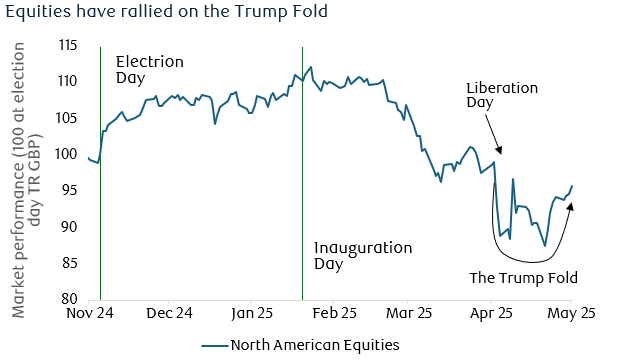
The early part of U.S. President Donald Trump’s second term has been challenging for stocks. Most notably U.S. stocks, which took their biggest hit when he shifted his rhetoric from “Make America Great Again” to “Make America Wealthy Again”. This coincided with his announcement on ‘Liberation Day’ tariffs, prompting a remarkable sell-off in global, particularly U.S., stocks.

Within a week, those tariff measures were partially walked back. Notably, the 90-day delay in the implementation of the individual tariff rates, affecting 60 countries, prompted a sharp rally in stocks. However, the president was keen to impress that the tough stance on trade was still in place by doubling tariffs on China. The situation has been chaotic ever since. Businesses have been in turmoil as they grapple with the measures and Apple announced last week that the measures would impose $900 million in additional costs this quarter. It presumably could have been worse, as the impact of tariffs was again diluted in response to a revolt from investors and business leaders. Consumer electronics were exempted, and although President Trump attributed this to the forthcoming additional measures on semiconductors, so far, those measures haven’t materialised. All of this has allowed a period of ‘announcement-calm’, during which the stock market has recovered most of the ground lost since ‘Liberation Day’.

By the end of Thursday last week, the S&P 500 had risen for eight consecutive days, a record run of strength. That still leaves U.S. stocks well below Inauguration Day levels, and the extent of the U.S. recovery is flattered when presented in local currency terms (i.e. U.S. dollars), due to the weaker dollar. Perhaps the leadership of the U.S. recovery has been a more significant factor.

Over this very short period, investors have used this weakness as an opportunity to get back into the exceptional U.S. companies that will benefit from the artificial intelligence (AI) revolution, a trend that will certainly outlast President Trump’s second term. Whether ‘Trumpism’ endures beyond the next few years remains less certain.

When will the economy weaken?

Jobs growth

Source: LSEG/DataStream

Last week’s U.S. Q1 GDP estimate was weak, suggesting that the U.S. economy contracted by -0.1% in Q1 (-0.3% on an annualised basis). Although this might suggest that the tariff policy has been a failure, in truth, the headline weakness is quite misleading.

Anticipation of tariffs prompted businesses and consumers to stock up ahead of possible measures. Imports detract from GDP while exports add to it, so this front-running weighed heavily on GDP in Q1. Final demand, by contrast, was very strong, also reflecting front-running of tariffs.

Trade will certainly be more of a tailwind in the second quarter; however, the uncertainty and higher costs are likely to be an overwhelming headwind to both consumption and investment.

The economy is currently showing potential, despite business and consumer surveys suggesting otherwise. Consumer confidence, according to the U.S. Conference Board, has collapsed to a level last seen in the depths of the initial COVID-19 wave. Respondents expressed more negative views on the labour market, expected higher inflation, and perceived the highest risk of recession in two years.

Businesses responding to the Institute of Supply Management (ISM) Manufacturing survey were also downbeat. Decline in new orders slowed, suggesting that business activity continues. The anecdotal comments released alongside surveys have been telling. All ten issued by the ISM mentioned tariffs in a negative light, citing difficulty in finding non-Chinese sources for tariffed imports, and an inability to tender for business because of the uncertainty over costs.

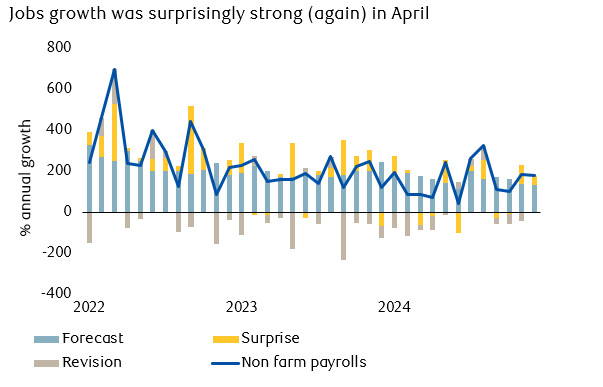
All eyes are on the labour market now. A fall in job openings reported Tuesday and a rise in jobless claims reported on Thursday, alongside the survey evidence listed above suggest the jobs market should be weakening. However, the official jobs report was a little stronger than expected. There were some negative revisions to previous reports, but forecasts now expect jobs growth to slow down to around 50,000 per month over the rest of the year.

The art of negotiations

Last week highlighted the different negotiating styles of the Chinese and U.S. administrations. We’ve previously described how Trump’s negotiating style aligns with aspects of his book ‘The Art of the Deal’ (despite allegations that he wasn’t particularly involved in its writing).

The key philosophy of ‘thinking big’ has been evident in terms of the measures used and, presumably, the concessions sought, although little substance has come from the negotiations so far. He has been aggressive, and outspoken, which are key tenets of ‘The Art of the Deal’ approach. One missing element has been a resolution. The book suggests that negotiations should be reconciled quickly, something that is unlikely to be possible in trade negotiations.

Perhaps most controversially, President Trump has actually made concessions. In general, his book suggests that concessions are unwise and can be perceived as a sign of weakness. However, he does suggest that a very aggressive negotiating stance can be moderated to make the opponent feel they have achieved something. It’s certainly conceivable that for many countries, reducing a 20% tariff to 10% could be perceived as a victory, despite being in a much worse position that they were just a few months ago.

China is now seeking to reduce a 145% tariff, which offers enormous scope for negotiation. According to Trump’s book, concessions should be given in return for negotiating wins, which has categorically not happened yet, it seems clear that the strategy has been at least partially flawed.

By contrast, China’s approach seems more consistent with Sun Tzu’s ‘The Art of War’. Ironically, despite being a military treatise, the text recommends avoiding conflict where possible. It takes a more strategic and measured approach, which seeks to win without fighting.

Last week, China sought to project a strong position, claiming not to be in talks with the U.S., while representatives of the White House were keen to concede that a deal and tariff reductions are possible; they’ve even suggested that current tariff rates are unsustainable. It seems to have been a public relations victory for China so far, but that doesn’t diminish its powerful need to persuade the U.S. to reduce taxes on trade with the richest economy in the world.

Please continue to check our blog content for advice, planning issues and the latest investment market and economic updates from leading investment houses.

Charlotte Clarke

08/05/2025

Team No Comments

Brooks Macdonald Daily Investment Bulletin

Please see below article received from Brooks Macdonald this morning, which provides a global market update for your perusal.

What has happened

The past 24-hours have seen more tariff trade war swings for investor sentiment. On the positives, it was confirmed late yesterday that US Treasury Secretary Bessent and US Trade Representative Greer will be heading tomorrow to Switzerland to hold trade talks with China’s Vice Premier He – that and separately, US President Trump yesterday promised an announcement that will be “as big as it gets” later this week, while Bessent said some “very good” offers had been made in trade negotiations by other countries. On the negatives, there are reports that the European Union (EU) are making detailed plans to hit US goods with tariffs if US-EU trade talks fail, while Trump yesterday said that “We don’t have to sign deals, they have to sign deals with us. They want a piece of our market. We don’t want a piece of their market.”

Oil prices

Oil price weakness has been something of a theme so far this year, notwithstanding a small bounce this week, in part as tariff-led economic growth fears have risen. Adding to downside risks, the Organization of the Petroleum Exporting Countries (OPEC) plus certain non-OPEC members including Russia (OPEC+) in their latest meeting last weekend agreed to accelerate oil production hikes. These increases in supply are designed to ultimately unwind post-COVID production curbs that were put in place to protect prices, but which have cost OPEC+ producers global market share. However, OPEC+’s latest production hike raises concern that such additional supply could lead to a global glut just as a global tariff trade war threatens broader economic growth.

China cuts a key policy interest rate

China’s central bank, the People’s Bank of China (PBOC) earlier today announced that it will be cutting a key policy interest rate, its 7-day reverse repurchase agreement (reverse repo) rate to 1.4% from 1.5% as well as separately lowering the reserve requirement ratio for banks. The measures announced should guide borrowing costs from the banks lower and release some extra monetary liquidity into the economy. This is because by cutting the reverse repo rate, the PBOC can boost monetary liquidity by making it less attractive for banks to deposit excess funds with the central bank – as a result, this encourages banks to instead lend more of those excess funds into the economy, increasing the overall money supply and promoting economic growth.

What does Brooks Macdonald think

Oil price weakness so far this year might be unwelcome news for energy producers, but it might be much better news for central banks. Oil prices can at times be a significant swing factor for the broader inflation outlook. At a time when tariff trade wars are risking higher price pressures as a result of increased trade friction in international trade, lower oil prices might help to keep a lid on inflation, and in turn might offer central banks some room for manoeuvre in being able to cut rates should economic growth falter.

Please check in again with us soon for further relevant content and market news.

Chloe

07/05/2025

Team No Comments

Tatton Investment Management: Tuesday Digest

Please see below, an article from Tatton Investment Management, providing a brief analysis of the key factors currently affecting global investment markets. Received today – 06/05/2025

Markets cheer US policy stabilisation
Last week was a good one for markets, despite a negative US Q1 GDP and mixed Mega Tech earnings reports. The GDP print caused a selloff in early Wednesday trading, but strong earnings from Meta and Microsoft precipitated a recovery on the day. Apple and Amazon’s earnings were weaker, but all projected solid capex plans. 

Tuesday saw a step back. Trump was helpful in suggesting that the US would lower tariffs on China eventually and that talks were imminent; and services data showed more positivity than expected. However, Trump’s Truth Social Post promising 100% tariffs on foreign films caused consternation, pulling down the share prices of Netflix and other media providers.

The announcement appears to have been the start of new policy thought rather than the opening of a thought-out strategy and may well be heavily amended. Nevertheless, it is the first time that services have been included in tariffs, something which the US had previously sought to exclude. Most in the US media industry would hope this will go away but the “100%” start makes a quick disappearance difficult. 

Encouragingly, Tuesday’s decline was small and implied market volatility remained around Friday’s level. Overall, implied volatility has dropped in the last few weeks, thanks to more conciliatory tones from US treasury secretary Scott Bessent – markets’ favourite member of Trump’s cabinet. His prominence since the US bond selloff last month has eased fears that the less market-friendly elements of the Trump administration rule the roost. Given Trump’s negative approval ratings, Bessent’s prominence will hopefully continue. 

The fact it only took a couple weeks of Trump quiet to calm markets suggest that investors see global growth as fundamentally strong and the president as fundamentally pro-growth. Whether that stability can continue – once policy disruption filters through to the economic data – remains to be seen.
 
The contraction in Q1 US GDP was down to increased imports ahead of tariffs (imports are subtracted from domestic sales). Counterintuitively, that might mean higher growth when imports fall later on, even though it signals weaker demand. As such, it’s more important to watch employment data – like the surprisingly strong April jobs report. Other jobs data has been mixed, suggesting companies are neither hiring nor firing. The Federal Reserve will focus on that data, and markets expect more interest rate cuts only by the year end – starting in July.
 
Longer-term rate projections have actually moved up – suggesting stronger growth 18-24 months from now. That would require more policy stability, of which there were some signs last week: US-India talks, Ukraine mineral deal, Germany’s coalition agreement. It also requires more dovish central banks, which is probably a safer bet, with the Bank of England set to cut rates next week.

April 2025 asset returns review
April was one of the most turbulent months for markets since the 2008 global financial crisis. Most stock markets are down at the end of it in sterling terms, but the slight rise in bond prices cushions some of the portfolio losses. 

Trump’s “Liberation Day” tariffs started the equity selloff, and losses mounted once Europe and China retaliated. Volatility eventually spread to US government bonds, due to highly leveraged investors (pension funds) needing to sell to meet margin calls. After Trump backed down, bond markets calmed, liquidity returned and hence a “buy the dip” mentality took hold. Even so, US stocks are the worst performers year-to-date in sterling terms, down 10.9%.

That is exacerbated by the falling dollar. Higher US yields – and a European interest rate cut – would normally push up the US currency, but investors are questioning how safe a haven the dollar is. European stocks are benefitting from this rotation – and were one of the few positive performers in April. The UK declined slightly by comparison, but is still up 5.4% year-to-date. This is partly down to looser monetary policy and partly because markets think Trump will cut trade deals with Britain and Europe.

China’s tariff prospects are worse, after a tit-for-tat escalation that has left sky high tariffs in either direction, making Chinese stocks April’s worst performer, even if they are still up for the year. Investors like Beijing’s domestic stimulus plan, but do not like it playing hard ball on trade. Markets still expect lower US-China tariffs than currently in place, but that requires thawing of relations.

April ended with US GDP release showing the economy contracted in Q1. That was down to America’s import rush (imports are subtracted from domestic production) ahead of tariff imposition, but the worst part is that it signalled both weaker growth and higher inflation. Hopefully, these clear impacts rein in Trump’s wilder policies.
 
Emerging markets caught in trade war crossfire
Last month’s International Monetary Fund (IMF) and World Bank Spring Meetings gave interesting insights into emerging market prospects during Trump’s trade wars. EMs are usually export led and therefore sell more to the US than they buy – which is why many were hit with high “reciprocal” tariffs.

This has caused a sharp pick up in EMs’ corporate credit spreads (the difference between US bond yields and EM corporate yields). A falling dollar would normally help reduce the debt burden, but this year’s decline in the dollar has been counteracted by credit spreads.
 
EMs do come into this difficult period in better financial shape, though. While credit spreads have increased, underlying credit ratings are higher than crises past. The IMF’s long-term support has had a big role in this, not only agreeing loans but working on financial stability – which is why many EM central banks have scope to cut interest rates. These improvements are why many EM investors haven’t abandoned EM assets altogether – as you might expect in a ‘risk off’ phase – but are instead being selective, according to JPMorgan’s survey of EM investors.

Unfortunately, IMF support for EMs is probably one of the reasons Trump considers such trade bodies anti-American. The Bretton Woods institutions cannot exist without US support – not only due to US funding but because the “Washington consensus” means nothing without Washington’s consent. One only need look at the World Trade Organisation (WTO), which has lacked a full appellate board since Trump’s first term and is effectively toothless. EMs would struggle if Trump gutted the IMF, but thankfully US treasury secretary Scott Bessent has suggested reform rather than destruction.
 
Unfortunately for EMs, we don’t know if Bessent’s reformist trade approach will win out in Trump’s cabinet. But they are at least better prepared for this turbulence than in the past.

Please continue to check our blog content for the latest advice and planning issues from leading investment management firms.


Marcus Blenkinsop

6th May 2025  
Team No Comments

EPIC Investment Partners: The Daily Update

Please see the below article from EPIC Investment Partners, focused on the prolonged contraction of US manufacturing. Received today – 02/05/2025

US manufacturing is caught in a protracted slump, with the ISM Manufacturing PMI stuck below 50 in 28 of the past 30 months. From November 2022 to December 2024, it didn’t register a single expansionary reading – a 26-month contraction streak, the longest on record. Hopes of a turnaround were dashed in March when the index slipped below 50 once more with April’s reading declining to 48.7. 

Manufacturing accounts for around 10% of GDP, but it often signals broader shifts in the economic cycle. A PMI below 50 means more firms report deteriorating conditions than improving ones. The length of this downturn implies more than a passing slowdown; it suggests demand is weak, in part due to the uncompetitive nature of US manufacturing, which in turn is heavily influenced by an overvalued dollar. A stronger dollar makes US goods more expensive abroad and imported goods cheaper at home, undercutting domestic producers. Orders are shrinking, production is slowing, and firms are reporting margin pressure as costs rise. 

Headline GDP growth has muddled through, but the detail paints a more fragile picture. Real GDP fell 0.3% in Q1 2025, while real final sales – a better gauge of demand – dropped by 2.5%. These figures mirror what manufacturers are experiencing. The ISM’s Production Index fell to 44.0 in April, and export orders collapsed to 43.1 – the weakest in over a year. 

Inventories are also rising, but not for the right reasons. Businesses have stockpiled goods ahead of new tariffs, only to find demand lacking. The resulting overhang threatens further production cuts. ISM officials have described the build-up as precautionary and temporary, yet with new orders weak, the adjustment could be painful. 

Tariffs are amplifying the strain. Companies report halted Chinese shipments and cancelled client orders due to unpredictable import costs. In some sectors, tariffs of over 100% have rendered products uncompetitive. The ISM Prices Index jumped to 69.8 in April, the highest since mid-2022, reflecting rising costs for materials like steel and aluminium. Yet soft demand makes it difficult for firms to raise prices, squeezing margins. 

The employment picture is also deteriorating. April’s factory employment index ticked up slightly but remains in contraction. Firms are laying off staff or halting recruitment altogether, in sharp contrast to the relative strength seen in the services sector. That divergence is increasingly unsustainable. 

Unlike past recessions, this isn’t a collapse but a slow erosion. PMI readings in the mid-to-high 40s point to steady, grinding contraction. The comparison is more with the industrial slowdowns of the 1990s or 2015–16 than the crash of 2008. But even without a formal recession, the risks are mounting. 

Markets now await today’s payrolls report, which could prove pivotal. The Federal Reserve faces a complex balancing act: tariffs are adding temporary upward pressure to inflation, while broader growth indicators turn soft. Rate cuts are unlikely without clear labour market deterioration, particularly a rising unemployment rate. Yet if the Fed delays too long, it risks keeping rates too high during a slowdown already well underway. For investors, the message from the factory floor is becoming harder to dismiss: the manufacturing slump is no longer a warning sign — it is the story — and one unlikely to improve unless the dollar falls sharply, the Fed cuts rates meaningfully, or both.

The figures outlined in this report paint a bleak picture for US manufacturing. The dollar’s role as the global reserve currency props up its value, making imports to the US cheaper and exports to the rest of the world more expensive. This reduces the competitiveness of US exports which dampens overseas demand for their products.

Trump’s tariff policies are also starting to bite as import duties begin to be paid on raw materials. This is likely to be passed on to consumers in price rises, but already weak demand for American goods makes this difficult. American manufacturing businesses are seeing their margins reduced.

Trump’s take on trade deficits, that they equal opposing tariffs, is a misunderstanding of sophisticated global supply chains that have been built up over decades. US manufacturing does not enjoy a comparative advantage over exporting nations like China and much of South East Asia.

Unless we see Trump row back on these policies, or a significant depreciation of the dollar, then manufacturing in America is likely to remain in contraction.

Please continue to check our blog content for the latest advice and planning issues from leading investment management firms.

Alex Kitteringham

2nd May 2025

Team No Comments

Brooks Macdonald Daily Investment Bulletin

Please see below article received from Brooks Macdonald this morning, which provides a global market update for your perusal.

What has happened

May has got off to a good start for markets. Yesterday saw key equity indices extend their run of back-to-back daily gains, in part down to strong US megacap tech earnings from Microsoft and Meta the day before. While the latest tech results overnight from Amazon and Apple were a bit more mixed, this morning the broader risk-on mood has had a shot in the arm after China said it is evaluating trade talks with the US, with Asian equity markets reacting positively. Finally, in focus later today will be US ‘non-farm payrolls’ jobs data for April where markets are looking for an unchanged +4.2% unemployment rate.

Possible thawing in China-US trade tensions

Earlier today, China’s Commerce Ministry said in a statement that it had noted that “the US has recently sent messages to China through relevant parties, hoping to start talks with China” and that “China is currently evaluating this”. In terms of possible next steps, and as a condition to negotiations, the statement asked to the US to “show its sincerity and be prepared to correct its wrong practices” by scrapping the current reciprocal tariffs.

Key equity indices extend their run of gains

The US S&P500 equity index was up +0.63% yesterday, extending its run of gains to 8 days in a row – that is the longest winning streak since August last year, and leaves the index “only” -1.18% below its 2 April close after which US President Trump’s ‘Liberation Day’ tariffs were announced. Elsewhere, the pan-European STOXX600 and UK FTSE100 equity indices just managed to eke out by the thinnest of margins, another day’s gain (both edging higher by +0.02%). It was marginal though – for example, while the FTSE100 notched up a 14th daily gain in a row, a joint record since the index was formed back in 1984, looking at different indices, the MSCI UK equity index (owing to a different constituent index composition), was actually marginally down on the day. All in local currency, price return terms.

What does Brooks Macdonald think

This morning’s statement from China signals the strongest indication yet that the trade tariff stalemate between the world’s two-biggest economies could get resolved. For context, the positive reaction in markets this morning comes against US-China tariff rates on both sides that are so high currently that they effectively amount to a trade embargo in all but name. It is still very early days, and there are thorny trade issues for both sides to address, but China’s apparent willingness to enter trade negotiations is in itself welcome news.

Please check in again with us soon for further relevant content and market news.

Chloe

02/05/2025