Team No Comments

Brooks Macdonald – Daily Investment Bulletin

What has happened

Equities yesterday added another day to an impressive run of gains, wrapping up a volatile month. The US S&P500 and the pan-European STOXX600 equity indices have now both rallied for 7 days in a row, while the UK FTSE100 equity index has notched up 13 days in a row of gains and the FTSE100’s best run in over 8 years. Since the markets close on 2 April, after which the US unveiled its “liberation day” tariffs, those 3 indices are respectively now “only” down -1.80%, -1.76%. and -1.32%, all in local currency price return terms. Looking to the day ahead, strong numbers last night after the US close from megacap tech companies Microsoft and Meta are expected to help equity markets today, while attention will turn later on to Apple and Amazon results due after the US close later today.

US GDP weaker, but distorted by a big surge in imports

Yesterday saw the advance estimate for US calendar 1Q Gross Domestic Product (GDP) released. The data showed Quarter-on-Quarter (QoQ) annualised real (constant prices) GDP shrinking -0.3%, versus market expectations for small growth of +0.3% – it was well below Q4 2024’s +2.4% print and the average growth of close to +3% over the past 2 years. To caveat, however, within the data there was a big distortion from a surge in goods imports (where imports are subtracted from GDP), which clocked a QoQ annualised growth rate of +50.9% in Q1.

Microsoft and Meta deliver strong numbers and outlook

Microsoft and Meta (the parent company of Facebook) both delivered strong results after the US close yesterday, sending both companies’ shares up in after-market trading by over +5% each. On the outlook for artificial intelligence (AI), both companies signalled continued strong demand: for Microsoft, its Azure cloud computing division which includes AI spend, posted an estimate-beating +33% revenue growth; for Meta, the company raised its capex spend plans for this year, with its CEO Zuckerberg saying that “the pace of progress across the industry and the opportunities ahead for us are staggering”.

What does Brooks Macdonald think

The latest US GDP data hides some cross-currents to be mindful of – with companies frontloading stock ahead of US tariffs, a surge in imports distorted the US 1Q GDP data – because any goods imported into the US are by definition not produced in the US, they are subtracted from US GDP. Instead, economists sometimes prefer looking at ‘real final sales to private domestic purchasers’ to get a cleaner snap-shot of consumer demand – indeed, US Federal Reserve Chair Powell has said in the past that this measure “usually sends a clearer signal on underlying demand” – on this measure the picture is a bit more encouraging, showing a +3.0% QoQ annualised increase in 1Q, and slightly up on the +2.9% QoQ annualised increase seen in 4Q last year.

Please continue to check our blog content for the latest advice and planning issues from leading investment management firms.

Marcus Blenkinsop

1st May 2025

Team No Comments

Brewin Dolphin – Markets in a Minute

Please see this week’s Markets in a Minute update below from Brewin Dolphin, received yesterday afternoon – 29/04/2025.

Tariff talk and rate cut hopes amid economic caution

Downgraded growth forecasts and more tariff talk. Could rate cuts cushion the tariff blow?

Softening tone from Trump. Will it last?

There are more U-turns from the White House, likely from the compounded market pressure due to the sell-off of U.S. stocks, the U.S. dollar and U.S. treasuries in unison.President Trump said he would be willing to “substantially” pare back his 145% trade tariffs on China and said both sides have been talking, though China has denied the latter. From being unapologetically provocative on China to the suggestion of “being nice” in just a matter of weeks, it’s no wonder “Trump chickens out” is a top trending hashtag on Chinese social media Weibo.

The softening in aggressive rhetoric came after a meeting with key U.S. executives from Walmart, Home Depot and Target. The sky-high tariff rates on China will significantly disrupt supply chains, risk empty shelves when inventories are run down, and raise the price of imported goods for the average American consumer. This is an indication that opinions from the Corporate American elites have some sway on President Trump.

Though perhaps the reason for backing down is simple – the trade war between the U.S. and China is “not sustainable”– as Treasury Secretary Scott Bessent neatly put it. The U.S. has a trade deficit of $274 billion with China, from where it imports $439 billion and exports $165 billion. At first glance, it seems China stands to lose the most, if a large part of these export revenues is lost. But as China stands firm and as days go by, it becomes increasingly apparent that the U.S. will suffer more in the near-term given its heavy reliance on a range of household goods and industrial inputs from China. American businesses and consumers will either find it difficult to substitute those Chinese imports or will pay a higher price due to tariffs.

Given the sensitivity of U.S. consumers on inflation and how integrated U.S. businesses are with supply chains in China, it’s difficult to see how these astronomical tariff rates can last for weeks, let alone months or years.

Aside from tariffs, President Trump also U-turned on his claims of firing Fed Chair Jay Powell. While President Trump reiterated his call for interest rate cuts, he said he had no intention of firing Chair Powell. Whether he means it from the bottom of his heart is debatable, but the point is, the bond market serves as a guardrail on how far he can test the boundaries.

While the trade drama is almost certain to continue, the recent developments did provide hope that the worst of the provocations are over. What we can learn from last week is that economic pragmatism and market pressures do hold Trump back, at least to some extent. That said, some credibility on the U.S. administration is damaged and investors are assigning a higher risk premium on U.S. assets under Trump 2.0.

The economic cost of tariff uncertainty

It’s certainly a welcoming development that the most aggressive tariff rates may scale back. Given the economic damage is self-inflicted, the U.S. administration does have control to reverse all these damaging decisions. What it cannot control and easily amend is the confidence and credibility lost. The impact of policy uncertainty on economic activity is often manifested through the confidence channel. We have already seen a plunge in various U.S. consumer and business surveys, with a worrying combination of higher price expectations and a decline in the desire to spend or invest. The latest PMIs in major developed economies provided yet more evidence of the potential stagflationary (higher inflation, lower growth) impact of Trump’s tariffs.

Source: Refinitiv Datastream.

Since the escalation of trade tariffs, various high-profile executives and sell-side economists have been warning about the negative impact. The latest World Economic Outlook by the IMF presents another authoritative voice on the subject. Unsurprisingly, the IMF has downgraded global growth forecasts due to trade tensions and deteriorating sentiment. The 2025 U.S. GDP growth forecast has been slashed by 0.9% to 1.8%, a very significant downgrade in just a matter of three months. While a U.S. recession is not expected, the IMF has raised the probability of this happening to 40%. Setting aside cyclical worries, the new reality highlighted by the IMF is that the global economic system, that has operated for the last 80 years, is being reset.

Rate cuts to cushion the tariff blow?

After the decisive rate cut by the European Central Bank due to economic concerns, the question is how far will central banks go to cushion the economy from tariff blows. There is a willingness to cut rates to support the economy for sure, but it all depends on whether there’s room to do so i.e. does inflation mean monetary policy can be loosened.

It’s interesting to hear the views of Monetary Policy Committee (MPC) member Megan Greene on the subject. She feels tariffs actually represent more of a deflationary risk than an inflationary risk. While the tariffs are expected to raise prices in the U.S., the UK could see the opposite effect due to the diversion of cheap Asian exports, a weaker dollar and the softening of demand from slower growth. The takeaway from the perspective of one of the most hawkish policymakers of the Bank of England is that the concern on growth probably outweighs that of inflation.

While Fed Chair Jay Powell is applauded to stand firm on no rate cut for now, two Fed officials expressed support for a rate cut if there’s more evidence of an economic slowdown and deterioration in the labour market. It seems that central bankers are adopting an agile mindset to deal with this new macro environment of multiple shocks. As growth outlook deteriorates, traders are pricing in a few more rate cuts in the UK, U.S. and the Eurozone for the rest of 2025.

Please continue to check our blog content for advice, planning issues and the latest investment market and economic updates from leading investment houses.

Charlotte Clarke

30/04/2025

Team No Comments

EPIC Investment Partners – The Daily Update: Trump Tariff’s Troublesome Tentacles

Please see the below article from EPIC Investment Partners detailing the ongoing impact of Trump Tariff’s on the US economy. Received this morning 29/04/2025.

The world is spending a great deal of time trying to justify the dubious hypothesis that tariffs help domestic manufacturers… even if it is true, it ignores the large potential cost to exporters and consumers.

Tentacle 1: Small domestic business. 40% of imports into the US are for domestic manufacturing use, often consisting of intermediate goods used as inputs in domestic manufacturing processes. 37% of US imports from China are indeed these intermediate goods for which prices have now doubled, and whilst domestic production of these input goods may cover some of the gap, it cannot replace all the imports in the short-term. Less than 5% of iPhone components are currently manufactured in the US, and aside from the chipsets coming from Taiwan, most of the phones are made in China. Whilst Apple may be able to get a reprieve on import tariffs, we are not sure the rest of the small-to-mid-cap firms will be so lucky. We have not yet mentioned that small businesses make up 36% of exports, and there could be significant retaliatory tariffs on their exports too. As a reminder, in 2024, small businesses in the US accounted for 46% of all employees and are historically more sensitive to margin compression. 

Tentacle 2: Freight. In attempts to encourage US shipbuilding, steep fees are being levied on Chinese-owned or built ships. There is no doubt this will raise freight costs, but we are yet to see how profound the ripple effect will be. This will impact US exporters trying to seek out the cheapest shipping options. Oil and Liquefied Natural Gas (‘LNG’) will have other problems too. Only three of the eight hundred complex LNG carriers are US-built ships, dating back to the 1970s! Interestingly, the only US shipyard looking to build one right now is owned by Korea’s Hanwha Ocean.

Tentacle 3: Loss of confidence from non-US investors. The 90-day pause has not helped reduce uncertainty. Trump compared the US to a department store, stating: “I am this giant store. It’s a giant beautiful store and everybody wants to go shopping there. On behalf of the American people, I own the store and will set the prices”. However, the jump in longer-term yields suggests that not everyone wants to go shopping in the US. Furthermore, the store may start running out of stock. The port of Los Angeles is the largest entry point for Chinese goods, and they expect arrivals to be down by a third. Airfreight is also down significantly. US importers will be running down stockpiles while looking to store new deliveries, duty-free for now, in bonded warehouses or divert them to Mexico or Canada. If the department store has no stock and no one wants to shop there, can they still set prices? 

Please continue to check our blog content for advice, planning issues and the latest investment, market and economic updates from leading investment houses.

Alex Clare

29/04/2025

Team No Comments

Tatton Monday Digest – Improving mood versus slowing growth

Please see below article received from Tatton this morning, which provides a global market update.

Capital markets bounced last week, supposedly because of Trump backing down on Chinese tariffs and Federal Reserve independence. 

We should be careful about these rationalisations. Greater liquidity led to a better mood in stocks and bonds, and a ‘buy the dip’ mentality from US retail investors. Trump suggesting Chinese tariffs could be lower – and that Fed chair Powell could keep his job – certainly helped, but this isn’t crisis averted. Institutional investors are still nervous, and tariff uncertainty has all but halted business investment. 

The mood benefitted from the public appearances of US treasury secretary Scott Bessent, who sounded much more constructive on trade, tariffs and the Fed. Unfortunately, we don’t know how long Bessent’s time in the sun will last. Trump likes his cabinet to fight for policy influence – exemplified by last week’s shouting match between Bessent and Elon Musk. China also called Trump’s claims of dialogue “fake news”. Beijing might be bluffing when it says they have more stomach for trade war, but the suggestion will anger Trump’s inner circle. Bessent’s ‘adult in the room’ style won out last week, but it might not next time. 

The fact US businesses can’t plan ahead – and hence can’t invest – is a growth negative for the world’s largest economy. US stocks are still more expensive than others in price-to-earnings valuations. That has been sustained for decades by exceptional profits, but the latest earnings reports show that exceptionalism is fading. 

Other regions could pick up some of the investment slack – most notably Europe, which is being forced to invest in its own capacity. And it’s worth noting that calls of a global recession aren’t backed up by the economic data. But the rest of world can’t fully make up for the reduction in US business investment. The growth outlook is therefore weaker than at the start of the year. We shouldn’t be surprised if last week’s positivity is soon tested. 

Tariff recap: what’s here and what’s near?

Trump tariffs are always in the news, but it’s surprisingly difficult to find out which tariffs are actually in place. The table below shows US tariffs currently in effect and those soon expected.

US imports from Mexico and Canada face a 25% import tax – except those covered by the USMCA trade deal Trump signed in 2019. The White House says that USMCA compliant goods account for 50% of Canadian imports and 38% of Mexican imports. Non-USMCA compliant energy and potash imports face a lower 10% tariff.

Trump suspended his “reciprocal” tariffs until 9 July, but the baseline 10% on most countries – and 25% on cars, steel and aluminium – is still in place. China faces a higher 145% rate, despite the president’s softer rhetoric last week. Chinese electronics are currently exempt but probably won’t remain so, and the de minimis rule excluding small orders up to $800 will end on 2 May. 

Looking ahead, the most likely outcome is a patchwork of bilateral trade deals. Despite White House antagonism towards Europe, many expect lower tariffs eventually. China is more complicated, as it’s unclear whether Trump is tactically or ideologically opposed. But trade deals take longer to sign than Trump’s 90 days, so even in the best case scenario we will probably see last-minute unilateral declarations from Washington. 

More tariffs are on the way, like 25% for pharmaceuticals and semiconductors. It’s also possible the US will threaten to tariff China’s trading partners – similar to their plan for Venezuela. Then there is the USMCA renegotiation between the US, Canada and Mexico looming next year. In the meantime, trade experts’ best guess for average US tariffs by the year end is 15-20%. That wouldn’t mean a deep recession, but the fact nobody is sure what will happen doesn’t help. 

Fed independence: it would have been a nice idea

Trump saying he has “no intention” of firing Federal Reserve chair Jerome Powell was a relief for markets, as central banks’ operational independence is a cornerstone of the global financial system. 

The central bank independence movement started in the 1920s, but was put on hold during WWII and the Keynesian macroeconomic consensus that followed. When the consensus collapsed during the 1970s inflation crisis, the role of central banking had shifted from emergency lending to ongoing economic management – which led to banks gaining legal independence from the 1980s. Economists generally think independence has succeeded in giving central banks credibility and taming inflation. 

But independence has always been more an aspiration than a reality. Governments scrutinise central banks, and successful economic policy requires fiscal and monetary coordination. Trump adviser Stephen Miran has argued this coordination means Fed independence isn’t realistic or desirable – but you could argue it means the opposite. Monetary policymakers need to think about the implications of public spending on interest rates, which requires thinking on longer timeframes than short-term election cycles. Fed independence is reminiscent of Gandhi’s famous line, when asked about Western civilisation: “I think it would be a good idea.”

Markets certainly don’t like Trump’s attempts to squash this aspiration. The longer-term impact of Fed’s independence removal would be on bonds. Interestingly, this might actually reduce our preferred measure of government ‘credit risk’ (the difference between government bond yields and Fed-guaranteed interbank swap rates) because it would mean the treasury can directly print money to pay off its debts. The real risk is that the money would become worthless – meaning higher yields. This puts the Fed in a bind. Arguably, Powell should cut interest rates because of weaker US growth, but the uncertain impacts of Trump’s policies on inflation is stopping the Fed from doing so. Hopefully, the White House won’t stop Powell from acting altogether. 

Please check in again soon for further relevant content and market news.

Chloe

28/04/2025


Team No Comments

EPIC Investment Partners The Daily Update – Tariff Stalemate Fuels China’s Renminbi Push

Please see the below article from EPIC Investment Partners detailing their discussions on the Tariff stalemate between the US and China, and China’s push for the internationalisation of the Renminbi. Received this morning 25/04/2025.

Negotiations between China and the United States remain deadlocked, with both nations imposing substantial tariffs on each other’s imports. US Treasury Secretary Scott Bessent has described these tariff levels as “unsustainable,” underscoring the urgent need for significant reductions to facilitate productive dialogue. Despite assertions from the US suggesting ongoing discussions, Chinese officials have repeatedly denied these claims, highlighting that no substantive negotiations are currently underway. This diplomatic impasse underscores deep-rooted differences and indicates a near-term resolution is unlikely.

Amid this standstill, China is actively redirecting its strategic efforts towards strengthening global diplomatic relations and accelerating the internationalisation of its currency, the renminbi (RMB). This strategic pivot directly addresses vulnerabilities exposed by dependency on the US dollar, particularly as geopolitical tensions intensify.

On 21 April, the People’s Bank of China (PBOC), alongside other financial regulators, issued clear directives urging state-owned enterprises (SOEs) to prioritise the renminbi in overseas transactions. This significant policy directive aims explicitly at reducing China’s reliance on the US dollar, thereby enhancing its financial autonomy and international economic influence. China’s insistence on complete removal of US tariffs aligns closely with its broader strategy to mitigate external pressures and assert greater control over its economic trajectory.

PBOC Deputy Governor Lu Lei has highlighted the importance of improving cross-border financial services and payment networks, essential for wider adoption of the renminbi internationally. Although the tangible impacts of these directives are yet to materialise, the strategic intent signals a deliberate and substantial shift in China’s long-term economic planning. Accelerating the renminbi’s global adoption serves not only to increase the currency’s prominence but also to leverage enhanced financial autonomy amid ongoing international friction.

Successful internationalisation of the RMB could significantly reshape the global economic landscape. A stronger and more broadly accepted renminbi would enhance China’s geopolitical leverage, attracting countries eager to diversify their foreign exchange reserves and mitigate dollar-centric financial risks. This shift would bolster China’s overseas investment capabilities, particularly benefiting initiatives like the Belt and Road, by enhancing the purchasing power of Chinese enterprises abroad. This may extend further to acquiring stakes and knowledge in key industries like AI and robotics.

Domestically, a stronger renminbi aligns with China’s overarching goal to shift economic growth from export dependency towards increased domestic consumption and the development of higher-value-added industries. We have seen this with electric vehicles, where China is the world leader producing 60% of the world’s electric cars and 80% of the batteries that power them.

China’s firm stance highlights the deepening divergence between the two economic superpowers. The US demand for mutual tariff reductions contrasts starkly with China’s insistence on unilateral US tariff removal, deepening the stalemate. Consequently, this unresolved conflict appears likely to endure.

In response to this persistent impasse, China is clearly leveraging the situation to expedite its currency internationalisation agenda, potentially redefining global financial dynamics. For investors, understanding this strategic shift is crucial, as it has disruptive implications for the future structure and stability of global finance. We will keep you updated as this story unfolds.

Please continue to check our blog content for advice, planning issues, and the latest investment, market and economic updates from leading investment houses.

Alex Clare

25/04/2025

Team No Comments

Brewin Dolphin – Markets in a Minute

Please see the below article from Brewin Dolphin, examining some possible explanations for why the U.S. dollar is weakening and discussing the recent European Central Bank interest rate decision and the prospect for further cuts. Received – 23/04/2025

The dollar declines

One of the most notable features of the Trump 2.0 market reaction has been the weakness of the dollar. This is notable because in previous periods of financial stress, the dollar has tended to strengthen.

Any weakness felt by the U.S. is often assumed to be felt even more harshly by its trading partners as it’s transferred to them via the global financial system. An important difference in this period of stress compared with previous ones is the unorthodox strategy the U.S. has adopted of fighting all its trading partners simultaneously. As a result, the economic impact is likely to fall more heavily on the U.S. than on other countries.

The U.S. tariff strategy has already pivoted. It’s still broad, but now specifically targets China with the deepest measures while, allegedly temporarily, applying a baseline 10% tariff to all other countries. A key question is whether this could change from being a principally U.S. problem to becoming a principally ‘all-other-countries’ problem. There’s also the question of whether the start of trade talks will see the U.S. negotiating on a weaker dollar through some kind of accord.

Trade Balances

Source: IMF, LSEG Datastream

Some of President Donald Trump’s advisers see the devaluation of the dollar as a policy goal. This is because the Pax Americana, which has existed since the end of the Second World War, has since been shown to bear some economic costs (perceived or real) for the U.S.

Most notably, the establishment of the Bretton Woods Agreement cemented the U.S. dollar as the reserve currency of the global financial system. It required other countries to accumulate foreign currency reserves in dollars. An inadequate supply of dollars would restrict the amount of trade that could take place, but trading partners need to get those dollars from somewhere and the only possible sources are loans, U.S. foreign aid, or earning them through trade.

So, initially the U.S. needed to supply the world with dollars, which it did through the Marshall Plan (aid) and running trade deficits, eventually undermining the dollar’s convertibility into gold. While the currency stability implicit in the Bretton Woods Agreement ended during the 1970s, the use of the dollar as a reserve currency remained.

Foreign Exchange

Source: IMF, LSEG Datastream

During the 1980s, this caused the dollar to appreciate relative to other currencies. The Plaza Accord – a joint agreement between France, West Germany, Japan, the United Kingdom, and the United States – was signed, in which all participants agreed to intervene to weaken the dollar.

Stephen Miran, the Chair of President Trump’s Council of Economic Advisers, has previously published a plan for a Mar-a-Lago Accord, with the objective of bringing about a weaker dollar. A weaker dollar could be an area in which the president and his advisers are in agreement.

However, a weaker dollar seems likely to imply higher borrowing costs (less foreign ownership of treasuries), which would bring real costs to U.S. taxpayers. 

If the U.S. does want to weaken the dollar, there are ways for investors to benefit. That would happen if foreign central banks reduced the weightings to dollars within their foreign exchange reserves. A beneficiary would be gold, which has been very strong.

Gold, which had once accounted for around 60% of foreign exchange reserves, fell to just 6% during the financial crisis and gradually rose until 2024, when its growth sped up, reaching nearly 15% once more.

Various actions may have motivated this. Many developing world economies have held large U.S. dollar foreign currency reserves, but reliance on the dollar exposes them to sanctions that the U.S. might wield in the future.

The U.S. president’s recent apparent disregard for key federal institutions, such as the judiciary and the independent central bank, is concerning and could potentially weaken the dollar even further.

This was brought into sharp relief around the Easter weekend, when President Trump made a series of comments and social media posts insulting and expressing his dissatisfaction with Federal Reserve Chairman Jay Powell.

Added to this is the possibility that current day America no longer wants the central role in the global trade and financial system that American economist Harry Dexter White negotiated for at the Bretton Woods conference.

The trade talks begin

U.S. Trade run

Source: IMF, LSEG Datastream

The first round of trade talks began last week. Japan is the first government to be granted the opportunity to negotiate with the U.S. According to mercantilists, Japan has been a longstanding adversary to the U.S. In fact, it was Japan that inspired President Trump to publish his open letter calling for protectionism in 1987.

President Trump announced that the talks had seen big progress, although details were scant. Ryosei Akazawa, Japan’s Economic Revitalisation Minister, said more talks will take place this month and that the currency wasn’t discussed. That’s a surprising development because Japan’s alleged currency manipulation has been a constant source of President Trump’s ire.

The resolution of trade issues with Japan may take months and it remains to be seen how many concurrent trade negotiations the U.S. is prepared to run. Japan alone will not materially change the size of its trade deficit.

Please continue to check our blog content for the latest advice and planning issues from leading investment management firms.

Marcus Blenkinsop

24th April 2025

Team No Comments

Brooks Macdonald – Daily Investment Bulletin

Please see below, Brooks Macdonald’s Daily Investment Bulletin which summarises the key issues currently affecting global investment markets. Received today – 23/04/2025

What has happened?

The last 24-hours has seen more Trump-news whiplash for markets, with the latest turn of events signalling a possible easing in US-China tensions as well as (after the US close yesterday) some relief for US Federal Reserve watchers. The better tariff hopes pushed the US S&P500 equity index up +2.51%, its strongest day’s performance in two weeks, and unwinding the previous day’s falls in the process. Over in Europe, given markets were closed on Monday, not having to claw back a previous day’s losses meant the gains yesterday were a bit more muted, with the pan-European STOXX600 equity index up +0.25% and the FTSE100 up +0.64%, all in local currency price return terms. Also notable yesterday was US megacap technology stock Tesla shares which rose in after-hours trading despite weaker results after its CEO Musk said he would step back “significantly” from the US Department of Government Efficiency.

Trump administration eases US-China tariff worries

There were welcome signs of an easing in tensions coming out from the US Trump administration yesterday. In a JPMorgan-hosted closed event on the sidelines of the IMF (International Monetary Fund) meetings in Washington DC yesterday, according to sources in the room, US Treasury Secretary Scott Bessent said that of the US and China, “neither side thinks the status quo [on the current tariff rates] is sustainable”. Following that, US President Trump separately said that he didn’t see the need to “play hardball” with China and planned to be “very nice”, adding that tariffs could drop “substantially, but it won’t be zero” if the two countries can reach a deal.

An independent Fed after all

After the past weekend’s headlines that suggested Trump was seeking to find ways to remove US Federal Reserve (Fed) Chair Jerome Powell from office (before Powell’s term is set to end next year, May 2026), yesterday was another welcome walk-back from US President Trump. Taking questions from the press yesterday, Trump said that he had no intention of firing Powell despite his frustration with the central bank not moving more quickly to cut interest rates: “Never did,” Trump told reporters yesterday, adding that “the press runs away with things. No, I have no intention of firing him, [but] I would like to see him be a little more active in terms of his idea to lower interest rates.”

What does Brooks Macdonald think?

It is hard to keep up with the almost daily U-turns in policy and views coming out from the US Trump administration at the moment – not surprisingly, markets are on edge and volatility is high. But making knee-jerk investment decisions in the heat of the moment, which can carry far-reaching longer-term performance consequences, is rarely a good idea. Instead, our focus continues to be on keeping a balanced and diversified approach, aiming to position our asset allocation choices to weather economic uncertainties effectively, and focused on a long-term investment strategy that is adaptable yet grounded in sound principles, aiming to position portfolios to effectively navigate the economic uncertainties that lie ahead.

Please continue to check our blog content for the latest advice and planning issues from leading investment management firms.

Alex Kitteringham

23rd April 2025

Team No Comments

Tatton Investment Management: Tuesday Digest

Please see below, an article from Tatton Investment Management, providing a brief analysis of the key factors currently affecting global investment markets:

Volatility drops but uncertainty remains 

Markets were calmer last week but there was no strong rebound. Falling government bond yields were welcome, after the previous week’s spike in US treasury yields. It now looks like markets once again see tariffs primarily as a growth negative. 

Federal Reserve Governor Waller backed that up by suggesting the Fed may have to cut interest rates – but his boss Jerome Powell prefers a wait-and-see approach. Powell’s caution earned him a full-throated attack from Donald Trump, setting up a fight over Fed independence that could rattle bonds once again. They could also be rattled if China uses its nuclear option of selling its vast stock of US treasuries – made likelier by the ban on Nvidia H20 chip sales to China. 

Lower yields mean greater liquidity, easing credit pressures and lower implied market volatility. Those conditions help build investor risk appetite, and should mean people are more willing to buy stocks. We saw some of that appetite after Taiwan’s TSMC beat its profit forecasts. The chipmaker’s results cheered on tech stocks, proving there is life in the AI boom yet. 

We should remember, though, that lower implied volatility (measured by the VIX index) doesn’t mean markets will actually be less volatile. Contrary to the risk-on interpretation, gold prices – the stereotypical safe haven – reached a new all-time high. Returning liquidity will only flow to stocks if they’re seen as profitable, and Trump’s policy chaos undermines that profit outlook. Even TSMC admitted that its earnings could have been driven by a rush to buy ahead of tariffs. 

Uncertainty is bad for corporate outlooks, as other company earnings are showing. But the worst may not happen – and there are some encouraging signs: resilient consumer demand everywhere, lower UK and European inflation, and internal opposition to Trump’s economic disruption. Long weekends can sometimes make for nervous trading, but we hope markets are still calm when we return.

Britain on the path to lower rates

UK inflation fell more than expected in March, giving the Bank of England (BoE) scope to cut interest rates. Encouragingly, prices were softer for both goods and services. Revisions to employment data also showed that Britain’s labour market isn’t as tight as feared – and in fact may be seeing layoffs. That relieves inflation pressure and should make the BoE more in line with the dovish European Central Bank (ECB). UK bond markets (gilts) moved to price in a 25 basis point cut at the BoE’s meeting next month, and two more by the end of the year. 

Britain’s economy is, of course, Trump-sensitive, but US tariffs will likely mean lower inflation and weaker growth for the UK. This isn’t just due to lost US demand, but redirected goods flooding UK markets (British retailers have warned of Chinese ‘dumping’ because of Trump tariffs). Tariffs would only be inflationary if Britain retaliated, but Downing Street shows no appetite for a tit-for-tat. In fact, it’s more likely the UK tariffs China to sweeten a US-UK trade deal, which would also align with the government’s desire to protect British Steel. Any such tariffs would likely be designed to counterbalance the influx of Chinese goods, and hence are unlikely to be inflationary on balance. 

Many have worried about government spending potentially pushing up inflation – leading to sporadic gilt tantrums in the last six months. That perception doesn’t match actual fiscal policy, which has tightened. In any case, the higher ‘risk premium’ for gilts can give you the wrong impression of markets’ inflation expectations. Mortgage rates have fallen, suggesting softer prices and ultimately lower BoE rates. 

The government seems to view lower rates as the best economic support, rather than fiscal policy. The BoE is likely to give it to them, which is why we think long-term gilt yields look attractive. 

Please continue to check our blog content for the latest advice and planning issues from leading investment management firms.

Andrew Lloyd

22nd April 2025

Team No Comments

EPIC Investment Partners – The Daily Update

Please see the below article from EPIC Investment Partners detailing their discussions on the factors weakening the US Dollar. Received this morning 17/04/2025.

Some clients have been asking whether the United States could lose its two star rating under our Net Foreign Assets (NFA) framework. While a formal downgrade to one star (the lowest rating) remains unlikely, this perspective illuminates how capital reallocates under stress and explains why the US dollar has been weakening in the current volatile markets—despite its traditional safe haven status—and highlights vulnerabilities to sudden outflows that conventional indicators may miss.

NFA measures a nation’s cumulative current account deficits adjusted for valuation shifts—such as changes in exchange rates, equity prices, and other asset values. When a country’s deficit roughly matches its nominal GDP growth, the NFA to GDP ratio stays stable; larger deficits weaken it, while surpluses or faster growth strengthen it. As the world’s reserve currency, the US benefits from dollar denominated liabilities that are largely insensitive to foreign exchange swings. Nevertheless, valuation changes—particularly equity market movements—still matter. Relative strength in US stocks inflates external liabilities, while sharp sell offs can moderately improve the NFA position.

Beneath these valuation effects lie deeper structural pressures. Chronic under saving relative to investment, persistent fiscal deficits, and a national debt exceeding 100% of GDP make US debt servicing increasingly burdensome. Demographic headwinds—slower growth in the working age population—further constrain potential output, limiting the extent to which productivity gains can offset fiscal and demographic drags.

However, the most decisive driver of capital flows during stress events is the mathematics of Value at Risk (VaR) models. Widely used by institutional investors, VaR algorithms attempt to cap expected losses by automatically adjusting portfolio risk to market volatility. In calm markets, VaR permits greater leverage, encouraging risk taking and asset-price appreciation. When volatility spikes, it forces systematic deleveraging to meet stricter risk thresholds.

This mechanism is entirely mechanical: as volatility inputs rise, risk metrics tighten, compelling portfolio managers to sell assets until they comply with VaR constraints. Since the largest providers of capital are institutions based in creditor nations, this forced deleveraging translates directly into capital withdrawals from debtor economies—including the US.

The currency effects are predictable. During recent stress episodes, the dollar weakened sharply while the Japanese yen, Swiss franc, Canadian dollar, and euro appreciated. For example, the Canadian dollar’s rally reflected Canada’s superior external position and stronger NFA standing. These moves result directly from VaR driven risk limits interacting with underlying NFA fundamentals.

The same principles apply to sovereign bond markets. Creditor nations with robust NFAs generally enjoy lower yields, while debtor nations face higher borrowing costs. The NFA differential fully explains the gap between US and Canadian government bond yields, and the same principle applies across the sovereign bond market—provided you know each country’s relative NFA standing.

Monitoring volatility indicators—such as the VIX index and credit-spread levels—provides early warning of impending capital shifts. VaR driven flows can override traditional safe haven assumptions: as volatility rises, capital systematically migrates from larger debtor nations (now including the US) into high NFA currencies and high credit-quality bonds. Recognising this dynamic—and acknowledging the gradual deterioration of the US NFA position—is essential for positioning portfolios during this and the inevitable next wave of market stress and capital repatriation.

Please continue to check our blog content for advice, planning issues and the latest investment, market and economic updates from leading investment houses.

Alex Clare

17/04/2025

Team No Comments

Brewin Dolphin – Markets in a Minute

Please see this week’s Markets in a Minute update below from Brewin Dolphin, received yesterday afternoon – 15/04/2025.

How have U.S. tariffs affected the markets

We examine the market response to the latest tariff announcements

Trade wars are good and easy to win

Trade Policy

Source: LSEG Datastream

The infamous quote from U.S. President Donald Trump, made during his first term, maintained that trade wars are “good and easy to win”. But last week, the opposite looked true for the trade war. 

The announcement made a couple of weeks ago of a 10% universal tariff, and individual tariff rates of up to 50%, put America’s weighted average import tariff on a path towards 28% and hit the stock market hard. It raised concerns for U.S. growth, questions over the judgement of the Trump administration, and indicated prices for goods in the U.S. would rise.

Last week, these concerns moved from the equity market to the bond market. Bond markets have a history of ending misguided policies. In September 2021, a riot in the bond market brought down Liz Truss’ doomed UK premiership, as she unveiled an expansionary budget at a time when UK spare economic capacity was very low. Going back even further, it was the currency market that caused the UK to leave the European Exchange Rate Mechanism at the behest of market vigilantes, led by American billionaire George Soros.

U.S. Secretary of the Treasury Scott Bessent cut his teeth working for Soros. He’s on record as deriding tariffs as being inflationary and causing dollar appreciation. However, towards the end of 2024, while in contention for his current role, he acknowledged their worth as a negotiation tool.

Bessent spoke to President Trump a couple of weekends ago, urging him to take a more measured approach that would give him more leverage. Finally, the respected head of J.P.  Morgan, Jamie Dimon, expressed his concerns about the measures on Fox News. 

We may never know which of these factors led President Trump to change course on tariffs, but that’s what he did.

Individual tariff rates will be deferred for 90 days to allow time for negotiation, according to the administration. The logistics of negotiating more than 60 trade deals seem incredibly challenging, and so most investors expect that these 90 days will inevitably be extended.

The market reaction was violent, with stocks rising nearly 10% in the following session – the NASDAQ actually rose more than 12%. However, investors are under no illusion about an enduring universal 10% tariff still being a headwind – and not all countries were spared.

China saw wild fluctuations in the anticipated tariff rates last week. At the end of the week, some categories of consumer electronics were exempted from the measures. Over the weekend, President Trump confirmed that this exemption was related to the fact that the entire semiconductor value chain would be subject to additional measures, which are scheduled to be announced this week and come into force over the next month or so. Plus ça change…

US Consumer Price Data

Source: LSEG Datastream

Tariffs raise prices for consumers, and although it may seem like we’ve been talking about nothing else for months, we’re still at least a month away from seeing the first impact in official inflation data. Taming inflation is consumers’ top economic priority, a point that the president’s advisers will surely have made in arguing for a more measured range of import taxes.

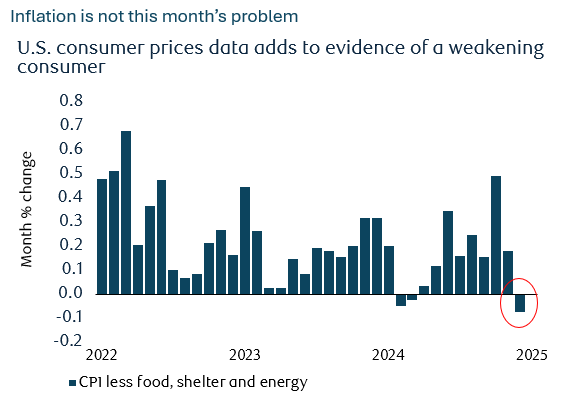
Meanwhile, inflation data for March was a little weaker than expected.

This was partly due to gasoline prices, but there was also a weakness in used cars and core services (with airfares and hotel rooms being the key categories). This suggests that consumers may be cutting back in anticipation of a weaker economy.

It won’t last, of course. From next month, prices should start to reflect tariffs and are likely to rise to a pace of 4% this year.

The persistence of inflation is hindering hopes that the Federal Reserve might provide some relief for the embattled U.S. consumers and markets. However, the odds of a rate cut in the early May meeting have dropped sharply since the tariff U-turn.

Chinese Inflation

Source: LSEG Datastream

Away from the U.S., news that some tariffs will be deferred reduces the headwinds for growth.

It’s true that many non-U.S. countries are far more open than the U.S., meaning that trade – both imports and exports – forms a large share of gross domestic product (GDP). But these countries are only suffering a big increase in tariffs on the U.S. portion of their trade, unlike the U.S. itself, which is suffering tariffs on all its trade. So, lower tariffs affecting a share of their growth is incrementally good news, which means the headwind to growth is lower. Meanwhile, any weakness in demand from the taxed U.S. import market seems likely to weigh on prices in other international markets.

China is the exception; its individual tariff rates weren’t reduced. In fact, they were raised further to 145%, making China more of an isolated target than had been the case at the beginning of the week. However, as mentioned above, following this latest increase, there was some considerable relief given in the form of exemptions for some consumer electronics.

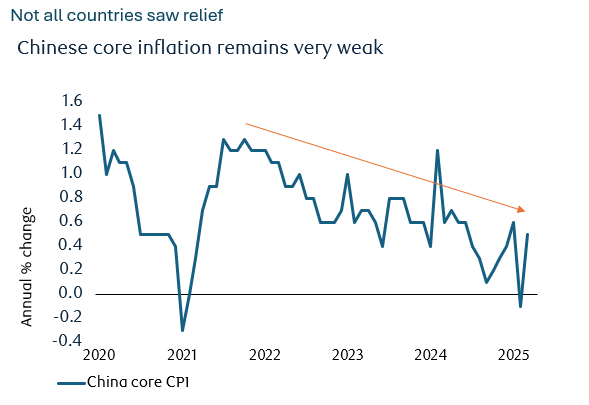
This will likely weigh heavily on Chinese growth but could present an investment opportunity. The Chinese authorities are not fighting inflation like other central banks, meaning that they can deliver stimulus to their consumers without risking high prices.

Furthermore, President Trump has signalled a willingness to negotiate with China. So, low expectations, the likelihood of stimulus measures, and the possibility of trade deals in the future that could see a sharp cut to tariffs could combine quite powerfully to revive flagging Chinese stocks.

Please continue to check our blog content for advice, planning issues and the latest investment market and economic updates from leading investment houses.

Charlotte Clarke

16/04/2025