Team No Comments

The Shape of the Recovery: V, W or L? Looking Beyond the Letters

Received by email today 11/05/2020 concerning potential investor concerns. SEI explore what markets suggest the potential recovery paths could be.

The Shape of the Recovery: V, W or L? Looking Beyond the Letters

  • It’s challenging to make accurate economic calls under normal circumstances
  • Add in the uncertainty around oil prices, interest rates and epidemiological models and there’s a serious lack of clarity about the future
  • While we believe that another significant pullback is likely, we also believe that long-term investors will be rewarded for their patience

Major economic setbacks can trigger a complex reordering of entire industries. Our current predicament has gone even further, forcing society to function under challenging conditions with consequences for every corner of the economy.

It’s challenging to make accurate economic calls even under more normal circumstances. Add in the direct and knock-on impacts of lockdowns, the range of potential paths that the COVID-19 outbreak could take, and the countless combinations of business and policy responses under each of these scenarios, and it is truly anyone’s guess what the future holds.

Why, then, do we try to distil these setbacks into simple shapes? Because humans—and financial markets— don’t like uncertainty. Despite that, guessing whether a recession and the ensuing recovery will look like a U, V or W provides minimal benefit to long-term investors. Focusing on the underlying fundamentals and economics, we believe, is more useful for framing investment decisions.

Searching for Clues

What do markets themselves suggest about the road ahead? A glance at the path of oil prices over the last few months certainly doesn’t project confidence for a strong rebound. The West Texas Intermediate oil price turned negative—a first—as its May 2020 contract neared expiration, and the June contract slid to between $10 and $20 per barrel at the end of April.

Low (and negative) prices imply that storage capacity has gotten full as demand plummeted during lockdown. The U.S. Energy Information Administration’s (EIA) April 2020 Short-Term Energy Outlook estimated “that the 2020 build could add 1.6 billion barrels to global inventories, which would fill them at or near their estimated full storage capacity levels.”

The EIA doesn’t see demand begin to cut into inventories until fourth-quarter 2020, and that assumes global consumption returns close to its long-term level starting in the third quarter (see Exhibit 1).

Interest rates also reflect considerable economic uncertainty. After falling sharply in late February and early March, long-term U.S. Treasury rates bounced into the second half of March. They have inched lower again in recent weeks. Long-term rates generally decline as economic conditions soften, so a flattening yield curve— anchored near zero on the short end—suggests there’s still great uncertainty about the economic road ahead.

Contagion Contingencies

Projections for the spread and fallout from COVID-19 have been subject to revision in recent weeks. First, they declined as the public adhered to social distancing and lockdown measures at a greater-than-expected rate. Then, as epidemiological models moved through their peaks and the narrative rolled on to the timing of reopening society, policies were forced to follow— loosening restrictions and pushing projections back upward.

Exhibit 1: World Liquid Fuels Production and Consumption Balance (millions of barrels per day)

The fluidity of COVID-19 forecasts is compounded by their wide potential ranges of outcomes. It’s completely in keeping with honest statistical modelling to offer a base case along with low and high projections, but such a wide range limits their utility for health-system planning purposes, let alone forecasts about the economy and financial markets.

SEI’s View

We spent much of February, March and April preaching patience and moderation in the face of steep selloffs and historic volatility. We contended that the decline was too fast and that it would likely be followed by a substantial rebound.

We think moderation is warranted again, albeit in the other direction. The rebound (notably driven by the same mega-cap technology firms that led the bull market) could eventually yield to another pullback, especially given the widespread uncertainty and shortage of concrete positive developments.

We expect the re-opening of the global economy to proceed cautiously and unevenly within and across countries. Many major developed-market countries still need to establish enhanced testing to track and isolate the outbreak before returning to broader re-opening. It will take time before this accrues to a meaningful increase in economic activity.

Many emerging markets are still seeing increased infection rates, so we’re far from a return to normal conditions. Moreover, there’s a possibility we may return to lockdown later this year if COVID-19 cases appear set to spike again.

Our investment managers are thinking in terms of years, rather than months, before the corporate earnings environment recovers from below-trend economic activity to more normal conditions. We believe there will be plenty of opportunities for skilled managers to capitalise on and that investors will be rewarded for their patience and moderation through shorter-term advances and declines.

As you can see SEI have a different view to some of their peers, with a slightly more negative (realistic?) view.

Since 1968, SEI has been a leader in the investment services industry, recognized for its history of innovation. Today, they serve about 11,300 clients, including banks, trust institutions, wealth management organizations, independent investment advisors, retirement plan sponsors, corporations, not-for-profit organizations, investment managers, hedge fund managers, and high-net-worth families. SEI manages or administers $920 billion in hedge, private equity, mutual fund and pooled or separately managed assets, including $283 billion in assets under management and $632 billion in client assets under administration.

Paul Green

11/05/2020
Team No Comments

Cornelian Asset Managers – The importance of remaining invested

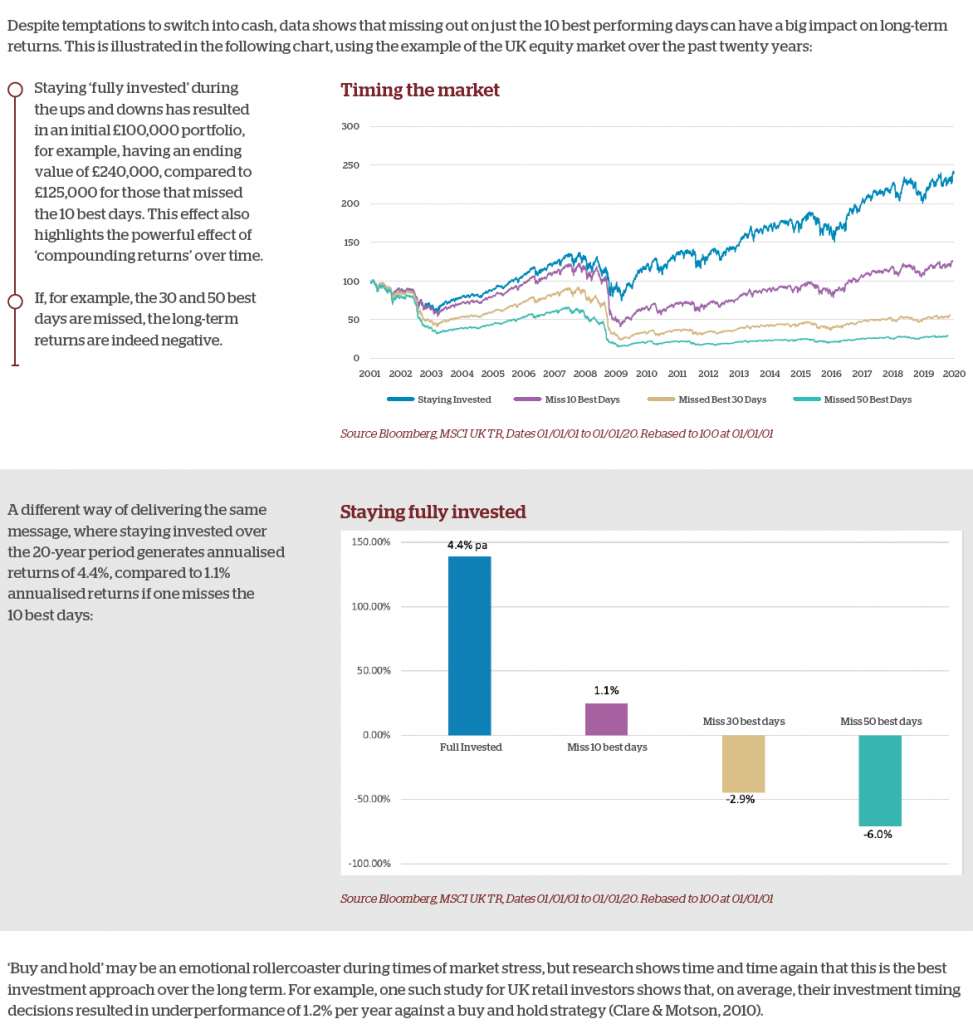
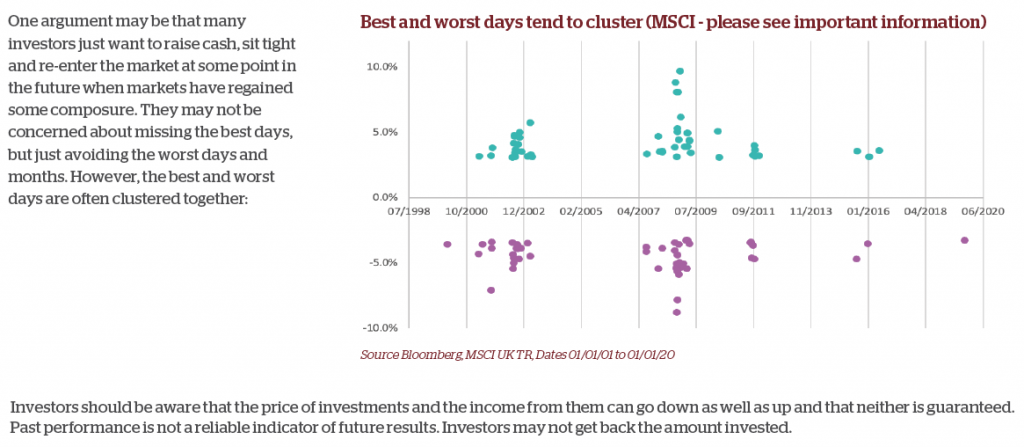
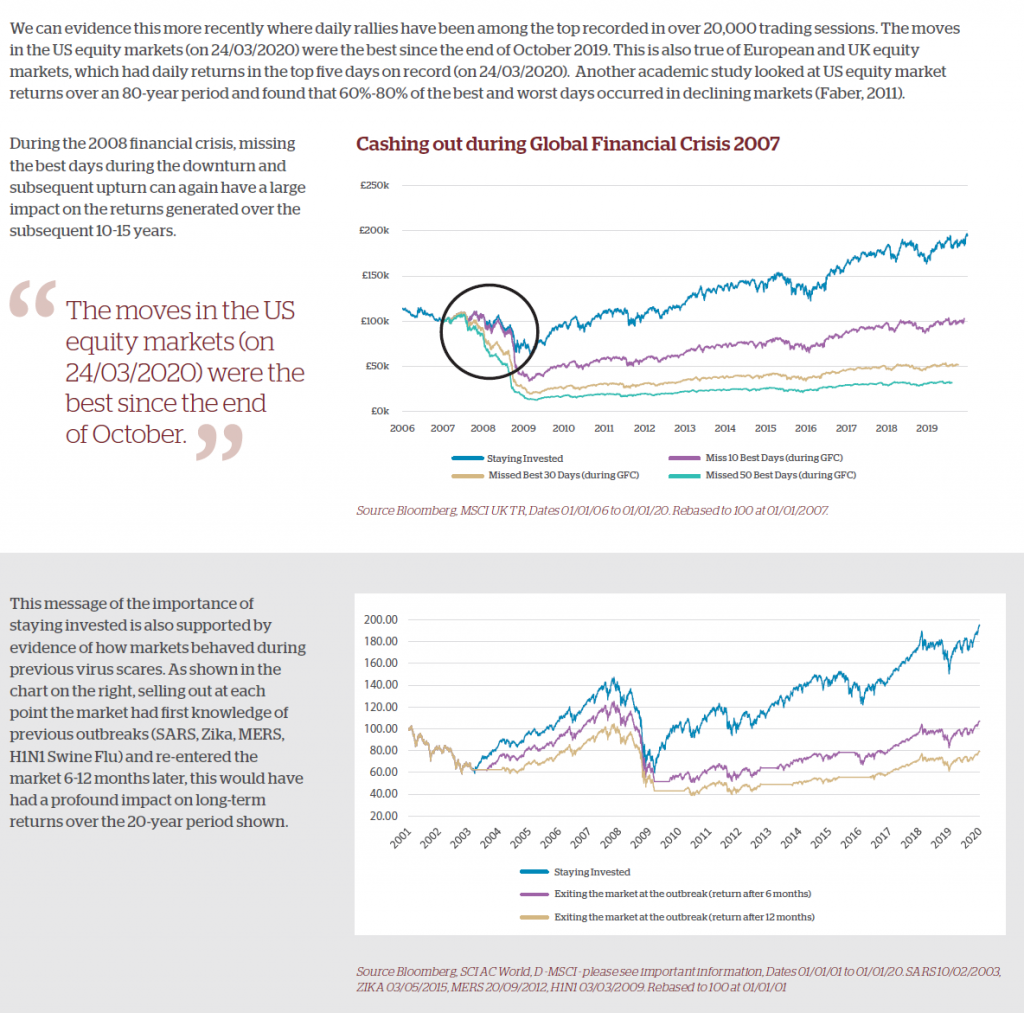
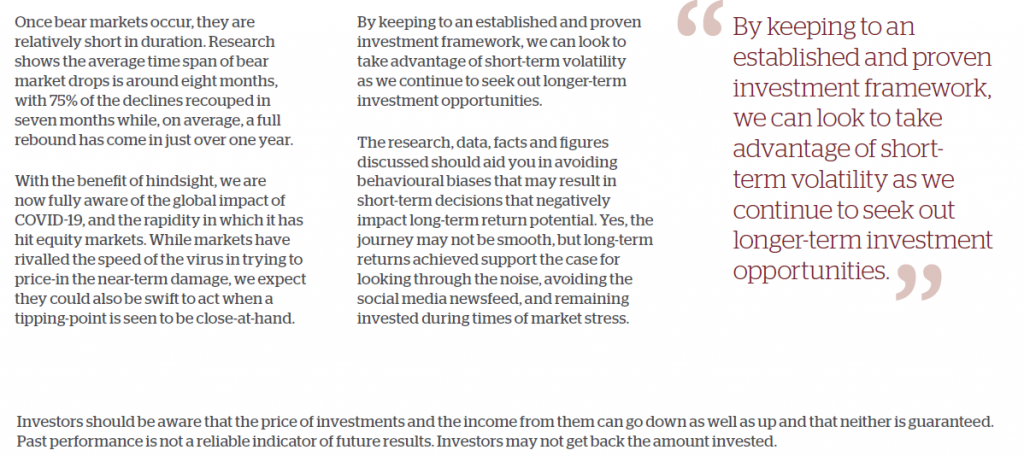
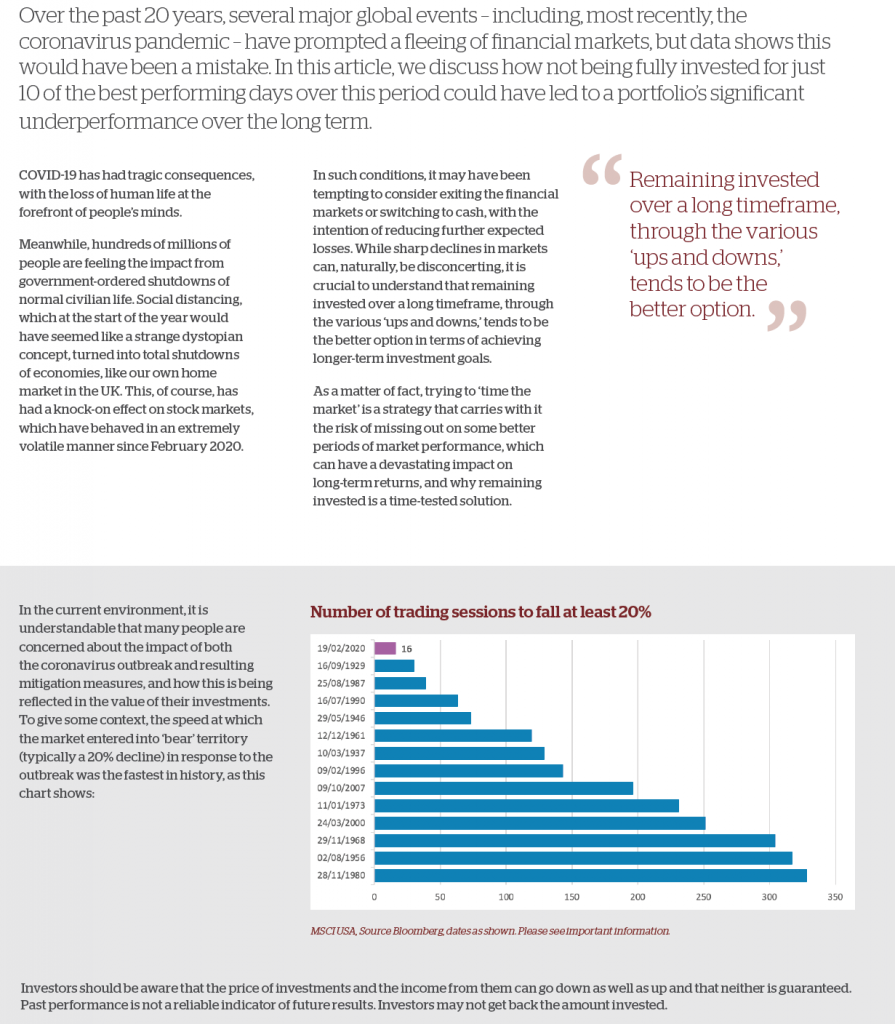
We have received a useful guide this week from Cornelian Asset Managers on the importance of remaining invested during the current investment climate. Cornelian have also recently been acquired by Brooks Macdonald Group plc, who are a leading Discretionary Fund Manager in the UK.

Hopefully, the above guide demonstrates the importance of remaining invested during market downturns. It helps highlight how trying to time the market and missing the best 10 days of investment returns can impact on the long-term investment returns generated.

The above guide relates to what we have been telling our clients since the beginning of this crisis, which is to ‘keep calm and remain invested’. You need to focus on your long-term investment objectives.

Please keep safe and healthy.

Carl Mitchell – Dip PFS

IFA and Paraplanner

07/05/2020

Team No Comments

Brewin Dolphin Update: Markets in a Minute

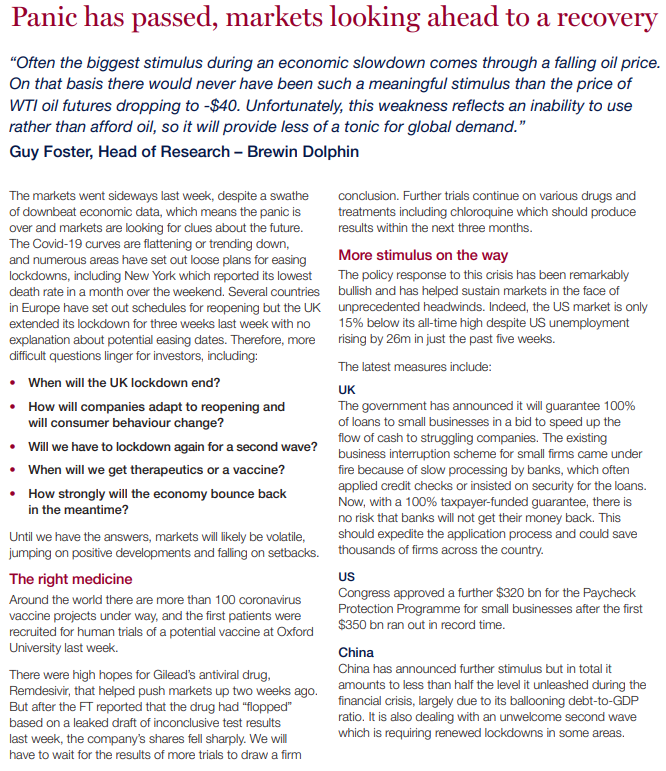
Brewin Dolphin emailed their weekly market update on Tuesday evening (05/05/2020) as below:

Some recovery but volatility expected to continue. These weekly market updates from Fund Managers Brewin Dolphin give you a quick update on the markets. We are giving you a range of updates from different Fund Managers at this time to give you some context and understand the markets from a consensus point of view.

Andrew Lloyd

06/05/2020

Team No Comments

Royal London Economic Viewpoint & Market View Update

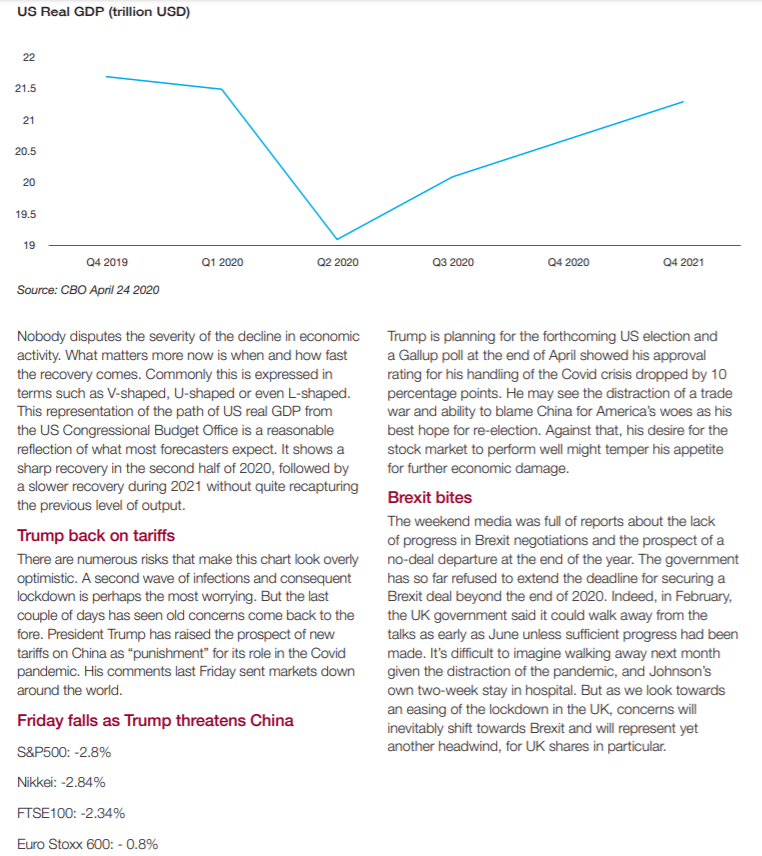
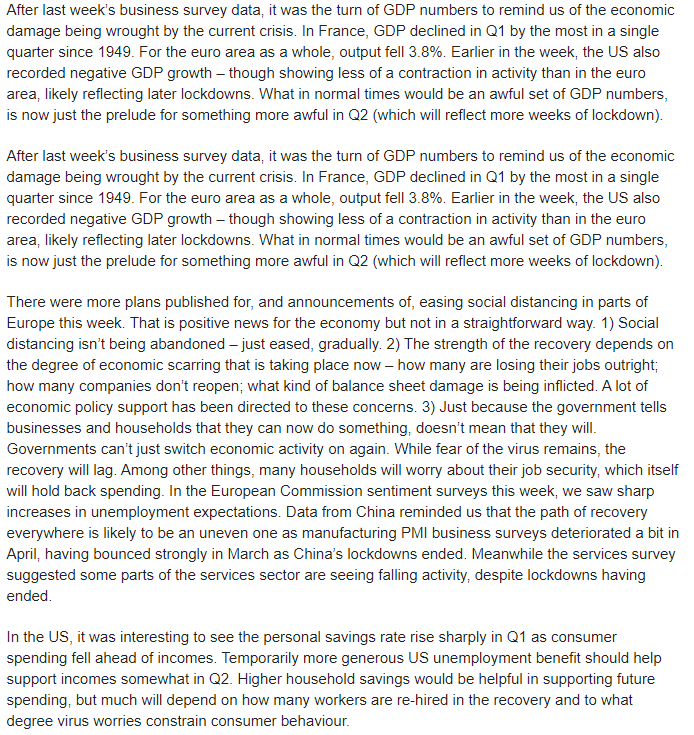
Royal London are the UK’s largest mutual life and pension company with valuable resources available to them. Yesterday (04/05/2020) they published their Economic Viewpoint and Market View update and I have cut and pasted this below:

RLAM Economic Viewpoint

Market View

We will continue to provide selective economic and market updates during this ongoing crisis.

Please keep safe and healthy.


Carl Mitchell – Dip PFS

IFA and Paraplanner

05/05/2020

Team No Comments

The European Central Bank aims to ‘thread the needle’

Further input from J P Morgan received at 18.25 on Friday night, 01/05/2020.   Although this article is slightly out of date, I think this is important input and an area we need to watch.

The European Central Bank aims to ‘thread the needle’

The leader of the European Central Bank (ECB) has become very familiar with the challenge of ‘threading the needle’ in recent years and the test facing Christine Lagarde today was no different. After last month’s major announcements regarding the expansion of its QE program, the ECB announced few new meaningful measures today. It left its key interest rates unchanged and made no enhancements to its asset purchases. It did however decide to make borrowing conditions more favourable for euro area banks under its Targeted Longer Term Operations III (TLTROs) facility.

With an increasingly restricted toolkit to provide further stimulus, the ECB’s messaging had to be reassuring enough to avoid triggering market volatility and at the same time diplomatic enough to appease divergent views from across the euro area on the appropriate policy path. This task was only made harder by the downgrade of Italy’s sovereign bond rating by Fitch to one level above junk status and the large contraction in eurozone GDP for the first quarter of this year (-3.8% quarter on quarter).

Few new policy changes

With its deposit rate already at -50 basis points, the ECB’s decision to not reduce interest rates so far this year suggests a strong reluctance to go even lower. However, the ECB is not alone in seeing limited value in pushing rates further into negative territory. The Federal Reserve in its own meeting yesterday dismissed the idea that it would consider negative interest rates. The ECB is instead focusing on other tools as its main policy levers.

Borrowing costs for the TLTRO III programme were lowered to -1%, a further 25 basis points lower from last month’s meeting. The recent ECB bank lending survey showed a material increase in demand for loans across the euro area as corporates search for funds to get them though this period. In the near term, another series of short-term refinancing operations were also made available, likely as a safety net over the coming months. These are helpful measures but the magnitude of bond purchases is likely to be more important in supporting government spending to help mitigate the impact on the economy.

What are the other options?

With markets focused on debt sustainability, particularly in countries such as Italy, the ECB will need to focus on expanding its asset purchase programmes. It could do so by ramping up purchase amounts under the Pandemic Emergency Purchase Programme (PEPP). In the press conference Lagarde suggested that PEPP is the preferred tool as opposed to Outright Monetary Transactions (OMT), previously used in the sovereign debt crisis, given this is a euro area wide issue. An extension of PEPP beyond the end of this year, dependent on the duration of the virus was also highlighted as an option.

Having already announced that it would accept recently downgraded high yield bonds – so called ‘fallen angels’ – as collateral for banks’ loans and made Greek bonds eligible for the PEPP, the ECB could also widen the scope of the asset purchases to include high yield bonds. Lagarde stopped short of explicitly confirming the forthcoming implementation of these measures, but stated that the flexibility of the ECB’s mandate can be increased if required.

Ultimately, it is clear that the ECB will need to increase stimulus measures this year to ensure that the wave of bond supply required to fund government stimulus packages is smoothly digested by the market. At this meeting, Lagarde preferred to take a “wait and see approach” in the hope that coordinated government action will shoulder some of the burden and lift some of the pressure on the central bank to save the day.

Investment implications

Trying to find the perfect balance of policy announcement and forward guidance was always a tough challenge and markets appear to have reacted negatively to the measures announced today. The euro has fallen around 0.3% versus the dollar and European equities are also down on the day. The spread of Italian 10-year yields over Germany has been volatile and has broadly risen. With expectations from the ECB that eurozone GDP could fall by 5% – 12% in 2020, calls for further central bank action look set to get louder over the coming months.

As we know markets fell a further c 138 points on Friday, 2.34%.  The ECB will have it’s work cut out keeping all of the eurozone happy with the issues facing the likes of Italy, Spain and Greece and the strength of Germany who don’t want too much change even when we have a crisis of this magnitude.

It does look like countries within Europe are standing on their own. As an initial response to Covid 19 some European countries closed their borders.  Understandable but not very European.

Let us see how this plays out, it could be interesting.  The ECB will have to do a lot more to keep everybody happy.

Steve Speed

04/05/2020

Team No Comments

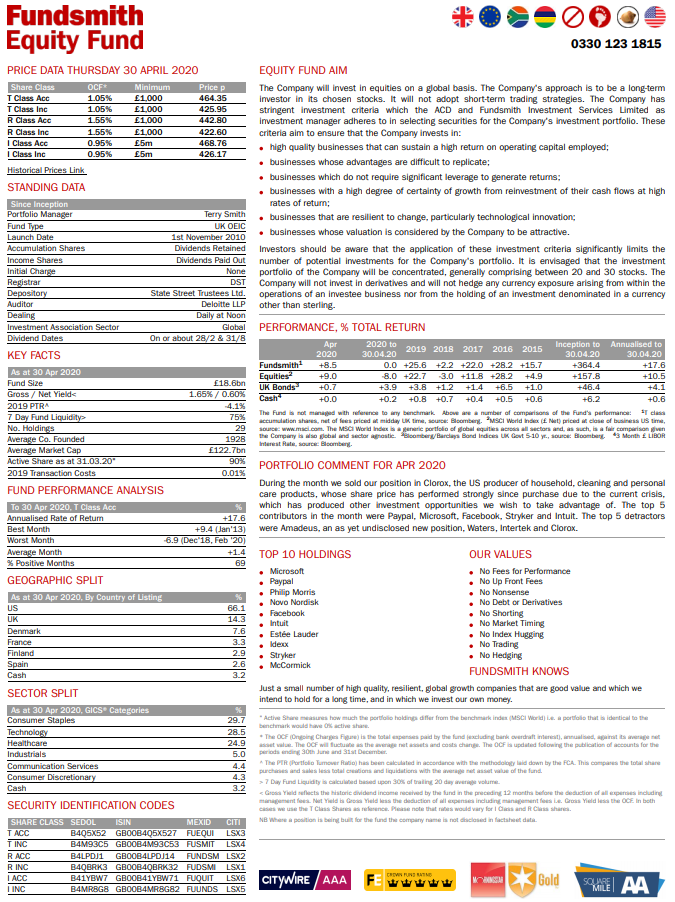
Fundsmith Equity Fund Blog

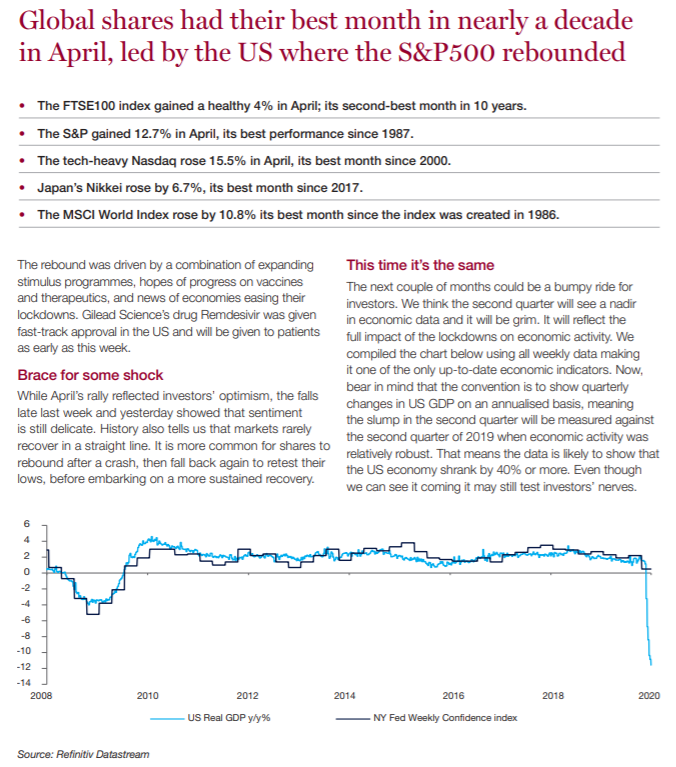
Please see below a Fund Factsheet of one of the funds we use within some of our client’s portfolios that was received earlier today (01/05/2020). The reason I have uploaded this factsheet is to show that there has been some recovery in markets, the US is probably one of the strongest to recover.

It is important to note that this fund should only be used as part of a diversified investment strategy and for clients who have the appropriate risk appetite.

Please keep safe and healthy.


Carl Mitchell – Dip PFS

IFA and Paraplanner

01/05/2020

Team No Comments

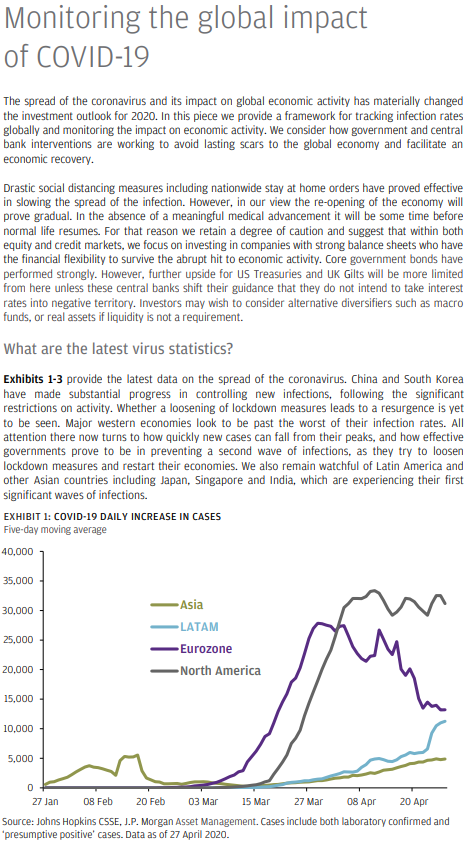
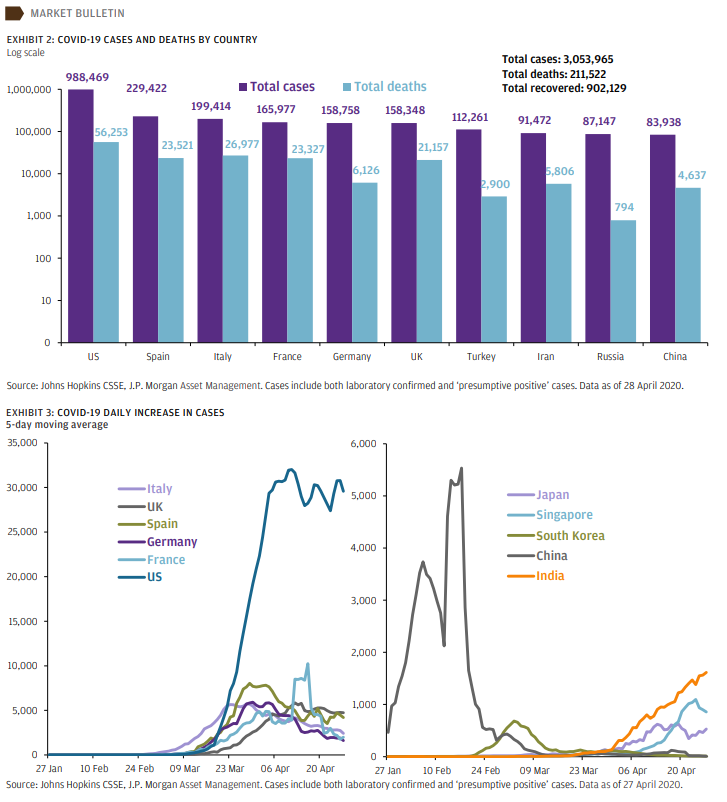
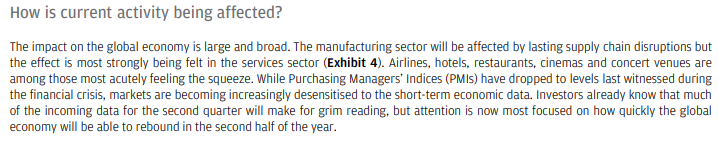
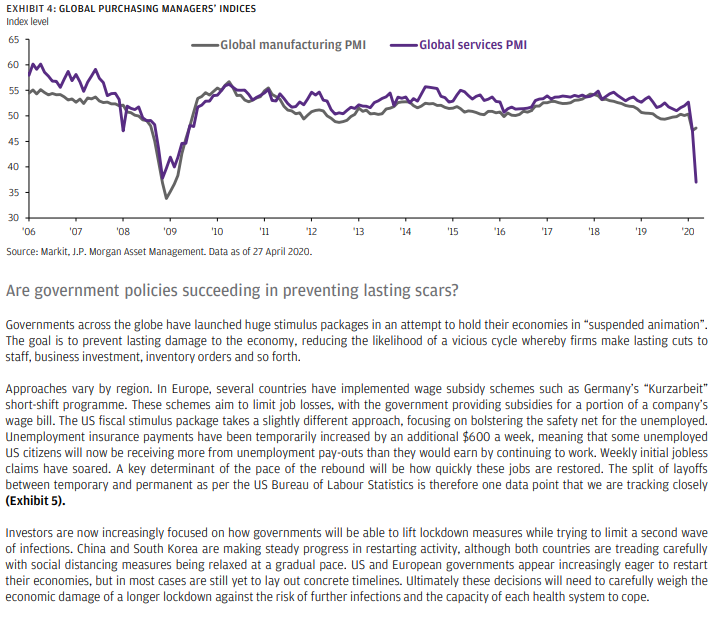
J.P. Morgan – Latest Market Update

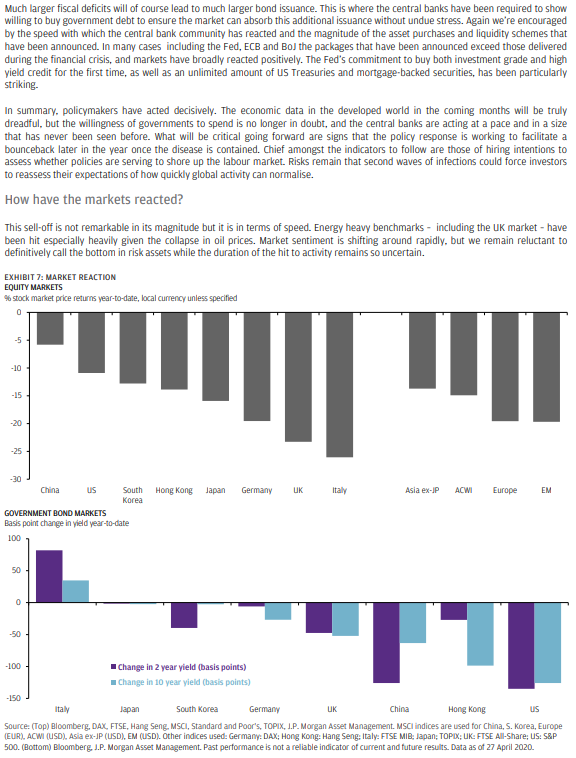
Please see below the latest market commentary input from J.P. Morgan Asset Management who have great technical and market resources available to them. This was published on Tuesday, 28th April 2020:

We will continue to selectively provide market commentary from leading fund managers from around the country.

Please keep safe and healthy.


Carl Mitchell – Dip PFS

IFA and Paraplanner

30th April 2020

Team No Comments

Brewin Dolphin Update: Markets in a Minute

Brewin Dolphin Update: Markets in a Minute

Brewin Dolphin emailed a market update on Tuesday evening (28/04/2020) as below:


As a Discretionary Fund Manager Brewin Dolphin offer a range of Managed Portfolio Services in the UK.  In keeping with our blogs over the last 6 weeks or so we seek to provide a wide range of input so that you can understand a variety of commentary and see consensus views.

Steve Speed

29/04/2020

Team No Comments

Investment Update from Brooks Macdonald

Please see below investment market commentary dated 27/04/2020 from Brooks Macdonald (a leading UK Discretionary Fund Manager):


We are continuously listening to various investment houses for their insight on markets, which we will selectively communicate to you. We do not want to overload you with input.  Please continue to check our blog content for the latest updates.

In the meantime, please keep safe and healthy.


Carl Mitchell – Dip PFS

IFA and Paraplanner

28th April 2020

Team No Comments

Prominent Investment Themes


Input from Jupiter’s Fund Manager Amanda Sillars received yesterday (15/04/2020) below as she outlines the four prominent themes in the market today:

Amanda Sillars

Fund Manager, Independent Funds

Quality and technology reign supreme in markets

Four prominent themes have emerged over the last few weeks, said Amanda Sillars, Fund Manager, Independent Funds: reduced dividends, exceptional innovation, and the supremacy of quality and technology stocks.

The first two themes are new. Firstly, it has been reported that over 40% of UK companies so far have ditched their dividends. On a more positive note, the second new theme is the exceptional innovation that is being unleashed in response to the crisis, particularly within the pharmaceutical, medical, monitoring and testing sectors.

The two other themes existed before the coronavirus, but have been supercharged as a result. The supremacy of quality has now gained even more momentum as fund managers unpick the balance sheets of companies they own and stress test for low or no earnings for Q1 and Q2. Many managers have sold weak companies and added to existing quality holdings: companies that are leaders in their fields, with strong balance sheets and long-term, responsible management. Owning quality stocks is seen as essential for survival: the strong companies are getting stronger, seizing new opportunities and investing while their competitors are struggling.

The final supercharged theme is technology, which has been described as the new defensive sector. The shift from physical to digital has accelerated at supersonic speed and is one of the primary outcomes of the global lockdown.

While a return to pre-coronavirus economic activity may well be several years, not several quarters, away Amanda believes that truly active, forensic fund managers can capture the huge opportunities emerging through these extraordinary changes and can identify the best companies, to the benefit of their clients.

For the right Fund Managers, they can see opportunity and select the right kind of stocks not just to survive but that will thrive in the current market.

Carl Mitchell

16/04/2020