Team No Comments

Brewin Dolphin – Markets in a Minute Update 26/05/2020

Please see this weeks ‘Markets in a Minute Update’ from Brewin Dolphin:

Markets

Global shares mostly rallied last week on hopes of a vaccine and continued lifting of lockdowns. In the UK, the FTSE100 nudged through the 6,000 mark for the first time in three weeks, before falling back on Friday as tensions between the US and China flared up once again.

Last week’s gains*
• FTSE100: 3.4%
• Dow Jones: 1.7%
• S&P500: 1.44%
• Dax: 3.65%
• Nikkei: 1.44%
• Hang Seng: -3.4%
• Shanghai Composite: -2%

Most markets in Asia closed up yesterday and were heading up today – even Hong Kong where the Hang Seng closed up by 1% on Monday. In early trade on Tuesday, most global markets were making solid gains due to optimism caused by more easing of lockdowns.

*Data to close on Friday May 22

US/China tensions

Last week China proposed the imposition of national security laws from Beijing in the special administrative region of Hong Kong, restricting freedoms of speech and the press. This move has increased worries about threats to democracy in Hong Kong that had formerly only really been subdued by the onset of social distancing. This has caused protests from the US and threats of retaliation, as well as public protests in Hong Kong by pro-democracy demonstrators. The Hang Seng, fell last week as a result. China will vote on the proposed legislation on May 28.

Trump has promised retaliation

President Trump said he would respond very strongly to what he sees as an assault on democracy in Hong Kong. He is most likely to consider tariffs, although he will be mindful of whether that is in his interests ahead of the US election in November. One conciliatory note from Premier Li Keqiang was a continued commitment to the phase one trade deal reached last year, but we are sceptical that China can really abide by its terms.

Even so, most Asian markets rose yesterday, with the best gains in Japan, as expectations increased that the nationwide state of emergency will soon be lifted.

Stimulus news

UK
The Bank of England has raised the prospect of negative interest rates for the first time. It has said the policy is under “active review”.

Bank of England MPC member Sylvana Tenreyro was probably the most outspoken of a number of MPC members, who coalesced around the position that negative interest rates could be considered in the UK. Tenreyro cited Europe’s experience with negative rates as demonstrating that they have a powerful effect on real activity, but nobody outside the MPC seems to agree. However, with Governor Andrew Bailey and Chief Economist Andy Haldane insisting that negative rates could be considered, we have to take them at their word, although market pricing reflects only a slim chance that negative rates could be introduced in 2021.

China
Premier Li Keqiang also suspended China’s growth target to facilitate a shift towards job creation as a priority. China’s GDP target had low credibility anyway, with the eventual GDP report assumed by all to be massaged to fit with the target rather than the other way around.

Europe
Stimulus news in Europe was more positive, albeit only tentatively. Progress on a €500bn aid package crept forwards as Germany reached an agreement with France that the aid could take the form of grants, funded by debt and secured on the EU budget. To finally ratify such an approach will need the consent of all members and it is expected to meet resistance from other northern European states.

Economic activity may have bottomed

Backwards looking data continues to paint a bleak picture. The UK claimant data last Monday showed the number of people claiming unemployment benefit jumped by 856,000 in April, to a total of 2.1m, according to the Office for National Statistics (ONS). This implies a jump to circa 6% unemployment when April’s official rate is released. Friday’s retail sales data indicate a decline of more than 18% in April compared to March, taking us back to activity levels last seen fifteen years ago (over which time the population has grown by about 10% or 6 million people).

However, more current “high frequency” data, such as energy consumption, road traffic etc, shows activity levels are improving. Therefore, we can take heart from the fact that we are at the nadir for economic activity and the path ahead is very likely one towards recovery from here.


Capital and income from it is at risk.
Neither simulated nor actual past performance are reliable indicators of future performance.
Performance is quoted before charges which will reduce illustrated performance.
Investment values may increase or decrease as a result of currency fluctuations.
The information contained in this document is believed to be reliable and accurate, but without further investigation cannot be warranted as to accuracy or completeness.

These updates from Brewin Dolphin provide a good weekly ‘snapshot’ look at the markets which is useful given the current volatility we are currently experiencing.

We try to capture a wide range of fund managers and investment experts opinions such as Brewin Dolphin to give you an overall consensus view of the current climate we are in.

Andrew Lloyd

27/05/2020

Team No Comments

Prudential PruFund Growth update

Last Thursday afternoon (21/05/2020) we had an update from Parit Jakhria of Prudential’s Treasury & Investment Office (TIO).  Parit is the Director for Long Term Investment Strategy at the TIO and his role is to lay out the long-term investment views and select assets for the multi asset fund at Prudential that includes PruFund Growth and With Profits funds.  The assets managed by Parit and the TIO value at circa £170 billion.

In an investment context, long term is 10 years plus.  I often hear about the TIO focusing on 15 years.  Short term is 0 to 5 years and medium term is 5 to 10 years.  One of the benefits of the scale of Prudential’s Multi Asset funds is that they can afford to invest with a long-term focus and not be concerned with liquidity issues.  Buying illiquid assets can help generate higher returns.

Parit commented that we have had 2 to 3 decades of globalisation and now this may decline slightly, and we could move more towards regional blocks, Europe (inc. UK), US, Asia etc.  This means that it’s more important to remain globally diversified.

Prudential’s TIO follow this process for investing:

  1. Capital markets assumptions
  2. Capital market modelling
  3. Portfolio construction
  4. Strategic asset allocation

This process is really useful in uncertain times.  The TIO look at a whole range of potential scenarios and on that basis, they are relatively positive.  The modelling is done on Prudential’s own unique inhouse system GeneSIS.

How are the TIO investing?

Their equity investment overall has increased with additional investment in the UK, Asia, Japan, Global Emerging Markets, China and a new investment in India.  Fixed Interest has seen a reduction overall.  They invested in African and Asian debt and now have a new Emerging Market debt allocation too.

Summary

I was awaiting written information from Prudential confirming their thoughts as outlined on Thursday afternoon, but they tend to be a little slower in issuing a written market briefing.

From my point of view the long-term asset allocation is positive and it’s good to see it when you have spent c 16 years looking at the strength and depth of their multi asset research that they are investing for growth over the long term.

Please note that this does not mean that the short-term volatility is over.  We may still experience further bouts of short-term volatility as we deal with the virus and try and get the economy working properly again.  Other news flow will impact on markets too, US/China, Brexit Trade Deals and US politics for example.

Please note that the above is based on my notes and interpretation of what Prudential said and can not be relied on.  Investments can (and obviously do) go up and down in value.

One of the key messages we hear repeatedly is to remain invested.  This is important.

Steve Speed

26/05/2020

Team No Comments

Quilter Investors – EU Update

Please see below an EU article published by Quilter Investors yesterday (21/05/2020):

EU plans €1trn coronavirus recovery package 

The European Commission has revealed it will outline a bold recovery plan to tackle the consequences of the coronavirus pandemic, which could exceed €1trn in the form of grants and loans to hard hit regions.

It followed France and Germany’s initial proposal on Monday (18 May) of a €500bn recovery fund that would offer grants to European Union regions and sectors hit hardest by the coronavirus pandemic.

However, on Tuesday (19 May) executive vice president of the European Commission, Valdis Dombrovskis, said the EU aimed to be bolder, with an ambition to increase financing by a figure exceeding €1trn. The resulting loans and grants would be linked to economic policies and structural reforms.

The plans for the EU’s ‘recovery  instrument’, which are expected to be unveiled next Wednesday (27 May), would be closely linked to the EU’s budget plans and is likely to include the creation of a recovery and resilience facility, which will concentrate on investments and structural reforms, said Dombrovskis.

The initial proposal from France and  Germany signalled a step change in  the eurozone’s attitude to sharing debt, by providing grants to harder hit regions, such as Italy and Spain, with the proposals pushing government bond  yields from southern European countries lower, and the euro higher.

CJ Cowan, assistant portfolio manager at Quilter Investors, says: “The suggestion of grants rather than just loans is a positive but this is still some way from the sort of debt mutualisation often argued for by economists. The conditionality attached to access the funding will be a sticking point between northern and southern European states as well, but this is a notable step in the right direction and lessens the risk of a dramatic adverse move in Italian and Spanish government bond markets in the near term.”

As our nearest trading block it will be interesting to see how this one plays out.  It looks like the EU want to stand together when it suits them and be independent when they want.  Watch this space!

Please keep safe and healthy.

Carl Mitchell – Dip PFS

IFA and Paraplanner

22/05/2020

Team No Comments

Market Update

Market Update – 21/05/2020

Over the last few days, I’ve been listening to the following Fund Managers for their input on investments and their views on markets:

  • BlackRock
  • J.P. Morgan
  • Schroders
  • Invesco
  • Prudential

In addition I’ve been listening to Curtis Banks on pension technical issues and the Federation of Small Business to hear Liz Truss in her position of MP, Secretary of State for International Trade and her views on where we are up to in the UK and with ongoing trade negotiations.

This research is on top of standard client advice work, I’ve not quite moved into the office, but it feels like I have sometimes!

Why do I do this level of research?  I want to get the consensus view on the global macro situation in the markets from the experts.  Fund Managers have substantial resource and spend a small fortune on research.

Whilst it is not an exact science and at the moment there are a lot of moving parts to take into account, I would say the general view is of cautious optimism.  Most Fund Managers are positioning for growth over the long term and for some Fund Managers for growth over the short term too based on modelling of scenarios and probable outcomes.

Markets are generally probably slightly too high as they tend to look through the very short term and focus on the (post virus?) future.

The risks are many and varied, the biggest one is a bad second wave of the coronavirus.  In addition, we have the US/China situation, Brexit trade deals (no deal Brexit?), Europe and US politics to name a few.

Consensus varies on where to invest if you have the freedom to choose but again common areas that appear good value now are Asia and Emerging Markets if you can take the volatility and associated risks.  As part of a portfolio or fund that is actively managed you get this allocation and the risks managed for you to some extent.

What next?

In summary you need to remain invested as you are for now, it is still too volatile to make fund switches.  If you have spare cash it is also a good time to invest, asset values are still low compared to valuations earlier this year.  You can try and buy into the dips, but this can be difficult to time.  Over the medium (5 years plus) to long term (10 years plus) you will see growth without perfect timing.

Paying regular monthly premiums into either pensions or investments is a good idea too.  If you can afford to increase your regular monthly contributions, please do.  This is a lot easier than trying to buy into the dips with a lump sum investment.  You may, if you are lucky, have spare cash with your reduced holiday and leisure spend!

Steve Speed

21/05/2020

Team No Comments

Brewin Dolphin – Markets in a Minute Update

Please see this weeks ‘Markets in a Minute Update’ from Brewin Dolphin

Brewin Dolphin – Markets in a Minute Update

Markets

Global share markets fell back last week amid worries about a second wave of the virus later this year.

Over the week:

  • US shares fell 2.3%
  • Eurozone shares fell 4.3%
  • Japanese shares lost 0.7%
  • Chinese shares fell 1.3%.

However, the mood changed as hopes of progress on a vaccine were boosted over the weekend, and the trend in new infections continued falling across Europe.

  • The FTSE100 gained 4.3% yesterday. Energy stocks outperformed on a rising oil price rebound in demand for fuel as economies open up again.
  • Stocks were up across Europe, while in the US, the Dow closed up by 3.8% and the S&P500 gained 3.1%.

Markets appear laser-focused on any good news on the fight against the virus and hopes for a quick economic recovery, while ignoring the downbeat economic data and more cautious forecasts.

No expense spared in hunt for vaccine

The government announced that it would provide a further £84m to fund the ongoing vaccine development at Oxford University and Imperial College London.

  • Oxford will receive £65.5m and ICL will receive £18.5m as the vaccine trials on humans and animals are expanded. The idea is to cut the development time for a vaccine from the usual eight years to just two years.
  • Oxford University has also agreed a licensing agreement with AstraZeneca for the commercialisation and manufacturing of their potential vaccine. If the trials are successful it means that AstraZeneca will make up to 30m doses available for UK residents by September, as part of an agreement to deliver a total of 100m doses.
  • The government also plans to contribute up to £93m towards the construction of a new vaccine manufacturing centre, which is intended to open next summer in Oxfordshire, and will have the capacity to produce enough doses for the entire UK population in as little as six months.

However, a note of caution. Nobody has ever succeeded in producing a vaccine for a coronavirus. Even if we develop one, we don’t yet know what depth of immune response it would generate and how long that response would last. It is possible, for example, for a vaccine to prevent suffering from a disease but without inhibiting its transmission. There are numerous reasons to be cautious but the government does at least appear to be throwing everything at its development, and the UK is among the frontrunners in the ongoing research.

Monetary policy

Last week we heard from Bank of England Governor Andrew Bailey. His most eye-catching comment was that the Bank of England can spread the cost of the crisis over time. This is a welcome statement, as it came against the backdrop of a leaked document from the treasury to the Daily Telegraph, which said the government faced a stark choice between spending cuts and tax hikes in order to prevent increased debt triggering a sovereign debt crisis. In other words, a return to austerity once the pandemic is under control.

Since austerity removes liquidity from the economy, it reduces investment and productive capacity, which is essential for economic growth, especially at a time when we will (hopefully) be emerging from recession. There has been a broad outcry from economists against the Treasury’s conclusions.

By way of tools to prevent this eventuality the Bank of England obviously has the ability to buy more bonds and also fund the government through the ways and means account (temporarily of course). At the same time the UK has a floating exchange rate which can decline to improve the attractiveness of UK debt at the cost of inflation to UK consumers. Therefore, there seems no risk of a sovereign debt crisis, even as debt to GDP does increase drastically.

Furlough scheme extended

Chancellor Rishi Sunak extended the job retention scheme that pays 80% of staff wages until the end of July, and then beyond to the end of October. It was due to finish at the end of June. During this longer extension there will be some sharing of the financial burden between the government and employers. There will be details emerging on this over the next fortnight allowing the standard “devil will be in the detail” conclusion. If the extended furlough scheme is not generous enough then it could see a serious increase in unemployment. If it is too generous it will see a serious increase in indebtedness. The latter looks the lesser evil for the time being.

Encouraging news from Asia

Asia is further ahead of the curve and generally seems to have better procedures for tracking and tracing potentially infectious individuals. Infection rates remain well contained. There were some stories of new infections in the Chinese cities of Wuhan and Jilin but the numbers are very low. The same is true for Hong Kong. Asia’s experience probably offers the best case of how we can expect the release of lockdowns to go in the west.

Activity is ramping up in China. Traffic jams have returned to Beijing while 100m students have returned to school across the country. Restaurants are also reporting that customers are dining out again, with no need for social distancing, although diners’ temperatures are usually taken on arrival.

Signs of life in UK property market

Rightmove said on Monday it saw an immediate release of pent-up demand on the day the housing market reopened last week.

Home-mover visits to Rightmove’s site returned to pre-lockdown levels on 13 May with circa 5.2m visits, up 4% on a year earlier. Unique sales enquiries were just 10% behind the same day in 2019, while rental enquiries hit the highest level since September 2019.

However, it seems likely that given the imminent recession, many properties will sell at a discount.

Oil price jumps

Oil prices rebounded by 20% in the week to Friday as production fell and demand rose (US gasoline demand rose by 22% in the last week of April). US WTI rose by a further 4% on Sunday to break through the $30 level for the first time in two months. Global benchmark Brent Crude rose by 3.9% at the weekend to more than $33 a barrel, and continued up past $34 yesterday.


Capital and income from it is at risk.
Neither simulated nor actual past performance are reliable indicators of future performance.
Performance is quoted before charges which will reduce illustrated performance.
Investment values may increase or decrease as a result of currency fluctuations.
The information contained in this document is believed to be reliable and accurate, but without further investigation cannot be warranted as to accuracy or completeness.

Some good news and signs that we are generally moving in the right direction. It may take some time before we reach our ‘new normal’, but these steps in the fight against the virus and some slight recovery in the markets are a good sign. However, we could see further downward legs before we move into full recovery. Volatility will continue.

Andrew Lloyd

20/05/2020

Team No Comments

Legal & General Update: The role of politics in a potential second wave

This piece is cut and pasted from an investment update from Legal & General Investment Management today (18/05/2020):

  The role of politics in a potential second wave
Media and investor attention has been drawn to the experience of the so-called ‘early easers’ of lockdowns, and so far the news has been quite good. There have been some localised outbreaks, but no material evidence yet of full-force second waves of COVID-19 emerging in countries like Austria, Korea and Germany.

That said, those countries all had manageable caseloads when paring back their restrictions – unlike the US, where active cases per capita are running around five times higher than they were in the early-easing countries at the time they began to unlock. Some American states that are relaxing stay-at-home guidance run serious risks of a secondary outbreak, especially with no contact tracing in place.

Looking deeper into the US, we see further evidence that the country should not be treated as one when it comes to the virus’s spread. Hospitalisation rates, which acted as a good leading indicator in Italy, are coming down in New York and New Jersey. But in much of the rest of the country, they are both high and consistent, implying those states have not passed their COVID-19 peaks even as they start to unlock.

Interestingly, the level of mobility in each state – an indicator of how serious lockdown measures are – is highly correlated with Trump’s vote share in the 2016 election, with the most Republican states the least locked down. Conversely, lockdown levels and hospitalisation rates show no relationship whatsoever, so it is politics, not epidemiology, that’s dictating the US approach to the restrictions.

What does unlocking mean for markets? The initial reaction may be positive as it means economic activity returns, but we believe such optimism is overdone. Unlocking will be slow and individuals will be reluctant to return to their previous lifestyles any time soon. To that extent, ending restrictions not only poses a risk of a second virus wave, but a market risk, too, as investors are disappointed by the slow speed of economic recovery.

J P Morgan also flagged up the management (or lack of it) of coronavirus in the USA as a potential issue/significant risk in their market update last Wednesday afternoon.

Steve Speed

18/05/2020

Team No Comments

Jupiter Coronavirus Update

Interesting input from the Jupiter Independent Funds Team below received on Friday evening 15/05/2020:


Jupiter Independent Funds Team

Data this week revealed the extent to which the government’s response to Covid-19 has left its financial projections in tatters. UK GDP in the first quarter declined by 2%, and in the month of March alone by 6%, but both only include one week of the lockdown. Second quarter figures to the end of June are likely to be closer to those projected by the Bank of England and The Office of Budget Responsibility, both of which see the economy shrinking by around 25%-30% over those three months. 

As cash flows to the Treasury reduce significantly (PAYE, business rate and VAT deferrals for companies, reduced duty income from fuel sales, air fares and property transactions, lower VAT receipts from retailers etc) but outgoings increase rapidly (e.g. the furlough and business interruption loan schemes), the Chancellor’s estimated 2020 budget deficit has blown out from £55bn at the time of the Budget in early March to £340bn and possibly even up to half a trillion pounds only 9 weeks later. The current furlough scheme to cover the 80% of the salaries of 7m employees (capped at £2500pm per person) costing £14bn per month is already more than the £12.5bn the Chancellor initially set aside in the Budget for his total Covid-19 lifeboat plan.  

We crossed the Rubicon last week in another sense too: that was the point at which more than 50% of the UK’s adult population became financially reliant on the state, either as public sector employees, or because they’re on benefits, or, now, they’re beneficiaries of the furlough scheme. The public sector has a vital role to play in society, however as harsh an observation as it might be particularly in current circumstances, that sector is not economically productive. The private commercial and industrial sectors create economic wealth and generate growth: it becomes an uphill struggle for any economy to grow when only a minority of the population is able to contribute to wealth creation (which, in circularity, includes the ability to pay for public services).

Labour’s manifesto pledge in the 2019 election to nationalise Royal Mail, the utilities, rail companies and BT’s Open Reach, and paying out PFI contractors in public services, was forecast to cost £450bn over 5 years. That would have incurred structural, long-term debt which they planned to recoup principally through higher taxes. Our present predicament which has arrived in relative terms in the blink of an eye is of the same order of magnitude but with the additional substantial headwind of a thumping great recession, the biggest in nearly a century. Within the constraints of the virus, it is not difficult to see the economic and political imperative to get the nation back in to productive employment. The Chancellor must ensure that the substantial debt the government has taken on is temporary, or at least transitory, and not structural. The longer the debt sits on the government’s balance sheet, particularly in the absence of recovery or growth, the greater the risk the international ratings agencies which assess governments’ creditworthiness take a dim view of the prospects. In that event, our national debt faces the possibility of being downgraded which immediately pushes up the cost of financing, not only for the government itself but also companies and individuals (e.g. for mortgages, car financing and credit card interest), all when the economy is least able to afford it. It is easy then to create a downward spiral. There will be difficult choices to make about how best to reduce the debt burden including cost savings and tax. But ultimately, the best way is to recover and restore growth. The state has made significant interventions to protect livelihoods as well as lives; it must now ensure that it is equally willing to let go again to ensure as far as possible that the debt burden is indeed transitory and not structural. With Labour and the Unions urging a New Social Contract, repaying the ‘debt to society’, it may be easier said than done. Time will tell!

We are living in interesting (challenging) times now but the future, how we recover and what society will look like are being impacted on by this pandemic and the response of our politicians and the people.  Hopefully, society will be fairer in future.

Jupiter Independent Funds Team manage the Merlin range of funds. 

Steve Speed

18/05/2020

Team No Comments

Jupiter Blog – Will Trump Weaponise Covid-19 in China Trade Dispute?

Please see below yesterdays (13/05/2020) article from Charles Sunnucks the Emerging Markets Fund Manager for Jupiter Asset Management:

Will Trump weaponise Covid-19 in China trade dispute?

As China continues to emerge from the worst effects of Covid-19, there is plenty of anecdotal evidence that pent up demand has created a snap back in sales since the lockdown ended, said Charles Sunnucks, Fund Manager, Emerging Markets. This is encouraging, but beyond the sugar rush of spiking activity due to pent-up demand and domestic stimulus; there is no doubt an unease about whether this pace can be kept up if developed nations do not stage a recovery. Ultimately, Charles’s view is that the recovery may well look more of a ‘W’ shape than ‘V’, as the reality of a very weak global backdrop hits.

In addition, there are signs of backlashes against China across a number of countries – the first foothills of what could become mountains of analysis into all the ‘could-haves, would-haves, should-haves’ of Chinese actions. Charles’s view is that this will only become more acute with the US Presidential election fast arriving on the horizon. Already, China is projected to import only $60bn from the US in 2020, due to the Covid-19 economic slowdown, which is well short of the almost $190bn committed to in the ‘phase 1’ trade agreement with the US – and it would not be a surprise if this was exploited by the US to extract further concessions.

So, what does likely rising hostility towards China mean for Chinese corporates? In higher value-add industries, such as technology, added Charles, Chinese policymakers are actively pursuing initiatives to grow export markets. This is the area where damage may be lasting, however. For instance, it will bring even greater scrutiny to Huawei’s 5G services and Chinese video sharing app Tik Tok; plus Chinese M&A abroad will likely be met with far greater regulatory examination than might have been the case four months ago, in Charles’ view. Even now a number of large US-listed Chinese firms are seeking Hong Kong listing.

Equity markets are a highly complex picture in China. Charles said that the market is home to quite a number of the most excessively valued companies globally, largely names listed in Shanghai/Shenzhen; but at the same time, he can identify some remarkable bottom-up opportunities, especially a number of firms not represented in the main indices that are trading at unprecedented valuations.

We will continue to monitor global markets and selectively communicate professional input to our clients.

Please keep safe and healthy.

Carl Mitchell – Dip PFS

IFA and Paraplanner

14/05/2020

Team No Comments

Brewin Dolphin – Market Update

Please see below the copy and pasted latest investment market update from Brewin Dolphin, which was published yesterday (12/05/2020):

Markets are likely to remain extremely volatile for a while during these unprecedented times. It is important to remember and focus on your long-term investment goals and ultimately remain invested whilst markets recover.  

Please keep safe and healthy.

Carl Mitchell – Dip PFS

IFA and Paraplanner

13/05/2020

Team No Comments

Brewin Dolphin – Weekly Update ‘What’s Brewin’

Input from Brewin Dolphin below in their weekly update ‘What’s Brewin’ received late yesterday afternoon (11/05/2020).

I hope you had an enjoyable bank holiday – the third in lockdown! The PM, in a televised address last night, has replaced his unquestionably clear message of ‘Stay at home. Protect the NHS. Save lives.’ with a rather more murky slogan of, ‘Stay alert. Control the virus. Save lives.’ to coincide with the easing of lockdown measures this week. In a bid to get the economy moving, while urging those who can work at home to continue doing so, he has encouraged people in the construction and manufacturing industries to return to work. However, this must be done in a way that respects social distancing, with guidance due to be published this week. The devolved nations have all chosen to keep the ‘stay at home’ message and lockdown measures in place, leading to a strategic divergence across the UK. It will be interesting to see how this develops over the next few weeks.

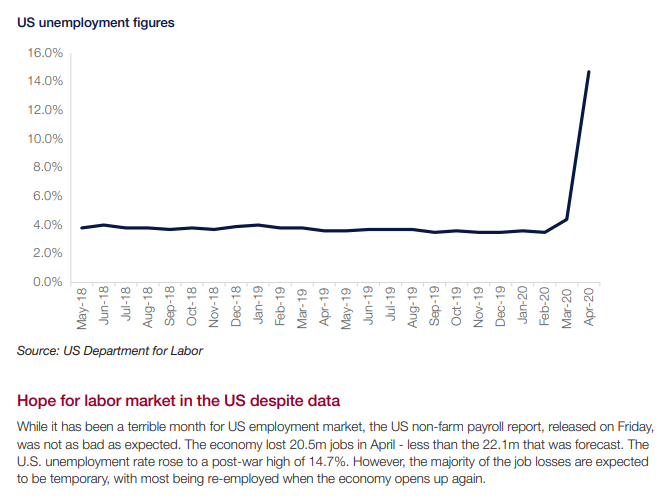
The major US indices rose on Friday; with the Nasdaq actually in positive territory by 1.7% YTD! This risk-on move came despite the depressing job reports that said the US unemployment rate spiked to 14.7% in April as the coronavirus forced a wide U.S. economic shutdown. That is the highest level since the Great Depression! However, there have been positive comments on the re-opening of parts of the economy and sentiment was boosted  by a Xinhua News Agency report that Chinese Vice Premier Liu He, Trade Representative Lightizer, and Treasury Secretary Mnuchin spoke Friday morning to pledge to create favourable conditions for a Phase 1 trade deal. This comes as a relief to markets after tensions rose between the US and China over the pandemic.

There has been much recent discussion about the shape of the recovery. Today, we’ll look at the market rebound, which has been dramatic since the market lows in March. Some analysts are concerned with the speed of this recovery as the full impact of the pandemic has yet to be quantified. They argue that typically, following a bear market, the recovery is more gradual. However, some believe that this has been an unprecedented market event and historical comparisons are less important. I have included a chart below to provide some context.

Markets in a Minute

  • The VIX, which is a measure of volatility, lost 11% to 28 on Friday. The last time it was at this level was 25 February and is off substantially from the mid-80’s in the midst of the crisis.
  • Tesla says it is planning to restart production at its factory in California in defiance of local government orders demanding it keep the plant closed.
  • Primark and Superdry have been boosted by opening shops in Europe
  • Fitness group Peloton, has benefitted from the lockdown measures with huge numbers of people exercising at home on the internet-connected bikes it pioneered. Shares surged by 17% on Thursday’s open to reach a record high.
  • Tickets for Walt Disney’s soon-to-be reopened Shanghai Disneyland sold out quickly, suggesting that consumers in the world’s second-largest economy are eager to get back to their pre-pandemic spending habits.

Stay safe and have a great week!

As you can see the consumer should help developed countries economies in their recovery.  It is still very finely balanced globally; the virus needs to be controlled.

Brewin Dolphin are Discretionary Fund Managers in the UK offering both Managed Portfolio Services and bespoke discretionary fund management.

Steve Speed

12/05/2020