
Please see below the article from Brewin Dolphin detailing their discussions on some of the factors driving market movement currently. Received yesterday 02/09/2026.
Last week saw Nvidia reporting earnings, which effectively lowers the curtain on the second-quarter earnings season. That means fewer obvious catalysts for uplifts until October, when third-quarter numbers begin to arrive. So, while the flow of corporate news ebbs, the controversies that remain are over what appear to be objectively high valuations and unproven business models.
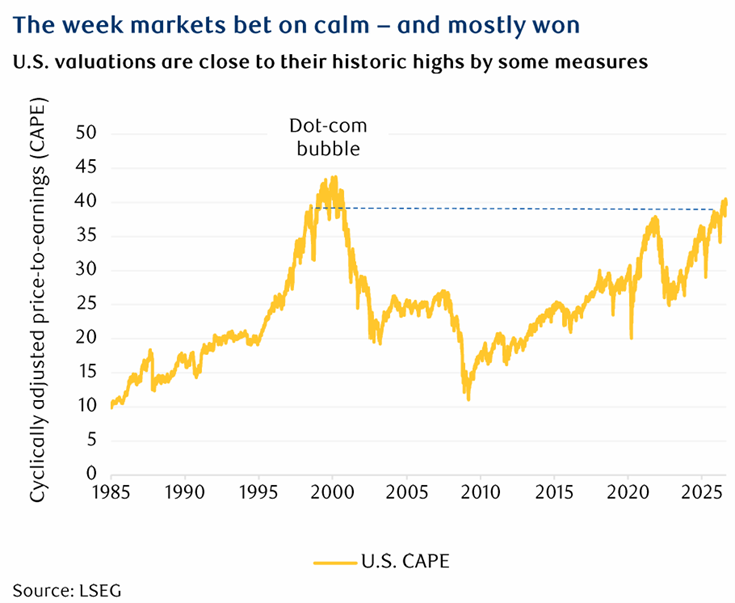
For some time, market milestones have invited comparisons with valuations of the past. Over the summer, the Financial Times observed that U.S. equity valuations now sit higher than in September 1929, surpassed only by the peak of the dot-com bubble. It’s a comparison that demands respect, and we take the underlying caution seriously. But context matters.
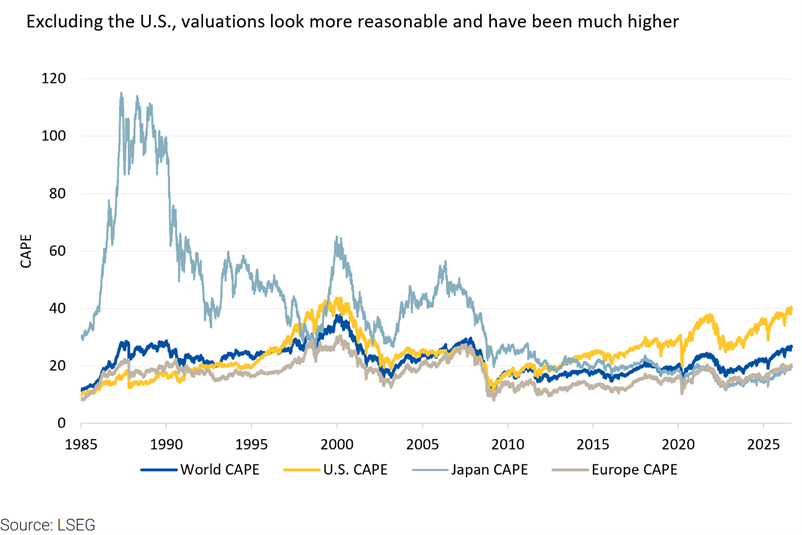
The metric being cited is the analytically useful, cyclically adjusted price/earnings (CAPE) ratio, which measures the real price over the 10-year average adjusted earnings (with both price and earnings adjusted for inflation). While U.S. valuations have only reached today’s levels once before, during the tech bubble, there’s still a further 26% upside to the peak they eventually reached. Look beyond the U.S., though, and valuations are far less stretched. Global equity valuations are dragged down by their weighting towards other regions.
Anchoring to the tech bubble valuation peak is also unhelpful because the peak for equity valuations was neither in the U.S. nor in 1999, it was in 1989 Japan, when valuations reached multiples of the highest levels.
The deeper point is that valuations are just numbers that need to be reconciled against the pace of profits growth, not just their level. In early 2000, the market’s largest company, Microsoft, briefly touched earnings growth near 80%. Today’s largest, Nvidia, has now enjoyed multiple years growing much faster than that. Its valuation seems high looking backwards, as CAPE does, but less than 20 times 2027 earnings doesn’t seem demanding.
Its results, announced last Wednesday night, were strong, with quarterly revenue close to doubling year-on-year and a first-ever full-year forward guidance of 70% growth, which is only that modest due to supply constraints.
Is the AI trade resting on shaky foundations?
Source: OpenRouter
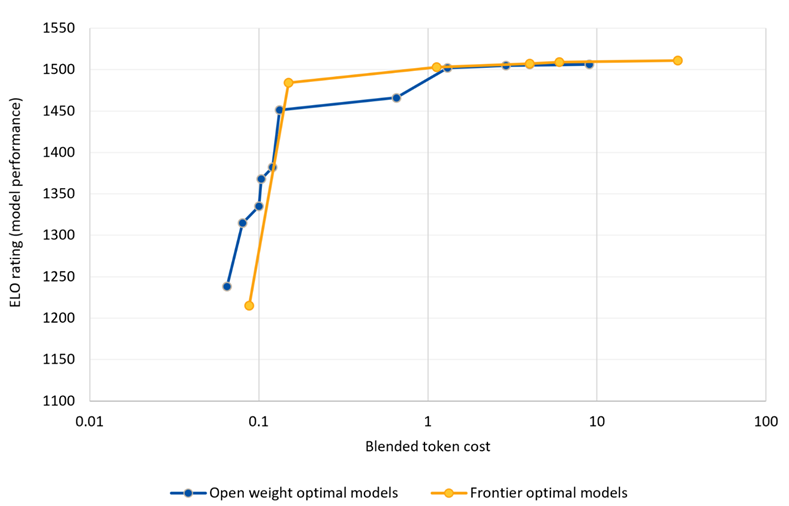
The more interesting debate is subtler. The performance gap between the frontier AI labs – OpenAI, Anthropic – and cheaper open-weight models has narrowed sharply, from perhaps 12–18 months to as little as three to six. That threatens the labs’ pricing power and they’ve made vast spending commitments to the hyperscalers (large cloud providers) who host them. Microsoft alone carries roughly $281 billion of contracted backlog tied to OpenAI, part of a group total near $700 billion.
So, it does make sense to wonder: what would the impact be if OpenAI and Anthropic found they couldn’t charge premium prices for their premium product? How does this affect the hyperscalers? Our read is measured.
Microsoft’s Azure platform is deliberately model agnostic. With over 11,000 models available, its economics are driven by total utilisation rather than any single customer. If OpenAI stumbled, that capacity would be redistributed to the enterprise demand queuing behind it, after a digestion period. Reduced demand from the AI labs, or reduced demand because of gains in model efficiency, would enable hyperscalers to slow their capital expenditure (capex).
So, does the real risk lie with the recipients of that capex? Back to the likes of Nvidia, which may also be at risk from greater efficiency in custom silicon as well? It’s a risk, but historical examples of this kind of technology show that efficiency gains tend to unleash more demand than they destroy.
Jevons’ paradox noted that as steam engines became more efficient, rather than reducing coal demand, they increased it because steam became a much more accessible technology. So far, that pattern seems to be holding for AI too. For Nvidia, cheaper open-weight models running on its highly flexible platform are a tailwind, not a threat.
Restoring credibility
It’s an open secret that public officials don’t always end up keeping their promises, but it feels like recent years have seen an unusual amount of policy flexibility. The UK’s debate over what increased taxes might mean for working people contributed to the change of its government. The U.S. plan to end military interventions has seen it mired in war in the Middle East.
Central bankers are assumed to be immune from the political pressures that lead to policy flexibility, but they can’t escape the financial pressures. So, inflation remaining persistently above target and governments delivering persistent budget deficits have created concerns that monetary policy is being directed at eroding debt burdens rather than managing inflation, a state known as fiscal dominance.
The relatively new Federal Reserve (Fed) Chair, Kevin Warsh, had the job of rebutting such concerns at last week’s Jackson Hole Economic Policy Symposium. He did so forcefully, acknowledging that inflation hasn’t meaningfully slowed and that the Fed has work to do. He reiterated the inflation target, said that short-term interest rates are the primary policy tool and acknowledged that the economy had strengthened. Without explicitly offering guidance, he gave the distinct impression that a rate hike was likely in mid-September.
That prospect saw a strong U.S. dollar and weaker bonds as Warsh affirmed the Fed’s commitment to controlling inflation with higher interest rates. That weighed on gold as it indicated the Fed won’t facilitate further inflating away national debt.
However, a lot could happen this week to tip the scales for or against a rate hike. A host of jobs data will come in on Friday – including the non-farm payrolls report, which was surprisingly downbeat last month.
Please continue to check our blog content for advice, planning issues and the latest investment, market and economic updates from leading investment houses.
Alex Clare
03/09/2026