
Please see below, todays daily update article from Brooks Macdonald, received this morning – 02/09/2026:
What has happened?
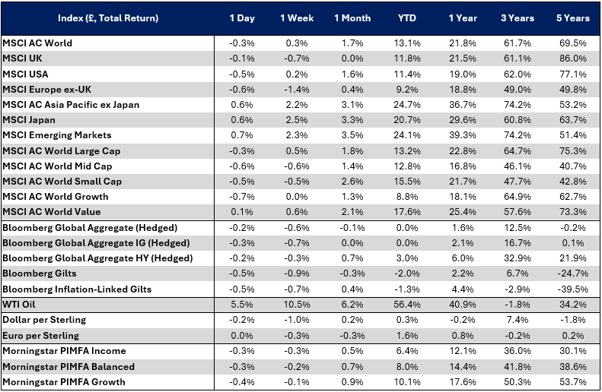
September has begun with a clear risk-off tone as escalating tensions between the US and Iran, rising energy prices and a sharp global bond sell-off weighed on investor sentiment. US air strikes on Iranian targets around the Strait of Hormuz and subsequent Iranian retaliation pushed Brent crude above $95 per barrel, reigniting concerns over inflation and global supply disruptions. At the same time, government bond yields reached multi-year highs across major markets, with UK gilts, US Treasuries and Japanese government bonds all under pressure as investors priced a greater likelihood of further central bank tightening. Equity markets declined across the US, Europe and Asia, with technology shares among the weaker performers, while attention now turns to US labour market data and Broadcom’s earnings later this week.
Markets Confront a Stagflation Shock
The standout theme is the re-emergence of stagflation concerns. Higher oil prices are arriving at a time when inflation has already proven more persistent than expected, prompting increasingly hawkish rhetoric from central banks. Markets are now pricing a much higher probability of a September Federal Reserve rate hike, while the ECB and Bank of England also face renewed pressure from energy-driven inflation risks. The combination of rising commodity prices and higher yields is challenging both equity and bond markets simultaneously, creating a difficult backdrop for traditional diversification. Unlike earlier geopolitical shocks, investors are increasingly focused on whether sustained energy price strength could delay the global easing cycle and prolong restrictive monetary policy.
Both Sides of the Yield Equation Turn Against Markets
A nominal bond yield comprises a real yield, which represents the return after expected inflation, and a breakeven inflation rate, which reflects both inflation expectations and the compensation investors demand for inflation uncertainty. Until recently, rising government bond yields had largely been driven by higher real yields, reflecting tighter policy expectations and an increase in term premia. The latest move is more concerning because both real yields and breakeven inflation rates have risen. Central banks continue to signal that policy may need to remain restrictive, while higher oil prices are adding to inflationary pressures and supply-related risk premia. The rise in breakevens suggests investors are not only pricing a higher near-term inflation path but are also demanding greater compensation for inflation risk. More importantly, it may indicate growing concerns about how quickly central banks can return inflation to target if supply shocks persist and inflation expectations become less firmly anchored. This combination increases the discount rate applied to future corporate cash flows while also threatening profit margins, consumer purchasing power and earnings growth. The result is a less favourable backdrop for equities, particularly long-duration growth stocks, and a reduction in the diversification benefits of government bonds, as inflation shocks can cause both asset classes to fall simultaneously.
What does Brooks Macdonald think?
While the geopolitical backdrop has clearly deteriorated, the market reaction reflects more than just Middle East tensions. The recent rise in yields also highlights the resilience of global growth and the reassessment of how much policy tightening may still be required to contain inflation. We believe investors should distinguish between short-term volatility and longer-term fundamentals. Strong economic activity, robust corporate earnings and structural growth themes such as AI remain important supports for risk assets, but higher oil prices and bond yields are likely to keep market volatility elevated in the near term. For now, markets appear to be transitioning from a growth-focused narrative to one increasingly dominated by inflation and policy expectations, making diversification particularly important.
Please continue to check our blog content for advice, planning issues and the latest investment market and economic updates from leading investment houses.
Andrew Lloyd
02/09/2026