Team No Comments

Tatton Investment Management: Monday Digest

Please see below, an article from Tatton Investment Management, analysing the key factors currently affecting global investment markets. Received this morning – 06/10/2025

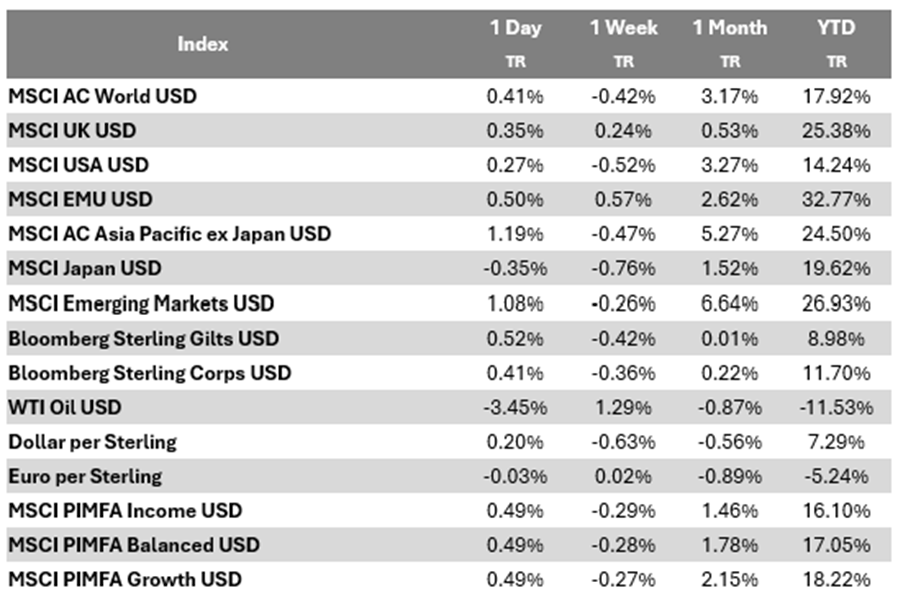
Nothing shuts down the stock markets

Global stocks bumped up last week, despite the US government shutdown. Perhaps markets expect a resolution, or perhaps only a mild economic impact. When US government shutdowns are short, they rarely hurt the economy too much. The last long shutdown (December 2018-January 2019) had a delayed impact on stocks, but investors don’t seem as concerned now (they suspect it will be more like the 1995 shutdown).

The clamour in Washington contrasted with a quiet Labour party conference in Liverpool, where the most important takeaway was what wasn’t said: Chancellor Reeves declined to rule out tax rises. The least economically disruptive hikes would be income or VAT, but they would be unpopular. At least the Treasury’s stamp duty suspension for new London stock listings should help bring liquidity back to our beleaguered market. With the FTSE 100 hitting another all-time high, we issue our usual reminder that UK growth and profits aren’t as bad as the media suggests.

More encouraging was the US Supreme Court’s stay of execution for Fed governor Lisa Cook. The next legal flashpoint will be the November ruling on tariffs. Investors don’t like tariffs, but they have brought in much-needed tax revenues – so a ruling against them could hurt US bond yields and, by extension, stocks.

Over the weekend in Japan, Takaichi Sanae was elected the new and first female leader of the ruling Liberal Democratic party, which is set to make her prime minister.  Stock markets reacted with a 4% rally, while the Yen lost about 2%. Given her pro fiscal stimulus, and anti central bank independence stance, the market reaction has set the scene for her surprise success, decisively and without delay.

US Q3 corporate earnings will now come into focus, and are expected to rise 8.2%. Companies usually downgrade expectations to engineer a ‘beat’ which boosts their share price. Analysts aggressively cut Q3 earnings amid earlier tariff uncertainty, and companies stopped issuing guidance. Lacking guidance, analyst forecasts remained static. That lowers the chance of a ‘beat’ (as does a drop in AI-related profits) which makes an earnings boost to stocks less likely.

There was also discussion of leveraged buyouts, following the Saudi-backed deal for EA. But we note that the actual amount of leverage was small compared to the deal’s price.

Markets are ignoring politics and awaiting earnings; we’re in the in-between space. But stocks are powering ahead anyway, suggesting a bit of speculation. We shouldn’t be surprised if we see a pullback in the coming weeks, considering the removal of favourable liquidity conditions.

September Asset Returns Review

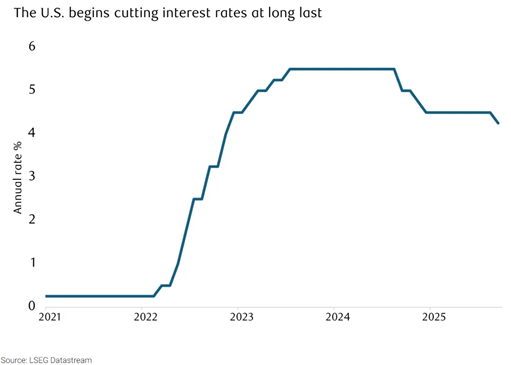
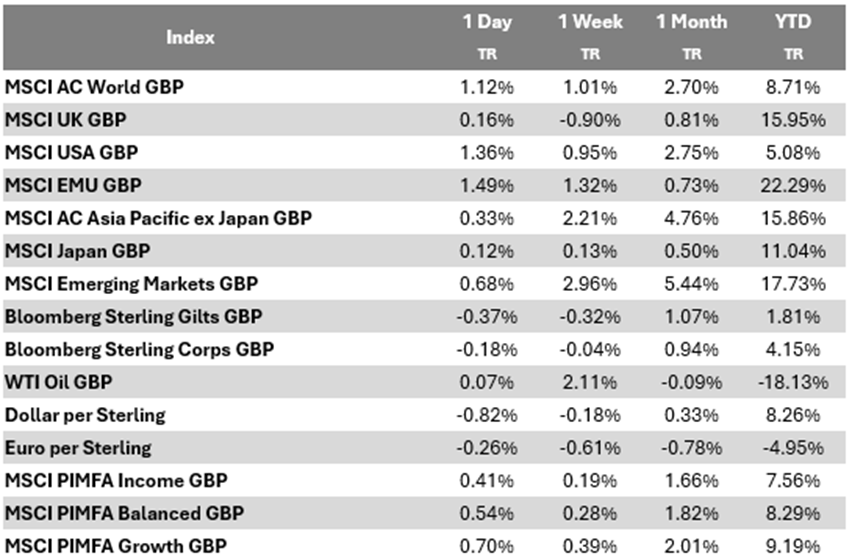
Global stocks gained 4% in sterling terms last month, while bonds added 0.7%. Risk appetite is strong across all major equity markets. That is despite a tightening of financial liquidity for seasonal and US treasury-related reasonings. The Federal Reserve’s dovish turn in September (a 0.25 rate cut and more signalled ahead) pushed up growth expectations, resulting in a 4% gain for US stocks and an outperforming tech sector.

Smaller US stocks were buoyed by the Fed’s cut, but underperformed through September overall. Stronger growth expectations raised long-term inflation and rate expectations, weighing on small-cap valuations. The ‘Magnificent Seven’ rallied for most of the month, but sold off in the last week due to end-of-quarter rebalancing and fears about AI investment’s sustainability.

The UK and Europe rallied by less than the US but are outperforming year-to-date. We think the UK economy is better than media commentary suggests.

The Fed’s dovishness is at odds with other central banks, which are signalling a tighter outlook and are probably right. The Bank of Japan is on the opposite end, signalling a rate rise in October amid stronger growth and inflation. Japanese stocks gained 2.8% and look strong.

China was yet again the best performer, gaining an incredible 9.1% through the month, despite persistent economic weakness. Chinese positivity is largely about Beijing’s stimulus drive, but stocks are supported in the near-term by strong liquidity conditions (both government and private).

Stronger Chinese growth expectations also pushed up copper prices last month. But gold was the standout commodity, with prices up 12.1% last month. This is sometimes taken as a sign of geopolitical anxiety, but gold has been rallying for years for a variety of reasons. The main release for investors’ political anxiety continues to be the dollar, which weakened again in September. For UK investors, the dollar’s weakness takes the shine off US equity’s impressive rally since “Liberation Day”.

Politics not derailing Japan

Japanese stocks pulled back from their highs last week, but their recent rally looks well supported. We’ve been positive on Japan for a while, thanks to corporate reforms boosting profitability and the competitiveness of Japanese exports. Both share buybacks and dividends are up this year, reflecting strong cash generation. Global investors are catching onto these improvements and sensing a bargain, due to Japan’s low equity valuations.

It’s not all sunshine: the recent trade deal with the US still includes a 15% tariff for Japan, and the government faced a new leadership contest on the weekend. Bond yields have increased 0.5 percentage points this year – a bigger sell-off than anywhere else.

Sanae Takaichi – one of the leadership candidates and an acolyte of former Prime Minister Shinzo Abe – has called for greater fiscal spending. But while fiscal stimulus helped in Abe’s era of zero inflation, Japanese inflation has been above 2% for three years. The Bank of Japan (BoJ) were split on whether to raise rates in September, but bond markets are pricing in a hike this month. The BoJ is tightening, but is still dovish relative to the underlying economy. That’s intentional, as the bank wants to kickstart a process of wage inflation.

That might sound odd, but Japan has historically struggled to embed wage rises. Koizumi – the other government leadership candidate – wants to explicitly tie wage rises to inflation, which could help consumer confidence (although undermine monetary stability). July’s 5.25% average wage rise was the highest pay bump in 34 years. This isn’t hurting profit margins either – suggesting incentivised employees are becoming more productive.

National pay negotiations in the spring will be crucial. Tariffs and government instability are headwinds, but domestic growth is coming through and a positive cycle is taking hold. For Japanese stocks, the cycle of reform, growth and confidence is more important than policy.

Please continue to check our blog content for the latest advice and planning issues from leading investment management firms.

Marcus Blenkinsop

6th October 2025
Team No Comments

The Daily Update | Yielding to US Weakness

Please see below article received from EPIC Investment Partners yesterday, which provides an update on the US economy.

Concerns over the health of the US economy are mounting, driven by a sharp decline in sentiment, a softening labour market, and the disruptive reality of a government shutdown. These compounding headwinds suggest a period of economic caution, making a compelling case for defensive, undervalued, fixed income issued by the wealthy nations.

Recent data paints a clear picture of deterioration. The Conference Board’s US Consumer Confidence Index fell to a five-month low in September. Crucially, the measure of expectations for the next six months remains below the 80 threshold that has historically signalled a recession. This weak sentiment is rooted in job worries, with the gauge of present conditions dropping to a year-low and the difference between “jobs plentiful” and “jobs hard to get” narrowing to the smallest since early 2021.

The labour market is displaying notable weakness. The ADP National Employment Report for September was a major setback, showing private employers shed 32,000 jobs, with job creation losing momentum across most sectors. Furthermore, for the first time since the start of the pandemic, there are now more unemployed people in the US than there are job vacancies (job openings), suggesting that labour demand is cooling off. Compounding this, the grim official jobs report for August showed a mere 22,000 gain, with June being revised down to a loss of 13,000. These figures strongly suggest the economy is cooling rapidly.

Adding to the instability is the government shutdown, which introduces immediate economic drag. The Congressional Budget Office estimated the 2018/2019 partial shutdown reduced annualised real GDP growth by 0.4% in Q1 2019, while the 2013 lapse lowered growth by as much as 0.6%. The current shutdown, with threats of mass federal layoffs and disruption to services like E-Verify, will further erode confidence and hit private businesses; the 2013 shutdown cut an estimated 120,000 private-sector jobs.

This combination of weak consumer confidence, a softening labour market, and government instability creates an environment of elevated risk and uncertainty. In times like these, investors typically seek safety. Undervalued, high-quality sovereign and quasi-sovereign bonds like those held in the EPIC Fixed Income Strategy, become attractive. These assets offer capital preservation and predictable income in the face of economic turbulence, acting as a crucial defensive counterbalance to potential volatility in other asset classes.

Please check in again with us soon for further relevant content and market news.

Chloe

03/10/2025

Team No Comments

Brewin Dolphin – Markets in a Minute

Please see this week’s Markets in a Minute update below from Brewin Dolphin, received yesterday afternoon – 30/09/2025.  

U.S. imposes fresh import tariffs

We explore the implications of new U.S. import tariffs coming into effect on 1 October.

Key highlights

  • U.S. announces new wave of tariffs targeting the pharmaceutical sector: President Trump announced new tariffs on branded and patented pharmaceuticals, along with a range of other products, effective from 1 October.
  • The impact of tariffs on U.S. jobs growth: U.S. jobs growth has slowed significantly since tariffs were announced in April. Forecasts expect only 50,000 new jobs in September, the lowest figure since the COVID-19 pandemic.
  • A dramatic shift on the war in Ukraine: In a high-stakes meeting in New York, President Trump met Ukrainian President Zelensky and signalled a major change in his stance on the Ukraine-Russia war, openly endorsing NATO’s potential use of force to down Russian aircraft.

U.S. announces new tariffs

Last week wasn’t a stellar one for stocks, even if the worst fears of September’s seasonal weakness seem unlikely to materialise.

The calm in trade policy was broken once more with the latest announcement from U.S. President Donald Trump, who took to social media to reveal a slew of new tariffs set to come into effect on Wednesday.

The most eye-catching was the president’s declaration that “branded or patented” pharmaceutical products will be subject to a 100% tariff, unless the company in question is actively building production plants in the U.S. This move could have a significant impact on the U.S. effective tariff rate – ‘un-tariffed’ pharmaceuticals currently make up 8% of U.S. imports, so imposing a 100% tariff on them ought to boost the effective tariff rate by eight percentage points. The effective tariff rate refers to the total amount of duties collected by the U.S. government, which is expressed as a percentage of the total value of imports.

While some companies may be able to mitigate the effects of these tariffs by leveraging their existing U.S. production facilities, the full impact of the measures remains to be seen.

A multi-billion-dollar pledge

It’s worth noting that many pharmaceutical companies have already begun investing in U.S.-based production facilities, which may help reduce the sting of the tariffs. The Trump administration has secured promises of $325 billion in pharmaceutical capital expenditure (capex).

So far this year, America’s capex has been heavily concentrated on building out artificial intelligence (AI) capabilities, with other categories of investment being relatively weak. However, durable goods order data released last week suggested that orders for machinery manufacturing are increasing, which could be symptomatic of an increase in more general investment activity.

Increased investment would be welcome at a time when U.S. jobs growth seems to have almost ground to a halt and would otherwise weigh on growth.

At the time of writing, there has been no additional detail offered beyond the social media post, so it remains unclear how strictly the requirement to have started building production plants will be enforced.

Another factor that may limit the overall impact of these tariffs is the significant stockpiling that has taken place in anticipation of their introduction. The long period of speculation ahead of the ‘Liberation Day’ tariffs allowed companies to build inventories and muted their immediate effects.

A major trade victory for the European Union?

The imminent onset of the tariffs reveals the value achieved by the European Union (EU) in securing an exemption from sector-specific tariffs as part of its trade deal with President Trump.

This could prove to be a major victory, particularly for Ireland. In 2024, U.S. imports of medicinal and pharmaceutical products reached $234 billion – the top 10 exporters to the U.S. were led by Ireland ($65.7 billion, 28.1% of total imports). In contrast, the UK and Switzerland, which are not EU members, have not been afforded the same protection.

The UK deal included references to special rates being considered in the event of tariffs being introduced under Section 232, but no concrete agreement has been reached. As the situation continues to unfold, investors will be watching closely to see how these tariffs play out and what impact they will have on the global economy.

Considering the exemptions for U.S. production, the existing commitments to expand domestic manufacturing, the EU exemption, and prior stockpiling efforts, the tariffs are likely to have much less impact than their headlines suggest.

It would also be politically prudent to avoid causing the price of medications to double at a time when many Americans believe the president should be counting reducing inflation as one of his top priorities.

In addition to the pharmaceutical tariffs, President Trump also announced tariffs on a range of other products, including heavy trucks (25%), upholstered furniture (30%), and kitchen and bathroom furniture (50%).

Trump meets Zelensky

President Trump and Ukrainian President Volodymyr Zelensky met last week on the sidelines of the United Nations General Assembly in New York. The tone was dramatically different from that of the ill-fated February meeting between the two (and U.S. Vice President JD Vance).

The most significant outcome was a major public shift in Trump’s stance on the war. The president declared that Ukraine could win back all of its territory from Russia and explicitly endorsed the potential for NATO to use force to shoot down Russian aircraft.

Please continue to check our blog content for advice, planning issues and the latest investment market and economic updates from leading investment houses.

Charlotte Clarke

01/10/2025

Team No Comments

Brooks Macdonald – Daily Investment Bulletin

Please see the below article from Brooks Macdonald detailing their daily discussions on markets and fiscal/political headwinds. Received this morning 30/09/2025.

What has happened?

Markets saw a global bond rally yesterday, with 10-year UST yields dipping 3.6 basis points, fuelled by a steep 3.45% decline in WTI crude oil. Signals that OPEC+ may boost production at next week’s meeting eased inflation fears and sparked fresh bets on deeper Fed rate cuts. This lifted most assets: US investment-grade credit spreads tightened 1 basis point to near post-1998 lows, while gold surged 1.96% to a fresh record of $3,834 per ounce. Equities edged higher across the board, as the S&P 500 rose 0.26%, inching within half a percent of last week’s record high. Tech led the charge, with the NASDAQ up 0.48%, but gains were generally broad-based with the equal-weighted S&P climbing 0.32%. In Europe, the STOXX 600 rose 0.18% to a two-week high, and the FTSE 100 added 0.16% to a five-week high.

US government shutdown jitters

With just hours to go, the US government teeters on the edge of shutdown unless a last-minute deal materialises today. The longest shutdown lasted 35 days across the 2018-19 year-end period. Historically, most fizzle out in 2-3 days, with only a few stretching beyond two weeks. Last night’s White House talks with Democratic leaders ended in deadlock, with no follow-ups scheduled. VP Vance hinted at openness to bipartisan fixes for expiring health subsidies (a Democratic priority) but only after reopening the government. Democrats dismissed the offer as too vague. Polymarket odds now peg an 79% chance of shutdown by tomorrow and 85% by year-end.

UK budget blues

In the UK, PM Starmer and Chancellor Reeves are laying groundwork for broader tax hikes, testing Labour’s election vows at the Labour Conference. Long-rumoured fiscal tightening now hints at ditching pledges to freeze income tax, payroll tax, VAT, and corporation tax. Starmer’s Tuesday speech is set to warn that ‘rebuilding Britain won’t come cheap’. Chief Secretary Jones stoked VAT rise chatter, while Reeves sidestepped her no-new-taxes refrain, doubling down on fiscal rules to woo markets. Investors, though, are wary: A Deutsche Bank poll ranks the UK second only to France among major economies for a debt crisis risk in the next two years.

What does Brook Macdonald think?

Amid these fiscal and political headwinds, trade tensions simmered anew as Trump outlined fresh tariffs: a 10% levy on imported timber and lumber. The sting is softened for trade partners with existing deals, whose rates stay capped by prior agreements. Meanwhile, US-China friction escalated with the White House expanding its export blacklist to snare subsidiaries of blacklisted firms, possibly affecting giants like Huawei and SMIC. These measures are likely to sustain uncertainty in global trade and supply chains. As the full effect of tariffs is yet to be captured by the real economy, investors need to stay vigilant ahead.

Please continue to check our blog content for advice, planning issues and the latest investment, market and economic updates from leading investment houses.

Alex Clare

30/09/2025

Team No Comments

EPIC Investment Partners | The Daily Update

Please see below, an article from EPIC Investment Partners analysing recent movements in gold prices and bond yields. Received today – 26/09/2025

Gold has overtaken the Euro as the world’s second central bank reserve asset and the BRICS continue to ‘de-dollarise’. Overseas demand for US Treasuries is being quietly replaced by increasing demand for gold. Gold is not rising in price – it is the Dollar’s purchasing power that continues to fall and an increasing amounts of the currency are required to purchase an ounce of the metal.

The UK’s Monetary Policy Committee has the sole objective of adjusting Base Rate to achieve an annual inflation rate of 2%. The US Federal Reserve has a three-goal mandate from Congress:

  • Maximising Employment: The Fed aims to foster economic conditions that promote the highest possible level of employment. 
  • Stable Prices: This objective involves controlling inflation to keep the purchasing power of money stable. The Federal Reserve’s longer-run inflation objective is 2%. 
  • Moderate Long-Term Interest Rates: The Fed works to keep long-term interest rates at levels that support economic growth and stability. 

The August UK Base Rate cut, was agreed by a slender 5:4 majority of the MPC, despite an inflation rate significantly above the 2% target. The August number was 3.8%. The Fed’s mandates currently appear mutually exclusive. US inflation at 2.7% although above target compares favourably with the UK, as does the unemployment number of 4.3% versus the UK’s 4.7%. However, downward revisions of US employment numbers over recent months have increased the likelihood of a September Fed Base Rate cut to a near certainty. 

Rising longer dated UK Gilt yields appear to have interpreted August’s quarter point drop as a surrender to above target inflation. The narrow majority in favour of the cut demonstrates the conflicting influences behind the decision. The narrative acknowledges that inflation will peak at 4% in September before falling ‘back to the 2% target after that’. No forecast of timing and no mention of confidence in this outcome. Despite relatively robust US GDP numbers, 10-year Treasuries have moved in the opposite direction, with yields falling back towards 4%. Gold and silver prices have taken the opposing view. Both cannot be right.

I repeat, the price of gold is not rising – it is the purchasing power of FIAT currencies that is falling. We measure returns from equities and bonds in FIAT currency terms, but if we had invested in the S&P 500 and reinvested our dividends from the end of gold’s backing for the Dollar in 1971, measured in gold, the return from the S&P has been zero. The total sum from the investment in US equities would today buy less gold than in 1971. Returns from monetary assets, cash and bonds, have lagged way behind, with 10-year Treasuries having generated negative real returns for the past 100 years. They will continue to do so.

The US dollar lost 75% of its purchasing power through the 1970s while the gold price rose by almost 2000%. It would be unsurprising in the light of the US debt spiral if this is repeated over the current decade. A yield of 4% from 10-year US$ Treasuries will provide no protection. Remember where Paul Volcker took rates last time the Fed faced a period of stagflation? In 1981 ‘The Volcker Shock’ took rates to 20%, unemployment rose and inflation fell and restored confidence in US economy, eventually contributing to a decline in the price of gold. What odds will you give me on the Fed and the MPC raising rates to 20% to restore confidence in the US and UK economies – and currencies?

Please continue to check our blog content for the latest advice and planning issues from leading investment management firms.

Alex Kitteringham

26th September 2025

Team No Comments

EPIC Investment Partners – More Defence spending means larger deficits and more bonds for sale

Please see below article received from EPIC Investment Partners this morning, which explains the link between defense spending and the bond market.

The size of militaries

According to the World Population review China has the largest military with 2m people. India has 1.5m, the US and North Korea each with 1.3m, Russia 1.1m and Ukraine 730,000. When it comes to military spending power the US is dominant, accounting for 37% of the world total, three times the amount of China in second place. 

Ukraine has the largest military in Europe because it is fighting a war. Russia is on a war footing. Both these economies are spending large proportions of their budgets on defence equipment and are increasing their weapon making capacities. China is building a large military capability to be able to intervene widely, with figures that may be understated. Germany, France, Italy, UK and Canada are all under pressure to increase spending as NATO members whilst Japan and South Korea are raising their budgets as allies of the US seeking to deter Chinese expansion.

In 2024 the US spent $1 trillion on defence, followed by China at $314bn and Russia at $149bn. All others were each under 9% of the US total spend. The US continues to lead in technology and development of new weapons, though China is now a serious rival with her own ability to innovate.

Defence shares have boomed on the back of planned expansion of budgets, with companies now needing to translate the increased order books into higher turnover and profits to justify the advances. Meanwhile bond markets are factoring in substantial increases in some defence budgets at a time when most countries need to cut their high deficits to reassure savers lending them money.

Defence budgets 

The US, EU and UK are all embarking on further growth in their defence budgets. NATO has set a new target of 3.5% of GDP by 2035, with related expenditures on relevant national infrastructure at an extra 1.5%. Most countries will struggle with hitting these new targets.

The US President is seeking a 13% budget increase for 2026 over 2025. He wishes to strengthen US industrial capabilities to make weapons, improve US defences against missile and drone attack (Golden Dome), start the F-47 new fighter plane and improve nuclear capabilities. He is also scaling back the F-35 programme and demanding various efficiency improvements.

Germany is doing the most to increase its spending, starting from a low base and with a lower stock of state debt to GDP. The German government set up a €500bn fund to supplement annual defence spending over a period of years. The current German government removed the debt brake from borrowing needed to boost defence spending. As a result, it plans to raise spending to 3.5% by 2029, when it was only 1.4% in 2022. It plans €649bn over 5 years, ramping up from €86bn this year. It will continue to provide weapons to Ukraine.

France is very constrained by its excessive debts and large deficit. The President has recently announced his wish to increase the spending set out by the Loi de programmation militaire in 2026 and 2027. The budget allows modest growth in defence against a background of the last PM seeking overall budget cuts of Euro 43.8bn hitting welfare and the civil service. The defence increase is not helping get the budget through as the government seeks to confront the Parliament with the need to cut the deficit. Given the budget pressures there is not going to be much increase in the €53bn budget for defence, keeping it around 2% of GDP.

The UK has always stayed above the 2%. 23 out of 32 NATO states have now got to that level or above. The UK government plans to increase spend to 2.4% of GDP this year and 2.5% next year. It is leaving it until the next decade to get to 3% and above. Current plans see the £56.9bn budget of last year rising to £59.8bn this. 

Deficits and bond issuance

The UK and US have to pay more interest on new borrowings than the Europeans or Japanese.

The UK has the highest long term borrowing rates as fears are more pronounced over the state of the national finances. The Chancellor raised substantial money in extra taxes last year in the budget, only to see the deficit go up again as a result of growth slowing and spending on welfare and public services rising by far more than the tax increases.  With a policy for growth that depends on increased defence work, and a foreign policy based around the European wing of NATO taking on more responsibility for European defence and for assisting Ukraine, the government is having to look at other areas to cut back. 

Germany with a lower debt to GDP is able to borrow more to pay for the shells. The USA continues to get away with a very high debt and deficit, and will be adding to it with extra defence, though seeking big cuts in some other areas like net zero policy. France is the most stressed of the major European economies, with a high debt and deficit. France has to pay considerably more to borrow than the Euro average given the budget risks. France will do the least to increase defence as a result. 

Conclusion

The bond markets will continue to warn the UK and France that their governments need to take more action to rein in deficits. Both countries will find it is difficult to cut spending and will be looking to see what extra taxes they can impose without too much more damage to growth. Share markets have adjusted to the improved relative outlook for defence companies, whilst bond markets have made an understandable assessment of different levels of risk of budget strains. Both France and the UK have work to do to reassure more; while the US economy is slowing so it does allow rate cuts.

Please check in again with us soon for further relevant content and market news.

Chloe

25/09/2025

Team No Comments

Brewin Dolphin – Markets in a Minute

Please see this week’s Markets in a Minute update below from Brewin Dolphin, received yesterday afternoon – 23/09/2025.  

The current state of interest rates

Stocks generally rose over the week to Friday. 

Changes to interest rates were largely anticipated, with a cut to U.S. rates and holds in Japan and the UK. Markets are currently anticipating the U.S. will face more rate cuts than the UK and Europe. Interest rates should still rise in Japan, but very slowly.

The main headlines were captured by the slowing of the UK’s quantitative tightening programme. This means that the government’s sale of bonds will slow, which will provide some relief, as it needs to find buyers for substantial bond sales over the coming months.

However, maintaining the stock of bonds for longer will now cost the Treasury, as it must ultimately foot the bill for differences between the returns being made on purchased bonds (at old historically low rates) and the interest rate paid on the reserves used to fund such purchases (at more recent, higher rates).

Currently, markets expect interest rates to remain within a corridor of stability; loose enough in the Eurozone and getting looser in the U.S., but with neither region threatened by an imminent recession.

The current environment could be described as a ‘Goldilocks’ environment where growth is weak enough (and inflation isn’t too high) to allow the Federal Reserve to cut interest rates.

Technology drives equity returns

Contributors to global equity market returns have broadened out, but technology remains a significant driver. Within the technology sector, we’ve seen some dispersion of returns.

Artificial intelligence (AI)-related stocks have been strong performers, but resolving which companies are benefitting from AI and which are threatened remains a source of controversy for the market.

For example, the rise of AI has raised concerns about competition from lower-cost, AI-driven research tools – which could potentially disrupt the business models of companies that provide market insights, research, and strategic frameworks, such as Gartner. In August, Gartner’s stock plummeted by as much as 40% after the company reported a slowdown in growth, citing weaker demand for IT advisory subscriptions and reduced value of federal contracts.

However, not all research companies are suffering. RELX, for example, has seen growth in its scientific, technical and medical (STM), legal and risk segments, thanks in part to the benefits of AI. The company’s ownership of copyright and its control over how its articles are used have allowed it to provide embedded AI tools to researchers, making them more productive.

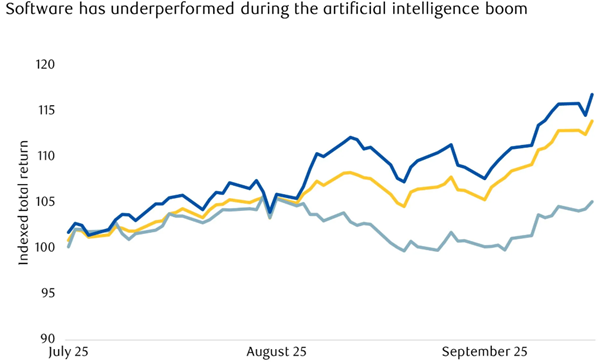
While AI may have driven strong returns from the technology sector overall, many software companies have started to see it as more of a threat. One of the primary reasons for this is the changing spending environment in the tech industry. Already limited IT budgets now needing to incorporate AI spending has resulted in a decrease in spending on traditional software solutions.

A graph of blue and yellow lines

AI-generated content may be incorrect.

The poor spending environment, combined with the rise of AI and the emergence of new technologies like vibe coding (coding using natural language prompts and AI), has led to concerns that traditional applications will be replaced.

A winning model

Companies with user-based revenue models (where the amount you pay is dependent on how many users are accessing the product or service), such as Adobe, are feeling the most pain. They face competition from lower-cost alternatives and struggle to maintain premium price points.

In contrast, services that are sold on a usage basis (rather than per user), such as cloud or database services, have been prospering. They require less commitment from customers, and their costs tends to be more related to their value, making them well-suited to the field of AI, where demand is difficult to forecast. Providers of this type of service are benefitting from the capital spending on AI from startups.

Microsoft and Palantir are two exceptions to this. Microsoft has a so-called ‘seat-based’ business (a pricing model where customers pay for individual licenses, or ‘seats’, that grant them access to a software or service). However, this forms part of a much more complete business that extends beyond software into infrastructure through its Azure cloud computing platform. This leaves it well positioned to benefit from AI adoption.

Historically, Microsoft’s Office package has been difficult to disrupt and its barriers to competitors remain robust. However, over the summer, Elon Musk announced that he would launch Macrohard to rival Microsoft. It will do this by using a fleet of specialised AI agents to handle all aspects of software development, including code generation, testing, and management. Although Musk is a formidable challenger, Microsoft has shown itself to be agile enough to meet such challenges in the past.

Ultimately, the future success of software vendors will depend on their ability to expand their existing customer base and adapt to changing user behaviours. Companies with strong research and development capabilities, and products that can fit around evolving user needs, will be better positioned for growth.

While this is theoretical, it highlights the importance of infrastructure players and the challenges faced by application vendors in the current software landscape. The emergence of Macrohard and other AI-powered initiatives will only add to the complexity and uncertainty of the software market, making it essential for companies to stay ahead of the curve and innovate to remain relevant.

Please continue to check our blog content for advice, planning issues and the latest investment market and economic updates from leading investment houses.

Andrew Lloyd

24/09/2025

Team No Comments

Brooks Macdonald Daily Investment Bulletin

Please see the below article from Brooks Macdonald detailing their discussions on markets and Central Bank policy. Received this afternoon 23/09/2025.

What has happened

Risk assets powered higher over the past 24 hours, with the S&P 500 climbing 0.44% to a fresh record high. Tech stocks led the charge, fuelled by Nvidia’s blockbuster announcement of a potential $100 billion investment in OpenAI to bolster AI infrastructure, including new data centres. This propelled Nvidia’s shares up 3.93%, lifting the NASDAQ (+0.70%) and the Magnificent 7 (+0.75%) to new highs, with the Mag-7 now boasting a 20.43% gain year-to-date. In contrast, European markets took a breather, with the STOXX 600 dipping 0.13%. UK assets, however, showed resilience, as the FTSE 100 gained 0.11% and 10-year gilts rallied slightly.

Fed signals a hawkish tilt?

Rates markets took a slightly hawkish turn as Fed speakers weighed in. Atlanta Fed President Bostic expressed caution, pencilling in just one rate cut for 2025 and citing persistent inflation. St. Louis Fed President Musalem echoed this, warning against overly accommodative policy, while Cleveland’s Hammack called current policy only ‘mildly restrictive.’ Governor Miran’s dovish push for a lower fed funds rate was largely shrugged off, given his outlier vote for a 50bp cut at the last meeting. As a result, markets trimmed expectations for rate cuts. Treasury yields ticked up, with the 2-year at 3.60% (+3.1bps) and the 10-year at 4.15% (+2.0bps). Investors await Fed Chair Powell’s comments today.

What does Brooks Macdonald think?

A familiar pattern is emerging in US equities, reminiscent of 2023 and 2024, where gains are heavily concentrated in a handful of stocks. The S&P 500 is up an impressive 13.81% year-to-date, but the equal-weighted index lags at 7.65%, highlighting the outsized role of the Magnificent 7. While tech’s dominance drives headlines, the broader market’s steadier performance suggests a need for diversification to navigate potential risks in this top-heavy rally.

Please continue to check our blog content for advice, planning issues and the latest investment, market and economic updates from leading investment houses.

Alex Clare

23/09/2025

Team No Comments

Tatton Investment Management: Monday Digest

Please see below, an article from Tatton Investment Management, analysing the key factors currently affecting global investment markets. Received this morning – 22/09/2025

Slowdown? What Slowdown?


The weekend’s domestic and international political events continue to be a source of risk but Monday’s markets continue close to Friday’s closing levels. Last week saw rate cuts but higher longer bond yields, and record highs for some equity markets.

The Federal Reserve cut interest rates and signalled more before the year end. The Bank of England didn’t – but its reduction in quantitative tightening. Dovish central bank actions are usually positive for bond prices (meaning yields would fall). It may seem of odd then that US, UK and most developed market long maturity yields rose.

The US yield rise on Thursday came from expectations of stronger growth, following the Fed’s switch to supporting employment over containing inflation. Investors are more confident about the world’s largest economy, so long-term US rate expectations actually moved up. If current rates are ‘neutral’ and the Fed cuts further, stronger US growth will require higher rates in the future.

The Fed turned dovish after weak jobs data, but rumours of a ‘weak’ US economy are exaggerated. There’s no sign of credit stress and households are arguably beneficiaries of higher rates, thanks to savings built up during the pandemic. For all the talk of tariff recession, corporate profit margins are expanding and companies are confident enough to pass on costs to consumers (hence US inflation currently running hot). The Fed thinks tariff inflation will be ‘transitory’ and they’re probably right – so a rate cut isn’t unreasonable – but neither the US nor global economy were crying out for support.

Notwithstanding Thursday’s spike, bond yields and corporate credit spreads have come down recently – meaning easier borrowing conditions and a boost for price-to-earnings valuations. Underlying earnings are improving too, not just in the US but everywhere. This is potent fuel for stock markets.

Why profit margins are expanding is slightly confusing, considering tariff warnings and weaker employment. The most plausible conclusion is that productivity is improving – perhaps from the AI efficiencies long promised. We hope so, since productivity growth is the only sustainable source of long-term real growth.

Autumn 2025 market outlook– Overview


We expect risk assets to keep steadily climbing in the months ahead, but there are risks to the outlook.

US tariffs have dominated the narrative this year, and have led to an underperformance of US stocks through a weaker dollar. The full effects haven’t been felt yet (further deadlines and inventory depletion will come) but the US economy is clearly more resilient than feared. A recession is highly unlikely in the medium-term and company earnings forecasts are improving.

The dollar has substantially weakened, which effectively makes global trade and finance cheaper (as the currency of global trade) and thereby boosts global liquidity. The Federal Reserve’s interest rate cuts should also support liquidity, but counteracting this is the rebuilding of the US Treasury General Account (TGA) balance – tapering off a liquidity flow that has supported markets in 2025. Investors will have to generate their own liquidity from here.

Tariff impacts have been milder than feared in April, and markets have ignored multiple geopolitical risks. But the dollar’s weakness and gold’s strength are signs of lingering anxiety. Background geopolitical risks can make downturns worse if and when they come. We hope the rumours of US capital controls are just that.

Regional Outlook


UK stocks are among the best performers in 2025 and the economy isn’t as weak as coverage suggests. The jobs market is improving, Britons have high savings and long-term gilt yields have fallen from their highs. Stubborn inflation has stopped the Bank of England from cutting interest rates but we expect that to change in the coming months, supporting UK markets.

US stocks are well supported but will struggle to outperform other regions as they have in the past. Interest rates and bond yields are falling, supporting smaller businesses. Corporate earning have held up well as tariffs work their way through the economy. Inflation will stay elevated, as demand is strong enough to pass on tariff costs to consumers, but the Fed thinks labour market weakness will prevent a wage-price-spiral. Large cap valuations are still higher than other regions, while earnings forecasts look broadly similar.

Europe is benefitting from a generational fiscal boost, but markets have front-run much of that boost. The euro’s strength tells us the US-to-Europe rotation continues – and is now backed up by a catch-up in European earnings expectations. Equity valuations should catch up with the US, which can only happen if Europe outperforms.

Japan is now seeing the benefits of its globally competitive workforce and corporate reforms. Our long-term positivity on Japanese equity remains.

China has significant upside but global investors should, as ever, be cautious. Chinese stocks are the world’s strongest in 2025 despite continued economic weakness. Investors think a turnaround will come from significant government support and a strong liquidity flow from domestic buyers. Chinese tech is a bright spot, but tariffs and geopolitical tensions mean there’s a risk of stranded capital.

Emerging Markets (EMs) should benefit from a weaker dollar. The Shanghai Cooperation Organisation foretells greater EM reliance on China and less on the US – but that could lead to tensions with the US.

Asset Classes


Bonds have room for more yield falls. The recent spike in long-term yields wasn’t a debt panic (it was a move up in real yields) and it has now reversed. With interest rates falling, that could continue. But recently improving growth and the long-term increase in the supply of bonds relative to overall asset markets limit how low yields can go.

Equities should benefit from improving profit margins and business sentiment. Cap size has become a bigger differentiator than region, and smaller caps are now faring better thanks to lower interest rate expectations. Global liquidity has tapered off, meaning bank lending is needed for further gains. But with businesses feeling positive, investor optimism is well-founded.

Please continue to check our blog content for the latest advice and planning issues from leading investment management firms.

Marcus Blenkinsop

22nd September 2025

Team No Comments

Brooks Macdonald: Daily Investment Bulletin

Please see below, Brooks Macdonald’s Daily Investment Bulletin which provides a brief analysis of the key factors currently affecting global investment markets. Received today – 19/09/2025

What has happened?

The S&P 500 (+0.48%) notched another record high, powered by a tech stock rally. Intel soared (+22.77%) after Nvidia’s $5 billion investment, following the US government’s 10% stake acquisition in August. Chipmakers dominated, lifting the Philadelphia Semiconductor Index (+3.60%) and the NASDAQ (+0.94%) to new peaks. The small-cap Russell 2000 (+2.51%) also hit its first record since late 2021, signalling broad market strength. However, US Treasuries faced pressure as yields climbed across the curve, tempering their earlier rally.

Bank of England stays steady

The Bank of England held its policy rate at 4%, as expected, and reaffirmed a ‘gradual and careful’ approach to future rate cuts. The BoE slowed its quantitative tightening (QT) pace, planning to reduce its balance sheet by £70 billion over the next year, down from £100 billion, with £21 billion in active sales and the rest from maturing debt. Notably, only 20% of sales will now involve long-dated gilts. Markets see a less than 30% chance of a 25-bps cut by year-end, aligning with Governor Bailey’s comments that the rate-cutting cycle continues but at a measured pace.

What does Brooks Macdonald think?

The market rally over the past two days has been largely driven by the Federal Reserve’s first interest rate cut of the year. Since the current easing cycle began in September 2024, rates have been reduced by a total of 125 bps. The last time the Fed cut rates this aggressively in a non-recessionary environment was back in the 1980s. Both the dot plot and market pricing now suggest there could be two more rate cuts before the end of the year. Historically, equities have performed well when the Fed eases policy into a soft landing. However, whether a soft landing is achievable remains under scrutiny, with labour market data likely to play a pivotal role.

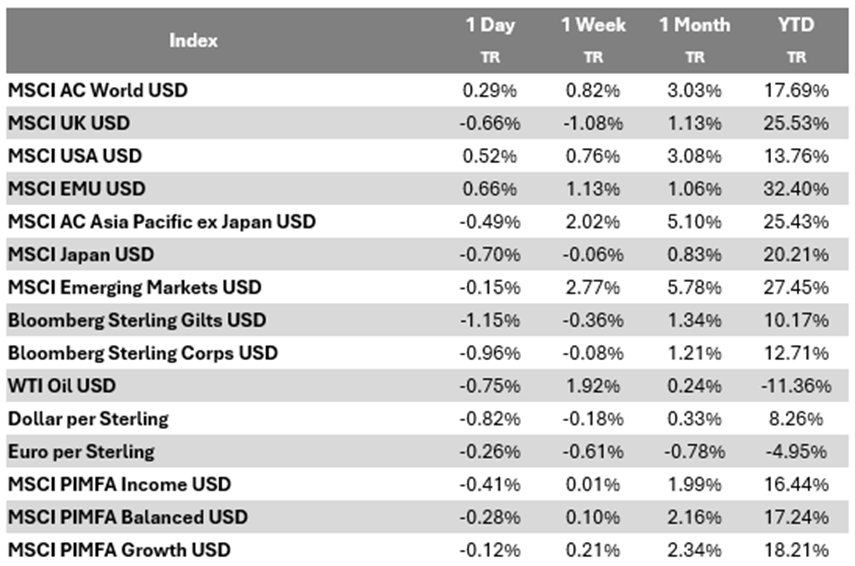
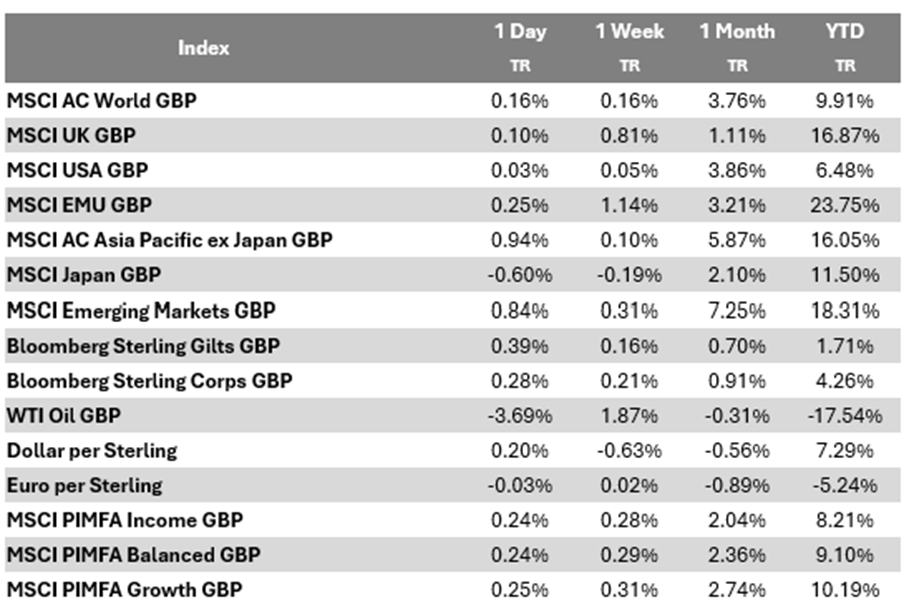
Bloomberg as at 19/09/2025. TR denotes Net Total Return.

Please continue to check our blog content for the latest advice and planning issues from leading investment management firms.

Alex Kitteringham

19th September 2025