
Please see the below article from De Lisle Partners, analysing the opportunities and risks within the US’s technology sector. Received today – 22/08/2025
At De Lisle Partners, we position ourselves in front of tailwinds to achieve the best stock market returns. Our starting point for stock selection is based on long-term market research designed to identify which quantitative characteristics give the best indication of future outperformance.
Eugene Fama and Kenneth French first pioneered this research model in the 1990s and have continued to refine it. Their conclusions show that cheap, small stocks with momentum offer the best risk adjusted returns.
Another key finding is that companies with low asset growth tend to outperform, implying that companies with the fastest asset growth underperform.* This phenomenon is known as the ‘asset-growth anomaly’. So while you might think companies that invest more deliver the highest returns, that turns out not to be true.
We like stock market anomalies. It is why we favour buybacks and dividends over dilution, spin-offs over large M&A deals and low debt or debt repayment over new loans. As much as the Fama-French research tells us what to favour, inverting it shows us what to avoid.
Over the last five years, the average US company has grown its assets by 14% per year.** There are only two sectors that have outpaced that: Healthcare (27%) and Technology (21%). These are high growth rates; a 20% compounded annual growth rate (CAGR) over five years results in an asset base that is two-and-a-half times larger. Nvidia, for example, has grown its assets at a 45% CAGR over this period.
Noticeably, these two sectors are our largest underweights in the Fund today. Our lack of participation is primarily on valuation grounds, but the level of asset growth adds another hurdle to involvement. Healthcare’s growth is largely explained by the response to Covid, as lots of companies experienced booming demand for their services. The problem, alongside current US policy uncertainty, is that over-expansion can lead to over-capacity and diminishing returns. Many Healthcare stocks are now in bear markets.
Technology’s asset growth is still unfolding. Last year the big tech hyperscalers (e.g., Microsoft, Meta, Google and Amazon) spent over $250 billion on AI and data centre related capital expenditures. It is estimated that this year they will spend between $350 billion and $400 billion. From the launch of the US Interstate Highway System build-out in 1956 to its formal completion in 1996, around $500 billion was spent in today’s dollars. Hyperscalers are going to spend around 80% of the cost of a 40-year project in one year!
The large US technology companies have been expensive for much of the last decade, but their stock prices and valuations have risen ever higher partly because asset growth was surprisingly low – their so called ‘capital light’ business models warranting higher valuations. But now there is another factor to catalyse a potential de-rating. The levels of asset growth we are seeing (alongside size and valuation) is a negative forward indicator and the negative impact on shareholder returns was found by Fama and French to persist for up to five years.
The counter argument for the hyperscalers is that productivity gains from AI will be so great, and the new revenue source so large, that the massive investment is worth it. Luckily for De Lisle Partners, we don’t need to settle this question today. We can benefit by finding opportunities among those companies receiving the capital expenditure as big tech’s capex feeds into their revenues and profits.
On the day in late July when both Meta and Microsoft extended capex guidance, our small manufacturer of data centre cooling equipment, Modine Manufacturing, announced further increases to its own data centre revenue forecasts. While the incremental returns of spending are question marks for the hyperscalers, Modine was happy to confirm estimated returns of 40-50% on its own investment in manufacturing cooling systems. These are essential for data centre build outs, as they control the intense heat emissions from AI chips.
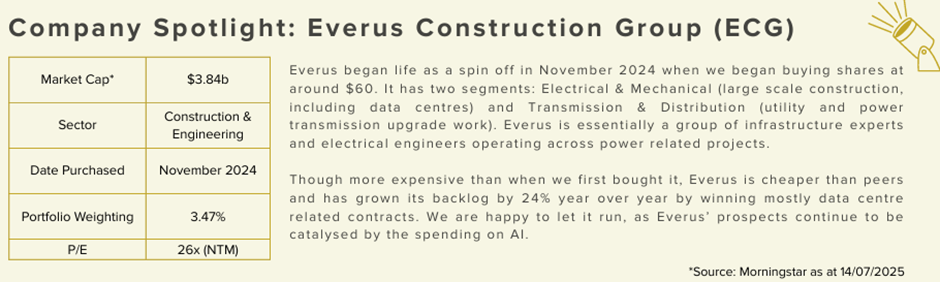
We recognise that a large part of the spend may go to Nvidia itself, but the need for power and data centre infrastructure flows down to many of our holdings. We have tried to put ourselves in front of any company that is a clear beneficiary of this big tech spending spree, including Hammond Power Solutions in transformers, IESC Holdings in power infrastructure and Jacobs Solutions in data centre project consultancy.
For the last decade, smaller companies have failed to participate fully in the market’s most successful area (large expensive tech), as wider economic growth and inflation remained low. But now those same companies are forcing growth elsewhere by spending at these levels.
With valuations relative to large caps at historic lows and an avalanche of AI related capital being thrown at them, the opportunities in cheap small companies today are starting to feel like pushing on open doors. We are already invested in the right places – power, infrastructure, project management – to walk right in.
Please continue to check our blog content for the latest advice and planning issues from leading investment management firms.
Alex Kitteringham
22nd August 2025