Team No Comments

Tatton Investment Management: Monday Digest

Please see below, the ‘Monday Digest’ from Tatton Investment Management which covers the key news from global markets and economies. Received this morning – 10/07/2023

Markets sour on news of resilient economy

The second quarter’s positive stock market returns were driven by a somewhat surprising improvement in investor sentiment. At the end of March the fear was that the US regional banks crisis would create a more pronounced slowdown than previously anticipated, which it did not and also while bond yields rose, analyst forecasts of corporate profits did not anticipate anything more serious than a period of stagnant growth.

Markets look to have abandoned this narrative. Positive US job growth figures have been blamed for a reversal in sentiment, with equity and bond markets having fallen and bond yields having risen. So why have investors shifted their views so suddenly to the downside?

The change we experienced over this week was one of sentiment towards the future cost of capital. Up until the end of June, there was a growing expectation that at least the US central bank, the Federal Reserve, was at least close to ending their rate hiking cycle and that cost of capital as a result would not rise further and indeed was likely to start to fall over the coming 6-12 months.

Particularly hawkish statements from the Fed began to challenge these expectations. This week’s data flow of continued tightness of the US labour markets provided more evidence that the Fed may not be done with raising rates, meaning that the other central banks who were expected to be following the Fed, would end their rate rises even later.

So, in summary not particularly much has changed on the hard data front over the past few days, but a surprisingly strong US labour market report disturbed the fragile market balance. Whether this return of ‘good economic news is bad news for market valuations’ is enough to sour sentiment more permanently, remains to be seen. A second set of labour market data on Friday presented much less of an upward outlier, however, confirmed that the US labour market shows no signs of imminent turning.

A higher cost of capital can more easily be absorbed and carried by the economy when accompanied by decent growth and good levels of monetary liquidity – both of which remain broadly in place at the moment. This means markets should continue to carry a higher probability of trading sideways than down over the summer. However, if the other effect of this economic resilience is a slowing or reversal of the recent steady decline in inflationary pressure from the input cost side then the central banks raise rates ever higher. For the time being positive sentiment may well prevail, but for markets to remain that way, this week’s data flow needs to show an environment, where services gradually start to follow the manufacturing sector into an economic soft patch.

Global Inflation Update

Last month’s Federal Reserve meeting was perplexing. Due to persistent inflationary pressures, the Fed intimated that it will likely need to raise rates two more times over the coming months, despite pausing for the time being. Markets had previously hoped for just one more hike, after which financial conditions might ease – but any easing in rates will not come until 2024 at the earliest.

The Fed defended this stance on the basis that the US economy and financial system will need time to settle, and that inflationary pressures persist. This makes some sense given the upheaval witnessed in US markets over the last year  – major US regional banks collapsing sent shockwaves across the financial system. While these considerations counsel against tightening too hard – and causing an unnecessarily painful recession – they do not negate the fact that the world’s largest economy is still running hot.

The Fed also published updated forecasts for core inflation, showing prices are expected to remain stubbornly high for some time. Officials now think core US inflation – currently at 4.7% – will fall to 3.9% by the end of this year. This is a much slower decline than forecast back in March and implies the Fed does not expect to reach its 2% target for another two years, or it expects other factors – like input prices – to offset core price rises over that period.

However, some capital market research institutions believe that the US inflation rate could fall faster than the Fed’s predictions, and there is also a clear downward trajectory in real consumer spending and shortages seen in the US labour market look set to find a balance. 

Over the past year, central banks have been extremely concerned about the impact of input-cost inflation. The most prominent is the dreaded wage-price spiral, but in the US – as in Europe- we are seeing tentative signs of wage moderation.

A year ago, persistently high inflation was causing people to demand higher pay, signals which fed back through into price setting in a worrisome loop. Now, with more stable longer-term horizons, wage pressure has eased, helped by a dramatic easing of supply chain problems, but we should not get ahead of ourselves. Inflation is steadily falling around the world but it is dangerous to assume this trend can continue unchallenged. External supply shocks, a fact of life over the past few years, are always possible. 

This was the lesson learnt from the period of stagflation seen in the 1970s: what might seem like simple supply-side shocks can have lasting consequences on how people react to changes in supply in the future. Central banks seem keenly aware of this prospect. The ECB’s latest inflation forecasts are above target until 2025, with core inflation being similarly long-lasting.

While supply chain issues have certainly eased, we are already in a phase of supply contraction. Crucially, this is happening both at the source of production and further along the supply chain in the stocks of intermediaries.

A leaner supply chain and a run-down of inventories is perhaps the natural reaction to weak global demand, but it makes the global economy more vulnerable to supply shocks. It could also mean that the fallback seen in input prices could soon be coming to an end. If global growth stays steady, we may see renewed input price pressures before too long. Headline inflation is still falling thankfully, but we should be cautious about how long this can last.

Please continue to check our Blog content for advice and planning issues and the latest investment, markets and economic updates from leading investment houses.

Alex Kitteringham

10th July 2023

Team No Comments

Brewin Dolphin: Quarterly Review: Q2 2023

Please see the below economic review of Q2 from Brewin Dolphin received last night:

Please continue to check out Blog content for advice and planning issues and the latest investment markets and economic updates from leading investment houses.

Andrew Lloyd DipPFS

07/07/2023

Team No Comments

EPIC Investment Partners: The Daily Update

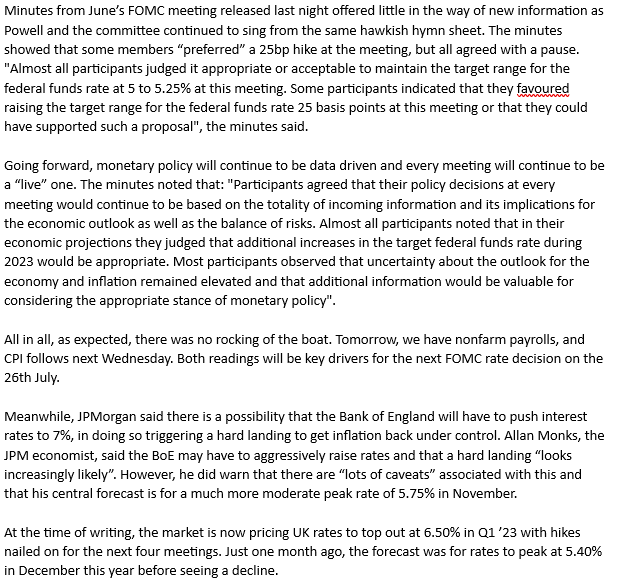
Please see below, mintues of the June 2023 Federal Open Market Committee (FOMC) meeting and comment on the UK interest rates. Received today – 06/07/2023 – via EPIC Investment Partners Daily Update.

Please continue to check out Blog content for advice and planning issues and the latest investment markets and economic updates from leading investment houses.

Adam Waugh

6th July 2023

Team No Comments

Brewin Dolphin – Markets in a Minute

Please see below, Brewin Dolphin’s ‘Markets in a Minute’ update, providing a brief analysis of the key news from markets around the world. Received today – 05/07/2023

Stocks rise on positive economic data

Stock markets rose last week as a slew of positive economic data and signs of easing inflation boosted investor sentiment.

In the US, the S&P 500 surged 2.4% and the Nasdaq added 2.2% to post its best first half since 1983. Investors were cheered by a slowdown in the Federal Reserve’s preferred inflation gauge and further signs of a resilient US economy. Last week also saw Apple become the first public company to achieve a market capitalisation of $3trn.

In Europe, the pan-European Stoxx 600 added 1.9% after eurozone inflation slowed for a third consecutive month. The FTSE 100 climbed 0.9%, despite comments from Bank of England governor Andrew Bailey that UK interest rates are likely to stay higher for longer than markets expect.

In China, the Shanghai Composite edged up 0.1% as hopes of economic support measures were offset by weak data.

Manufacturing downturn deepens

Stock markets started this week on a lacklustre note. The FTSE 100 and Stoxx 600 fell 0.1% and 0.2%, respectively, at the close of trading on Monday (3 July), whereas the S&P 500 registered a small gain of 0.1%. This came after manufacturing purchasing managers’ indices (PMIs) for the UK, US and eurozone all showed a steeper contraction in activity in June.

S&P Global’s manufacturing PMI for the UK fell to a six-month low of 46.5, while the index for the eurozone dropped to 43.4, the lowest since the height of the pandemic. The readings were well below the 50.0 mark that separates growth from contraction. In the US, economists had been expecting a slight improvement in manufacturing activity, but the Institute for Supply Management’s index slipped to 46.0 from 46.9 in May. In China, meanwhile, the manufacturing sector registered slower growth, with the Caixin / S&P Global PMI falling to 50.5 from 50.9.

Fed’s preferred inflation gauge falls to 4.6%

Last week saw the release of the US personal consumption expenditures (PCE) price index, which measures the prices consumers pay for goods and services. The core PCE, which excludes food and energy and is the Federal Reserve’s preferred inflation gauge, showed prices rose by just 0.3% in May from the previous month. This took the year-on-year rate to 4.6%, down from 4.7% in April. When including food and energy, inflation was even lower with prices up just 0.1% monthon-month and 3.8% year-on-year. This was the lowest annual rate since April 2021.

While the data suggests inflation is moving in the right direction, Fed chair Jerome Powell said the central bank’s 2% target wouldn’t be achieved for a few years. Speaking at the European Central Bank’s (ECB) annual conference in Sintra, Powell said inflation was being kept high by the very strong labour market and that further interest rate increases were on the cards.

US new home sales beat forecasts

Sales of new US single-family homes rose to the highest level in nearly 18 months in May, boosted by a very low inventory of existing homes for sale. New home sales jumped by 12.2% to a seasonally adjusted annual rate of 763,000 units. Sales were 20% higher than a year ago, according to the US Census Bureau and the Department of Housing and Urban Development.

Existing home sales also improved in May. However, pending home sales (where the contract has been signed but the sale has not yet closed) shrank 2.7% in May from the previous month and by 22.2% year-on-year, according to the National Association of Realtors. This could be reflected in declining existing home sales when June’s data is published.

Weekly jobless claims plummet

In another sign of economic strength, US weekly jobless claims fell by 26,000 to 239,000 in the week ending 24 June, the steepest drop for 20 months. This reversed a recent jump, which saw claims hit levels last seen in October 2021 and led economists to speculate that layoffs could be increasing.

A separate report from The Conference Board showed consumers’ perception of the labour market was upbeat in June. More people viewed jobs as ‘plentiful’ relative to May, and there was a slight decline in the proportion who believed jobs were hard to get. Consumer confidence increased to the highest level in nearly 18 months to 109.7 from 102.5 in May. Nevertheless, the expectations gauge continued to signal that consumers anticipate a recession at some point over the next six to 12 months.

Eurozone inflation eases to 5.5%

Over in Europe, an initial estimate from the European Union’s statistics office showed annual inflation in the eurozone slowed for the third month in a row in June. Headline inflation measured 5.5%, down from 6.1% in May and lower than forecasts. This was driven by a 5.6% yearon-year decline in energy prices.

However, core inflation (excluding food and energy) rose to 5.4% year-on-year in June, up from 5.3% in May. At the conference in Sintra, ECB president Christine Lagarde said the bank could not declare victory yet in the fight to tame inflation. “We will face several years of rising nominal wages, with unit labour cost pressures exacerbated by subdued productivity growth,” Lagarde said.

Please continue to check our Blog content for advice and planning issues and the latest investment, markets and economic updates from leading investment houses.

Alex Kitteringham

5th July 2023

Team No Comments

Weekly Market Commentary: This week’s focus will be on US employment data release

Please see below article received from Brooks Macdonald this morning, which concentrates on economic developments in the US and the consequent effects on markets.

  • We now enter the second half of the calendar year after a strong Q1 and more mixed Q2 2023.
  • Soft PCE data along with consumer spending data suggest price pressures may be fading which helped catalyse the week end rally in markets.
  • All eyes on US employment data at the end of the week which will provide further insight to the inflationary outlook. 

We now enter the second half of the calendar year after a strong Q1 and more mixed Q2 2023.

The first half of the year, proved to be a strong half for financial markets however it is fairer to say that Q1 was strong and Q2 somewhat more mixed. In terms of the 2023 leader boards, the US technology sector has surged ahead, driven by the mega-cap names and hopes of a generative Artificial Intelligence (AI) revolution. The half-year was capped off by a strong week for equities, with the rally particularly strong on Friday after Friday’s personal spending and Personal Consumption Expenditures (PCE) data suggested that inflation may be moderating in the United States.

Soft PCE data along with consumer spending data suggest price pressures may be fading which helped catalyse the week end rally in markets.

The PCE inflation index for May came in line with market expectations, at 3.8% year-on-year however the core inflation number missed a 4.7% estimate, coming in at 4.6%. The month-on-month increase in US core services inflation was the smallest since June 2022 which helped catalyse the week end rally in markets. Lastly, consumer spending was softer than the market expected which may suggest that some of the demand-side impetus behind the uptick in prices may be fading.

All eyes on US employment data at the end of the week which will provide further insight to the inflationary outlook.

This week’s focus will be on the non-farm payroll report which will give insights into the US employment picture. The headline number of new jobs created is expected to have slowed from 339k in May to 215k in June with average hourly earnings and the length of the workweek expected to be unchanged. While the headline number is expected to ease from the last reading, we are still some way off a level that would imply an imminent recession. A resilient employment report sits in contrast to some of the other lead indicators which are pointing to a slowdown however the outsized strength of the labour market has been a key driver of market inflation expectations so far this year. The Institute of Supply Management (ISM) manufacturing data is out today and is expected to show the US manufacturing sector still in contraction after turning negative in November last year.

With core inflation easing slightly in the US, and the manufacturing sector in clear contraction, the market is awaiting a change in the US employment situation that will bring some of the inflation readings down more decisively. If we see a smaller-than-expected number of new jobs created last month, there will be an expectation that this will filter into weaker hourly earnings in future months which will weigh on consumption as the second half of the year develops.

Please check in again with us soon for further relevant content and market news.

Chloe

04/07/2023

Team No Comments

Tatton Investment Management – Monday Digest

Please see the below article from Tatton Investment Management discussing the key economic news from the past week. Received this morning – 03/07/2023.

Overview: A glass half-full half year

The second quarter ended with positive sentiment towards global risk assets (Although UK assets have fared less well), a surprising turnaround given the black clouds that gathered back in March amid the  US regional bank crisis. Markets have responded well to more earnings positivity from analysts, but the biggest change has been in their reaction to valuations. Developed world equity indices have doubled up on rising underlying profit expectations with rises in the price-to-earnings multiples applied on top of those earnings. This sign of increased investor optimism may perhaps be lack of pessimism, a sense that the downside is protected, following the experience of renewed central bank support in the aftermath of the US banking crisis.

Somewhat contradictory, manufacturing sentiment (the outlook from businesses rather than the analysts covering them), has continued to show looming recession. This has been particularly evident in Europe, despite the easing of energy price pressures. Furthermore, June’s purchasing managers’ index (PMI) data saw the service side of the economy also gradually turning less positive and manufacturing more negative. Europe was notable for quite a sharp decline across the board, while China’s June reading is estimated to slide back to about 52.8 which would probably mean a World Composite PMI reading of about 52.7.

The European Central Bank (ECB) held its annual symposium in Singa, Portugal last week and leading central bankers from across the world spoke. The tone ranged from mild to bloody-clawed hawkishness, and convinced money markets to factor in more short-term rate rises. Bond yields duly reacted and moved higher, yet equities gave the event a ‘whatever’ shrug. Perhaps investors believe that the impacts of inflation may be less problematic for the financial and economic system than previously feared. Perhaps the central banks also think so. They certainly have not been as hawkish as their rhetoric.

The other intriguing aspect of the past quarter was the lack of corporate bankruptcies and default. In the US, following Silicon Valley Bank’s demise, investors were on the lookout for signs of default contagion. Although there were a few, most would say that it did not become a problem. In the UK, the same could have been said right up until the news concerning Thames Water. The 2021 Bulb bankruptcy was an example of how a utility company can be caught between costs, competition and price caps. Thames Water is potentially of a different magnitude. Perhaps most important will be the impacts on current equity holders, generally pension funds. In itself, the Thames Water situation is not likely to precipitate a crisis. Nevertheless, large debtors with problems are things we should watch closely, as much perhaps as hitherto deemed ultra-safe infrastructure investments.

The heat of June is forecast to give way to a cooler July in Europe. We hope the relative calm experienced by equity markets in June will carry on regardless of the weather.

Markets don’t listen to Wagner

After Yevgeny Prigozhin launched (and quickly retracted) his Wagner rebellion, global stocks and bonds did not budge. The biggest geopolitical event since the Ukraine war began was not even a blip for investors. This is understandable as far as equities go. Russian assets were removed from westerners’ investment universe as soon as Putin launched his invasion, and the remaining trade links between companies have been almost entirely dismantled since then. What is perhaps more surprising is that oil and gas markets were similarly unmoved.

This is a far cry from a year ago, when Russia’s military and political exploits felt like the dominant driver of global – and particularly European – energy prices. Brent crude nearly doubled in price during the build-up to Russia’s war, while Dutch TTF, the European natural gas futures index, more than doubled in just the last two weeks of February 2022. The spikes were even greater when Russia cut the European Union (EU) off from pipeline imports. Still, markets hate instability, and a Russian civil war could destabilise energy supplies again. And, while Europe is far less reliant on Russian gas than it was, it would be a big overstatement to say the continent is unaffected by Russia’s supply situation. 12.9% of the EU’s imports is no insignificant amount in absolute terms. Moreover, the fact that Russian supply is no longer going to the west does not mean it is unimportant for global energy markets. It is now clear that Russian oil and gas has made its way to Asia, whose imports from elsewhere have adjusted downward.

Saudi Arabia recently signalled it would further cut its oil production in response to weak global demand. This is believed to be in large part down to overproduction in Russia, as it tries to pump out supply for much-needed funding. With the ongoing slowdown in the global economy – and even looming recessions in many parts of the world – the biggest swing factor in energy markets is the lack of demand, rather than supply. This puts big suppliers like Russia in a much weaker position than they were a year ago.

Much has been written about perceived Putin weakness following the botched rebellion – backed up by Ukrainian peace discussions with a host of developing nations, including China. But we should not assume that either his grip on domestic power or desire to take Ukraine has been diminished by this. What all this does suggest, however, is that Russia can only afford to keep fighting for so long. That, together with Ukraine’s dwindling counteroffensive, increases the likelihood of a ceasefire in the medium term.

Please check our blog content for advice, planning issues and the latest investment, market and economic updates from leading investment houses.

Alex Clare

03/07/2023

Team No Comments

Brooks Macdonald – Daily Investment Bulletin

Please see below, Brooks Macdonald’s ‘Daily Investment Bulletin’ providing an analysis of the key events from the financial markets – received late this afternoon, 30/06/2023.

Please continue to check our Blog content for advice and planning issues and the latest investment, markets and economic updates from leading investment houses.

Adam Waugh

30/06/2023

Team No Comments

Brewin Dolphin – Markets in a Minute

Please see below, Brewin Dolphin’s ‘Markets in a Minute’ update, providing a brief analysis of the key news from markets around the world. Received yesterday – 27/06/2023

Stocks fall as Bank of England hikes rates

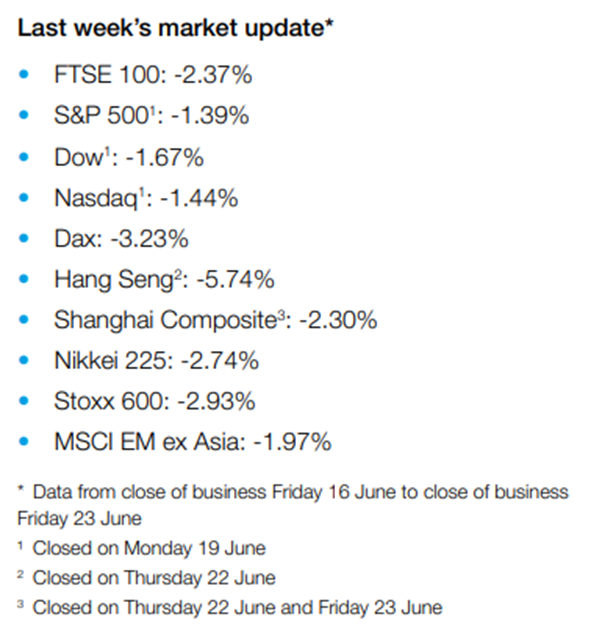
Stock markets fell last week as the Bank of England (BoE) hiked UK interest rates by a larger-than-expected 0.5 percentage points.

The FTSE 100, Stoxx 600 and Dax declined 2.4%, 2.9% and 3.2%, respectively, on concerns that interest rate hikes could lead to a recession in the UK and eurozone. Norway’s central bank also announced a 0.5 percentage point increase in its key interest rate, while the Swiss National Bank raised rates by a quarter of a percentage point.

Interest rate fears also weighed on US indices. The S&P 500 suffered its first drop in six weeks, finishing the week down 1.4%, while the Nasdaq recorded its first decline in two months, also down 1.4%. This came after Federal Reserve chair Jerome Powell indicated that further rate hikes could be on the cards this year.

Over in Asia, the Shanghai Composite finished its holiday-shortened trading week down 2.3% amid ongoing concerns about China’s post-pandemic economic recovery. Hong Kong’s Hang Seng slid 5.7%, its biggest drop in three months.

Failed Russia coup weighs on markets

Stock markets started this week in the red as geopolitical concerns dented investor sentiment. The S&P 500 lost 0.5% on Monday (26 June), while the FTSE 100 and the Stoxx 600 both edged down 0.1%. Russian mercenary leader Yevgeny Prigozhin embarked on an armed rebellion over the weekend, but called it off after 24 hours.

In economic news, German business sentiment deteriorated for the second consecutive month in June. The Ifo institute’s index fell to 88.5 from 91.5 in May, a steeper drop than had been expected. In the manufacturing sector, business expectations fell to their lowest level since November 2022.

BoE surprises markets with 0.5pp rate hike

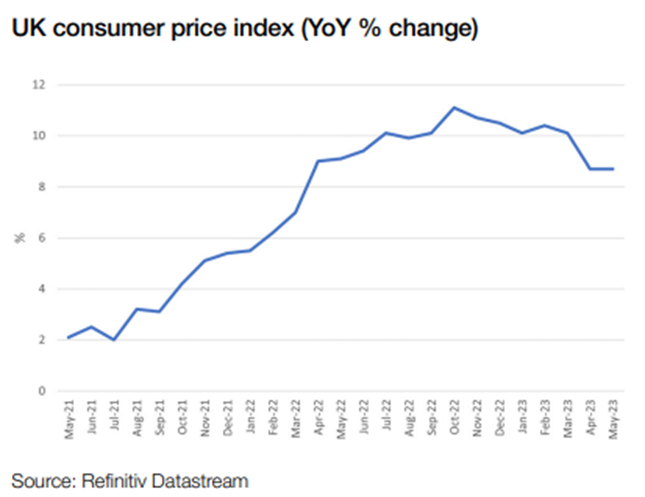
Last week saw the Bank of England announce a surprise 0.5 percentage point (pp) increase in the UK base interest rate. This was bigger than the 0.25pp hike that markets and economists were expecting. The increase takes the base rate to 5.0%, the highest level in 15 years. Andrew Bailey, governor of the BoE, said inflation was still too high and “we’ve got to deal with it”. He added: “If we don’t raise rates now, it could be worse later.” The announcement came after figures from the Office for National Statistics (ONS) showed the UK headline inflation rate remained stubbornly high at 8.7% year-on-year in May. It was the fourth month in a row that the consumer price index (CPI) exceeded forecasts. On a monthly basis, the CPI rose by 0.7%, driven by particularly strong increases in prices for air travel, recreational and cultural goods and services, and second-hand cars.

Even more concerning was the rise in core inflation, which excludes volatile food and energy prices. The core CPI rose from 6.8% in April to 7.1% in May, the highest rate since 1992.

Markets now expect the BoE to increase the base rate to 6.0% by the end of the year to try to combat inflation.

Eurozone business output weakens

In the eurozone, business output growth came close to stalling in June, according to the HCOB flash purchasing managers’ index (PMI) from S&P Global. The index declined from 52.8 in May to 50.3 in June, its lowest since January and just above the 50.0 mark that separates growth from contraction. “Although recording an expansion of output for a sixth consecutive month in June, the latest increase was only marginal and far weaker than the gains seen in the previous four months to signal a considerable loss of growth momentum,” S&P Global said.

Factory output fell for a third straight month and at the fastest rate since last October. Services sector output growth slowed sharply as the recent resurgence in spending on services lost momentum. Expectations for the year ahead deteriorated markedly in manufacturing, down to a seven-month low in June, but also sunk to a six-month low in the services sector.

US manufacturing activity falls

Data painted a similarly sombre picture of the US manufacturing sector. S&P Global’s flash manufacturing PMI fell from 48.4 in May to 46.3 in June, a six-month low and well below estimates. The decline was the most severe in 2023 to date and stemmed from a marked reduction in new orders. The report also showed that cost pressures eased, as suppliers sought to boost their sales and offer reduced prices. The pace at which input prices fell was the quickest since the pandemic lockdown in May 2020.

Japan core CPI rises to 3.2%

In Japan, consumer inflation rose by more than expected in May. The core CPI, which excludes fresh food prices, rose by 3.2% in May from a year ago. This was lower than the previous month, but was above forecasts and well above the Bank of Japan’s 2.0% target. The ‘core-core’ index, which strips out fresh food and fuel, rose to 4.3% in May, the highest reading since 1981. The data has increased expectations that the Bank of Japan will increase its inflation forecasts at its quarterly review in July. The jury is out on whether it will tweak its yield curve control policy.

Please continue to check our Blog content for advice and planning issues and the latest investment, markets and economic updates from leading investment houses.

Alex Kitteringham

28th June 2023

Team No Comments

Brooks Macdonald – Weekly Market Commentary

Please see this week’s Weekly Market Commentary from Brooks Macdonald detailing the latest economic and market news:

This weekend’s mutiny in Russia is likely to create further regional instability over the short and medium term

After a poorer week for equity performance, market attention quickly shifted to events in Russia over the weekend which will likely herald further political instability in Russia over the medium term. In terms of near term implications, this could either lead to President Putin escalating the Ukraine war to re-establish authority or leave a void which Ukraine may be able to utilise.

Friday’s US PCE inflation release will be watched for signs of a further easing in US price pressures

This Friday sees the release of the US Personal Consumption Expenditure (PCE) inflation which is released alongside a broader set of personal income and consumption data. The PCE data is preferred to the Consumer Price Index (CPI) data by the US Federal Reserve (the Fed), in part because it assumes a degree of substitution if one good or service surges in price. The core PCE reading (excluding food and energy) is expected to stay flat at 4.7% while the headline PCE reading is expected to fall from 4.4% to 3.8%. Given the importance of inflation expectations to the path of US interest rates, this will be closely watched as will the personal income and consumption components which will guide markets as to how long the current pace of US consumption can continue.

Eurozone core CPI is expected to rise on Friday however the headline CPI rate should see significant falls

This week also sees the European CPI releases, with Italy starting the country-level releases on Wednesday before Friday’s Eurozone data. In terms of the Eurozone data, the market expects Core CPI to rise from 5.3% to 5.5% and for the headline to fall from 6.1% to 5.6%. With this the last CPI number ahead of the July European Central Bank (ECB) meeting, this report will have significant implications for Eurozone interest rate policy.

The annual US bank stress test results are also due on Wednesday and will be of interest to the market given the regional banking crisis earlier in the year. The tests will include a ‘severely adverse scenario’ which will model a severe global recession combined with a sell-off in real estate and corporate debt markets. While the regulator will be keen to avoid further lack of confidence in the banking sector through banks failing the stress tests, the tests will need to be sufficiently tough to retain credibility.

Please continue to check our Blog content for advice and planning issues and the latest investment, markets and economic updates from leading investment houses.

Andrew Lloyd DipPFS

27/06/2023

Team No Comments

Tatton Investment Management: Monday digest

Please see the below article from Tatton Investment Management providing their regular Monday update on the financial markets. Received today – 26/06/2023.

Please check our blog content for advice, planning issues and the latest investment, market and economic updates from leading investment firms.

Adam Waugh

26/06/2023