Team No Comments

Tatton Investment Management: Monday Digest

Please see below, Tatton Investment Management’s ‘Monday Digest’ received this morning, 15/04/2024.  

What the return of volatility tells us

Equities were fairly stable in the US and UK last week, despite bond yields moving higher. Europe was the opposite: stocks fell despite falling yields. We might have thought bond volatility would hurt risk assets more than it did.

American investors still seem to be in “buy-the-dip” mode. Stronger growth and inflation signals have been hitting equity prices (since inflation holds back interest rate cuts) and core US CPI rose to 3.8% year-on-year last week. US Treasury yields broke above 4.5% for the first time since November, and the probability of a June rate cut fell to just 30%. But markets are happy enough about growth that they don’t seem to mind rates staying high – hence equities keeping pace.

US growth is still lopsided, though. The outlook for small business profits is reportedly the worst it has been in 10 years, and firms are worried about returning inflation. Manufacturers are thankfully feeling better, and overall profits are on the rise thanks to strong pricing power.

Analysts have been raising their forward profit estimates for the S&P 500 at a 10% annualised rate for most of this year, compared to a 6% historical average. Much of that is concentrated on the Mag-7 – US tech behemoths – whose profits are expected to jump 38% year, compared to a 2% fall for the rest of the index. That being said, the also-rans’ profit estimates have risen 6% since last May. Uneven distributions aside, growth is broad enough to worry the Fed. No one thinks they will raise rates, but if CPI keeps rising idea might be tested.

Europe has the opposite problem, which is why the ECB has finally promised rate cuts in June. Labour markets are tight either side of the Atlantic, but European companies are hurting, as shown in stock markets. Manufacturers are still battling energy costs and – according to a European Commission report – are suffering from Chinese ‘dumping’.

Europe might have to impose tariffs, like the US, but will struggle considering how much it exports to China. Then again, China is struggling with domestic demand too – not a surprise considering President Xi’s philosophy frowns upon individual consumption.

Thames Water investable, but badly priced

Thames Water is in a standoff. It says it needs investment, but the pension funds that own the company say they cannot give it unless regulations that limit prices and payouts are changed. The stakes were raised two weeks ago when its parent company, Kemble Water Finance, defaulted on £1.4bn worth of debt. Shareholders say the utility company is “uninvestable” in the current environment. We disagree. It is investable; they just paid the wrong price when they bought it from Macquarie in 2017.

Kemble cannot pay its debts because the regulator, Ofwat, has blocked dividend payouts from Thames Water. But the default might push Thames Water into Special Administration, meaning a write-down of the operating company’s £15.6bn net debt. Shareholders recently rejected a planned £500mn equity injection, demanding Ofwat approve a 56% real price increase by 2030 and allow dividend payouts again.

A Financial Times article last week argued that Thames Water’s nosediving equity value – from a £5bn purchase in 2017 to practically zero now – shows that the Capital Assets Pricing Model (CAPM) pension plans used to value the utilities company is faulty. But focus on CAPM’s failings is misleading. The problem is that key information about the asset was misrepresented or ignored. Models give conclusions based on the information you input. No model can give you the right conclusions if you input the wrong information.

Macquarie deserves some blame, taking £2.7bn worth of dividends when it owned Thames Water from 2006 to 2017, loading it with debt and underfunding infrastructure updates in the process. But the pension funds should have done their due diligence too.

They assumed prices would scale with inflation – when in reality people don’t like paying more for water when other prices are spiralling. Low-returning assets like utilities can only compete with other investments if they are highly leveraged. But for public services, leverage and shareholder payouts are always political.

If pension funds had appreciated this and known what they were buying, they wouldn’t have paid anything near what they did. Nationalisation or tight regulation are always likely for crucial public utilities with little private investment value. Asset values should reflect that.

Gold as a currency alternative?

Gold has been one of the best performing assets of 2024. This is strange for a so-called safe haven asset. Returns on cash – interest rates – are high, and the stock market rally proves investors aren’t running scared.

That is in the West at least, but gold’s reputation as a cash alternative is arguably stronger in emerging markets. Zimbabwe just announced a gold backed currency, and the central banks of India and China are buying bullion reserves to protect against Russian-style sanctions. Chinese and Indian middle classes are a big source of demand.

Wealthy Chinese in particular are increasingly buying bullion as a means of shielding assets from an overzealous government. Economic malaise, stock market volatility and the dire state of China’s property market are driving more citizens toward physical gold.

The People’s Bank of China is indirectly (and directly) supporting demand. It has been maintaining a stable exchange rate against the US dollar despite selling pressures on the renminbi. The PBoC holds a loose dollar peg by setting a target exchange rate every day and allowing a 2% trading band around it.

Keeping a stable rate against the dollar helps Chinese citizens buy gold because the precious metal is priced in dollars. But that could be about to change. The PBoC has consistently been letting the renminbi get closer to the upper bound of its 2% range. The last time that happened was before the sharp renminbi devaluation of 2015. A devaluation against the dollar now would make sense too: it would boost Chinese exports and maybe spur some life into a deflationary economy.

For now, Chinese savers worried about a devaluation will be even more likely to buy physical gold. So, the longer the PBoC maintains its current exchange rate, the longer gold’s rally has left to run. If it does devalue, gold prices would struggle to climb higher.

Please continue to check our blog content for the latest advice and planning issues from us and leading investment managers.

Charlotte Clarke

15/04/2024

Team No Comments

EPIC Investment Partners: The Daily Update | ECB’s Dovish Hold

Please see below, an update from EPIC Investment Partners following the European Central Bank’s recent policy decision to hold interest rates at 4%. Received this morning – 12/04/2024

Yesterday, as the vast majority of the market had expected, the European Central Bank (ECB) held interest rates at 4% for the fifth consecutive meeting. However, in a more dovish tone, the central bank indicated that as inflation cools, rate cuts could come as soon as June. In the accompanying statement, the council, for the first time, said that while the ECB would remain data dependent, cuts are dependent on economic projections, confirming that inflation is steadily returning to the 2% target. 

While the ECB clarified that its decisions are not “pre-committing to a particular rate path,” President Christine Lagarde also highlighted the likelihood of revising rates in the upcoming months. “In April we will get more information and data,” she said. Adding that “a few” members of the Governing Council are already confident about the inflation trajectory.  “But in June, we know that we will get a lot more data and a lot more information” she continued. 

She went on to say that: “Inflation is expected to fluctuate around current levels in the coming months and to then decline to our target next year. We’re not going to wait until everything goes back to 2% to make the decisions that will be necessary in order to make sure that inflation returns to 2% sustainably at target in a timely manner.” 

Lagarde was also at pains to emphasis that the ECB’s rate decisions are independent of the Fed policies, despite the significant economic interactions between Europe and the United States. “The United States is a very large market, a very sizable economy, and a major financial centre, all of which naturally impact our deliberations” Lagarde said. She went on to say that while “multiple channels through which influence can be exercised” the ECB was “not Fed-dependent”.  

Ahead of yesterday’s announcement, markets had already been predicting that the first EU rate cut could come in June, at around 75%. At the time of writing that is now priced at 90%.

Please continue to check our blog content for the latest advice and planning issues from leading investment firms.

Alex Kitteringham

12th April 2024

Team No Comments

Evelyn Partners Update – March US CPI Inflation

Please see article below from Evelyn Partners detailing their thoughts on the US CPI inflation announcement for March 2024, received yesterday afternoon 10/04/2024.

What happened?

US March annual headline CPI inflation rose at 3.5% (consensus +3.4%) and compares with +3.2% in February. On a monthly basis, CPI rose 0.4% (consensus +0.3%), compared to an increase of 0.4% in January.

Turning our attention to the core figure, which excludes volatile food and energy prices, the annual number came in at 3.8% (consensus 3.7%), compared to 3.8% in February.  In monthly terms, core CPI increased 0.4% (consensus 0.3%), which compares to 0.3% in February.

What does it mean?

March’s inflation report came in slightly above forecasters expectations with headline CPI re-accelerating slightly to 3.5%. However, core inflation remained unchanged, with today’s figure of 3.8%. Base effects proved a slight headwind to today’s release with March 2023’s headline monthly print of 0.1% falling out of the annual comparison. However, these base effects become more favourable next month and could help to reverse some of March’s acceleration in the annual inflation rate.

The index for shelter continued to remain resilient rising by 0.4% on the month. However, on an annual basis shelter inflation has slowed to 5.7% from its peak of 8.2% in March 2023. The monthly index for energy remained positive for the second consecutive month, having been falling for the previous four months as rising oil prices fed through to gasoline. However, on an annual basis energy inflation is running at an acceptable 2.1%.

There was some encouragement for households in the data, when it came to food prices, with the index increasing on the month by just 0.1%. On an annual basis the food inflation basket is now running at just 2.2%. Additionally, core goods shrank by 0.2% on the month, with both used and new cars driving this deceleration.

Turning to the labour market, March’s non-farm payroll figure of 303k looks solid when compared to the 10-year average of ~180k, taken from up to the end of 2019 before the pandemic distorted the data. Other measures of hiring outside of the payroll report also corroborate a healthy labour market. For instance, the latest February job openings (from the JOLTS survey) reported earlier this week came in at 8.8m, down from a peak of 12.0m in March 2022, but it is still significantly up from a pre-covid level of around 7.0m at the end of 2019. Essentially, the demand for available workers (employed plus job openings) is running around 2m higher than the supply of workers (employed plus unemployed). This labour supply gap supports wage growth which is currently growing at an annual rate of 4.1%. The risk is that while wage growth remains strong, the US economic resilience we’ve seen over the last year will continue, making it more challenging to return inflation back to the Fed’s 2% target.

Market interest rate expectations have moved substantially over the last three months. At the start of the year, futures markets anticipated the Fed would start cutting rates in March and make at least six 25 basis point rate cuts this year. Since then, optimism has been reined in, with markets now expecting the base rate to end 2024 at 4.85% with the first of these cuts now expected to materialise in July. This means markets are now pricing in less rate cuts than the Federal Open Market Committee who forecasted three cuts for 2024.

Immediately following the report US equity futures gained fell 1% while 10-year treasury yields rose 15 basis points.

Bottom Line

Although today’s inflation report was slightly warmer than expected, it is unlikely hot enough to warrant the FOMC to shift away from cutting rates later this year, which markets currently expect to start occurring during the summer. However, as recent inflation prints have pointed to a slowing path back to the Fed’s target of 2% we could see fewer rate cuts this year than the three currently forecasted by the FOMC at their latest meeting.

Please continue to check our blog content for advice and planning issues and the latest investment, markets and economic updates from leading investment houses.

Charlotte Clarke

11/04/2024

Team No Comments

Brewin Dolphin – Markets in a Minute

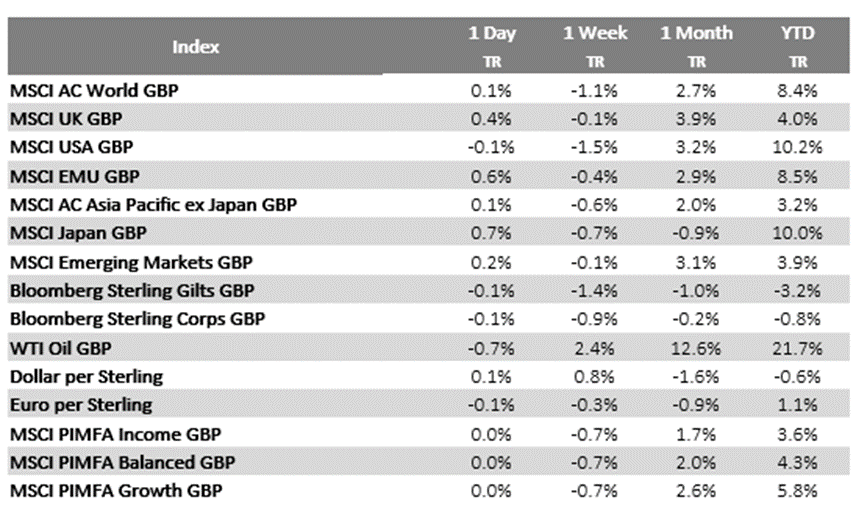
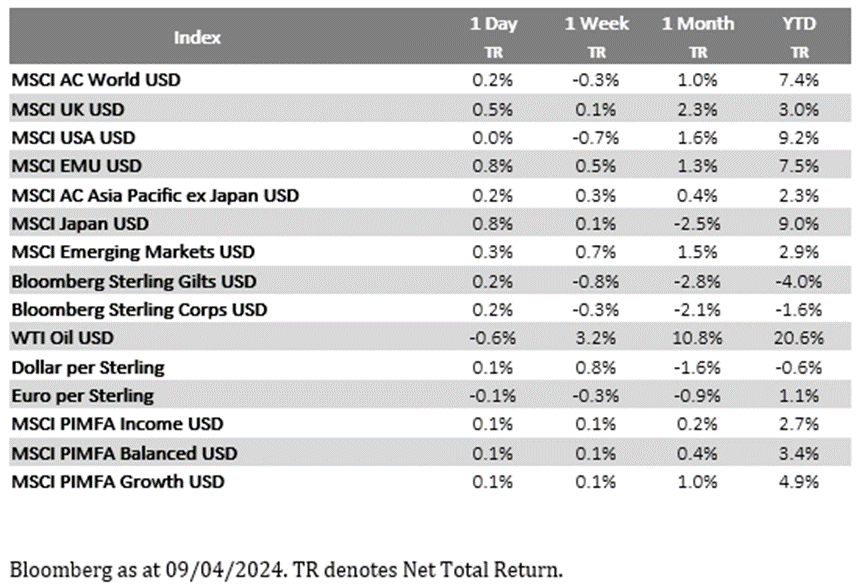
Please see below this yesterday’s global market round-up from Brewin Dolphin, which was received late yesterday afternoon – 09/04/2024:

Please continue to check our blog content for advice and planning issues and the latest investment, markets and economic updates from leading investment houses.

Carl Mitchell – DipPFS

Independent Financial Adviser

10/04/2024

Team No Comments

Brooks Macdonald Daily Investment Bulletin

Please see below article received from Brooks Macdonald this morning, which provides a global market update for your perusal.

What has happened

Government bond pricing in both the US and Europe fell back (with bond yields rising) on Monday, as markets moved to cut hopes for the number of interest rate cuts this year. For context, at the start of the year, markets were pricing in more than six quarter-percentage-point cuts this year from the US Federal Reserve (Fed) – on Monday, this number was standing at less than three. Adding to the latest shift in view, US bank JPMorgan CEO Jamie Dimon said in his annual letter to shareholders, that the US economy “is being fuelled by large amounts of government deficit spending and past stimulus …  this may lead to stickier inflation and higher rates than markets expect.” Staying with inflation, ahead of tomorrow’s US consumer inflation data, yesterday we got the latest New York Fed Survey of Consumer Expectations – to be fair it showed a bit of a mixed picture on inflation expectations, though the good news is that 5-year expectations fell by -0.3% points on the previous month, down to +2.6%,

Markets now fully pricing in just two rate cuts from the Fed

Market confidence around the number of interest rate cuts out of the Fed looked to wane further on Monday. Verus the Fed’s ‘dot plot’ of its members which showed last month a median expectation of three quarter-percentage-point cuts this year, markets on Monday moved to price in 61.5 basis points (bps) of cuts by the Fed’s December 2024 meeting, a fall of -3.3bps on the previous day – it implies that only two 0.25% rate cuts are currently being fully discounted.

Middle East tensions take a breather, but China fills the geopolitical gap

Oil prices saw a modest dip down from a five-month high on Monday after Israel said it would remove some troops from Gaza, helping to cool some of the previous week’s geopolitics-led gains. Instead, China looked to be filling the geopolitical gap on Monday- it emerged that US President Biden is expected to warn China about its increasingly aggressive activity in the South China Seas later this week during planned summits with Japan and the Philippines. According to newswires yesterday, a senior US official was quoted as saying that “China is underestimating the potential for escalation … China needs to examine its tactics or risk some serious blowback.”

What does Brooks Macdonald think

There is debate currently as to whether we might see some interest rate policy divergence between the Fed and the European Central Bank (ECB). In the case of the Fed, the probability of an interest rate cut by the US central bank’s June meeting is down to just 52% currently (the lowest since October last year), and the total number of Fed cuts priced by the December 2024 meeting is now just 61.5bps. Contrast that with the ECB where the probably of a cut by June is higher at 91% currently, and the total number of cuts by December 2024 is also higher at 80.5bps currently. All in all, it points to a contrast in the differing economic backdrops with the US showing relatively stronger economic growth currently, but with it, the risk of relatively stickier inflation as well.

Please check in with us again soon for further relevant content and market news.

Chloe

09/04/2024

Team No Comments

Tatton Investment Management: Monday Digest

Please see below, Tatton Investment Management’s ‘Monday Digest’ which summarises all the key factors currently affecting global markets and economies:

Overview: Bumpy start to the quarter

Last week saw 2024’s first real bout of volatility. The S&P 500 had its biggest one-day percentage range in over a year on Thursday. This came after two extremely strong quarters for investors. Indeed, we suspect it was a response to the bull run, and the valuation gap between large and small caps it made.

Commentators attributed it to more headline-grabbing news, like Israel-Iran tensions and the sharp increase in oil prices. It could also be down to asset reallocation from big investors though, as tends to happen at the start of the quarter.

If so, that would mean investors moving away from the US mega-caps that have dominated for so long. Small and mid-cap profits and expectations actually fell over the last year, despite strong US growth. As a result, small and mid-caps are trading at valuations around their historical average price-to-earnings ratio, while the S&P 500 is trading well above. This seems logicical, given small and mid-cap earnings have fallen about 11% since 2023, while large caps’ have climbed 8%. However, this still leaves a 20% unexplained valuation gap between the two stock market segments.

Part of that is about the difference in available financing – since higher interest rates usually hurt smaller or riskier companies more. Small caps will struggle to get capital before rates fall, but 2024 rate cuts keep being pushed back thanks to the resilient US economy. Jobs and wages are still growing, and nominal growth around 5% looks set to stay.

Fed members are playing down the prospect of rate cuts soon. Not only is growth still strong, but the Fed doesn’t want to be seen as partisan in an election year – especially so considering they still hold massive amounts of US treasury debt. This has already created distortions they have had to clean up.

There are good reasons to think small and midcap equities could catch up and outperform US mega-caps. If recession risks fade and rates do start to come down, smaller companies will find it easier to borrow and their risk premia – the return investors demand for a given level of risk – should come closer to that for large companies. The only way this wouldn’t happen is if people think US growth will stay top-heavy, which is unlikely if rates fall and the recovery goes ahead.

The risk is that rates go higher rather than lower, though. Although it might be a good long-term view, rational investors could be in for a rocky ride.

March Asset Review

Global stocks gained an impressive 3.3% in sterling terms through March, capping off an impressive 9.2% rally for Q1 2024. Falling volatility was a key theme of the month and quarter. It tells us investors’ appetite for risk assets has increased – evidenced by the fact virtually all major stock markets were positive.

Markets appear convinced of “immaculate disinflation” – lower price pressures but growth staying decent – and central bankers now seem to be reading from the same page. The Bank of England and the US Federal Reserve both said last month that interest rates will likely be cut by the summer. That led to a 0.9% pick up in global bond prices (the inverse of yields) in March – contrary to the virtually flat trend overall for Q1.

Underlying the -0.1% return for bonds in Q1 is the fact that markets are now pricing in significantly fewer rate cuts for 2024. But it shows how good markets feel, given stocks have roared ahead anyway. Since the late October trough, global stocks have jumped 20% in sterling terms.

UK stocks finally caught up in March too, beating all other regions with a 4.8% jump. BoE messaging and brighter growth prospects were key, but so too was the rally in oil prices, as the FTSE 100 features several big energy companies. Brent crude quietly rose to a five-month high of $90 per barrel.

Europe beat expectations too, rallying 3.7%. China was on the lower end, gaining just 0.8% on the month and finishing Q1 down -1.5% in sterling terms. Chinese stocks improved into the end of March, though, thanks to policy support and stronger business sentiment.

China’s long underperformance might be ending, but that could well mean its disinflationary impulse ends too. If it starts exuding inflation instead, that could hurt markets’ rosy view of the world economy. Let’s hope that view isn’t too good to be true.

Oil breaking higher

Oil prices have had an impressive but underappreciated rally this year: Brent crude is up more than 17% year-to-date, to its highest level since October. Back then, weak global demand preceded falling prices into the end of 2023 – contributing to market excitement around disinflation. The current oil rally therefore threatens to undo some of the progress on inflation.

Middle Eastern tensions and Ukrainian strikes against Russian refineries are constraining supply, but OPEC+, led by Russia and Saudi Arabia, is sticking to its production cuts of 2.2 million barrels a day until June. The cartel’s discipline and cohesion in the face of sharply higher prices has been surprising.

There are also suggestions that Russia’s underproduction is down to a lack of expertise or capacity, following the departure of Western oil companies. Russian production is running significantly below quota, with little sign of improving.

Demand has been strikingly strong, too. Oil inventories declined January, a month they usually build, and demand is way ahead of estimates. The growth recovery in China and the continued resilience of the US consumer are two key factors.

Technical factors could support oil too. History suggests the break above $90 per barrel might mean speculative trading, and spot prices have gone higher than future delivery. There is clearly price momentum and speculation, which seems likely to support prices for now.

The rally doesn’t fit with markets’ overall disinflation story, and if rates fall and growth recovers as expected, it should mean even more oil demand. On the other hand, the very dynamic US production could fill some of the supply gap, and OPEC might allow more production if Russia is lagging. The cartel doesn’t want to crush demand with too high prices.

Speculative rises can often fizzle out too, especially in the era of AI-related high frequency trading. Brent might reach $100, but anything beyond that will be hard to maintain.

Please continue to check our blog content for the latest advice and planning issues from us and leading investment managers.

Andrew Lloyd DipPFS

8th April 2024

Team No Comments

Brooks Macdonald Daily Investment Bulletin

Please see below article received from Brooks Macdonald this morning, which provides a global market update for your perusal.

What has happened

Equity markets were initially building for a small up-day yesterday, but after Europe closed, in later US hours trading things took a sharp turn down. The US S&P 500 equity index fell by over 2% intraday, ending the session down – 1.23%. The main catalyst for the fall was rising tensions in the Middle East, which has pushed oil prices higher, and in turn adding to worries around the risks for resurgent inflationary pressures. In better economic news, yesterday saw the Euro Area composite PMI (Purchasing Managers Index) which was up to 50.3 for March, versus February’s 49.2, and marking the first time it has been in expansionary territory in ten months. Later today, markets will be focused on the US labour market, with US non-farm payroll numbers for March due – payrolls are seen increasing by at least 200,000 for a fourth straight month. Average hourly earnings are projected to climb 4.1% from the same month last year, which would be the smallest annual advance since mid-2021.

Oil prices hit $91 a barrel

Brent crude oil prices have made new 5-month highs in early trading this morning, building on yesterday’s gains, and briefly trading above $91 per barrel. The latest rise follows mounting geopolitical tensions around the Middle East – Israel has increased preparations for potential retaliation by Tehran after Monday’s strike on an Iranian diplomatic compound in Syria. Meanwhile, US President Joe Biden told Israeli Prime Minister Benjamin Netanyahu this week that US support for the war in Gaza depends on new steps to protect civilians. Separately, Netanyahu said at his country’s security cabinet meeting that Israel will operate against Iran and its proxies and will hurt those who seek to harm it. Oil has rallied this year on the back of combination of tightening global supplies, better than expected demand, and geopolitical risks in both Russia-Ukraine and the Middle East. Finally, regarding Russia, a NATO official said yesterday that Ukrainian drone strikes on Russian refineries may have disrupted more than 15% of Russian capacity, potentially adding to supply constraints.

US dollar strength is not good news for some

This year has seen an arguably already strong dollar move stronger, boosted as markets have in recent months reduced their expectations for the scale of likely Fed rate cuts later this year. As a result, a resurgent US dollar is causing problems for central bankers and governments around the world, forcing them into action to relieve the pressure on their own currencies. By way of example, Japan’s Finance Minister Shun’ichi Suzuki last week warned of “bold measures” to bolster the yen, while Turkey unexpectedly hiked interest rates last month, and elsewhere, Swedish officials have recently said a weaker krona could delay its first move to ease interest rates.

What does Brooks Macdonald think

Exchange rates matter because a depreciating currency can risk increasing the cost of imported goods for the country in question, leading to a drive-up in inflation. Meanwhile, there’s also an increased risk that investment flows could also move away from a country with a weakening currency in search of higher expected returns elsewhere. This so-called ‘capital flight’, which can harm domestic investment and growth, can be a risk for some emerging market countries in particular given their often relative economic reliance on investment inflows to start with.

Please check in again with us soon for further relevant content and market news.

Chloe

05/04/2024

Team No Comments

Brewin Dolphin – Markets in a Minute

Please see the below article from Brewin Dolphin detailing their key takeaways from global markets. Received yesterday.

Guy Foster, Chief Strategist, discusses the market movements of technology and energy stocks and bond yields. Plus, Janet Mui, Head of Market Analysis, analyses updated purchasing managers indices from the UK, U.S., and China.

The final week before the Easter break was a reasonably positive one for investors. The S&P 500 continued to reach new all-time highs and from a technical perspective there were encouraging signs.

For those concerned about the narrowness of the market earlier in the year, evidence of leadership shifting from technology and growth companies to a broader range of companies is good news.

Sometimes, technical analysis conflicts with fundamental analysis.

It’s encouraging to see broader participation in market gains, but amongst that increased breadth, energy stocks have been shining in recent weeks. Their strength reflects the return of some inflationary pressure from higher energy prices.

The oil price has risen into the mid $80s per barrel, close to its 2023 peak. The Organization of the Petroleum Exporting Countries (OPEC+) has maintained production cuts despite pressure from members to exploit reserves while demand remains high.

Energy stocks remain a valuable component of portfolios as companies are careful not to over invest, as was their tendency during previous cycles. This should enable the sector to maintain an unusual level of profitability. The energy sector also offers some benefits from a portfolio construction perspective because, as discussed above, energy price rises can be a problem for the economy and for growth equities.

So far in the first quarter, energy prices have contributed to a number of drivers of inflation, which the market has maintained a relaxed attitude to.

Last week, Federal Reserve board member Christopher Waller, who is known as a relatively hawkish member of the Federal Open Market Committee (FOMC), which sets interest rates in the U.S., explained that he sees the recent data on the economic outlook and the labour market to be showing continued strength. This, alongside slower progress in reducing inflation, persuades him that there should be no rush to reduce interest rates.

As it stands, the chance of a cut in June (the meeting after next) remains at a little over 50%, which seems surprisingly high based on current data.

How does Easter affect markets?

Last week was a shortened week for the UK due to the Good Friday bank holiday. The U.S. does not treat Good Friday as a federal holiday, but the stock market does remain closed on that day, by convention. Apart from the UK and U.S., several other markets were open despite strong Christian traditions leading to unusually thin trading.

Various trading strategies have determined there is both a Maundy Thursday and an Easter Monday effect, whereby these days exhibit above average gains relative to other markets. The general prevalence of markets to rise more often than they fall, and the tendency of price moves to be larger during times of lower liquidity, could explain these effects. However, these effects are less pronounced now that algorithmic trading, which doesn’t take holidays into account, has evened out some of the fluctuations in trading activity.

Easter has traditionally been a period of relatively benign markets with the more traumatic market events tending to be associated with September and October. However, it’s almost exactly 16 years ago that Bear Sterns was eventually rescued through its acquisition by JP Morgan, after seeing assets diminished by subprime mortgage exposure, an event eventually overshadowed by the failure of Lehman Brothers later that year.

The bunny and the bubble

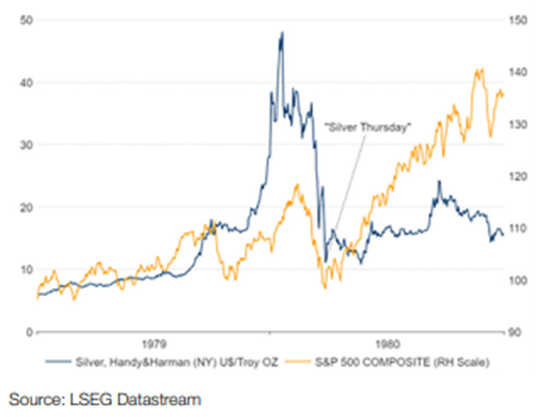
In 1980, Easter marked a tough time for the markets, which had suffered from fears of contagion effects as a speculative bubble in silver was unwound.

45 years ago, almost to the day, Silver Thursday occurred when three brothers (the Hunts) failed in their attempt to corner the silver market, believing the metal to be intrinsically under-valued as a hedge against inflation. Their aggressive accumulation of silver futures contracts sent prices up 500%. However, in response to apparent manipulation, regulators increased margin requirements, forcing the brothers to liquidate positions and resulting in an even sharper decline in prices with possible implications for financial stability.

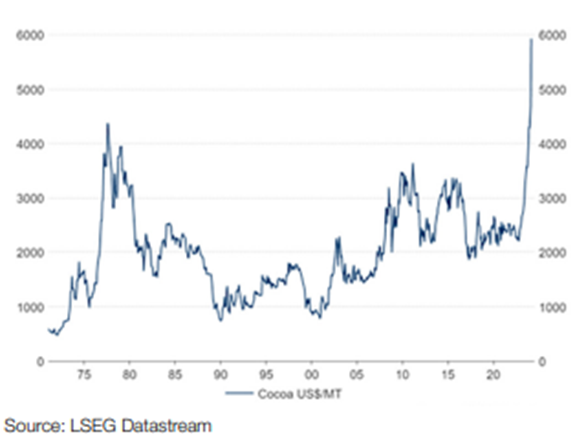
Today, cocoa is experiencing a sharp appreciation. Whilst it’s tempting to attribute this to Easter egg demand, it’s mainly a function of supply shortages due to low crop yields in West Africa, where weather conditions have been too dry. The rise in fertiliser costs driven by the war in Ukraine is also a factor. And yes, demand for chocolate has remained strong among consumers.

The direct impact on inflation will be modest, but it’s one more factor alongside the rise in energy prices, last week’s collapse of Baltimore’s Francis Scott Key Bridge, and continued harassment of shipping in the Red Sea, which has seen Suez Canal volumes down around 50% compared with the same period last year, according to the International Monetary Fund (IMF). These factors make it understandable that policymakers would be wary of easing monetary policy too fast and risking a resumption of the upward inflationary trend.

Please continue to check our blog content for advice, planning issues and the latest investment, market, and economic updates from leading investment houses.

Alex Clare

04/04/2024

Team No Comments

Brooks Macdonald: Daily Investment Bulletin

Please see today’s Daily Investment Bulletin from Brooks Macdonald, received this morning:

What has happened

Tuesday saw something of collective risk-off in world markets following the higher-than-expected US manufacturing survey ‘Prices Paid’ print on Monday, its highest reading since July 2022. Stocks and bonds dropped in markets around the world as speculation mounted that major central banks might have to keep interest rates higher for longer. In the US the S&P 500 (-0.72% on the day) saw its worst daily performance in 4 weeks, and in Europe the STOXX 600 (-0.80% on the day) saw its worst daily performance in 7 weeks.

Better economic data signals resilience

Adding to the sense that we might be returning to a narrative where interest rates could stay higher for longer, Tuesday saw a clutch of perceived-resilient economic data. The latest US JOLTS job openings print (so-called as it’s the US Job Openings and Labor Turnover Survey),  showed job openings in the US were at 8.756m, a shade higher than the 8.73m expected. Also out yesterday was US factory orders, where new orders for US manufactured goods rose by 1.4% from the previous month, above market expectations of a 1% increase and pointing to further resilience of the US economy. Responding to the data, US 10-year treasury yields were up 3.9 basis points (bps) yesterday to 4.35%, marking the highest level since November 2023. The moves were also echoed in Europe yesterday, with rises there for various 10-year sovereign bonds. Closer to home, the final UK manufacturing Purchasing Manager Index (PMI) for March was revised up to 50.3 (versus the initial reading of 49.9), marking the first print in expansionary territory (represented by a number greater than 50), since July 2022.

Oil prices firmer

Echoing the better economic outlook, oil prices edged higher on Tuesday, touching $89 per barrel at one point intraday for Brent Crude, a level last reached in October last year. Subsequently, they have opened at $89.22 per barrel this morning. As an aside, the broader Bloomberg Commodity Spot Index hit a 4-month high yesterday.

What does Brooks Macdonald think

The recent economic data, out of the US in particular, has pointed to an economic outlook on a relatively solid footing in aggregate, at least in terms of versus expectations. The flipside is that this seems to be driving a revival of the “good news is bad news” inflexion for markets. This is the reaction function, that with good economic news, the worry in markets is that this could drive something of a resurgence in inflation pressures, and could therefore push central banks into a corner where they are forced to have to keep interest rates higher for longer. As a result, the higher that bond yields go, the more they risk becoming a potential headwind for equity valuations, at least in the short-term .. as such, the markets’ risk-off move yesterday was a reflection of that.

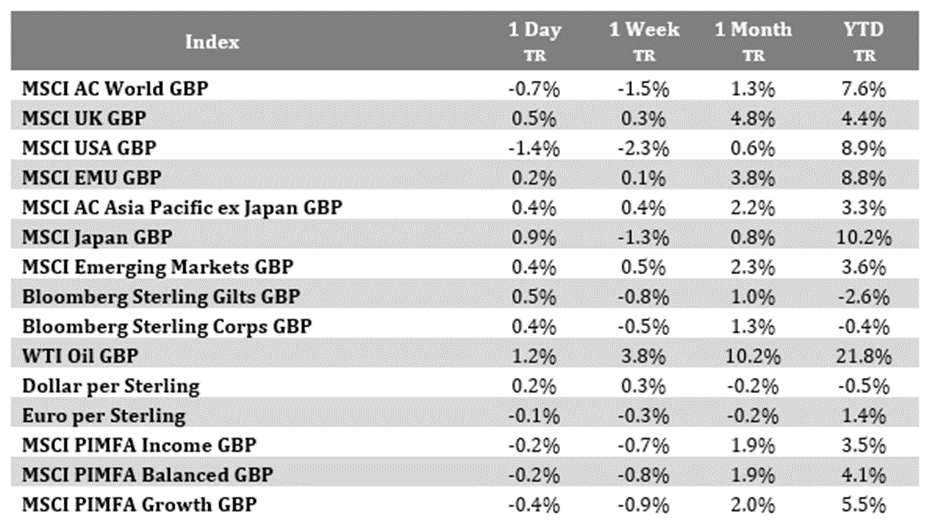
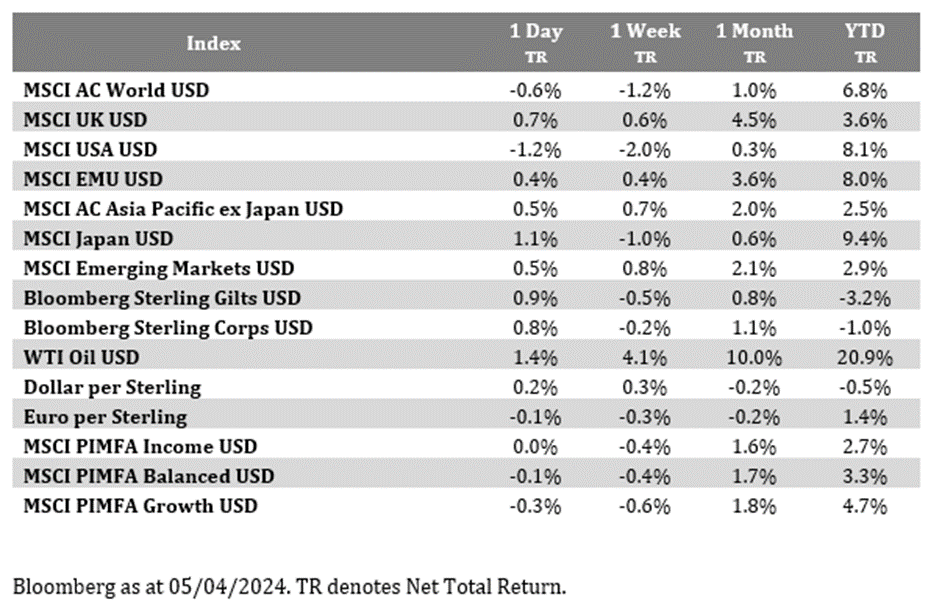
Bloomberg as at 03/04/2024. TR denotes Net Total Return.

Please continue to check our blog content for advice and planning issues and the latest investment, markets and economic updates from leading investment houses.

Charlotte Clarke

03/04/2024

Team No Comments

Tatton Investment Management: Tuesday Digest

Please see below, Tatton Investment Management’s ‘Tuesday Digest’ which summarises all the key factors currently affecting global markets and economies. Received this morning – 02/04/2024

Overview: Everyone is an optimist now

The first quarter of 2024 was another strong one for stocks. That’s a pleasant surprise, given the massive rally that came before. The MSCI World Index has only had one down week since the end of October, and has risen 25% in dollar terms in that time. UK stocks haven’t rallied as much, but the FTSE 100 is now within touching distance of 8,000 points. Flutter Entertainment’s recent US listing switch shows the unfortunate decline in the UK’s worldwide status, but London will keep being a hub for global capital flows even if trades are executed elsewhere.

Corporate bonds have also improved, even for riskier borrowers. Credit spreads have come down even though government yields have gone up slightly. That means overall borrowing costs for companies are only a little higher, on a net basis, than pre-rate rises. Rates are higher but growth is stronger and is expected to remain strong – so firms can afford it.

Volatility has come right down too, with the VIX index at levels not seen since 2019. But expected volatility – as measured by the MOVE index – remains high, suggesting investors are worried yields could spike again. If expectations come down to meet reality, there is still greater risk appetite to be awakened – good news for equities.

That might be fuel for another bullish quarter, but positivity is already priced in. While growth expectations and private sector balance sheets are generally better than pre-pandemic, public sector borrowing is a concern. We saw what this can do during Liz Truss’s not-so-mini budget, and BlackRock’s Larry Fink is warning that the US might be in for something similar. Expect the presidential election to throw a few fiscal bombshells at bond markets.

Another risk is that inflation could come back, with Brent Crude oil prices heading back to $90 per barrel. This could be nothing if oil supplies even out, but it could also spook markets in the short-term. Markets will now look to see if Q1’s corporate earnings results live up to the growth hype.

Inflation volatility creating inflation?

Central banks are now hinting that inflation has been beaten, without causing deep recessions. Commentators call it ‘immaculate disinflation’ and markets need no convincing: year-to-date stock returns are strong in the US, Europe and UK. But there are niggling signs of sticky inflation, particularly in the US and in the global services sector.

A recent paper from Evi Pappa of Carlos III University, Madrid, argues prices have not budged because of inflation volatility. We know that firms often raise prices when inflation is high – the dreaded wage-price spiral – but her research suggests this isn’t just when inflation is high, but when it is rapidly changing. That means we can still see inflationary behaviour even when inflation is coming down.

Intuitively, this is because it creates a feeling of price instability. Firms might want to keep prices high to protect against volatile costs, and consumers might be more willing to accept a higher price if they can’t work out what the fair price should be. Supermarkets regularly exploit this by putting ‘bargain deal’ labels on products to disguise underlying price rises.

Uncertainty is the key element – and we have had plenty of uncertainty in the last few years. This might be why central bankers were preaching ‘higher for longer’ for so long, against market expectations. Pappa’s research suggests that when inflation is volatile, rates need to stay high to discourage companies from building price buffers.

But we think the problem with this story is that it focuses entirely on the supply-side effects. Uncertainty also decreases demand by making consumers less willing to consume – as we have seen in the UK, Europe and China. It is hard to say whether the supply or demand effects will be stronger going forward. The dovish Fed seems to think demand, while the cautious ECB seems to think supply.

Carbon border adjustment

The UK is running a consultation on its carbon border adjustment mechanism (CBAM), to be rolled out in 2027. It follows the EU’s CBAM introduction last year, designed to level the playing field for emissions costs between domestic and foreign goods – a key pillar of net-zero targets.

CBAM is designed to fix a problem with the Emissions Trading System (ETS), a ‘cap-and-trade’ policy where firms trade carbon credits (which allow them to emit) on the open market. The UK and EU’s ETS systems are broadly the same, designed to let the ‘invisible hand’ of the market allocate emission rights to companies that most need them, while giving policymakers the power to control overall emissions.

Unfortunately, ETS leads to ‘carbon leakage’ – emissions from Europe or the UK just being replaced by emissions from somewhere with less stringent regulations. Not only does this negate the environmental impact of ETS, it means that foreign producers – like US companies under no ‘cap-and-trade’ scheme – have a price advantage over domestic producers.

CBAM is supposed to fix this by putting a “fair price on the carbon emitted” by companies selling into Europe. Importers buy CBAM certificates to match the emissions that went into their production (all of which must be thoroughly reported), and the price of certificates is set by the price of carbon credits. The EU’s CBAM is currently in a “transition phase” where firms have to report but not pay, which officials call “a learning period for all stakeholders”.

One of the biggest issues will likely be the sole focus on imports, leaving open the possibility that British and European exports might have a price disadvantage in global markets. The problem, as always with climate policy, is lack of international cohesion. We think CBAM will have a positive impact on reducing emissions, but could be another disadvantage for Europeans. We will watch the transition closely.

Please continue to check our blog content for the latest advice and planning issues from us and leading investment managers.

Alex Kitteringham

2nd April 2024