Team No Comments

EPIC Investment Partners – The Daily Update | The World Bank’s Drought Gambit

Please see below article received this morning from EPIC Investment Partners.

The World Bank is poised to expand its catastrophe bond (cat bond) programme with the introduction of its first drought bond within the next 12-18 months. This initiative, likely to focus on Africa, represents a significant evolution in the Bank’s efforts to provide financial protection to vulnerable countries against natural disasters. 

George Richardson, director of the capital markets and investment department at the World Bank Treasury, highlighted the institution’s ambition to venture into the drought space. This move comes as the World Bank has already facilitated over USD 4.8bn in cat bonds across 17 transactions, primarily covering earthquake and wind risks in the Pacific and Caribbean regions, with Mexico being a prominent issuer. 

The existing cat bond program, operated through the International Bank for Reconstruction and Development (IBRD), has proven effective, making USD 568m in insurance payouts to date. These financial instruments have played a crucial role in helping emerging economies mitigate the economic fallout from storms and earthquakes for over a decade. 

However, the introduction of a drought bond presents unique challenges. Richardson emphasised the complexity of modelling droughts, wildfires, and floods compared to earthquakes or storms, particularly for parametric cat bonds where payouts are triggered by specific physical parameters of an event. The fundamental hurdle lies in the need for extensive historical data to enable accurate risk modelling by various agencies. 

The timing of this initiative is particularly pertinent given the recent severe drought conditions in Southern Africa. The region has been grappling with its worst drought in years, exacerbated by the naturally occurring El Niño phenomenon and rising global temperatures due to greenhouse gas emissions. These factors contributed to numerous record-breaking weather extremes in the past year, underscoring the urgent need for financial mechanisms to support affected countries. 

In addition to expanding its cat bond offerings, the World Bank has introduced Climate Resilient Debt Clauses (CRDC) for vulnerable, low-income countries. This innovative feature allows governments to defer loan repayments for up to two years if hit by a severe natural disaster. Seven countries, including several in the Caribbean and Montenegro, have already adopted these clauses. Some are currently evaluating whether to activate this provision in the wake of Hurricane Beryl, which recently caused extensive damage across several Caribbean islands. 

The World Bank’s multifaceted approach to disaster risk financing, encompassing both cat bonds and flexible loan terms, demonstrates its commitment to supporting countries vulnerable to climate-related disasters. As global temperatures continue to rise and extreme weather events become more frequent and severe, these financial instruments will play an increasingly critical role in building resilience and facilitating rapid recovery in the world’s most vulnerable regions. 

Please check in again with us soon for further relevant content and market news.

Chloe

18/07/2024

Team No Comments

Evelyn Investment Partners – UK June CPI Inflation

Please see the below article from Evelyn Investment Partners detailing their thoughts on this morning’s UK inflation announcement for June. Received this morning 17/07/2024.

What Happened?

UK June annual headline CPI inflation came in at 2.0% (consensus: 1.9%), versus 2.0% in May. In monthly terms, CPI was 0.1% (consensus: 0.1%), compared to 0.3% in May.

Core CPI inflation (ex-energy, food, alcohol and tobacco) came in at 3.5% (consensus: 3.5%) vs 3.5% in May. In monthly terms, Core CPI was 0.2% (consensus: 0.1%), compared to 0.5% in May.

What does it mean?

Despite headline inflation remaining in line with the Bank of England’s (BoE) inflation target for a second consecutive month, June’s inflation data came in very slightly warmer than forecasters had been expected.

Within today’s data, the category for clothing and footwear was responsible for nearly half of this month’s deceleration in the annual rate, with prices falling by 1.2% for the month of June, decelerating the annual rate to just 1.6%. Similarly, the basket for food and non-alcoholic beverages continued to ease, decelerating to 1.5% on an annual basis. This has helped drive the overall basket for goods firmly into deflationary territory with prices in this segment contracting by 1.4% over the last 12 months.

Meanwhile it’s the services sectors of the economy which are still running hot, with an annual inflation rate of 5.7%. within this, restaurants/hotels posted the strongest monthly print, with prices rising 0.9% compared to the month prior. As has been seen in previous locations during her tour, there is speculation that Taylor Swift’s ‘Eras tour’ that gripped the UK during June could be responsible for driving up hotel prices during the month.

However, looking forward:

Ofgem has signalled a further £122 reduction in the energy price cap effective from July 1, this 7% reduction should help to further cool household pricing pressures later this summer and further cement headline inflation at a rate within the BoE’s target. 

Furthermore, the slowing trend in core CPI inflation remains broadly intact. Lead indicators, such as producer price inflation is also heading south. Moreover, cost-push led inflation from wages that feed into the service sector is also decelerating. In addition to weakening employment data, annual private sector wage growth slowed to 5.8% in April, down from a peak of 8.2% in June 2023.

Bottom Line

Even as headline inflation remains within target for its second consecutive month, the continued strength in services inflation will likely remain a cause for concern for committee members at the BoE, heading into their August meeting. However, it remains to be seen if this will be alarming enough to delay their first rate cut later into the year. Currently markets are only pricing in a 35% chance of a cut in August, while prior to this inflation print that number stood at around 50%.

Please continue to check our blog content for advice, planning issues and the latest investment, market and economic updates from leading investment houses.

Alex Clare

17/07/2024

Team No Comments

Brewin Dolphin – Markets in a Minute

Please see the below article from Brewin Dolphin detailing their discussions on the UK and US markets over the last week. Received 16/07/2024.

The major development over the weekend was the assassination attempt on former U.S. President Donald Trump. According to online prediction market PredictIt, the probability of Donald Trump winning the upcoming U.S. election has risen from 60% to about 66% since the event.

Market reactions have been relatively muted despite such a dramatic event, but there are some important observations as markets price in a higher chance of Trump being re-elected. Longer-term U.S. government bond yields have edged higher relative to shorter maturity bond yields. That is because a Trump re-election is expected to be more inflationary due to tariff threats.

Markets also believe there will be a bigger fiscal deficit and more supply of bonds because of Trump’s pledge to extend tax cuts. U.S. equities reacted favourably, but that may also be due to higher hopes for rate cuts as soon as September.

Cuts come into view

The U.S. consumer price index was the most anticipated data last week and coincided with Federal Reserve (the “Fed”) Chair, Jay Powell’s semi-annual testimony at the Senate earlier in the week. The outcome of both events helped cement the market’s view that U.S. interest rate cuts are coming soon.

Powell said the latest data shows that U.S. labour market conditions have cooled considerably from where they were two years ago. Indeed, we discussed the week before last how the U.S. unemployment rate has been steadily picking up and temporary help services jobs have fallen sharply. Because the labour market is no longer as tight, wage growth has slowed meaningfully. U.S. economic data indicated more of a soft patch recently, and Powell recognised that elevated inflation is not the only risk the Fed faces anymore.

The Fed’s mandate has two objectives: 2% inflation and full employment. In the past two years, the priority has been on curbing inflation. But, as inflation has made great progress, the balance of priority is now shifting toward full employment.

Powell is perceived to be leaning on rate cuts, but he’s keen not to commit to a specific timeline. The guidance is that more good data would strengthen the Fed’s confidence that inflation is moving sustainably towards 2%.

U.S. inflation eases

The Fed and the markets did not have to wait long for that evidence. Last Wednesday, both U.S. headline and core consumer price index (CPI) inflation were reported at below estimates. U.S. headline inflation surprisingly contracted by 0.1% month-on-month (MoM) in June, which was the first time the CPI was negative since we started getting the high prints back in 2021. CPI slowed more than expected on a year-on-year (YoY) basis too, with headline CPI now at 3% and core CPI at 3.3%.

The slowdown in inflation is broad-based, which is welcome. The categories most responsible for driving the downturn in core inflation were the two big shelter categories – rent and owners’ equivalent rent, which together account for over 43% of the weight in the index. Both decelerated sharply, rising just under 0.3% MoM. This is finally starting to reflect the slowdown we’ve observed in new lets inflation.

Core goods inflation is now negative for the third consecutive month. Notably, durable goods prices fell sharply by 4.1% YoY in June, which could be a symptom of weaker demand. Airfares and new or used car prices were all falling in June. The Fed’s preferred measure, so[1]called supercore CPI (core services excluding housing), contracted marginally for the second month in a row, a very different picture compared with the average +0.7% MoM pace in the first quarter of the year.

The satisfactory set of inflation data and cooling jobs data paves the way for the Fed to cut soon. Markets are now pricing in about 62 basis points of rate cuts by the end of 2024 and have fully priced in a 25-basis point cut in September. It feels like we really are finally inching towards a Fed interest rate cut, following wild fluctuations in expectations throughout the year.

The market reacts

Perhaps the most interesting aspect of the CPI release was the market reaction. Bond markets saw a marginal reduction in bond yields across maturities, while gold prices gained as real yields fell. The U.S. dollar weakened as real yields fell and interest rate differentials between the U.S. and other major economies are likely to narrow.

Lower bond yields and a dovish Fed tend to support growth stocks due to their sensitivity to interest rates, as their prospective profits are further out into the future. But mega-cap technology stocks, particularly the so-called “Magnificent Seven” (Microsoft, Apple, Alphabet, Tesla, Amazon, Meta and Nvidia), have plunged post-CPI, dragging the S&P 500 index down due to being heavyweights of the index.

Meanwhile, the S&P 500 Equal Weight Index and S&P 500 ex-Magnificent Seven posted gains. The most stunning move was the Russell 2000 (small cap) Index, which surged +3.6% on the day, the biggest outperformance versus the large-cap S&P 500 since 2020. While it’s tempting to extrapolate a one-day move, the CPI report spurred excitement on the resurrection of small cap stocks via a rotation away from valuation-rich mega-cap stocks.

Time for the lightweights to shine?

The obvious reasons for being more bullish on small caps is the rate cuts argument; smaller businesses have struggled in the higher rates environment, whereas mega-cap companies have robust cash reserves that have shielded them.

Positioning is another argument. Given the extended rally in mega-cap tech stocks due to their embrace of artificial intelligence (AI), it’s unsurprising that investors are taking profits on winners and seeking out laggards.

That said, it’s not a foregone conclusion that small caps can persistently outperform. The conditions needed for small caps to outperform are low rates and a robust economic environment (usually at the recovery phase of the business cycle). Small caps tend to lead the markets when coming out of a downturn – but the U.S. economy is not coming out of a downturn, it’s in late cycle. Also, a shallow rate cut cycle is expected, provided there’s no recession.

All in all, lower inflation, rate cuts, and a soft landing are beneficial to the entire market backdrop. We may well be heading into an environment where both small and large caps can prosper. It’s not a zero-sum game, as fresh capital can be deployed as investors become increasingly confident in the outlook.

Index concentration has been raising concerns amongst some investors, so a broadening of the rally is a welcome development and would support a more sustainable long-term rally for the broad indices.

A brighter outlook

Across the Atlantic in the UK, luck is in the air since a new government took office. The outlook for the UK has brightened despite the contentious weather this summer. One notable piece of data to be cheerful of is that the UK gross domestic product (GDP) growth in May (+0.4% MoM) was double that expected by economists.

This means not only did the UK come out of a shallow recession, but activity is recovering faster than expected, with second quarter growth likely to be around 0.6% to 0.7%. This will be a boost to the new Chancellor Rachel Reeves, who wants to make kickstarting economic growth a “national mission”.

With stronger GDP data, a new government that is perceived to bring stability and a pushback on UK rate cut expectations, the pound traded at its strongest level in a year against the dollar, and in almost two years against the euro.

Investors are increasingly singing their praises for UK assets, a huge change from being one of the least popular regions since Brexit. Fundamentally, the pound remains cheap compared to its long-term average and purchasing power parity, whereas UK equities are trading at half the valuation of U.S. equities.

There is indeed room for UK equities to catch up if more international investors upgrade their allocation from negative to neutral or overweight. Our view is that some diversification into the value plays that the UK is so heavily weighted in makes sense at this stage. It can provide a relatively cheap hedge against inflation risks and growth-style equities in portfolios.

Please continue to check our blog content for advice, planning issues and the latest investment, market and economic updates from leading investment houses.

Alex Clare

17/07/2024
Team No Comments

Brooks Macdonald Daily Investment Bulletin

Please see below today’s Daily Investment Bulletin from Brooks Macdonald, which was received this morning, 16/07/2024:

What has happened

Politics dominated most of the session yesterday with markets trying to price potential Trump presidential trades. The focus in the bond market was on the changing Treasury yield curve, which saw the gap between the 2-year and 10-year Treasury yields compress to approximately 22 basis points, the smallest inversion since January. This movement was attributed to the anticipation that Trump’s proposed policies on taxes, trade tariffs, and immigration could lead to inflationary pressures and a bearish steepening trend. In the stock market, there was a noticeable shift towards companies likely to gain from Trump’s policy agenda, with the broader market finishing just shy of the previous week’s peak by less than 0.1%. Meanwhile, the Russell 2000 index, which tracks small-cap stocks, climbed 1.8%, reaching its highest point in over two and a half years.

Pricing in a Trump win?

Sectors such as banking and the oil and gas industry are perceived as likely beneficiaries in the event of a Trump victory, owing to his inclination towards deregulation and their limited vulnerability to potential tariffs. While the anticipation of Trump’s presidency buoyed many assets, it also highlighted vulnerabilities in certain areas. Notably, solar energy companies experienced declines, as the sentiment suggested they would have been more advantaged under a Democratic leadership. This was reflected in significant drops for companies like Sunrun, which fell by 8.95%, and SolarEdge Technologies, which saw a 15.36% decrease.

Powell confirms a more dovish stance

Speaking at the Economic Club of Washington, Federal Reserve Chairman Powell expressed increased confidence that inflation is on track to meet the target, based on Q2 data. However, Powell refrained from hinting at any upcoming policy decisions. He also noted a slowdown in the labour market. With the latest Fedspeak mostly in line with other recent commentary, market pricing for a July cut remains below 10%, though the odds of a September cut close to 100% and the year-end median fed funds rate of 4.80% represents 57 bp of cuts from the current midpoint.

What does Brooks Macdonald think

Yesterday also marked President Trump’s announcement of J.D. Vance, the Ohio Senator, as his vice-presidential candidate. At the age of 39, Vance stands as one of the youngest senators in the current assembly. Typically, a presidential hopeful selects a vice-presidential partner to attract a broader voter base or to balance out perceived shortcomings in image or policy areas. However, Trump has chosen a young loyal Make America Great Again (MAGA) supporter. Equity markets will try to price in the impact of a Trump victory and a potential return of extreme MAGA agenda. Investor could see rising volatility in specific sectors in coming months, though disinflation momentum and Fed pivot could somewhat mute the impact.

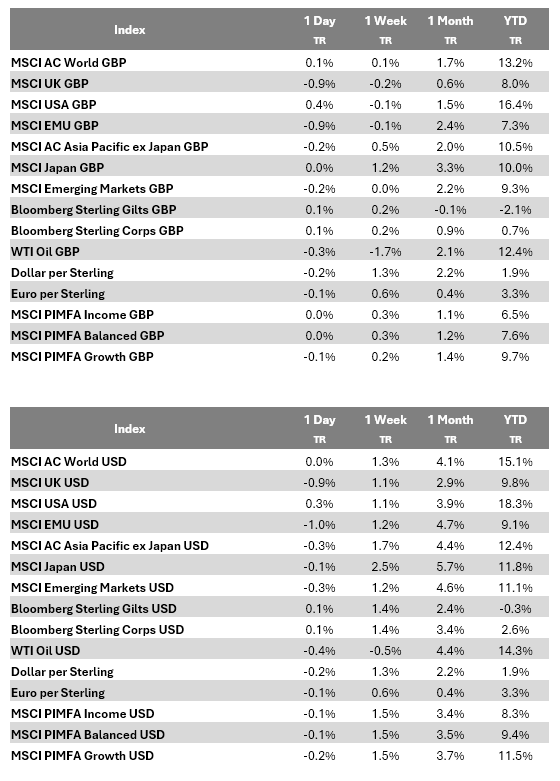
Bloomberg as at 16/07/2024. TR denotes Net Total Return.

Please continue to check our blog content for advice, planning issues and the latest investment, market and economic updates from leading investment houses.

Charlotte Clarke

16/07/2024

Team No Comments

Tatton Investment Management – The Monday Digest

Please see this week’s Monday Digest from Tatton Investment Management detailing their thoughts on global markets over the last week:

Lower inflation, less profits?

Global stocks fell into the latter part of the week – thanks to a sell-off for US mega-caps. Smaller caps and other regions outperformed, in a reversal of the year’s trend so far. UK stocks did well, with markets seemingly believing Kier Starmer’s promise of quietly competent government. The clearest signs of markets’ endorsement (or at the very least its lack of opposition) of the Labour government’s plans are sterling’s appreciation versus the euro and gains for the FTSE 250. It seems that, after upheaval in Europe, investors now see the UK as relatively stable – a far cry from the ’Liz Truss moment’ less than two years ago.

US events were more impactful for global stocks. Remarkably, a surprisingly low US inflation print led to a sell-off for the ‘Magnificent Seven’ stocks on Thursday, dragging down national and world indices. This makes a Federal Reserve rate cut much more likely, which was previously considered only good news. Instead, the reaction suggests disinflation will mean lower medium-term profits.

Aggregate figures hide so much dispersion, though. US small cap stocks rallied hard, which is a little counterintuitive. Small-caps are generally seen as more sensitive to growth, while long-duration assets (like tech stocks) are supposed to benefit more from low rates.

Instead, investors clearly think an easing of the rate burden for small-caps is more important than immediate growth. Tech giants might have been punished because investors doubt how cycle-proof their earnings really are (Nvidia has to have companies to sell to, of course) or just simply diversified some of their allocations towards small and midcap.

In any case, the rebalance could be positive. It dissipates the market concentration we were worried about, and the dollar has weakened, which should benefit global growth. US specific growth implications depend on whether you think lower borrowing costs for most – or the investment spending of the mighty few – are more impactful.

Inflation targets: can central banks adjust?

The idea of central banks changing their 2% inflation targets is a hot topic this year. The question they face is: what long-term target is the optimal balance between growth and stability? 2% is orthodox but ultimately arbitrary, and there have been suggestions that the Federal Reserve or ECB have implicitly moved to a 3% target, to accommodate structural changes in the post-pandemic world economy. Resilient US growth with inflation persistently around 3% (as measured by CPI) shows that this is not necessarily a threat to price stability.

To clarify, higher background inflation doesn’t necessarily mean lower real growth or profits – as some have worried. Higher prices mean higher revenues for someone, which is why equity earnings are considered a natural inflation hedge. In the US case, 3% long-term inflation might actually mean higher real growth, as consumers have kept spending (until very recently) and corporate profits are keeping up with higher inflation. We might think this applies less to the weaker economies of Europe and the UK, but on the other hand, you could argue that less dynamic economies need higher targets to avoid stagnation (Japan maintained a 2% target despite no realistic chance of hitting it for well over a decade).

It might surprise to learn that most central banks have discretion over their inflation targets. Indeed, the Fed and ECB already showed a willingness to reinterpret their “price stability” mandate by changing to “symmetric” targets in 2020 and 2021 respectively. The Bank of England is different; its 2% target is set by law and it has to report to the treasury when it is not met. This might be why the BoE has looked more hawkish than peers in recent years. Unless the treasury tells it to change, we should expect UK policy to be more restrictive than elsewhere.

Trump trumps Truss?

Opinion polls and betting markets suggest a second Donald Trump presidency is now likely. How that will affect markets depends on whether the Republicans can also win a ‘clean sweep’ – the White House and both houses of congress. Current odds suggest the party will win control of the Senate, but lose their majority in the House of Representatives. That would limit what Trump can do, but the House race is very tight.

If Republicans did get a clean sweep, Trump’s agenda of tax cuts and tariffs will become reality once more. Markets reacted very well to his 2017 tax cuts, but they may not be so happy about an expansion of the fiscal deficit this time around. Trump has no qualms borrowing to fund tax cuts, but current debt metrics are worse than in 2017 (debt-to-GDP at 122% and a 6.3% deficit last year), in part because of his policies.

Potential trade wars – particularly with the EU – will make any debt problems worse. The US historically has escaped bond market punishment due to its status as world’s largest economy and owner of the global reserve currency. But fragmented global trade and deteriorating fiscal policy make it less likely capital will flow to the US. The dollar is already expensive on historical and purchasing power parity bases.

Without international flows, the treasury will need to borrow from domestic investors – which takes capital out of the stock market. If yields (particularly longer-term) go up, the extreme result would be a ‘Liz Truss moment’ and a reckoning for US policymakers that thought their bonds immune to global pressures. That isn’t our base case, but the risk is growing. That growing risk itself might lead to short-term sell-offs, but the bigger problem for the US is a long-term deterioration of its global market status.

Please continue to check our blog content for advice, planning issues and the latest investment, market and economic updates from leading investment houses.

Andrew Lloyd DipPFS

15/07/2024

Team No Comments

EPIC Investment Partners: The Daily Update | EURO 2024 Final, Paul the Octopus unmatched

Please see below, The Daily Update from EPIC Investment Partners. Received late this morning – 12/07/2024

Over the last few weeks, we’ve been having a bit of fun applying our NFA model (which measures a country’s net assets held abroad less liabilities owed to foreigners) to predict the EURO 2024 matches. With England facing Spain in the final on Sunday, it’s time for a look back at our model’s performance – and our prediction for the winner. 

Early results were promising, with 10 out of 12 countries automatically qualifying for the round of 16 boasting NFA scores of 3 stars or better. Only Portugal and Spain seemed to defy the odds. We even managed a 63% success rate in the round of 16! But alas, the semi-finals proved our undoing, with a 100% failure rate. 

You might think we are disappointed, but we’re actually thrilled. Why? Because 4-star England defied our model’s prediction and triumphed over 6-star Netherlands!  

Although predicting the EUROs is just a light-hearted distraction, there is a serious side to NFA analysis. Last week we highlighted the similar debt levels of the UK and France (with debt-to-GDP ratios of 104% and 111% respectively) but noted that France’s NFA position has markedly deteriorated in recent years. France only just scrapes in as a 3-star rated country, with net foreign liabilities of 48.8% of GDP. Deteriorating NFA positions are often associated with credit downgrades (and vice versa), so it is worth noting that both Moody’s and S&P have flagged that France could be downgraded following the recent elections. S&P already downgraded France’s rating at the end of May due to the country’s deficit figures, and further downgrades may occur if growth is slower than previously predicted.  

Back to the Football. Regardless of Sunday’s outcome, we cannot quite compete with the legendary Paul the Octopus. His keepers at Germany’s Sea Life Centre presented him with two boxes representing each team, and his food choice determined his prediction. With an astonishing 85.7% accuracy, Paul’s legacy is unmatched. Sadly, Paul passed away at the tender age of two, so we can’t ask for his expert opinion for the final. 

We will have to rely on our NFA model instead. Now, here’s the worry: our model predicts an England victory in the final against Spain. So, fingers crossed our NFA gets it right this time!

Please continue to check our blog content for the latest advice and planning issues from leading investment firms.

Alex Kitteringham

12th July 2024

Team No Comments

Brewin Dolphin – Markets in a Minute

Please see below an article from Brewin Dolphin detailing their views on recent market data and events which was published yesterday (09/07/2024) and received this morning:

Janet Mui, Head of Market Analysis, discusses how markets digested the news of Labour’s landslide election win, France’s hung parliament, and the latest U.S. economic data.

It was politics that occupied the news headlines last week. And while it’s had some impact on markets, the UK general election was met with market apathy given that the result had been expected – that’s despite a historic seat gain for Sir Keir Starmer’s Labour Party.

This result is popular with the markets, as Labour is seen as a more functional governing party compared to the years of infighting, division and leadership contests under the Conservative Party.

A strong majority for Labour means an endorsement of the party’s leader and policy agenda. In Labour’s case, its commitment to avoid a repeat of Liz Truss’s infamous brush with fiscal mortality means a likely period of economic orthodoxy is welcome.

In France, by contrast, a majority for Marine Le Pen’s National Rally Party over the weekend would’ve been a concern for markets because her policy agenda seems fiscally cavalier. However, last week, it seemed increasingly likely that National Rally wouldn’t achieve a majority, causing French assets to perform relatively well. Indeed, National Rally came third in the second round of voting on Sunday. Left-wing alliance New Popular Front won 188 seats while President Emmanuel Macron’s liberal coalition Ensemble came in second with 161 seats.

The strength of Labour’s performance stands in contrast to a general tide of increased preference for more socially conservative policies. UK voters don’t necessarily have a different perspective on what’s important, but they do have a different political system, and this victory for Labour had more to do with the fracturing of the rightwing vote than a triumph of the left.

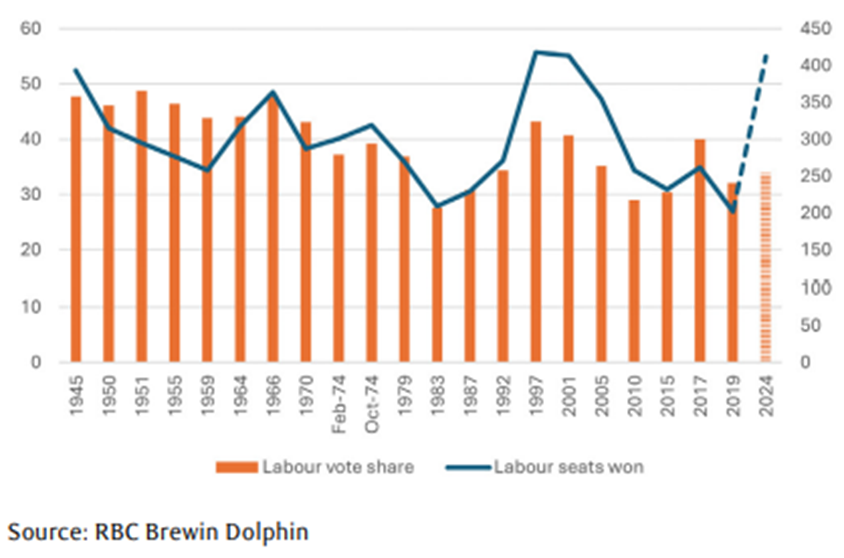
This was Labour’s third highest seat haul, but its sixth lowest share of the popular vote, since 1945. Its vote share was up less than 2% on the 2019 election, in which Jeremy Corbyn’s Labour was trounced by Boris Johnson.

The splitting of the right-wing vote across the Conservatives and Reform UK was instrumental in delivering huge seat gains for Labour and the Liberal Democrats. Also contributing towards Labour’s success was the decline in the Scottish National Party’s vote share.

With a Labour majority always seeming the most likely result, the market was apathetic, with no discernible movement in bonds or currency markets.

Within the FTSE 100, the housebuilders were amongst the leaders. They are perceived to benefit from Labour’s plan for a blitz of planning reform, which will enable more housebuilding. The policy will doubtless be unpopular with many existing constituents, but a large majority helps quell any stirrings of rebellion.

Is a change on the cards for the Democrats?

The biggest political headlines were drawn by U.S. President Joe Biden, as he has been fighting to retain his position as the presumptive Democratic nominee to contest the presidential election this November.

A few Democrats have finally started to break cover and call for Biden to stand down. By convention, a sitting president is not challenged when seeking re-election, but Biden’s advanced years have caused many to question the wisdom of him standing.

The issue has been that nobody else has been seen to stand a better chance of beating Trump than Biden, but that seems to be changing with head-to-head polling suggesting that Vice President Kamala Harris may have a better chance than Biden. She would be the easiest replacement candidate for the party as she was already Biden’s stated running mate. Prediction markets and betting odds seem to suggest that Harris may even be considered more likely to face the voters.

Bond markets would likely look fondly on a change in Democratic candidate now that Biden’s chances have diminished so much. They perceive Trump as a malign inflationary influence.

However, in reality, the economic consequences of a Trump presidency are more complex than that, depending on whether his party would also control the Senate and House of Representatives (all of which are quite possible).

Is economic momentum slowing?

It’s easy to get distracted by the politics but, of course, the more tangible factor affecting markets is economics. Last week’s business surveys from across the globe painted an ambiguous picture of the economic outlook.

Manufacturing activity remains muted although the low level of inventories should reassure us that downside is limited. Services sector activity continues to expand but does so at a slower rate than in May. There were confusing irregularities in the data, making it difficult to see a distinct trend.

In general, the economy looks to have lost some momentum compared to the first quarter. What’s consistent is evidence that price growth is slowing.

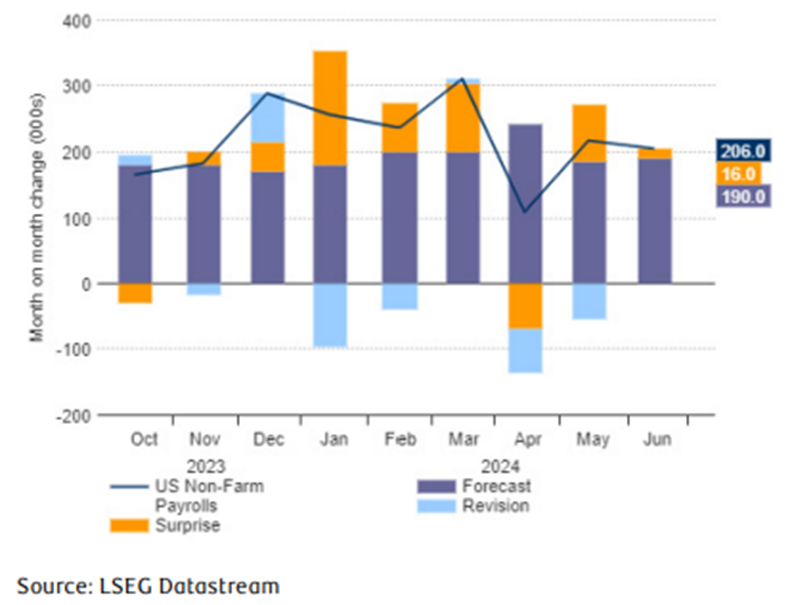
The book end to last week was Friday’s U.S. employment report. Headline employment growth was slightly ahead of expectations, but there were plenty of caveats to threaten the positive headline.

The unexpected jobs growth came from government hiring, with the private sector slower than expected. The unemployment rate ticked up and this has been moving higher in a way that could be consistent with a recession. However, the moves have been about increasing labour supply, rather than job losses or a slowdown in hiring. April and May’s jobs growth was also revised down to a more modest pace.

Finally, wage growth slowed on an annual basis. Taken as a whole, this was a labour market report that will help the Federal Reserve to build the case for rate cuts. If services sector inflation (excluding housing) is reasonable in June, the case for a September rate cut will have become very compelling.

Please continue to check our blog content for advice, planning issues and the latest investment, market and economic updates from leading investment houses.

Carl Mitchell – DipPFS

10/07/2024

Team No Comments

EPIC Investment Partners – The Daily Update | The Middle East’s Journey to Net Zero

Please see today’s daily update from EPIC Investment Partners received this morning:

The Middle East is experiencing a remarkable transformation in sustainability, with 2024 marking a watershed year for ESG across the region. Businesses are spearheading this change, rapidly transitioning from ambitious goals to tangible actions and reshaping industries and economies. 

A recent survey by PWC reveals impressive progress: 80% of companies now have formal sustainability strategies, up from 64% in 2023. Over half have fully integrated these strategies into their core operations. Leadership is driving this change, with 50% of companies either having appointed a Chief Sustainability Officer or planning to do so within a year. 

Climate action is at the forefront, with half of all surveyed companies pledging to achieve carbon neutrality within realistic timeframes. This significant increase in net-zero commitments showcases the region’s determination to address climate change. Transparency is also improving, with over 40% of companies producing comprehensive sustainability reports and an additional 24% disclosing selected ESG metrics. 

Innovation plays a crucial role, as companies explore cutting-edge technologies like GenerativeAI to enhance their sustainability efforts. The financial sector is supporting this green transition, with a growing number of companies accessing green loans and bonds. This trend is bolstered by significant initiatives like the UAE’s USD 30bn ALTÉRRA climate investment fund. 

Collaboration is key, with the private sector actively seeking partnerships to drive the sustainability agenda forward. Consumers are aligning with this shift, showing willingness to pay premiums for sustainably produced goods. Companies are recognising the economic benefits of sustainable practices, with some state-owned organisations demonstrating significant cost savings and competitive advantages. 

Looking ahead, there’s a growing focus on sustainability education and upskilling to ensure the region has the expertise needed to maintain momentum. While challenges remain, the Middle East is positioning itself as a leader in sustainable development. 

With many of the countries in the region, e.g. Abu Dhabi and Qatar, ranking amongst the wealthiest in the world, and with the growing focus on sustainability, the Middle East is an attractive hot spot for fixed income investment. Discerning investors seeking both returns and alignment with sustainable practices are finding the region increasingly attractive.  

Please continue to check our blog content for the latest advice and planning issues from leading investment firms.

Charlotte Clarke

09/07/2024

Team No Comments

Tatton Investment Management – The Monday Digest

Please see the below article from Tatton Investment Management detailing their thoughts on global markets over the last week. Received this morning 08/07/2024.

New government, same economy

The election results were emphatic but full of contradictions. Labour achieved one of the largest majorities ever with the lowest winning vote share, and it did so by promising change while emphasising continuity. The contradiction most relevant to investors is that capital markets were unmoved by this political earthquake.

Even though UK stocks rallied on Friday morning, this probably had more to do with global factors than domestic politics – just like last month’s sell-off. Markets are nonchalant because Kier Starmer continues to emphasise fiscal discipline. This is more about Liz Truss’ legacy than his own preferences: the former prime minister’s disastrous ‘mini budget’ reaffirmed the position of capital markets as the most unforgiving opposition of all. That means fiscal growth upside from the new government is limited, but growth indicators are already trending up and could well benefit from Labour’s stability.

That is a far cry from the US. Debt-to-GDP has risen dramatically in the last decade under successive administrations, and this is likely to continue regardless of who wins the November election. But Morgan Stanley research suggests that fiscal policy will be looser under Trump – so Biden’s recent debate failure has increased fears about debt instability. The US usually avoids bond market punishment thanks to its global economic dominance, but that could be tested if its fiscal stance worsens further. Even Jay Powell seems to be worried about the US eventually at risk of facing a ‘Liz Truss moment’.

US stocks continue to outperform all the same. Lately this has been a ‘bad news is good news’ story, with weaker economic data firming up expectations of a Federal Reserve rate cut. There are problems with this mindset. Stock market returns are so concentrated on a handful of mega-tech companies, but background macro conditions seem to have worsened for the group. And while slower growth might mean quicker rate cuts, it could also mean weaker profits. Markets seem to expect a ‘goldilocks environment’, but that could just be hubris. We will have to watch valuations, relative to the unfolding economic progress, closely.

June 2024 asset returns review

Global stocks returned a healthy 3% in sterling terms through June, but returns were highly concentrated on the dominant US mega-tech sector. Interestingly, emerging markets (EMs) also outperformed, jumping 4.7%, despite a 1.6% fall in Chinese stocks – the biggest component of EM indices. This continues the theme of dispersion between China and wider EMs. The latter rallied 6.8% because of rebounds in India and South Africa. Both had previously slumped due to surprising election results, but we said at the time that such political upsets are often overdone and can be good buying opportunities. So it proved.

European stocks saw a political sell-off too, dropping 1.7%, after President Macron’s surprise election call. We wait to see if the French far-right can win an outright majority in second-round voting. The 1.1% drop in UK stocks, on the other hand, isn’t political. The large multinationals that dominate the FTSE 100 are just particularly sensitive to global commodity demand – which has been weak for commodities other than oil. Markets were neither surprised by Labour’s landslide nor fearful of its moderate policies.

The US outperformed again, gaining a further 4.3%. This came despite weakening economic data through June. Investors clearly see slowing growth merely as proof that the Federal Reserve will cut interest rates in September. Bond yields moved gradually lower, but spiked into the end of the month. Reasons for the spike aren’t certain – but we suspect it could be down to struggling Japanese banks offloading their foreign bond holdings.

US strength was yet again really strength of a handful of mega-tech stocks. It shows how skewed returns are that Nvidia alone accounts for 35% of the S&P 500’s year-to-date returns. Monitoring this concentration and the risks it brings is the key challenge for investors in the second half of 2024.

Are Americans wrong about their economy?

US consumers are much less confident about the economy than aggregate economic data should suggest. The US continues to outperform in growth and capital market terms, but 55% of Americans think their economy is in recession, and 49% think the S&P 500 is down year-to-date, according to a Harris poll for the Guardian.

Consumer confidence has never recovered to pre-pandemic levels, despite strong growth and low unemployment during that time. This is a big problem for Joe Biden, and it has been suggested that highly partisan US news sources could be to blame. Backing this up is the fact that economic confidence differs dramatically by party affiliation – but political bias isn’t the whole story.

Some economists have suggested that traditional economic measures miss key factors, like the psychological impact of inflation and high interest rates. The clearest example is that average real (inflation-adjusted) hourly earnings are still below where they were in mid-2020. These were boosted during the pandemic thanks to emergency stimulus, but that did little for confidence because consumers couldn’t spend it on what they wanted at the time.

Wealth inequality, which grew during the post-pandemic recovery, is a crucial component too. Low aggregate unemployment hides the fact that the worst off are struggling much harder. Booming stock market returns are concentrated on just a handful of mega-tech companies, an uncanny reflection of America’s unevenly spread opportunities.

The US economy is set to gradually slow and restart at the aggregate level, but aggregate figures hide so much of what makes the economy important to people. The sentiment gap might have more of a concrete impact – both economically and politically – as growth comes down.

Please continue to check our blog content for advice, planning issues and the latest investment, market and economic updates from leading investment houses.

Alex Clare

08/07/2024

Team No Comments

What does the election mean for UK markets?

Please see below article received from Jupiter Asset Management this morning, which provides their market predictions following the Labour Party’s victory in the UK General Election. 

As the nation wakes up after polling day, the public, press and markets will be digesting news of the result. To give an investment perspective on what it means for markets, we asked some of our experts for their immediate reaction.

Matthew Beesley, CEO

“The UK market has very healthy underlying fundamentals and is trading at near all-time high levels. Yet frustratingly at the same time, the valuations of UK stocks are also at record low levels because of the political uncertainty of the last few years. There is every reason to hope that the new government will usher in a period of political stability, prioritise the Edinburgh reforms and hold themselves accountable to a clear industrial growth strategy that will cement the UK’s recovery and turn it back into a key focus for international investors.”

Adrian Gosden and Chris Morrison, Investment Managers, UK Equity Income

“This election was decided without major policy announcements from either of the main parties, and we are hopeful that a stable political backdrop will prove to be good for the economy and for market sentiment. UK equities have enjoyed solid performance this year to date, and we are looking for a sustained rebound in the market, helped by supportive factors such as weakening inflation, a potential Bank of England rate cut, attractive valuations for UK equities and good earnings performance from UK companies.”

Tim Service, Investment Manager, UK Small & Mid Cap Equities

“After nearly a decade of political shocks in the UK, today’s election result feels unusual for a Labour win having been so predictable. I expect this to be good news for the UK equity market over the medium-term, if for no other reason that markets and companies alike crave certainty. A government with a clear mandate will give companies confidence to hire people and invest in the future, while markets can better discount future company profits accurately.

However, ‘certainty’ is a still a relative concept given Labour’s campaign rhetoric to deliver change – so it’s important for investors to consider how new legislation, tax and spending plans might affect individual companies. We hope that Labour can start addressing productivity issues through planning reform and infrastructure investment, while also reenergising the UK’s capital markets. We are encouraged that Labour seems to recognise the problems, but would stress the urgency with which the remedies are required.”

Mark Nash, Huw Davies and James Novotny, Investment Managers, Fixed Income – Absolute Return

“Relative to the high level of uncertainty seen in the aftermath of international elections over the last few weeks (South Africa, India, Mexico, EU, France) and the concerns around President Biden’s performance at the first US presidential debate, the UK election has been something of a non-event. Labour’s victory means that we have now entered a period of relative stability in UK politics which is in stark contrast to the possibility of continued volatility elsewhere, especially in the run up to the US presidential elections in November. The UK could well look like a haven of political stability, a very different landscape to the years since the Brexit referendum.

The new government has to contend with the perilous scale of the UK’s twin deficits, with the adverse market reaction to Liz Truss’s mini budget almost two years ago still vivid in our memories. Labour will need to convince the market, and also the electorate, that they are fiscally prudent while still improving the shoddy state of UK public services and anaemic productivity and growth profile, none of which will be easy.

Growth will be their get-out-of-Jail free card, easier said but hard to deliver. They look likely to rest their hopes on a better trade deal with the EU to try and reduce friction at the border with the EU, and also by liberalising the UK planning laws. If they can succeed in this endeavour, then there may be some renewed hope for better UK growth along with less inflationary pressure within the UK. Despite the UK’s fiscal position, we believe Gilt yields look cheap compared to other countries that have a weak fiscal position (e.g. France) so there may well be some flows towards Gilts from other challenged sovereign bond markets that continue to have political problems now our election is done and dusted.”

Please check in with us again soon for further relevant content and market news.

Chloe

05/07/2024