Team No Comments

EPIC Investment Partners – The Daily Update | Does the ‘West’ need a recession?

Please see the below daily update article from EPIC Investment Partners:

We appreciate that recessions have negative connotations and often create hardship for many. However, when viewed from an economic standpoint, they can be a necessary evil to lower prices, correct imbalances and serve as a catalyst for restructuring and removal of wasteful endeavours. If we look through the unique COVID-19 period, we have not had one of these ‘corrective’ episodes since the Great Financial Crisis, which was over 15 years ago! 

Politicians and central bankers, quite sensibly from a political point of view, will throw the kitchen sink at avoiding recession. Yet, long periods of economic expansion can lead to inefficient resource allocation, unsustainable business models and inflated asset prices. The June 2024 Bank of International Settlements (“BIS”) Annual Economic Report showed that c.13% of all US corporates are ‘Zombies’ (unprofitable firms whose earnings are less than interest payments and the ratio of market value of their assets to replacement cost is below the industry median). They remain in business when interest payments are low, and lenders find it easier to ‘extend and pretend’. Some companies borrow simply to service existing debt and/or avoid bankruptcy/restructuring. The BIS go on to state that “…empirical evidence confirms this contributes to the misallocation of labour and capital by crowding out more productive businesses.”  

Ultimately this hinders competition, which can mean more expensive products for consumers or negatively impact innovation, reducing productivity and contributing towards stagnation. Long-run these factors reduce GDP growth, which will have a knock-on impact on living standards for households too. 

A simple technical recession is classed as two consecutive quarters of GDP decline. A more prolonged or deeper one has typical characteristics that all sound bleak – economic contraction, decreased consumer spending, business failures, rising unemployment and falling asset prices etc. However, a recession can prick asset bubbles and rebalance economic activity. It can force innovation, efficiency and productivity gains, within an industry through creative upcycling and new product creation, but also within an economy to regear for industries of the future through invention and discovery. Broadly speaking, households, businesses and governments must alter their mindset and focus on their budgets to live within their means. This can often end up improving long term debt burdens and fiscal positions after times of contraction. All these items lay the foundations for an economy to push through the cycle into expansion again.  

Recessions can effect dynamic change and lead to a price reset which otherwise can never happen, and without which a perpetual expansion leads to fiscal troubles, cost of living crises and large wealth inequality. Unchecked growth leads to increased demand and higher prices which necessitates higher wages and can then lead to a wage / inflation spiral. A short period of deflation can help those on fixed incomes. Reduced asset prices can create opportunities for opportunistic or strategic buyers. Companies can reshape, as skilled workers may be willing to accept lower wages or new career paths. 

We do, however, absolutely recognise the human cost of any recession and appreciate that it is a delicate balance to manage the economic cycle and the very real impact of job / salary cuts to individuals and households over a significant period. However, the previous era of peaceful globalisation and its many benefits may well be over. A return to more traditional economic policies could be beneficial, where growth and inflation cycles are better controlled by managing debt, demand and supply through recessions and expansions. In this regard, the developed world may have a lot to (re)learn from its emerging counterparts.  

Please continue to check our blog content for advice, planning issues and the latest investment, market and economic updates from leading investment houses.

Andrew Lloyd DipPFS

15/08/2024

Team No Comments

Evelyn Partners Update – UK July CPI Inflation

Please see below article received from Evelyn Partners this morning, which provides an economic update for the UK.

What happened?

UK July annual headline CPI inflation came in at 2.2% (consensus: 2.3%), versus 2.0% in June. In monthly terms, CPI was -0.2% (consensus: -0.1%), compared to 0.1% in June.

Core CPI inflation (ex-energy, food, alcohol and tobacco) came in at 3.3% (consensus: 3.4%) vs 3.5% in June. In monthly terms, Core CPI was 0.1% (consensus: 0.2%), compared to 0.2% in June.

What does it mean?

Despite headline inflation reaccelerating slightly back above the BoE’s 2% target, unfavourable base effects where largely to blame, as a -0.4% monthly print from July 2023 fell out of the annual comparison. Both headline and core inflation undershot expectations in July with both measures’ comings in 0.1% lower than forecasters had been expecting.

Within today’s data, the category for Housing and household services, which includes energy, was responsible for nearly all this month’s acceleration in the annual rate. Despite the category remaining in deflationary territory, pricing pleasures are easing at a slower rate than they where a year ago, causing the overall annual rate to accelerate. Restaurants and hotels, which had been one of the hotter segments of the economy started to ease in July with the annual rate decelerating to 4.9% from 6.2% the month prior. This move was responsible for the largest negative contribution to the headline annual rate in July.

Despite decelerating in July, it’s the services segments of the economy that continue to run hot, with annual services inflation coming in at 5.2% compared to -0.6% for goods inflation.

However, looking forward:

The slowing trend in core CPI inflation remains broadly intact. Lead indicators, such as producer price inflation remain supportive. Moreover, cost-push led inflation from wages that feed into the service sector is also decelerating. In addition to weakening employment data, annual private sector wage growth slowed to 4.9% in June, down from a peak of 8.2% in June 2023.

Bottom Line

Although the annual rate of headline inflation reaccelerated slightly in July, much of this came because of poor base effects. With all 4 main measures of inflation coming in below expectations today, the inflation picture will remain a source of encouragement to the Bank of England (BoE). Markets are currently still split on if the BoE will cut rates again at their September meeting or if they will replicate the actions of the European Central Bank and pause after their first cut, but committee members will still have one more month of macro data to inform their decision before then.

Please check in again with us soon for further relevant content and market news.

Chloe

14/08/2024

Team No Comments

Markets in a Minute

Please see below article received from Brewin Dolphin yesterday evening, which provides a global market and economic update.

Last week was volatile for markets. A major driver of the weakness in Japanese stocks was the strength of the Japanese yen. Most of the activity took place in the early hours of Monday morning when the Japanese TOPIX index fell a stunning 12% in a single session. This capped a three-day descent into the technical definition of a bear market (a 20% cumulative decline). Before we get too carried away, the TOPIX had recovered by 11.5% when the Japanese market closed on Friday. So, the peak-to-trough decline of the Japanese market since mid-June was 24%, but is now just 15%. In sterling terms, this would represent a 15% total decline and just 7.5% following the partial recovery. The decline in Japanese stocks is different depending upon whether you’re a Japanese investor (in yen) or a UK investor (in sterling).

The carry trade revisited

The difference in returns by currency reflects that Japanese equities have not just been affected by currency; they have arguably been driven by it.

Apologies for the repetition for regular readers, but the Japanese carry trade has been a major influence on markets. A carry trade involves borrowing money in a low-interest rate environment (like Japan) and investing it in a high-interest rate environment (like the U.S.). The returns are made up of the interest earned in the invested currency less the interest due in the borrowed currency, plus the gain (or loss) in the invested currency relative to the borrowed currency. The carry trade does not need to be invested in bank deposits or even bonds in the invested currency. It seems likely that some of it has flowed into U.S. equities, or maybe specifically tech shares (based on the observation that tech shares rose as the yen fell, and fell as the yen rose).

Understanding the size of this trade is very difficult. However, this week J.P. Morgan gained a lot of headlines announcing that it had unwound by 75%. How did it estimate this? By checking how much of the carry currency appreciation since August 2021 has now reversed.

We’re not convinced by this because it’s using a basket of carry trades that together seem to have been much less effective than the yen/dollar carry trade we’re trying to measure (the basket went up less and came down more). Looking at the yen/dollar trade specifically, over the period J.P. Morgan measured, the trade has only unwound by around 25%. That would seem more in line with data on positioning by investors, but unfortunately, that data is not timely enough to account for this week’s movements. In summary, it’s hard to tell how much carry trade is still in place.

Focusing on liquidity

The Bank of Japan (BoJ) seems worried about the carry trade. It’s been keen to move very slowly in its interest rate normalisation process – so much so that during its last monetary policy meeting, it referenced a statement saying that so far, interest rate increases have not yet led to tightened monetary policy. Last week, the BoJ’s deputy governor, Shinichi Uchida, also sent a strong dovish signal in the wake of historic financial market volatility in Japan by pledging to refrain from hiking interest rates when the markets are unstable. It seems likely that the BoJ is very focused on the impact interest rate differentials could have on financial conditions, not least because its domestic demand could be impacted by currency volatility. Japanese domestic investors have been buying overseas assets in their own funded version of the carry trade. By contrast, U.S. investors invest principally at home, allowing the Federal Reserve to be more parochial with its monetary policy. Any weakness in the U.S. economy will be met by interest rate cuts, inflicting more potential pain on carry traders.

U.S. growth concerns linger

There wasn’t much data last week that provided further insight into the fundamentals that may drive U.S. rate cuts or Japanese rate hikes. As mentioned, the BoJ will tread carefully. In the U.S., weekly jobless claims cut a reassuring tone, with new claims falling well below previous troughs during economic expansions. The caveat to this is that far fewer people now claim the unemployment insurance benefit in the U.S. than previously. Why? The explanation seems to be that either they are migrants who may not yet qualify for insurance, or they find opportunities in the gig economy that are preferable to the hassle of claiming insurance.

The difficult thing for investors is that the week after the payroll report is always a quiet one for economic data, so there was little to reassure or intensify worries about U.S. growth. In addition, we remain in a liquidity trough due to the summer holiday season, and the earnings season is unlikely to change the market’s perception of consumer strength (although it will be interesting to hear from the discount retailers still to report). Friday morning saw the Taiwan Semiconductor Manufacturing Company report a sharp increase in revenue in July, which bodes well for suppliers like ASML following the bruising market response to Intel’s planned reduction in capital expenditure the week before last. Technology shares have suffered during the current earnings season due to fears they might be overinvesting.

What’s next?

This week, we’ll see what’s happening to inflation in the U.S. It’s easy to imagine the market has moved on from inflation. After two months of reassuringly low inflation, focus has shifted to growth. Continued weakness of inflation will be good for bonds, but bad news for carry traders, who are invested in the dollar market. There’ll also be UK inflation and employment data. The Bank of England has taken the plunge and started cutting interest rates. It could probably do with seeing its decision validated by some modest weakness.

Please check in again with us soon for more relevant content and market news.

Chloe

14/08/2024

Team No Comments

EPIC Investment Partners – The Daily Update

Please see the below article from EPIC Investment Partners detailing their thoughts on the Economic Resilience and Cultural Innovation of Abu Dhabi. Received this morning 13/08/2024.

In the face of global economic challenges, Abu Dhabi continues to serve as a beacon of stability and growth. The emirate’s recent economic performance and strategic investments paint a picture of a forward-thinking, diversified economy that’s propelled the wealthy emirate’s ascent to the global stage.

Since the beginning of the month, amidst market turbulence, Abu Dhabi’s sovereign and quasi-sovereign holdings have demonstrated remarkable resilience, outperforming expectations in the EPIC Fixed Income strategies. This performance is no surprise to those who have long recognised the value of Abu Dhabi’s Aa2 rated bonds. The emirate’s journey in the international bond market, which began in 2007 with its first USD denominated bonds, has been a testament to its financial acumen and long-term vision.

Abu Dhabi’s economic prowess was further underscored by its impressive GDP growth of 3.3% in the first quarter of 2024 compared to the same period in 2023. What’s particularly noteworthy is the stellar performance of the non-oil sector, which grew by 4.7% and now accounts for 54.1% of the emirate’s economy – its highest share since 2015. This shift clearly demonstrates Abu Dhabi’s successful efforts to diversify its economy beyond hydrocarbons.

The growth story spans across multiple sectors, with construction, finance and insurance, telecommunications, and hospitality all showing significant upticks. The transport and storage sector, in particular, exhibited a remarkable 14.4% growth rate, highlighting the emirate’s increasing importance as a global logistics hub.

Ahmed Jasim Al Zaabi, chairman of Abu Dhabi Department of Economic Development, attributes this success to the emirate’s resilience and its journey towards becoming a smart, diversified, and sustainable economy. The numbers speak for themselves – the construction sector alone contributed 8.8% to the overall economy, reaching its highest level in five years.

Moreover, Abu Dhabi is expanding its global ambitions beyond traditional economic sectors. The emirate’s sovereign wealth fund, ADQ, is set to acquire a minority stake in Sotheby’s, a world-renowned auction house, in a USD 1bn deal. This strategic investment underscores Abu Dhabi’s commitment to becoming a global cultural hub.

By partnering with a 280-year-old institution like Sotheby’s, Abu Dhabi is bridging the gap between East and West. This collaboration not only promises to strengthen Sotheby’s presence in the Middle East but also positions Abu Dhabi as a key player in the global art world. The investment signifies more than financial gain; it represents Abu Dhabi’s vision to be at the forefront of cultural innovation and exchange.

As the world grapples with economic uncertainties, Abu Dhabi stands out as a model of sustainable growth and strategic diversification. From its robust non-oil economy to its bold investments in global cultural institutions, the emirate is crafting a future that’s not just prosperous, but also culturally rich and globally connected. Abu Dhabi’s journey is a testament to what can be achieved with vision, resilience, and strategic planning. 

Please continue to check our blog content for advice, planning issues and the latest investment, market and economic updates from leading investment houses.

Alex Clare

13/08/2024

Team No Comments

Tatton Investment Management – Monday Digest

Please see the article below from Tatton Investment Management providing an insight into the markets over the past week.

Market correction turns into pothole

Last week started with some of the worst stock market losses in nearly two years – prompted by recession fears and Japanese liquidity problems – but ended with most of those losses recovered. Volatility spiked across most regions and almost all asset classes. The sell-off proper started in Japan (where stocks were routed last Monday) after higher interest rates unwound the ‘carry trade’ (borrowing where rates are cheap and investing where yields are higher) but US liquidity has also been under pressure for a while, which suddenly became apparent. We suspect the growth of high-frequency trading amplified volatility, since it shortens the timeline between trades and increases market sensitivity.

US recession fears are arguably overdone, considering that corporate credit remained relatively stable – and in fact corporate cost of finance fell thanks to sharply lower ‘risk free’ government yields. Recession risks are certainly higher than a few months ago, but our base case is still a ‘soft landing’. Business sentiment in the services sector continues to be strong, for example, counteracting weakness in manufacturing unemployment. Even Bitcoin (a fairly reliable risk indicator) recovered strongly into the end of the week.

There is still much to be positive about. Lower yields should help US mortgage rates, for example. The gap between mortgage rates and long-term treasury yields has come in from the highs of 2023, but it still has a way to come down in terms of historical averages. That should support growth. 

The market shakeout was brewing for weeks, judging by the positioning activity of some hedge funds. This need not threaten stability (volatility settled down pretty quickly) but we seem to be in a different phase, in terms of medium-term outlook. Equity valuations have fallen but still look pretty optimistic in terms of expected earnings growth. Falling yields will help those valuations – but probably at the expense of the expected earnings growth they are based on. That could mean higher valuations but slightly soggier profits. Decent returns perhaps, but with a different set of winners.

Japan’s carry-trade catharsis

The Bank of Japan’s rate rise has unwound the yen ‘carry trade’ (borrowing cheaply in Japan and investing in high-yield assets like US stocks) and knocked markets everywhere in the process. Japanese stocks had their worst day since 1987 last Monday, erasing all of the TOPIX’s year-to-date gains. It regained ground in the following days, after dovish comments from the BoJ. This volatility is bad for confidence: Japanese risk appetite is slow to build and quick to collapse, and there is little economic momentum to fall back on. 

The BoJ felt it had to dial back rate rise talk, but it will be wary of staying too easy. The problem for policymakers is that international hedge funds have been much more willing to take advantage of cheap Japanese rates than domestic investors. The carry trade grew massively this year, with money flowing out of Japan and into the US and Mexico – sinking the value of the yen. The BoJ probably turned hawkish because it saw the small impact its easy policy was having on the domestic economy, compared to the huge impact it was having on the yen. This hurt hedge funds involved in the carry trade, amplifying volatility across global stocks.

Domestically, volatility could spook Japanese investors, but the long-term case for Japan remains strong. Recent corporate reforms are a positive for profitability – one of the reasons Japanese stocks broke all-time highs earlier this year. And the yen is extremely cheap on a purchasing power parity basis (even with the currency’s sharp recent gains) making Japanese exports extremely competitive. The ingredients are all there for profit growth over the long-term – exemplified by Honda’s strong Q2 earnings against a difficult backdrop for carmakers. If that comes through, Japanese stocks will start to look very cheap. Hopefully, the carry-trade shakeout is a much needed catharsis.  

Interest rate expectations

Interest rate expectations have moved down sharply after capital market turbulence. The US Federal Reserve has a rate cut pencilled in for September, which the Fed all but confirmed in its July meeting. Recent job market data was disappointing, and the acceleration in unemployment has now triggered an historic recession indicator (the ‘Sahm rule’). Markets now expect the Fed funds rate to be 4.5% by January (down from current 5.25-5.5%). The Fed will have to do something extraordinary to meet current market expectations – but we doubt it will. Recession fears are arguably overplayed, and Jerome Powell has proven his willingness to stick to the plan, even if markets don’t like it.

The Bank of England cut rates in July, but cautioned against further cuts. The sell-off since has moved down markets’ rate expectations – but not as sharply in the UK as elsewhere. Bond traders see the BoE settling on 3.5% rates in 2026, much later than the US and Europe. This is partly cyclical: the UK economy is improving, unlike most developed countries. But it is also structural: the BoE’s 2% inflation target is written in law, unlike its peers who have more discretion. With talk about changing targets globally, we think that makes the BoE structurally more hawkish.

The ECB cut in June and is expected to do so again in September. Markets now put Eurozone rates at 3% by January and close to 2% by the end of 2025. Even though growth and inflation recently beat expectations, forward looking economic indicators are weak and Europe faces many headwinds. If the ECB cuts in line with market expectations, it would mean a rate-lowering cycle almost as aggressive as the pace of hiking before. Europe’s ailing economy might need it.

Please continue to check our blog content for advice, planning issues and the latest investment, market and economic updates from leading investment houses.

Charlotte Clarke

12/08/2024

Team No Comments

EPIC Investment Partners – The Daily Update | Unwinding of the Yen Carry Trade

Please see the below update from EPIC Investment Partners on a current focus point for global markets, the rise in Japan’s interest rates and the implications for the Yen carry trade. Received yesterday – 08/08/2024

Please see the below update from EPIC Investment Partners on a current focus point for global markets, the rise in Japan’s interest rates and the implications for the Yen carry trade. Received yesterday – 08/08/2024

The recent volatility in the Japanese yen, culminating in a sharp appreciation against the dollar, has sent shockwaves through global markets. While some have interpreted the Bank of Japan’s (BOJ) recent comments as dovish, a closer look reveals a different picture. BOJ board members, including Naoki Tamura, have indicated that the neutral interest rate in Japan is likely above 1%, suggesting that the central bank has ample room to tighten monetary policy further. This revelation should have triggered a reassessment of the yen’s trajectory and the viability of the long-standing yen carry trade. Unfortunately, some have misinterpreted the recent BoJ comments as dovish, adding to their short yen positions. 

The yen’s recent strength signals an end to the era of the yen carry trade, a strategy built on the flawed premise that Japan’s low interest rates would persist indefinitely. This trade, where investors borrow yen to invest in higher-yielding assets elsewhere, has always been a house of cards, propped up by investor naivety and a misunderstanding of economic fundamentals.

Japan’s persistent trade surpluses and vast net foreign assets (NFA) paint a different picture. These assets, representing Japan’s claims on the rest of the world, have long suggested that the yen was undervalued. Yet, the allure of easy profits blinded many investors to this reality. As BOJ board member Toyoaki Nakamura put it, “The real effective exchange rate of the yen is still weak compared with its long-term average.”

The carry trade’s unwinding isn’t merely a technical adjustment; it’s a long-overdue reckoning. As investors repatriate capital to Japan, seeking the safety of a creditor nation with a strong economic foundation, the yen’s appreciation is set to continue. The BoJ’s path towards policy normalisation, even if gradual, further reinforces this trend.

The fallout of this unwinding is already evident in the Tokyo stock market’s recent tumble. However, the implications extend far beyond Japan. The dollar, as the world’s reserve currency, has been artificially propped up by the carry trade’s distorted incentives. As the yen strengthens and the carry trade unwinds, the dollar faces a looming reckoning, especially as the Federal Reserve signals a potential easing of its monetary policy.

The yen’s ascent is a harbinger of a broader shift, a signal that the era of easy money in Japan and distorted valuations is coming to an end. The fact that the Fed is set to ease will further undermine the US dollar, accelerating this shift. Investors who fail to heed this warning do so at their own peril. 

Please continue to check our blog content for the latest advice and planning issues from leading investment firms.

Alex Kitteringham

9th August 2024

Team No Comments

Invesco: Why are global stocks selling off?

Please see the below article from Invesco detailing their thoughts on the latest bout of market volatility. This article is from their Multi Asset team on the reasoning behind the ‘global sell off’:

Global stocks have fallen sharply from their all-time highs in the last few weeks.

It appears we are on the brink of that next broad-based 10% decline as the economy weakens, the Federal Reserve passed on lowering interest rates at the July meeting and investors continue to lighten their holdings in expensive tech stocks.

It is hard to say with precision how long this bout of volatility will last for, and even though market participants appear to have quickly moved from pricing an overly rosy picture to an overly negative one, we think that at this stage, investors shouldn’t necessarily throw in the towel.

The current state of play of financial markets

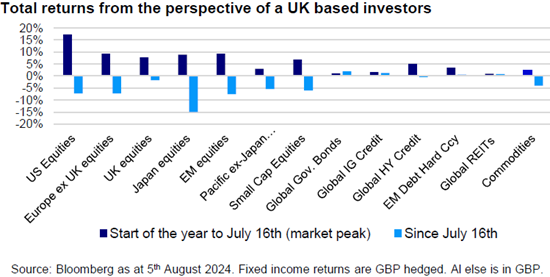
Risk assets performed strongly since the start of the year, driven by hopes for a goldilocks economic scenario and a rush into US tech stocks fuelled by enthusiasm for artificial intelligence technology. At their peak on July 16th, global equites were up 14% in GBP terms.

In the last few weeks however, sentiment started to shift, with global equities giving back half of their year-to-date gains. Bonds on the other hand have offered multi-asset investors some reassurance as this more classical growth-driven sell-off has seen government bonds cushion part of the blow in equities by moving in the opposite direction.

Notwithstanding the alarming moves, investors should note that most markets are still up for the year as shown below.

What has triggered the sell-off?

It’s hard to pin this on any single event. Below we list what we think are some of the key culprits.

1. Recession fears?

After several months of stability, economic data around the world has started to soften with the most noticeable decline being in the US – evidenced by last Friday’s unexpected 114k new jobs added (lower than the 215k average of the last year) and the unemployment rate jumping to 4.3%, the highest since October of 2021. Although that’s not in and of itself an unhealthy unemployment rate, its sudden march higher has raised concerns for a potential recession.

2. Fed too slow to act?

Post the 2022 pull-back, equity markets have been unstoppable, buoyed by falling inflation and growing expectations of rate cuts, particularly from the US Fed. But during last week’s meeting, the Fed didn’t cut rates as many had hoped triggering fears that the Fed may be too late to act before a slow in hiring turns into rampant layoffs.

3. AI trade losing steam?

After benefitting from stellar returns, investors started to unwind big positions in the likes of Apple, Nvidia, Microsoft, Meta, Amazon, Alphabet and other tech stocks. Warren Buffet, Berkshire Hathaway’s CEO for instance recently sold half of Berkshire’s stake in Apple, which many see as a troubling sign for the health of the tech sector. Because these companies make up an enormous chunk of the overall value of the S&P 500, when investors sell off tech stocks, that has a massive detrimental effect on the broader market.

4. Unwinding of the Japanese yen carry trade

While less structural in nature, the mayhem that swept across world markets was amplified by a market strategy known as the “carry trade.” Japan’s benchmark Nikkei 225 plunged 12.4% on Monday and markets in Europe and North America suffered outsized losses as traders sold stocks to help cover rising risks from investments made using cheaply financed funds borrowed mostly in Japanese yen. Markets recovered much of their losses on Tuesday. But the damage lingers.

More common than you think

Drawdowns (a decline of less than 10%), are always coming. Since the early 1980s, there has been a greater than 5% drawdown in the S&P 500 Index in every year but two (1995 and 2017). Even in this year, which had felt relatively benevolent until the past few weeks, the S&P 500 Index experienced a 5% drawdown in April before climbing to an all-time high in the middle of July.

On the other hand, corrections (declines of greater than 10%) happen less frequently. Corrections typically don’t just emerge out of nowhere. Often, they’re the result of policy uncertainty and/or surprising weakness in economic activity. The market has currently gone since Nov. 2, 2023, without an official correction, representing a 188-day period of a resilient economy and declining inflation.

Reasons to remain constructive as the dust settles

We appear to potentially now be on the brink of that next 10% decline as the economy weakens, the Federal Reserve passed on lowering interest rates at the July meeting and investors continue to lighten their holdings in expensive tech stocks.

It is hard to say with precision how long this bout of volatility will last for, and even though market participants appear to have quickly moved from pricing an overly rosy picture to an overly negative one, we think that at this stage, investors shouldn’t necessarily throw in the towel.

Growth slowdown is not the same as recession

In our opinion, this macro backdrop is consistent with an incoming deceleration but not indicative of imminent recession risks given:

  • Ongoing resilience in consumer and corporate balance sheets
  • The labour market is cooling, but not falling off a cliff
  • Banks do not appear to be tightening lending standards significantly
  • There does not appear to be significant excess in the economy

As of today, growth is solidly in positive territory on a global basis, with developed markets growing between 1-2% and consensus expectations signalling similar growth rates over the next two years.

The Fed should join the rate cut party soon

Last week, the Fed kept its main interest rate between 5.25 per cent and 5.5 per cent. However, the combination of a slowing jobs market, cooling inflation and the negative market reaction should lead the central bank to finally act. Historically, markets tended to perform well in easing cycles that were not associated with recessions. All eyes are therefore set on the Fed’s next meetings scheduled for September, November and December.

Tech stocks may be falling out of favour, but we don’t think this is their end

Tech stocks are still trading at lofty valuations, and while this may temper future upside potential, we don’t think investors will completely shy away from the sector. To evaluate the sustainability of their performance, investors should eschew reliance on charts of share price performance and focus instead on business fundamentals and valuations. While not unassailable these companies have large moats, very strong balance sheets, and many have revenue streams that are far less cyclical than tech companies of the past.

Please continue to check our blog content for advice, planning issues, and the latest investment, market and economic updates from leading investment houses.

Andrew Lloyd

08/08/2024

Team No Comments

The Daily Update – The Market’s Roller Coaster Ride

Please see below article received from EPIC Investment Partners this morning, which provides a global market update.

The global market rout that began on Monday showed signs of easing on Tuesday, with the Nikkei 225 rebounding more than 8% after its worst day since 1987. However, investors remain on edge as they grapple with the implications of a potential US economic slowdown and the Federal Reserve’s policy stance. 

The catalyst for the sudden risk-off sentiment appears to be growing fears of a “hard landing” as central banks, particularly the Fed, attempt to tame stubborn inflation without tipping economies into recession. Friday’s shockingly weak U.S. jobs report crystallised these concerns. It raised doubts about the health of the economy and the Fed’s ability to engineer a soft landing while keeping rates at 23-year highs. 

According to Mohamed A. El-Erian, the market turmoil can be attributed to five key factors: worries about a US growth slowdown undermining “American exceptionalism”, concerns that the Fed’s policy stance is too restrictive, crowded investment positions being caught offside, geopolitical risks in the Middle East, and domestic political developments ahead of the US presidential election. 

Nonetheless, the volatility outburst underscores the precarious and non-linear path to policy normalisation. As central banks attempt to delicately balance cooling demand whilst avoiding a hard landing, markets are prone to air pockets. Investors should brace for choppy and potentially divergent conditions across asset classes in the coming months. In this environment, selectivity and relative value are crucial. 

Within equities, companies with pricing power and resilient margins are likely to weather the storm better. In fixed income, high-grade credit offers attractive yields with lower default risk. Wealthy nations’ bonds are a strong addition to the portfolio aside from plain vanilla US Treasuries given global recessionary risks. 

Looking ahead, incoming US inflation and jobs data, as well as the Fed’s Jackson Hole Symposium, will be key watchpoints for any hints of a monetary policy pivot. More broadly, staying nimble and reactive will be critical as even small data surprises can spark outsized market moves in this fragile environment. While the path ahead might remain bumpy, the volatility spike does not fundamentally alter the broader macroeconomic backdrop at this stage. 

In this “middling” macro regime, a focus on quality, value, and resilience across asset classes remains the prudent approach. If the market’s ups and downs leave you feeling a bit queasy, just remember: every roller coaster eventually comes to a stop. 

Please check in again with us soon for further relevant content and market news.

Chloe

07/08/2024

Team No Comments

Brooks Macdonald Daily Investment Bulletin

Please see below the Daily Investment Bulletin from Brooks Macdonald, which was received on 06/08/2024:

What has happened

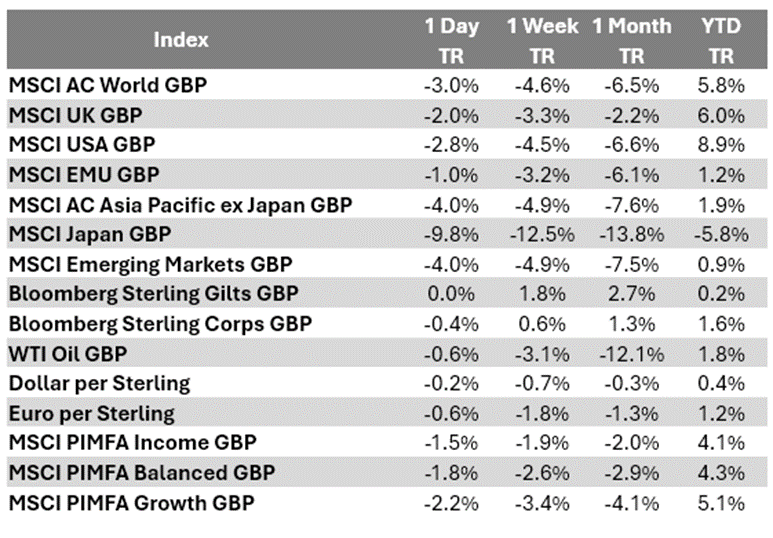
What a difference 24 hours makes. The big takeaway coming into today’s trading session is that markets, for the time being at least, appear to have found their footing. This comes after markets over the past week hit by a triple whammy of weaker economic data, mega-cap US technology results disappointments, and the surprise interest rate hike out of Japan. Much of the rebound from yesterday’s lows is stemming from a better-than-expected US ISM (Institute for Supply Management) Services PMI (Purchasing Managers’ Index) which has in part pushed back some of the fear that the US economy was about to tip into recession. Arguably the epicentre for the wave of selling over the last few days, Japan’s TOPIX has this morning posted a gain for the day of +9.30% and has as a result pushing the index for the whole of 2024 to date back into positive territory (just) of +2.33%. Otherwise, the other news out overnight is that Australia’s central bank (the RBA), has left interest rates unchanged at a 12-year high (of 4.35%) for the sixth meeting in a row.

A better US services PMI pushes back on fears of impending recession

After the weaker US manufacturing PMI and weaker US non-farm payroll jobs data last week, the markets were desperate for good news. For near-term investor sentiment, coming to the rescue was yesterday’s US services PMI print. The July reading saw a rise to 51.4 from 48.8 in June (and better than the 51 expected). Importantly, it put the index into expansionary territory (over 50). Beneath the headline, the ISM employment sub-component saw a bounce up to 51.1 (against 46.4 expected) and reaching its highest level since September 2023. While the data also showed some degree of sustained inflationary pressure, with the ‘prices paid’ sub-component up to 57 (versus 55.1 expected), markets were yesterday understandably more focused on the economic growth side of the equation.

Latest US Fed survey on credit conditions sees continued improvement

Also supporting a more constructive picture yesterday was the latest (calendar-quarterly) US Federal Reserve Senior Loan Officers’ Opinion Survey (SLOOS). While credit standards for commercial & industrial loans were still tightening, they were doing so at their slowest pace for 2 years, since Q2 2022, while standards for mortgages moved back to neutral. Reflecting the more market-friendly nuance, the US S&P500 banks sector index marginally outperformed the wider market yesterday. Historically, there is quite a good correlation between the SLOOS and trailing 12-month corporate earnings growth, so as the SLOOS continues to see a turn away from relatively tighter credit conditions, so this might bode positively for the earnings picture more broadly.

What does Brooks Macdonald think

Yesterday’s wild swings in markets has seen volatility return with a vengeance. At one point intraday yesterday, the so-called ‘fear gauge’ (the VIX index which measures the volatility of the US S&P500 equity index) was trading at 65.73, up 42.34 points and up +181% from Friday’s close. To put that in context, the largest full day move since the VIX index was first calculated back in 1990 was the 21.57-point increase on 12 March 2020 at around the time of the initial Covid-19 wave. After yesterday’s part-recovery in investor sentiment, last night the VIX index closed at 38.57. Whether the latest 24hours marks a slow return to some degree of relative market calm, or whether it is just the opening bout of more volatility to come, it is impossible to say. However, what we do know is that, as we said in our recent July edition of our Quarterly Market Overview, in an uncertain world, diversification remains key, enabling us to position our asset allocation settings for more than just one central forecast economic and market scenario.

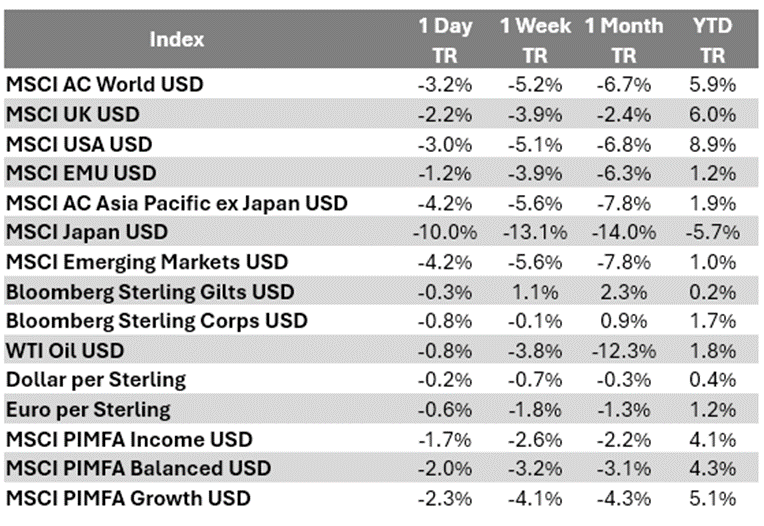
Bloomberg as at 06/08/2024. TR denotes Net Total Return.

Please continue to check our blog content for advice, planning issues and the latest investment, market and economic updates from leading investment houses.

Charlotte Clarke

06/08/2024

Team No Comments

EPIC Investment Partners – The Daily Update, Payrolls Boost Rate Cut Expectations

Please see the below article from EPIC Investment Partners detailing their thoughts on the labour market upon receipt of recent payroll statistics. Received last week.

A week is a long time in politics, but it can feel like an eternity in financial markets. In our recent piece, “The Mirage of Western Prosperity” (Markets – EPIC Investment Partners (epicip.com) we highlighted the concerning debt levels of G7 nations, concluding that the question wasn’t if interest rates would fall, but how far and how fast. Recent events have provided a resounding answer.

The precipitous drop in global bond yields, notably a 45 basis point decline in the US 10-year since our daily, can be partly attributed to Federal Reserve Chair Powell’s hints that payroll data might be overstating job growth, suggesting a September rate cut is on the horizon.

Today’s payroll figures further solidified this expectation, with the headline number falling well short of forecasts (114k versus expectations of 175k). Crucially, the unemployment rate has risen to 4.3% from its low of 3.4% in January last year. Models like the McKelvey Rule and Sahm Rule, which use changes in unemployment to predict recessions, are flashing warning signs. Adding to the unease, Intel’s announcement of a 15,000-person workforce reduction suggests trouble brewing within certain US companies.

However, jobs aren’t the sole driver of this rapid shift in interest rate expectations. The US ISM manufacturing survey, while indicating contraction, isn’t new news, as the survey has shown contraction for 20 of the past 21 months. What is noteworthy is the sharp decline in household expectations of future income. Last week, the University of Michigan’s Consumer Confidence report, while weaker than last month, masked a concerning trend buried within its data. A survey question on expected income changes has seen one of its sharpest declines ever, suggesting that people are bracing for reduced incomes or job losses. This implies weaker demand going forward, which in turn could lead to more job cuts, creating a potentially vicious cycle. Watch for larger rises in the unemployment rate going forward.

This raises questions about the seemingly strong job gains in recent payroll data. It’s important to remember that payroll figures measure the number of jobs, not individuals employed, and incorporate a statistical adjustment called the birth/death model. This model, based on historical data, can overestimate job creation, particularly at economic turning points. Therefore, the unemployment rate provides a more reliable picture of the labour market’s true state.

Today’s payroll data and the further rise in the unemployment rate reinforce our earlier assertion: the question isn’t if interest rates will fall, but how far and how fast. Moreover, today’s figures raise the alarming possibility that we may already be in the midst of a recession. 

Please continue to check our blog content for advice, planning issues, and the latest investment, market and economic updates from leading investment houses.

Alex Clare

05/08/2024