
Please see below, an article from Brooks Macdonald providing a brief analysis of the key factors currently affecting global investment markets. Received this morning – 01/04/2025:
What has happened
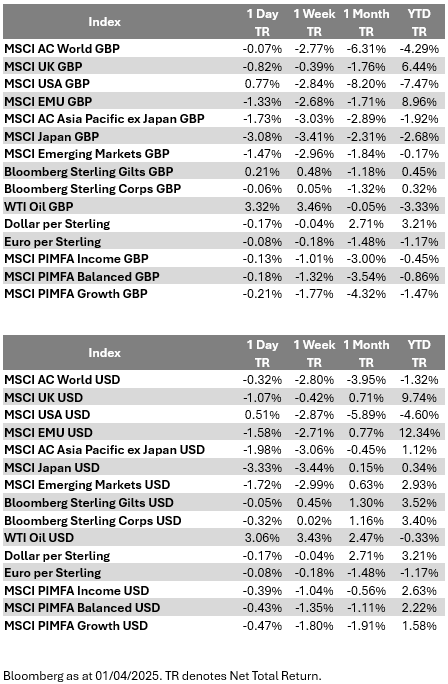
Yesterday wrapped up a mixed quarter for markets. With global tariff risks rising in Q1, investors rotated into previously unloved parts of the global equity market and challenging hitherto megacap tech leadership. During the quarter, the US ‘Magnificent Seven’ tech group fell -16.0%, weighing on US (and by extension global) equity markets with the US S&P500 equity index falling -4.6%. By contrast, over in Europe, the UK FTSE100 was up +5.0% and the pan-European STOXX600 equity index gained +5.2% in Q1, though investors here were not immune from tariff concerns, with the latter index losing over half of its cumulative year-to-date gains by quarter-end. China’s equity performance meanwhile was sandwiched between US and Europe, with the China CSI300 equity index down -1.2% in Q1 (all in local currency price return terms).
More tariffs coming but tax cut news too maybe?
We have just one more day to wait until US President Trump’s reciprocal tariffs are announced tomorrow, Wednesday 2 April at 3pm US Eastern Time. Yesterday, White House Press Secretary Leavitt said that there would be “country-based” tariffs, with further sectoral duties to come later. Separately on tax cuts, there were comments yesterday from US Treasury Secretary Bessent who said that he was working with Republicans in Congress to deliver Trump’s fiscal campaign promises, including “no tax on tips, no tax on Social Security, no tax on overtime” – meanwhile Republicans are reportedly seeking to formulate a tax cut package in Congress that permanently extends Trump’s 2017 tax cut provisions.
Australia’s central bank keeps interest rates on hold
As expected by markets, the Reserve Bank of Australia (RBA) earlier today left interest rates unchanged (at a cash rate of 4.1%). In their statement, the RBA highlighted an uncertain economic outlook for both domestic activity and inflation, while global risks remain significant driven by geopolitical and policy uncertainties, including US tariffs. For context, the RBA’s 25 basis points interest rate cut back in February this year was its first rate cut since late 2020.
What does Brooks Macdonald think
Markets have been bruised by Trump’s tariff escalation in recent weeks and the impact that they might have on economic growth and inflation – yet these trade levies (in principle) were always part of Trump’s November 2024 election manifesto, alongside his promises to deliver tax cuts and deregulation. So far, there has been an adverse timing mis-match of these two policy strands, with lots of negative tariff news, but precious-little in the way of new news on tax cuts in particular. Given the latest comments from the US administration yesterday around tax cuts, that sequencing of policy news and action could be about to change – it that is the case, a renewed focus on Trump’s market-friendly policies could bring a welcome positive distraction for investors and offer some support for risk assets more broadly.
Please continue to check our blog content for the latest advice and planning issues from leading investment management firms.
Andrew Lloyd DipPFS
1st April 2025