Team No Comments

M&G Wealth Weekly Market Commentary

Please see below article received from M&G Wealth yesterday afternoon, which provides an insight into market movements and the broader economic landscape.

This week’s highlights

  • Markets rise despite mixed economic data: stocks and bonds gained over the week.
  • US-China trade talks offer optimism: S&P 500 now up 20% from April lows.
  • Tesla tumbles: a heated exchange between President Trump and Elon Musk unsettled investors.

Market review

Early in the week, US economic reports pointed to challenges in manufacturing and services sectors. The Institute for Supply Management (ISM) Manufacturing Purchasing Managers Index (PMI) fell, signalling contraction for the third consecutive month and ISM Services PMI had its first decline in nearly a year.

The US labour market showed mixed signals. Job openings exceeded expectations at 7.4 million. However, a recent employment report showed a slowdown, with only 37,000 new jobs added in May – the lowest since March 2023.

US President Trump and China’s President Xi held a phone conversation aiming to ease tensions. While details on trade negotiations remained unclear, markets responded positively, with the S&P 500 briefly entering a bull market – up 20% from April lows.

However, momentum slowed later in the week following an exchange of sharp words between President Trump and Tesla CEO Elon Musk. Their disagreements ranged from recent spending legislation, past political ties and concerns over government contracts. Tesla shares fell 14.26% on Thursday.

Outlook

The economic environment has been resilient so far. The recent stumbling blocks posed to tariff implementation on the scale initially laid out, have offered a temporary reprieve for world leaders and policymakers. We expect markets to remain volatile as the legality of Trump’s tariffs moves into the spotlight, meaning nations may pause or pivot on their efforts to strike trade deals with the US.

Chart of the week

ECB reduces interest rates The European Central Bank (ECB) has reduced interest rates again, bringing the deposit rate down from 2.25% to 2%. This marks a significant shift, as rates have now been cut by half since their peak in September 2023.

The decision comes in response to declining inflation in the eurozone, which fell to 1.9% last month – below the ECB’s 2% target. Additionally, the central bank adjusted its inflation forecasts, lowering projections for 2025 and 2026 to 2% and 1.6%, respectively.

ECB President Christine Lagarde highlighted concerns about ongoing tariff uncertainty and its potential impact on economic growth, reinforcing the need for rate cuts. However, she also suggested that the ECB is nearing the end of its rate-cutting cycle.

What this means for you

Varying inflation levels and trade tariff uncertainty continues to influence market performance across the globe, strengthening the importance of maintaining a well-diversified long-term investment approach, rather than reacting to short-term market swings. By staying committed to carefully considered plans, investors can navigate through periods of volatility and uncertainty.

Please check in with us again soon for further relevant content and market news.

Chloe

10/06/2025

Team No Comments

Tatton Investment Management – Monday Digest

Please see below, an article from Tatton Investment Management analysing the key factors currently affecting global investment markets. Received today – 09/06/2025

Summer starts with less spring


Global stock markets edged close to all-time highs, but the Trump-Musk spat knocked Tesla shares – though thankfully not much else. The bust-up is probably less important than the week’s other political news: the UK Defence Review suggests tax rises, the Germany-US meeting went well, and US-China negotiations trundled along.

Stock prices were helped by lower bond yields – even though these came from weaker growth. The US’ non-farm payrolls (US jobs figures) came in relatively strong, but other US employment data look weak. We said before that companies were neither hiring nor firing – but the latter part is now threatened. The Federal Reserve will be watching the employment data closely, and markets now expect two rate cuts by the year’s end. Soft data didn’t spook equity investors, though, as it was only mild and bond yields have been the bigger concern lately.

German and French bond yields actually spiked this week – despite the ECB cutting rates. This was because ECB president Lagarde said the rate cutting cycle is nearly over, which markets took as hawkish on rates but fairly bullish on European growth. The euro rallied, as did sterling. Part of this is dollar weakness, but we should recognise UK and European strength (the best performing stock markets this year).

Dollar weakness is a concern for US assets. Capital has flowed out of the world’s biggest market this year due to higher risks. For international investors, the dollar is one of those risks. The S&P 500 is still firmly negative year-to-date for British and European investors, for example.

Risk-reward metrics (like Sharpe ratios) have shifted, leading non-US institutional investors to reallocate away from the US – as we said they would. These trends can reinforce themselves: capital outflows weaken the dollar, which increases currency risk, which, at the margin, forces more allocation away from US assets. Currency moves will be crucial to watch from here.

May asset returns review


May was good to global investors, with global stocks up 4.7% in sterling terms and all major regions in the black. Equity investors feasted on the so-called “TACO trade” (Trump Always Chickens Out) and Donald Trump’s promised tax cuts. The US was May’s best performer, up 5.3%, largely thanks to its tech sector gaining 8.6%.

US tax cuts led to debt fears in bond markets, however. This drove US treasury yields up substantially through the month, which caused a stock market wobble mid-month. Thankfully, the government bond sell-off didn’t crank up corporate borrowing costs (thanks to low issuance of corporate bonds), and better-than-expected data helped equities quickly recover.

UK government bonds were particularly hurt by higher US yields, losing 1.2% in May. Downing Street’s fiscal discipline message isn’t affecting its borrowing costs (which remain at the mercy of the US) but is arguably helping sterling strength. UK stocks rallied 3.8% last month and are behind only China over the last 12 months. The euro also strengthened against the dollar, a sign that the US-to-EU capital flow continues. Germany’s fiscal expansion is seen as positive – as it has much more room to issue debt – and Europe is the best performer year-to-date, up 12.8%.

China was the weakest region (+2.1%) in May but is still the strongest over 12 months, despite tariff threats and the government’s inability to properly stimulate its weak economy. Commodities were the worst performers but were still positive overall – up 0.6%. We take this as a sign of market liquidity and risk appetite, evidenced by the pullback in gold prices (which go up when investors are fearful).

The return of liquidity and risk appetite was May’s defining characteristic. Trouble bubbles away under the surface, impacting bonds and capital flow out of the US. But for now, investors seem happy to let them slide.

Earnings analysts are as uncertain as everyone else


American companies’ Q1 earnings were good, but strength was yet again focussed on the Magnificent Seven (Mag7 – Alphabet, Amazon, Apple, Meta, Microsoft, Nvidia, Tesla). The Mag7 posted 30.2% year-on-year growth versus 8% for the other S&P 500 companies, and smaller companies struggled. Even the Mag7 has become more of a Mag6, with Tesla’s profits falling a miserable 40% year-on-year (and that’s before any of the Trump-Musk threats).

The Mag7 delivered some of the best surprises too – with Amazon, Alphabet and Meta beating earnings estimates. The communication services sector (including Alpabet and Meta) is now the only one with projected 2025 earnings higher than at the start of the year.

Corporate earnings expectations have been hit this year, falling 1% from January to April and another 2% after “Liberation Day” tariffs. Normally, positive earnings surprises like those seen for Q1 would push up future earnings projections – since companies are building from a higher base. But while the Mag7’s beat cranked up Q2 expectations, earnings beyond that are largely unchanged. This is, again, about tariffs. Apple has been particularly threatened by the White House, for example, and was one of the Mag7’s weaker earners.

Earnings analysts basing their projections on macroeconomic policy predictions is a little problematic. It’s a top-down approach, when earnings estimates are supposed to be bottom-up. It could certainly be positive for stocks: if companies are more resilient than expected or the TACO narrative prevails, earnings surprises would likely spur a rally. But you would always rather have precise earnings estimates. They are what stock valuations are based on, impacting investment decisions.

In other words, if analysts are influenced by the prevailing market narrative more than company specifics, it increases the chance that stock markets themselves are mispriced. This mispricing might work out for the best, but reliable information is better than unreliable information.

Please continue to check our blog content for the latest advice and planning issues from leading investment management firms.

Marcus Blenkinsop

09/06/2025

Team No Comments

Brooks Macdonald: Daily Investment Bulletin

Please see below, Brooks Macdonald’s Daily Investment Bulletin which highlights the key factors currently impacting global investment markets. Received today – 06/06/2025

What has happened?

Equity markets struggled for direction yesterday with positive and negative news flow creating a tug-of-war for investors. While market sentiment got a boost from a positive read-out of a telephone call between US and China Presidents Trump and Xi, against this there was an unexpected rise in weekly US initial jobless claims, hitting a 7-month high. Adding to downside pressure on markets, while the European Central Bank yesterday cut interest rates as expected, unexpectedly it laced the move with hawkish commentary saying that it was “nearly concluded” with the rate-cutting cycle. Later today, all eyes are on the latest (May) US non-farm payrolls employment data, due out at 1.30pm UK time – a Reuters survey of economists is looking for +130,000 jobs added in May, which if that is the number would be the smallest gain in 3 months.

Musk and Trump have a very public falling-out

A dramatic falling-out played out over social media yesterday between the world’s richest man Elon Musk and US President Trump. Musk’s Tesla share price plummeted -14% on Thursday, while Trump’s social media platform share price (Trump Media and Technology) dropped -8%. Trump said he was “disappointed” by Musk’s criticism of Trump’s tax and spending cut bill, while Musk said Trump would have lost the election without his support and responded “yes” to a suggestion that Trump should be impeached. Following Trump’s threat to “terminate” Musk’s companies’ government contracts, Musk has since signalled he might be open to a cooling-off period in his war of words with Trump.

ONS reporting error weakens confidence in UK economic data

The UK Office for National Statistics (ONS) yesterday admitted that Consumer Price Index (CPI) inflation data for April was overstated. The error arose from Department of Transport data where the number of vehicles subject to tax in the first year of registration was too high. It means that the annual all-items CPI reading for April should have been +3.4%, and not +3.5% as was previously reported. Nonetheless, the correct figure of +3.4% was still higher than the +3.3% that had been expected at the time and was still sharply higher versus the +2.6% reported in March. Despite the error, the ONS said it would not be revising the official published (now incorrect) figure. The next (May) monthly CPI print from the ONS is due out Wednesday 18 June.

What does Brooks Macdonald think?

Economic data quality is crucial. It is hard enough for businesses, consumers and investors to discern the economic outlook, let alone if the quality of the data cannot be trusted. This is not the first time the ONS has had data issues, but it is not a UK-only phenomenon – the US Bureau of Labour Statistics (BLS) announced only this week that it had “suspended CPI data collection entirely” in parts of Nebraska, Utah, and New York, due to government cutbacks resulting in fewer people and resources available to do all the statistical work necessary – in BLS parlance, it said that “current resources can no longer support the collection effort”. All in all, question marks around economic data quality and reliability add an unwelcome layer of uncertainty for investors to have to navigate.

Bloomberg as at 06/06/2025. TR denotes Net Total Return.

Please continue to check our blog content for the latest advice and planning issues from leading investment management firms.

Alex Kitteringham

6th June 2025

Team No Comments

Brooks Macdonald – Daily Investment Bulletin

Please see below, Brooks Macdonald’s Daily Investment Bulletin which summarises the key factors currently impacting global investment markets. Received today – 05/06/2025

What has happened

Wednesday saw global equities (as measured by the MSCI All Country World Index in US dollar price return terms) hit a fresh all-time record high for the first time since February earlier this year. Yesterday’s gains came about despite weaker US economic data, as investors instead appeared to focus on hopes that the data could boost chances for interest cuts later this year. That global equities have hit a fresh record is pretty impressive (albeit measured in dollars where the US dollar is weaker in recent months) given there is still significant uncertainty on the tariff policy outlook. Later today, the focus is on the European Central Bank (ECB) interest rate decision due at 1.15pm UK time, where an interest rate cut (which would be the ECB’s eighth cut in the current cycle) is widely expected.

US banking deregulation expectations

Yesterday saw Senate approve US President Trump’s pick of Michelle Bowman for the position of US Federal Reserve (Fed) vice-chair for banking supervision. Bowman, who has served on the Fed’s board as a governor since 2018, is expected to be a ‘light-touch’ advocate, in keeping with Trump’s plans for banking deregulation, and is expected to get such a programme underway – this would also fit with recent comments from US Treasury Secretary Scott Bessent who said last month that “the growth of private credit tells me that the regulated banking system has been too tightly constrained”. Amongst some of the possible banking deregulation measures under consideration, this could include a relaxing of the rules around setting banks’ capital buffer requirements, more co-ordinated and streamlined regulatory oversight, as well as quicker and likely more sympathetic regulatory views towards bank merger-and-acquisition activity going forwards.

US economic data buoys interest rate cut hopes

It seems we might be back to a ‘bad news is good news’ mindset in markets – this is the idea that bad economic news is good news for markets as it might buoy hopes for interest rate cuts. The weaker economic news yesterday came in two parts: first, an ADP Research Institute report of US private payrolls saw hiring up by the smallest increase in over 2 years, since March 2023; second, the US ISM (Institute for Supply Manufacturing) Services survey for May dropped below the 50-midpoint mark that splits the month-on-month economic picture between expansion versus contraction – it dropped to 49.9 in May from 51.6 in April – in addition, as the ISM chair Steve Miller commented, survey respondents “continued to report difficulty in forecasting and planning due to longer-term tariff uncertainty”.

 What does Brooks Macdonald think

It will be interesting to see if any US-led banking deregulation spurs similar moves in other countries as banking regulators around the world will likely come under pressure to avoid suffering undue competitive disadvantage for their own home-grown banking champions. As a counter to this, there are valid arguments that too much banking deregulation might weaken the counter-cyclical ability of banks to weather economic downturns, which some government policy makers might be more cautious around relaxing. Either way, in the near-term, any banking deregulation is likely to boost banks’ lending growth outlooks and with it set an improved earnings outlook for the banks as well, providing another tailwind for risk-asset markets more broadly.

Bloomberg as at 05/06/2025. TR denotes Net Total Return.

Please continue to check our blog content for the latest advice and planning issues from leading investment management firms.

Marcus Blenkinsop

5th June 2025

Team No Comments

Brewin Dolphin – Markets in a Minute

Please see this week’s Markets in a Minute update below from Brewin Dolphin, received yesterday afternoon – 03/06/2025.

Trump tariffs face setback as markets calm 

U.S. trade court challenges Trump’s tariffs, potentially easing trade tensions – but a longer fight may lie ahead.

U.S. Court of International Trade strikes down tariffs

There have been dramatic legal twists this week in the ongoing saga over President Donald Trump’s trade tariffs. The U.S. Court of International Trade (CIT) ruled that the Trump administration’s ‘Liberation Day’ tariffs were illegal, exceeding the president’s authority under the International Emergency Economic Powers Act (IEEPA). As a result, the 10% universal tariff, 20% fentanyl-related tariffs on China, and 25% fentanyl-related tariffs on non-compliant imports from Canada and Mexico (under the U.S.-Mexico-Canada Agreement) were all set to be removed. 

That would have led to a reduction in the effective U.S. tariff rate, which would likely remain at 6.5% instead of rising to 15%. It would mean lower tariff revenue, now estimated at around $115bn annually, rather than the previously estimated $360bn. Tariff revenue offset some of the planned increases to borrowing, which are driven by the administration’s plans to roll over and extend tax cuts. The U.S. budget deficit would reach around 7% of gross domestic product (GDP) under the House of Representative’s plan with a lower tariff income, rather than remaining near 6% of GDP with a higher tariff income.

However, plenty of uncertainty remained over this. The president’s authority under IEEPA was deemed an overreach, but he could still use Section 232 investigations, Section 301 tariffs, or other (mostly untested) options to impose tariffs on trading partners.

Section 232 allows the president to impose tariffs on imports that threaten national security, and it was this route he used for steel, aluminium and, more tenuously, car imports. Section 301 allows the U.S. Trade Representative (USTR) to impose tariffs on imports from countries that engage in unfair trade practices. That seems the most appropriate means for reciprocal tariffs, but it requires an investigation into those practices. The USTR did initially conduct an investigation. However, the eventual tariffs were imposed based on trade balances rather than the investigation, and no country was exempted.

Supreme Court

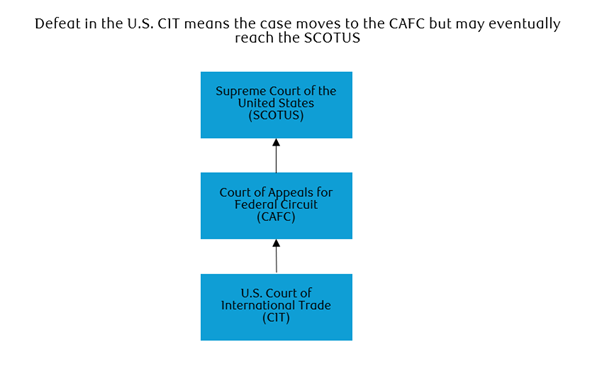
The initial CIT decision was seen as good news for the stock market and the U.S. dollar. However, gains faded. There are a few reasons for caution. The most obvious being the risk that the decision could be challenged, which it was.

A U.S. federal appeals court granted a temporary reprieve to the Trump administration’s global tariff plans on Thursday, pausing the CIT’s ruling. The U.S. CAFC issued a stay “until further notice,” effectively putting on hold the CIT’s decision that had blocked the tariffs and given the administration ten days to unwind the levies.

There will now be a further pause until 9 June, when the CAFC will decide on the request for a longer-term stay.

If the Court of Appeals reinstated the CIT decision, it wouldn’t be good news across the board. The additional fiscal pressure due to lost tariff income would put the public finances under more pressure, which would be bad for bonds and could undermine stocks. It also adds to the narrative that the administration is being curtailed by ‘unelected judges’ sowing more division within a polarised nation. The case would likely then go to the U.S. Supreme Court, which currently has a majority of conservative members. Sky-high trade uncertainty would continue to undermine business activity and companies would opportunistically use any temporary stays of the tariff measures to bolster inventories, causing trade to be lumpy and unpredictable.

American consumer sentiment improves

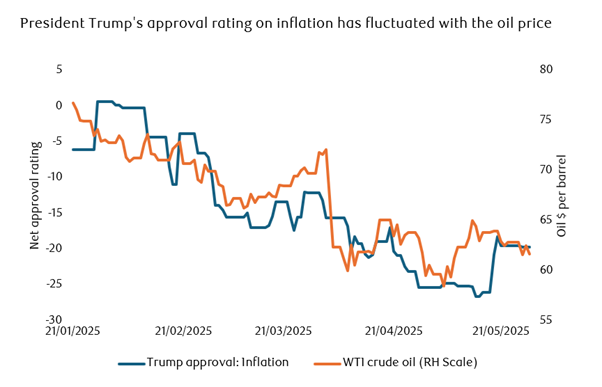
U.S. consumer confidence improved during May. This reflects a greater sense of positivity that has developed in the U.S. and that’s reflected in a stabilisation of President Trump’s approval rating.

Trumps approval rating

Source: LSEG Datastream

The natural path of presidential popularity is downward, and President Trump was becoming unpopular at a historically fast pace. However, his approval ratings have steadied and recovered during May. This likely reflects the deferral of the highest tariff rates and the prospect of trade deals being announced (like the one with the UK).

Tariffs have yet to wreak the kind of havoc media headlines might have suggested, and other factors have offset them. Most obviously, the price drop in energy markets has offset price inflation in other categories.

OPEC agrees to cut oil production

Last week, the Organisation of the Petroleum Exporting Countries (OPEC) agreed to cut oil production in the future. However, the latest near-term plan to increase production was approved over the weekend.

These increases are a means for Saudi Arabia to punish its fellow cartel members for breaking previous production limits. An increase in production will weigh on the oil price, hurting the finances of oil producing companies and nations. However, it will be cheered in the U.S., where the lack of tax on gasoline means that volatile swings in energy commodity markets are felt directly in the pockets of U.S. consumers. Recent falls will feel very much like a tax cut for many Americans, boosting growth and reducing inflation.

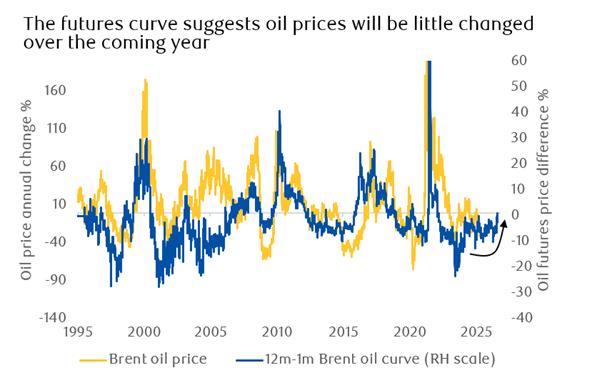
Anticipated shortages of crude oil due to production cuts from OPEC and possible disruption in the Middle East had caused the oil futures curve to become ‘backwardated’ (futures prices are below current oil prices). Usually when this happens, it indicates energy prices will be weaker in the future, as seen in this instance. Oil prices fell as OPEC temporarily expanded production, which it’s poised to do again this weekend.

The news for energy investors has been poor due to these production increases. But with a flat-to-upward sloping curve, the outlook seems more balanced. Energy stocks are a useful component for portfolios that are otherwise vulnerable to the growth and inflation impact of an oil price spike.

Oil prices

Source: LSEG Datastream

Please continue to check our blog content for advice, planning issues and the latest investment market and economic updates from leading investment houses.

Charlotte Clarke

04/06/2025

Team No Comments

Brooks Macdonald Daily Investment Bulletin

Please see below article received from Brooks Macdonald this morning, which provides a global market update for your perusal.

What has happened

Markets had a mixed first-trading day of the new month yesterday. The US S&P500 equity index rallied late in the day to finish up +0.41%, as strength in semiconductor stocks led the market higher despite weaker manufacturing survey data. Elsewhere, the pan-European STOXX600 equity index closed marginally lower at -0.14%, closing before that late US intraday rally had kicked in, while Asian equity markets overnight are mostly higher (all in local currency price return terms). Finally – breaking news this morning that the Dutch government has collapsed after the far-right Freedom party quit the governing coalition citing disagreement over migration and border control policy – if a new coalition cannot be formed, it is expected to trigger a snap general election – the timing is unfortunate given the Netherlands is due to host world leaders for a NATO (North Atlantic Treaty Organization) summit later this month.

US manufacturing data underwhelms

The latest US Institute for Supply Management (ISM) manufacturing survey for May was released yesterday. In it, the headline print was 48.5, a six-month low; it was down month-on-month from April’s 48.7, below 49.5 expected, and below the 50-midway point that divides between month-on-month surveyed economic activity contraction versus expansion. Of particular note, within the data, the imports index sub-component fell to 39.9, from 47.1 in April, below its low point during the Covid pandemic and at a level last seen back in May 2009 when the US economy was coming out of the 2008 Global Financial Crisis.

China manufacturing data weaker

Earlier this morning, China has released its own latest manufacturing survey activity data for May. The Caixin/S&P headline print was 48.3, below 50.7 expected, down from 50.4 in April, marking the lowest reading since September 2022, and the first sub-50 reading since September last year. The weaker print in part reflects a drop in the new export orders sub-component, which fell for the second month in a row and was at the lowest level since July 2023.

What does Brooks Macdonald think Tariff uncertainty between the US and China, triggered by US President Trump’s 2 April “Liberation Day” announcement, is already starting to show up in the data – as evidenced by weaker China export and US import data, respectively. Given the recent 90-day pauses in the most extreme parts of Trump’s tariffs, it will be interesting to see whether there might be a subsequent bounce-back in these export and import readings in the coming months. However, it suggests that even if this is the case, there will still be a high level of uncertainty around the range of economic forecasts, and which will likely keep markets on edge for the time being.

Please check in again with us soon for further relevant content and market news.

Chloe

03/06/2025

Team No Comments

Tatton Investment Management – The Monday Digest

Please see the below article from Tatton Investment Management detailing their discussions surrounding the ongoing Trump Tariff saga and how trade markets are responding. Received this morning 02/06/2025.

Complacency or checks and balances

The pullback a couple weeks ago has proved just a blip, thanks to the TACO trade (Trump Always Chickens Out) and a US trade court ruling Trump’s tariffs illegal (though the ruling was quickly suspended). Markets were happy but the previously “Mr Nice Guy” president was furious.

So we expected and got some Nasty Trump. On Friday, steel and aluminium tariffs were raised from 25% to 50%, probably signalling a greater focus on sectoral levies. While there is probably more internal logic to a sector-based approach, this makes country-based negotiations generally more complicated and certainly disrupts current talks. Deadlines are unlikely to be hit.

The start-date for the increase is Wednesday but, given his beef with the chicken jibe, there is virtually no hope of a Trump back-down.

The end of the Q1 US earnings season has been resilient. Nvidia continued to show the AI boom is driving profit growth. Meanwhile, US consumers are still showing some confidence and previous recessionary signals have faded. This helped credit spreads come down and financial conditions ease. The main problem now is that economic strength will prevent the Federal Reserve from substantially cutting interest rates – especially since companies are still retaining employees.

It’s notable that markets took the court’s tariff ruling so well, considering bond investors have been fretting about government debt. Tariff revenues are necessary to fund Trump’s tax cuts, and that’s why the Republican-controlled Congress will almost certainly hand tariff-setting power back to the president.

Unlike the US, the UK is signalling some fiscal discipline but a little less so. Everyone expects tax rises to fund the budget gap, and Reeves intends to keep to the rules – except that she might change those rules to allow more investment spending, given that the IMF helpfully suggests she cuts herself some slack. Any such change will give the UK a one-off boost, raising overall debt levels and increasing probably, marginally, increasing the interest burden. Nevertheless, on balance, the policy mix is likely to improve long-term stability, helping rate expectations and sterling. It’s just unfortunate that our borrowing costs are still heavily tied to the undisciplined US.

As for the fights a wounded Trump might pick, the Fed independence question could rear its head again. The Supreme Court recently suggested the president could fire who he wants, but curiously signalled an exception for the Fed. Jerome Powell shouldn’t get too comfortable though, as many in the White House are looking to test the bounds of executive power.

Meanwhile, China’s economic weakness is being taken as evidence that Beijing might play nice – but this might be mistaken. Beijing could well replace economic prosperity with nationalist expansionism, like a rumoured Taiwan blockade in the autumn.

But markets are more focussed on the positives. We hope that’s a good sentiment sign, rather than complacency. 

The end of US exceptionalism?

By “American exceptionalism” we mean the dominant of US asset performance over the last decade and a half, particularly in stocks. This shouldn’t be confused by the political theory of American exceptionalism – though the shared name is no accident; both about people believing that the US is exceptional. This has manifested in US assets being the best and safest earners in tangible (Sharpe ratio) and intangible (reserve currency safe haven, stable business-friendly government) terms. We’ve written before about how the US’ current account deficit typically returns as a flow of dollars into its asset markets. That, combined with US businesses’ focus on high profit industries, has led to corporate profits and equity valuation outstripping the world.

But Trump’s erratic policies are undermining both pillars of American exceptionalism: high returns and low risks. His obsession with balancing the trade deficit would undermine the flow of dollars back into asset markets, but even without that the uncertainty is preventing business investment and souring consumer sentiment – which dampens long-term returns. That uncertainty also makes US assets riskier, like the spike in volatility we saw post “Liberation Day”. It’s telling that the dollar has not recovered in line with US stocks recently, suggesting the safe haven status has been weakened.

The end of US exceptionalism doesn’t mean bad returns; the US economy is too resilient for that, and ‘buy the dip’ mentality is too strong. But it means returns will be less world-beating. That’s a problem for American companies – as their high stock valuations depend on capital inflows which have already started reversing this year. We expect that trend to continue, as long-term institutional investors reduce their portfolio allocations to the US. This might only be a marginal change – but a marginal change on such a huge part of global markets means a big impact on global markets.

China’s Belt and Road

US trade isolationism has many wondering if China could capitalise – perhaps through its Belt and Road Initiative (BRI). More than 150 countries have signed BRI agreements with China, which typically provides capital and labour for overseas infrastructure. Westerners often consider the BRI a foreign policy tool, but it was originally a solution to economic imbalances: China had too much capital and construction capacity, but needed access to materials.

Some accuse Beijing of “debt trap diplomacy”, as BRI agreements are opaque and have left poor countries facing high debt payments. Foreign policy experts don’t find this accusation credible, and many BRI agreements have been mutually beneficial – particularly with Latin America, which now trades more with China than it does the US.

Beijing would struggle take advantage of US isolationism, though, and BRI investment has slowed in recent years amid an economic downturn. Beijing domestic stimulus programs take precedence over building trade ties. The trade ties China is building seem mostly practical – ‘connector’ countries on route to the US.

Cutting off China is also part of the US’ plan – as seen in Panama abandoning its BRI deal after a visit from Washington. The Trump administration also made sure to include anti-China measures in its trade deal with the UK, and is reportedly planning to do the same for any EU deal. The US wants to force its trade partners to chose between the world’s two largest economies.

There’s no guarantee everyone will pick America, of course. Brazil’s Lula recently declared he wants “indestructible” relations with China, at a conference of 33 Latin American and Caribbean countries in Beijing. President Xi notably promised to back Panama against US threats at that meeting, showing how the US’ hard line could backfire. A Chinese-dominated world trade order is unlikely but, amid US aggression, many leaders will like the sound of Xi’s promised multipolar world.

Please continue to check our blog content or advice, planning issues and the latest investment, market and economic updates from leading investment houses.

Alex Clare

02/06/2025

Team No Comments

Brooks Macdonald – Daily Investment Bulletin

Please see below, Brooks Macdonald’s Daily Investment Bulletin which summarises the key factors currently impacting global investment markets. Received today – 30/05/2025

What has happened

Optimism around potential tariff relief outweighed mixed economic data, boosting market sentiment. The S&P 500 gained +0.40%, with ten of its eleven sectors advancing. The Magnificent 7 stocks hit a three-month high, up +0.61%, driven by Nvidia’s strong +3.25% performance.

Tariffs back in place

Yesterday, Federal Appeals Court temporarily upheld tariffs imposed under the International Emergency Economic Powers Act, including a 10% baseline tariff, a 20% additional tariff on China, and a 25% tariff on non-USMCA-compliant imports from Mexico and Canada. In the meantime, the White House is exploring alternative tariff powers under the Trade Act of 1974, which allows 15% tariffs for 150 days to address trade imbalances and allows tailoring country-specific tariffs after investigation. While legal challenges are likely, this approach could stand on stronger legal footing than the current framework.

Data drives rate cut hopes

Markets also saw weaker economic data than expected. Weekly jobless claims rose to 240,000 (above the 230,000 forecast), and continuing claims hit 1.919 million (versus 1.893 million expected). Q1 GDP showed personal consumption growth revised down to +1.2%, the weakest in seven quarters. April’s pending home sales also dropped significantly, the largest decline since September 2022. These figures fuelled hopes for Federal Reserve rate cuts, with markets now pricing in 50 basis points of cuts by December.

What does Brooks Macdonald think

Recent tariff developments are getting hard to keep up. In a week, we have seen a 50% EU tariff announced, delayed by five weeks, and a US Court ruling against broad tariffs, followed by an appeals court stay keeping them in place. At the same time, the Trump administration is prepared to pivot to alternative tariff powers if needed. While a court ruling could potentially reduce tariffs, a return to a pre-2025 ‘tariff-free’ world seems unlikely. We expect ongoing trade policy uncertainty to influence markets, but resilient corporate earnings and increasing expectations of Fed rate cuts could support risk assets in the near term.

Bloomberg as at 30/05/2025. TR denotes Net Total Return.

Please continue to check our blog content for the latest advice and planning issues from leading investment management firms.

Marcus Blenkinsop

30th May 2025

Team No Comments

Brooks Macdonald – Daily Investment Bulletin

Please see today’s Daily Investment Bulletin from Brooks Macdonald covering the overnight news that the US Court of International Trade ruled that President Trump lacked the authority to impose the ‘Liberation Day’ tariffs:

What has happened

Yesterday was a quiet day for markets, with the S&P 500 dipping 0.56% after Tuesday’s 2.05% surge, while Europe followed a similar trend. The big news came after the US market close, when the US Court of International Trade ruled that President Trump lacked the authority to impose the ‘Liberation Day’ tariffs. This decision sparked a global market rally, with S&P 500 futures jumping 1.60% overnight. The positive sentiment spread globally, with Asian equity indices advancing and European markets opening higher this morning.

US trade court strikes down Trump’s tariffs

The US Court of International Trade unanimously ruled that the Trump administration lacked the authority to impose most of its recently announced tariffs under the International Emergency Economic Powers Act (IEEPA). This decision nullifies several tariffs, including the 10% baseline reciprocal tariffs announced on April 2, the 25% tariffs on Canada and Mexico, and the 20% duties on China tied to border crossings and fentanyl traffic. However, tariffs on steel, aluminium, and automobiles, enacted under separate authorities like Section 232 for national security, remain unaffected. The Justice Department has filed an appeal with the US Court of Appeals, and this case could potentially reach the Supreme Court. While President Trump has not yet commented publicly, the ruling poses a challenge to the administration’s tariff strategy, which aimed to use tariff revenue to fund tax cuts. For now, the decision may delay high tariff rates, giving businesses and investors more time to adapt.

Nvidia revenues holding up

Nvidia’s Q1 earnings, released after the US market close, further fuelled market optimism. The chip giant reported $44.1 billion in revenue, slightly above the $43.3 billion expected, and forecasted $45 billion for Q2, in line with analyst projections despite an $8 billion sales hit from US restrictions on AI chip exports to China. Nvidia’s shares jumped nearly 5% in after-hours trading. However, the broader tech sector faced headwinds earlier in the day. A Financial Times report revealed that the Trump administration ordered US chip design software companies to halt sales to China, leading to sharp declines in stocks like Cadence Design Systems (-10.67%) and Synopsys (-9.64%). The ‘Magnificent 7’ tech group also fell 0.53% before Nvidia’s earnings provided a counterbalance.

What does Brooks Macdonald think

While the tariff ruling is a setback for the Trump administration’s trade agenda, it is not the endgame. The ongoing appeal could overturn the decision, and the administration may pivot to alternative tariff mechanisms, such as expanding Section 232 tariffs used for steel, aluminium, and autos. Nonetheless, the decision could slow the pace of aggressive tariff hikes, offering investors and businesses a window to adjust. It also underscores the strength of the US judicial system in upholding the rule of law. However, with multiple other legal pathways available for imposing tariffs, the tariff war is far from over.

A table with numbers and text

AI-generated content may be incorrect.

Please continue to check our blog content for advice, planning issues and the latest investment market, and economic updates from leading investment houses.

Andrew Lloyd

29/05/2025

Team No Comments

Brewin Dolphin – Markets in a Minute

Please see this week’s Markets in a Minute update below from Brewin Dolphin, received yesterday afternoon – 28/05/2025:

Bond vigilantes return

U.S. government bonds (treasuries) fell in price as investors required higher yields. A 20-year auction (government sale of bonds to investors) saw weak support and a bump up in yields, adding to U.S. borrowing costs.

The rapid expansion of U.S. government debt, which has accelerated in recent years, has started to cause ructions in the bond markets. U.S. President Donald Trump’s administration has helped craft a tax and spending bill that’s currently under negotiation in Congress. The bill narrowly passed the House of Representatives by a vote of 215 to 214 and is widely expected to increase the federal budget deficit. It still has to pass the Senate, which may require more changes, to become law.

As it stands, the deficit increase is largely mitigated by tariff income, but this is controversial because tariff income doesn’t reflect current legislation; instead, it stems from executive emergency powers with an implication that it should be temporary in nature (although seems likely to remain in place).

Ultimately, Congress can convince itself that tax cuts can pay for themselves through higher growth, but the bond market is more objective. More issuances seem to be driving the increase in bond yields.

Bond vigilantism occurs when the bond market sells off and borrowing costs rise in response to the government seeming to want to pursue unsustainable policies. It ended Liz Truss’s premiership in the UK, and it may have prompted President Trump to reverse course on his ‘Liberation Day’ tariffs.

One of the inconsistencies of the new trade policy is that by discouraging trade with the U.S., President Trump’s also discouraging the use of the dollar as the world’s reserve currency and, in doing so, is making it less important for foreign investors to lend to the U.S. government. This has led to a decrease in demand for U.S. treasuries at a time when the government wants to borrow more and therefore sell more treasuries.

Yields are heading towards more attractive levels, but the path of least resistance is for treasury yields to rise. 

Inflation could be an additional concern for the U.S. bond market, but when dissecting the movement of the U.S. yield curve into different components, it doesn’t seem to be the greatest concern.

Output prices are on the rise

 Longer-term inflation expectations have been stable despite alarming results of consumer inflation expectation surveys.

This week’s purchasing managers indices (PMIs) suggested that European economies, including the UK’s, remain sluggish. More notable was the significant improvement in U.S. business conditions, at least as far as new orders are concerned. But perhaps the most significant series of data was that related to output prices.

According to the PMIs, a significant majority of U.S. companies increased their prices. Since the ‘Liberation Day’ announcements, that proportion has been increasing sharply. The increase was “overwhelmingly linked to tariffs”, according to company responses. 

So, while it’s been frustrating that surveys continue to suggest that the impact of tariffs has been more meaningful than activity data suggest, here’s more compelling evidence that tariffs will weigh on U.S. consumers and businesses in the coming months.

A graph of a sales increase

AI-generated content may be incorrect.

A welcome boost to UK retail sales

UK retail sales figures for April were pleasantly surprising, with a 1.2% increase in sales over the month. The sunny weather and late Easter likely played a big role in boosting sales, especially for outdoor goods and Easter treats. However, some of the growth was simply a rebound after a couple of tough months. As a result, it’s likely that retail sales will slow down in the coming months.

The underlying trend is still positive though. Retail sales have been steadily increasing since late 2023, driven by growing real wages and consumer confidence. Spending should continue to grow, albeit at a slower pace.

On the inflation front, the news is more mixed. Inflation surged to 3.5% in April, driven mainly by government-set price hikes, such as the 26% increase in water and sewerage bills, and the doubling of Vehicle Excise Duty rates. Airfares and package holidays also contributed to the rise, partly due to the timing of Easter. However, even excluding these one-off factors, underlying inflation pressure remains stubborn.

The Bank of England’s Monetary Policy Committee (MPC) is likely to proceed with caution, and the two additional rate cuts previously expected this year now seem open to question.

Looking ahead, headline inflation will average around 3.5% between April and December, driven by strong wage growth, hikes to the minimum wage, and tax increases. It’s expected to remain above target for an extended period, risking further de-anchoring of inflation expectations and persistent wage pressure. This is what the MPC needs to guard against.

UK bonds weakened over the week. They’ve been buffeted by both inflation and strong sales but also in sympathy with the bond vigilantism in the U.S.

A graph of a graph showing the growth of the company's sales

AI-generated content may be incorrect.

Please continue to check our blog content for advice, planning issues and the latest investment market and economic updates from leading investment houses.

Andrew Lloyd

29/05/2025