Team No Comments

W1M Macroeconomic Background

Please see the below article from W1M detailing their views on the current macroeconomic background. Direct from their Global Outlook Report issued on 11/08/2025.

Over the summer there has been surprisingly little market nervousness about the assorted uncertainties relating to US economic policy. Tariffs are generating genuine revenue ($26.6 billion in June alone) but there remains considerable uncertainty about who is paying this new tax. It seems to be a combination of corporates and consumers. But it is very difficult to model how this is going to evolve given that there remains no sign of an agreement with China. And even those agreements that have been made are light on details. For example, does the 15% tariff agreed with the European Union include pharmaceutical exports to the US? That seems unlikely given that President Trump has made it clear that is exactly the sort of thing that he wants to reverse and bring such manufacturing back to the USA. But for now at least the market has decided to not be concerned about these great unknowns.

The other theme that has asserted itself in recent weeks has been the outperformance of the US stock market and within the US the leadership has reverted to the so called “Magnificent 7” (Alphabet, Amazon, Apple, Meta Platforms, Microsoft, NVIDIA and Tesla). Those stocks now represent a record 32% of the benchmark S&P500 Index. The broadening of market leadership that we saw at the end of last year and the beginning of this has not been maintained. Although the theme of technological innovation and in particular the investment in Artificial Intelligence is very real it would be healthier if stock market leadership reverted to being broader than the current very narrow focus.

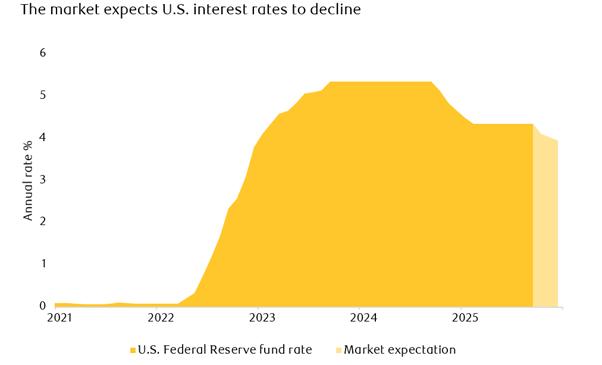
The market is also not showing concern about the political pressure being exerted on the Federal Reserve. There is a long history of President’s being frustrated by the Federal Reserve. Lyndon Johnson famously shoved Fed Chair William McChesney Martin against a wall at his ranch in Texas. Trump has not done that to Jerome Powell, yet. But Trump has appointed his Chair of Economic Advisors, Stephen Miran, as a Governor to serve until January 2026 and will be able to appoint a permanent Governor at that time. The likelihood is that interest rates will be reduced by the Fed in coming months. The market is expecting two rate cuts between now and the end of the year and sees the Fed Funds rate getting to 3.0% by January 2027, down from its current 4.5%.

That could happen if the market is correct in thinking that inflation is not going to reassert itself. The five year inflation swap is priced at 2.7% (i.e. that is what the market expects inflation to average over the next five years). A year ago the swap was priced at 2.25% but there has not been an adverse reaction to the repricing. It will be important though for the market not to expect the inflation picture to deteriorate any further.

As the investment team highlighted this week, with 90% of S&P 500 companies reporting quarterly results, corporate earnings season is winding down. Earnings results have been stronger than expected, as 82% of S&P 500 companies have beaten analyst estimates, with an average upside surprise of 8.5%. As a result, forecasts for earnings growth have been revised sharply higher to 9.7%, from 3.8% at the end of 2Q, showing that prior downgrades appear to have been overdone.

The Mag 7 continued to generate an unusually big share of overall 2Q earnings growth. In aggregate Mag 7 are forecast to report average growth of 25.7% as of August 5, according to FactSet. Excluding those big tech firms, the S&P 500’s other 493 stocks were expected to post much slower growth of 6.3%. But the health of the US corporate sector remains rude, a helpful backdrop given the uncertainty around tariffs.

Risk warning: The above should be used as a guide only. It is based on our current view of markets and is subject to change. As at 11.08.25

Please continue to check our blog content for advice, planning issues and the latest investment, market and economic updates from leading investment houses.

Alex Clare

14/08/2025
Team No Comments

Brewin Dolphin – Markets in a Minute

Please see this week’s Markets in a Minute update below from Brewin Dolphin, received yesterday afternoon – 12/08/2025.  

UK cuts interest rates – will the U.S. be next?

Janet Mui, Head of Market Analysis, and Guy Foster, Chief Strategist discuss the U.S. markets’ strong earnings season, President Trump’s 100% tariffs on semiconductor imports, and interest rate cuts in the UK.

Key highlights

  • Trump appoints Fed Governor: : President Trump has appointed Stephen Miran temporary Governor of the Federal Reserve. Governor Miran is expected to vote for lower interest rates whenever possible.
  • Bank of England cuts rates: The central bank voted to cut interest rates by 0.25% last week. A further rate cut in September now seems much less likely.
  • UK inflation expectations rise: UK consumers are expecting inflation to rise as services prices are driven upward by higher wage growth.

The Trump administration breaches the Fed

Last week was another busy one for President Donald Trump. He recently found himself in need of a new Federal Reserve (the Fed) Governor after Adriana Kugler surprisingly stepped down early from her post. The president could have left the seat open if he wanted to ponder the decision longer; however, he chose instead to make a temporary appointment of Stephen Miran, who will serve until January.

Miran is well-qualified for the job. He is a Harvard Economics PhD, and a former economic adviser to the U.S. Treasury. He spent a short spell working as a strategist for a fund manager before taking up the role of chair of the Council of Economic Advisers, which operates like an economic think tank for the president.

While at Hudson Bay Capital, Miran wrote what became his magnum opus, a document called ‘A User’s Guide to Restructuring the Global Trading System’.

The document has never been directly embraced as Trump policy, but it’s one of the most controversial potential directions that the administration could take. This is because it discusses a ‘user charge’ imposed on U.S. dollar holders, with the aim of discouraging them to hold other assets. This would facilitate a devaluation of the dollar, making U.S. imports less competitive and, in turn, threaten to force reserve holdings into non-dollar markets.

This would complicate trade that takes place in the dollar and would raise borrowing costs for the U.S. (which has traditionally been funded by the recycling of global savings into U.S. Treasuries).

As mentioned, the guide was never embraced by the administration but the ‘dollar user charge’ had parallels with section 899 of the One Big Beautiful Bill Act. The latter sought to punish companies for having their own punitive (“unfair”, in the words of the authors) taxes. This was far narrower in scope than the ‘user charge’, but the punishment would be a tax on interest, which seemed similar.

Ultimately, Treasury Secretary Scott Bessent managed to get the section dropped from the bill to the relief of foreign investors. This seemed to demonstrate that Bessent, as much as anyone, has the president’s ear when setting economic policy.

It seems clear that Miran will play the role of administration stooge and vote for lower rates wherever possible. This may seem more impactful than it actually is. The Fed was probably going to cut rates next month anyway, following the recently discussed weaker payroll numbers. So, Miran will be swimming with the tide initially at least.

In subsequent meetings, he could become a dovish dissenter. By convention, there’s relatively little dissent on the Federal Reserve Open Markets Committee, with the Committee typically reaching a consensus and then voting it through largely unanimously.

U.S. interest rates

Source: LSEG

The Bank of England cuts rates

Dissent is much more encouraged on the Bank of England (BoE)’s Monetary Policy Committee (MPC). Indeed, the August meeting saw an unprecedented stalemate, which required a second vote. In the end, five members voted in favour of cutting interest rates by a quarter of a percentage point after one member eased back from his original preference for a half percentage point cut. The voting made it seem quite a dovish meeting but in fact, the trajectory of interest rates has risen since the meeting. It now seems much less likely that we get a further rate cut in September, and it’s touch-and-go whether we get another during 2025 at all.

This was communicated through the accompanying statement (which talked about upside risk around inflationary pressures), subsequent comments from the governor (which described the decision as finely balanced), and the BoE’s forecasts (which show inflation peaking later, and higher, than previously). To be clear, BoE Governor Andrew Bailey confirmed he believes the direction of rates remains lower, but he wouldn’t be drawn on the timing.

Gilts have been in a holding pattern all year. It seems likely that their yields will fall, reflecting strong performance and lower interest rate expectations.

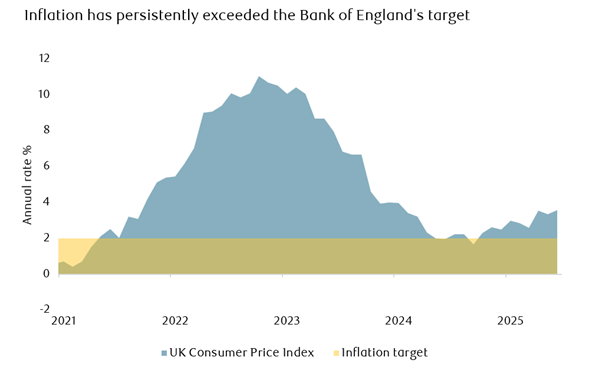
However, the MPC’s caution is understandable, because right now the case for further easing is far from conclusive. Inflation is above target. The energy cost increase is largely to blame but services prices, driven by higher wage growth, are a material and concerning factor. Employees have been keen to demand higher wages to reclaim their lost purchasing power following a couple of years of sharp price increases, which is reflected in elevated consumer inflation expectations. The BoE must feel compelled to try and redress that balance – inflation has spent just one month below target since May 2021 and has been more than double the target since.

The MPC’s conviction that rates will come down further will be based on the sensible assumption that as the labour market weakens, wage growth will follow, and as a consequence, consumer prices will rise more slowly.

UK government bonds remain attractive while the prospect of lower rates looms. Despite this, U.S. interest rate expectations fell faster than UK interest rate expectations last week, causing the pound to appreciate relative to the dollar.

Both the Fed and the BoE will be focused on whether forthcoming data suggests the labour market weakness is moderating or accelerating.

Inflation

Source: LSEG

Please continue to check our blog content for advice, planning issues and the latest investment market and economic updates from leading investment houses.

Charlotte Clarke

13/08/2025

Team No Comments

M&G Wealth – Weekly Market Commentary

Please see below, an article from M&G Wealth, analysing the key factors currently affecting global investment markets. Received – 08/08/2025

Market review

Equity markets put in a strong performance, while government bond yields rose during a week where sentiment was generally positive. Technology stocks have continued to drive this buoyant move in markets, with the “Magnificent 7” reaching new all-time highs. Momentum was supported by strong earnings, particularly in the US and Europe, while hopes have risen for imminent rate cuts in the US, as macroeconomic data has softened and Federal Reserve speakers have communicated more openness in lowering the deposit rate. This comes after Non-Farm Payroll Data showed worrying signs for the labour market; with bond investors reacting to price in a 97% chance of a rate cut at the next meeting – up from 40% before the data release. 

Federal Reserve Governor Kugler’s resignation has created an opportunity for US President Donald Trump to appoint a new board member, who could potentially be groomed as a successor to Chair Jerome Powell or at least represent another dovish voter. Trump has since nominated Stephen Miran for the position on a temporary basis, an economic advisor who recently co-authored a plan for reforming the Fed. Trump has been especially vocal about his desire for the Fed to lower rates more quickly and it appears he is looking to find ways of appointing people to the Fed who are on that same wavelength. 

The deadline for trade deals with the US has now passed, yet nations continue to be in negotiations to lower the tariffs imposed upon them. Switzerland have had little luck so far in trying to strike a deal and are set to continue incurring 39% tariffs, while India have been threatened with a substantial tariff increase should they continue to purchase oil from Russia. Pressure from the West has been building on nations to distance themselves from the Russians, as war continues to rage on with the Ukraine. Tariff focus is now also centred on pharmaceuticals and semi-conductors, with 100% tariffs on these sectors being touted. However, there was some positive news for investors as some mega-cap companies like Apple and Taiwan Semiconductor Manufacturing Company (TSMC), who are building manufacturing capabilities in the US, would be exempt.

Outlook

While trade tensions continue to simmer in the background, markets appear to be taking comfort in resilient earnings and signs that trade negotiation may be prevailing over escalation. The coming weeks will be key in assessing whether this optimism is justified. Data driven central banks continue to be in focus, with potential divergences in monetary policy occurring as inflationary forces, labour markets and growth come under the spotlight.

Movers table:

Equities1 WeekYTD1 Year
S&P 5001.64%8.61%20.78%
FTSE 1000.67%14.18%15.93%
Euro Stoxx 503.26%11.17%16.97%
MSCI Asia Pacific ex Japan2.67%17.95%24.22%
MSCI China2.74%24.99%46.34%
Source: Bloomberg as at 8:35am on 08.08.2025

Please continue to check our blog content for the latest advice and planning issues from leading investment management firms.

Marcus Blenkinsop

12th August 2025

Team No Comments

Tatton Investment Management: Monday Digest

Please see below, an article from Tatton Investment Management, analysing the key factors currently affecting global investment markets. Received this morning – 11/08/2025

Trump goes for easy targets as tail risks fade

Markets regained their footing – aided by a slew of US trade deals. This is excepting a few others; Brazil and Canada with leaderships that irk Trump; and poor Switzerland because of the movement of gold.  After the shock, the Swiss president failed to get a meeting with Trump, let alone any reprieve on the US’ surprise 39% tariff. Trump was too busy firing the Bureau of Labour Statistics’ chief for releasing statistics he doesn’t like and hiring a friend to set interest rates he does like. But markets were unphased by these ‘Banana Republic’ policies.

The Bank of England’s 5-4 vote for an interest rate cut was unexpectedly tight, and its updated forecasts show more inflation into the year-end. Bond markets dialled back bets on further rate cuts in response. Longer-term yields didn’t move much, though, as the BoE hinted it might slow its sale of long-term bonds. Before that, stories emerged about a multibillion “black hole” in the government’s finances. Reading between the lines, it looks like Downing Street is preparing to break one of its fiscal promises. 

The US and Russia edged closer to ceasefire negotiations for Ukraine. Washington is offering Moscow both the carrot (a Trump-Putin sit-down in Alaska on Friday) and stick (secondary tariffs on India and others for buying Russian oil). Markets have raised hopes if not expectations of  ceasefire progress too – judging by sharply lower oil prices. Oil’s loss was partly due to OPEC+ loosening output constraints, but a Russia-Ukraine ceasefire would boost global oil supplies further. This is a major positive for Europe, boosting its equities. 

Investors see tail risks receding. Those betting against the market therefore have to close their positions, supporting the momentum which has pushed up equities for weeks. Momentum has dropped a little, but sentiment (particularly among retail investors) is strong – backing up by strong big tech earnings. That doesn’t mean everything’s alright: US effective tariffs are still close to 20% and we don’t know how badly that will hurt economic demand and corporate profits. But recent data suggests the late spring soft patch is improving. Markets see the US economy as resilient – so the world carries on. 

July Asset Returns Review

July was full of drama but ended up being a standout month for global stocks, which finished up 5% in sterling terms. It began with the passage of US tax cuts – seen as a positive for American companies – but another tariff deadline on 1st August loomed large. In the end, the Trump administration mostly signed trade deals or further suspended tariffs. But tariff threats pushed up implied volatility (the cost of insuring assets) in the meantime, while actual volatility was soothed by abundant liquidity. That arbitrage opportunity incentivises buying stocks – which pushed the US up 5.9%.

Some strong Q2 earnings reports – mainly among the ‘Magnificent Seven’ tech stocks – also helped. US returns were amplified, in sterling terms, by the dollar’s 4% gain on the pound. 

Despite negative coverage of UK growth and inflation UK stocks gained 4.3%. European equity was more muted at 0.9%, but is still 14.6% up from the start of 2025. July’s best performer was China, gaining 8.6%. This was partly down to signs of US conciliation, but also due to Beijing’s desire to stimulate domestic consumption. The government’s greater focus on demand will benefit not just China but emerging markets more broadly, whose stocks climbed 5.6% in July.

Commodities had a strong month, up 7.3%, mostly powered by the 11.2% jump in oil prices. This is often a global growth indicator, but last month’s data (weak US job numbers) did not back that up. US bond yields fell sharply into the end of the month. 

The mismatch between strong markets and weaker data had commentators doubting the equity rally. But markets are still awash with liquidity. There’s money to buy assets, so volatility will be low and risk appetite high – evidence by Bitcoin’s stellar 12.6% gain last month. Markets can rally hard on little news in this environment.

(Where possible, quoted performance data are sterling-based net total returns for the period).

Do fiscal rules stop growth?

Given the dour coverage of the UK economy, it was interesting to see renowned financial journalist Anatole Kaletsky argue recently that Britain could see a revival, if the government removes its restrictive fiscal rules. 

He argues that the balanced budget rules hamper growth by constraining spending when it’s needed most. The problem is compounded by the UK’s fragile tax base: a big chunk of tax revenues is paid for by the top 10% of earners, while middle income earners pay less than other countries. Part of that is income inequality, but concentrating the tax base on high earners puts government finances at risk. Last week’s report that company directors are leaving the UK for more favourable tax treatments demonstrates this. 

Kaletsky argues the government needs to “tax the middle” over the long-term. Noting that this would be unpopular and economically destructive right now – given Britain’s weak economy –he favours borrowing to invest (thereby giving people enough money to pay future taxes) while resetting fiscal policy for longer-term tightness . That’s why he thinks Labour’s current fiscal rules will be abandoned by 2026. He argues that this will either be pre-emptive or forced by a bond market sell-off – just like after 1992’s infamous ‘Black Wednesday’ which forced Britain out of the ERM. 

Kaletsky’s diagnosis is valid, but his suggestion that bond traders would welcome the abandonment of Labour’s fiscal rules is possibly wishful thinking. It’s ironic that he uses ‘Black Wednesday’ as a template, since the last time bond markets forced a change of UK fiscal policy was Liz Truss’ ‘mini’ budget. Most took the opposite message from the Truss episode: containing interest rates is the priority in supporting growth. The weakest part of Kaletsky’s argument, in our view, is that it glosses over potential significant volatility in the UK bond market and how this feeds back into the economy. Labour might change its rules soon – but bond traders’ response is much less certain. 

Please continue to check our blog content for advice, planning issues and the latest investment market and economic updates from leading investment houses.

Andrew Lloyd

11/08/2025

Team No Comments

EPIC Investment Partners: The Daily Update

Please see below, an article from EPIC Investment Partners analysing the latest US economic data release. Received today – 08/08/2025

The Federal Reserve’s recent decision to keep its target interest rate range at 4.25% to 4.50% was marked by an unusual double dissent from Governors Christopher J. Waller and Michelle W. Bowman. They warned that despite seemingly stable employment numbers, the U.S. labour market was dangerously close to “stall speed,” arguing urgently for immediate rate cuts. 

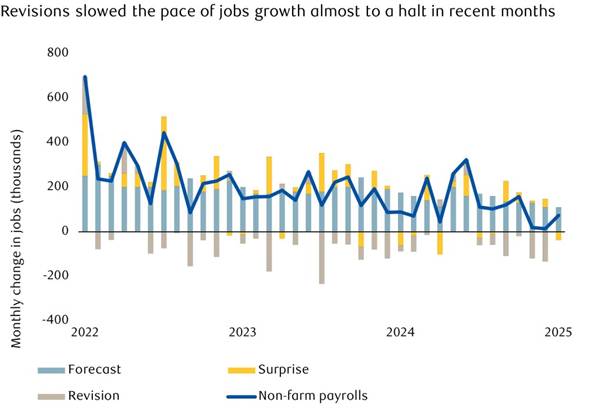
July’s nonfarm payroll report released last week has dramatically validated their concerns. The headline figure showed just 73,000 new jobs, far below the median expectation. More significantly, earlier months were revised drastically downward: May’s job growth was cut from 144,000 to only 19,000, and June’s from 147,000 to just 14,000. These revisions erased a total of 258,000 previously reported jobs, significantly altering perceptions of the labour market’s strength. 

Detailed sector analysis further highlights these vulnerabilities. July’s job growth was primarily concentrated in health care and social assistance, while government employment saw a decline. Key sectors sensitive to interest rate hikes, such as construction and manufacturing, showed little change. Even the leisure and hospitality industry, previously resilient, barely expanded, reflecting broader consumer spending constraints amid persistent inflation and high borrowing costs. 

The Household Survey, used to calculate unemployment rates, paints an even bleaker picture, showing an outright decline in the number of employed people. As a result, the unemployment rate rose to 4.2%, alongside a slight drop in labour force participation. This suggests increased worker discouragement, a significant labour market weakness masked by headline employment figures alone. 

A key reason for these dramatic downward revisions is the Bureau of Labor Statistics’ (BLS) use of the Birth-Death Model, which estimates employment changes from new and closed businesses. While effective during stable economic times, this model can lag and requires significant revisions during periods of economic change, leading to overestimations of job creation in retrospect. 

These developments place Federal Reserve Chair Jerome Powell in a challenging position. Previously relying on labour market resilience to justify maintaining higher interest rates, Powell now faces undeniable evidence of economic fragility. This calls into question the Fed’s restrictive monetary policy, suggesting it might be causing deeper economic harm than intended. 

The weak payroll data provides new support for policymakers who have argued that the Fed’s policies have been too restrictive. Federal Reserve Chair Jerome Powell is under pressure to respond. He faces the challenge of a potential rate cut, which could be seen as giving in to political pressure, while maintaining current rates could be viewed as ignoring clear signs of economic weakness. 

Attention now shifts urgently to upcoming inflation data, which will be crucial for determining the Fed’s next steps. The July Consumer Price Index (CPI) report, scheduled for release on Tuesday next week, will be a pivotal moment. Only surprisingly strong inflation figures in that report could justify holding current rates. July’s payroll data strongly supports Governors Waller and Bowman’s earlier dissent, warning that delaying rate cuts risks significant economic damage. 

The critical question is whether the Federal Reserve has already waited too long to address clear signs of labour market distress. With evidence of economic weakness now indisputable, the Fed’s next moves—informed by the upcoming inflation report—will be crucial in averting further economic deterioration.

Please continue to check our blog content for the latest advice and planning issues from leading investment management firms.

Alex Kitteringham

8th August 2025

Team No Comments

Brooks Macdonald – The Daily Investment Bulletin

Please see the below article from Brooks Macdonald detailing their discussions on the macro-economic environment and ongoing geopolitical risk. Received this morning 07/08/2025.

What has happened

Equity indices were somewhat mixed on Wednesday. In the US, while a new all-time high for the “Magnificent Seven” group of megacap US tech stocks (up +1.93% yesterday), led the US S&P500 equity index up +0.73%, more than half of the S&P500 constituents were down on the day. Furthermore, the US smaller company Russell 2000 equity index was an outright faller, down -0.20% yesterday. Over in Europe meanwhile, the pan-European STOXX600 equity index also finished the day lower, down -0.06% (all in local currency terms). Later today at 12 o’clock UK time, the Bank of England is widely expected to cut interest rates by 25 basis points, from 4.25% currently, to 4.00%.

More Trump trade tariff news

US President Trump yesterday announced an additional 25% tariff on goods from India going into the US in response for India’s continued buying of Russian oil exports. This stacks on top of the 25% tariff for India announced last week, and which would leave India later this month facing a cumulative 50% rate. Trump was blunt in his justification, saying that India is “fuelling the [Russian] war machine [against Ukraine]. And if they’re going to do that, then I’m not going to be happy”. Separately, yesterday saw Trump announce he would be imposing “a tariff of approximately 100% on chips and semiconductors”, though for companies moving production back to the US, such as Apple, “there will be no charge” said Trump.

Apple plans more US investment

Apple’s share price gained +5.09% yesterday (in US dollar terms) on news the company is investing an extra US$100bn in US domestic manufacturing. According the White House, it will bring more of Apple’s supply chain to the US, as well as giving the US more domestic control over critical component assembly. Apple had previously announced plans to spend $500bn in the US over 4 years, so this latest sum is on top of that.

What does Brooks Macdonald think

According to Bloomberg data, fixed income derivative markets were yesterday pricing in over 100 basis points of interest rate cuts from the US Federal Reserve (Fed) by mid-2026. However, why interest rates are expected to be cut matters – whether it is because of easing inflation, or a weaker economic picture, each can have very different market impacts – indeed, historically, stock markets don’t tend to do as well when central banks are cutting rates into the start of a recession for example, versus against a soft-landing scenario back-drop. With US and global equity indices currently close to record (dollar) all-time highs despite the mounting risks from higher trade tariffs, the economic growth outlook arguably matters even more than usual.

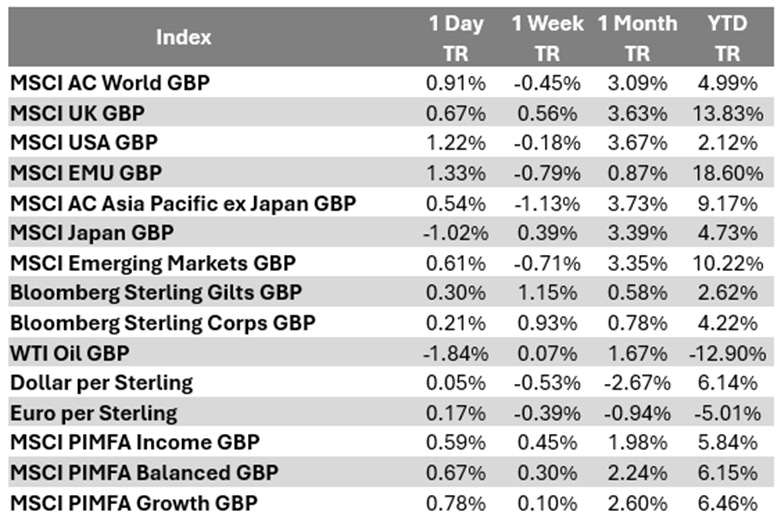
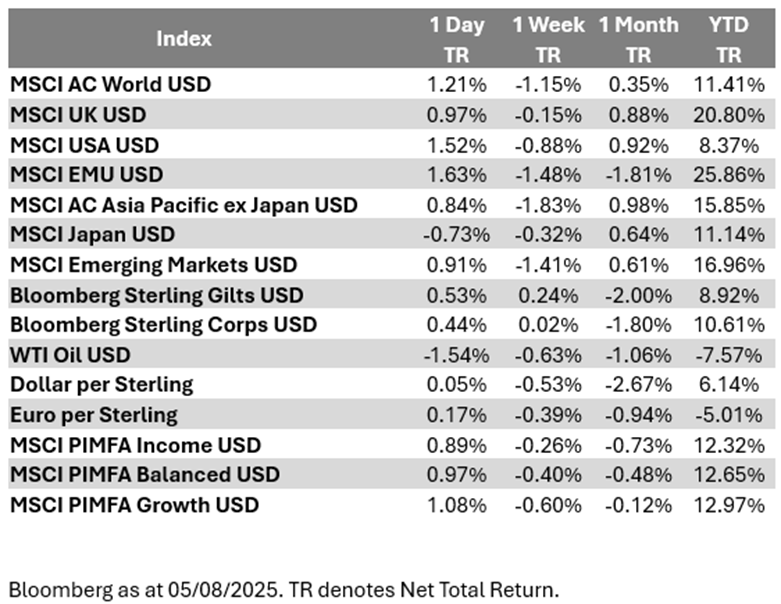
Bloomberg as at 07/08/2025. TR denotes Net Total Return.

Please continue to check our blog content for advice, planning issues and the latest investment, market and economic updates from leading investment houses.

Alex Clare

07/08/2025

Team No Comments

Brewin Dolphin – Markets in a Minute

Please see this week’s Markets in a Minute update below from Brewin Dolphin, received yesterday afternoon – 05/08/2025.  

Expectations grow for a new U.S. rate cut

Janet Mui, Head of Market Analysis, discusses fresh U.S. jobs data and how this has raised expectations for a September rate cut. Plus, Guy Foster, Chief Strategist, explains how this data could affect the so-called term premium.

Key highlights

  • ‘Liberation Day 2’: Stocks were bolstered following positive earnings reports last week.
  • U.S. tariffs reintroduced: U.S. trade tariffs kicked back into effect last week, although many countries have negotiated reductions. As before, markets responded negatively.
  • U.S. jobs data weak in July: the U.S. reported only 73,000 new jobs created last month. With continued job losses in manufacturing, and a significant downgrade to July’s report, the case for a rate cut was bolstered.


‘Liberation Day 2’

A line graph with orange lines

AI-generated content may be incorrect.

Source: LSEG

Stocks had a mixed run last week, supported by favourable earnings news while also plagued by concerns over the economic outlook. Two thirds of companies have now reported – including most of the mega-cap stocks, which have been driving the market in recent years. The obvious exception is Nvidia, which reports frustratingly late in the reporting season for such an influential company. 

Technology and consumer discretionary stocks have been well received as the artificial intelligence (AI) theme remains at the forefront of investors’ minds. Some laggards, such as Apple and Alphabet, have shown renewed signs of life.

As the summer draws on, attention turns to what will drive markets next.

U.S. tariff measures are reintroduced

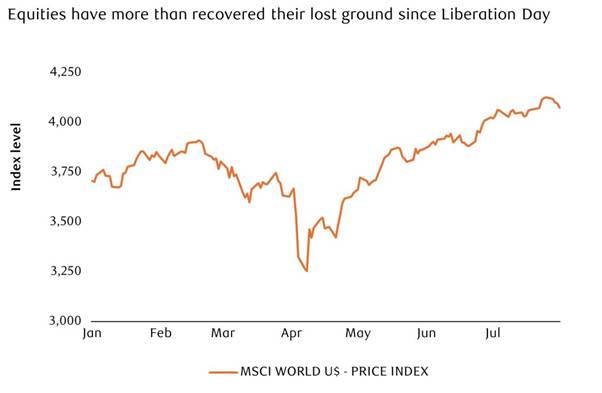
Three months have passed since U.S. President Donald Trump stood in the White House Rose Garden and announced a series of extremely punitive tariff rates on America’s trading partners. Back then, the market reaction was equally punitive, resulting in sharp declines in the dollar and U.S. equity and bond markets. His reversal of those measures caused a huge equity market recovery.

Last week, the measures were largely reintroduced, albeit with many countries having negotiated some form of reduction. The market reaction was, once again, negative as the measure took effect. Maybe there was still a lingering belief that the president would ‘chicken out’ and avoid raising tariffs, although it more likely reflects the impressive run that stocks have been on.

So far, the president has secured more than a trillion dollars of promised investment in the U.S. and imposed taxes of 15% on U.S. imports for most major importers. It seems like a phenomenal deal, though it will come at a cost.

Despite the conviction of Federal Reserve (the Fed) Governor Christopher Waller in lower rates, some element will inevitably be paid by U.S. consumers. So far, that has been modest. But the risk remains that companies have been reluctant to pass on costs while trade uncertainty remains, and that they’ve been able to avoid doing so while running down inventories.

A graph showing the growth of the economy

AI-generated content may be incorrect.

Source: LSEG

U.S. interest rates are held

U.S. interest rates were kept on hold last week, but it wasn’t a unanimous decision, with two Federal Open Market Committee members dissenting for the first time since 1993. One of these was Michelle Bowman, who’s typically regarded as a relatively dovish member. The other was Waller, who has, at times, been relatively hawkish.

Cynics might say that Waller’s conviction in lower rates has to do with his possible nomination as the new chairman of the Fed. However, he attributes it to a belief that producers and importers will share the burden of tariffs, sparing consumers from the pain. That seems optimistic, but his belief that tariffs are a one-off adjustment and not an enduring inflationary influence is more credible.

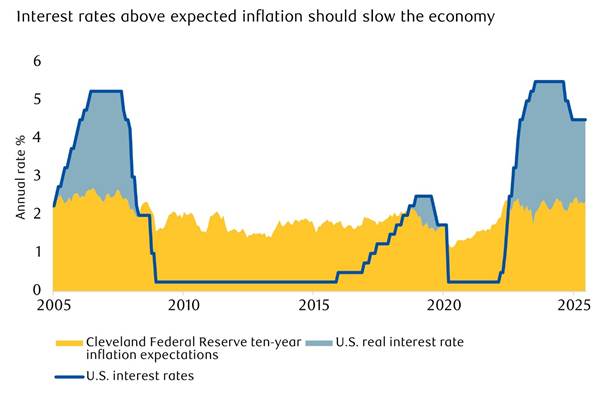
Another observation from Waller was that monetary policy is tight, and the economy is slowing. ‘Real’ interest rates (interest rates adjusted for inflation) are still quite positive based on long-term inflation expectations. 

Weak U.S. job market bolsters the case for a rate cut

The evidence of a weakening labour market is pretty mixed, but one factor Waller points to is that in June, government employment offset weakness in private sector jobs growth, leaving the overall pace of jobs growth little changed.

As it happens, Friday’s jobs report showed private sector jobs growth rebounding slightly, but overall, it was still a weak report with just 73,000 new jobs created. Continued job losses in the manufacturing sector, and a significant downgrade to last month’s relatively upbeat report, bolstered the case for a rate cut.

Source: LSEG

A graph of a graph showing a number of jobs

AI-generated content may be incorrect.

Source: LSEG

Jobless claims reported last week remained close to their lows for the year. Job openings fell earlier in the week, but they still remain at a high level compared to previous cycles, and the Employment Cost Index continued to rise at a historically fast pace. This index is the best measure of the total pay and benefits accruing to employees, and its growth reflects their ability to achieve better compensation.

Overall, Waller will feel vindicated by the jobless claims, but the other data makes it understandable that his colleagues wanted to sit on their hands.

However, the most striking thing about this data release was that although it seemed to strengthen the case for an interest rate cut, which President Trump has been calling for, the president himself rejected the release as rigged for political purposes and promptly fired the head of the Bureau of Labour Statistics, which compiles the numbers. This is an extraordinary move and one that further weakens the credibility of U.S. institutions.

Taken together, these factors are likely to add to the so-called term premium, which investors need to lend to the U.S. Bond yields are the government’s borrowing costs. They are determined by investors’ expectations of interest rates over the life of a bond, plus an additional amount to cover uncertainty about that path of interest rates. This extra amount is called the term premium. 

Perhaps the final measure landing last week, which the Fed will keep a close eye on, was its preferred measure of inflation, the Personal Consumption Expenditure price index. Its 2.6% rise (with core prices rising by 2.8%) suggests that inflation remains above target and has been rising at a time of political pressure, when some financial indicators suggest the economy is slowing.

Please continue to check our blog content for advice, planning issues and the latest investment market and economic updates from leading investment houses.

Charlotte Clarke

06/08/2025

Team No Comments

Brooks Macdonald Daily Investment Bulletin

Please see below article received from Brooks Macdonald this morning, which provides a global market update for your perusal.

What has happened

Markets bounced on Monday, but only partly unwinding the bigger falls from Friday. For the US S&P500 and the pan-European STOXX600, both equity indices still closed yesterday below where they had closed last Thursday. Furthermore, not all stocks saw a bounce – of particular note, US ‘Magnificent Seven’ megacap tech stock Amazon, which fell -8.27% on Friday, dropped a further -1.44% yesterday (all in local currency price return terms).

US dollar resumes its slide

The US dollar fell again yesterday, with the DXY index (which tracks the dollar against a basket of major global currencies) down for the second day in row. For context, while the DXY index had a relatively good July, its best month since last year, that was only on the back of the dollar suffering its weakest calendar 1H performance since 1973. Trying to make sense of the moves, some market watchers are suggesting that dollar weakness this year is in part reflecting ebbing investor confidence in owning US assets given US President Trump’s tariff policy consequences in particular.

Trade tariff escalation

US President Trump threatened higher trade tariffs again India yesterday, saying that he would be “substantially raising” tariffs on India’s goods coming into the US because of India’s continued willingness to buy oil from Russia. That would be over and above the 25% tariff rate on India announced last week. India’s stock market has been weak recently, arguably reflecting a marked recent deterioration in US-India relations. Highlighting the war of words, Trump said last week that if India maintains its close ties with Russia, then “they can take their dead economies down together”.

What does Brooks Macdonald think

According to data complied by the ‘Washington Service’ research company and reported by Bloomberg, only 151 US S&P500 constituent company executive insiders bought their own shares in July, the fewest in a month since 2018. Furthermore, the ratio of insiders’ buying-to-selling was the lowest in a year. While it is important not to try to read too much into one month’s data, a cautious stance among those that likely know their businesses best might be signalling concerns around either relatively high valuations and/or slower economic growth expected ahead.

Please check in again with us soon for further relevant content and market news.

Chloe

05/08/2025

Team No Comments

Tatton Investment Management: Monday Digest

Please see below, an article from Tatton Investment Management, analysing the key factors currently affecting global investment markets. Received this morning – 04/08/2025

Busy going nowhere

This week has been one of the most information-heavy in recent memory, with significant implications for global markets. Equity markets began positively but turned negative, particularly in Europe. US indices fared better, buoyed by the Magnificent Seven tech giants, though Friday’s ISM manufacturing survey revealed unexpected weakness, dragging domestic stocks lower. 

Bond yields fluctuated, ultimately falling sharply, while the dollar strengthened through most of the week before retreating post-ISM data. Currency movements amplified US equity outperformance until Friday’s reversal. In sterling terms, France’s CAC40 fell 3.4%, while the Nasdaq 100 rose 0.7%. Gold weakened slightly, and commodities ended the week poorly. 

Markets have shifted to a risk-off stance, with defensive global quality stocks—especially tech—attracting attention. The week’s agenda was packed: trade negotiations ahead of Trump’s tariff deadline, central bank meetings, GDP and inflation data, confidence indicators, employment reports, China policy updates, and Q2 earnings from major firms.

The EU-US trade deal initially appeared constructive, mirroring Japan’s agreement. However, discrepancies—particularly around pharmaceuticals—surfaced, casting doubt. European equities, notably autos, rallied briefly before faltering. Macron’s criticism of the Commission further undermined confidence. 

GDP data disappointed, with the Eurozone posting just +0.1% q/q growth. The Euro weakened significantly. Some countries portrayed trade outcomes as victories, though Mexico and China secured extended negotiations due to their leverage. Trump’s approval on economic handling has declined, prompting aggressive tariff hikes on Canada and Switzerland. The UK, by contrast, emerged relatively unscathed. 

While tariffs are unpopular, they may aid US fiscal sustainability. Investors remain concerned about the deficit, evidenced by rising bond risk premia. The Treasury’s funding plans were announced, but the timing of tariff shocks—amid a fragile labour market—poses challenges. 

The Fed held rates steady, acknowledging contained inflation but warning of future rises due to tariffs. Labour market data showed weak job growth but strong wage increases, suggesting supply constraints. Trump’s renewed attacks on Fed Chair Powell added to market tension, pushing yields higher. 

Despite European struggles, US indices benefited from strong Q2 tech earnings. Apple’s rebound in China underscored the region’s importance. Nvidia’s results are awaited later in August. 

Bills and bonds 

In summary, while Q2’s policy upheavals have settled somewhat, August may bring renewed volatility. Tariff-driven price rises in the US feel imminent, and markets are increasingly uncertain about a smooth resolution. 

The surge in government debt issuance has long been a focal point for asset strategists and portfolio managers. This week, the US Treasury outlined its financing plans, revealing that despite a projected $1.98 trillion rise in debt to $37.2 trillion by year-end (per the CBO), the bulk of this will be financed through short-term Treasury Bills (T-bills). 

Why the preference for short-term debt? The Treasury faces a delicate balancing act: attracting investors without overburdening future cash flows. In uncertain times, T-bills—essentially short-term cash equivalents—are more appealing due to their lower capital risk. Demand for longer-dated bonds has weakened, prompting both current Treasury Secretary Scott Bessent and his predecessor Janet Yellen to favour short-term issuance. 

This shift reflects investor sentiment. Since 2021, preferences have tilted toward liquidity, though there are signs of easing aversion to maturities up to five years. For the Treasury, this means lower interest costs in the near term. The term premium—the excess return investors demand for holding longer maturities—has narrowed slightly, reinforcing the appeal of short-term funding. 

However, this strategy carries risks. Short-term debt is more sensitive to interest rate fluctuations. A shock to price stability or supply could drive rates higher, immediately increasing borrowing costs. With Trump’s second-term policies continuing to disrupt supply and pressure inflation, the risk is non-trivial. 

Critics argue that the growing reliance on T-bills increases financial fragility. Bloomberg’s Simon White notes that the US debt maturity profile is now more vulnerable to rate hikes. While short-term debt still comprises only 20% of total issuance—broadly in line with historical norms—the rising debt-to-GDP ratio limits fiscal flexibility unless maturities are extended. 

An additional concern is the quasi-monetisation of debt. Michael Howell of CrossBorder Capital suggests that increased T-bill issuance may be indirectly funded by the Fed, via commercial banks’ large cash reserves—remnants of pandemic-era stimulus. Regulatory inconsistencies have discouraged banks from holding T-bills, but reforms proposed by Bessent could redirect this liquidity. 

If the Treasury taps this reservoir, it could fund more spending than forecasted—potentially stoking inflation. The Fed, already under political pressure, would face a difficult choice: tighten policy or risk its independence. 

In sum, while short-term financing offers immediate savings, it leaves both policymakers and investors more exposed to future shocks. 

Please continue to check our blog content for advice, planning issues and the latest investment market and economic updates from leading investment houses.

Charlotte Clarke

04/08/2025

Team No Comments

EPIC Investment Partners: The Daily Update

Please see the below article from EPIC Investment Partners, analysing the latest interest rate decision by the Federal Reserve. Received today – 01/08/2025

The Federal Reserve’s decision on July 30, 2025, to maintain the federal funds rate at 4.25%–4.50% revealed deep divisions marked by a rare double dissent. Governors Christopher J. Waller and Michelle W. Bowman argued for an immediate 25-basis-point rate cut, reflecting sharp disagreements over tariff impacts and labour market conditions. 

Chair Jerome Powell and the majority consider recent tariff-induced inflation as potentially temporary, cautioning against premature easing that could undermine price stability. Powell cited the stable 4.1% unemployment rate as evidence of labour market resilience, supporting the Fed’s restrictive policy stance. 

Yet, recent labour data paints a more nuanced picture. July’s ADP payroll report showed private-sector employment increased by 104,000, surpassing forecasts but indicating a slowdown. Notably, small businesses added only 12,000 jobs, highlighting ongoing vulnerability due to high borrowing costs and tariff-driven price pressures. 

Governor Waller emphasised underlying fragility, asserting the labour market is approaching “stall speed.” He warned that superficial job growth numbers obscure deeper economic weaknesses. 

Governor Bowman’s dissent highlights additional concerns, particularly within smaller community banks serving small businesses. Bowman argues that tariff disruptions, initially viewed as temporary, are now causing sustained economic distress, justifying immediate action by the Fed. 

This mix of moderate employment growth and rising inflation poses a policy challenge. Tariffs raise the risk of stagflation—higher prices coupled with slower growth. Powell’s cautious approach prioritises inflation control, but dissenters argue continued restrictive policy could unnecessarily deepen economic slowdown risks. 

Markets initially perceived Powell’s message as hawkish, resulting in modest stock declines and rising Treasury yields. Analysts remain divided, with Powell’s backers expecting tariff impacts to fade quickly, and dissenters seeing deeper vulnerabilities that require immediate easing. 

Political factors complicate matters further. Waller and Bowman, appointed during the previous Trump administration, echo the President’s calls for lower interest rates, raising concerns about Fed independence as Powell’s term nears its May 2026 expiry. 

Today’s nonfarm payroll release has significant implications. Weak numbers would bolster the dissenters’ argument for immediate easing, while stronger figures would validate Powell’s cautious “wait-and-see” stance. 

As Governor Waller succinctly put it, “Waiting for undeniable weakness means waiting too long.” Today’s payroll data may be pivotal in shaping the Fed’s next move.

Please continue to check our blog content for the latest advice and planning issues from leading investment management firms.

Alex Kitteringham

1st August 2025