Team No Comments

EPIC Investment Partners: The Daily Update | The R-Star Reality: Low Rates Forever?

Please see below, an article from EPIC Investment Partners discussing the concept of an equilibrium interest rate and where it may lie in the future. Received today – 29/08/2025

On 25 August 2025, New York Federal Reserve Bank President John C. Williams addressed an audience in Mexico City with a message that resonated far beyond the confines of central banking circles. He argued that the neutral interest rate, or r-star, remains anchored close to its pre-pandemic level of around half a per cent. Despite high inflation in recent years, aggressive tightening, and subsequent cuts, Williams insisted that the long-run equilibrium rate has not shifted. “The era of low r-star is far from over,” he declared. 

For markets, the implications are significant. If the neutral rate really is this low, then policy remains restrictive even after recent rate reductions. That means the cost of capital is tighter than headline levels suggest, with knock-on effects for bond yields, valuations and currencies. It also raises the prospect that the Fed will once again collide with the effective lower bound in the next downturn, forcing policymakers back towards unconventional tools such as quantitative easing. 

Williams’s reasoning rests on structural forces that he argues remain intact. Demographics, including longer lifespans and falling birth rates, continue to elevate global savings while curbing demand for investment. Productivity growth, once the motor of higher returns on capital, has slowed sharply, limiting profitable opportunities. And the legacy of the global savings glut, reinforced by investor demand for safe assets since the financial crisis, keeps the equilibrium rate pinned down. None of these dynamics, he stressed, have been overturned by the pandemic. 

Central to his credibility is his reliance on the Holston-Laubach-Williams (HLW) model, which he co-authored. Originally developed as the Laubach-Williams framework in 2003 and later updated with Kathryn Holston in 2017, the model has become the benchmark for estimating r-star. By inferring the neutral rate from the observed relationship between output, inflation and interest rates, it seeks to capture the underlying structural drivers that markets often miss. For Williams, this is not simply a technical preference — it is his intellectual legacy. He openly contrasts it with market-based measures, which he derides as a “hall of mirrors,” distorted by risk premiums and sentiment rather than fundamentals. That scepticism matters for investors: policy may be guided by HLW’s slow-moving structural compass rather than the volatility of market pricing. 

The distinction Williams draws between cyclical fluctuations and structural anchors is crucial. Robust demand, resilient investment and stubborn inflation, he maintains, reflect temporary late-cycle dynamics and fiscal stimulus, not a permanent shift in equilibrium. To mistake heat for structure, he cautioned, would mislead both policymakers and markets. 

For bond traders, the message is sobering. A persistently low r-star caps the long-term trajectory of yields, shapes the curve, and means easing cycles are more likely to run into the lower bound. Williams’s Mexico City speech offered a reminder that, in monetary policy, the deepest currents are structural, not cyclical — and that financial markets ignore them at their peril.

Please continue to check our blog content for the latest advice and planning issues from leading investment management firms.

Alex Kitteringham

29th August 2025

Team No Comments

Brooks Macdonald Daily Investment Bulletin

Please see the below article from Brooks Macdonald detailing their thoughts on the Nvidia earnings results and their current market input received this afternoon, 28/08/2025:

What has happened?

While the S&P 500 hit a new record in USD terms yesterday, ongoing concerns about the Fed’s independence and France’s fiscal outlook tempered the optimism. These worries led to a steeper US yield curve and pushed the Franco-German bond spread to a seven-month high. After the US close, Nvidia’s earnings received a lacklustre response from investors.

Nvidia growth outlook uncertain

Nvidia reported Q2 results that slightly beat expectations, with revenue of $46.7bn and guidance for the next quarter broadly in line with expectations. While sales were still up over 50% year-on-year, this marks a clear slowdown from the triple-digit growth seen in previous quarterly announcements. Revenue from the key data centre segment came in just below forecasts, and uncertainty remains around sales to China. Although the US has resumed export licenses for these chips, Nvidia noted that the revenue-sharing plan tied to those exports has not yet been formalised and this uncertainty disappointed investors. Looking forward, Nvidia’s expectations for $54.0bn (+/-2%) in sales for Q3 vs previous expectations of $53.8bn did not constitute the strong ‘beat and raise’ that some investors had hoped for and the shares fell approximately -3% post the close.

Trump maintains pressure on the Fed

Concerns about the Federal Reserve’s independence continued to influence markets, with investors pricing in faster rate cuts and higher inflation expectations. This led to a steepening of the yield curve, as 2yr yields continued to fall after the news earlier this week that President Trump was seeking to fire Fed Governor Lisa Cook.

French political uncertainty continues

French bonds remained under pressure ahead of the 8th September confidence vote, as investors questioned the government’s ability to manage the deficit. Prime Minister Bayrou offered to negotiate with opposition parties, but the risk of the government falling—and potentially triggering new elections—remains high. This uncertainty pushed long-end yields higher, with the 30-year reaching its highest level since 2011 and the Franco-German 10-year bond spread nearing last year’s peak.

What does Brooks Macdonald think?

The reaction to Nvidia’s results last night, together with the MIT report released last week which found that 95% of organisations are currently getting zero return on their investments in Generative AI, reinforces our view that some AI related stocks appear fully priced. Given the resulting equity market concentration, adequate diversification by sector and region remains more important than ever.

Please continue to check our blog content for advice, planning issues and the latest investment, market and economic updates from leading investment houses.

Andrew Lloyd

28/08/2025

Team No Comments

Brooks Macdonald Daily Investment Bulletin

Please see the below article from Brooks Macdonald detailing their discussions on the Federal Reserve and concerns about the French fiscal situation. Received this morning 27/08/2025.

What has happened?

The Federal Reserve and its future independence were in focus again yesterday, and in France both equities and government bonds came under pressure due to the government’s upcoming confidence vote.

President Trump’s pressure on the Fed continues

President Trump’s continuing attempt to remove Fed Governor Lisa Cook has sparked legal and institutional pushback, with Cook’s lawyer announcing plans to challenge the firing and the Federal Reserve reaffirming that governors can only be removed “for cause.” With two current members already dissenting in favour of cuts and Stephen Miran nominated to fill another seat, replacing Cook could tip the balance. Reports also suggest Trump is exploring ways to exert more influence over the Fed’s 12 regional banks, whose presidents rotate onto the FOMC and are up for approval in early 2026. Markets responded with a notable further steepening of the yield curve as the difference between 2yr and 30yr yields rose to the highest since January 2022, as investors priced in a more dovish policy outlook with the futures markets now expecting over 100 basis points of rate cuts by mid-2026.

Concerns about the French fiscal situation mount

The focus on France intensified as Prime Minister Bayrou faces a likely no-confidence vote on September 8, with major opposition parties pledging to vote against the government. This political uncertainty has recently weighed heavily on French assets, with the CAC40 underperforming regional peers and major banks seeing sharp declines. The French 10-year yield moved to within 6bps of Italy’s, the tightest since 2003, highlighting investor unease.

What does Brooks Macdonald think

Despite this uncertainty, equity market investors remain sanguine, with the S&P500 closing last night only very marginally below its all-time high. Nvidia, widely seen as the bellwether AI stock, reports earnings today after the US market closes. Analysts’ revenue expectations have risen since June but given Nvidia’s c30% share price rise in USD terms year to date, any disappointment will spook investors.

Please continue to check our blog content for advice, planning issues and the latest investment, market and economic updates from leading investment houses.

Alex Clare

27/08/2025

Team No Comments

Tatton Investment Management: Tuesday Digest

Please see below, an article from Tatton Investment Management, analysing the key factors currently affecting global investment markets. Received this morning – 26/08/2025

Market leaders taking late summer break


Last week, the Bloomberg World stock market index gained 0.5%, with mixed bond prices and UK yields rising. US large-cap stocks underperformed, while China and the UK saw gains, with the FTSE 100 reaching new all-time highs. The market’s tepid action was attributed to a typical summer lull following an unusual market rally, prompting some investors to take profits.

Fed Chairman Jerome Powell’s speech at the Jackson Hole Central Bank symposium raised hopes for a rate cut on September 17th, though he was cautious about further cuts. US 10-year bond yields reacted with a 0.05% decline, while broad stocks gained 1%. Overall though, despite additional significant political events like the Trump-Putin summit and European leaders’ visit to Washington, there was remarkably little market reaction.

The FTSE 100 nevertheless had a strong week, with gains in nine out of eleven GICS sectors. The hot UK inflation report caused another rise in bond yields, but overall rate expectations remain for two more cuts to 3.5% by next summer. It needs to be remembered that Inflation is not generally bad news for stocks, with Unilever being a top contributor to market gains as they raised prices.

China continued to perform well despite ongoing tariffs and no trade deal with the US. Chinese investors, driven by high cash balances and growing confidence in economic stability, were the main drivers. Meanwhile, Kenya’s decision to swap Dollar-denominated borrowing from China into Renminbi loans highlights China’s growing global influence.

In the US, the Magnificent 7 tech giants had a poor week, pausing their market-leading rally. Nvidia’s upcoming earnings report is highly anticipated, with past trends showing share price drops before the report, followed by gains. However, we note that US investors may have finally exhausted their excess cash balances from the pandemic largess, which probably have been a factor in supporting extended valuations and speculative meme stocks and crypto investments.

Political and geopolitical news often has little direct market impact unless it significantly changes companies’ business operations. Over the past week, the broader financial media came up with a number of explanations for the different market moves, but from our vantage point of view we are not convinced that it was much more than a typical summer lull. The exception from the norm is that this one comes after a long and seasonally unusual market rally, that may have some investors more itchy to take some profits.

UK Inflation


The July price data disappointed those hoping for lower UK interest rates. Headline CPI inflation rose to 3.8% year-on-year, higher than economist projections and up from 3.6% in June. Core CPI inflation also accelerated to 3.8%, with services CPI inflation rising to 5.0%, surpassing most forecasts.

The Bank of England’s Monetary Policy Committee narrowly voted to cut the base rate to 4% from 4.25% on August 7th. Economists now believe further rate cuts are unlikely this year. Money markets have slightly adjusted the probability of future rate cuts, with a 66% chance of a 0.25% cut in December 13.

Two items significantly contributed to the rise in services inflation: a large spike in airfares and an increase in catering services. Airfares added 0.3% to services inflation, while catering services, a key component of the BoE’s supercore measure, rose 0.7% 14 15. The pass-through of rising non-core food prices into core services is contributing to the recent path of inflation and regulated prices such as rail tickets will continue to do so for the medium-term.

But there are some signs that labour costs are leveling off after a surge. Median pay settlements by private-sector employers held at 3% in the three months to July according to Brightmine. Economists broadly agree that consumer price inflation will remain above 3% year-on-year until well into next year. However, from October onwards, the monthly annualized pace should drop below 3%, bringing the CPI rate towards 2.7% by mid-next year. Investors and traders continue to expect a rate cut in December or January, with a final one in late spring.

Insight Article – Does the US Have Enough Money?


The pandemic’s impact on financial markets is dwindling, and one of the most important may be about to disappear; cash created by the Fed may now no longer be in excess. 

In a well-functioning economy, most money is created by private sector banks through loans. However, during financial crises like 2008-2009 and the pandemic, central banks created money to ensure interest payments could be met and prevent the system’s money from disappearing.

The Federal Reserve created huge liquidity, and the federal government was dramatically effective in pushing it into the economy. This led to ballooning public balance sheets and increased private (business and household) cash balances. Some of the cash was quickly spent (creating inflation) but much was saved, slowly moving pushing into higher-risk equities and corporate bonds, leading to higher asset valuations.

The Federal Reserve used reverse repos to soak up excess cash in the system. Now, the level of reverse repos has fallen to pre-pandemic normality. With little or no excess cash in the system, asset valuations may stabilize. There will be fewer carry-seekers and lower expectations of capital gains.

The dwindling of reverse repos is likely to raise asset risk perceptions, leading to market volatility in the coming weeks. The Fed has slowed quantitative tightening and, although the Fed balance sheet remains extended  they could feasibly return to quantitative easing if there was a damaging fall in bond and risk asset prices.

Please continue to check our blog content for the latest advice and planning issues from leading investment management firms.

Marcus Blenkinsop

26th August 2025

Team No Comments

De Lisle Partners: Big Tech’s Capex Anomaly – Who Benefits?

Please see the below article from De Lisle Partners, analysing the opportunities and risks within the US’s technology sector. Received today – 22/08/2025

At De Lisle Partners, we position ourselves in front of tailwinds to achieve the best stock market returns. Our starting point for stock selection is based on long-term market research designed to identify which quantitative characteristics give the best indication of future outperformance.

Eugene Fama and Kenneth French first pioneered this research model in the 1990s and have continued to refine it. Their conclusions show that cheap, small stocks with momentum offer the best risk adjusted returns.

Another key finding is that companies with low asset growth tend to outperform, implying that companies with the fastest asset growth underperform.* This phenomenon is known as the ‘asset-growth anomaly’. So while you might think companies that invest more deliver the highest returns, that turns out not to be true.

We like stock market anomalies. It is why we favour buybacks and dividends over dilution, spin-offs over large M&A deals and low debt or debt repayment over new loans. As much as the Fama-French research tells us what to favour, inverting it shows us what to avoid.

Over the last five years, the average US company has grown its assets by 14% per year.** There are only two sectors that have outpaced that: Healthcare (27%) and Technology (21%). These are high growth rates; a 20% compounded annual growth rate (CAGR) over five years results in an asset base that is two-and-a-half times larger. Nvidia, for example, has grown its assets at a 45% CAGR over this period.

Noticeably, these two sectors are our largest underweights in the Fund today. Our lack of participation is primarily on valuation grounds, but the level of asset growth adds another hurdle to involvement. Healthcare’s growth is largely explained by the response to Covid, as lots of companies experienced booming demand for their services. The problem, alongside current US policy uncertainty, is that over-expansion can lead to over-capacity and diminishing returns. Many Healthcare stocks are now in bear markets.

Technology’s asset growth is still unfolding. Last year the big tech hyperscalers (e.g., Microsoft, Meta, Google and Amazon) spent over $250 billion on AI and data centre related capital expenditures. It is estimated that this year they will spend between $350 billion and $400 billion. From the launch of the US Interstate Highway System build-out in 1956 to its formal completion in 1996, around $500 billion was spent in today’s dollars. Hyperscalers are going to spend around 80% of the cost of a 40-year project in one year!

The large US technology companies have been expensive for much of the last decade, but their stock prices and valuations have risen ever higher partly because asset growth was surprisingly low – their so called ‘capital light’ business models warranting higher valuations. But now there is another factor to catalyse a potential de-rating. The levels of asset growth we are seeing (alongside size and valuation) is a negative forward indicator and the negative impact on shareholder returns was found by Fama and French to persist for up to five years.

The counter argument for the hyperscalers is that productivity gains from AI will be so great, and the new revenue source so large, that the massive investment is worth it. Luckily for De Lisle Partners, we don’t need to settle this question today. We can benefit by finding opportunities among those companies receiving the capital expenditure as big tech’s capex feeds into their revenues and profits.

On the day in late July when both Meta and Microsoft extended capex guidance, our small manufacturer of data centre cooling equipment, Modine Manufacturing, announced further increases to its own data centre revenue forecasts. While the incremental returns of spending are question marks for the hyperscalers, Modine was happy to confirm estimated returns of 40-50% on its own investment in manufacturing cooling systems. These are essential for data centre build outs, as they control the intense heat emissions from AI chips.

We recognise that a large part of the spend may go to Nvidia itself, but the need for power and data centre infrastructure flows down to many of our holdings. We have tried to put ourselves in front of any company that is a clear beneficiary of this big tech spending spree, including Hammond Power Solutions in transformers, IESC Holdings in power infrastructure and Jacobs Solutions in data centre project consultancy.

For the last decade, smaller companies have failed to participate fully in the market’s most successful area (large expensive tech), as wider economic growth and inflation remained low. But now those same companies are forcing growth elsewhere by spending at these levels.

With valuations relative to large caps at historic lows and an avalanche of AI related capital being thrown at them, the opportunities in cheap small companies today are starting to feel like pushing on open doors. We are already invested in the right places – power, infrastructure, project management – to walk right in.

Please continue to check our blog content for the latest advice and planning issues from leading investment management firms.

Alex Kitteringham

22nd August 2025

Team No Comments

Brooks Macdonald – Daily Investment Bulletin

Please see the below article from Brooks Macdonald detailing their discussions on market fluctuations surrounding the Fed’s independence concerns and anticipation of Powell’s Jackson Hole speech. Received today 21/08/2025.

What has happened?

In equity markets, technology stocks sold off early in the day with the Nasdaq down -2% at its weakest, although it subsequently recovered to -0.67% by the close. This may have been triggered by an MIT study which claimed that 95% of enterprises adopting AI were getting ‘zero return’ from their investment, which triggered concerns about the immediate profitability of AI technologies. The market’s reaction over the course of the day likely indicates that investors are willing to take a longer-term view when considering the benefits of AI. Outside of the technology sector, in the US most sectors had a decent day with energy (+0.9%) benefiting as the price of Brent crude rose by 1.6% to $66.84.

Renewed focus on the Fed’s independence

President Trump has posted on social media calling for the resignation of Fed Governor Cook, after Federal Housing Finance Agency (FHFA) Director Bill Pulte wrote a letter to Attorney General Pam Bondi alleging that Cook may have committed mortgage fraud. Cook is seen as mildly dovish, but if she were to resign or be fired, that would create another opportunity (after the appointment of Trump loyalist Stephen Miran) for President Trump to reshape the Board.

What does Brooks Macdonald think?

The path of future US monetary policy continues to be in the spotlight. The Federal Reserve minutes from the 29 – 30 July meeting were published yesterday, with the majority of participants judging the upside risk of inflation to be larger than the risk posed by the slowdown in the labour market. Views on the impact of tariffs were divided, with some FOMC members thinking that tariffs would lead to a one-time increase in the level of prices as opposed to a more persistent increase in inflation. Looking forward, investor’s attention will be on Fed Chair Powell’s speech at the Jackson Hole symposium tomorrow for any indication of the likelihood of future rate cuts.

Please continue to check our blog content for the latest advice and planning issues from leading investment management firms.

Marcus Blenkinsop

21st August 2025

Team No Comments

Brewin Dolphin – Markets in a Minute

Please see this week’s Markets in a Minute update below from Brewin Dolphin, received yesterday afternoon – 19/08/2025.  

Global stocks hit record high

Janet Mui, Head of Market Analysis, discusses how global stocks have hit a record high, the weak UK economy, and how geopolitical risk may be easing.

Key highlights

  • Stocks rally: Good news drives global stocks to new highs.
  • Rising bets on Fed cuts: U.S. inflation in July was broadly in line with expectations, fuelling the prospect of a September rate cut.
  • The devil is in the detail: UK Q2 GDP was better than expected, but government spending was doing most of the heavy lifting.


Stocks made new highs as good news keeps coming

Global stocks hit yet another new high last week, driven by the continued good news. Investors are now embracing a scenario where inflation remains under control despite tariffs, a growing likelihood of Federal Reserve (the Fed) rate cuts, and easing geopolitical risks.

One of the most closely watched geopolitical events in recent times was the Alaska Summit, where President Trump and President Putin met face to face. There has been no breakthrough, which isn’t surprising given the highly contentious issues remaining, such as territorial disputes.

The event was followed by a high-profile meeting between President Trump and President Zelenskyy, amongst European leaders in Washington. The joint pledge by the U.S. and Europe to begin discussions and work on long-term security guarantees for Ukraine marked a shift to a more conciliatory tone from Trump. While a full ceasefire remains difficult, investors are contemplating the idea that this could mark the beginning of the end of the war in Ukraine.

Overall, even without a peace deal, coordinated diplomacy offers a positive signal for market sentiment.

U.S. inflation report supports a September rate cut

U.S. Inflation reportU.S. consumer price index (% year-on-year)

Source: Bloomberg

Last week’s U.S. inflation report for July was broadly in line with expectations. Headline inflation remained at 2.7%, while core inflation (excluding food and energy) picked up from 2.9% to 3.1% year-on-year.

Most of the inflationary pressure came from services including airfares, insurance and recreation. Although tariffs did show up in categories like furnishings, auto parts and food, the broader inflationary impact was less severe than feared – at least for now.

However, the U.S. producer price index (PPI) data told a more cautionary tale. Both headline and core producer prices rose more than expected in July, which points to rising input costs that may gradually feed through to consumer prices. The tariff effect is likely to build over time as inventories deplete and companies may raise prices on newly imported goods.

But businesses tend to be adaptive when managing their supply chains and bottom line. They may cut costs in other areas of the business, distribute price changes among other countries (for global companies) and negotiate lower prices with overseas suppliers to offset some direct tariff impact. So far, the data suggest tariffs are mildly inflationary in a gradual manner and aren’t creating a real shock.

With the recent economic releases, markets are leaning towards a Fed rate cut in September, with a total of two cuts priced in by year-end. Supporting that view, Treasury Secretary Scott Bessent said in a Bloomberg interview this week that the Fed funds rate should be 150 to 175 basis points lower, based on macro model estimates.

With the potential appointment of a new, dovish-leaning Fed chair post-Jay Powell, and the recent appointment of Trump-ally Stephen Miran as temporary Fed Governor, it’s no wonder that markets are gearing up for rate cuts. That said, Fed officials are likely to remain cautious around the uncertain transmission of tariffs and the continuation of strong services inflation.

The September policy meeting is likely to happen, but the Fed will still have the inflation and jobs data for August to consider before acting.

UK GDP surprise – what’s behind the numbers?

UK GDPContributions to UK GDP Growth (% quarter-on-quarter)

Source: Bloomberg

The devil is in the detail. This rings true for the second quarter UK gross domestic product (GDP) report. While monthly GDP rose 0.4% in June and Q2 GDP rose by 0.3% – which exceeds estimates – the underlying picture is weak. Pretty much all the growth in Q2 was driven by a jump in government spending while the private sector struggled.

Business investment dropped sharply by 4% as policy uncertainty and tax hikes led firms to put the brakes on expanding. Consumer spending slowed markedly and was close to stagnant as households tighten their belts under economic uncertainty, especially as ongoing speculation about further tax rises in the Autumn Budget keeps people cautious.

On the labour market, job losses persisted, and job vacancies continued to fall. Although wage growth has slowed as the job market has loosened, it remains elevated at 4.6% year-on-year, which is well above the level consistent with the 2% inflation target. This puts the Bank of England between a rock and a hard place. The job market is slowing down, which means interest rates should be lowered – but with wages still rising and inflation higher than usual, a rate cut might not be the best choice. As a result, the hurdle for further policy easing is high and markets are pricing in a 60% chance of another rate cut by the end of the year.

Please continue to check our blog content for advice, planning issues and the latest investment market and economic updates from leading investment houses.

Charlotte Clarke

20/08/2025

Team No Comments

Brooks Macdonald Daily Investment Bulletin

Please see the below article from Brooks Macdonald detailing their discussions on Trump, War in Ukraine, and Bond Markets. Received this morning 19/08/2025.

What has happened

Equity markets logged a quiet session yesterday, with the S&P 500 dipping slightly by -0.01% for its second straight day of losses. The Magnificent 7 group fared a bit worse, down -0.16%. Sentiment took a hit from hawkish shifts in rate expectations and disappointing data, including the NAHB housing market index unexpectedly dropping to 32 in August (versus 34 expected). In Europe, the STOXX 600 inched up +0.08% to a three-month high, showing muted reaction to ongoing geopolitical talks. Brent crude oil rose +1.14% yesterday as ceasefire prospects dimmed.

Trump pushes for Ukraine-Russia talks, but hurdles remain

Ukrainian President Zelenskiy and European leaders met President Trump at the White House. Trump is working to set up a direct meeting between Putin and Zelenskiy, posting on Truth Social that he’d called Putin to ‘begin arrangements.’ Zelenskiy expressed readiness, but the Kremlin remains noncommittal, with Putin’s aide Ushakov offering vague comments about elevating talks between Russia and Ukraine. Security guarantees for Ukraine were another key focus. Trump said that European nations would lead these, coordinated with the US, while Zelenskiy hailed it as a ‘major step forward’ and suggested formalisation within 10 days. NATO’s Rutte echoed the push for details soon, and the FT reported Ukraine offering to buy $100 billion in US weapons, funded by Europe, to bolster the deal. Tensions persist, though. Trump sees no need for a ceasefire before talks, unlike France’s Macron and Germany’s Merz, though Zelenskiy also dismissed a ceasefire precondition.

Bond markets push back on rate cut expectations

Doubts are mounting about the Federal Reserve’s pace of rate cuts in the coming months. This shift builds on last Thursday’s hotter-than-expected US PPI data, showing producer prices rising at the fastest pace since March 2022. With inflation still above target and potentially exacerbated by tariff effects and financial conditions remaining loose, markets are growing cautious. Futures now price in 53 basis points of cuts by December. In the UK, gilts sold off as Bank of England cut expectations cooled. A December cut is now priced at 50/50 chance. Yields rose accordingly, with the 30-year hitting a post-1998 high of 5.61% (+4.7bps) and the 10-year reaching 4.74% (+4.1bps), its highest since May.

What does Brooks Macdonald think

The Trump-Putin summit didn’t seal a deal, but a softer tone is emerging, signalling the start of more meaningful negotiations. Prospects for peace look brighter than earlier this year, yet significant hurdles loom, especially bridging gaps on territory and negotiating security guarantees for Ukraine that Moscow will accept. Separately, this week ramps up with retail earnings: Home Depot, Lowe’s, Target, Walmart and others. Mixed Q2 results are likely amid tariff and immigration uncertainties. Investors will be watching for clarity on tariff impacts, as retailers may soon face higher costs, potentially squeezing margins or raising consumer prices.

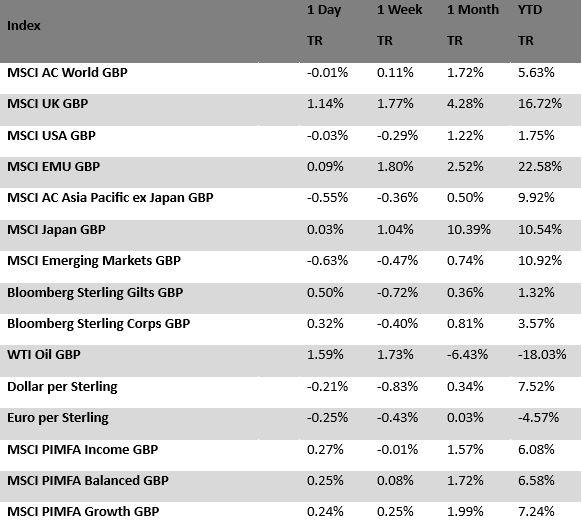
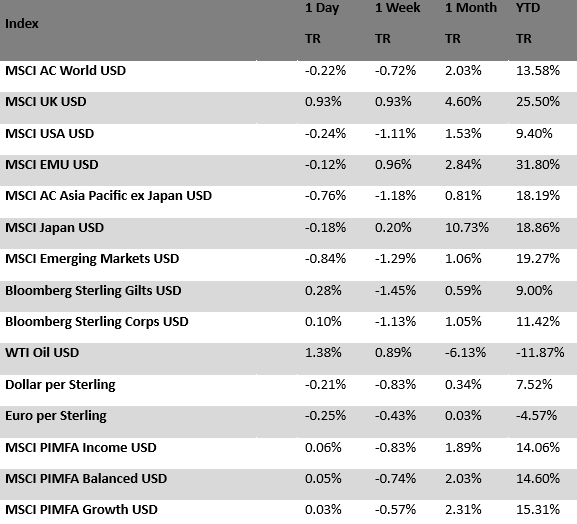
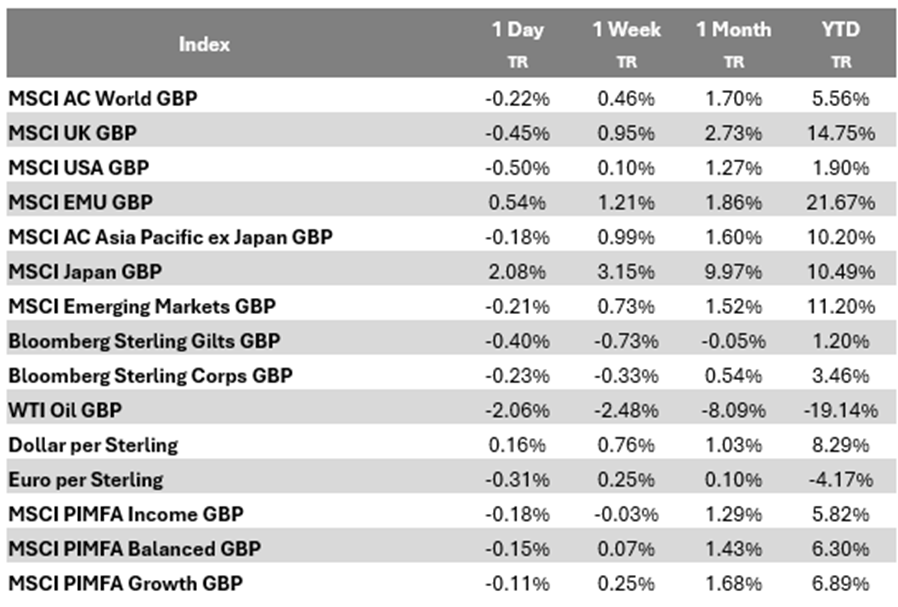
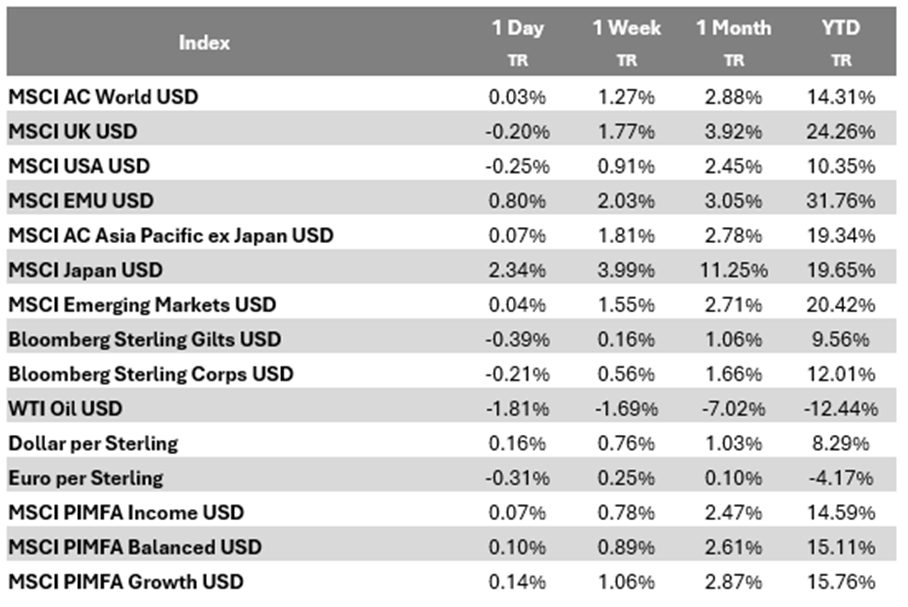
Bloomberg as at 19/08/2025. TR denotes Net Total Return.

Please continue to check our blog content for advice, planning issues and the latest investment, market and economic updates from leading investment houses.

Alex Clare

19/08/2025

Team No Comments

Tatton Investment Management: Monday Digest

Please see below, an article from Tatton Investment Management, analysing the key factors currently affecting global investment markets. Received this morning – 18/08/2025

The slowdown never comes


Friday night’s meeting between Trump and Putin has produced some clarification from Russia of the current land-grab ambition. While Putin’s proposal is not acceptable (nor designed to be so), there are elements which may lead to more discussions in the Europe/Ukraine/US meetings scheduled for today. Markets retains some positivity about potential progress in the last fortnight, although some of it some of which drained away late on Friday. 

Despite this slight pull-back, the good times keep coming – backed up by improved corporate earnings in most major markets. Previously, the rally seemed like a consequence of abundant liquidity; economic data were weak (particularly employment) and many thought incoming tariffs would keep it that way, leading to doubts over the equity rally’s sustainability. But rising corporate earnings expectations almost everywhere have changed the narrative. We know there was a rough patch after April, and that’s what the ‘lagged’ data (employment and GDP) show. But company surveys are more positive, and retail sales remain strong. 

Markets also suggest a Federal Reserve rate cut is all but certain next month – helping smaller US companies in particular. So far, tariff pass-through into consumer price inflation has been relatively mild, and consumers and businesses are resilient. 

But producer prices are rising faster and there is still a risk that prices spiral. July’s core finished producer goods prices spiked, undermining the case for a Fed cut. Bond markets lowered their bets on a September cut but still think it likely. That might be due to Trump’s pressure on the Fed: he’s openly mulling chairman Powell’s replacement and even Scott Bessent (usually the saner voice of MAGA-nomics) says rates should be 1.5 percentage points lower. 

You’d expect this to mean higher long-term inflation, and hence higher long-term bond yields – but that hasn’t happened. The lack of market reaction to Trump’s policies (except perhaps in the dollar) means bonds might be overpriced. But that’s tomorrow’s problem – and won’t disturb market momentum today. Right now, markets are focussed on global growth which is better everywhere except China – and even China might be improving, judging by its recent rally and likely US trade deal. 

This isn’t to say markets couldn’t wobble again, and US liquidity has started to drain a little. But right now, things are going fairly smoothly. 

Japan: liquidity flowing from home and away


Japanese stocks have been strong in August. Part of this is the US trade deal (which sees ‘just’ a 15% tariff on Japanese exports) but another part is the longer-term improvement in corporate profitability. There’s also a new wave of Japanese investment capital: a generation of retail investors unencumbered by the painful memories of the 1990s asset bubble are swapping low-yielding bank deposits for risk assets. Government and central bank policy is encouraging this switch. Tax-free investment accounts have been introduced, while the Bank of Japan is keeping interest rates well below inflation – meaning people have to invest in higher yielding assets just to not lose money. 

The stock market rally isn’t matched by a strong economy, though. Q1 saw zero growth, high inflation and pessimistic consumers. Much of this has to do with the weakness of global manufacturing, particularly the autos sector – which employs millions in Japan. Donald Trump’s 25% tariff threat made the situation worse. So, after a trade deal was agreed, company analysts steadily upgraded earnings forecasts. Profit margins had already improved from corporate reforms, so exporters can take advantage. 

The retail investment boom is encouraging, but it has been difficult to direct that investment towards Japanese companies themselves. Japanese investors often buy US or global stock indices – so the domestic investment pool has a relatively low domestic allocation. But Japan’s recent equity rally suggests this might be changing. MUFG found last year that a significant chunk of capital in the government’s new tax free investment accounts is going towards Japanese stocks. 

The momentum has dragged in international investors – aided by abundant global liquidity. Liquidity usually flows to undervalued pockets of the market, and Japan fits the bill. But the positivity is backed up by solid fundamentals. Investors are now taking notice of Japan’s improvements. 

US debt falling?


We’ve written before about mounting US government debt and the threats that poses, but we should be clear that total US debt-to-GDP (public and private) has been falling since the pandemic. In the decade before it, private debt had been falling in exact proportion to the rise in government debt (unpayable debts were written off after the 2008 crash and the government picked up the slack) and we have since gone back to that trend. But the private sector’s post-pandemic deleveraging isn’t to do with write-offs; companies are just struggling to refinance at historically high interest rates. 

One way to interpret the swap of private for public debt is as a ‘crowding out’ story. The government is demanding capital, pushing up ‘risk free’ yields and making private debt less attractive. The rise in our internal measure of government bond risk supports this idea. But as this stifles growth, a high government debt pile could well mean lower long-term yields, as in Japan. Growth isn’t strong enough to incentivise companies to borrow – at least while interest rates are higher than your expected profit growth. Outside of the tech giants (who have strong cashflows and little need to borrow) US corporate earnings are sluggish.

That’s why US companies are under pressure to deleverage, and that will continue as long as interest rates stay high. But rates are coming down – just not as fast as Donald Trump would like. It’s his policies which are stopping the Federal Reserve from cutting rates sooner but, judging from the Fed’s latest meeting, many committee members seem to feel the US economy needs a rate cut regardless of what happens on tariffs. If that happens, it won’t take much to make borrowing viable for US companies. That will benefit smaller US companies in particular.

Please continue to check our blog content for the latest advice and planning issues from leading investment management firms.

Marcus Blenkinsop

18th August 2025

Team No Comments

EPIC Investment Partners The Daily Update | Ageing Demographics and a Slowing Economy: The US Faces a Contradiction

Please see below article received from EPIC Investment Partners this afternoon, which offers an interesting insight into the US economy.

The narrative around the US economy often fixates on the latest employment figures as the primary indicator of inflationary pressure. However, this view overlooks a deeper, more significant force at play: demographic change. While a tight labour market is traditionally seen as a driver of wage-led inflation, the reality of an ageing population suggests a different, more nuanced outcome. The US, like other advanced economies, is experiencing a fundamental shift in its workforce, and this structural trend is likely to result in lower inflation than many would assume. The contradiction lies in how a shrinking pool of workers, which should theoretically boost prices, is being offset by a decline in overall consumer demand as the population gets older. 

This demographic weakness is becoming increasingly evident in the latest economic data. The most recent US labour market figures from July point to a greater slowdown than the headline suggests. Non-farm payrolls rose by just 73,000, and significant downward revisions of 258,000 to the May and June data reveal a much weaker underlying trend. While the unemployment rate stayed at 4.2 per cent, the broader picture is less positive. The labour force participation rate has fallen to 62.2% from a year ago, and the employment-population ratio is also lower. This indicates that a large number of people are leaving the workforce, a trend partly driven by an ageing population. 

This cyclical weakness is unfolding against a deeper structural shift. Between 2000 and 2020, all net job growth in the US came from workers aged 60 and above, with younger cohorts seeing net losses. The retirement of the Baby Boomer generation, combined with low birth rates, means the working-age population is barely expanding. Congressional Budget Office projections show that without immigration, population decline could begin after 2033, making migration the only source of workforce growth. 

The implications for inflation and demand are finely balanced. The supply-side view, rooted in the Phillips Curve, argues that a shrinking labour pool forces up wages, lifting prices. Labour-intensive sectors like healthcare are particularly exposed. However, the demand-side case points the other way. As the share of retirees rises, consumption growth slows. Japan’s experience since the 1990s demonstrates how this can dominate: despite a dwindling workforce, wages have barely risen and inflation has stayed near zero. Similarly, China’s rapid ageing is already weighing on consumption and contributing to disinflation. 

In the US, the next few years will be shaped by these opposing forces. Labour scarcity is likely to keep unemployment low and support wages, but ageing will sap demand, flattening the relationship between employment and inflation. This will also affect productivity and keep the neutral real interest rate low, leaving central banks with less scope to cut rates in downturns. While immigration and flexible markets can temper these effects, slower growth, modest inflation, and persistent labour tightness are the likely outcome, challenging conventional economic models. 

Please check in again with us soon for further relevant content and market news.

Chloe

15/08/2025