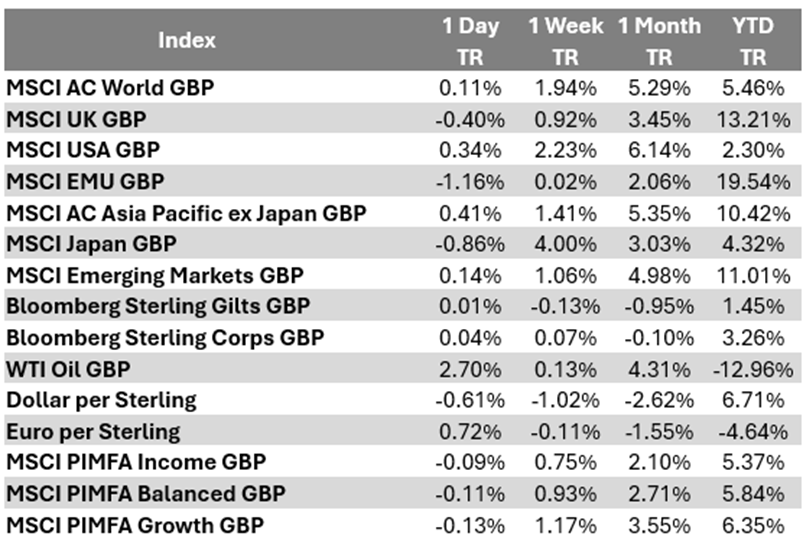
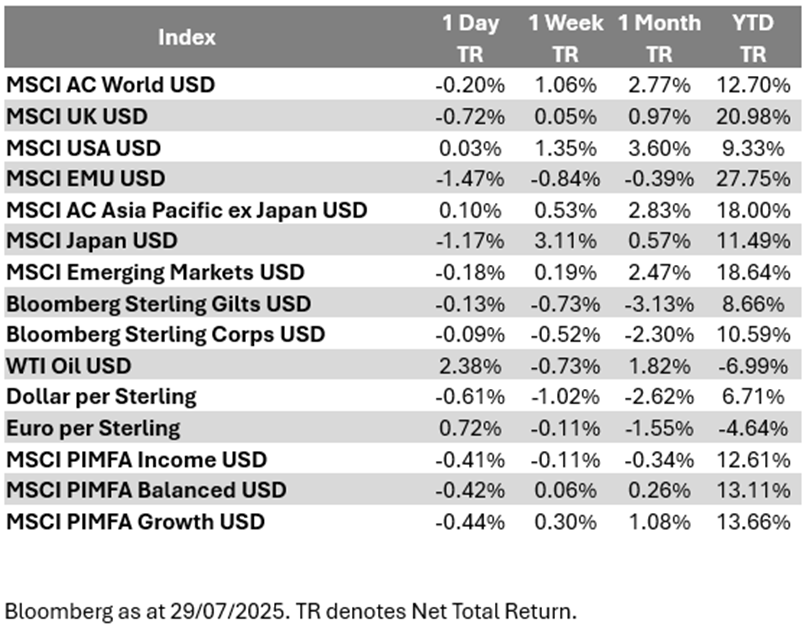
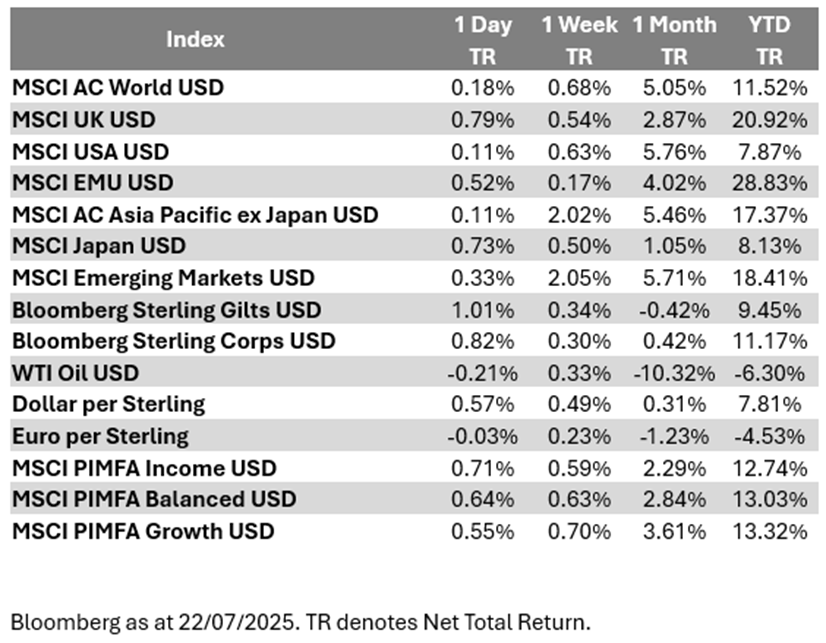
Please see the below article from EPIC Investment Partners detailing their discussions on the US economy. Received this morning 31/07/2025.
While the overall US consumer debt delinquency rate remains lower for upper-income households compared to other groups, a notable and concerning trend has emerged: delinquencies across all loan products for households earning over $150,000 per year have more than doubled since 2023. This is a significantly sharper increase than for middle- or lower-income households, suggesting that even those with substantial earnings are beginning to feel the pinch of economic shifts. Despite this acceleration, the actual delinquency rate for this group remains relatively low at around 0.34%, but the rapid upward trajectory is a red flag, indicating that a broader segment of the population might be struggling with rising costs and potentially stagnant real wage growth.
This strain on upper-income consumers comes at a time when consumer spending, which accounts for roughly two-thirds of US GDP, has seen its tamest growth in consecutive quarters since the pandemic. In the second quarter of 2025, consumer spending rose by a modest 1.4%, a deceleration from previous periods. While the overall US GDP did rebound to a 3.0% annual rate in Q2 2025 after a Q1 contraction, this was significantly influenced by a decrease in imports and an acceleration in consumer spending on durable goods and services. However, a deeper look reveals that “real final sales to private domestic purchasers” – a measure stripping out trade and government spending – increased by a more subdued 1.2% in Q2, down from 1.9% in Q1.
This subdued consumer spending growth, coupled with the rising delinquencies among higher earners, points to a potential underlying fragility in the US economy. While overall job growth has continued and consumer confidence saw a slight improvement in June, there are signals of caution. The deceleration in personal consumption expenditures and the increasing financial strain on a segment of the usually more resilient upper-income bracket suggest that consumers may be reaching a breaking point after a sustained period of high spending and rising debt. This could lead to a further slowdown in the vital consumer spending engine, impacting future GDP growth, and prompting a re-evaluation of the economic outlook.
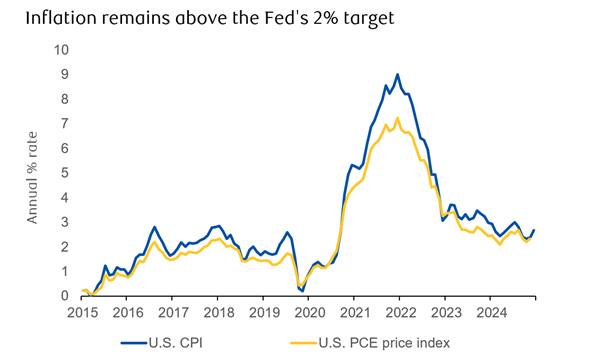
Separately, as expected, the FOMC maintained the fed funds rate target range at 4.25-4.50% yesterday. The decision was not unanimous, with two members, Waller and Bowman, dissenting in favour of a 25bps cut, suggesting a growing dovish sentiment within the committee. Futures markets are forecasting one rate cut this year, amid a cooling labour market and restrictive current rates. However, these anticipated cuts could be delayed into 2026. We await the Fed’s favoured PCE readings, and the personal income and spending figures this afternoon.
Please continue to check our blog content for advice, planning issues and the latest investment, market and economic updates from leading investment houses.
Please see this week’s Markets in a Minute update below from Brewin Dolphin, received yesterday afternoon – 29/07/2025.
Japan and the EU secure U.S. trade deals
Guy Foster, Chief Strategist, discusses newly announced trade deals between the U.S. and Japan and the European Union. Plus, our Head of Market Analysis, Janet Mui, analyses the European Central Bank’s latest interest rate decision, and the prospect of further cuts.
Key highlights
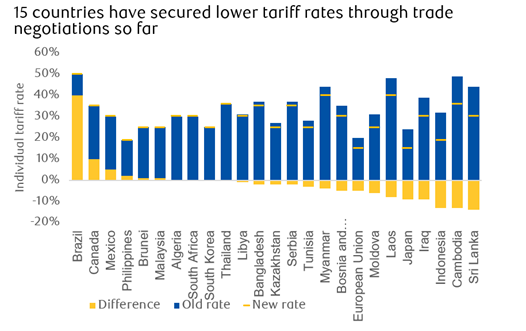
Japan and EU secure U.S. tariff deals: Japan and the European Union have successfully negotiated a 15% tariff rate with the U.S. The deals include cars, which is an improvement on the Trump administration’s previously announced 25% global auto tariff.
Will the Federal Reserve hold interest rates? The central bank is expected to maintain its federal funds rate at 4.25% to 4.5% this week as the U.S. economy and inflation have been holding up.
Eurozone outlook remains uncertain: The European Central Bank held its deposit rate at 2%, as expected. However, the future direction of interest rates will depend on how the tariff drama between the U.S. and European Union plays out.
It was a quiet week in the markets as investors began to head off for the summer, taking some liquidity with them. Earnings season hit full stride, and the reports were generally good, providing some support to indices.
The general backdrop was somewhat supportive, with additional trade deals announced at lower-than-expected tariff rates. Trade deals haven’t resulted in a pivot back to the low tariff environment that existed before President Trump returned to power, but they have reduced uncertainty about the future trading environment. This is evident in a reduction in the VIX Index of expected volatility to the lowest level since 14 February.
Japan and the EU secure U.S. tariff deals
A number of trade agreements were reached over the last week, with the European Union (EU) and Japan being the most significant.
Both deals saw a reduction in the baseline tariff rate to 15%; Japan’s tariff rate was 24% on ‘Liberation Day’, and the EU had been threatened with a 30% rate at one point. The deal includes cars, which represents a significant improvement on the 25% global auto tariff previously announced by the Trump administration. Pharmaceuticals should also be covered, mitigating the effects of more tariffs due to come on the sector.
Source: RBC Brewin Dolphin
The U.S. has prioritised making commitments to inward investment a part of the deals. The White House announced that Japan will invest $550bn in a range of U.S. strategic industries, with the U.S. apparently retaining 90% of the profits from those investments. On the face of it, that seems an intolerably bad deal for Japan, so we await more details on exactly how, or why, this would happen. The EU is understood to have committed to $600bn of inward investment into the U.S. and the purchase of $750bn worth of energy products.
Overall, more trade deals appear to have been achieved with lower tariff rates compared to those announced on ‘Liberation Day’. Obviously, this still represents a significant increase from pre-Inauguration Day levels, which could weigh on growth by driving higher inflation. Despite this, the markets seem to have responded positively.
With days to go until the new tariff rates come into effect, many countries still haven’t come to agreements with the U.S., and President Trump has been vague about what the new universal tariff rate might be.
Will the Federal Reserve hold interest rates?
The president has continued to needle Federal Reserve (Fed) Chairman Jay Powell while maintaining that he has no intention to replace Powell before his term as chair expires in 2026. But President Trump and members of his administration continue to be critical of Powell in relation to monetary and non-monetary matters. In doing so, they seem to be normalising the idea that the president should influence monetary policy.
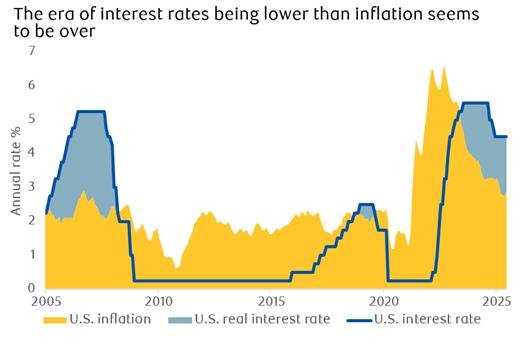
The Fed will announce interest rates this week. It seems highly unlikely that there will be any change because the economy and inflation have been holding up. However, interest rates are still expected to fall later in the year as the economy gradually loses further steam.
Source: LSEG
Eurozone outlook remains uncertain
The European Central Bank (ECB) has held its deposit rate steady at 2%, which was widely expected. However, the future direction of interest rates is uncertain and will depend on how the tariff drama between the U.S. and EU plays out.
If the U.S. imposes a 15% tariff on the EU, as is currently being discussed, it may negate the need for further rate cuts by the ECB. Markets are currently pricing in a better-than-50%-chance of a rate cut between now and March, despite the trade deal (without which the economic outlook would be more precarious.)
The ECB’s latest bank lending survey shows strong residential mortgage demand, suggesting that this interest rate-sensitive sector may not need additional stimulus. Meanwhile, recent data has shown an uptick in new orders in the Eurozone.
Despite improved sentiment towards the Eurozone, the French economy is likely to weigh on the upside. France has the second-largest government budget deficit in the region and is facing a debt crisis. The government has announced a package of spending cuts, tax hikes, and reforms aimed at shrinking the deficit, but these measures are unlikely to be passed into law due to political opposition. The budget deficit is expected to remain unchanged over the next couple of years, and developments in France are a reminder that the upside for the Eurozone should be limited.
Overall, while the Eurozone has shown signs of improvement, the ongoing tariff drama and challenges in France mean the outlook remains uncertain.
Please continue to check our blog content for advice, planning issues and the latest investment market and economic updates from leading investment houses.
Please see below article received from Brooks Macdonald this morning, which provides a global market update for your perusal.
What has happened
Yesterday saw US and European equity markets largely unwind their earlier intraday-gains as investors focused on negative ramifications from the US-European Union (EU) trade deal that was announced over the weekend. The share prices of German auto makers, which are especially sensitive to US trade access, reflected the evolving investment mood that the EU had struck a weak deal: Volkswagen shares, which had surged over +3% in the opening minutes of yesterday’s session, ended up closing more than -3.5% down by the end of the day (all in local currency terms).
US-EU trade deal criticised
As we noted in our Daily Investment Bulletin yesterday, the 15% tariff rate that will now apply to most EU trade going into the US is significantly higher than the average trade-weighted pre-existing US tariff rate of under 2%. While European Commission President von der Leyen had previously conceded the deal “was the best we could get”, yesterday saw French Prime Minister (PM) Bayrou label it “a dark day” and a “submission” for the EU, while Hungarian PM Orbán called von der Leyen a “featherweight” negotiator, adding “[US President] Trump ate von der Leyen for breakfast’.
US Federal Reserve meets
Yesterday sees the US Federal Reserve (Fed), arguably the world’s most important central bank, kick off its latest two-day policy meeting. The Fed announcement on interest rates is due out 7pm UK-time tomorrow evening, with a press conference starting 7:30pm UK-time tomorrow. While no change in interest rates is expected (the Fed’s benchmark interest rate target range of 4.25-4.50% has been unchanged so far this year), markets will instead be on the lookout for any signalling around possible interest rate cuts later this year, not least given the huge pressure that Trump has put on Fed Chair Powell recently to cut interest rates.
What does Brooks Macdonald think
It is a big week for stock markets, with a lot riding on the latest US megacap technology results in particular. Microsoft and (Facebook parent company) Meta have results tomorrow, while Apple and Amazon results are on Thursday, all coming out after the US trading close on each day. High hopes for Artificial Intelligence has powered broader US and global equity index performance so far this year, but with the aforementioned four megacap tech stocks currently accounting for around a fifth of the market-capitalised weight of the US S&P500 equity index, there is significant near-term two-way performance risk.
Please check in again with us soon for further relevant content and market news.
Please see below, an article from Tatton Investment Management, analysing the key factors currently affecting global investment markets. Received this morning – 28/07/2025
The Meme Generation
We start the week with another boost from a trade deal. The European Union has emulated Japan in securing a nearly-uniform 15% tariff on goods exported to the US. The signed agreement included autos, pharmaceuticals and metals (with a quota) but this may have surprised Trump, and that might lead to interpretation difficulties later. Equity markets have greeted it cordially at the open.
Last week, UK economic data releases showed that June’s retail sales rose just 0.9%, failing to recover from May’s sharp drop. Consumer sentiment dipped slightly, and government borrowing widened to £20.7bn, above expectations. Households appear to be saving more, possibly in anticipation of the autumn budget. While this caution isn’t recessionary, it reflects a hesitant mood. Increased savings may be supporting UK equities and giving the Bank of England room to lower rates despite persistent inflation.
In the US, Donald Trump has intensified criticism of Fed Chair Jerome Powell, blaming him for economic weakness due to “high” interest rates. Although Trump lacks the power to remove Powell, he may use the Fed’s $3bn HQ renovation overrun as political leverage. Despite tensions, Trump recently visited the Fed and downplayed any desire to oust Powell—likely keeping him in place as a convenient scapegoat.
Japan’s Prime Minister Ishiba faces mounting pressure after his coalition lost its upper house majority. Despite securing a trade deal with the US—imposing a blanket 15% tariff on Japanese exports but sparing cars from a harsher 25% rate—his domestic support is waning. Japan also pledged $500bn to support US industry, with spending decisions left to the US government. The Bank of Japan responded by reaffirming its hawkish stance, nudging the Yen higher.
Meanwhile, the European Central Bank held rates at 2%, with President Christine Lagarde suggesting the economy is in a “good place.” Markets now believe the rate-cutting cycle may be over.
Back in the US, retail investors—dubbed the “meme generation”—are targeting stocks disliked by hedge funds, using social media to coordinate buying. This disrupts short-selling strategies and drives up borrowing costs for hedge funds. While reminiscent of 2021’s frenzy, today’s meme stock activity is powered by profits from earlier trades and cheap options. Despite past underperformance, some meme stocks have delivered outsized returns.
Ultimately, meme investing is more game than strategy—high-risk, emotionally driven, and not unlike the hedge fund tactics of the 1990s. Still, it’s proving effective for now.
Platinum Prices Rising
While gold remains the most closely watched precious metal, platinum and palladium have seen a sharp price rise over the past year. Gold’s recent gains are tied to geopolitical and monetary uncertainty, particularly under Trump’s presidency. But, over the past two decades, the story for platinum has focussed on its use as utility and industrial use.
Platinum is extremely stable and unreactive, even more so than gold. Historically, its high melting point made it difficult to work with, delaying its widespread use in jewellery until the 20th century. Its real breakthrough came in the 1980s, when it became essential in catalytic converters to reduce vehicle emissions. Palladium followed a similar path, eventually surpassing gold in price at times due to its efficiency in catalysis.
However, their industrial use has also capped their price potential. Demand for platinum jewellery has declined over the past 15 years, and catalytic converters are now widely recycled—25% of platinum supply comes from recycled sources. The global shift to electric vehicles has further reduced demand, leading to falling mine investment and production. South Africa, which holds 88% of known platinum group metal reserves, saw a 7.7% drop in output in April 2025 and nearly 12,000 job losses in the sector.
Since 2022, platinum has faced a persistent supply deficit, projected to continue for at least five years. China remains the largest consumer, with industrial demand falling but jewellery and investment demand rising. Platinum is increasingly seen as a cheaper alternative to gold, especially after Trump’s metal tariffs prompted stockpiling in Chinese warehouses.
Recent data shows a slight dip in Chinese imports, suggesting inventory building may have peaked. Jewellery demand will be key to sustaining the rally. If consumer interest doesn’t match jewellers’ optimism, prices could fall by 20–30%. Yet, if just 1% of China-HK gold jewellery demand shifts to platinum, it could tighten global supply by over 2%.
With property investment out of favour in China and liquidity looking for a home, platinum—historically undervalued—may be poised for further gains.
The Oracle of Trading Platform Kalshi
Prediction markets are gaining traction in the U.S., with Kalshi recently raising $185 million at a $2 billion valuation, and rival Polymarket reportedly seeking $200 million. These platforms surged in popularity during the 2024 U.S. election and, following the Trump administration’s decision to drop legal actions against them, are poised to become a fixture in American finance.
Prediction markets allow users to trade contracts on the outcomes of real-world events. Though similar to betting, U.S. platforms like Kalshi and Polymarket argue their contracts are financial instruments, not wagers. U.S. firms can now claim regulatory ‘legitimacy’ —Kalshi is CFTC-approved, while Polymarket operates in a legal grey area.
These platforms use blockchain technology, with Polymarket accepting only cryptocurrency. Advocates say prediction markets offer a new asset class and powerful forecasting tools. The theory is that market prices reflect the collective probability of an event occurring, aggregating information more effectively than any individual could.
For investors, prediction contracts offer a direct way to hedge or speculate on specific events—such as geopolitical developments—without relying on indirect instruments like futures. For example, Polymarket allowed users to bet on the likelihood of Iran closing the Strait of Hormuz.
Despite their growth, legal uncertainty looms. Kalshi is being sued by several U.S. states that view it as a gambling platform. Polymarket, fined in 2022 for operating without a license, was raided by the FBI in 2024. However, the Trump administration has since dropped investigations into both firms, aligning with its broader deregulatory stance, including toward crypto.
This regulatory leniency has allowed prediction markets to expand rapidly. Kalshi contracts are now available on Robinhood, and some investors liken the sector’s potential to early-stage crypto. Yet risks remain. Prediction markets often suffer from low liquidity, making prices volatile and susceptible to manipulation. Prices can become self-reinforcing signals, creating feedback loops and undermining their reliability as forecasting tools. If widely adopted in financial hedging, these distortions could pose systemic risks.
Supporters argue that deeper markets will resolve these issues and democratize access to information. But with little oversight, prediction markets are entering a “wild west” phase—one that could end in innovation or casualties, as history has shown with other unregulated financial frontiers.
Please continue to check our blog content for the latest advice and planning issues from leading investment management firms.
Please see the below article from EPIC Investment Partners detailing their discussions on the macro environment for trade, including the ongoing Trump Tariff saga. Received this afternoon 24/07/2025.
Global equities rose yesterday, as traders rode a wave of optimism following signs that the US is back in deal-making mode. Hot on the heels of a pact with Japan announced on Tuesday, markets are now buzzing with talk of similar moves with Europe and South Korea. The Stoxx 600 climbed 0.7%, while the S&P 500 and the MSCI World reached record highs. Risk-on is back, and traders are betting Washington’s bark may prove louder than its bite when it comes to tariffs.
But, behind the rally, not everyone is cheering.
President Trump’s Japan deal is being hailed by the White House as a model for others: a 15% tariff cap, sweetened by Tokyo’s promise of a $550 billion investment fund targeting US projects. Trump declared Japan’s markets “OPEN” for the first time ever. But, at home the backlash is growing. Critics say the deal hands Japan a free pass on autos — the very sector driving America’s trade gap with Tokyo — and risks undermining domestic manufacturing just as tariff pressure was starting to bite.
“Any deal that charges a lower tariff on Japanese imports with zero US content than on North American-built vehicles with high US content is a bad deal,” said Matt Blunt of the American Automotive Policy Council, voicing what many in Detroit are now thinking.
The agreement is also raising alarm among protectionists who see it as a crack in the armour of Trump’s Section 232 tariffs — long considered the most durable shield for US industry. Unlimited auto imports at a 15% rate? Steel and parts, though, still taxed at 25% and 50%? For some, it looks like the goalposts are moving — and not in America’s favour.
Still, the administration insists its strategy is working — cutting deals, cracking open markets, and keeping rivals guessing. Next stop: Stockholm, where US and China officials are gearing up for round three of trade talks.
Buckle up — trade season’s not over yet.
Please continue to check our blog content for advice, planning issues and the latest investment, market and economic updates from leading investment houses.
Please see this week’s Markets in a Minute update below from Brewin Dolphin, received yesterday afternoon – 22/07/2025.
U.S. inflation remains contained
U.S. core inflation has only been modestly impacted by tariffs so far, rising marginally month-on-month in June.
Key highlights
Boost for cryptocurrencies: U.S. Congress passed legislation to regulate stablecoins, paving the way for the potential broader use of cryptocurrencies.
Tariff costs and consumer price increases: the full impact of tariffs will unfold slowly, making it much harder for consumers to associate their loss of disposable income with tariff increases.
Rumours continue around Federal Reserve Chair’s departure: frontrunners to replace Jerome Powell include President Trump’s economic adviser Kevin Hassett, and former Fed governor Kevin Warsh.
Boiling frogs by design or accident?
Last week was busy, with earnings season really kicking off. The banks posted good numbers, buoyed by a lot of trading-related volatility during the second quarter.
Japan’s upper house elections saw the ruling Liberal Democratic Party-led coalition lose control of the chamber. It is now in the minority in both chambers, making Prime Minister Shigeru Ishiba’s position particularly tenuous as Japanese households struggle with the return of inflation. The yen rose on an expectation that a future government would provide more support to households, in turn requiring more contractionary policy (higher interest rates) from the Bank of Japan.
Meanwhile, the United States Congress passed legislation to regulate stablecoins − a type of cryptocurrency whose value is pegged to an external reference, such as gold or fiat currencies (national currencies that are backed by the issuing government rather than commodities such as gold or silver). Stablecoins now have a clearer path to broader use in financial transactions.
The bill imposes federal or state oversight on U.S. dollar-linked tokens. Regulatory rules include a requirement for firms to fully back currency values with reserves in short-term government debt or equivalent products, bringing some perceived legitimacy to the crypto industry. It also brings demand for securities, which will help to finance increased government borrowing.
Supporters of the bill believe it could lead to cheaper, faster, and more business-related transactions. Critics, on the other hand, warn that the bill won’t do enough to protect consumers.
The development of the coins could have a macro-economic impact though, as it creates demand for bills that can support government borrowing, but it takes deposits away from the banking system, which could inhibit credit creation.
Have U.S. import tariff costs been passed on to consumers?
Investors have been scouring inflation reports for evidence that companies are passing on the costs of U.S. import tariffs by raising consumer prices. So far, tariff-driven inflation had been the dog that didn’t bark, but last week’s inflation report allowed another opportunity to check. Inflation picked up, but by less than expected. So, another month of no tariff inflation? Not quite.
Source: LSEG
Services prices were suppressed by travel prices (such as airfares and hotel prices) and housing (such as rent). But core goods inflation did pick up, and while the move was not very large, it was quite broad, covering several sectors that would instinctively suffer from import taxes (clothes, appliances, home wears).
This is really the first sign of these moves, and it reflects the fact that many months have passed between the first speculation about import tariffs and their eventual implementation, a process that even now hasn’t finished.
Is this an example of the kind of haphazard implementation that is characteristic of the Trump administration? Or is it a deliberate strategy?
Most economists assume that tariffs are a tax paid by consumers. The political risk is that consumers realise that too. That will be most obvious if you implement the tariffs and then prices go up. However, if you implement tariffs and then prices don’t noticeably rise, then it seems like the government has achieved an immaculate tax hike.
How can that happen? Firstly, you give some warning so that companies buy in a lot of inventory ahead of the tariff increase. Then you increase tariffs a bit, while deferring further increases.
It doesn’t hurt for there to be some ambiguity about what will happen, as happens if you dangle the prospect of trade deals, even though in practice hardly any such deals get done. Exporters don’t want to hike their prices and lose market share if tariffs might be cut again soon, so they suffer the tax themselves for a few months.
The upshot, therefore, is that importers have had the inventories and exporters have had the incentive to keep prices down for the time being, which has put some distance between the tariff announcement and the tariff impact. It means the impact will unfold gradually over time, rather than lurching higher, making it much harder for consumers (or, more accurately, voters) to associate their loss of disposable income with the tariff increase.
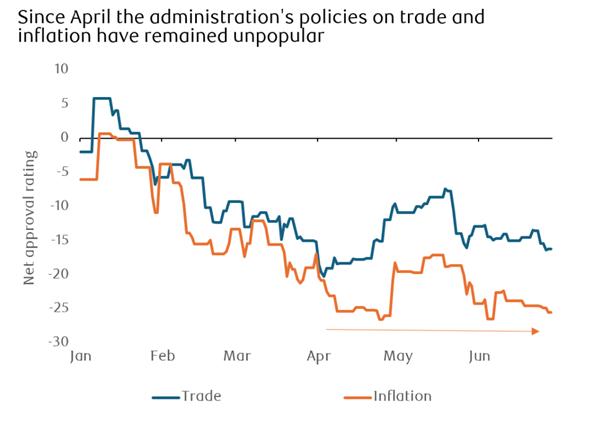
Imposing tariffs, like boiling frogs, is probably easier if you do it slowly. Has it made the policies popular? To an extent. The disapproval rate of President Trump and his policies on trade and inflation has stopped worsening since the ‘Liberation Day’ tariffs were partly deferred, although his policies haven’t actually become more popular.
However, what seems significant is that if the policies become embedded, it’s harder to see this, or a future administration removing them. As we’ve discussed before, the trajectory of the budget deficit makes it very hard for either party to give up revenue sources.
The chaotic implementation of tariffs – was it deliberate?
Source: Silver Bulletin
In that sense, the chaotic implementation of the tariffs may help to ensure their permanence. Was it deliberate? Probably not. But what seems more stage managed has been the repeated rumours, and subsequent guarded denials, that President Trump is preparing to fire Federal Reserve (the Fed) Chairman, Jerome Powell.
Last week, Trump met with congressional Republicans in a private meeting, at which he discussed the matter, even showing them a draft letter of termination. News of the meeting was leaked, the dollar fell, the yield curve steepened, and gold and bitcoin rose.
President Trump subsequently said he was probably not going to fire Powell after all, and added that former President Joe Biden had appointed Powell, a falsehood that is so obvious that it would immediately cast additional doubt on the topic. The market reaction was less severe than last time the topic was raised; prediction markets had already assumed a higher chance of it happening and, presumably, they will continue to do so. By repeatedly floating and walking back the idea, the market reaction, when it happens, will be less severe.
President Trump seems fixated on the fact that interest rates should be lower, despite inflation picking up recently. As a result, the shortlist for Powell’s replacement includes Kevin Hassett and Scott Bessent, both members of President Trump’s current economic team. Either would face challenges to being confirmed, as that would appear to undermine the independence of the Fed. More conventional alternatives would be former Fed governor Kevin Warsh or current governor Christopher Waller.
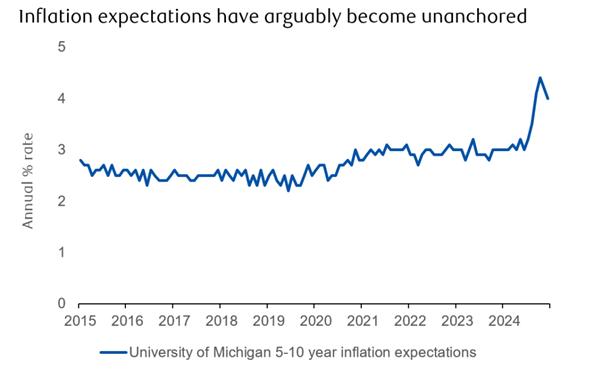
The frontrunners are Warsh and Hassett; but last week, Waller stated his view that interest rates should be cut at the next meeting on 30 July. His view is that the limited evidence of inflation from tariffs will be temporary (which seems likely) and that inflation expectations are unlikely to be unanchored (i.e. they’ve started to move unusually far away from their previous average). This last point is debateable as, by some measures, they have already become unanchored. It’s therefore pretty certain that rates will be held at that meeting.
Source: LSEG
Please continue to check our blog content for advice, planning issues and the latest investment market and economic updates from leading investment houses.
The Government is pushing ahead with plans to include pensions within inheritance tax (IHT) from April 2027, but has made some adjustments to its implementation plans.
The move is expected to raise £1.5bn a year by 2029/30, with the average IHT burden expected to increase by £34,000.
The plans were confirmed by the Government on Monday (21 July). From April 6 2027, IHT will be applied on unused pension funds and death benefits.
Chancellor Rachel Reeves first unveiled the plans in the Autumn Statement 2024.
Adjustments
The Government has adjusted its original proposals following a consultation on the mechanics of implementation, which closed in January.
One such change is that personal representatives, rather pension scheme administrators, will be liable for reporting and paying any IHT due, and death in service benefits payable from a registered pension scheme will remain out of scope of IHT.
As part of the Autumn Budget 2024, the Government announced measures to reform IHT and “deliver a fairer, less economically distortive tax treatment of inherited wealth and assets, including this measure”.
Comment
Personally, I think Labour have got it wrong again on this one. They are penalising hard working people that have done the right thing and accumulated good pension assets for their retirement.
Having said that, for the majority of people funding pensions is still one of the best things to do to provide your retirement income, it’s tax efficient.
For a lot of married couples or for those in a Civil Partnership, you might not have an inheritance tax position unless your assets exceed £1 million, including your pension funds, from April 2027.
We can implement individual planning strategies as appropriate if you have an inheritance tax position now or in the future.
Generally, we caution against any knee jerk reaction to this legislative change. Consider your position, think long term, and take independent financial advice.
Please see below article received from Brooks Macdonald this morning, which provides a global market update for your perusal.
What has happened
Global equity indices were up yesterday (in US dollar terms), once again led by mega-cap tech. While the day’s rally did fade a little at the end, Monday still marked fresh record closing highs for both the US S&P500 and tech-focused US Nasdaq equity indices. In contrast, this morning the UK FTSE All-Share equity index is struggling and UK government bond yields are up across the maturity curve, following a dire set of UK public sector deficit numbers – outside of the pandemic, last month was the highest net borrowing for a June month since records began in 1993.
EU trade-talks
With the 1 August tariff-pause deadline next week fast approaching, the lack of progress in European Union (EU)-US trade talks is becoming a concern. While talks are continuing this week, there is speculation that the EU are already planning retaliatory moves in case talks fall apart. Adding to tensions was a veiled threat from US Treasury Secretary Scott Bessent, who said yesterday “it doesn’t have to get ugly”, but “we are the deficit country, so the surplus country will always feel it more. We have a gigantic trade deficit with the EU, and so with the level of tariffs, it will affect them more”.
Middle East
News wires yesterday reported that Iran had agreed to hold talks with the UK, France and Germany to discuss Iran’s nuclear program, expected to take place this Friday in Istanbul, Turkey. However, there are low expectations for any meaningful progress. Ahead of those talks, Iranian officials are due to host a meeting with Russia and China representatives later today, while separately, Iran has yet to formally agree to fresh talks with the US.
What does Brooks Macdonald think
It is hard to argue with recent comments from US bank JP Morgan CEO Jamie Dimon that as regards tariff risks “unfortunately, I think there is complacency in the markets”. It is certainly impressive that global equities (in US dollar terms) are hitting record highs, while at the same time we are still yet to navigate a significant amount of near-term trade tariff uncertainty and risk. Should next week’s 1 August tariff-pause cliff-edge see talks with the EU and other countries unravel, it is not obvious that markets are greatly prepared for such an outcome.
Please check in again soon for further relevant content and market news.
Please see below, an article from Tatton Investment Management, analysing the key factors currently affecting global investment markets. Received this morning – 21/07/2025
Higher and higher
Markets keep rising on incoming liquidity. Growth optimism is improving, helped by strong early Q2 earnings reports. Volatility – both in measured and implied terms – has fallen dramatically, but measured more than implied (the cost of insuring against losses). That means you can profit by selling options and buying the broader market – a recipe for grinding higher.
Chancellor Reeves’ deregulation speech at Mansion House wasn’t well received – but that was more about what she didn’t say (no mention of tax rises) than what she did. Her comments about encouraging risk-taking and getting savers invested in the UK stock market were valid; we’ve argued them before. Follow-through is key, but the City’s pessimism seems a little misplaced. The only thing she did say about fiscal policy was that the fiscal rules are iron-clad. That’s nothing new, but repeating it for bond traders at the back of the room never hurts.
Donald Trump reportedly penned Fed chair Powell’s letter of dismissal – nominally over misconduct but pretty obviously over his refusal to cut rates to the president’s liking. Bond markets were unmoved by this assault on Fed independence (the slight rise in US yields was about stronger growth). We suspect they have faith in the Fed’s institutional strength. Removing the committee chair won’t change the views of the committee – and there’s little suggestion that Trump’s next appointee will follow his rate-cutting orders.
Chinese stocks had a strong week. The media put it down to better growth and nicer Trump – but we think the underlying story is again about liquidity. Chinese households have cash and the government is encouraging them to buy stocks, rather than low-yielding savings or property. That supports stock prices even if company profits are weak. That doesn’t necessarily mean international investors will flock to China (the risk of stranded assets remains), but even if they just move to a “neutral” allocation, it will be strong fuel for Chinese stocks. Like everywhere, liquidity keeps things grinding higher.
Sticky inflation won’t stop UK rate cuts
June’s inflation print – 3.6% year-on-year – was above expectations and the highest in 18 months. Core and services inflation accelerated too, causing markets to slightly dial back their bets for an interest rate cut at the Bank of England’s meeting next month. Markets still see a 0.25 percentage point cut as likely, though. The UK economy is weak and unemployment is rising, as April’s rise in employer national insurance contributions bites. Global input prices are also subdued, largely thanks to Chinese deflation. And while housing inflation looked bad in June’s report, it has decelerated recently.
The fact consumer inflation is high when producer price inflation is subdued tells us companies are moving costs onto customers. They can do so because consumer demand is surprisingly resilient, despite mounting job losses. Pantheon Macroeconomics think the UK economy isn’t as weak as some suggest, with lasting support from last year’s public sector wage rise. Backing that up is the fact that both consumer confidence and retail sales numbers have stabilised in recent months. This could be to do with the fact that total wages aren’t declining, despite layoffs. If that pattern holds, the BoE will have a tough time cutting rates further.
The BoE faces a dilemma. On the one hand, cutting rates while inflation pressures remain undermines the central bank’s credibility (inflation has been above the 2% target for four years). On the other, rising unemployment could quickly spiral into recession if rates stay too restrictive. Last Thursday’s payroll data gave no clarity which way it will go: June’s layoffs were sharper than expected, but May’s job losses were revised down significantly.
June’s inflation won’t stop the BoE from cutting rates next month, but it’s a challenge. Investors can at least take comfort that the challenge is strong consumer demand – ultimately a growth positive.
US inflation: tariffs or growth?
US CPI gained 0.3% month-on-month in June, taking annualised inflation to 2.7%. That’s either in line with or slightly above economists’ expectations, depending who you ask. Core CPI (more important for the inflation trend) came in slightly below expectations at 0.2%. Donald Trump’s tariffs had some inflationary impact – on clothes and furnishings – but it was mild. Tariff effects were subdued by the weakness in global producer prices, coming from Chinese deflation. The most interesting part of June’s inflation report, though, was the New York Fed’s survey showing a fall in consumer inflation expectations.
Markets’ main concern about tariffs has been that they will hurt growth through compressing consumer demand. We worried that this might happen during a weak employment market, but recent employment data has improved. The New York Fed’s survey also suggests that Americans feel more secure in their jobs and finances. It’s early days, but this suggests that tariffs might not hurt demand too much after all. The outlook for real (inflation-adjusted) US growth has improved.
Stronger growth is good for US stocks. For international investors, though, what happens to the dollar is just as important. The currency has weakened greatly year-to-date, dragging down sterling returns on US stocks, but dollar weakness has mellowed recently. We have argued before that the dollar is due a short-term rebound – as low growth was the main downside, and that’s now easing.
But the longer-term case against the dollar remains. The ‘twin deficits’ problem (fiscal and current account) is a drag on the dollar, and it gets worse if US asset returns stop being as exceptional. Trump wants to address one of those deficits (by reducing imports) but his tax cuts are widening the second. The growth and inflation story is dollar positive for now, but that might not last.
Please continue to check our blog content for the latest advice and planning issues from leading investment management firms.
Please see below, The Daily Update from EPIC Investment Partners covering their thoughts on Indonesia’s economic strength following their US Trade Agreement – Received today 18/07/2025:
Indonesia’s Power Play: US Trade Deal Fuels Growth & Ambition
The recently announced US-Indonesia trade agreement is set to significantly reshape bilateral trade dynamics. Under the agreement, Indonesian exports to the US will face a reduced tariff of 19%, down from an initially proposed 32%. Importantly, energy commodities and critical minerals have been exempted from tariffs, aligning closely with Indonesia’s strategic ambitions in industrialisation. In exchange, Indonesia has agreed to substantial purchases from the US, including $15 billion in energy commodities, $4.5 billion in agricultural products, and 50 Boeing 777 jets. These commitments not only support key American industries but also strategically enhance Indonesia’s position in the competitive global market.
Indonesia’s resilience following the devastating Asian Financial Crisis of 1997-1998 highlights its robust economic recovery. That crisis saw severe economic contraction, currency collapse, and substantial capital flight. However, comprehensive macroeconomic reforms, restructuring of the banking sector, and prudent management of foreign reserves have enabled the nation to achieve steady growth, projected by the World Bank to average 4.8% annually between 2025 and 2027.
A key factor underpinning this resilience is Indonesia’s demographic advantage. As the world’s fourth most populous country, with an estimated population of 284.44 million by mid-2025, Indonesia boasts a large workforce and expansive domestic market. Although the annual population growth rate has moderated to around 1.11%, the sheer size of its population continues to fuel domestic consumption and production, underpinning sustained economic activity.
Central to Indonesia’s modern economic strategy is its mineral downstreaming policy, which mandates the domestic processing of minerals like nickel, bauxite, and copper. This policy aims to retain greater economic value within the country, attract foreign direct investment (FDI), facilitate technology transfers, and create employment. The policy has proven successful, attracting record FDI inflows, primarily within the basic metal and non-machinery sectors. The International Monetary Fund (IMF) has endorsed this strategy, acknowledging its positive impact on Indonesia’s external financial stability. The critical minerals exemption included in the US trade agreement further validates this approach, securing crucial markets for Indonesia’s processed minerals.
Despite ongoing challenges related to environmental sustainability and equitable employment, Indonesia’s downstreaming policy exemplifies its ambition to climb the global value chain, reinforcing economic sovereignty and long-term resilience.
A pivotal indicator of Indonesia’s economic transformation is the significant improvement in its Net Foreign Assets (NFA). Following the Asian Financial Crisis, Indonesia’s net foreign liabilities stood alarmingly at -106% of GDP. Through disciplined economic management, sustained current account surpluses, strategic foreign exchange reserve accumulation, and increased FDI, Indonesia has notably improved its NFA position to around -19% recently. This progress, reflected by the country’s upgrade from a one-star to a four-star rating on our net foreign asset analysis, underscores Indonesia’s enhanced capacity to manage financial imbalances and navigate future economic shocks.
In contrast, the US has experienced a stark deterioration in its NFA position. Previously rated four stars in 1998, it is now rated two stars due in part to prolonged budget deficits. With a projected deficit of around $1.9 trillion, or approximately 6% of GDP, the US faces continued reliance on external financing. In contrast to Indonesia’s successful turnaround, the US NFA outlook suggests limited improvement unless significant fiscal adjustments are implemented.
Please continue to check our blog content for the latest advice and planning issues from leading investment management firms.