Team No Comments

Markets in a Minute: Equities start 2022 on a strong footing

Please see below this week’s Markets in a Minute update from Brewin Dolphin – received late yesterday afternoon – 05/01/2022

Global equities made solid gains in the final week of 2021 to start the new year on a strong footing.

A ‘Santa Claus rally’ helped the S&P 500 reach new record highs and end the week up 0.9%, as fears about Omicron waned. The Dow also gained 1.1%, while the technology[1]focused Nasdaq was flat.

The pan-European STOXX 600 and the FTSE 100 ended their holiday-shortened trading weeks up 1.1% and 0.2%, respectively, with the latter closing near its highest level for 2021, despite surging coronavirus infections.

Over in Asia, the Shanghai Composite advanced 0.6% following encouraging manufacturing data.

Last week’s market performance*

• FTSE 1001 : +0.17%

• S&P 500: +0.85%

• Dow: +1.08%

• Nasdaq: -0.05%

• Dax2 : +0.82%

• Hang Seng3 : +0.75%

• Shanghai Composite: +0.60%

• Nikkei2 : +0.03% *

Data from close on Friday 24 December to close of business on Friday 31 December.

1 Closed Monday 27 and Tuesday 28 December; early close on Friday 31 December at 12:30pm.

2 Closed Friday 31 December.

3 Closed Monday 27 and Friday 31 December.

US indices hit fresh record highs

 The S&P 500 and the Dow hit new record highs on their first trading day of 2022, rising by 0.6% and 0.7%, respectively, on Monday (3 January). Easing concerns about the economic impact of Omicron helped to boost investor sentiment, despite rising case numbers. Bank stocks performed particularly strongly on speculation the Federal Reserve could lift interest rates earlier than expected.

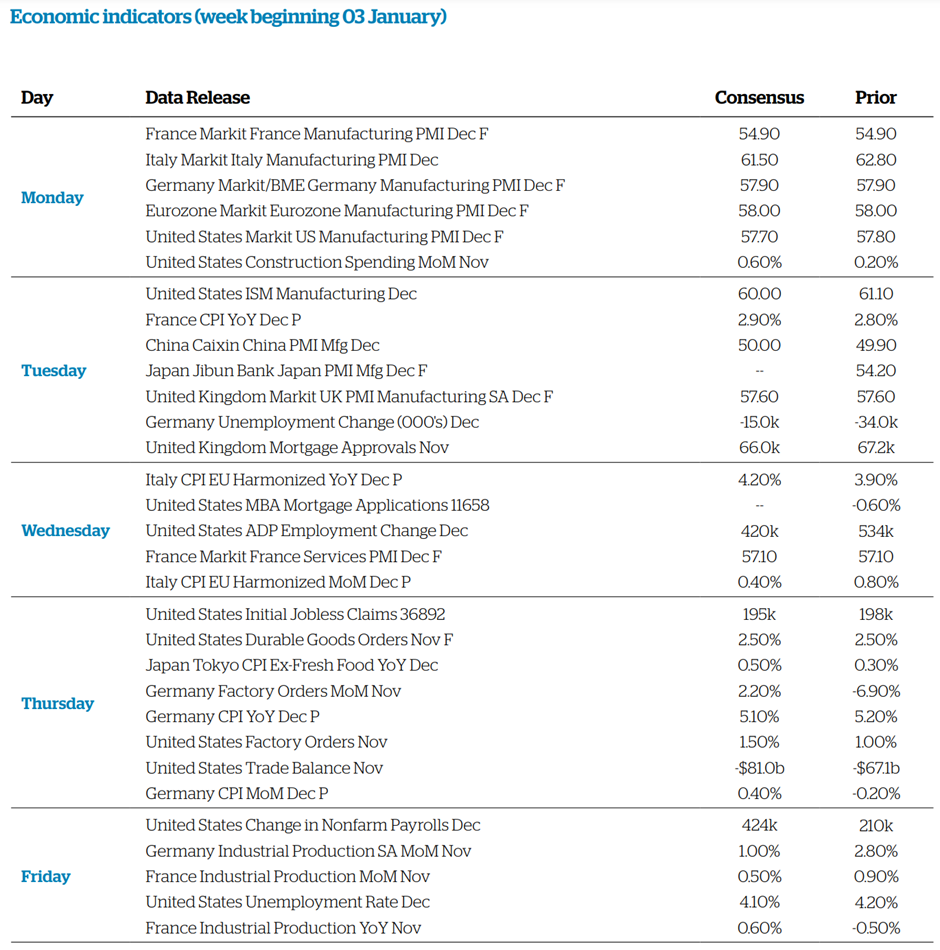
The FTSE 100 also rose in its first trading session of 2022, gaining 1.6% on Tuesday to finish above 7,500 for the first time in almost two years. The IHS Markit/ CIPS manufacturing purchasing managers’ index (PMI) measured 57.9 in December, up from an initial reading of 57.6 although slightly below November’s three-month high of 58.1. Companies maintained a positive outlook at the end of 2021, with 63% forecasting that production would increase over the coming 12 months, compared to only 6% anticipating a contraction.

The STOXX 600 also rose by 0.8% on Tuesday, with travel and leisure stocks surging after the UK’s vaccine minister said Britons hospitalised with Covid-19 are generally showing less severe symptoms than before.

At the start of trading on Wednesday, the FTSE 100 was down 0.2% ahead of the release of the Federal Reserve’s December meeting minutes later in the day.

US jobless claims fall despite Omicron

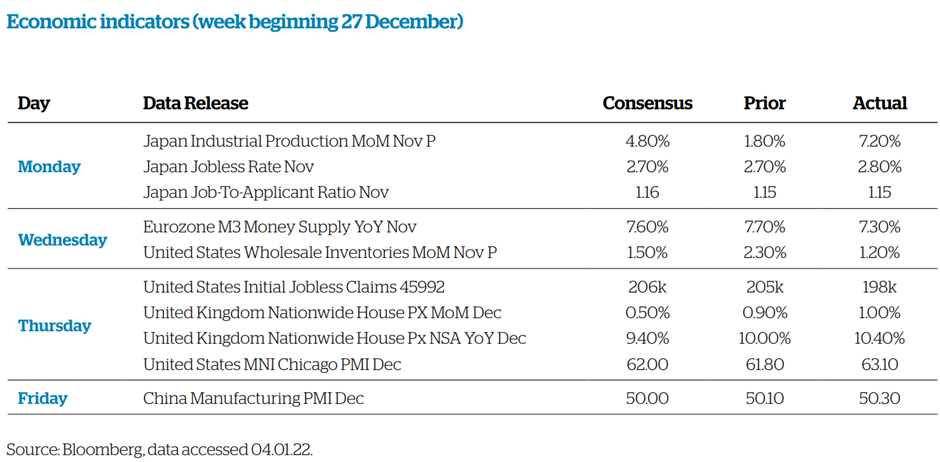
US weekly jobless remained close to their lowest level for over 50 years in the week ending 25 December, showing the rapidly spreading Omicron variant has yet to impact employment. Initial claims for state unemployment benefits totalled 198,000, less than the 205,000 forecast by economists and 8,000 lower than the previous week, according to the Labor Department data.

US initial jobless claims

Continuing claims – which measures the number of unemployed people who have already filed a claim and continue to receive weekly benefits – fell by 140,000 to 1.72 million in the week ending 18 December. This was the lowest level since 7 March 2020, just before the first wave of Covid-19 lockdowns.

Investors are now waiting for the latest monthly employment figures, which will be released on 7 January. Economists polled by Reuters expect the unemployment rate to edge down to 4.1% in December from the 21-month low of 4.2% in November.

Festive retail sales soar

In another sign that Omicron is having a milder effect on economic activity, US retail sales surged by 8.5% during this year’s holiday shopping season (1 November to 24 December). This was the biggest annual increase in 17 years, according to the Mastercard data. Online sales grew by 11.0% compared to the same period last year, while sales at physical stores rose by 8.1%.

“Shoppers were eager to secure their gifts ahead of the retail rush, with conversations surrounding supply chain and labour supply issues sending consumers online and to stores in droves,” said Steve Sadove, senior adviser for Mastercard. “Consumers splurged throughout the season, with apparel and department stores experiencing strong growth as shoppers sought to put their best dressed foot forward.”

Covid restrictions tighten

Several countries in Europe tightened their coronavirus restrictions last week as infections surged to record levels. In France, where daily infections reached a new high, the government announced that from 3 January people must work from home if they can and public gatherings will be limited to 2,000 people for indoor events. Other countries cancelled official new year celebrations, and introduced limits on bar and restaurant opening hours.

Over in China, which is holding on to its zero-Covid strategy, 1.2 million people were placed into strict lockdown in Yuzhou in the Henan province this week, joining 13 million others who have been locked down in Xi’an for almost a fortnight.

 China manufacturing PMI beats forecasts

China’s official manufacturing PMI beat forecasts in December, rising to 50.3 from 50.1 in November, according to the National Bureau of Statistics. Analysts had expected it to fall slightly to the 50-point mark that separates growth from contraction. Activity in the services sector also grew at a slightly faster pace in December, rising to 52.7 from 52.3 the previous month.

However, China’s vice commerce minister warned last week that the country faces “unprecedented” difficulties in stabilising trade next year. Export gains could slow as other countries recover their production capabilities and inflation eases, Ren Hongbin said.

To view the latest Markets in a Minute video click here

Please continue to check back for a range of blog content from us and from some of the world’s leading fund management houses.

David Purcell

6th January 2022
Team No Comments

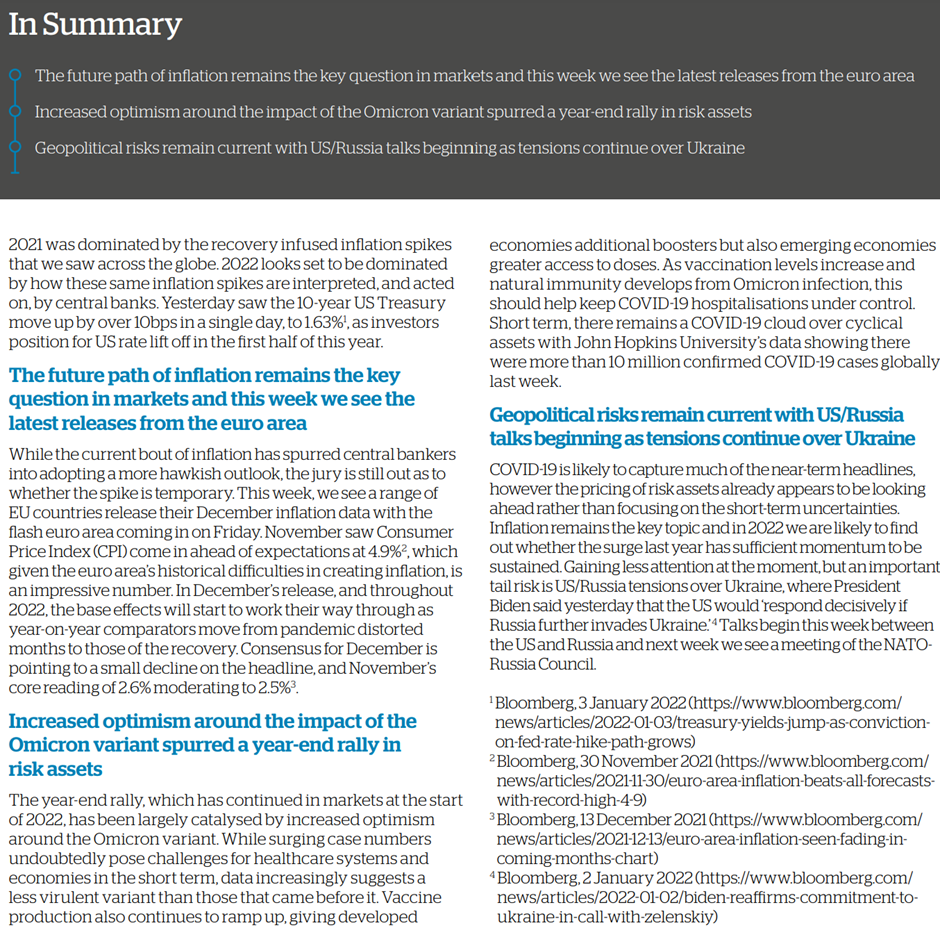
Brooks Macdonald – Weekly Market Commentary

Please see below an article published by Brooks Macdonald yesterday (04/01/2022) detailing their views on markets over the last week:

Please continue to check our Blog content for advice and planning issues and the latest investment, markets and economic updates from leading investment houses.

Please keep safe and healthy.

Carl Mitchell – Dip PFS

Independent Financial Adviser

05/01/2022

Team No Comments

Welcome 2022 – Happy New Year! Some less strenuous New Year’s resolutions..

Make your money work harder:

  1. Maximise tax reliefs and allowances.  This will help you get more for your money when investing and planning.  The obvious options are pension funding and using your ISA allowances.  But we have plenty more to use if appropriate.
  2. Have you any lazy capital sitting in cash?  If you have a medium or long term investment horizon, consider investing some of it for real capital growth over time.  Cash buying power is eroded by inflation over the long term.
  3. Do you have any legacy pension and investment assets that have not been reviewed recently?  Are they invested in line with your risk profile, capacity for loss and objectives?  If not, you could be missing out on potential investment returns and/or taking too much risk.
  4. Do you have any spare monthly income?  If you have, you could invest it in either your pension or a Stocks & Shares ISA.  Other investments are also available.

Get your ‘legal’ house in order:

  1. Do you have up to date Wills in place?  If not, please take legal advice.
  2. Have you got both Power of Attorney in place?  One for Finance and Property and the other for Health and Welfare: https://www.gov.uk/power-of-attorney
  3. Are your pension nomination forms up to date on your current Workplace Pension and on any legacy pension assets?  As these are potentially some of your biggest assets, it’s important that your nominations/Expression of Wishes reflect your current situation.  They can drift out of date and legislation can and does change.

Please take independent financial advice and legal advice as appropriate.

Whilst any of the above won’t help you lose weight or get a (better?) beach body they could help you straighten out your finances for your financial good health.

All the best for 2022, have a happy, healthy and prosperous year.

Steve Speed

04/01/2022

Team No Comments

Goodbye 2021 and Happy New Year!

Goodbye 2021 and Happy New Year!

Thank you for taking the time out to read our blogs this year.  Our focus since the pandemic started is to keep everyone abreast of market news as we have been through this roller coaster ride for economies and markets.

We have used a variety of market commentary and input from economists, fund managers and stockbrokers from a wide range of businesses.  I think it’s important for you to read a variety of views to understand the consensus view.

In addition, we pop in the occasional planning article on topical issues or things that we think we need to bring to your attention.  Hopefully these are useful too?

Given the last c 22 months that we have experienced we are changing the way we think as a business here too and once again we have not mailed out Christmas cards but decided to make charitable donations and sponsor good causes throughout the year.

We have supported the following this year:

Reach Family Project (Bolton)

Queenscourt Hospice (Southport)

Macmillan Cancer Support

Armed Forces Charity

Alzheimer’s Society

The Candice Colley Foundation (aims to help leukemia and other blood cancer patients and their families)

The Bloom Appeal (Merseyside against blood cancers – provides support to patients and medical staff)

We aim to continue this into 2022.

With regards to the business, we are managing in the current environment, but I really do look forward to when we can all work in the office together again.  Personally, I think this is the best option for the mental health and wellbeing of us all and for the development of our staff.  We also benefit from the teamwork, the banter and the social aspects of work being back in the office.

We wish you all a happy, healthy, and prosperous New Year!  Hopefully 2022 will be much better for all of us.  Take care of yourselves.

Steve

Steve Speed and all the team at P and B.

31/12/2021 

Team No Comments

Brewin Dolphin – Markets in a Minute

Please see below this week’s Markets in a Minute update from Brewin Dolphin – received late yesterday afternoon – 29/12/2021

Markets enjoy rally into Christmas

Further evidence that Omicron may be milder than previous strains saw markets become more optimistic that this variant will not have a lasting impact over the economy.

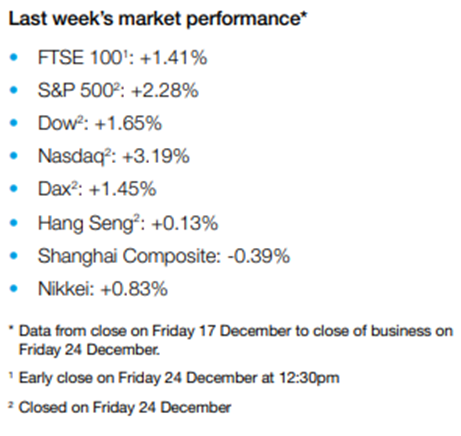
In the US, the S&P 500 ended its last trading day before Christmas at a record high, up 2.3% for the week, while the Nasdaq was up 3.2% and the Dow 1.7%.

The UK’s FTSE 100 rose 1.4%, to hit its highest level since February 2020 on Christmas Eve. The Dax was also up 1.5%.

In Asia, China’s Shanghai Composite slipped 0.4%, with ongoing Omicron cases weighing on market sentiment.

Omicron optimism continues

As markets reopened after the Christmas break, they retained their momentum from the previous week. US stocks rose further on Monday before stalling on Tuesday to end a four-day rally for the S&P 500 and Nasdaq as investors locked in their gains.

London stocks maintained their momentum in early trading on Wednesday on the optimism that the Omicron variant will be less severe than previous strains. European shares also rose in the morning trade. The day’s session is expected to be quiet, with little new economic data that would drive markets being published.

UK GDP growth revised lower

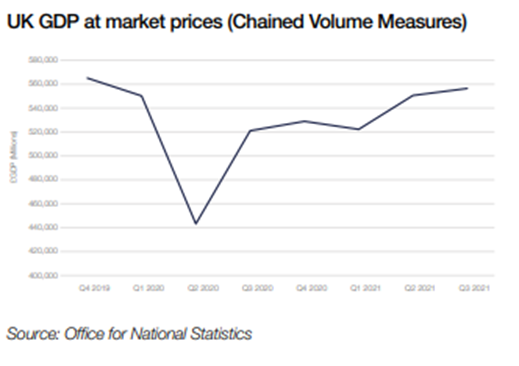
Figures released by the Office for National Statistics (ONS) last week showed third quarter UK gross domestic product (GDP) grew at a slower pace than previously thought. GDP rose by 1.1% in July to September, down from the initial estimate of 1.3% and a marked slowdown from the 5.4% growth seen in the second quarter.

Services output grew by 1.4% as coronavirus restrictions eased. However, wholesale and retail trade declined by 2.4%, while health and social work fell by 1.3%. Production output fell by 0.1%, revised down from a rise of 0.8%, amid ongoing supply chain challenges. Construction output also fell by 1.0% following four consecutive quarterly increases.

The ONS data also showed a 2.7% rise in household consumption in the third quarter, with increased spending on restaurants, hotels and transport following the reopening of the economy.

US consumer confidence rises in December

Over in the US, the latest survey from The Conference Board showed consumer confidence rose again in December after an upward revision the previous month. The index now stands at 115.8, up from 111.9 in November. The present situation index – based on consumers’ assessment of current business and labour market conditions – was relatively flat at 144.1. The expectations index – based on consumers’ shortterm outlook for income, business and labour market conditions – rose to 96.9 from 90.2.

Lynn Franco, senior director of economic indicators at The Conference Board, said the data suggested the economy maintained its momentum in the final month of 2021, while improved expectations about short-term growth “set the stage for continued growth in early 2022”.

The proportion of consumers planning to buy homes, cars, major appliances and holidays over the next six months increased, and concerns about inflation declined after hitting a 13-year high last month. However, Franco warned that confidence and spending will face headwinds in 2022 from rising prices and an expected winter surge of the pandemic.

Separate data from the National Association of Realtors showed existing home sales increased for a third consecutive month in November, rising by 1.9% from a year ago. A shortage of supply meant the median existing house price surged by 13.9% from a year ago to $353,900.

Several countries reinstate restrictions

A surge in Covid-19 cases has seen several countries reinstate pandemic restrictions as the Omicron variant continues to spread.

Germany announced that from 28 December private gatherings would be restricted to ten people, nightclubs would close, and football matches would be played behind closed doors. Portugal ordered bars and nightclubs to shut from 26 December and made working from home obligatory from that date until 9 January. Over in China, which has a ‘zero-Covid’ policy, up to 13 million people have been placed into lockdown in the city of Xi’an.

There is some evidence to suggest Omicron is milder than the Delta variant. An Imperial College London study pointed to a 20-25% reduced chance of a hospital visit and a 40-45% lower risk of being admitted overnight. However, scientists have stressed that studies such as these are preliminary, and concerns remain that the sheer number of cases could put serious strain on health services.

Please continue to check back for our latest blog posts and updates.

Charlotte Clarke

30/12/2021

Team No Comments

What lights up your Christmas tree?

Please see the below article from Invesco and our own input following the article:

It’s Christmas. You’re sitting at home, marvelling at your lit up Christmas tree.

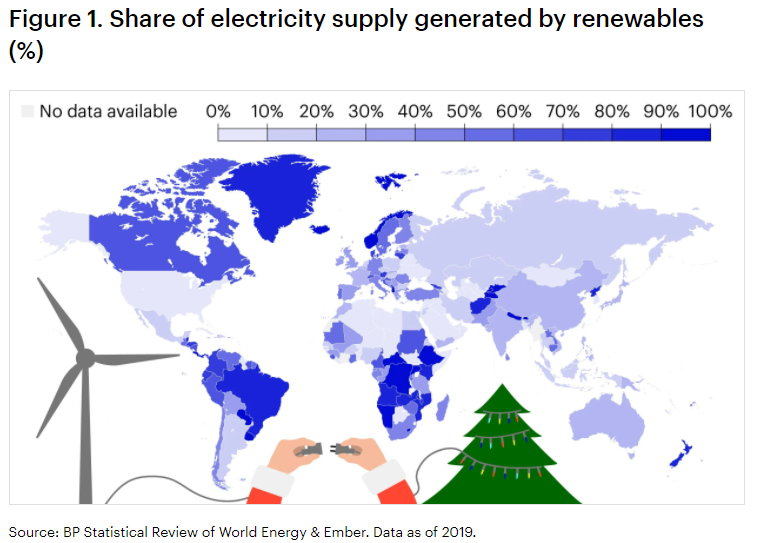
Have you ever wondered where the electricity that adds a magical sparkle to a simple pine tree comes from?

For the best part of the 20th century, electricity was generated by burning fossil fuels such as coal or gas.

The UK was the first country that burned coal to supply energy. And in the late 1980s, coal accounted for 60% of electricity production in the country.

But this has changed.

By 2020, this number had fallen to less than 2%. And much of this change was due to an increased awareness of the environmental impact of fossil fuel consumption.

With climate change high on the political agenda, countries all around the globe have set their eyes on renewable energy to supply people’s homes with electricity.

In a few years’ time, it may power those sparkling lights on your Christmas tree. 

Our Comment

The conversations about Climate Change are not new, but over the past few years, they are more serious.

One of the key areas of ESG investing looks at the environment. What are we doing to reduce our carbon footprint?

There are five major renewable energy sources which are as follows:

  • Solar energy (from the sun)
  • Geothermal energy (from heat inside the earth)
  • Wind energy
  • Biomass (from plants)
  • Hydropower (from flowing water)

They are called renewable energy sources because they are naturally replenished. The sun shines, plants grow, wind blows, and rivers flow.

People are also looking at new and innovative sources of energy, also known as ‘alternative energy’ sources.

Energy supplier EDF list the following ‘alternative energy sources’ which scientists are currently researching:

  • Solar wind
  • Algal biofuels
  • Body heat
  • Bioalcohols
  • Dancefloors
  • Jellyfish
  • Confiscated alcohol

The possibilities could be endless, and it’s this research and visibility from articles such as this that may help change the attitudes and practices of how we source and use energy.

Andrew Lloyd DipPFS

29/12/2021

Team No Comments

Five trends from 2021 (that could influence 2022)

Please see the below article from AJ Bell published earlier this week and received yesterday:

The past 12 months have been a bit of a mixed bag from a portfolio point of view.

Yes, the US equity market stands at a record high, and Germany and India reached new peaks in the autumn, while the FTSE 100 has, as of the time of writing, chalked up a solid, double-digit percentage capital gain, with dividends on top. Oil surprised with a near-40% gain.

But Brazil and China are down for the year, gold has done nothing and some of the air has started to leak out of some of the more speculative areas of the market: Bitcoin has shed a quarter of its value, Cathie Wood’s ARK Innovations ETF has collapsed, and the record of new market floats is looking patchy both in the UK and globally. The US markets regulator, the Securities and Exchange Commission (SEC), is even talking about tightening up the rules on Special Purpose Acquisition Companies (SPACs) just as its British equivalent, the Financial Conduct Authority (FCA), bizarrely loosens them.

“The US equity market stands at a record high, and Germany and India reached new peaks in the autumn, but Brazil and China are down for the year, gold has done nothing and some of the air has started to leak out of some of the more speculative areas of the market.”

As a history graduate, this column is a great believer that you need to understand the past before you can take a view on the future. These five trends from 2021 could yet make their presence felt in 2022, so they are worthy of further study, especially if advisers and clients are preparing to do a New-Year review of their strategic asset allocation plans for portfolios.

1. UK money flows

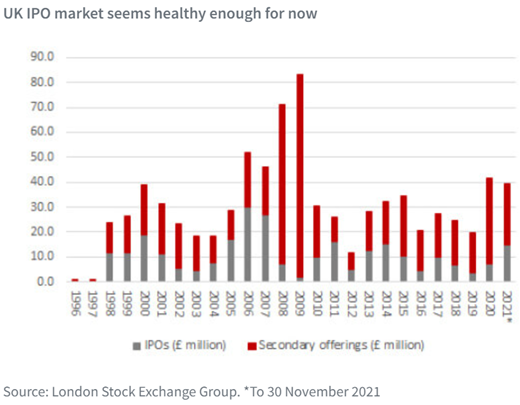
The average capital gain from an Initial Public Offering (IPO) on the London Stock Exchange is some 20% at the time of writing, which looks perfectly healthy, especially for a sample of almost 100 deals. However, the range of returns is wide, from a trebling to a drop of 77% and only half generated a positive return: for every success like Oxford Nanopore there has been a flop like Deliveroo and even Darktrace has shed a lot of its early gains.

Such stock-specifics will be of little interest to time-pressed advisers and clients. They pay fund managers to sort the wheat from the chaff. But IPOs are important because a real boom in new offerings is often the sign of a market top – that certainly proved to be the case in the UK in 1999-2000 and 2006-07. It often works out that way because the quality of deals goes down as stock indices – and risk appetite – go up and misallocation of capital and subsequent losses bring down the curtain. As the old saying goes, “bull markets ends when the money runs out.”

IPOs are important because a real boom in new offerings is often the sign of a market top because the quality of deals goes down as stock indices – and risk appetite – go up and misallocation of capital and subsequent losses bring down the curtain. As the old saying goes, “bull markets ends when the money runs out.”

The good news at least is that the flow of IPOs (and for that matter secondary capital raisings by firms that are already listed) is nowhere near the levels seen near past peaks in the FTSE 100.

According to the London Stock Exchange website, primary listings have totalled £14.7 billion and secondary offerings have soaked up a further £24.7 billion of portfolios’ cash.

But ordinary dividends from the FTSE 100 alone will exceed £80 billion according to analysts’ estimates in 2021. Moreover, members of the UK’s leading index have already declared £5 billion in special dividends and nearly £19 billion of cash returns in the form of share buybacks. That lot comes to over £100 billion, and then come the proceeds from the 70-odd bids for UK-listed firms of all shapes and sizes.

The good news at least for advisers and clients with exposure to the UK equity market is that the money is not running out, to suggest the UK market has upside potential in 2022, providing the new offering pipeline is kept to sensible levels.

2. Oil

Oil’s near-40% gain to date in 2021 will have surprised many an adviser and client, but uranium and even coal were strong markets too, despite the tide of public and political opinion, which has swung even further toward alternative and renewable sources of energy, especially after the COP26 summit.

Yet demand for energy continues to grow and renewables are not yet producing sufficient capacity to take the baseload strain. That means hydrocarbons are still important, whether we like it or not, but supply is being constrained, partly by the machinations of OPEC and its allies, partly by geopolitics (and sanctions against Iran and Venezuela) and partly by oil firms themselves. Fund managers are pressuring them to invest in renewables or simply disinvesting, Governments are refusing to sanction fresh exploration and insurers are declining to insure new projects.

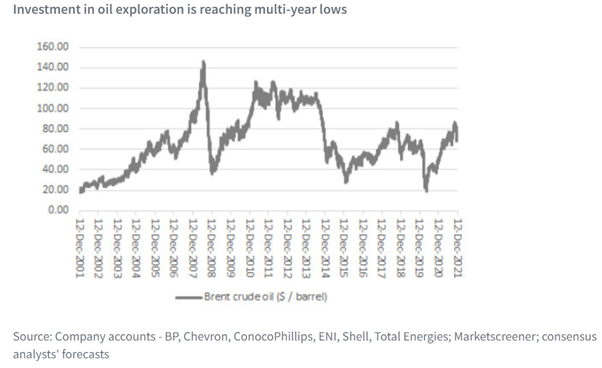
“The aggregate capex-to-sales ratio of the seven oil majors is heading toward multi-year lows. This could create a supply-demand squeeze if the economy shakes off the latest strain of COVID-19 and keeps growing. And higher oil prices, if that’s what we get, could play a major role in shaping inflation.”

Not surprisingly spend on drilling is under pressure: the aggregate capex-to-sales ratio of the seven oil majors – BP, Chevron, ConocoPhillips, ExxonMobil, ENI, Shell and Total Energies – is heading toward multi-year lows. This could create a supply-demand squeeze if the economy shakes off the latest strain of COVID-19 and keeps growing. And higher oil prices, if that’s what we get, could play a major role in shaping inflation, so watch this space in 2022.

3. The Misery Index

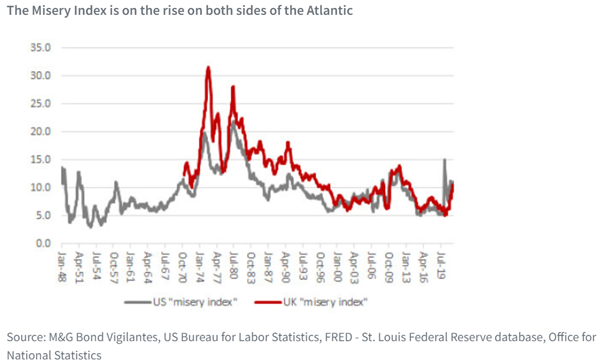
This column is indebted to a conference hosted by M&G’s Bond Vigilantes team for reminding it of the importance of the Misery Index.

Developed by economist Arthur Okun in the 1960s, this indicator simply adds together the prevailing rate of unemployment and the prevailing rate of inflation. As such, it defines the balancing act which central banks face when they set policy. For the past few years – and certainly since the pandemic – unemployment has been central banks’ number one preoccupation and they have run ultra-loose monetary policy as a result. But galloping inflation means the misery index is going higher, even if unemployment is coming down, and policymakers must now decide whether to start tapering Quantitative Easing and raising interest rates as a result.

The Omicron variant complicates calculations, but the Misery Index would suggest that action may be required (especially if oil prices catch light again).

4. Bonds

There will be no spoilers here, just in case any adviser or client has yet to get round to seeing the latest 007 film, No Time To Die. But 2021 was no fun for anyone who had a large allocation to Government bonds in the view that disinflation or even deflation would be the defining macroeconomic theme of the year (in a continuation of the trend of the prior decade).

“The question now is whether a trend toward lower Government bond yields and higher prices, that dates back to the early 1980s and Volcker-led Federal Reserve in America and the Thatcher-Lawson axis in Government in the UK, is decisively broken or not.”

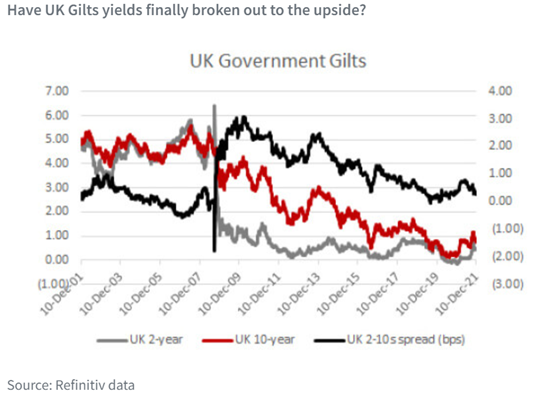
Using the UK as a benchmark, Gilt yields rose and prices fell, as inflation picked up pace and the Bank of England had to confront the prospect of whether to start tightening monetary policy. The question now is whether a trend toward lower yields and higher prices, that dates back to the early 1980s and Volcker-led Federal Reserve in America and the Thatcher-Lawson axis in Government in the UK, is decisively broken or not. The chart does suggest a break-out but we have seen many false signals such as that in the last four decades.

5. Central banks

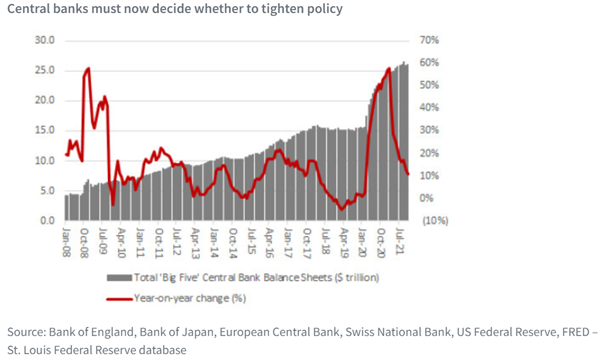
Unfortunately, no discussion of financial markets can be complete without an assessment of central bank policy, as the above commentary makes only too clear. The monetary authorities have their fingers in more pies than Mr. Kipling: interest rates have been kept at historic lows since spring 2020 and Quantitative Easing, asset-buying programmes designed to suppress interest rates, force cash into financial markets and create a so-called wealth effect mean that balance sheets have ballooned. In aggregate, the balance sheet of the Bank of England, Bank of Japan, European Central Bank, Swiss National Bank and US Federal Reserve has grown by:

  • $9.5 trillion since the start of 2020 – that is 67%
  • $13.0 trillion over five years – that is 99%
  • $ 17.4 trillion over 10 years – that is 199%

“Do a 0.1% base rate and £895 billion of Quantitative Easing in the UK seem appropriate when the Office for Budget Responsibility is forecasting 6% GDP growth, 4% inflation and just 4.8% unemployment for 2022, at a time when house prices are rising at their fastest rate for 15 years, asset prices more widely are elevated, and parts of the financial markets are feeling positively bubbly?”

On the face of it, tighter policy makes sense. After all, do a 0.1% base rate and £895 billion of Quantitative Easing in the UK seem appropriate when the Office for Budget Responsibility is forecasting 6% GDP growth, 4% inflation and just 4.8% unemployment for 2022, at a time when house prices are rising at their fastest rate for 15 years, asset prices more widely are elevated, and parts of the financial markets are feeling positively bubbly?

The Omicron variant of COVID-19 complicates decision-making and central banks are clearly weighing the danger of inflation on one side against the threats posed by unemployment, higher interest costs in a massively indebted-world and sagging asset prices (and perhaps thus consumer confidence) on the other. It is a difficult balancing act and one that will have huge implications for advisers’ and clients’ portfolios in 2022 and beyond.

Some central banks are already acting. The Bank of Canada has stopped adding to QE, the Reserve Bank of Australia and US Federal Reserve are tapering their bond-buying programmes, while there have been 94 interest rate increases from central banks around the world this year, against just 11 cuts. However, none of those 94 have come from the big five in the UK, EU, Japan, Switzerland and US and they will have to prove in 2022 that they are ahead of the curve and not behind it, if markets are to keep the faith in policies which have done so much to stoke risk appetite in equity markets and suppress bond yields in fixed-income ones for more than a decade.

Past performance is not a guide to future performance and some investments need to be held for the long term.

Please continue to check back for our latest blog posts and updates.

Andrew Lloyd DipPFS

23/12/2021

Team No Comments

Brewin Dolphin: Markets in a Minute

Please see the below market update from Brewin Dolphin, received yesterday evening – 21/12/2021.

Stocks fall as central banks turn more hawkish

Most major stock markets ended last week in the red as central banks moved to raise interest rates and rein in their support for the economy.

In the US, the Nasdaq slumped nearly 3.0% after the Federal Reserve’s survey of policymakers found a majority now expect three interest rate hikes in 2022 instead of two. The S&P 500 and the Dow also fell 1.9% and 1.7%, respectively.

The UK’s FTSE 100 slipped 0.3% after the Bank of England surprised the market with an increase in the base interest rate to 0.25%. The pan-European STOXX 600 also dropped 0.4% as Covid-19 restrictions tightened in several European countries.

Over in Asia, China’s Shanghai Composite slid 0.9%, with technology stocks particularly hit hard by the Federal Reserve’s more hawkish interest rate outlook.

Surge in cases gives investors the jitters

Stocks started this week in the red as a surge in Covid-19 cases gave investors the jitters. The FTSE 100 fell nearly one percentage point on Monday (20 December) with travel and leisure stocks under pressure after an emergency cabinet meeting was convened to discuss possible pandemic restrictions.

Wall Street stocks also closed sharply lower, following news the Omicron variant has now been found in 43 US states and around 90 countries. Also in focus was Democratic senator Joe Manchin’s statement that he would not back President Joe Biden’s ‘Build Back Better’ bill, thereby putting the legislation in jeopardy.

At the start of trading on Tuesday, UK and European stocks had managed to claw back some of the previous day’s losses, with the FTSE 100 and STOXX 600 opening 0.9% higher after the UK cabinet said it would wait for more data before imposing restrictions.

BoE first major central bank to lift rates

Last week, the Bank of England (BoE) became the first major central bank to increase interest rates since the pandemic hit. The monetary policy committee voted 8-1 to raise the base rate from 0.1% to 0.25%, surprising investors for the second time in six weeks. Investors and economists had expected the Bank to leave interest rates unchanged because of the uncertainty created by the Omicron variant.

Governor Andrew Bailey said the Bank needed to tackle the strong inflationary pressures building up in the economy. The annual rate of inflation hit 5.1% in November, the highest level in a decade. Bailey told the BBC it could reach around 6% in the next two to three months. He said the Bank had thought “long and hard” about the impact of Omicron on economic activity before making its decision. “But it is not at all clear if the impact [on the economy] could cause inflation to come down, or even go up,” he added.

Fed and ECB reduce asset purchases

The US Federal Reserve announced last Wednesday that it would taper its support for the economy more quickly than planned. Stimulus will be reduced by $30bn a month from January and is expected to end by March. Fed chair Jerome Powell said economic activity is on track to expand at a robust pace this year, and the US is making “rapid progress” towards maximum employment. Officials forecast that benchmark interest rates would need to rise from current near-zero levels to 0.9% by the end of 2022 amid higher inflation and declining unemployment.

The European Central Bank (ECB) also announced it would reduce bond buying under its pandemic emergency purchase programme, which is due to end in March. However, bond buying under the asset purchase programme will be increased and will continue for “as long as necessary to reinforce the accommodative impact of its policy rates”, the ECB said.

Black Friday boosts UK retail sales

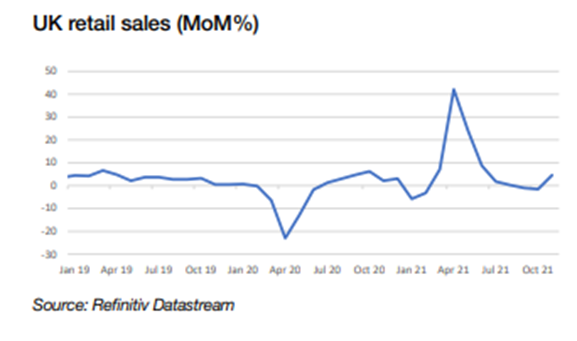
Last week also saw the latest retail sales figures from both the UK and the US. In the UK, retail sales volumes rose by 1.4% in November from the previous month, faster than analysts had expected and 7.2% above their February 2020 level.

Growth was driven by non-food sales, including clothes, toys, computers and jewellery, with retailers reporting strong trading around Black Friday and in the lead-up to Christmas, the Office for National Statistics said. Clothing stores sales volumes were above their pre-pandemic levels for the first time.

In the US, retail sales were below expectations, rising by 0.3% in November following a revised 1.8% gain the previous month. The suggestion is Americans started their holiday shopping earlier than usual to avoid empty shelves amid the ongoing supply chain disruption. After adjusting for inflation, retail sales fell by 0.5% in November from the previous month.

Please continue to check our Blog content for advice and planning issues and the latest investment, markets and economic updates from leading investment houses.

Alex Kitteringham

22/12/2021

Team No Comments

Fidelity – Hawkish Fed enters 2022 with a catch

Please see below an article from Fidelity which was published late last week and received late yesterday afternoon and covers Fidelity’s views on the US Federal Reserve and its potential movements in 2022:

As you can see from the above, the Fed remains focused on inflationary pressures and some action is likely to be needed to help curb these pressures. However, now is the time for potential policy mistakes by moving too soon or too aggressively on interest rate hikes. This needs to be managed carefully. The Fed appear to have a good grasp of the key issues at the moment and their communication to date is better than the Bank of England’s.

Please continue to check our Blog content for advice and planning issues and the latest investment, markets and economic updates from leading investment houses.

Please keep safe and healthy.

Carl Mitchell – Dip PFS

Independent Financial Adviser

21/12/2021

Team No Comments

Covid trumps inflation at the top of investor concern for 2022

Please find below an article detailing the impacts of Covid on stock markets and investments, received from AJ Bell yesterday – 19/12/2021

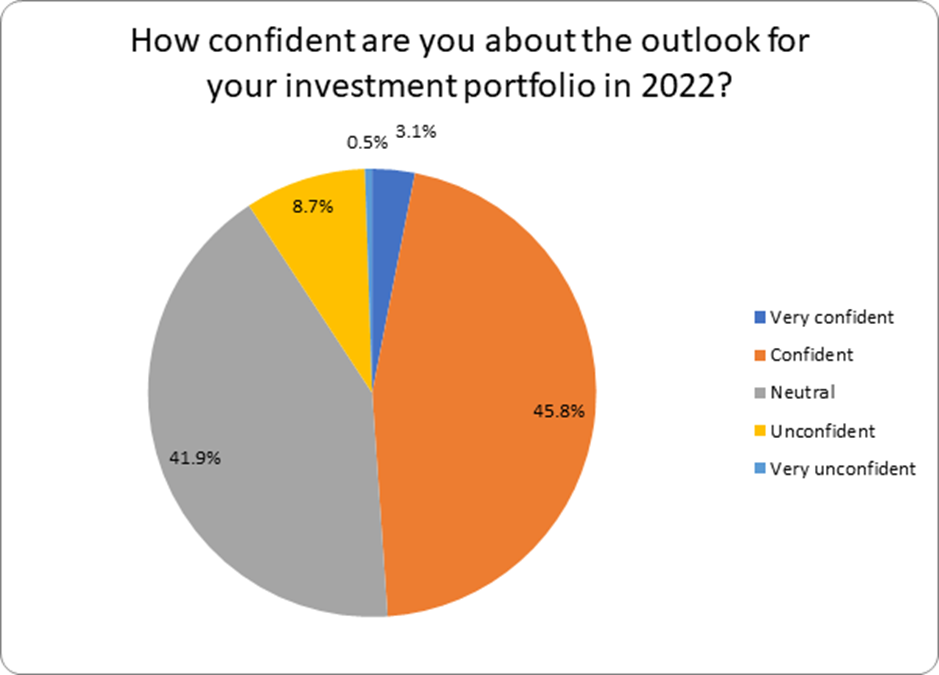
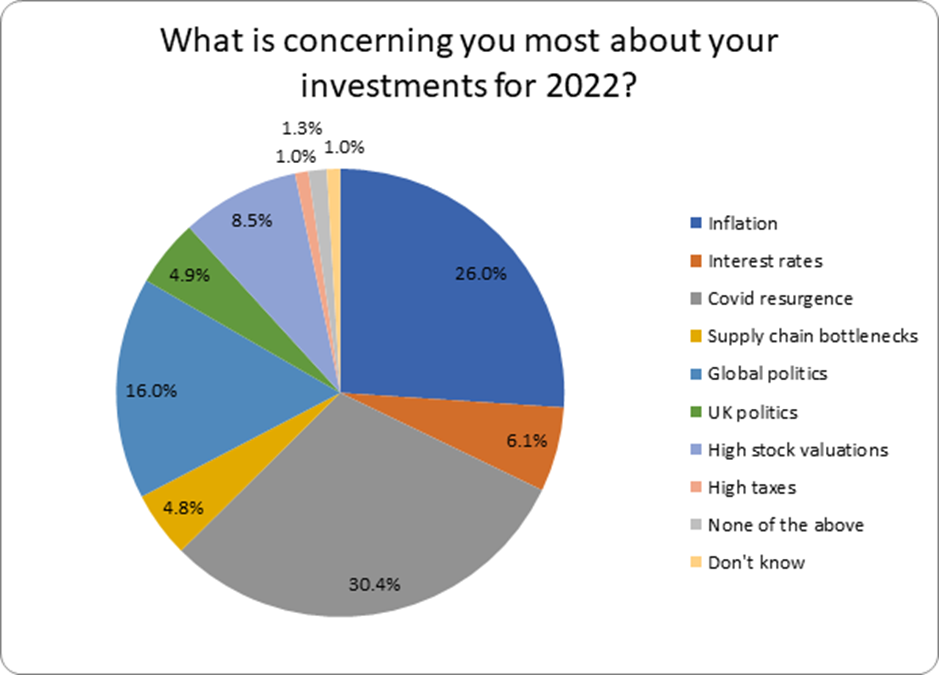
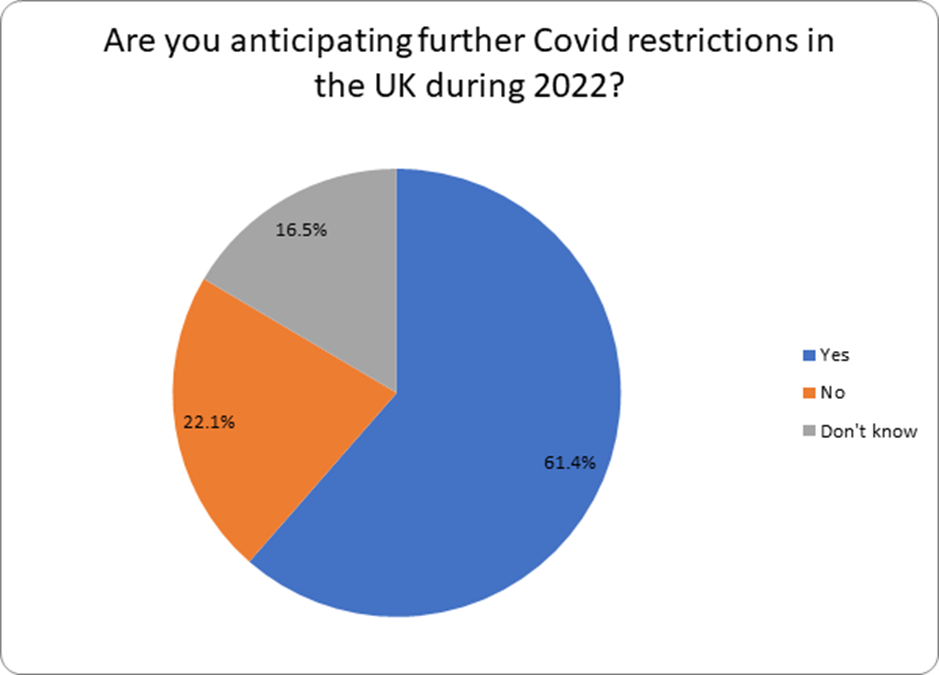
DIY investors are entering 2022 in a mood of constructive realism, recognising market risks, but also largely confident in their investments. Six in ten expect further covid restrictions in 2022, and a resurgence in the pandemic is the number one worry for investors as we head into the new year. Indeed, covid is seen as a greater risk than inflation, which makes sense seeing as the stock market provides some protection from price rises. Inflation comes a close second in the list of concerns for 2022 though, which shows investors are wary of price rises and the effect this may have on their portfolios. Global politics and high stock valuations are also cause for concern for some investors. 

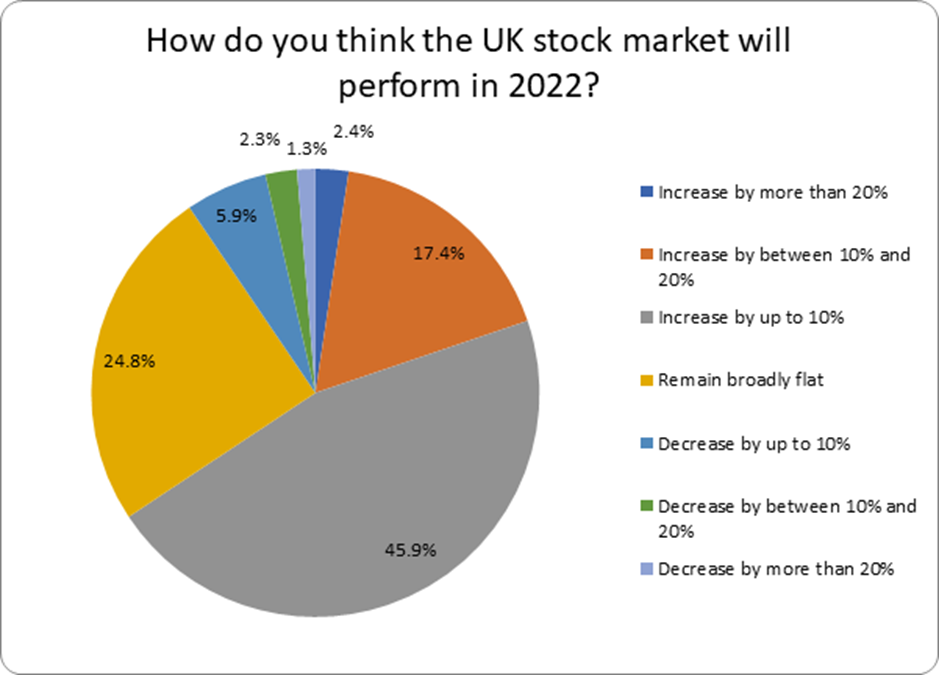
On the whole though, investors see the glass as half full rather than half empty. About 50% were confident or very confident about their investments in 2022, and around four in ten were neutral. That’s also reflected in forecasts for the Footsie, with two thirds of investors (65.7%) expecting the UK stock market to make further ground over the course of the coming year. Almost half of investors expect single digit returns in 2022, which suggests investors aren’t getting carried away, and are settling in for a more modest year for growth than 2021.

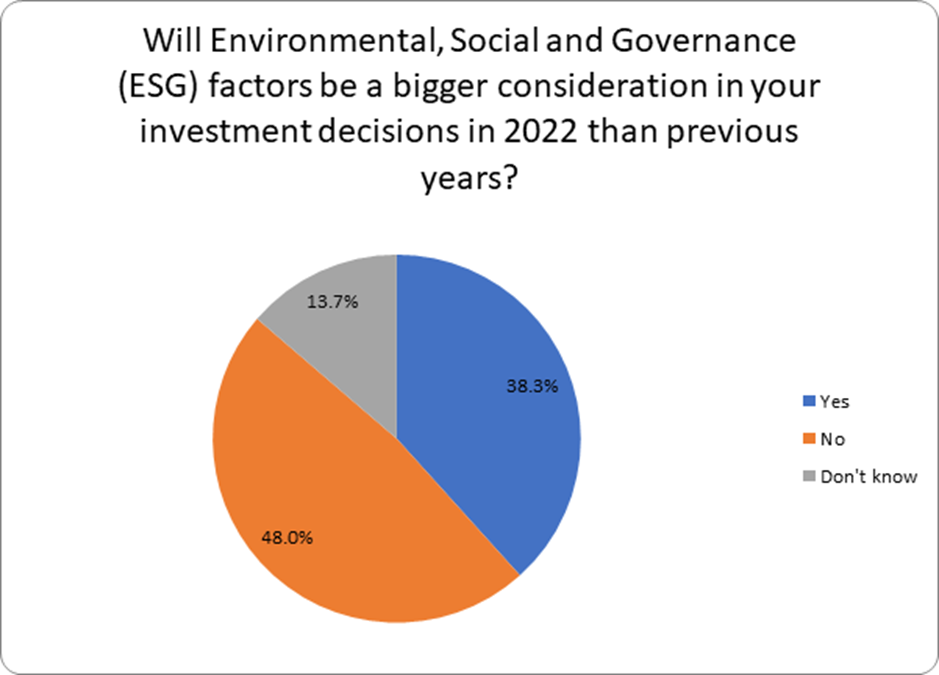
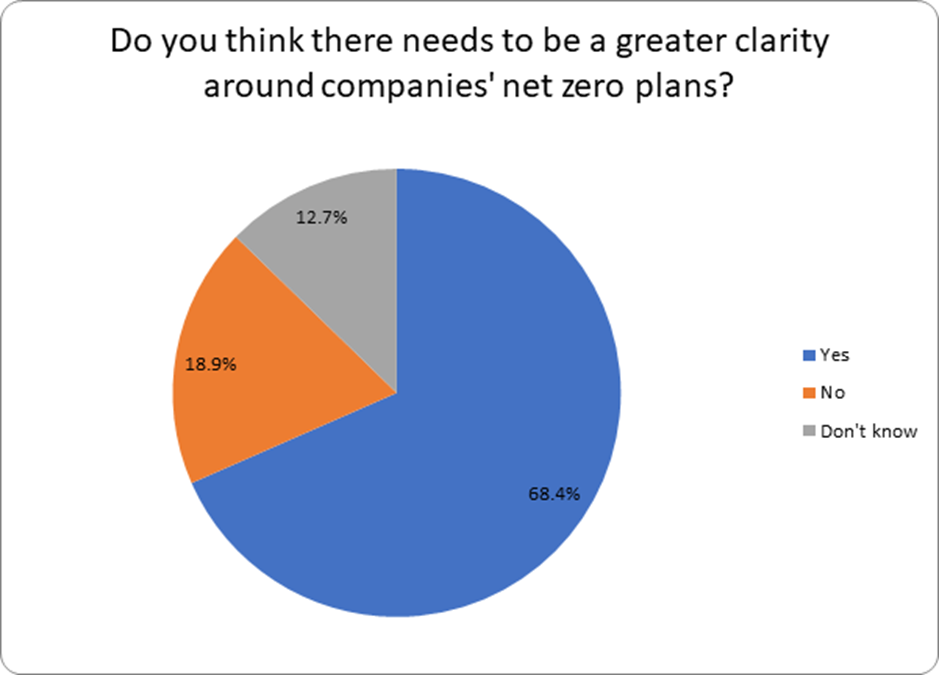
Investors are also becoming more attuned to ESG considerations, with four in ten (38.3%) saying these were going to play a bigger part in investment decisions in 2022. There’s already been a groundswell of interest in ethical funds in the last two years, and our survey suggests this isn’t going to abate in 2022. More than two thirds of investors also said they think there should be grater clarity over companies’ net zero plans. 

The ESG agenda has developed so rapidly across the investment industry that the information available to investors is struggling to keep up. The FCA is formulating proposals on a new green labelling regime, expected in the first half of 2022, which should help make things a bit easier for investors seeking ESG investment options.

Please continue to check back for a range of blog content from us and from some of the world’s leading fund management houses.

David Purcell

20th December 2021