Team No Comments

Brewin Dolphin – Markets in a Minute

Please find below, a market update received from Brewin Dolphin, yesterday evening – 28/09/2022

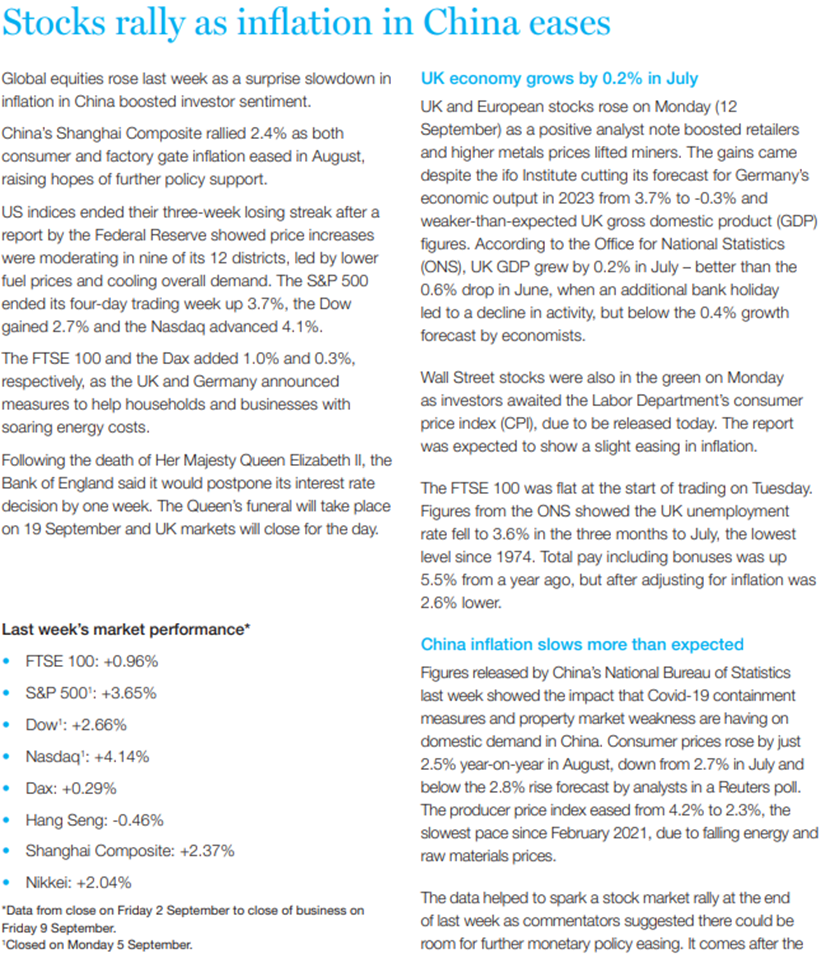
Stocks slide as central banks hike rates

Stock markets suffered another bout of steep losses last week as a series of interest rate hikes intensified fears of a global recession.

The UK’s FTSE 100 lost 3.0% as the Bank of England (BoE) lifted interest rates by 0.5 percentage points and chancellor Kwasi Kwarteng’s raft of tax cuts raised concerns of more aggressive rate hikes in the near future. The pan-European STOXX 600 slid 4.4% following interest rate increases by central banks in Sweden, Switzerland and Norway.

US indices recorded a second week of losses after the Federal Reserve indicated that short-term interest rates are likely to continue increasing sharply over the next few months. The S&P 500 fell 4.7%, the Dow lost 4.0% and the Nasdaq tumbled 5.1%.

Fears of a slowdown in global economic growth weighed on stock markets in Asia, with the Nikkei and Shanghai Composite losing 1.5% and 1.2%, respectively.

Last week’s market performance*

• FTSE 1001 : -3.01%

• S&P 500: -4.65%

• Dow: -4.00%

• Nasdaq: -5.07%

• Dax: -3.59%

• Hang Seng: -4.42%

• Shanghai Composite: -1.22%

• Nikkei1 : -1.50%

*Data from close on Friday 16 September to close of business on Friday 23 September. 1 Closed on Monday 19 September.

Pound hits record low against the dollar

The pound hit a record low of $1.033 early on Monday (26 September) as investors reacted to Kwarteng’s ‘growth plan’ for the UK economy. The so-called mini-budget included a much bigger package of tax cuts than had been expected and raised concerns about a surge in government borrowing.

Several lenders pulled mortgage deals from the market amid speculation the BoE will be forced to hike interest rates at a more aggressive pace. The Bank’s governor Andrew Bailey ruled out an emergency rate hike this week, but said it would “not hesitate to change interest rates by as much as needed”. The Treasury announced that a fiscal plan would be published on 23 November, setting out details of the government’s fiscal rules “including ensuring that debt falls as a share of [gross domestic product] in the medium term”.

In the US, the Dow slid into bear market territory on Monday, down more than 20% from its recent peak, and continued to decline on Tuesday as fears of a recession grew. The FTSE 100 slipped 0.5% on Tuesday, with housebuilders hit especially hard by interest rate concerns. The blue-chip index was 1.4% lower at the start of trading on Wednesday after the International Monetary Fund criticised the UK’s tax-cutting plans. The BoE has now said it will start a temporary programme of bond purchases from 28 September to stabilise the market.

UK interest rate reaches 2.25%

The mini-budget came the day after the Bank of England lifted interest rates by 0.5 percentage points for the second month running. The base rate now stands at 2.25%, its highest level since 2008.

Bank of England base interest rate

Source: Refinitiv Datastream

The BoE’s monetary policy committee (MPC) noted that while annual inflation fell slightly from 10.1% in July to 9.9% in August, it is still expected to near 11% when energy bills rise in October and remain above 10% over the following few months.

“The labour market is tight and domestic cost and price pressures remain elevated. While the [energy price] guarantee reduces inflation in the near term, it also means that household spending is likely to be less weak than projected in the August report over the first two years of the forecast period. All else equal, and relative to that forecast, this would add to inflationary pressures in the medium term,” the committee said.

The MPC forecast a 0.1% decline in UK gross domestic product (GDP) in the third quarter, as opposed to its previous forecast of 0.4% growth. GDP already declined by 0.1% in the second quarter and another drop in Q3 would mean the UK is in a technical recession.

Fed announces another 0.75% rate hike

Over in the US, the Federal Reserve announced its third[1]consecutive 0.75 percentage point interest rate hike in its quest to tame inflation. The federal funds rate is now in the 3.0-3.25% range, the highest since early 2008.

Fed chairman Jerome Powell said the central bank was “strongly resolved” to bring inflation down to 2% and “will keep at it until the job is done”. In comments reported by CNBC, Powell admitted that interest rate hikes could spark a recession. “No-one knows whether this process will lead to a recession or, if so, how significant that recession will be,” he said.

Fed officials expect US GDP growth to slow to 0.2% for 2022, down sharply from June’s expectation for 1.7% growth.

Eurozone economic downturn deepens

The eurozone’s economic downturn deepened in September, according to S&P Global’s flash purchasing managers’ index (PMI). The composite output index fell from 48.9 in August to 48.2 in September and has now registered below the neutral 50.0 level for three successive months.

Manufacturing led the downturn, with factory output falling for a fourth straight month. Service sector output also fell, down for a second consecutive month. The service sector decline was the sharpest since 2013 excluding the falls seen as a result of pandemic containment measures.

Chris Williamson, chief business economist at S&P Global Market Intelligence, warned that a eurozone recession was on the cards. “The early PMI readings indicate an economic contraction of 0.1% in the third quarter, with the rate of decline having accelerated through the three months to September to signal the worst economic performance since 2013, excluding pandemic lockdown months,” he said.

Please continue to check our Blog content for advice and planning issues and the latest investment, markets and economic updates from leading investment houses.

David Purcell

29th September 2022

Team No Comments

Brooks Macdonald Daily Investment Bulletin

Please see below article received from Brooks Macdonald this morning, which provides a market update and refers to economic developments in the UK, the US and Europe.

What has happened

Equity markets failed to buck the trend of recent days, closing lower yesterday. A small loss in the US index disguises huge intraday volatility where positive US economic data was seen as emboldening the Federal Reserve in raising rates faster and further. The US index closed at its lowest level since November 2020, a sharp reversal after the optimism seen over the summer.

UK

The UK Gilt market remained a hotspot for the global bond selloff with the UK 10-year yield at 4.5% for the first time since the global financial crisis. The ongoing UK bond market rout caught the attention of the IMF yesterday, that cautioned the UK to reconsider its fiscal position and said that it would be closely monitoring the UK bond market for signs of stress. A public declaration that the IMF was actively engaging with UK authorities did little to boost confidence causing sterling to fall again versus the US dollar after a short period of stabilisation. All eyes are now looking at the Bank of England to find out when, and by how much, the Bank will raise rates. The Bank’s Chief Economist said yesterday that the fiscal event will require ‘a significant monetary response’ whilst also suggesting that the November meeting would be used for such a move, effectively suggesting an intra-meeting hike was not the preferred route. Given the recent volatility there is a degree to which the Bank of England will need to respond to events so markets are yet to fully rule out such a possibility.

European energy

Adding to the risk off feeling yesterday, multiple countries suggested that the recent leaks from the Nord Stream pipelines may be due to sabotage. Given the difficulty in defending such long pipelines, markets quickly extrapolated the impact of this occurring to other pipelines causing natural gas futures to surge. Furthermore, suggestions that Moscow could sanction Ukraine’s Naftogaz creates further questions over European energy supply.

What does Brooks Macdonald think

Given the range of bad news that markets could focus on, it seems counterintuitive that some strong US economic news could lead to a downturn in US equity indices. At the moment markets are constantly reassessing the need and ability for central banks to raise rates. Europe and the US both need to raise rates but the US is fairly unique in seeming to have significant relative capacity to raise rates given the more buoyant economy. Better US data suggests an economy that can absorb additional tightening, leading to higher rate expectations and further US dollar strength.

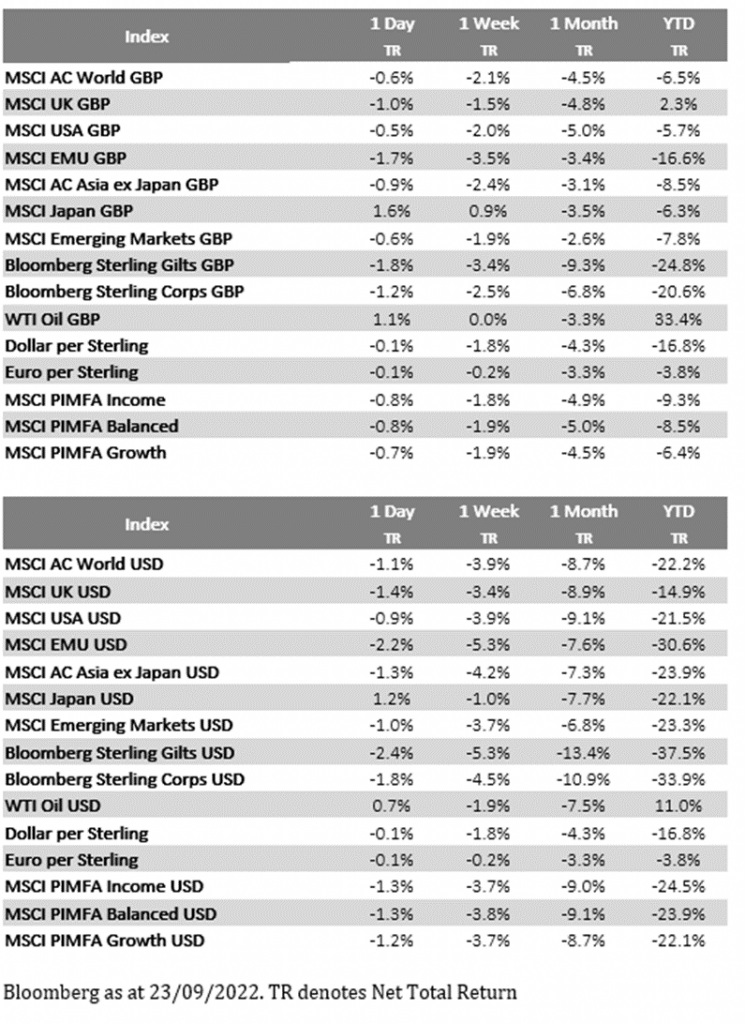
Index 1 Day1 Week1 MonthYTD
 TRTRTRTR
MSCI AC World GBP -0.1%0.4%-1.7%-4.7%
MSCI UK GBP -0.6%-2.8%-5.8%-0.2%
MSCI USA GBP -0.1%0.8%-1.1%-3.4%
MSCI EMU GBP -0.8%-1.8%-2.7%-16.8%
MSCI AC Asia ex Japan GBP 0.3%0.6%-2.1%-6.2%
MSCI Japan GBP 0.2%1.6%-1.8%-5.3%
MSCI Emerging Markets GBP 0.4%0.5%-2.3%-6.0%
Bloomberg Sterling Gilts GBP -3.2%-10.9%-16.9%-31.6%
Bloomberg Sterling Corps GBP -2.4%-8.5%-12.7%-26.2%
WTI Oil GBP 2.4%-0.9%-7.1%32.3%
Dollar per Sterling 0.4%-5.7%-8.6%-20.7%
Euro per Sterling 0.6%-2.0%-5.1%-5.9%
MSCI PIMFA Income -0.9%-3.6%-6.4%-11.6%
MSCI PIMFA Balanced -0.8%-3.3%-6.1%-10.6%
MSCI PIMFA Growth -0.4%-1.9%-4.3%-7.3%
Index 1 Day1 Week1 MonthYTD
 TRTRTRTR
MSCI AC World USD -0.1%-5.8%-10.7%-24.8%
MSCI UK USD -0.6%-8.9%-14.4%-21.3%
MSCI USA USD -0.2%-5.5%-10.1%-23.8%
MSCI EMU USD -0.8%-7.9%-11.6%-34.4%
MSCI AC Asia ex Japan USD 0.2%-5.7%-11.1%-26.0%
MSCI Japan USD 0.2%-4.7%-10.8%-25.3%
MSCI Emerging Markets USD 0.4%-5.7%-11.2%-25.9%
Bloomberg Sterling Gilts USD -3.3%-15.9%-24.1%-45.6%
Bloomberg Sterling Corps USD -2.5%-13.6%-20.2%-41.3%
WTI Oil USD 2.3%-7.0%-15.6%4.4%
Dollar per Sterling 0.4%-5.7%-8.6%-20.7%
Euro per Sterling 0.6%-2.0%-5.1%-5.9%
MSCI PIMFA Income USD -1.0%-9.6%-15.0%-30.3%
MSCI PIMFA Balanced USD -0.9%-9.3%-14.7%-29.5%
MSCI PIMFA Growth USD -0.5%-8.0%-13.1%-26.9%

Bloomberg as at 28/09/2022. TR denotes Net Total Return

Please check in again with us soon for further relevant content and market news.

Chloe

28/09/2022

Team No Comments

Brooks Macdonald – Weekly Market Commentary

Please see below, this weeks Weekly Market Commentary from Brooks MacDonald received late yesterday afternoon (26/09/2022).

This weeks commentary looks at the increase in interest rates around the world in recent weeks, the fiscal event in the UK last week and at the reaction from sterling and the gilts markets.

Global interest rates rise last week as a second week of major central bank meetings conclude

Last week was dominated by monetary and fiscal developments as we saw 500bps of rate rises from global central banks and the unveiling of the UK mini-budget. Against this backdrop bond yields rose and equity markets suffered, bringing major equity indices back to around their 2022 lows.

UK Chancellor unveils the largest tax cutting budget since the 1970s

The UK’s fiscal event was revealed as the single largest tax cutting budget since 19701. The Chancellor has pursued an aggressive tax cutting agenda, particularly impacting higher earners, in order to pursue economic growth. Global financial markets were less keen however, reflecting that such a cut would increase the budget deficit of the UK and raise borrowing costs. There is very much a short term versus long term narrative here. In the long run, cutting taxes may boost growth and help drive internationally mobile talent towards the UK. In the short term though, the higher budget deficit will need to be financed by international investors who have not been won over by what is seen as a fiscal handout at a time of heightened inflation. With markets already highly volatile due to inflation fears, the higher certainty of short term factors have won out, leading to higher gilt yields and weaker sterling.

Friday’s fiscal announcement, and comments from the Chancellor over the weekend that more cuts are on their way, creates a credibility problem for the Bank of England. Last week the Bank opted for a smaller 50bp move instead of a 75bp2 move after balancing inflation and economic growth risks. The heavy downward pressure on sterling since Friday risks further import price inflation which will worsen the cost-of-living crisis. The Bank is therefore likely to want to get on the front foot, raising interest rates by a sizeable quantity to restore faith in the independence of the Bank of England.

Sterling falls and gilt yields rise as investors react to higher government borrowing expectations
Bank of England Governor Bailey has two broad options, talk big or act now. Comments today outlining that the Bank is determined to raise interest rates aggressively in November due to rising inflation fears would be a good start although market assumptions have already baked some of this into expectations. The perhaps politically less palatable move would be an emergency rate hike today which would show that the Bank was determined to act quickly when the facts change. Such a move may look politically charged however, given such a decision would raise government borrowing costs one business day after the government had announced plans which will lead to a larger budget deficit, which the bond market will need to absorb.

1 Bloomberg, 23 September 2022 (https://www.bloomberg.com/news/articles/2022-09-23/uk-sets-out-biggest-tax-cuts-since-1988-to-boosteconomic-growth)

2 Bloomberg, 22 September 2022 https://www.bloomberg.com/news/articles/2022-09-21/bank-of-england-is-set-to-raise-base-interest-rate-andstart-qt-asset-sales

Please continue to check our blog content for advice and planning issues from us and leading investment houses.

Cyran Dorman

27/09/2022


Team No Comments

Brooks Macdonald Daily Investment Bulletin

Please see below today’s Daily Investment Bulletin from Brooks Macdonald, received this morning – 23/09/2022

What has happened 

The downbeat market tone continued yesterday as additional central banks joined the hawkish drumbeat of the last week. The Bank of England raised rates by 50bps rather than the 75bps expected by the market but those voters that dissented from 50bps leant towards a larger rather than smaller move. Equities fell further as monetary policy filtered into recessionary fears and risks of global policy error. 

Bank of England 

On the face of it, the Bank of England’s 50bp rate rise, being smaller than the market was predicting, should have led to falling gilt yields rather than rising ones. 10 year yields rose by around 18bps as investors interpreted the voting split of the committee. 5 members favoured the 50bps hike but 3 voted for 75bps and only one for 25bps. Additionally all voting members agreed to reduce the size of the Bank’s balance sheet of gilts by £80bn over the coming year. The overall statement was considered hawkish by the markets that now believe the Bank will raise rates by 75bps at the next meeting given yesterday’s meeting was a close call and inflation pressures are yet to abate. 

Mini-budget 

One of the factors that the Bank of England will need to consider next month will be the inflationary impact of today’s mini-budget which has been widely leaked ahead of time. The new Growth Plan will include a reversal of the 1.25% National Insurance rise from earlier this year and corporation tax will remain at 19% rather than moving to 25% as previously planned. In addition to these announcements, stamp duty cuts were announced as well as a cut to the basic rate of income tax from the next tax year. These releases are on top of the energy measures already announced which introduce a £2,500 price cap for the average household’s bill.

 What does Brooks Macdonald think 

With the UK seeing both fiscal and monetary changes in the last 24 hours, much investor focus has been on these well telegraphed changes. The EU responded yesterday to the partial mobilisation announced by President Putin, saying that it would work to impose a price cap on Russian oil exports. European natural gas prices have fallen during September as markets price in economic growth fears as well as growing expectations that European governments are going to become more proactive in their energy market interventions.

Please continue to check our Blog content for advice and planning issues and the latest investment, markets and economic updates from leading investment houses.

David Purcell

23rd September 2022

Team No Comments

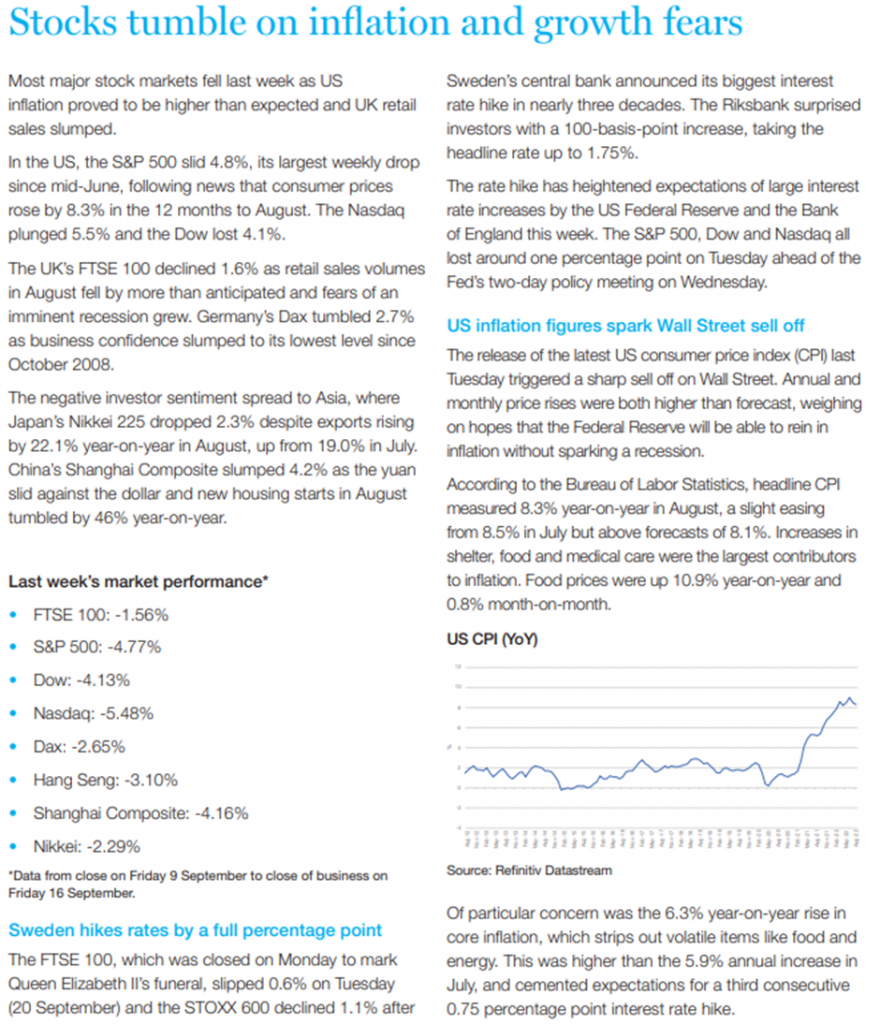
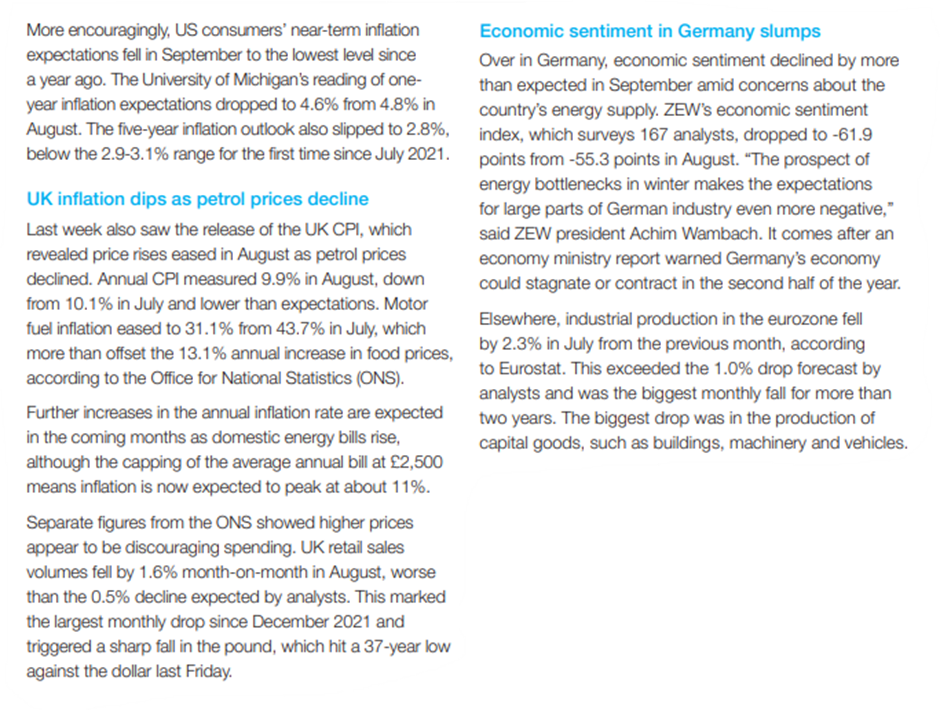
Brewin Dolphin – Markets in a Minute

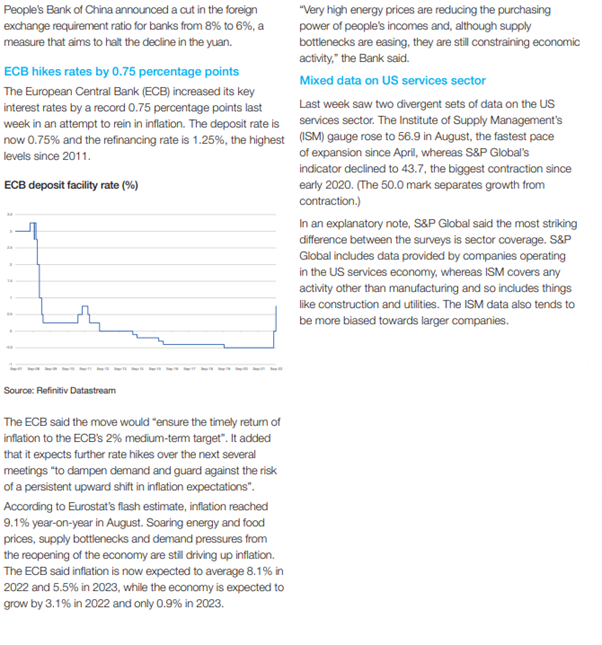
Please see this weeks Markets in a Minute update from Brewin Dolphin received late yesterday (21/09/2022) afternoon:

Please continue to check our Blog content for advice and planning issues and the latest investment, markets and economic updates from leading investment houses.

Carl Mitchell – Dip PFS

Independent Financial Adviser

22/09/2022

Team No Comments

Daily Investment Bulletin

Please see below Brooks Macdonald article received this morning, which provides a market update and refers to Ukraine’s successful counter-offensive strategies in their ongoing war with Russia.  

What has happened

Despite a lack of new news on the central bank front, markets have been increasingly preparing themselves for another hawkish rebuke from the Federal Reserve that could lead to a leg higher in interest rate hike expectations. As a possible portent of things to come, Sweden’s Riksbank surprised investors with a 100bp rate hike, which was above expectations.

Federal Reserve

7pm UK time will see the release of the latest Fed decision with markets expecting a 75bp increase in interest rates alongside some aggressively hawkish language. The mood coming into this meeting is a far cry from August when bond markets were hoping for a sign of a Fed pivot towards a more balanced outlook that weighed inflation and recessionary risks. Earlier in the summer we saw a leak when market pricing was significantly different to what the Fed was intending on unveiling, a lack of a similar briefing for this meeting suggests the Fed is comfortable with 75bps. Arguably the key question therefore is how the fresh economic projections from the central bank paint the inflation and growth picture and whether the bank prepares the market for a further 75bp hike in November. Whilst the Fed meeting is the most important of the week, the market is pricing a 50:50 chance between the Bank of England hiking by 50 or 75bps tomorrow.

Ukraine war

Yesterday Russia announced that it would be holding referenda in the four Russian-controlled regions of Ukraine. Such a move has been widely condemned and appears to be part of a strategy to quickly lay territorial claim to parts of Ukraine so as to claim that further incursions into that territory are an invasion of Russia itself. The recent, successful, counter-offensive by Ukraine appears to have raised concerns within the Russian government that further land could be lost, prompting these referenda and also a partial mobilisation of Russian forces. The mobilisation was announced earlier this morning and reservists will now be called up to assist in the invasion of Ukraine.

What does Brooks Macdonald think

The announcement of a partial mobilisation has led to a rise in oil prices but so far is yet to feed into broader equity markets, although it should be noted that an escalation in Ukraine War rhetoric, alongside the US CPI release last week, has already been weighing on risk appetite in recent days.

Index 1 Day1 Week1 MonthYTD
 TRTRTRTR
MSCI AC World GBP -0.5%-1.4%-4.4%-5.1%
MSCI UK GBP -0.5%-2.5%-4.5%2.7%
MSCI USA GBP -0.9%-0.8%-5.1%-4.2%
MSCI EMU GBP -1.3%-2.8%-4.3%-15.3%
MSCI AC Asia ex Japan GBP 1.2%-2.4%-1.8%-6.8%
MSCI Japan GBP 0.4%-0.6%-3.7%-6.8%
MSCI Emerging Markets GBP 1.1%-2.2%-1.7%-6.5%
Bloomberg Sterling Gilts GBP -1.2%-1.3%-8.4%-23.3%
Bloomberg Sterling Corps GBP -0.9%-0.9%-6.2%-19.4%
WTI Oil GBP -1.2%-2.1%-3.4%33.5%
Dollar per Sterling -0.4%-1.0%-3.8%-15.9%
Euro per Sterling 0.1%-1.0%-3.1%-4.0%
MSCI PIMFA Income -0.8%-1.4%-4.7%-8.3%
MSCI PIMFA Balanced -0.8%-1.5%-4.9%-7.6%
MSCI PIMFA Growth -0.9%-1.7%-4.7%-5.4%
Index 1 Day1 Week1 MonthYTD
 TRTRTRTR
MSCI AC World USD -0.8%-2.6%-7.9%-20.2%
MSCI UK USD -0.6%-3.7%-8.1%-13.7%
MSCI USA USD -1.2%-2.0%-8.7%-19.4%
MSCI EMU USD -1.6%-4.0%-7.8%-28.8%
MSCI AC Asia ex Japan USD 0.9%-3.6%-5.5%-21.6%
MSCI Japan USD 0.1%-1.8%-7.3%-21.6%
MSCI Emerging Markets USD 0.8%-3.4%-5.3%-21.4%
Bloomberg Sterling Gilts USD -1.4%-2.4%-11.5%-35.3%
Bloomberg Sterling Corps USD -1.0%-2.0%-9.3%-32.1%
WTI Oil USD -1.5%-3.3%-7.0%12.3%
Dollar per Sterling -0.4%-1.0%-3.8%-15.9%
Euro per Sterling 0.1%-1.0%-3.1%-4.0%
MSCI PIMFA Income USD -1.1%-2.6%-8.3%-22.9%
MSCI PIMFA Balanced USD -1.1%-2.7%-8.5%-22.3%
MSCI PIMFA Growth USD -1.1%-2.9%-8.2%-20.5%

Bloomberg as at 21/09/2022. TR denotes Net Total Return

Please check in again with us shortly for further news and relevant content.

Chloe

21/09/2022

Team No Comments

Church House Investment Management: UK Market Analysis – September 2022

Please see the below article from Church House Investments, providing analysis of the key factors currently impacting markets. Received yesterday – 14/09/2022

Have you ever slogged your way up a large hill and reached what you thought was the summit, only to discover that this was a false horizon and that you will have to push on higher? This is how markets felt in August.

After a rotten first six months of the year, there was a brief moment of respite when it looked as if the worst of the pain might have been felt with the panic sell-off in June and that things were at least not getting any worse than feared. This was swiftly extinguished by Putin turning off the gas taps to Europe, seemingly permanently this time, and Jay Powell (Chair of the Fed) flagging ongoing sharp interest rate increases at his Jackson Hole keynote address. Risk assets, from equities, to debt and most else in between, fell back again in late August and investors were again left licking their wounds.

Fundamental to weak equity markets in 2022 has been the weakness of sovereign and corporate debt markets. Gilt yields (that move inversely to their price) have tripled in 2022 and now stand at over 3%, levels not seen for any meaningful period since pre-2012 (remember that golden Olympics?). Falling prices of (theoretically) risk-free UK Government bonds (no comment on our new PM’s fiscal promises!) are always going to have a negative effect on assets higher up the risk spectrum, from corporate bonds, right the way up to small-cap equities (at the top of the risk scale). Sovereign bonds yields are unlikely to steady until the market feels that it has a handle on inflation and the path of interest rates. This is not to say that investors need (or could ever have) certainty on the path of inflation and rates, but the negative surprises need to stop coming.

In the midst of all this doom and gloom I am going to be controversial and give some points for optimism. Firstly, one has to suspect that with Nord Stream now fully shut down, Putin has played his ace card. Of course, he can continue to commit atrocities in Ukraine, but short of invading another European nation or threatening nuclear war, Putin’s power to hurt a Western world that has severed all possible ties with Russia has to be past its peak.

Secondly, the ex-Putin contributing factors to rising inflation are showing signs of calming. Anyone who has filled their car up recently will be relieved that the oil price has begun to retreat, while the price of industrial metals such as aluminium, iron ore and copper are sharply lower in the last six months. Shipping still takes longer than pre-pandemic, but the bottleneck is clearing – the time it takes to ship cargo across the arterial China-US route has fallen in 16 of the last 17 weeks. Cheaper commodities and quicker shipping should help to ease input cost inflation which, in turn, will reduce pressure to increase prices to the end consumer. All of this will take time to wash through and there is no hiding from the pain that high energy bills will cause to consumers this winter, but one look at the BBC News website will tell you that this is already widely known and priced into asset prices.

Market confidence is fragile and investors remain jittery. Despite significant declines in equity valuations across the board, few buyers have put their head above the parapet. However, it is interesting to see that some enterprising investors have stepped in recently, particularly in the UK technology sector, where valuations had reached notable lows. Over the last few weeks we have seen private equity bids for three UK-listed technology businesses: Aveva, Micro Focus and GB Group. While we were not shareholders in any of these businesses, we found these bids heartening vindication that all is not lost and that there are bargains to be had amidst the overwhelming negativity. At Church House we focus on the fundamentals of individual businesses, looking for unique companies that we believe can grow at steady rates over the long-term. From time-to-time fear will prevail in markets and we get opportunities to invest on behalf of our clients in such outstanding businesses at more than reasonable prices – now appears to be just such a time.

Please continue to check our blog content for advice and planning issues from us and leading investment houses.

Alex Kitteringham

15th September 2022

Team No Comments

Weekly Market Commentary – Nord Stream 1’s closure has led to volatility in the European energy market

Please find below, a weekly market commentary received from Brooks Macdonald yesterday afternoon – 12/09/2022

  • Central banks continue to dominate sentiment with the ECB raising rates by 75bps and bond markets expecting a similar move from the Fed
  • Nord Stream 1’s closure has led to volatility in the European energy market however prices fell last week as investors positioned for government intervention
  • The US CPI release on Tuesday will be a key input into the Fed’s interest rate policy decision next week

Central banks continue to dominate sentiment with the ECB raising rates by 75bps and bond markets expecting a similar move from the Fed

Central banks remained in focus last week as Federal Reserve (Fed) Chair Powell reinforced his hawkish message, saying that he was entirely focused on fighting inflation. These words impacted bond markets with a 75bp rate hike almost entirely priced in for the Fed’s September meeting. The European Central Bank (ECB) meanwhile raised interest rates by 75bps with President Lagarde noting that inflation was ‘far too high’ and that policy needed to tighten substantially. Despite this, equities performed well, mostly as prior trading weeks had come to terms with the reality that hawkish central bank rhetoric appears to be here to stay for the short term.

Nord Stream 1’s closure has led to volatility in the European energy market however prices fell last week as investors positioned for government intervention

With European energy markets still reacting to the closure of the Nord Stream 1 pipeline, EU energy ministers met on Friday to start forming a plan to help mitigate the energy price surge. Ministers pointed to a large range of tools that they could use to bring price levels under control. Markets were impressed by their fervour, driving European natural gas futures down over 6% on Friday. Over the weekend, the news that Ukrainian forces had successfully executed a counter offensive in the Northeast of Ukraine was welcomed by market participants. With Nord Steam 1 closed, the relative balance of power in the Ukraine War is arguably even more important for investors. Of course, progress by Ukrainian forces does risk a more aggressive escalation by Russia however equities have initially taken this positively.

The US CPI release on Tuesday will be a key input into the Fed’s interest rate policy decision next week

This week’s highlight is likely to be the US Consumer Price Index (CPI) report on Tuesday which will be front and centre of the Fed’s mind when they meet on 21st September. The market is expecting US Core CPI to actually increase year-on-year from 5.9% to 6.1% as housing costs continue to push up the core figures. By contrast, the fall in energy costs in recent months is expected to lead to a substantial fall in headline CPI with the annual rate moving from 8.5% to 8.1%. The month-on-month figure is expected to show a -0.1% decline, reflecting the sharp fall in US gas prices as well as global oil benchmarks.

Given the proximity of the Fed meeting, US central bank speakers are in the communication blackout window meaning that we will have little live reaction to the CPI print. That said, with investors very conscious of the sustained hawkish drumbeat of recent weeks, market pricing will quickly swing based on the CPI report.

Please continue to check our Blog content for advice and planning issues and the latest investment, markets and economic updates from leading investment houses.

David Purcell

13th September 2022

Team No Comments

Tatton Investment – Monday Digest

Please see below Tatton Investment’s Monday Digest which looks at last week’s events in the UK and globally. This article was received this morning (12/09/2022):

Overview: The end of eras 

With great sadness, we pass from the second Elizabethan age. Our Queen was a constant during this period of intensely rapid change. Across the political spectrum, we can acknowledge her ceaseless responsibility to her people. She retained her dignity as monarch throughout her reign supported by her faith and her humanity that was obvious to all.

Despite her failing health, her last official act on Tuesday was to invite Liz Truss to form a government, the 15th Prime Minister during her reign. The official pictures show the Queen undertaking the task with a warm smile and a welcoming handshake.

New Prime Ministers can be signals of change and Truss, showing initiative, has moved quickly to propose action on the energy crisis. Within the energy policy proposals, a six-month energy price cap for businesses will be welcomed by many. 

Her finance-related cabinet team is also imbued with a radical pro-business deregulatory agenda. Kwasi Kwarteng is said to focus on policies that create an attractive UK environment for global firms. The current refusal to countenance windfall taxes is such a signal, as is the proposal made (in the Conservative leadership campaign) to cut corporate taxes. The appointment of John Redwood also signals a wish to get back the reforming years of Margaret Thatcher’s premiership. 

The speed of Truss’s proposals is commendable, but it is also clear that she has announced only partially-formed policies. The Institute for Fiscal Studies and the Resolution Foundation both point out that is remarkable for such huge proposals to be costed only in the most sketchy way. There is no real clarity on how they will be achieved. 

This is not to say that the policies will be ill-formed. The aims are laudable but we just don’t know yet whether they will be achieved in a way which solves problems or adds to them. 

A further aspect is a growing dissonance between fiscal and monetary policy. Both Bloomberg and JP Morgan Research expect that the Bank of England will still raise rates, although the energy price caps have lowered UK inflation forecasts over the next year, and hopefully go some way to lowering future inflation expectations. Both expect that the fiscal boost will support the economy enough to avoid more than one-quarter of negative growth next year.

This means that both expect rates to peak at a higher level than before. Neither the markets nor the analysts above expect rates to go higher than 4%. 

The biggest conundrum will be around the new debt that will have to be issued by the Government. During the pandemic, the Bank of England bought much of the debt issued, difficult to stomach currently while inflation and a weak sterling are its monetary problems. Over the past two weeks, gilt yields have risen and the Sterling has fallen. Potentially, they could go further if the details of the policies show open-ended costs.

During her campaign, Truss talked of re-establishing a money supply-led monetary policy, in the manner of the early Thatcher years. However, her fiscal largesse is in some way from the economic policies that Thatcher favoured. The era of neo-classical economics may be also passing.

Coping with the energy crisis

The post-pandemic inflation boom has taken many turns over the past couple of years and pushed central banks into current aggressive policies. Fading growth and business confidence (outside of the US, at least) have lessened concerns of a wage-price spiral, but the war in Ukraine has kept inflation pressures excruciatingly high. Now, inflation pressure comes mostly from the cost of energy, caused by a severe cost-push around natural gas and electricity – and it is overwhelmingly focused on Europe.

All European economies face serious problems around energy supplies. With a harsh winter looming and no sign of loosening supply, blackouts and gas rationing are expected in Germany and some of its neighbours. Costs are skyrocketing for consumers and especially businesses. 

The policy response to this crisis is crucial. Inaction is not an option, but the ‘how’ is difficult. If government aid creates an increase in the aggregate energy demand, the world’s undersupply will grow, and inflation will only get worse.
 
Finding that balance has led to various plans from politicians. Germany has set out various support schemes for households, with utility companies able to for state support, while new Prime Minister Liz Truss announced a general price cap on typical household energy bills at £2500 and it appears UK companies will benefit from a price cap lasting six months. 

This will certainly lower consumer energy prices in the short term and reduce CPI inflation readings that Central banks usually target. The problem is that these do not address the supply-demand imbalance. Without higher energy prices, there is no incentive to reduce consumption meaning price pressures remain. 

In mainland Europe, the EU is reportedly planning to change the way the electricity market functions to avoid sudden price rises, aiming to decouple end energy prices from wholesale gas prices – to soften any sudden supply-side shifts – and proposes to redistribute energy companies’ excess profits. 

The G7 nations announced that they will seek to impose a price cap on Russian oil, starting in December for crude and then in February 2023 for refined products. While this has primarily been presented as a geopolitical play to hurt Moscow’s finances, it could also have a critical impact on prices down the line. Unfortunately, the cap applies only to oil which is not the key driver of Europe’s price pressures. 

In many countries, spending plans or price caps are being financed by (or coming at the expense of) energy company profits. While there is renewed political pressure on Truss to apply a ‘windfall’ tax on energy companies, it appears the current support package will be fully debt financed and debt-financing is a risky move in the current economic environment keeping real prices high and creating inflationary pressures further down the line.

This is likely to put pressure on the Bank of England (BoE) to tighten monetary policy further meaning that we are in a rather “classical” situation where a higher fiscal deficit puts upward pressure on yields. After years of fiscal austerity, coupled with low inflation readings and therefore supportive monetary policy, this is a different framework to operate in. 

A tighter monetary policy will push borrowing rates up and weigh on businesses and households alike, but a benefit of the Government’s plan is that borrowing can be more targeted than interest rates. In the best-case scenario, this creates actual wealth redistribution and in the very worst case, it damages the whole economy and creates unemployment. 

The Pound has already fallen to its lowest dollar value in decades, and further debt or inflation pressures could weigh on it further. It is therefore vital for the BoE to keep its independence from Government. From a more general political point of view, the UK and the EU are at the cusp of defining Europe’s (energy) future but without investment to sufficiently shift its energy infrastructure disruptions are more, not less, likely.

Global property prices fade

The current inflation spike has hit virtually all parts of the world economy, and property is no exception – according to reports global house prices jumped 11.2% from April 2021 to March 2022 – the first double-digit jump in property prices since the global financial crisis of 2008, The rise was broad-based, affecting both emerging and developed economies. 

If this was good news for homeowners, it points to a real stretch of affordability across multiple markets. House price gains have been a big contributor to the cost-of-living crisis facing the developed world. Even adjusting for inflation, global residential property prices grew 4.6% over the twelve months to the end of March 2022 and most likely hits buyers and renters hardest. Adjusting for real wage loss due to inflation we estimate that the surge is around 7%.

Affordability is the key thing to watch and, on that basis, the inflation wage-adjusted figure is revealing. House price rises are paper gains until you move and without a supply of sellers consumers end up being squeezed for housing. For property prices to comfortably rise above inflation indicates how strong the market was – and suggests that house prices themselves are a big contributor to global inflation.

While property prices are certainly a big part of this year’s inflation story, they were on an uptrend long before the current supply-side shocks. Looking back at the twelve years since 2010 analysts at the Bank for International Settlements calculate that real house prices are 29% above where they were after the global financial crisis, and the gains are again unevenly shared: EM residential property has gained 19% while developed markets have jumped 41% over the same period. From a longer-term perspective, this is quite astonishing.

What does this mean currently, and for the future of the housing market? Developed economies have pushed this limit over the last decade, by keeping interest rates at historic lows and pumping markets full of liquidity meaning house buyers could borrow to keep with prices, even if their wages fell behind.

Now, the borrowing environment is entirely different. Central banks have tightened policy to combat inflation, and are signalling higher rates ahead but we are in a severe cost-of-living squeeze and falling real disposable incomes. It is hard to see how demand could keep up with soaring prices. This is not to say a crash is coming – but a slowdown or slight reversal seems inevitable.

More recent signs back this up. After climbing high into the first three months of the year, Australian and German house prices seem to be falling. In the UK, prices are still increasing, but the gains are small and below consumer price inflation, though importantly our housing market no longer likes a source of inflationary pressure.

China – is now a key region in the global property market with the collapse of property developer Evergrande creating severe knock-on effects on the country’s house prices. China has also impacted other nations’ property markets, especially in the cities among new-build apartments. 

The main exception to the recent global price stagnation is in North America, where house prices are still rising at or above inflation. During the pandemic and up to this April, US and Canada saw new-build costs rise sharply and now mortgage costs have hit 10-year highs. This removes much of the surge in demand and new build costs are back at pre-pandemic levels. If that helps to reduce some price pressure, the strong labour market continues to give housing prices strong support.

The timing of this price reversal and the difference in the fortunes of the US should be expected. The war in Ukraine has hit Europe economically the hardest making cost pressures more pronounced than in North America, squeezing its consumers more. US energy costs have been much milder, and its consumers have fared better. How much longer that can continue remains to be seen – particularly with the Fed tightening policy. But with winter approaching, we should not expect the outperformance to end in the short term.

Please continue to check our Blog content for advice and planning issues and the latest investment, markets and economic updates from leading investment houses.

Carl Mitchell – Dip PFS

Independent Financial Adviser

12/09/2022