Team No Comments

AJ Bell – Why the supply issue isn’t going away

Please see below an article published by AJ Bell on Saturday (05/11/2022) and received yesterday afternoon, which covers their views on the global supply chain issues:

Please continue to check our Blog content for advice and planning issues and the latest investment, markets and economic updates from leading investment houses.

Carl Mitchell – Dip PFS

Independent Financial Adviser

07/11/2022

Team No Comments

Global markets: What to watch in November

Please see the below article from Invesco received this morning:

Key takeaways

The global economy is slowing.

The eurozone economy showed signs of further weakening, and China reported data that revealed a bumpy path toward an economic rebound.

All eyes on the Fed.

The Federal Open Market Committee meets this week. The most important thing to watch, in my view, is the press conference following the rate announcement.

Singles Day in China.

In my view, a good gauge of the Chinese consumer is Singles Day, an extremely important shopping event in China that occurs in November.

Global markets: What to watch in November

October was quite a month, and November promises to be just as busy in terms of market news. Here’s a brief summary of the highlights – and lowlights — of the past month, and what I’ll be watching in the weeks ahead.

The highlights and lowlights of October

Lowlight: With little fanfare, the 3-month/10-year US Treasury yield curve inverted last week, arguably confirming the 2-year/10-year US Treasury yield curve inversion as a recession indicator. Keep in mind that the 3-month/10-year yield curve is generally the preferred recession indicator of Federal Reserve (Fed) officials, and is even used by the New York Fed in its recession probability models. Ironically, however, while investors fretted about the 2-year/10-year inversion, they seem to be more sanguine about this inversion, assuming it could mean a faster Fed pivot.

Highlight: October brought positive performance from US stocks.1 I think a combination of factors were at work, including expectations of a Fed pivot coming sooner rather than later, oversold conditions created by the sell-off in September, and better-than-expected earnings thus far (although there have been some very notable disappointments).

Lowlight: The European Central Bank (ECB) hiked rates 75 basis points again, with little guidance on what will happen in the future. In its most recent statement, the ECB noted it had made “substantial progress” in tightening and replaced language indicating that it will raise rates for the “next several meetings” with a more ambiguous reference to increasing interest rates “further.” This has suggested to some that the ECB will soon make a subtle pivot.2 However, whether the ECB will soon pivot is unclear. ECB President Christine Lagarde shared, “We have acknowledged more rate hikes are in the pipeline but at which pace and to which level I cannot tell you.”3 As I have said before, I worry about the ECB hiking rates significantly since much of the inflationary pressures in Europe can’t be impacted by monetary policy. It’s no surprise that the outlook for the European economy is growing dimmer.

Highlight: The Bank of Canada got less aggressive, hiking rates just 50 basis points last week. Bank of Canada Governor Tiff Macklem explained, “This tightening phase will draw to a close…We are getting closer, but we’re not there yet.”4 This occurred despite relatively strong economic data and an anticipated hike of 75 basis points by the US Federal Reserve next week. As someone who has been concerned about the breakneck speed of tightening for some central banks, I believe this is welcome news. The Bank of Canada may be in the vanguard of Western central banks making a “subtle pivot.”

Highlight: The Bank of Japan is in a very different place than its Western counterparts. In its most recent decision, it kept rates static and maintained yield curve control. It also increased its inflation forecast to 2.9%.

Lowlight: The global economy is slowing:

  • Eurozone. The eurozone economy showed signs of further weakening, as October flash Purchasing Managers Indexes (PMIs) deteriorated from their September readings. Manufacturing PMI fell to 46.6 in October, from 48.4 in September.5 This was well below expectations – and marked the fourth month in contraction territory. Perhaps most concerning is that new orders contracted substantially. Services PMI also fell in October, marking the third month in contraction territory.5 In addition, input cost inflation accelerated in October.
  • United States. US third-quarter gross domestic product (GDP) growth of 2.6% was better than expected, and a welcome change after two quarters of contraction. Not surprisingly, it was met with a positive stock market reaction.6 However, my colleague Paul Jackson has pointed out that stripping out the net export and inventory effect paints a different picture – one of far lower growth (though still in positive territory). He also noted that fixed investment has shrunk in the last two quarters, which is concerning given that it has often been the component that leads the economy into recession.
  • China. China reported its delayed GDP and economic data, which revealed a bumpy path toward an economic rebound. The good news is that household consumption has risen significantly; the bad news is that it is still below pre-pandemic levels.

Lowlight: Last week was a difficult one for Chinese equities, which were down dramatically following the National Party Congress. There could be continued weakness in the near term, as investors worry about reports of COVID-related lockdowns and wait for more information on economic policies going forward. The good news is that China equity valuations look attractive relative to history. The most recent sell-off has pushed valuations close to historical lows. Chinese equities’ cyclically adjusted price-to-earnings ratio (CAPE) is 13.7, slightly above its historical low of 13.1 (by way of comparison, the current CAPE for the US stock market is 31.8 and that for India is 37.6).7

Medium-light”: US earnings reports were relatively disappointing last week, with some major tech companies posting underwhelming results. But the news across the board hasn’t all been disappointing, and thus far earnings season has been relatively solid. As of October 28, 52% of S&P 500 companies have reporting earnings. Of those, 71% reported a positive earnings per share surprise and 68% reported a positive revenue surprise.8 The energy and information technology sectors have had a better earnings season so far, with the highest percentages of companies reporting earnings above estimates, 89% and 84% respectively. However, the materials and utilities sectors have had disappointing earnings seasons so far, with the lowest percentages of companies reporting earnings above estimates, 55% and 57% respectively.8

What to watch in November

The Federal Open Market Committee (FOMC). The FOMC will be meeting this week, but I’m not expecting any surprises. There is strong consensus that the fed funds rate will be increased 75 basis points. The most important thing to watch, in my view, is the press conference following the announcement. Some believe this will be when the Fed pivots. I think this could very well be the pivot, but it could be a subtle pivot like the Bank of Canada’s. I think it’s very possible that Fed Chair Jay Powell could echo Macklem’s message that it is appropriate to slow down rate hikes going forward, to give time for the tightening that has happened thus far to be reflected in the economy. In other words, tightening would continue – just at a slower pace. That would be good enough for me, but it might not be good enough for markets.

US midterm elections. It seems very clear to me that Democrats are likely to lose the House of Representatives, although it’s questionable what will happen in the Senate. For our purposes, though, the midterm elections are unlikely to have much impact on markets. Of course, investors tend to like checks and balances in government, so a split Congress could be a slight positive. However, it is worth noting that what has historically mattered more is the year itself; the third year of a presidential cycle has, over time, tended to be the most positive for stock market returns.9 Let’s hope history repeats itself this time around.

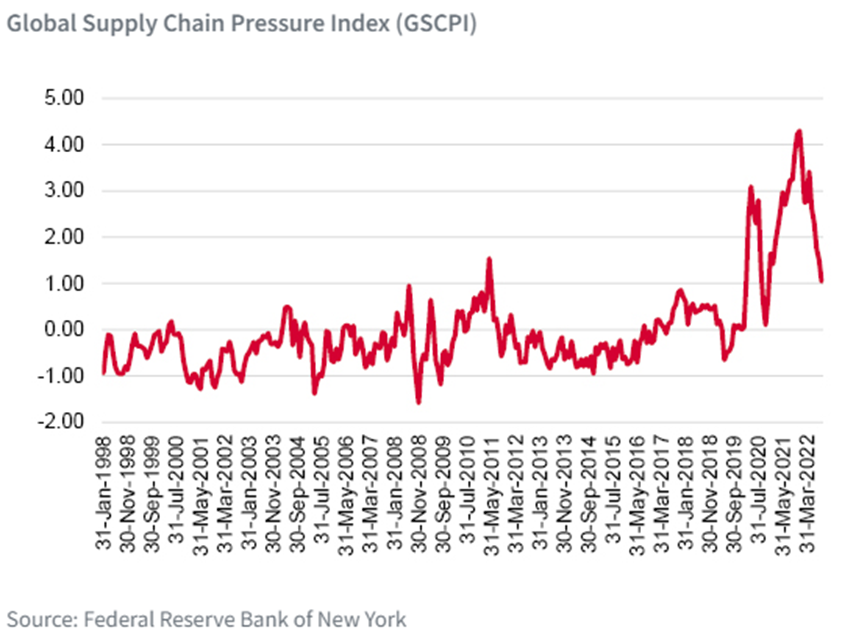
Inflation. Some are hoping for “immaculate disinflation,” the idea that prices fall quickly, especially in the US. However, I don’t think it will be as easy or clean as that. Some sources of inflationary pressure are easing quickly, such as global supply chain pressures, while other sources could be more stubborn, including wages. What’s more, components that are easing, such as global supply chain pressures, could reverse if we were to see significant COVID lockdowns again, as we did in the spring.

Global PMIs. We’ve been in an extraordinary environment of synchronized tightening on the part of many central banks. Given that there is a lag, while we have seen some economic damage, I believe we have yet to see much of the impact of this tightening on the economy. PMIs, especially the new orders subindex, can often be the first “canary in the coal mine.”  We will want to monitor those closely. I’m comfortable with modest month-over-month declines, given that central banks are engineering a potent slowdown. However, any sharp drop would be cause for concern and a sign that central banks had “overdone” tightening.

Singles Day in China. There’s a lot of gloom and doom surrounding China and its economy. However, more important than sentiment is actual results. In my view, a good gauge of the Chinese consumer is Singles Day, an extremely important shopping event in China that occurs on November 11 (although in recent years has been extended into multiple days). Recall that in 2020, Singles Day sales provided an accurate sign that the Chinese economy had rebounded substantially from the initial COVID downturn. Sales numbers this year could give us a good sense of how the Chinese economy is rebounding from its recent downturn – and especially how strong the Chinese consumer is.

The Russia-Ukraine war. Of course, this war has had a major impact on the global economy, driving down growth and driving up inflation. So we will want to follow developments in coming weeks, especially as the weather gets colder; some believe this could give Russia a military advantage, given Russia’s history of several notable military successes in winter. One development that could be very problematic for food prices is the new Russian embargo on Ukrainian grain (basically a suspension of participation in a previously agreed-upon deal to allow Ukrainian grain to be exported from its Black Sea ports).

More earnings. We still have a ways to go with earnings season, and the coming weeks could reveal more disappointing earnings that could alter market sentiment for the worse.

Please continue to check our Blog content for advice and planning issues and the latest investment, markets and economic updates from leading investment houses.

Andrew Lloyd DipPFS

4th November 2022

Team No Comments

How to measure the new Chancellor’s progress

Please find below, an update on the new Chancellor’s progress so far, received from AJ Bell, yesterday evening – 30/10/2022

Jeremy Hunt is the fourth Chancellor of the Exchequer in four months. He is likely to measure success in terms of jobs, economic growth and ultimately opinion polls and then votes when the next General Election comes around, in 2024, if not earlier.

“Jeremy Hunt is the fourth Chancellor of the Exchequer in four months. He is likely to measure success in terms of jobs, economic growth and ultimately opinion polls and then votes when the next General Election comes around, in 2024, if not earlier. Advisers and clients will be looking to their portfolios to gauge the effect of his policies.”

Advisers and clients will be looking to their portfolios to gauge the effect of his policies. Mr Hunt’s first-day hat-trick of share prices up, sterling up and gilt yields down (17 October) was a good start, as he calmed markets with a return to something that looked like fiscal orthodoxy and promises of some numbers that would actually add up, come the launch of the Medium-Term Fiscal Plan, and the Office for Budget Responsibility’s independent analysis, on 31 October.

Gilt yields have started falling as the pound stabilises

But sterling might already be rolling over and the benchmark ten-year gilt yield is still some fifty basis points (0.50%) higher than when Mr Hunt’s predecessor Kwasi Kwarteng launched his hurried, and ultimately ill-fated, mini-Budget on 23 September. There is still work to be done before jokes about the UK turning into an emerging market stop being funny and start turning serious.

Lessons of history

Jeremy Hunt is the twentieth Chancellor of the Exchequer since the inception of the FTSE All-Share index in 1962. Whether he will match Gordon Brown for longevity remains to be seen, as the Labour Chancellor held office for 3,708 days from 1997 to 2007, but he will certainly be hopeful of outlasting his Conservative predecessor, Kwasi Kwarteng, who managed just 38 days.

Fourteen of his predecessors have been Conservative and five Labour, so the public has, so far, preferred to have the Tories in office and in charge of the nation’s finances.

At first glance, from an advisers’ and clients’ point of view, there is little in it between the two parties’ financial stewardship.

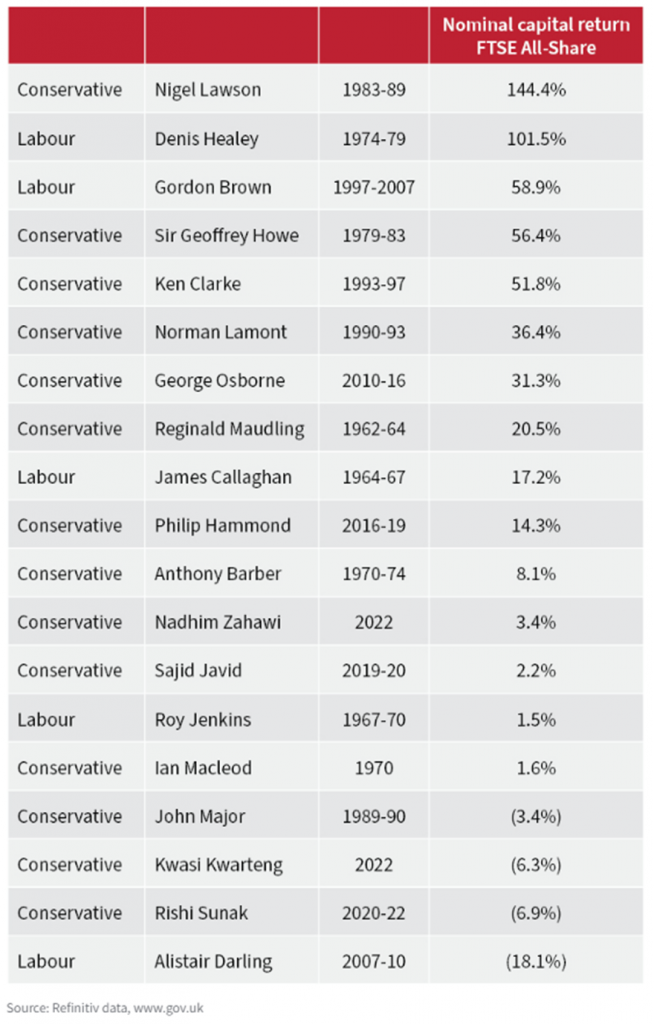
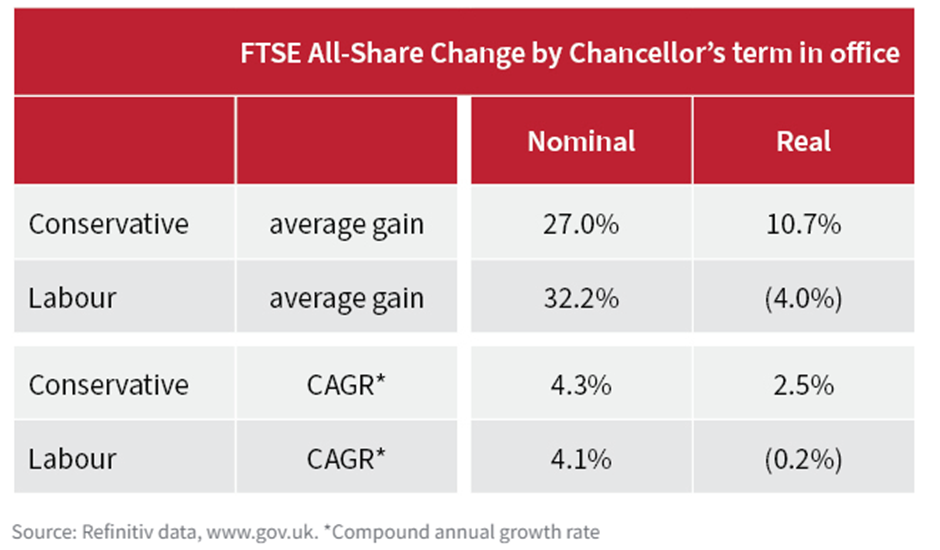
Under Conservative Chancellors, the FTSE All-Share has chalked up a total capital gain of 354%, in nominal terms. That equates to an average advance per Chancellor of 27% (and the average is dragged down by the short tenure of both Nadhim Zahawi and Kwasi Kwarteng).

Under Labour the benchmark has risen by 161% for an average gain of 32.2%.

Across 36 years of Tory Chancellorships that is a compound annual growth rate (CAGR) of 4.3% against 4.1% under 24 years of Labour in 11 Downing Street and two of the top-five best spells under a single Chancellor come under Labour, again in nominal terms.

FTSE All-Share performance by Chancellor of the Exchequer in nominal terms

“The picture changes profoundly when inflation is taken into account and capital returns from the FTSE All-Share are assessed in real (post-inflation) terms rather than nominal ones.”

However, the picture changes profoundly when inflation is taken into account and capital returns from the FTSE All-Share are assessed in real (post-inflation) terms rather than nominal ones.

FTSE All-Share performance by Chancellor of the Exchequer in real terms

Here, Conservative Chancellors come out well on top, as the withering effect of inflation upon investors’ returns from the stock market under Labour’s Healey Chancellorship of the mid-to-late 1970s comes into play, even if Labour supporters will argue his record is tarnished by the need to tackle the mess left behind by the Conservatives’ Anthony Barber’s crack-up boom and the oil price spike of the early seventies.

“The Barber boom and its legacy was one reason why the Truss-Kwarteng mini-Budget frightened markets, as inflation was already lofty before the stimulatory, tax-cutting plan, which conjured up the spectre of more inflation and faster interest rate increases, even as the economy potentially slowed.”

The Barber boom and its legacy was one reason why the Truss-Kwarteng mini-Budget frightened markets, as inflation was already lofty before the stimulatory, tax-cutting plan, which conjured up the spectre of more inflation and faster interest rate increases, even as the economy potentially slowed.

From the narrow perspective of advisers and clients, inflation also chewed up the nominal gains made by the FTSE All-Share under Mr Barber (and under one of his Conservative successors, Geoffrey Howe, for that matter).

FTSE All-Share performance by Chancellor of the Exchequer in real terms

Advisers and clients could therefore be forgiven for wishing Mr Hunt to look back to, and learn from, the experiences of both Barber and Healey, as, helped by the Bank of England, he attempts to steer the economy between the twin threats of inflation on one side and recession on the other.

Misery Index

“The economist Arthur Okun’s Misery Index could be a useful tool to measure the Chancellor’s progress.”

The economist Arthur Okun’s Misery Index could be a useful tool to measure the Chancellor’s progress. It simply adds together the prevailing rate of inflation to the prevailing rate of unemployment, to remind all that full employment is no guarantee of content if there is inflation and that low inflation is no guarantee of happiness (or political success) if unemployment is high.

The Misery index, based on the last published unemployment rate of 3.5% and the last retail price index inflation reading of 12.4%, is 15.5% (RPI is no longer an officially recognised statistic, but the dataset has a longer history that CPI).

That is the highest reading since 1991, when the UK was in a deep recession, and one that was resolved, at least in part, by the devaluation of sterling after its inglorious exit from the Exchange Rate Mechanism in 1992. If the Misery Index starts to drag Mr Hunt down, then sterling could be quick to show further strain.

Past performance is not a guide to future performance and some investments need to be held for the long term.

Please continue to check our Blog content for advice and planning issues and the latest investment, markets and economic updates from leading investment houses.

David Purcell

31st October 2022

Team No Comments

Brooks Macdonald – Daily Investment Bulletin

Please see today’s Brooks Macdonald Daily Investment Bulletin received earlier this morning (28/10/2022):

What has happened?

Bond markets continued to price in a heightened probability of a Federal Reserve ‘pivot’ as signs emerged of a more dovish tone within the ECB. Despite this bond market pricing, concerns about the forward guidance from major US technology companies dampened the mood with the US index falling and Europe ending the day in slightly negative territory.

US Tech earnings

Meta (Facebook) fell by almost a quarter yesterday after its poorer than expected earnings report released on Wednesday. Last night saw Apple and Amazon report with Apple producing a report that largely satisfied the market, particularly given growing concerns that Apple may join the other tech heavyweights in a disappointing release. Amazon however guided that Q4, a critical quarter for retailers given the build up to Christmas, would be much weaker than markets had been expecting. Amazon fell by almost 13% in after-hours trading which is a remarkable fall in market capitalisation given the company’s c. $1tn size.

The ECB

The press conference that followed the ECB statement contained some more dovish language, which was welcomed by the bond market despite the central bank raising interest rates by a further 75bps, in line with expectations. Specifically the conference focused on the downside risks to economic growth, the lagged impact of interest rate hikes and more generally a less aggressive tone regarding future tightening of monetary policy. The bond market concluded that the ECB was getting closer to its terminal rate for this cycle and reduced expectations of that rate down to 2.6%. As a result, the euro underperformed and bond yields fell across Europe. Italian government bonds which have been under pressure due to higher interest rate expectations, outperformed German bunds. The ECB also said that the principles around quantitative tightening would be discussed in December, giving a sense that actual implementation could be a little way away still. 

What does Brooks Macdonald think

With the ECB sounding more balanced, the key question is whether Fed Chair Powell follows suit next week. A 75bp rate rise still looks highly likely however what the Fed will do in December is now up for debate. It is tricky for the Federal Reserve to commit to too much next week as there are two months of inflation and employment releases between the November and December meetings. Bond markets are used to Powell delivering a rebuke in his press conference, even the absence of that could be taken very positively by the still skittish bond market.

Please continue to check our Blog content for advice and planning issues and the latest investment, markets and economic updates from leading investment houses.

Carl Mitchell – Dip PFS

Independent Financial Adviser

28/10/2022

Team No Comments

Brooks Macdonald Daily Investment Bulletin

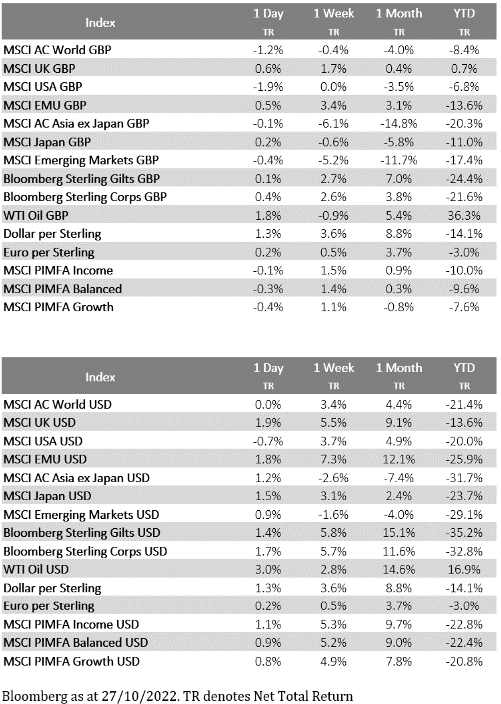
Please see todays Daily Investment Bulletin from Brooks Macdonald:

What has happened

Hopes of a Fed pivot towards less aggressive monetary tightening gathered pace yesterday after the Bank of Canada raised interest rates by 50bps instead of the 75bps expected. Bond markets quickly extrapolated this change in tone into the US Treasury market, reducing the expectations for interest rate hikes in the US next year. Despite this more positive tone, US equities struggled yesterday as investors absorbed the weaker-than-expected technology earnings from the previous evening.

Corporate earnings

Technology and Communications were the two underperforming sectors during the late US equity sell-off. Alphabet fell by almost 10% and Microsoft by almost 8% as the market repriced after the earnings releases. Given the size of these two heavyweights in the index, this helped drive the sector and overall index lower. After the closing bell last night, Meta (Facebook) released their earnings, missing expectations, falling by almost 20% in afterhours trading. Outside of technology the earnings have been more robust with Kraft Heinz, for example, reporting alongside Meta with an earnings beat and upside revision to the company’s future guidance.

ECB

Today sees the latest interest rate decision from the European Central Bank. The market is expecting a 75bp increase in European interest rates however it is the pace and timing of the ECB’s balance sheet reduction and the forward guidance that will be of most interest to financial markets. Quantitative tightening has been kicked down the road due to concerns over fragmentation risk which could see the difference in yields between Italian and German debt, soar. Looking further ahead, the bond market has less confidence around the future path of interest rates in December and into early next year. A hawkish tone is expected within the ECB’s statement as well as the subsequent press conference though investors will be eagerly searching for any signs that the ECB is considering a Bank of Canada style pivot.

What does Brooks Macdonald think

The Bank of Canada was one of the first central banks to start raising rates and also one of the first banks to embrace larger interest rate rises to ramp up its response to inflationary pressures. As a result, it is seen as somewhat of a bellwether for Federal Reserve policy. We have however seen many attempts this year at beginning a ‘pivot rally’ with the US central bank pushing back against the narrative each time. 

These daily investment bulletins from Brooks Macdonald provide us with a short clear overview of what is happening in the global markets.

Please continue to check our Blog content for advice and planning issues and the latest investment, markets and economic updates from leading investment houses.

Andrew Lloyd DipPFS

27th October 2022

Team No Comments

Markets look on as Westminster psychodrama continues

Please find below, an update on how politics are affecting global markets, received from Tatton, this morning – 24/10/2022

Overview: markets look on as Westminster psychodrama continues

Given the volatility in UK politics last week, broader capital markets felt like a sea of calm in comparison. Markets had already priced in the upside on sterling, believing unfunded Tory tax cuts were no longer on the agenda, but not another leadership hiatus or even the possibility of an early general election. This perhaps explains that after initial cheers, sterling settled at where it had been already against the US dollar before Liz Truss tendered her resignation. Gilts have experienced a rollercoaster of wild and outsized movements during her short but turbulent reign and so the relief rally that followed her departure is understandable.

However, as noted before, the ill-advised fiscal event that triggered Truss’s political death spiral unhelpfully boosted an uptrend in bond yields that had been well underway since the beginning of the year. How yields and yield differences will fare from here will (hopefully) now only partially depend on the further political developments in the UK, but much more on where the rate of inflation is heading and with it, economic activity levels. On the so-called ‘loss of trust’ of international capital markets in the reliability of the UK and its institutions, the past week has demonstrated that while the UK is most certainly not immune from political mistakes, the system deals swiftly and reliably with failure.

UK inflation (as measured by the Consumer Prices Index) was interesting last week, with food and insurance leading the core (non-energy prices) back up to 10.1%. Both may be seeing lagged impacts from previous energy price rises – but also the shortage of available labour. Our food has become much more energy-intensive in recent years. Indeed, the lagged impacts of energy are still evident across the board. Overall, and compared to previous weeks, the market has been cheered by a lessening of the sense of crisis around Europe and the UK, even if the backward-looking economic data reports still look concerning. 

Europe’s energy struggles may be easing 

Regarding price pressures on consumers, last week offered some good news for Europe, including the UK. Gas and electricity prices for near-term delivery (over the winter) have come down, as gas storage reserves have filled to higher levels and earlier than anticipated, while industrial demand has fallen much more quickly than thought possible. There was further good news on the electricity front as Germany’s Chancellor Scholz spoke a ‘Machtwort’ (meaning word of authority) and more or less forced his coalition partners to agree a temporary extension of the life of the three remaining German nuclear reactors over the winter. 

This altogether lower temperature from the demand and the supply side in pan-European energy markets has led to a sense that the probability and extent of downside scenarios have lessened. This in turn is taking fiscal support pressure off politicians, and leaves markets anticipating less bad times ahead. Despite government-imposed price caps, there had been heightened fear of bankruptcies – which remains elevated, but the immediate danger is clearly receding, as we note from falling European high yield credit rates for those firms with the lowest credit ratings. 

Increasingly, scenario assessments like the recent one from Bloomberg’s energy analysts are raising the possibility that Europe could find itself with a gas surplus should the coming winter prove not to be particularly cold one. This would certainly be very good news for hard-pressed consumers, even though the boost to demand from the release of energy earmarked savings could fan broader inflation once again and force the hand of central banks to follow the US Federal Reserve’s push for rates that are anticipated to reach 5% at the end of Q1 next year. 

How much isolation can President Xi’s China afford?

Attention has been on Beijing over the last few days, as the Chinese Communist Party hosted its 20th national congress. Held every five years, the congress decides key party posts – which in turn decide state, military and commercial appointments – and sets the policy agenda for the next half a decade. The biggest but least surprising announcement was the inevitable reappointment of Xi Jinping as leader, with party rivals purged (including the very public ‘retirement’ of Xi’s predecessor Li Keqiang) and loyalists installed in his new leadership team. Without question, this is now Xi’s China.

It is somewhat disheartening, then, to hear Xi’s priorities are more political than economic. The biggest brake on growth is Beijing’s strict zero-COVID policy. China is still cycling through regional lockdowns every few months, while its housing market is still ailing from the slow-motion collapse of property developers such as Evergrande. Meanwhile, slowing developed world demand makes it difficult for China to export its way out of trouble. Growth was slowing even before the pandemic, thanks to Beijing’s deleveraging efforts and crackdown on the shadow banking sector. But that was at least an admirable goal – removing excessive debt and improving economic or financial stability. However, harsh crackdowns at home (both COVID- related and on corporates) and tough rhetoric against major trading partners – in the face of an economic slowdown – are a different matter.

It was easy to see why Chinese officials delayed the release of GDP data last week: people may not like what they see. Economists predict annual growth has slowed to 3.3%, the second-lowest figure in the last three decades (after 2020’s initial lockdown year). This is deeply worrying for the party. Just last week, the US announced a de facto embargo on selling high-end technology to China, pushing the rivalry between the world’s pre-eminent powers into something approaching a cold war. This hit tech stocks in the US, but had a broader impact on Chinese stocks. If sustained, the effective ban on technology intellectual property transfer could have a severely limiting effect on long-term growth.

Indeed, the longer-term picture is clouded by China’s ageing population and its increasingly isolated position. Some analysts suggest we are moving into a structurally weaker period for China, where growth may average around 3% per year instead of the incredible 7% or 8% we have grown accustomed to. Even if true, base effects would mean that growth opportunities would still be very significant. China’s estimated 2022 GDP is $18.3 trillion, meaning that 3% growth would add over $500 billion to the global economy – that is still more than China’s total growth in 2016. Zero-COVID is still the biggest hurdle, but if we see signs of that policy loosening early next year – which may well happen if vaccinations of the elderly continue and economic growth falters – then global investors could in the short term become very positive on China. 

Please continue to check our Blog content for advice and planning issues and the latest investment, markets and economic updates from leading investment houses.

David Purcell

24th October 2022

Team No Comments

Brooks Macdonald – Daily Investment Bulletin

Please see today’s Brooks Macdonald Daily Investment Bulletin received earlier this morning (20/10/2022):

What has happened?

After a good start to the week, equity markets ran out of steam on Wednesday with US government bond yields moving higher, as worries surfaced again over inflation and the expected next round of central bank interest rate hikes. The US Federal Reserve meeting on 2 November is now less than 2 weeks away, and markets have priced in a 75bp hike, which if it happens would be the fourth 75bp-sized hike in a row. Elsewhere, of interest was a Bloomberg news report that China is considering cutting quarantine for arrivals from abroad from 10 days (with 7 days in a hotel followed by 3 at home), to 7 days (with 2 days in a hotel followed by 5 at home), giving oxygen to hopes that China’s zero-Covid policy might be loosening a bit.

Dare markets hope again for a Fed monetary policy pivot?

Federal Reserve Bank of Minneapolis President Neel Kashkari said on Wednesday that the US central bank could potentially pause its interest-rate increases at some point next year if policymakers see clear evidence that core inflation is slowing. “My best guess right now is yes, do I think inflation is going to level out over the next few months, the services, the core inflation, and then that would position us some time next year to potentially pause,” For balance however, Kashkari did make it clear that he saw no evidence yet to give him “comfort” that core prices were moderating, and that was something he was “quite concerned about”. Also supporting the idea of an easing in Fed interest rate ‘tempo’ at least, Federal Reserve Bank of St. Louis President James Bullard, said on Wednesday that he expects the US central bank to end its front-loading of aggressive interest-rate hikes by early next year and shift to keeping policy sufficiently restrictive with small adjustments as inflation cools. “You do have to think about what the reasonable level is” Bullard said.

Mounting pressure for the UK Truss government

Over the course of yet another dramatic day in Westminster, the Home Secretary Suella Braverman resigned over what was described as a national security breach, reportedly sending sensitive documents from a personal email. However, adding to the sense of a volatile political climate, in her resignation letter Braverman said “Pretending we haven’t made mistakes, carrying on as if everyone can’t see that we have made them, and hoping that things will magically come right is not serious politics”, and adding that “I have concerns about the direction of this government. Not only have we broken key pledges that were promised to our voters, but I have had serious concerns about this Government’s commitment to honouring manifesto commitments”.

What does Brooks Macdonald think

While the UK is dominating the political headlines for now, it is not the only country facing the risk of political upheaval. Over in the US, crucial mid-term elections are due to take place on 8 November (with some states having already started early-voting). According to the latest financial betting odds from PredictIt, Democrats are expected to cede control of the House of Representatives, and lately in recent days, possibly also the Senate, to the Republicans. While the risk of impending political gridlock sounds unwelcome, for markets it can often be a least-worst option –  as it stymies the chance of any more radical political policy ambitions becoming law, and supporting a political status-quo. Simply then, for markets, political risk can become one less thing to worry about.

Please continue to check our Blog content for advice and planning issues and the latest investment, markets and economic updates from leading investment houses.

Carl Mitchell – Dip PFS

Independent Financial Adviser

20/10/2022

Team No Comments

Markets in a Minute – Stocks mixed as mini-budget fallout continues

Please see below article received from Brewin Dolphin yesterday evening, which provides a global market update with reference to economic developments in the UK, US and China.

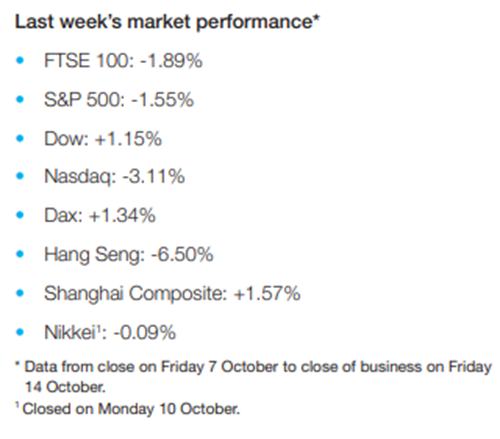
Stock markets were mixed last week as US inflation proved higher than expected and the UK government announced its second major mini-budget U-turn.

The S&P 500 dropped sharply on Thursday morning as the latest US consumer prices data was released, before surging 5.5% in its largest intraday move since March 2020. The index ended the week down 1.6% after data on Friday showed consumer inflation expectations had worsened.

In the UK, the FTSE 100 lost 1.9% and yields on ten-year gilts retreated from near 14-year highs after the government reversed its decision to scrap a planned increase in corporation tax. The Dax gained 1.3%, despite Germany’s economy minister predicting a 0.4% decline in the country’s gross domestic product (GDP) next year.

In China, the Shanghai Composite rose 1.6% after the governor of the People’s Bank of China said the central bank would step up the implementation of prudent monetary policy and provide stronger support for the real economy.

Hunt reverses mini-budget tax cuts

New UK chancellor Jeremy Hunt announced on Monday (17 October) the reversal of almost all the tax-cutting measures contained in last month’s mini-budget. The planned reduction in basic-rate income tax and the reversal of the dividend tax rate hike will no longer go ahead. Plans to freeze alcohol duty, introduce VAT-free shopping for tourists and reverse off-payroll working rules have also been overturned.

The emergency statement came just one working day after UK prime minister Liz Truss announced the departure of former chancellor Kwasi Kwarteng following weeks of market turmoil. Truss also overturned plans to cancel next year’s increase in corporation tax. Together with the decision to scrap proposals to axe additionalrate income tax, the changes are expected to save the Treasury around £32bn a year.

The pound rose, gilt yields fell and the FTSE 100 rose 0.9% on Monday as investors welcomed Hunt’s emergency statement. The positive sentiment continued in Europe and the US, with the pan-European STOXX 600 and S&P 500 climbing 1.8% and 2.7%, respectively.

Investors will now be looking ahead to a big week for US corporate earnings, including from the likes of Netflix, Tesla and IBM.

US inflation remains high

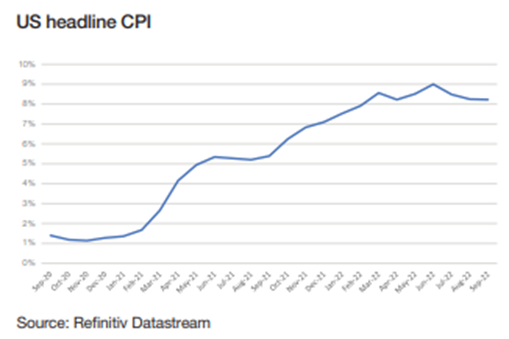
Last week’s US inflation data cemented expectations for another 0.75 percentage point interest rate hike by the Federal Reserve. The headline consumer price index (CPI) rose 8.2% year-on-year in September, only slightly lower than the 8.3% annual rise recorded in August.

More concerning was a 6.6% annual rise in core inflation, which strips out volatile energy and food costs. This was higher than the 6.3% rate in August and the fastest pace in four decades. On a monthly basis, core CPI was up 0.6%. President Joe Biden said Americans were being squeezed by the cost of living and that there was “more work” to do to fight inflation.

The CPI was followed a day later by the University of Michigan’s consumer sentiment index, which showed expectations for price rises over the next 12 months had risen to 5.1% in October from 4.7% in September. Five-year inflation expectations increased to 2.9% after falling to 2.7% the previous month. Consumer sentiment improved modestly, with the index rising to 59.8 from 58.6 in September. The current economic conditions index jumped to 65.3 from 59.7.

UK economy shrinks by 0.3%

The UK’s GDP shrank by 0.3% in August from the previous month, led by a 1.6% decline in manufacturing. GDP also fell by 0.3% over the three months to August, suggesting the 0.1% increase in July reflected a rebound from the Queen’s platinum jubilee celebrations the previous month.

Services fell by 0.1% in August, driven by cuts to health service spending and a 5.0% drop in arts, entertainment and recreation activities. Output in consumer-facing services declined by 1.8% following a 0.7% rise in July, according to the Office for National Statistics.

China’s ‘Golden Week’ hit by Covid curbs

China celebrated a weeklong National Day holiday – known as Golden Week – at the beginning of October. The week is typically a peak period for travel and consumption, but tourism revenue this year was down 26.2% from a year ago and equal to just 44.2% of the revenue in 2019’s Golden Week. Some popular tourism destinations remain subject to strict Covid curbs, resulting in many people choosing to stay close to home.

Authorities in cities such as Beijing and Shanghai tightened restrictions ahead of the Communist Party’s congress, which began on Sunday. The congress will lay out the party’s policy for the next five years. It is expected that president Xi Jinping will win a third term as party general secretary.

Please check in again with us shortly for further relevant content and news.

Chloe

19/10/2022

Team No Comments

Brewin Dolphin: Hunt reverses mini-budget tax cuts

Please see the below article from Brewin Dolphin, which takes a look at the new Chancellors reversal of last month’s ‘mini-budget’ and the impact of this on the market. This was received late Monday afternoon – 17/10/2022.

UK chancellor Jeremy Hunt has announced a reversal of almost  all the tax-cutting measures contained in last month’s mini-budget.  Guy Foster, our Chief Strategist, highlights the key announcements and how markets are responding.

On his first full working day as the new UK chancellor, Jeremy Hunt has overturned nearly all of his predecessor’s tax-cutting proposals. In an emergency statement, Hunt said the government was committed to doing whatever necessary to achieve UK financial stability and put the public finances on a sustainable path.

The statement was not only about further plugging the gap in the government’s fiscal plans, but also restoring the UK’s economic credibility after the turmoil created by September’s mini-budget.

Here, we highlight the main measures and the impact on financial markets.

Key measures

Hunt announced that the planned reduction in basic-rate income tax will no longer go ahead in April. Instead, the rate will remain at 20% “indefinitely” until the economic circumstances allow it to be cut.

The new chancellor also overturned Kwasi Kwarteng’s plan to reverse the 1.25 percentage point rise in the rate of dividend tax. The rate of dividend tax increased in April 2022 to 8.75% for basic-rate taxpayers, 33.75% for higher-rate taxpayers and 39.35% for additional-rate taxpayers1. Today’s announcement means these rates will remain in place rather than fall next year.

Plans to freeze alcohol duty, introduce VAT-free shopping for tourists and reverse off-payroll working rules have also been axed. Together with the corporation tax U-turn and the decision to scrap proposals to axe additional rate income tax, the changes are expected to save the Treasury around £32bn a year2. And while energy support for households will not change between now and April, beyond that it will depend on the outcome of a Treasury-led review rather than stay in place for a further 18 months.

The only tax-cutting measures from the mini-budget that haven’t been axed are those that are already going through parliament – namely, the reform to stamp duty and the reversal of the 1.25 percentage point National Insurance (NI) rate hike. Reforms to stamp duty came into effect on the same day as the mini-budget, and the rate of NI will reduce from 6 November.

How are markets reacting?

Sterling extended its early morning gains against the US dollar and the yield on UK government bonds (gilts) fell following the statement, suggesting financial markets are so far welcoming the changes.

The decline in bond yields means government borrowing is less expensive. The things financial markets worry about the most are the ability of a country to pay interest, the potential for more debt to be issued in the future (which weighs on the price of existing debt) and to maintain the value of its currency. If any of these things are in doubt, financial markets will feel less inclined to hold gilts and less inclined to hold the pound, unless they can be compensated by higher interest rates. Those higher interest rates end up being suffered each time the government issues a new bond and will last for as long as that bond lasts (some bonds borrow money over a few years, whereas others borrow over several decades).

Ultimately, government expenditure must be met from taxes or borrowing. If it is met from borrowing, this debt will have to be repaid and so will the interest on that debt which, in turn, will have to be borrowed or paid from taxation.

If the market starts charging the government more over the coming years, then it will affect interest rates for other kinds of borrowing as well. The most obvious example of this is mortgage rates.

Will borrowing costs fall further?

Borrowing costs for governments rose throughout this year, reflecting the return of inflation and the prospect of higher interest rates to try and bring that inflation down. From the beginning of August onwards, borrowing costs in the UK rose a bit more than in its international peers, which likely reflected anxiety over promises being made to cut taxes and increase spending. These fears were amplified by the mini-budget.

While we have seen some improvement in borrowing costs, there is still further to go. Even accounting for the general increase in global borrowing costs, UK bond yields were still higher than they were in July, when the Conservative Party leadership contest began to narrow. This, however, has been changing fast.

Markets have been highly volatile, but one silver lining has been improved buying opportunities in the UK government bond market. Gilt prices move in the opposite direction to yields, so the recent sharp rise in yields has seen the prices of some longer-dated gilts fall substantially. Gilt prices are expected to stabilise as the market starts to anticipate the onset of a recession, and they could rise if held until redemption.

Inflation-protected (index-linked) bonds, where the redemption amount and the interest rise with inflation, now offer positive returns which are comparable with the rates offered by other savings instruments and they can also be very tax efficient.

Is further volatility on the cards?

The chancellor is due to deliver a medium-term fiscal plan on 31 October. This will contain the government’s fiscal rules and a forecast by the Office for Budget Responsibility. The experience of his predecessor means Hunt will likely be careful not to spook the markets at Halloween.

In the meantime, UK inflation data due out this week will serve as a reminder that not all challenges can be walked away from as the mini-budget has been.

The UK bond market is very responsive to changes in the UK economy, but the equity market is typically more global or even US-centric in nature, so being too absorbed in domestic challenges has never served UK investors well.

Nevertheless, today’s statement has shown how the UK’s institutions will step in when policymaking is shown to be unsustainable. That may offer investors a degree of confidence in what has been a truly tumultuous month for UK financial assets. 

1 https://www.gov.uk/tax-on-dividends

2 https://www.gov.uk/government/news/chancellor-brings-forward-further-medium-term-fiscal-plan-measures

Please continue to check our Blog content for advice and planning issues and the latest investment, markets and economic updates from leading investment houses.

Cyran Dorman

18th October

Team No Comments

Competing policy measures leave markets fearful – Tatton Monday Digest

Please find below, an update on markets received from Tatton, this morning – 17/10/2022

Outlook: Bond markets 1 – UK Government 0

It is seldom that the UK alters the course of global capital markets, particularly given our domestic stock market comprises just 3.1% of global equities and 4.1% of the global government bond market. However, over the course of October, far bigger bond markets – like that of the US and Italy – have experienced significant changes in the wake of events earlier in the day in the UK.

In our view it can all be traced back to a profound misunderstanding of the UK’s relative position in the global competition for capital at just the point when central bank’s decisive anti-inflation measures have re-introduced fragility into capital markets not seen since the 2010-2012 Eurozone crisis. To this end, the US economy has been attracting huge swathes of capital and the US dollar has motored ahead, with interest rates and bond yields rising in parallel to expanding economic activity. In particular, the sharp rise in yields on US inflation-linked bonds has been at the heart of the stresses in the global economy. With the rest of the world facing massive competition for capital, it was unwise for the UK government to make a grab for more at a point when the costs have been made almost unbearable. To blame circumstances now suggests Liz Truss et al. were unaware of the situation when devising the policies. It’s no wonder the Chancellor is now a different person. Indeed, global markets have been cheered by signs the UK is unwinding its recent pronouncements. Should it reverse the bulk of policies that capital markets balked at as fiscally irresponsible, then rates and yields may still revert to the trajectory they were on before September’s fateful fiscal event. Whether they can do so fully will largely depend on how much of the reputational trust in UK institutions lost by international investors can be regained.

From the global perspective, beyond the UK’s domestic woes, the October 2022 UK bond market crisis will be remembered as the moment when central banks around the world were forced to grapple with something they have been denying for many months. Namely that their formidable efforts in forcing the inflation genie back into the bottle have unveiled fragilities in the global financial markets that may now hamper their ability to follow through with their inflation fighting strategy. The dependencies on ultra-low interest rates they had allowed to build up since the Global Financial Crisis mean that the risk that something, somewhere, in the global financial ecosystem would break – or at least seriously buckle – has now become all too apparent.

Will UK property downturn change the investment landscape?

In the wake of Kwasi Kwarteng’s ill-received fiscal event, lenders pulled swathes of mortgage products in expectation of sharply higher interest rates from the Bank of England (BoE). The potential effects on consumers and households were well-publicised – but as well as households, damage has also been done to equity markets – particularly to property funds and house builders. Both have fared substantially worse than the broader market throughout the year, and the latest drama precipitated another swipe down. The building sector has nearly halved in value since January, while real estate investment trusts (REITs) have lost around 40%.

Clearly, these problems precede the fiscal fallout – though it undoubtedly made the situation considerably worse. Both sectors fared well throughout the pandemic, buoyed by an increase in consumer savings and property deals. But the sharp contraction of monetary policy since the beginning of the year has made conditions extremely difficult.

With the UK probably already in recession, commercial property is one of the most vulnerable sectors. This would be the case even without the supply-side inflation pressures and fiscal imprudence, since house building and purchasing are extremely cyclical. We are also seeing this stress spread to banks with large property-related loans on their balance sheets – many of which have seen their share prices come under pressure. It seems that, having (somewhat) stabilised the pension fund problem in recent weeks, property is the new site of financial and economic instability.

Unfortunately for many property companies, there is little they can do about the situation. Balance sheet management has improved vastly in recent years, and property funds have made themselves much more resilient. But with the tide turning against them, some will probably fail – barring a shock turnaround in the underlying trends. However, improved balance sheets mean many of the larger players -particularly those unrelated to danger areas like inner city office space – will be able to weather the storm. When they come out the other side, they will find a significantly cheaper market ripe for plundering.

Headaches all round after the UK’s Gilt trip

The BoE’s emergency intervention three weeks ago was vital in stopping the gilt market bleed. But last week, Governor Andrew Bailey was keen to remind everyone that what the Old Lady giveth, she can taketh away. He responded to extension requests on the BoE’s bond-buying programme by firmly telling UK pension funds “you’ve got three days left”. Before giving way to optimism over the UK government’s latest U-turn, fear spread that pension funds would once again come under extreme pressure, with volatility pushing up collateral demands and making them forced sellers once more. The downturn was not limited to the UK either: US stocks fell sharply with investors concerned about global financial contagion. Bailey’s deadline was treated as an “all-time central bank gaffe” in some quarters, and sterling dropped hard and fast immediately after his comments.

But the BoE chief is in an unenviable position. His team is tasked with taming runaway inflation while avoiding a financial crisis triggered by government action that markets deemed fiscally profligate and irresponsible. In the current environment, these goals pull in opposite directions. Exceptionally high inflation requires exceptional monetary tightening, while the threat of pension fund collapse requires liquidity injections. Setting a timeline on these injections threatens to create a cliff-edge scenario, but open-ended purchases would undermine any monetary tightening done elsewhere. The BoE line was always that bond purchases were an emergency provision and would be dialled down when the immediate threat was gone.

We have grown used to near or below-zero real yields in the last decade and a half. But with the world in a sharp supply shortage (now mainly labour and fossil fuels), it is reasonable to think yields must move higher over the long-term to re-establish the balance between supply and demand. Currently, RPI-linked ten-year gilts yield 0.75% (above retail inflation). Runaway inflation necessitates some compression of activity from the BoE, meaning these real yield levels look justified. In fact, these yields arguably look attractive to global investors. That might seem bizarre, given BoE intervention seems to be the only thing keeping gilt markets intact. But the sharp sell-off had more to do with pension fund ‘fire sales’ because of a structural weak link in UK pension regulation, rather than underlying fundamentals.

The recent mayhem has caused many commentators to liken the UK to an emerging market, with fiscal imprudence and policy divergence from its central bank. But Britain is not an emerging market – it has highly functional financial and corporate structures and a highly skilled workforce. Recent bond movements bely this, but arguably suggests there are now bargains to be had. This is not to say we expect a sharp rebound (and thereby fall back in yields) – there are far too many intractable short-term problems for that – but there could be healthy returns in the future and, for the time being, yield-based return contributions we have not seen in over a decade.

Please continue to check our Blog content for advice and planning issues and the latest investment, markets and economic updates from leading investment houses.

David Purcell

17th October 2022