
Team No Comments

Invesco – Chief Investment Officer (CIO) – What are the investment opportunities for 2023

Please see below an article published by Invesco on the 14th December, which details their CIO’s thoughts on where they believe the investment opportunities for 2023 lie:

Going into 2022, debate was raging over whether inflation in the system was transitory or more permanent. Our concern at that time was that financial assets were not pricing any risk that inflation could be back in the system.

As we now know, the transitory viewpoint faded over the course of 2022. Central Banks raised rates aggressively causing sovereign and investment grade bond markets to have their worst year ever.  Deflation-era winners such as technology and secular growth equities came under heavy selling pressure, whilst relative leadership in equity markets passed to sectors in the defensive and value spaces. Energy linked commodities and equities soared.

Moving into 2023 debate has now shifted to the inevitable timing of a fall in inflation from elevated levels. In the eyes of many commentators, this would signal a peak in US interest rates allowing the Fed to ‘pivot’ away from tightening and firing the starting gun for an aggressive risk-on rally.

Whilst inflation is likely to moderate from the current peak levels seen this year, this is different to achieving target inflation. Deflationary versus inflationary pressures in the financial system are a function of changes in input costs, labour, and demand.
 

What does geopolitical tensions mean for the markets?

Deteriorating Chinese demographics as well as rising geopolitical tensions mean less ability to outsource to cheap labour sources. Developed markets are witnessing labour shortages because of generational shifts in working patterns, albeit it is not yet clear how permanent those changes will be.

Meanwhile, the pandemic and the invasion of Ukraine ensure that fiscal spending will focus on ensuring security in its widest sense – covering energy supply, defence spending and supply-chain resilience. This is likely to drive a capex cycle, made more urgent by energy and raw material supply failing to keep up with demand (in part a function of the desire to reduce carbon intensity in response to climate change). This demand/supply tension will only be accentuated as China progressively unlocks from its Covid control orthodoxy.

As a result, whilst we believe the market is right to anticipate a pause in the rate hiking cycle, we are wary of expecting a fast pivot because we believe there are more structural drivers of inflation in the system.

The era of free money has run out

For three decades investors in developed markets have enjoyed tailwinds on the journey from interest rates above 15% to near zero by early 2022. As interest rates neared zero the valuation anchoring effect of a positive risk-free rate disappeared for long duration assets justifying elevated multiples for growth equities, and historically low yields in the fixed income world (30% of global debt had a negative yield in 2019). Performance in both assets was exceptionally strong.

Central banks are now taking liquidity out of the system in their efforts to combat inflation. The era of ‘free’ money is over.

What does all this mean to us as investors? Near-term the risk of recession is present. Multiples have fallen this year as discount rates have risen, but we are yet to see real weakness in analysts’ earnings estimates. The early part of 2023 is likely to be dominated by assessing the degree to which they will be revised down versus what is already in the price. Cyclical sectors have been already marked down severely whilst defensives have held up much better despite rising input cost pressures.
 

What will be the key drivers of return?

On a longer-term basis, we anticipate a high ongoing cost environment. In that context pricing power will be crucial and the ability of individual management teams to navigate the complexities of a more deglobalized operating environment will be a real differentiator. In a higher rate environment, absolute levels of debt at the corporate level become much more important in assessing risks, whilst cash on balance sheet begins to be an interest-bearing asset, providing earnings support.

Above all, the risk-free rate is now imposing a cost of capital. Companies will need to be able to evidence cash returns not long-term promises.  

Valuation is back as a risk factor having been largely abandoned as interest rates hit the zero-bound. With the market moves we have witnessed in 2022, our teams across asset classes are seeing opportunities being offered. The Fixed Income team is starting to see value returning to their market but with higher rates of interest, careful analysis of credit risk is vital.  Our Asia team have seen the China market de-rate significantly from elevated valuations and are now seeing selective opportunities with the overall market trading back at 1998 valuations. UK and Europe remain unloved by global investors but have significant exposure to industries set to benefit from changing market dynamics at attractive valuations (which under-pinned relative performance during 2022 despite very difficult macro and political backdrops).

The over-arching message from all the teams, however, is that relying on market-driven returns (beta), or factors is likely to be less effective than in the previous decade. Instead, stringent analysis of financial and non-financial metrics, engaging with management to understand corporate strategy and valuation discipline will be the key driver of returns. This is a rich environment for fundamentally driven active investors.  

Please continue to check our Blog content for advice and planning issues and the latest investment, markets and economic updates from leading investment houses.

Carl Mitchell – Dip PFS

Independent Financial Adviser

16/12/2022
Team No Comments

Invesco – A December to remember for the global economy

Please see the below article from Invesco received over the weekend:

December is shaping up to be a momentous month for the global economy and markets. Following are some reasons why:

Changes to China’s COVID policy. China is making meaningful and positive alterations to its COVID policies. Last week China announced a new initiative to encourage further vaccinations for the elderly, and it has also recently relaxed its COVID testing requirements in some major cities. This news has been very well received by investors, who have driven up Chinese stocks. And it has been reported that China may announce this week a new, less stringent set of national COVID policies that could be stimulative for the economy, which could provide another strong boost to Chinese stocks.

China’s growth target. Senior policymakers in China will meet in mid-December for the Central Economic Work Conference (CEWC) in order to agree upon key economic policies for the coming year. All eyes will be on the growth target set for 2023 – specifically whether the target will be 5% or above. I expect it will be 5% or above, and that there will be supportive fiscal policies to help China reach that target. In addition, the People’s Bank of China recently cut its reserve requirement ratio, and I expect its supportive policies to continue. This could set the stage for significantly stronger economic growth in 2023.

The Tankan Index. This index helps us take the temperature of the Japanese manufacturing sector, and it’s expected that the upcoming reading on Dec. 14 will show conditions have improved since the previous quarter. However, some recent economic data points from Japan have disappointed, such as retail sales. A disappointing Tankan Index could suggest a less-positive outlook for the Japanese economy and weigh down Japanese stocks in the short term, despite a supportive central bank.

US Inflation measures. I’m especially keeping an eye on the US Consumer Price Index (CPI) and Producer Price Index (PPI), as well as preliminary inflation expectations from the University of Michigan. While I do believe that a 50 basis point rate hike in December is almost a “fait accompli,” there is a small chance the Federal Reserve (Fed) could hike 75 basis points instead. I don’t believe that the higher wage growth in last week’s jobs report would be enough to prompt a higher hike on its own; however, if it is followed up with higher-than-expected inflation or inflation expectations, it could change the Fed’s mind. Recall that in June, the Fed had communicated it would only hike rates by 50 basis points. However, just a few days before the rate announcement, both CPI and Michigan inflation expectations were higher than expected, and the Fed pivoted to a 75 basis point hike. And so these upcoming readings have a small chance of influencing the Fed’s decision in December, although most likely they will just contribute to higher volatility.

Bank of Canada meeting (BoC). Canada has been at the vanguard of central banks downsizing rate hikes, so it’s good to keep an eye on the BoC. Canada is also facing many of the same challenges as the US economy, with a tight labor market and high wage growth; it also has run the risk of slowing its economy too much because of its “fast and furious” rate hike cycle. Like the US yield curve, the Canadian yield curve has experienced a deep inversion. The Bank of Canada was initially expected to hike rates by 50 basis points at its December meeting, although there is a growing likelihood of a 25 basis point hike. A 25 basis point hike, in my view, is more likely and would ease the pressure on the Canadian economy — as well as lead the way for other central banks to follow in normalizing the size of rate hikes.

The Federal Open Market Committee. FOMC economic projections and the accompanying press conference are scheduled for Dec. 14. At the end of the day, markets aren’t focused on December’s rate hike — they’re focused on what the terminal rate will be and when the Fed will hit the “pause” button, because that will help dictate how the stock market performs and when an economic recovery can unfold. And it is the FOMC press conference as well as the “dot plots” that will give us a far better idea of that.

The European Central Bank (ECB). It looks like inflation may have peaked in the eurozone, increasing the likelihood that the ECB will downshift to a 50 basis point hike at its Dec. 15 meeting. However, at a recent conference, ECB President Christine Lagarde disagreed that inflation had peaked and warned about the danger of letting inflation expectations become unanchored, which suggested she may err on the side of greater hawkishness in reinforcing ECB credibility.

Watching the markets

December has tended to be a good month for risk assets, inspiring the term “Santa Claus Rally” to describe late December surges. It’s been the third-best month for both the S&P 500 Index (since 1950) and the NASDAQ Composite (since 1971), and the second-best month for the Russell 2000 Index since 1979 International stocks also have historically participated in Santa Claus Rallies. For example, the FTSE 100 Index’s average monthly return for December is 2.55%, the MSCI Emerging Markets Index’s average return is 3.18%, the MSCI EAFE’s average return is 2.34%, and the Hang Seng’s average return is 1.79%.

But this year, markets have largely been driven by the Fed and other central banks because of their historic monetary policy tightening, and so I expect these central banks will likely continue to have an outsize impact on stocks in December. In addition, lowered earnings revisions could exert downward pressure on stocks. Therefore, I expect significant volatility for the month, although the bias is likely upward given historical trends. I suspect this will be a December to remember for the global economy – and markets – as we get ready for 2023.

Please continue to check our Blog for advice, planning issues and the latest investment, markets and economic updates from leading investment houses.

Andrew Lloyd DipPFS

12/12/2022

Team No Comments

Brooks Macdonald Weekly Market Commentary: ECB’s Lagarde signals the probability of a 50 or 75bp rate hike

Please see Brooks Macdonald’s weekly market commentary below late yesterday afternoon:

Equities and bonds rose last week after Fed Chair Powell’s speech contained some dovish comments

Last week saw a further rally in bond and equity markets, catalysed by comments from US Federal Reserve (Fed) Chair Powell which were considered, on the margin, more dovish than previous speeches. Signs that China was moving away from its tougher COVID-19 regime was also welcomed by markets at the tail end of last week. This week’s schedule is significantly quieter with the US Fed now in its communication blackout ahead of its next meeting and a relatively small number of data releases.

Canada’s central bank meeting will be closely watched as the bank leads others with a dovish pivot

While we will not hear from Fed speakers this week, we will hear from the European Central Bank’s (ECB) Lagarde today which will be influential as markets attempt to price the probability of a 50 or 75bp rate hike by the ECB in December. Elsewhere we have Canada’s central bank meeting where policy setters are expected to continue on their dovish pivot seen at the last meeting. The market would welcome a smaller hike which implied a rapid move away from the bank’s rapid tightening of policy earlier in the year which included a 1% hike in July. Australia and India are also in the process of moderating the size of their rate hikes so their meetings on Wednesday will also be watched closely.

US average hourly earnings rose more than expected, however the response rate was very low

Markets on Friday were surprised by an upside beat to the number of new jobs created in November with 263,000 new jobs compared to expectations of 200,0003. The main focus was on the average hourly earnings number however, which came in at 0.6% compared to a consensus figure of 0.3%. Given the importance of income growth to inflation figures, markets took this headline figure poorly with the US equity index falling slightly on the day and US banks continuing their underperformance.

Wage growth inflation remains crucially important and Fed Chair Powell confirmed this when he spoke last week, Indeed, Powell explicitly referenced the strong demand for workers with the Job Openings and Labor Turnover Survey (JOLTS) showing 1.7 jobs for every unemployed worker. There is reason for some caution over the data however as the response rate for the jobs survey was very low, at just 49.4% compared to an average rate of c. 65-70%. This smaller data set is more likely to contain skews and therefore the figures that spooked the markets on Friday may well be heavily revised in coming months.

Please continue to check our Blog content for advice and planning issues and the latest investment, markets and economic updates from leading investment houses.

Andrew Lloyd DipPFS

06/12/2022

Team No Comments

Brooks Macdonald Weekly Market Commentary: Global Inflation likely to have peaked

Please see Brooks Macdonald’s weekly market commentary below received yesterday evening:

Signs that global inflation may be peaking helped buoy equity sentiment last week

Equities rose last week, with hopes that global inflation may start to ease outweighing increased concerns over the Chinese COVID-19 response.

Wednesday’s Eurozone CPI report will be the latest gauge of European inflation pressure

Wednesday sees the release of the latest Eurozone Consumer Price Index (CPI) report with headline CPI expected to fall from 10.6% to 10.4%. With European natural gas prices far below the peaks set in August, headline European inflation pressures should continue to fall. In terms of other lead indicators, German factory gate prices fell by 4.2% in October month-on-month with UK and US producer inflation also slowing since the summer. This sets up a more constructive backdrop for inflation readings coming into 2023 and has added to optimism within the bond market that inflation figures will begin to slow globally. With energy prices falling, it is likely that we see a peak in headline inflation before a peak in core (excluding food and energy) inflation as it will take some time for additional high energy costs seen in August to work through the global supply chain.

China’s COVID-19 restrictions led to protests over the weekend, increasing the political cost of stricter short-term measures

Over the weekend, a series of protests began against the Chinese government’s COVID-19 restrictions. Whilst the protests themselves do not pose a current threat to the regime in China, it does suggest a population increasingly weary of COVID-19 restrictions, making further lockdowns politically unpalatable. The timing of the recent COVID-19 surge has meant that Chinese authorities have struggled to implement two contrasting approaches, seek to reduce the impact of COVID-19 restrictions on everyday life and the economy, but at the same time, tackle the current elevated case rate. For the time being, policy choices appear to have favoured tougher short-term measures however the protests may change some views in Beijing.

China is likely to continue to find a balance between the broader opening up of China from COVID-19 restrictions whilst also trying to limit the rise in case numbers. It is likely that cases will continue to edge up without a strict containment regime therefore Chinese authorities are likely to favour managing hospital capacity rather than seeking zero COVID-19. One risk is that different local authorities take different approaches, leading to a range of severity in restrictions and a range of economic outcomes for parts of China.

Please continue to check our Blog content for advice and planning issues and the latest investment, markets and economic updates from leading investment houses.

Andrew Lloyd DipPFS

29/11/2022

Team No Comments

Brooks Macdonald: Daily Investment Bulletin

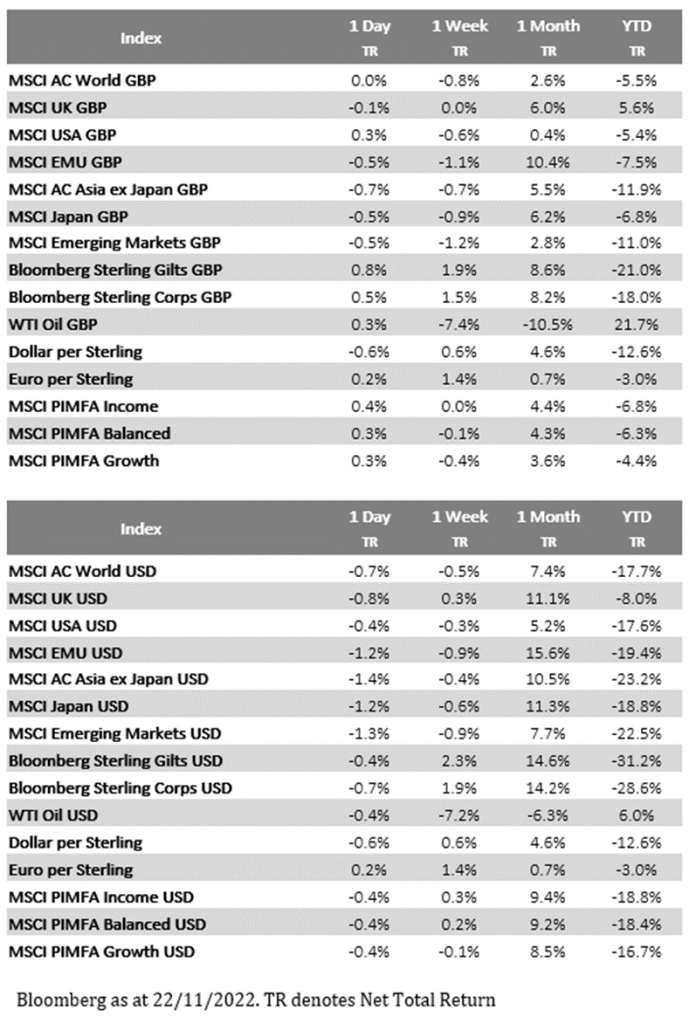
Please see below, the Daily Investment Bulletin from Brooks Macdonald. Received late this morning – 22/11/2022

What has happened

US equity markets fell yesterday as investors pondered what the Chinese authorities may do in response to the rising COVID cases in the country.

Energy 

The oil price was hit yesterday by a confluence of factors: reduced expectations of Chinese demand, US recessionary fears and rumours that OPEC may increase supply.  Both WTI and Brent measures moved more than 6% lower intraday yesterday as speculation of reduced demand and increased supply left few places to hide. Eventually Saudi sources issued a strong denial of the supply-side rumours which led WTI and Brent to end broadly flat on the day. This latest volatility within the oil market is another reminder of how easily the narrative can shift when markets lack direction.

China

Whilst it was only a week ago that investors were looking forward to an easing of Chinese COVID restrictions, sentiment has swung in the other direction given the pickup in COVID cases. The key question is whether the recent uptick in cases will be enough for the government to abandon their reopening ambitions in the medium term. In the short term we have seen Beijing increasing its restrictions with new arrivals required to take 3 PCR tests over 3 days and to stay at home until all results are negative. We have also seen some return to online learning rather than in-person schooling as officials respond. While the US CPI release has undoubtedly been the major driver of the optimism of the last two weeks, the release of a Chinese plan to reduce COVID restrictions was also a key driver. Reduced Chinese COVID restrictions mean not only that the outlook for the Chinese economy would improve but also that Chinese consumer demand would begin to support the global recovery. 

What does Brooks Macdonald think

The Federal Reserve did not come to the rescue yesterday, with President Daly speaking about the economic risks of over-tightening but in the same speech warning that the US terminal rate may need to go above 5% to be sufficiently restrictive. President Mester put it in plainer language, saying that the Fed was not ‘anywhere near to stopping’ its interest rate hike process. Markets still expect the Fed to hike by 50bps rather than 75bps in the December meeting but the terminal rate for this cycle remains highly uncertain.

Please continue to check our Blog content for advice and planning issues and the latest investment, markets and economic updates from leading investment houses.

Alex Kitteringham

22nd November 2022

Team No Comments

Tatton Monday Digest

Please see the below article from Tatton Investment Management which was received this morning detailing their thoughts on last week’s events and their impact on markets:  

Overview: Prospects of a Fed pivot put on pause

On the whole, investors enjoyed another positive week in markets, as better-than-expected US retail spending figures, a falling dollar and still-declining European energy prices prolonged last week’s positive sentiment swing initiated by slowing US inflation. The downside of this is that all these data points indicate more current and future resilience in the US economy and a potentially shallower recession in Europe. This is not providing central banks with the confidence that labour supply pressures are likely to ease any time soon. As a result, a near-term pivot in their monetary policy away from tightening is no more likely now than it was a month ago. The December meeting of the US Federal Reserve rate setters will be awaited with a fair dose of nervousness, and anything less than a clear signal of a pivot is likely to lead to significant market disappointment.

Return of ‘Rishinomics’ plugs the holes

Last week’s Autumn Statement was perceived as quite sensible from a capital market perspective, with sterling and bond yields closing within their most recent trading ranges. However, it is hard to shake the feeling that the measures introduced amounted to little more than a short-term repair job rather than a long-term strategy to overcome the UK’s structural weaknesses: comparatively low productivity – caused by the lack of capital and education investment – paired with a paucity of post-Brexit trade opportunities.

So, Trussonomics is history, while Rishinomics returns. For now it seems Chancellor Jeremy Hunt has managed to keep foreign buyers of UK government bonds onside, while maintaining the enormous fiscal expansion of the energy price cap but pushing the bulk of the tax rises and spending cuts into the next parliament in 2024 and beyond. No wonder the shadow Chancellor called the postponement of the brunt of the tax rises and public spending cuts an election ‘trap’. Should dire Office for Budget Responsibility (OBR) forecasts become reality, UK households will be faced with the inevitability of shrinking real incomes for years to come. But the OBR report also contained a few lifelines for UK wage-earners, such as the prospect that inflation may well turn negative in 2024 and pull bring down mortgage costs with it. Given the recent steep fall in European gas and electricity prices, the energy cost price shock may also end sooner, lowering the upward pressure on energy-intensive goods.

China bullishness returns

While the UK public was focused on the Autumn Statement, and despaired over the latest inflation data, the most significant news in the global investment world once again came from China. Less than a month ago, overseas investors were fleeing, and commentators were decrying China was yet again becoming “un-investable”, following the dogmatic inflexibility on display at the Communist Party congress a few weeks ago. This resulted in a 20% stock market drop over October. Now, those losses are more or less recovered, thanks to an impressive two-and-a-half-week Chinese stock market rally.

Like the losses beforehand, recent gains have been driven by political decisions. In the last couple of weeks, Beijing has changed its tune on three extremely important issues. Firstly, policymakers issued a sweeping plan to help the struggling property sector. Secondly, official Covid rules were relaxed, in the first major sign that President Xi might change his zero-Covid directives. And finally, Xi’s appearance at the G20 summit, where he held a one-on-one meeting with US President Biden, pointed to better relations between China and its major trading partners. We should not get ahead of ourselves: the biggest problems in US-China relations are deep-rooted, ranging from economic ideology to Taiwan’s independence. These will not go away with a few nice words. Even if Xi is happy to shelve his plans for annexing Taiwan, it is a goal tied up in the very fabric of the People’s Republic. Geopolitical flashpoints are therefore a given in the months and years ahead.

Even so, the pragmatism shown by Beijing in the past couple of weeks is comforting. To be sure, Xi’s extreme consolidation of power of the last decade has shifted China’s focus from growth and globalisation to stability and ideological conformity. But as we have often noted, a vibrant private sector is crucial to China’s future, and the government has repeatedly made attempts to support that. China has been one of the biggest contributors to global growth for more than a decade and, being at a completely different stage of its cycle, a policy push now could counteract weakness elsewhere. What’s more, because of China’s production build-up over the pandemic, the growth it pushes out to the world might not even be inflationary. This is an optimistic scenario, but a perfectly plausible one. As ever with China, investors must keep an eye on the risks – but the benefits could be vast.

FTX: A pitfall on the path to cryptomaturity?

The dust is still settling from the collapse of FTX, the cryptocurrency trading hub that went into meltdown earlier this month. For the uninitiated, FTX is a digital currency exchange run by (former) crypto icon Sam Bankman-Fried. Bankman-Fried was regarded by industry insiders and regulators alike as the Warren Buffet of the crypto world, though the last few weeks have made him look more like its Bernie Madoff. Michael Lewis, author of Liars’ Poker and The Big Short was in the process of writing a book about him when the troubles emerged – given he writes about financial disasters, Lewis remains remarkably prescient.

For all the technicalities and jargon surrounding this story, the basic plotline is all too familiar: certain market players tried to hide their leverage to make assets look better than they really were. It went so well they felt like they could print their own money. In FTX’s case, this was literally true: the value of its own FTT token was backed by more FTT. When this came to light, the whole thing unravelled spectacularly. Commentators have suggested this could be the crypto market’s ‘Lehman moment’, as other exchanges struggle to mitigate their exposure and shore up liquidity. Any rush of that sort inevitably means forced selling, and the majority of cryptocurrency exchanges’ assets are cryptocurrencies. We should therefore expect to see price falls across the crypto space. Sure enough, Bitcoin – the most well-known cryptocurrency, has fallen about 20% since the start of November.

FTX is not Lehman’s, by a long stretch. But its demise is certainly a destruction of capital, and it may be a long time before we know the wider damage. While other crypto exchanges are the obvious ones in peril, we should not be surprised if other financial institutions take a hit down the line. It is notable, for example, that Bitcoin volatility has been relatively low, compared to previous crypto downturns. While this might show resilience in the crypto sphere, it might also point to a lack of appreciation for the deeper risks. Regardless, episodes like this are thinning the crypto field. The fallout is likely to increase volatility further even for the better-known brands, but it will hurt the little guys more. And in order to rebuild the trust of their believers those better-known brands might just have to accept regulation from the very institutions they demonised as inherently untrustworthy.

Please continue to check our Blog content for advice and planning issues and the latest investment, markets and economic updates from leading investment houses.

Andrew Lloyd DipPFS

21/11/2022

Team No Comments

Brooks Macdonald: Weekly Market Commentary – US CPI Boosts Hopes of Less Hawkish Monetary Policy

Please see the below article from Brooks Macdonald, detailing the key news from markets over the past week. Received yesterday afternoon – 14/11/2022

Equities rallied significantly last week as a downside miss to US CPI boosted hopes of less hawkish monetary policy

Equity markets continued their gains on Friday with the US outperforming as investors priced in the implications of the lower than expected US Consumer Price Index (CPI) report.

China releases a plan to ease COVID restrictions and loosen policy for the embattled Chinese property sector

Prior to the Chinese party congress, investors had hoped that the new leadership would feel comfortable easing COVID rules and loosening economic policy. Foreign investor sentiment towards China has become decidedly poorer in the last month however, as investors fear that Xi’s consolidation of power may lead to policies which deprioritise economic growth. Pushing back against some of these concerns, China has released a 20-point plan to ease its zero-COVID policy which has stifled recent economic growth. In addition to this, the government also announced a 16-point plan to support the domestic property sector which has looked increasingly weak in the aftermath of the Evergrande default and as property developers focus on complying with the central bank’s ‘three red lines’ governing leverage. It is too early to say whether these two announcements are part of a broader attempt to provide additional impetus to the Chinese economy however they have been welcomed within Chinese equity markets this morning.

US Central Bank governors have begun to comment on the inflation numbers, warning that more hikes are still needed

Bond and equity markets welcomed the downside miss to headline and core CPI last week which may mean that the US Federal Reserve (Fed) will not need to be as hawkish to keep inflation under control. We are yet to see how the Fed, in aggregate, will respond to last week’s reading but we have heard from a few Fed Governors, including Waller earlier today. Waller said that there was still ‘a ways to go’ in tightening US monetary policy, predominantly as the central bank would need to see a run of softer CPI readings before it gained confidence that it could stop hiking rates. Waller also speculated that some of the exuberance last week echoed the market’s, ultimately premature, rally after the July CPI release which commenced a rally which was eventually snubbed by Fed Chair Powell.

Fed speak will be important as we look ahead to the December Fed meeting and we get further clues as to whether the Fed is now less concerned about inflation. In reality however, Fed sentiment may impact the size of the December rate hike but inflation itself will dictate how high interest rates need to go in 2023.

Please continue to check our Blog content for advice and planning issues and the latest investment, markets and economic updates from leading investment houses.

Alex Kitteringham

15th November 2022

Team No Comments

Tatton – Monday Market Digest

Please see the below an article from Tatton Investment Management which was received this morning (14/11/2022) and details their thoughts on last week’s events and their impact on markets:  

Overview: signs of ‘peak’ inflation emboldens markets

There were three big stories in capital markets last week: the US midterm elections, the latest crash in the surreal world of crypto currencies, and the release of US inflation data for October. By Friday, it was the lower-than-expected inflation data that took precedence. Thursday’s report from the Bureau of Labor Statistics revealed annual consumer price index (CPI) inflation slowed to 7.7% in October, below the 8% expected by most economists, and the lowest level since January. So, for the first time this year it appeared that current rising inflation may be over for the US. While it is still too early to assume the Federal Reserve (Fed) will pivot away from its monetary tightening policy, the market euphoria following the data release was quite something. We may not have reached the actual turning point in terms of shifting economic tides, but perhaps this week’s activity confirms our suspicion of the shared belief among market participants that the current economic downturn is more likely to be shorter and shallower than some scaremongers (including the Governor of the Bank of England) suggest.

Last week also saw FTX, the second-largest crypto exchange, become a casualty of both crypto’s defining feature (lack of regulation) and the less forgiving market environment. It turns out that diehard cryptocurrency traders still prefer the stability of the money created by central banks. For us, what is most interesting about this episode is the likely impact on general credit spreads – the proverbial canary in the coalmine of capital markets during economic downturns. While FTX’s demise and bankruptcy filing is still in its early stages, talk of FTX as a “mini-Lehman” will depend on which financial institutions  report large exposures (if any). This may change this week when the impact of FTX’s related hedge fund, Alameda Research, on prime brokers and other hedge funds emerges.

As we head towards the close of the year, when asset managers have a tendency to shut down exposures, last week’s positive upturn certainly felt encouraging. However, investors should not expect 2022’s market pressures to end here. The Fed’s December meeting may well cause yet another turn in market sentiment and the underlying corporate profit development, coupled with thinning seasonal liquidity from institutional investors, leaves us bracing for more potential volatility before the year ends.

Republican ‘red wave’ fizzles out

Last week’s midterm elections in the US had been labelled as the most important midterms in recent memory, with democracy itself on the ballot. But while Republicans went as far as to predict a ‘red wave’, the weekend brought news that the Democrats had retained Senate control at least, with the House of Representatives still up for grabs. The Republican party’s underperformance was an unwelcome surprise for capital markets last week, mostly because investors crave stability, which means a preference for the status quo and even political gridlock. 

For markets, the real test lies in judging what fiscal policy will emerge after all the votes have been counted. The Democrats have shown a desire to increase the overall tax base in line with spending proposals – coming out at fiscally neutral – and control of the Senate could them make progress with this agenda. What the future holds for the Republican party after this ballot box set back  is much less clear, and could come down to whoever gains the Republican presidential nomination in 2024. Trump is expected to announce his candidacy this week and, were he to be successful, some fear a return to fiscal indiscipline, especially in the face of slower growth. On the other hand, the unexpectedly poor performance of Republicans – particularly those linked to Trump himself – suggests the party may field someone else. That someone would almost certainly be Florida Governor Ron DeSantis. His successful re-election campaign was built around promises of sales-tax cuts targeted on everyday items, which would benefit the less well-paid. It is yet to be seen how the lower tax revenues will impact Florida’s provision of public services. It would be difficult to achieve a similar policy at the federal government level, as sales tax is levied by the states, so the equivalent would be lower income tax. 

Meanwhile, Biden and the Democrats gained a fillip from the electorate, and will be poring over the voter data and surveys to divine what were the key positives. Recapturing the Senate gives Biden some ammunition to counter critics who believe his age and frailty should render him a one-term-only president. The Democrats have no obvious centre-ground alternative candidate themselves, but Trump’s early entry into the nomination race means they may wait to see how things pan out, especially if the Republican fight gets messy. With Trump involved, it almost certainly will. 

To PE or not to PE? That is the question

This year, private equity (PE) has protected some of the world’s largest investors from the misery in publicly-traded securities. On average, PE firms recorded 1.6% of gains in the first quarter of 2022, and only some mild falls since then. Publicly-traded global equities by contrast are down 22% over the same timeframe. Lower volatility does not seem to come at the cost of growth either. The industry has grown exponentially in the last decade and a half and, while it was thought rising interest rates would make things much harder, PE firms predict a bright future. According to BlackRock analysts, returns from US private equity are expected to eclipse other asset classes over the next decade.

Of course, when something seems too good to be true, it usually is, especially when you remember that private fund managers set those fund valuations themselves. Private equity funds hold their assets for a long period, so at any given time it is difficult to work out what the market value for those assets should be. And on other measures, the private equity market looks much less rosy. Carlyle Group, for example, has lost more than half of its stock value this year – despite flat or even positive reported returns in its underlying assets.

PE funds also recently struggled to attract capital in similar amounts as in recent years. That much should be expected, given the tightening of global financial conditions. But this is being compounded by the so-called ‘denominator effect’. PE funds work by setting up a closed-end fund for certain acquisitions, then drawing in ‘limited partners’ (LPs) to foot the bill. These funds are then managed by PE firms like KKR or Carlyle – which take a healthy chunk of the profits – but the risks are borne by the LPs. The problem comes from the fact that the LPs are often large institutional investors like pension funds, which have strict regulatory requirements on where they can put their money. These rules often dictate that only a certain percentage of an overall portfolio can be put into private assets, usually in the 20-30% range. If those PE funds outperform other parts of the portfolio by a significant margin – as seen this year – the ratio gets out of kilter. PE backers therefore have to pull out some funding as a regulatory requirement.

Many have taken to calling on existing LPs for more capital. Large pension funds and the like should have enough cash to do so, but smaller investors may be forced to sell some assets to meet these payments. Given how large PE exposure has become over the last decade and a half, this could have serious knock-on effects in publicly-traded markets. Moreover, if PE funding continues to dry up and firms keep having to make capital calls, we could see a similar liquidity crunch

Please continue to check our Blog content for advice and planning issues and the latest investment, markets and economic updates from leading investment houses.

Carl Mitchell – Dip PFS

Independent Financial Adviser

14/11/2022

Team No Comments

Singles Day 2022: What’s in store for the world’s largest e-commerce festival?

Please see the below article from Invesco about this years ‘Single’s Day’ online shopping event which is taking place today:

Key Takeaways

  • Singles Day 2022 – World’s largest online shopping event, outstripping Cyber Monday and Black Friday
  • Trends for brands – Keeping consumers engaged and entertained have been a trend for brands participating in the event
  • Customer lifetime value – Brands that focus on creating customer lifetime value and cultivating loyalty keep shoppers engaged and entertained

The worlds’ largest online shopping event, Singles Day or Double 11, this year features experiences in the metaverse, livestreaming sessions, while big themes of the festival are sustainability and inclusiveness.

First created in 1993 by four single university students to celebrate being single, the day became a commercial event in China in 2009 and now global sales – mostly online – generate billions and outstrip Cyber Monday and Black Friday.  This year more than 290,000 brands from 90 countries are participating in the sale.

What will be the trends for brands this Singles Day?

The shopping extravaganza usually kicks off with a gala celebration the night before. In the past, there’s been no shortage of guest star appearances, including Benedict Cumberbatch showing up via a pre-recorded video last year, previous years have seen performances by Taylor Swift and Katy Perry.

Keeping consumers engaged and entertained have been a trend for brands participating in the event.  Consumers can play games to win discounts, while celebrities and influencers entertain them through livestreaming demonstrations of products. Shoppers can have their products delivered to their doorsteps within an hour or even minutes.

Livestreamed shopping has been one of the most successful sales channels. Li Jiaqi, a top Chinese livestreaming host sold US$1.9 billion of goods during China’s Singles Day last year. In a recent livestreaming session in September 2022, Li attracted 150,000 viewers in just the first 10 minutes.

Gross Merchandise Value (GMV) or the total value of merchandise sold over a given period has become for companies an important measure of success for Singles Day. GMV is used to determine the health of an e-commerce site.  Since 2009, this figure for the festival has proliferated in China. The first Singles Day sales dating back more than a decade ago generated GMV 50 million yuan, while last year, traditional online retailer platforms totalled GMV of RMB 314.63 bn, while livestreaming platforms recorded RMB 73.76 bn.

How can brands gain new joiners, while maintaining customer loyalty?

Singles Day sales are not just celebrated by customers from tier-1 cities, the largest and wealthiest cities in China. Penetration to lower-tiers cities has also increased in recent years. Last year, non-tier 1 cities shoppers accounted for 77% of all shoppers during the festival.

Despite these impressive figures, it is challenging for brands to increase their market share through Singles Day.

To increase growth, brands are looking at ways to improve the shopping experience, while maintaining customer loyalty.

Various online platforms offer pre-sale events to attract customers’ attention. This year, pre-sale started on 20 Oct 2022. The impact of pre-sale numbers can’t be ignored, last year a top Chinese e-commerce platform experienced a 20-min system breakdown during the event.

Attractive discounts will be offered during the shopping extravaganza. For instance, a large variety of cross-store rebates, such as an extension on returns for purchased products, and compensation for the price difference should customers discover the same product is cheaper on another platform.

In addition, there are heart-warming promotions such as the “one-shoe scheme.” This started last year and enables disabled people to purchase shoes at half the price. University students have also set up online stores to help them gain entrepreneurial experience in Singles Day sales.

E-commerce platforms further created impact via diversification of marketing strategy. Metaverse is another initiative to launch, where consumers can virtually participate in online shopping in the metaverse. Platforms are also using interest-based marketing to individually tailor messages to customers and making entertaining videos that are a bit more personal to the consumer, lifting the excitement of online shopping.

Eco-friendly products are also offered, there are more than 3 million green products on shelves this year. Green logistics is also being promoted in the Singles Day sales, such as offering a self-pickup locker network to reduce carbon footprint, targeting environmentally conscious customers.

Defining the success of Singles Day for e-commerce platforms is not as simple as it used to be. Although there are still discounts and deals for consumers, brands that focus on creating customer lifetime value and cultivating loyalty keep shoppers engaged and entertained.

Maybe todays the day to do some early Christmas shopping online and partake in singles day?

Please continue to check back for our variety of blog content.

Andrew Lloyd DipPFS

11th November 2022

Team No Comments

Brooks Macdonald: Weekly market commentary – Market focus will be on US inflation report

Please see below the weekly market commentary from Brooks Macdonald, covering the latest economic and markets news. Received late yesterday afternoon – 07/11/2022.

Last week saw hopes for a dovish US Federal Reserve peter out as Powell delivered a hawkish message

The start of last week saw hopes for a dovish US Federal Reserve (Fed) fizzle out with Chair Powell’s press conference eliminating hopes of an imminent Fed pivot, for the short term at least. Against that backdrop, bond yields rose with the US 2-year yield rising an outsized amount as the yield curve inverted further.

Thursday’s CPI inflation print will yet again set the tone for a market eager to see easing price pressure

The market will focus its attention on the US inflation report due on Thursday. Last month the upside beat to core Consumer Price Index (CPI) inflation rattled market sentiment with investors particularly concerned about the breadth of inflationary pressures. Core CPI is expected to ease slightly on a year-on-year basis, falling from 6.6% last month to 6.5%. Headline CPI remains highly volatile due to the large energy component of the reading and the market expects headline CPI to rise by 0.6% over the month, but for the year-on-year reading to fall from 8.2% to 8.1% due to base effects. 

 The US midterm elections are likely to end with a divided US government

The midterm elections take place tomorrow and will set the scene for the balance of political power over the next two years in the US. The latest polling suggests that Republicans are likely to take control of at least one element of Congress which will prevent the Democrats from passing any partisan legislation. The House of Representatives currently looks likely to move into Republican hands with the Senate a coin toss between the two parties. Whilst, optically, there has been political alignment between the US President, Senate and House of Representatives, all currently Democrat, the day-to-day reality has been far less united. Given the Democrat’s wafer-thin majority within the Senate, moderate Democrat Senators such as Joe Manchin have been hugely influential in watering down policies over the last two years. The Democrat party has been forced to use budget reconciliation bills to avoid the Senate filibuster and even then, with the pressure from Democrat moderates, the ambition of these bills has had to be constrained.

A divided government will mean that the President is limited, in practice, to executive powers and only using Congress for bipartisan measures. Budget bills could prove to be particularly contentious with Congress needing to decide how to deal with the US budget deficit. Should a split Congress threaten not to raise the US debt ceiling, this could catalyse a broad market concern over the US economy and US dollar.

Please continue to check our Blog content for advice and planning issues and the latest investment, markets and economic updates from leading investment houses.

Alex Kitteringham

8th November 2022