Team No Comments

Brewin Dolphin – Markets in a Minute

Please see this weeks Markets in a Minute update from Brewin Dolphin received yesterday evening:

Please continue to check our Blog content for advice, planning issues and the latest investment, markets and economic updates from leading investment houses.

Andrew Lloyd DipPFS

15th February 2023

Team No Comments

Multi Asset market analysis – February 2023

Please see below article from Church House Investment Management providing multi asset market analysis. Received 09/02/2023.

January set a better tone for world markets, picking-up from Q4 last year rather than December’s negative tone. Let’s hope that January has set the tone for the year.

The European Central Bank and the Bank of England put their base rates up by a further 50bp (to 3% and 4% respectively), with the promise of a further 50bp to come from the ECB and rather more talk of “considerable uncertainties” and close monitoring by the Bank.  The US Federal Reserve lifted the Fed Funds rate by just 25bp to 4.75% and Chairman Powell cheered with talk of the onset of dis-inflation, though he was careful to warn that there is a long way to go, and it was probably going to be bumpy.

The first bump followed quickly with a jump in US employment in January (half a million new jobs, far greater than expected) and US bond yields rose.  But, over this period, ten and thirty-year US Treasury yields are still lower (both trading around 3.7%).  UK Gilt yields have also fallen, the ten-year is down to 3.3% and the thirty-year to 3.8%, not leaving a lot of room for disappointment.  Lower rates and the improved background are bringing down credit spreads and the primary market is buoyant, particularly in euros, with plenty of new issues meeting strong demand.

Equity markets have had a strong month led by the NASDAQ, which was squeezed higher by 16% over this period.  Having observed last month that big tech would need to show some signs of life soon to feel at all confident about the equity rally, this condition would appear to have been met.  But this does need to be qualified with a slowing in momentum apparent in figures from a number of the big tech companies over the past ten days. 

The US dollar has continued the sell-off that began in the autumn, but the momentum is definitely slowing and most of the move appears to have happened now.  Oil prices have picked-up over the period but, thankfully, European gas prices have not.  The rise in the price of gold also appears to have halted for now, recent data have revealed strong buying by central banks over 2022 in the wake of the war in Europe and ensuing sanctions.

The principal concerns that we set out at the beginning of the year are largely unchanged:

  • Have we seen the worst of inflation? 
  • How far will the Federal Reserve (and the other CBs) go? 
  • Will the recession be worse than currently expected? 
  • Is there an endgame in Ukraine or does it get worse?

At the moment, the prospects for inflation still appear to be improving, which, in turn should limit central bank action, but…  The prospects for recession appear to be pointing more towards shallow or minimal outcomes.  I am sure this will all change.  We still like shorter-dated sterling corporate fixed interest (credit) but would be cautious for longer-dated fixed interest.  Equity markets feel more comfortable at present, and the impression is still that stocks are ‘under-owned’, though we definitely expect more volatility to come.

Please check our blog content for advice, planning issues and the latest investment, market and economic updates from leading investment houses.

Adam

10th Febraury 2023

Team No Comments

Brewin Dolphin – Markets in a Minute

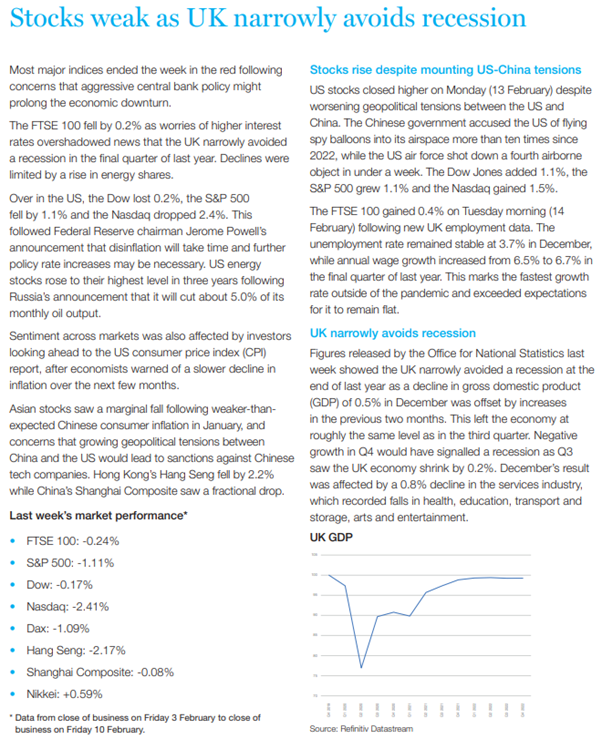
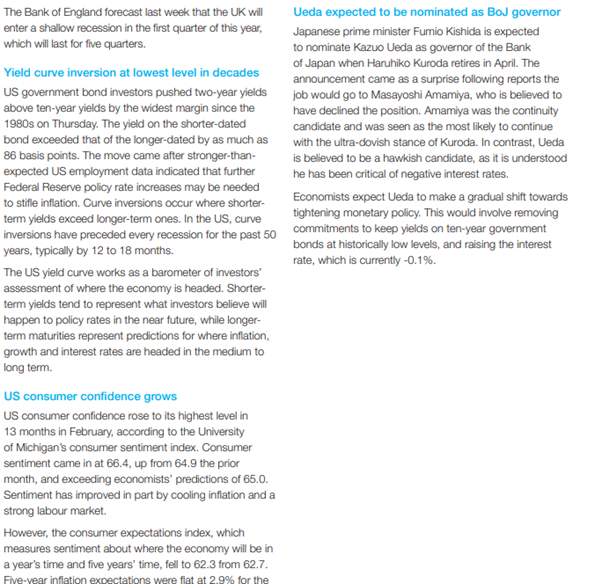
Please see below, Brewin Dolphin’s ‘Markets in a Minute’ article summarising the key economic and markets news from the last week. Received late yesterday afternoon – 07/02/2023

Please continue to check our Blog content for advice and planning issues and the latest investment, markets and economic updates from leading investment houses.

Carl Mitchell – Dip PFS

Independent Financial Adviser

08/02/2023

Team No Comments

Brooks Macdonald Weekly Market Commentary: Fridays US job report reiterates the current tightness of the US labour market

Please see this weeks Weekly Market Commentary from Brooks Macdonald received yesterday afternoon:

US Federal Reserve (Fed) Chair Powell’s failure to push back on market expectations of interest rate cuts helps drive equities higher

Equity markets retreated on Friday as the market digested the latest US jobs data. That said, equities still made solid gains last week with US large cap technology names leading the way.

A strong US jobs report last Friday reiterates the current tightness of the US labour market

The US non-farm payroll report on Friday contained benchmark revisions and large beats, breaking the market complacency that had settled in after a strong January for risk assets. Revisions to the calculations in 2022 meant that the official numbers for nominal income growth have surged, suggesting an even more robust labour market than previously thought. Of course, the 2022 numbers have already filtered through to broader economic data sets including the inflation report, Gross Domestic Product reports etc, so the revision in some ways is pure history however given that labour market tightness continues to be a theme in 2023, there is some read-across. In terms of the headline jobs growth in January, 517,000 jobs were created versus expectations of just 260,000. As a result unemployment fell to 3.4%, the lowest level in half a century. There was some good news, with labour force participation (percentage of the workforce in work or actively looking for work) ticking up to 62.4%, which will provide some support to the narrative that higher wages are tempting back workers who voluntary left the workforce during the pandemic.

The positive market tone of 2023 was unscathed by a week of major central bank meetings

Last week saw a deluge of central bank meetings which, in aggregate, provided a more dovish tone than we have been used to in recent quarters. It was also a major week for economic data with inflation numbers from the Eurozone as well as key labour market inflation data from the US. This week we will see the release of the delayed German Consumer Price Index numbers with this figure closely watched to see if the disinflationary forces seen in January’s release are continuing. The US earnings season also continues this week and is joined by European oil majors such as BP and Total. Lastly, we will see whether US/China relations fray after the shooting down of a Chinese balloon which entered US airspace.

US/China relations are likely to come back into the spotlight this week with the US considering a further clampdown on Huawai’s access to US companies and now the Chinese balloon incident. Secretary of State Blinken was meant to be visiting China this weekend as part of an attempt to reset diplomatic relations. With this now postponed, and an aggressive Chinese reaction to the shooting down of the balloon, investors will be wary of a political change that could reverse the positive Chinese equity market story that has been in place since the COVID reopening.

Please continue to check our Blog content for advice, planning issues and the latest investment, markets and economic updates from leading investment houses.

Andrew Lloyd DipPFS

7th February 2023

Team No Comments

Tatton Investment Management – Monday Digest

Please see below, a ‘Monday Digest’ from Tatton Investment Management discussing the key economic news from the past week. Received this morning – 30/01/2023:

Overview: Goldilocks makes a reappearance

Recent macroeconomic data releases report declining rates of inflation and underwhelming (but nevertheless still positive) economic growth across the western world. Perhaps unsurprisingly then, the term ‘Goldilocks’ (not too hot, not too cold) returned to the market narrative. There are rate rises expected from the major central banks this week, but on the back of the ‘Goldilocks’ data picture, markets now price in for the US Federal Reserve (Fed), to further reduce the size of this rate rise from 0.5% to just 0.25% – and only for a further one or two more hikes to follow before then reversing quite quickly to rate cuts again later in the year. The idea of central banks managing to induce a soft-landing – reversing inflation without causing a recession – is gaining momentum among the market commentariat.

At Tatton, we see the current environment more as a temporary market truce, or period of ‘wait-and-see’ as the economic reality unfolds and evidence tilts the balance of arguments in one direction or the other. In this respect, central bank actions and their (just as important) accompanying comments will be very closely observed as will further inflation figures and Q4 2022 company earnings trends.

As has been the case over the past few months, the UK is somewhat trailing economic trends elsewhere, and consumers and private investors can be excused for not sharing in the more upbeat sentiment. Last week’s news that UK car production had declined to the same levels as the 1950s does not indicate economic vibrance. However, the more positive economic picture emerging in some of the most important markets for UK multinational companies, bodes well for the still comparatively cheap UK large cap stocks. The UK government clearly has a substantial to‑do‑list in its in-tray for those trading opportunities to materialise. So, the next stage of post-Brexit trade normalisation will be a key area to watch here, beyond the inflation, labour market and company earnings briefings elsewhere.

US debt ceiling showdown looms (again)

The US government’s total outstanding debt has once again hit its ceiling. This legal limit on how much the US Treasury can borrow is updated periodically by Congress, and was most recently set at $31.4 trillion in December 2021. Of course, raising the debt ceiling should be a no-brainer, considering it is just a procedural financial constraint that does not affect already agreed spending commitments. But since the Obama era the Republican party has periodically used the debt ceiling to get all manner of fiscal concessions from the White House. Most recent showdowns during the Biden years have been resolved more quickly though, as Congress seemed less concerned about spending during the pandemic. Unfortunately, this time the fight could be more ferocious than at any point in the last decade.

First, the unofficial Covid moratorium on budget balancing is long gone. Second, over the years, politicians and investors have become complacent that the other side of the equation will work out in the end – meaning risks are likely underappreciated. Finally, and perhaps most worryingly, the Republican party is now at the mercy of its most radical members, as the recent protracted election of new House of Representatives speaker Kevin McCarthy demonstrated. Among the concessions McCarthy pledged Republican members to win their vote included a commitment to not raise the debt ceiling without sweeping budget cuts.

A compromise still seems inevitable, but these background factors mean it is likely to skew fiscally hawkish. We are still cautious though. We saw how damaging short-term disruption can be with the UK’s own bond yield blowout last October. The threat of default – even a brief, accidental one – with yields shooting up violently will loom large over the US bond market, and could spook investors’ fragile confidence. With such a huge amount of debt outstanding, even a short-term rise in yields could adversely affect the US fiscal position for years to come. Perhaps the most worrying part is that all of this is avoidable. Both sides know this, and yet neither seem particularly eager to avoid it. We suspect that the debt ceiling debate will become mainstream in the months ahead, and could well make fiscal policy a defining issue for the next presidential election.

LatAm common currency far from a Sur thing

According to reports from Buenos Aires, South America’s two largest countries are set to announce preparations for a single common currency, which would become the world’s second-largest currency union after the Eurozone. Brazil and Argentina want a common currency to start as a bilateral agreement between them, but with the aim of expanding it across the entire region. Both are main members of Mercosur (translation: ‘Common Market of the South’), a South American trade bloc that includes Uruguay and Paraguay as full members, with seven more associate nations. There would be a lot to gain from such an initiative. Trade between the two countries is huge and still growing – with 21% more direct trade last year than in 2021. Moreover, Latin American economies are expected to grow rapidly over the next few decades.
However, Brazilian politicians and its public would likely baulk at the idea of tying their nation’s finances to the more profligate Argentina. Argentina has defaulted on its national debt more times than most care to remember, and has effectively been cut off from international debt markets since the last default in 2020. It still owes $40 billion to the International Monetary Fund (IMF), while Brazil is a net creditor to the global financial system. Even so, there are certainly benefits for the two countries. Bilateral trade at the moment depends heavily on US dollar financing, meaning traders are often at the whim of US economic policy. Rectifying that would increase cross-border efficiencies. It is also no surprise that this proposal is favoured more by the countries’ left-wing politicians, despite its apparent focus on free trade. Freedom from US interference or economic power has long been a goal of the Latin American left. That is what Brazil-Argentina integration points to.

And even if no one else gets on board with a common currency or accounting unit, it is very likely that Latin American leaders will be swayed by the idea of stronger regional ties and less reliance on the US. Such integration often naturally leads to economic convergence – perhaps making the common currency idea less senseless in the distant future. It is worth remembering, after all, the road that led to the euro. When the Treaty of Paris was first being discussed after the Second World War, the notion of a common European currency would no doubt have seemed equally fanciful.

Please continue to check our Blog content for advice and planning issues and the latest investment, markets and economic updates from leading investment houses.

Carl Mitchell – Dip PFS

Independent Financial Adviser

30/01/2023


Team No Comments

Brooks Macdonald Weekly market commentary: A busy week ahead for economic releases

Please see the latest weekly market commentary from Brooks Macdonald published yesterday evening:

US and European equities lose ground last week despite a late US rally on Friday

The strong equity market rally so far this year, slowed last week with the US and European headline equity indices falling slightly on the week. US equities rallied significantly at the end of last week which helped mitigate the index level losses. Technology outperformed with positive corporate news flow coming alongside an improving outlook for growth stocks as bond yields fall.

Economic data will be in focus this week with US Q4 GDP, Global PMIs and US lead indicators all featuring

With the US Federal Reserve now in its communication blackout window, the market’s focus will turn to the latest global economic data as well as commentary from ECB speakers. In a busy week for economic releases, highlights include the US Q4 GDP release on Thursday and global PMI surveys tomorrow. The Conference Board’s US leading indicators are out later today and are expected to continue to decline, which historically has been associated with a US recession. Last month the Conference Board said that they ‘project a US recession is likely to start around the beginning of 2023 and last through mid-year. On Friday we will see the latest Personal Consumption Expenditure (PCE) report which contains the Fed’s preferred inflation measure. PCE inflation and Consumer Price Index (CPI) inflation differ in important ways and therefore the market expects PCE inflation to remain stickier in the near term.

With the Fed in communication blackout, close attention will be paid to ECB President Lagarde today

Market attention will pivot towards the ECB this week with President Lagarde speaking later today. President Lagarde delivered a hawkish narrative when she spoke at Davos therefore today will be an opportunity to either double down on her rebuke of market pricing or start to become specific in terms of forward guidance. Over the weekend Dutch central bank head Knot told the market to expect at least two 50bp ECB rate rises (February and March) before the central bank downshifts again to 25bps. Lastly on central banks, the Bank of China is expected to hike by 25bps on Wednesday.

Behind the central bank rhetoric and economic data, corporate earnings are beginning to gain momentum. This week sees the start of the Big Tech results with Microsoft tomorrow and many of the other big names reporting next week. Tesla will release on Wednesday with investors eager to gauge demand for cars, which is highly cyclical, as well as electric vehicle demand more specifically.

Please continue to check our Blog content for advice, planning issues and the latest investment, markets and economic updates from leading investment houses.

Andrew Lloyd DipPFS

24th January 2023

Team No Comments

Brooks Macdonald Weekly Market Commentary

Please see the Weekly Market Commentary from Brooks Macdonald received yesterday:

US inflation met market expectations, allowing US equities to rise during the week

Equity markets have continued their strong start to 2023, with the US Consumer Price Index (CPI) number coming in line with market expectations. This week sees the US earnings season start to ramp up despite a US holiday on Monday and Wednesday’s highlight will be the Bank of Japan meeting which may contain some policy tweaks.

The market now expects the US Federal Reserve (Fed) to raise interest rates by only 25bps on 1st February

With the CPI release matching market expectations, the bond market was quick to price in a smaller Fed rate hike when the committee meets in a few weeks’ time. The market now expects 27.2bps of rate hikes in February as of Friday’s close, suggesting investors are only assigning a very low probability to a larger 50bp rate hike. This week we have a number of Fed speakers who will update their monetary policy views in light of the latest CPI and wage numbers. Next weekend sees the beginning of the communication blackout ahead of the next Fed meeting so the rhetoric used this week will be of crucial importance to bond markets. Whilst there is no direct inflation data this week, Wednesday’s Retail sales number will be a good barometer for consumer demand. Retail sales are expected to have declined last month as weaker car sales combine with lower gasoline prices.

The Bank of Japan meets with Japanese inflation rising and Japan yet to raise interest rates this cycle

Japan remains a stark outlier amongst other global central banks, having not risen interest rates during this cycle. Even if we do not see a change to monetary policy this week, the bank’s inflation forecasts are likely to have risen, driving a debate around a future tightening of policy. Indeed, a day after the Bank of Japan meets, the countries’ inflation data will be releases with headline inflation expected to have risen by 4% year-on-year. With the annual wage negotiation cycle in Japan coming up, the level of national inflation will undoubtedly influence wage demands, a risk the Bank of Japan will be well aware of.

Last week’s US CPI release saw US equities post a strong week, outperforming European equities. One of the major drivers looking forward will be the Q4 earnings season where analysts are expecting a year-on-year decline in corporate earnings of almost 4%. This week sees large US banks report as well as some of the cyclical bellwethers in the US such as Alcoa, Kinder Morgan and Schlumberger. While the market has welcomed weaker economic data, such as the ISM services survey earlier this month, it will still be hoping for robust corporate numbers.

Please continue to check our Blog content for advice, planning issues and the latest investment, markets and economic updates from leading investment houses.

Andrew Lloyd DipPFS

17/01/2023

Team No Comments

Brooks Macdonald Daily Investment Bulletin

Please see todays Daily Investment Bulletin from Brooks Macdonald:

What has happened

Some of the early 2023 optimism faded yesterday as Fed officials pushed back against dovish bond market expectations and US data continued to point to strong demand. The US equity index moved back into negative year-to-date territory, underperforming European equities which were slightly down on the day.

US politics

The impasse within the US House of Representatives continued for a third day yesterday with Kevin McCarthy still unable to reach a majority of votes. There have now been 11 failed ballots, the first time this has happened since 1860. McCarthy has offered holdouts one of their demands, namely that any single member of the House can now call a motion to oust the Speaker. While this may improve McCarthy’s chances of reaching a majority, this could create legislative gridlock down the road when it comes to contentious legislation.

Jobs data

US jobs data continues to be a driving force behind the weaker US market sentiment, with the ADP report of private payrolls showing a stronger-than-expected gain in December whilst November’s number was also revised upwards. Initial jobless claims also hit a 3-month low in the last week of 2022, suggesting that the employment market remains robust. All of this, and the JOLTS report earlier this week, leads us into today’s US non-farm payroll report of US employment. The market expects the number of new jobs in December to have fallen from 263,000 in November to 200,000. This would leave the unemployment rate steady at 3.7%. Perhaps the more interesting measure will be the average hourly earnings figure which is expected to rise by 0.4%, less than November’s 0.6% but still a high number. For context, November’s 0.6% gain was the highest in 10 months. On a year-on-year basis average hourly earnings in the US are expected to have risen by 5%.

What does Brooks Macdonald think

With the jobs data continuing to point to a strong US labour market, Fed speakers have been eager to stress the bank’s focus on tighter monetary policy. President George said yesterday that the Fed should keep US interest rates above 5% into 2024 and President Bostic reiterated that inflation levels remained ‘way too high’. A slowdown in US economic activity during 2023 is the base case amongst economists however with the labour market remaining robust, there is a risk that the Fed overtightens in the short-term, possibly exacerbating the US downturn when it comes.

Please continue to check our Blog content for advice, planning issues and the latest investment, markets and economic updates from leading investment houses.

Andrew Lloyd DipPFS

06/01/2023

Team No Comments

Blackfinch Group – Market Update

Please see below the latest Blackfinch Group – Market Update, which was received this morning (04/01/2023):

UK COMMENTARY

  • Property prices fell for the fourth consecutive month in December, the longest run of price declines since 2008, according to Nationwide. The average property price dropped 0.1% month-on-month to £262,068 – a much smaller fall than the previous two months. This left house prices 2.5% lower than their August peak after taking seasonal effects into account

NORTH AMERICA COMMENTARY

  • The US Labor Department reported that the number of Americans filing new unemployment benefit claims had risen. There were 225,000 ‘initial claims’ last week, an increase of 9,000. This was still at low levels in relative terms, suggesting the jobs market remains healthy.
  • US consumer sentiment bounced back in December amid falling energy prices, stock market gains and moderating inflation. December’s final reading of the University of Michigan’s consumer confidence index rose 2.9 points to 59.7.
  • The University of Michigan also reported that one-year inflation expectations for households dipped to 4.4% in December the lowest in 18 months. Inflation expectations over the next five to ten years declined 0.1 points to 2.9%.
  • New home sales rose 5.8% in November to a seasonally-adjusted annual rate of 640k. This was the strongest pace of sales since August, according to the US Department of Housing and Urban Development and US Census Bureau. 
  • Sales were mixed at the regional level, with the overall increase driven by gains in the West and Midwest. Median home prices fell 2.8% month-on-month and the annual rate of home price inflation slowed from 13.4% in October to 9.5% in November.

EUROPE COMMENTARY

  • S&P Global reported December’s final Eurozone manufacturing purchasing managers’ indices (PMIs) were in line with the mid-month release at 47.8, a three-month high and up 0.6 points from November. Across all four of the ‘big economies’, manufacturing PMI rose in December but remained below the neutral 50 mark, suggesting they are still in contraction territory.

Please continue to check our Blog content for advice and planning issues and the latest investment, markets and economic updates from leading investment houses.

Carl Mitchell – Dip PFS

Independent Financial Adviser

04/01/2023

Team No Comments

Tatton Investment Management: End of year wrap-up

Please see the below end of year wrap-up from Tatton Investment Management where they look back on the year and provide an outlook for investment markets:

A year of volatility draws to a close

We saw broad and deep losses across asset classes in 2022, as investors feared slowing global growth and priced in sharply tighter monetary policy. Sky-high inflation forced interest rate hikes at the quickest pace in a generation, while business sentiment soured across major economies. Rising bond yields drained markets of their liquidity and made equities less attractive by comparison, leading to sporadic but persistent falls in stock markets. Even with a late rally into December, the MSCI All-Country World index is down around 9% in 2022 (in Sterling net total return terms, London close 16th December).

Supply side problems were the big story as 2022 started. The post-pandemic burst of demand met disrupted global supply chains, sending inflation to its highest level in decades. Some of those pressure are now fading while higher prices reduce demand. The fading of supply-side problems does not mean that inflation becomes yesterday’s problem. Central banks are still extremely worried about inflation, and are likely to keep interest rates high even while price pressures lose steam. As expected, many major central banks raised rates last week and said they had more to do next year. Leaving the inflation concerns to one side, the global economy, in aggregate, saw a marked slowing of growth in 2022 but not an imminent recession. In 2023 the world may be faced with that reality. But a demonstrably positive turn in asset values will probably happen before the economic recovery blooms. Markets front-run the underlying economy, which is why we had such heavy losses earlier this year despite the global economy bumping along fairly well. In acute awareness of this, investors have for months been pre-occupied by the twin peaks – peaking inflation and interest rates – and have scoured the data for signs that the world’s central banks might be about to loosen their grip. In China, the marked slowing of growth has led to an easier monetary regime domestically, but the mechanisms for that to spread out from China are not there.

Meanwhile, sky-high inflation in Europe has kept both the European Central Bank (ECB) and the Bank of England (BoE) on a tightening path despite clear signals that real economies had slipped to stagnation or worse as the winter started. The last act of 2022 has seen an interesting divergence between the UK and Europe. The hawkish surprise was that the ECB’s economic research staff put in an inflation forecast substantially above expectations that is expected to guide rate setters higher in 2023 than had been anticipated. Central bankers have perhaps been Santa’s little helpers for too long and have definitely not helped Santa deliver a rally this year. They appear to have grown up and all become Scrooges. Ah well, those who have followed our thinking over the past weeks will know we are neither surprised nor shocked by this week’s market reaction to the latest rumblings from central bankers. As we said before and laid out in the 2023 Outlook that follows, things are looking up for 2023, but we are not quite out of the woods yet.

Outlook for regions

US: Despite all the talk of looming recession, layoffs and cost of living crises, the world’s largest economy is in a strong position. Indeed, this continued strength is what worries the Fed. It sees historically low unemployment as kindling and excess inflation as the match. Fed Chair Jerome Powell continues to warn about a potential wage-price spiral, and his policy committee will keep monetary policy tight until there are clear signs that the labour market has cooled.

For much of 2022, the growth disparity between the US and everywhere else sent investors piling into dollar assets. For the domestic US economy, this supported household disposable incomes as imported goods remained relatively less expensive than elsewhere. That meant demand stayed strong, and growth ploughed ahead, in spite of gloomy headlines. As the US economy has now joined the global cooling, the dollar has come off its highs and could ease further if fortunes improve elsewhere (particularly in Europe and China). But any hit to businesses or consumers will be offset by lower input-cost inflation and lately lower corporate bond yields. We are already seeing this and the trend towards falling headline inflation still has some way to go. That is a positive for short-term growth, but only worsens the Fed’s bigger problem: a structural labour shortage.

Business sentiment remains depressed, but this time they are holding on to their labour force, which raises consumer confidence. Since external pressures are fading, inflation will likely come down (in year-on-year terms at least) in the first half of 2023, while growth remains strong – for as long as lagged effects of past policy tightening don’t come through. Indeed, the main question is when households and corporates alike will have to refinance at higher costs. The longer that the real economy resists, the more markets will need to adjust their views on likely Fed policy delays. Powell would have to signal even higher interest rates but convince markets that this would avoid financial stress or unnecessary recession. Although there will be less pressure to raise rates quickly, the Fed will have to keep up the pressure on both labour and corporate profit margins – even through falling headline inflation.

In 2023, the US presidential cycle will hot up. Trump has already confirmed his intention to run in 2024 while Biden is still the most likely Democratic candidate (as the incumbent always is), but neither are particularly loved by their respective parties. The Republican party’s identity crisis will take centre stage as we head into the second half of the year, and could rock capital markets. However, the key political issue remains US-China relations. Tensions between the two largest economies have been high since Trump entered office, his trade war being effectively continued (or even accelerated) by the Biden administration. This is perhaps the biggest component of the ‘deglobalisation’ trend of recent years, which has played a big part in post-pandemic supply-side issues. While China may regain economic importance at the global stage in 2023, it is the direction of the US economy, its consumers and the Fed’s policy which will ultimately determine the global economic climate. From this perspective, the remarkable resilience the US economy has shown over 2022 bodes well for 2023, even if America faces increasing economic headwinds just at the point when they are likely to recede in Europe.

UK: Britain has had a tough year, with some of the highest inflation and lowest growth figures of any developed nation. Unfortunately, this does not look set to improve particularly in 2023. We are likely already in recession, following a 0.2% contraction in gross domestic product (GDP) over the third quarter of 2022. Growth is similarly expected to be negative for 2023 as a whole, though estimates vary of how bad it will be. The Office for Budget Responsibility (OBR) expects a 1.4% drop next year, while the BoE predicts a 1.5% fall. Worse still, the BoE thinks the recession will continue through to the first half of 2024. Despite all that gloom, UK assets look surprisingly buoyant. The FTSE 100 has rebounded strongly from its depths in October, while sterling is worth just as much in dollar terms as it was mid-summer – long before Liz Truss’ car-crash “mini” budget. Meanwhile, corporate bond yields have come significantly down from their October highs, giving companies more breathing space and improving equity valuations. Policy is a big part of this. The wildly pro-cyclical policies of Truss and Kwarteng were replaced by a much more austere public sector agenda under Rishi Sunak, even though the very substantial energy support subsidy payments remain in place.

The BoE will be pleased to see falling input prices, bringing down external pressures and hopefully getting inflation lower than its record levels currently. But just like the Fed, we do not expect falling year-on-year inflation to suddenly flip UK monetary policy. Like his US colleagues, BoE Governor Andrew Bailey is deeply concerned about tightness in Britain’s labour market, which he fears could lead to a damaging wage-price spiral. Despite all the recessionary talk, UK unemployment (the percentage of those looking for work but not currently employed) is still extremely low. Conversely though, the overall employment rate (the percentage of the total population currently in work) is still significantly below its pre-pandemic peak. This shows how much the UK labour supply has shrunk, due to the combined effects of Brexit and Covid. Britain is operating with less productive capacity than before – forcing the BoE to compress demand.

Targeted policy for boosting earnings growth is sorely needed but may not be fast enough to make a difference for 2023. Meanwhile, appeasement with Europe is extremely welcome. Rishi Sunak’s government appears much more conciliatory than recent Tory governments. This is one area where there could be genuine improvement, after years of Brexit uncertainty and hostility standing in the way of new and old trade. This should be a particular help to small cap companies. Again though, the effects may take a while to be felt, or might even be reversed if politicians need an easy scapegoat. As such, the economic benefits will likely not be felt until late 2023 or beyond.

Eurozone: Europe is set for a harsh winter, and households will feel the chill early next year as prices continue to rise at a historic pace. Many forecasters believe that the Eurozone is already in recession (though Q3 2022 data still showed a 0.3% gain in GDP). Despite this negativity, things could look much brighter come spring. It is still a big concern whether global suppliers will be willing or able to meet European energy demand (US producers have severely run down their inventories), but the short-term crunch is already fading.

This lessens the cost-push inflation Europe faces. Unlike the US and UK, the European labour market is not dangerously tight. Eurozone unemployment reached a record low in October, but at 6.5%, there is still room to manoeuvre. Nevertheless, the economic research staff at European Central Bank (ECB) surprised everybody with forecasts of a resurgence in inflation during 2023 as a consequence of second-round (wage growth) effects. While economists generally agree that there will be some feedback from wage rises, they do not see the same extent.

The reward for suffering gas prices is that the continent is no longer beholden to Russia, which should boost long-term stability. Moscow has made a clear attempt to divide European politicians over the years, and in many ways the energy crisis was a perfect opportunity to start the ‘conquer’ phase of that plan. Things have not worked out that way though, and there has been a surprising display of cohesion and solidarity across the EU. Even Italy’s new far-right government seems much less antagonistic towards Brussels than previous Italian governments, and has taken a clear stance against the Russian invasion of Ukraine. This is a good omen for the European economy – admittedly against the background that expectations for European policy co-ordination tend to be rather low. If this stability can continue, Europe will be well-placed when the next global growth cycle begins.

China: As the rest of the world slows or even suffers recession, China could have a strong year. The major caveats to this rosy view are the various political risks. Beijing’s interventionism in recent years has made many international commentators label China “un-investable”. This pessimism reached its zenith following the 20th Communist Party Congress in October, when President Xi tightened his vice-like grip on the nation, reaffirmed the zero-Covid policy and made almost no efforts to shore up economic confidence. Perversely, recent protests against China’s Covid restrictions seem to have lowered these risks. While government forces were quick to suppress any semblance of popular revolt, officials appeared to quietly recognise that the people had a point. Beijing has already laid out a path away from zero-Covid, and is likely to increase efforts in 2023.

We are yet to see any concrete improvements on reducing trade barriers, and we should not expect these any time soon. Under Biden, the US continues to impose restrictions on Chinese companies deemed to be security threats. Much of the relationship depends on US politicians, who may decide that China-bashing is a vote-winner heading into the election cycle. But on its part, China is signalling it wants reconciliation. This is good news for global investors, as US-China trade accounts for a significant chunk of global economic activity.

As ever though, China can be full of surprises. While we do not expect a flare-up of tensions over Taiwan any time soon, it always remains a risk – and the potential for western sanctions cannot be underestimated. Likewise for domestic policy, where deleveraging and social control remain fundamental goals for Beijing. Officials want growth, and are signalling they will act to support it. But there are other priorities, and policy can easily change. We expect China to do well in 2023, but any rewards will come with added risks.

Emerging Markets: Emerging Markets’ (EM) economic progress has always been mixed, and last year was a case in point. China went through a harsh slowdown, while Russia was ostracised from the international community following its invasion of Ukraine. And yet, EMs excluding China and Russia held up much better than feared. Select equity markets in Asia and Latin America (LatAm) should finish the year positively in GBP terms (Mexico, Brazil), and some even in local currency terms, such as India, Indonesia and Chile. There are several reasons why. Compared with China, other EMs did not have to deal with outright negatives such as a broken property sector, overly restrictive regulatory policy, or zero-Covid policies. Indeed, LatAm countries were at the forefront of vaccination efforts, and hence much better equipped to move into the endemic part of the pandemic. Some markets benefitted through their commodity exports from strong global demand, mostly those in Latin America, but also South Africa.

Most importantly though, EMs were in much better financial shape to withstand high USD rates. Structurally, many EM countries have improved their foreign exchange (FX) reserves and macro prudential management – for example, countries that can afford it, now issue government debt in local currency, so FX fluctuations are not a threat to debt sustainability.

Looking forward, some EM economies may have the option to ease monetary policy as global inflation declines, which would be supportive of their debt markets. Equally, a China rebound tends to feed positively into EMs, especially commodity exporters and Asian countries. The elephant in the room remains a potential US recession, which could result in higher risk aversion and global USD shortage. Most EM economies, especially those dependent on external financing, will therefore be cautious in their policy setting. But once the current Fed tightening cycle has fed through and global markets are ready to anticipate the next cycle, EM may be another beneficiary.

Outlook for asset classes

Bonds: Bond markets should be much quieter in 2023 than in 2022, but this does not mean yields will fall immediately. On the contrary, we expect central banks – particularly the Fed – to keep monetary policy tight even while headline inflation figures fall. Initially, this may push up real (inflation-adjusted) government bond yields, and put downward pressure on prices (their inverse). But this should not lead to the same bond market disruption we saw over the last year. Markets have adjusted to a very different backdrop in monetary policy, and overall yields will remain more stable. If they rise initially, they are likely to fall later, which is a stabilising dynamic.

Corporate credit spreads have recovered well from stress earlier in 2022 and are no longer signalling defaults across major developed markets. Corporate bond prices have also been supported by tight supply, as companies have put off refinancing long-term debt. The reason for this is because credit costs are too high – deterring companies from issuing more debt. But companies will have to refinance at some point, and the recent fall back in yields will likely tempt many back. That means it is hard to see corporate credit spreads falling much from here. And indeed, if and when we get pockets of bond market volatility, credit spreads will likely widen again – at least temporarily.

The Fed’s concern with a tight labour market means it will probably maintain interest rates despite falling inflation – pushing real rates up rather than down. That could lead to disappointment among bond investors, which could well translate into episodes of volatility. That volatility will likely extend to corporate bond markets. During those episodes, 2023 bond markets will feel a lot like 2022. But the underlying dynamics are different: bond buyers are not on strike following a rapid adjustment to neutral rates, but rather digesting the economic data as it comes through. We should expect tamer markets, but certainly not smooth sailing.

Equities: We expect global equities to be a tale of two halves, especially in the US. The heavily anticipated global recession – if it comes – will mean stagnant or falling corporate earnings, lowering the base attractiveness of stocks. Some earnings negativity is already priced into current equity values, after global stock markets saw heavy losses in 2022. Investors are tempted to look forward to the cycle after this one – when central banks will loosen policy and growth can start again. Optimists are hopeful about the next cycle, pessimists are still worried about this one, and everyone else is caught in the middle. Markets will likely go back and forth between these two modes until the underlying economic data makes it clear who is right.

We expect central banks – the Fed in particular – to keep monetary policy tight despite headline inflation numbers falling back in 2023. That will mean higher short-term real yields and, if that raises longer-term real yields, it may make equities less attractive by comparison. But valuations have already taken a hit, and bond markets have had to adjust. We should therefore expect the ‘normal’ negative correlation between stock and bond values to resume. This also implies investors’ earnings growth expectations are likely to be the defining variable. 

Of course, some underlying economies may avoid recession altogether – a scenario which is not implausible in the US – but volumes could be kept positive because corporates are less able to maintain margins, in which case earnings could still take a hit.  If the US economy and earnings prove completely immune to 2022’s tightening,  then monetary policy would have no reason to loosen, money would stay tight, and risk appetite would have to fall. This is the limbo we are in now, and it will have to end sooner or later. Perversely, just slightly ‘bad’ economic data early next year might lead to rallying stock markets, as it points to a soft landing. And ‘good’ data might similarly lead to falls, as it points to further Fed tightening. We expect markets to bounce between these poles in 2023 until the negative effects of past policy tightening become obvious. The biggest danger though, is that the limbo continues and we end up having the exact same conversation next year.

Property: The backdrop for both commercial and residential property looks more stable for 2023, and certain parts of the sector may even see some upside. Still, next year could continue to be challenging for the property sector, which is facing several headwinds. Overall, we expect commercial property net asset value repricing (to the downside) will gather pace in 2023, as transactions become more frequent, although that will merely make visible what the market already expects.

This year was especially tough for office commercial property in particular – with interest rates rising sharply and demand for office space still below pre-pandemic levels. The key question – across the entire developed world – is whether old work patterns will ever return, or whether there has been a structural shift lower in demand. Residential property prices are somewhat better supported. A lack of savings among younger working age groups has meant they cannot afford to buy but a stable jobs market has meant that they are renting. Thus, rents have increased and the strong price action this year means that rental yields are quickly approaching attractive levels. Meanwhile, slowing economic activity (particularly in the UK and Europe) has meant that very little housing supply has been built. That supply demand imbalance should be supportive of prices. The longer-term problem remains that buyers and renters are being squeezed. Affordability is stretched across major economies and the good rental situation is vulnerable if unemployment rises.

Commodities: We expect the recent pullback in commodity prices will give way to a stable outlook for 2023. Overall global demand should be mildly positive as supply-side problems fade. Moreover, prices will likely be underpinned by a growth boost from China. The backlog created by China’s halt in residential construction will tend to support metals like copper and iron. Equally, a resumption of more normal consumption patterns could help auto-related metals. The longer-term climate-change dynamic will underpin construction-led demand, but a return to the pre-pandemic levels of build may have to wait until 2024.

Energy prices (particularly natural gas and electricity in Europe) have a very high starting point and that typically leads to concerted attempts to improve energy efficiency. Oil prices have now come back down to roughly where they were before the war began – but that itself was already a very elevated price. Meanwhile, natural gas prices are still extremely elevated, despite a fall back in recent months. From that alone it is difficult to see how prices could move significantly higher – particularly in the face of slowing global demand. It seems that Russia’s displacement from oil and gas markets has largely filtered through, and other suppliers have adjusted. Indeed, the latest production decision from OPEC+ to limit supplies further is a recognition of how weak global energy demand is, rather than a show of strength or solidarity.

For much of 2022, analysts talked of low inventory levels across both metals and energy, especially natural gas. Over the course of the year though, for many commodities the global economy had weakened to the point of balance rather than undersupply. Continued global monetary policy tightness – and the consequent fragile nature of global growth – could still see commodity prices being sensitive to lower demand, although metal prices may prove stickier than oil, as climate change infrastructure, construction and car production increases.

Please continue to check our Blog content for advice, planning issues and the latest investment, markets and economic updates from leading investment houses.

Andrew Lloyd DipPFS

19/12/2022