Team No Comments

Tatton Investment Management: Monday Digest

Please see below the Tatton ‘Monday Digest’, which was received this morning (07/08/2023) and provides their views on global economic news from the past week:

Overview: Expecting the unexpected

Stock and bond markets started August with something of a wobble last week. When bond yields suddenly ticked up over the week, for reasons that were not immediately obvious, equity valuations reacted with a mild correction. Only after Friday’s US jobs data signalled a cooling of underlying inflation drivers from the tight labour markets did equity markets begin to relax again. The catalyst for bond yields rising (which means prices fell) was not immediately obvious. It may have been Fitch’s downgrade of the US long-term foreign currency credit rating to AA+ but, since US Treasuries are NOT issued in a foreign currency, this shouldn’t matter greatly. Also, the much more influential Standard & Poor’s has had its US rating at AA+ since 2011.

It is more likely that the price falls were simply due ‘more sellers than buyers’. The US Treasury surprised markets by selling substantially more new long-term bonds than expected, just as corporate borrowers have been shifting from high-cost short-term borrowing to longer-term financing (as we noted last week) and therefore – like the US government – also looked for more buyers of long-term bonds.

The bond sell-off may not have much further to go, but investors are still wary after the huge capital losses of 2022. Here in the UK, we are no stranger to bond price falls since last autumn’s mini-budget disaster. Last Thursday, the Bank of England’s Monetary Policy Committee (MPC) voted by a majority to raise rates by another 0.25% and reiterated that “further tightening in monetary policy would be required”. Although the MPC sees inflation as hard to shift, investors see the risks as no longer heavily skewed. Growth here and in Europe (extremely important for the UK) seem to be on a slower path than the US, especially recently. Although the UK government bond yield curve is inverted, UK (and Euro) bonds look cheaper than those in the US. All areas have seen some price falls but, when comparing bonds of similar maturity, UK Gilts and Euro government bonds have been relatively stable. 

The previously-mentioned US non-farm payroll data of new jobs created over the month (being slightly weaker and below 200,000 new employees) helped alleviate some of the pressure on US yields. Nevertheless, we suspect the incentive to issue around the 10 year maturity because of the currently lower yield cost compared to short term debt could still have some further follow-through – pushing this maturity band’s yield up further. It’s not the end of the world, but equities could lose momentum. So, while we welcomed July’s upbeat investor sentiment, August so far has again demonstrated the fragility of optimism-driven valuations. We expect market fortunes to remain finely balanced and therefore sensitive to anything with the potential to sway investors one way or the other.

European energy update: safer but not safe

Europe has come an incredible way from a year ago. Last August, European natural gas prices peaked at around €340 per megawatt hour, but currently prices are under €30. Far from shortages, current industry talk is of weak demand and storage capacity being close to full. Prices for futures contracts point to a sharp oversupply, leading benchmark contract prices to fall 24% in July, according to Bloomberg.

However, due to recent problems with production in Norway, and lower-than-expected cargoes of liquified natural gas (LNG), there has been a sharp drop in Europe’s projected supply recently. That pushed back analyst predictions of the date when storage will hit 100% of capacity. Bloomberg went from mid-September to the end of October. A year ago, this would have been the kind of news that sent commodity markets rocketing and policymakers spinning, but this time the news was shrugged off by traders, with storage levels currently at 86%.

Traders are now much more focused on weak demand prospects than supply side concerns. Despite Eurozone growth pulling out of a dip in the last quarter, manufacturing output has proven weak on the continent, lowering energy demand. The near future also looks difficult, with business sentiment surveys weakening further and unexpectedly. Last week, Bloomberg lowered its forecast for European gas demand for the 2023-24 winter; they expect it to be 27 billion cubic metres below the 2016-2020 average, if the weather is within the normal range.

Should the weather stay within a normal range, Europe will start its gas drawdown from a strong position and have comfortably enough energy supplies to provide for a sluggish economy. Given there are no great harsh winter fears (indeed policymakers’ attention is currently on the punishingly hot summer in southern Europe) it therefore makes sense that futures pricing for gas has come down, which should help European consumers down the line. On the negative side, however, the continent is still vulnerable to events entirely beyond its control, and despite the pressing need for energy security and the close-to-full gas supplies, Europe’s gas storage capacity has not significantly improved over the last two years. If the supply-demand balance did unexpectedly shift, the storage situation could mean prices change rapidly.

Please continue to check our Blog content for advice and planning issues and the latest investment, markets and economic updates from leading investment houses.

Carl Mitchell – Dip PFS

Independent Financial Adviser

07/08/2023

Team No Comments

Brewin Dolphin – Markets in a Minute

Please see below, Brewin Dolphin’s ‘Markets in a Minute’ update, providing a brief analysis of the key news from markets around the world, which was received late yesterday (01/08/2023) afternoon:

Please continue to check our Blog content for advice and planning issues and the latest investment, markets and economic updates from leading investment houses.

Carl Mitchell – Dip PFS

Independent Financial Adviser

02/08/2023

Team No Comments

Tatton Investment Management: Monday Digest

Please see below, Tatton’s ‘Monday Digest’ providing their analysis on market movements and economic events during the last week. Received today – 31/07/2023.

Please continue to check our Blog content for advice and planning issues and the latest investment, markets and economic updates from leading investment houses.

Adam Waugh

31/07/2023

Team No Comments

Evelyn Partners Update – July Fed rate decision

Please see below an article received from Evelyn Partners earlier this morning (27/07/2023), which details their thoughts on yesterday’s interest rate decision that was announced by the Fed:

What happened?

After pausing in June, the FOMC raised its upper bound interest rate by 25bps to 5.50%, which is broadly in line with what the market had expected, and is at its highest level for 22 years.

In the following press conference, Fed Chair Powell did leave open the possibility of further hikes to return inflation to its 2% goal. This means the next FOMC on 20 September is a “live” meeting. As of today, the Fed Futures market is not expecting a full 25bps rate hike in September.

What does it mean?

Unless there is a material rebound in inflation, the Fed is set to pause on interest rates from here, with the next move likely to be down sometime in 2024. Importantly, favourable macro data over the last few months should leave the hawks at the FOMC in the minority, reducing the risk that the Fed goes on to overtighten on interest rates.

First, the June CPI inflation report showed that underlying price pressures continue to subside. All three of the main core inflation categories that the Fed is focusing on, such as housing, core services ex shelter and core goods, are all trending down on an annual basis. Consumer surveys of inflation expectations are also coming down, which will be encouraging for the Fed in its efforts to prevent inflation becoming entrenched in the economy.

Second, the jobs market is cooling. At the headline level, June non-farm payrolls came in at 209k, its lowest increase since the recovery from the pandemic. Importantly, firms are cutting back on job vacancies and this is reducing the number of workers willing to quit jobs to seek higher paying opportunities. In effect, the Fed appears to have reduced the risk of a price-wage spiral that would make its job to bring down inflation more difficult. The next key data point to determine the whether wage rates have indeed peaked is the second quarter Employment Cost Index (a comprehensive measure of wages and benefits) due on the 28 July.

Third, the FOMC will be cognizant of the impact of monetary tightening on the financial system. Back in March, the failure of Silicon Valley Bank (SVB), the 16th largest bank in the US, raised concerns of systemic problems appearing, like those suffered during the Global Financial Crisis (GFC) in 2008. However, those fears proved to be unfounded as SVB was more of a manageable idiosyncratic risk. Nevertheless, further monetary tightening could potentially lead to rising debt default rates in the private sector that leads to material financial and banking sector stress.

Bottom Line

With the Fed set to pause on interest rates, it provides an opportunity for equities to continue to broaden out from the Artificial Intelligence-led rally.

Please continue to check our Blog content for advice and planning issues and the latest investment, markets and economic updates from leading investment houses.

Carl Mitchell – Dip PFS

Independent Financial Adviser

27/07/2023

Team No Comments

Is cash king again?

Please see below article received from Brooks Macdonald this morning, which reminds readers to remain invested for long-term growth.

Cash savers are currently enjoying the highest returns in nearly two decades, with some popular savings accounts offering fixed-term deposit rates over 5% p.a. After a prolonged period of virtually zero return on cash, rates today are multiple times higher compared to previous years, and investors are naturally keen to put more into cash than they have done so previously. So, are investors right to prioritise cash? To answer this question, we examine the role of cash in the context of inflation, investment horizon and opportunity cost of reinvestment. Despite the current attractiveness of cash deposit rates, cash may not be the best place to be for long-term investors.

Cash is not inflation-proof

Cash offers certainty only in its nominal value but not its real value, which is measured by the resilience of its purchasing power over time. Inflation erodes the purchasing power of any asset. While cash may retain its real value to some extent during periods of low inflation, its purchasing power rapidly diminishes during times of high inflation. In fact, in the past two decades, there were only three isolated years where cash managed to outperform inflation and retain its purchasing power. Even during the era of subdued inflation that preceded the COVID pandemic, deposit rates languished at levels even lower. Despite the recent surge in cash rates, they still fall short of the prevailing higher inflation rates. Consequently, relying solely on cash rates often proves inadequate in terms of providing comprehensive real value protection.

A diversified portfolio could be a better option for long-term investors

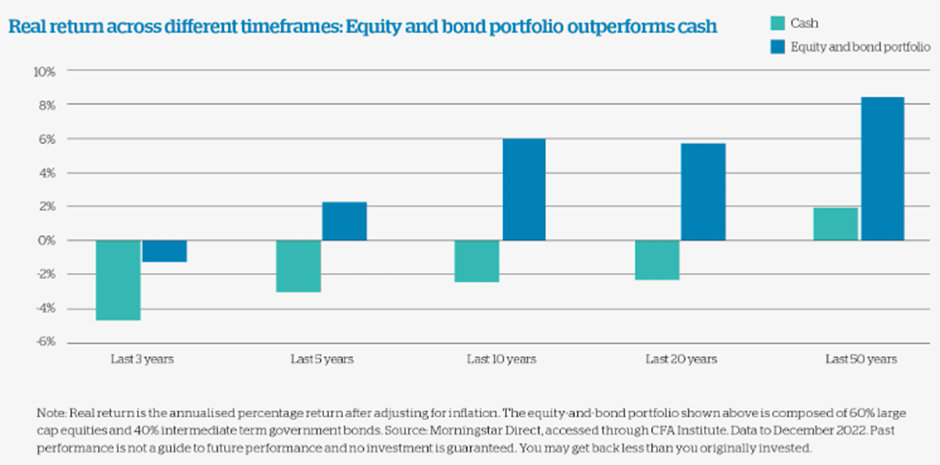
It is important to examine the case for cash in comparison to other investment instruments such as equities and bonds. For investors with long-term goals, a diversified 60% equities and 40% bonds portfolio can hold greater potential for generating real returns. If we examine the excess returns of cash vs. an equities and bonds portfolio across varying time horizons, we see that over the past 3, 5, 10 and 20 years, cash savings have delivered negative real returns, thereby diminishing the purchasing power of depositors. While cash managed to retain a level of real value over a 50-year period which will incorporate many different economic cycles, it is still lower than the returns generated by the equities and bonds portfolio. By contrast, the equities and bonds portfolio has consistently delivered returns that outpaced inflation across timeframes of 5 to 50 years, regardless of the prevailing macroeconomic conditions.

Hidden costs of fixed-term deposits

Investors attracted by the higher rates offered by fixed-term deposits are often locked in for a period of time. One key consideration for depositors in these situations is reinvestment risk, which is the risk of earning lower returns when choosing a new investment after their original fixed-term investment has expired. Once the fixed rate reaches its end, they must either renew at potentially lower rates or explore alternative investment options. However, the financial landscape at that time could differ significantly, and the investor could have missed attractive entry points in equity and bond markets. Historical analysis also reveals that high deposit rates rarely persist over an extended period. Looking at past patterns, in the five previous hiking cycles, the Bank of England typically maintained peak interest rates for an average of 9 months between its last hike and its first rate cut. It is unlikely for higher rates to endure, and investors risk sacrificing long-term opportunities for the allure of short-term ‘guaranteed’ gains.

What does it mean for investors?

While current cash deposit rates may be attractive, investors should carefully evaluate the role of cash in light of inflation, investment horizon, and reinvestment risks. So, whilst holding cash can be a useful tool for investors with a very short investment horizon, a diversified investment portfolio could provide better returns for investors seeking to preserve and grow their wealth over the long term.

Please check in again with us soon for further relevant content and news.

Chloe

25/07/2023

Team No Comments

Invesco: Mid-Year Investment Outlook

This has been cut and pasted from Invesco’s mid-year investment outlook received this morning, 21/07/2023:

In an effort to curtail the worst inflation in decades, Western developed central banks have moved aggressively to tighten monetary policy. This has helped exert downward pressure on inflation but has also brought about a meaningful slowdown in global growth and some financial accidents, including several US regional bank failures.

However, against this backdrop, we see resilient domestic demand in many economies, especially in services. Our base case anticipates a relatively brief and shallow economic slowdown as inflation continues to moderate and monetary policy tightening nears an end, followed by a recovery.

We call this a bumpy landing because there will continue to be some economic damage in this scenario. We believe there is the possibility of a downside scenario – a “hard landing” – in which global growth is hit harder, with a recession first in the US, which then cascades into other economies.

We also believe there is the possibility of an upside scenario – a “smooth landing” – in which monetary policy impacts growth less than expected and the global economy is relatively unscathed. In the US, we believe rate hikes are ending, and US inflation will continue to fall significantly, albeit imperfectly.

While discussion of a recession in the US is now commonplace, we continue to believe the US is likely to avoid a substantial broadbased recession. Instead, we expect some weakness in the second half of this year as policymakers accomplish a bumpy landing, but we anticipate activity will nevertheless remain relatively resilient.

As we enter 2024, we expect a more positive growth outlook to unfold as the economy recovers. In our view, the eurozone and UK are likely to follow a pattern similar to the US, but with a lag.

A variety of forces have helped sustain European economic momentum so far in 2023, but we expect tightening financial conditions to weigh on credit growth over time, helping to reduce inflationary pressures but also causing a significant economic slowdown.

In contrast with many major developed market economies, China is in a markedly different place in its cycle. The relaxation of COVID-19 restrictions has driven a meaningful though uneven recovery. The reopening is largely benefiting the services component of the economy while slowing growth momentum globally has meant weaker-than-hoped manufacturing activity.

Nevertheless, China remains a bright spot with subdued inflation and a robust growth outlook. We expect continued accommodation from the People’s Bank of China (PBoC) through the rest of 2023.

In short, we believe we are at a policy peak, that disinflation is underway, and that a relatively brief global economic slowdown is occurring, but markets are likely to soon look past this episode and begin to discount a future economic recovery.

Comment

For circa 40 months conditions have been challenging with volatility ongoing, and for the last couple of years markets have really just traded sideways. 

It will be good to see inflation coming under control in the US, and an economic recovery.  China should help too, lifting the Asia region, and in turn, both the US and China aiding the economic recovery globally.

2024 will hopefully be a better year for invested assets.

Steve Speed

21/07/2023

Team No Comments

Brooks Macdonald: Daily Investment Bulletin

Please see below, Brooks Macdonald’s ‘Daily Investment Bulletin’ providing their commentary on global markets. Received today – 20/07/2023.

Please check our blog content for advice, planning issues and the latest investment, market and economic updates from leading investment houses.

Adam Waugh

20/07/2023

Team No Comments

Tatton Monday Digest

Please see below this week’s Tatton Monday Digest which was received earlier this morning:

Overview: Core inflation slowdown equals upbeat equity markets

We wrote at the end of last week that markets were still absorbing the prospect of another round of significant interest rate rises from central banks, and that equities would therefore come under further pressure. But by the end of last week equity markets had risen sharply, with most more than reversing their losses of the previous week. The catalyst for the US stock market rally was the release of the latest consumer price index (CPI) figures, which showed that core inflation (with energy and food stripped out) cooled to 3% in June, the lowest rate of growth in two years.

Greedflation or wage-price spiral?

Probably not since the 1970s has inflation been such an all-consuming topic in public discourse. This is because, of course, for decades there was very little of it. Things could hardly be more different now. People are clearly worried about rising prices for goods and services, and what might happen to their individual or collective spending power. But beyond that, there is a deep argument raging about what causes inflation. Opinions remain divided across two major camps: those who think corporate ‘profiteering’ is to blame for runaway prices, and those who think wages are the main cause. As you might imagine, the dividing line is highly political. Here in the UK, the Bank of England (BoE) is adamant wages are the biggest inflationary concern, whereas in Europe, policymakers are much more concerned about corporate profits. Last week, BoE Governor Andrew Bailey joined Chancellor Jeremy Hunt in calling on Britons to show restraint in their wage demands. This is his second intervention, having called for similar restraint back in March. At the same time, Hunt reportedly asked the BoE to scrutinise profits in the UK food industry, following accusations of ‘price gouging’ (the British Retail Consortium recently revealed food prices increased 14.6% in the year to June).

Unfortunately, it is almost impossible to objectively say whether profits or wages are the bigger inflationary force, because they are two sides of the same economic coin. There has been a lot of talk recently about the return of labour pricing power – particularly after two years of widespread industrial action. In this sense, the sensitivity of inflation to employment has increased, which the BoE clearly sees as its main way of impacting the economy. But one could just as well argue there has been a return of corporate pricing power, following a long period of consolidation across nearly every major industry. This has led to wages and profits feeding off each other without either backing down – what should perhaps be called the ‘wage-profit spiral’. Who should ‘give in’ first is a political issue but, unless somebody does give in, we will keep talking about inflation for some time to come.

Banking sector pressure appears far from over

Last Wednesday, BoE Governor Bailey called on UK banks to pass along higher interest rates to savers. Over the past year-and-a-half, interest rates have seen the sharpest spike in a generation, going from near zero at the end of 2021 to 5% now, with further hikes set to come. But deposit interest rates from the big retail banks remain at little over 1% in many cases. UK retail banking suffers from a notable lack of competition, being largely dominated by older, established players and building societies. This means savers have few options and have to take whatever rate is offered, as regulators point out, however, both the government and the BoE have been complicit in reducing the number of British banks, leading to the concentrated environment we see today.

The situation is notably different in the US and Europe, where smaller regional banks are much more prominent. But the prominence of regional banks in the US has been much discussed this year after many of them collapsed, most notably Silicon Valley Bank (SVB), bringing to light deeper structural problems. Having many smaller players increases competition and should benefit customers. But for the banks themselves, the lack of scale and the fact their lending and borrowing all happen in relatively small regions, substantially decreases the potential for diversification. As investors know, a lack of diversification can mean losses piling up quickly. That is exactly what happened to SVB, and these problems have not gone away for the regional banks.

A difficult financial and economic climate is toughest for smaller businesses. For banks specifically, tightening financial conditions can boost profitability if it means higher long-term lending rates over short-term deposits (as seen in the UK), but it can also threaten liquidity, something smaller players inevitably have less of. The incentive for mergers or acquisitions is therefore large. We suspect this is less likely to play out in Europe, where the structural barriers to cross-border mergers are higher. European banks tend to be well capitalised, so stormy conditions might not be a problem at first. But the combination of high interest rates for longer and smaller corporates suffering under the higher cost of borrowing could lead to banking stress and even defaults if the Eurozone economy takes a turn for the worse. Here in the UK, we seem not to have these problems, but a highly concentrated banking system has its drawbacks too. Political pressure is now being exerted on British banks, both by politicians and the BoE. If consolidation increases in the US, we should expect the same political problems to play out, and if the US is more active in its antitrust policies – as has often been the case historically – some of that pressure might make it over here too

Please continue to check our Blog content for advice and planning issues and the latest investment, markets and economic updates from leading investment houses.

Andrew Lloyd DipPFS

17/07/2023

Team No Comments

Brooks Macdonald – Daily Investment Bulletin

Please see below today’s Brooks Macdonald Daily Investment Bulletin, which was received earlier this morning (14/07/2023):

What has happened

Equities and bonds continued their surge yesterday as investors contemplated the likelihood of a US ‘soft landing’ where inflation falls sufficiently to allow the US economy to avoid a recession. US equity markets have now recovered a significant portion of last year’s sell-off and are back to levels last seen in April 2022.

Market narrative shifts

It was only one week ago that the market narrative was decisively behind a sticky inflation, high interest rate backdrop however the CPI release (and yesterday’s PPI release) has catalysed a rapid shift towards hope for a sudden cooling in US inflation pressures. Those cooling inflation expectations are then feeding a growing chance of multiple interest rate cuts in 2024. The Producer Price Inflation numbers released yesterday painted a similarly rosy outlook for consumer inflation. Producer Inflation, which will ultimately filter into consumer prices, rose at just 0.1% year-on-year, below expectations and very close to outright deflation territory. The core PPI release also missed expectations and is growing by just 2.4% year-on-year. With the CPI and PPI releases impacting bond market thinking, investors are becoming more confident that the July meeting will be the final rate hike for this cycle.

Fed reaction

The ‘pivot’ towards US rate cuts occurred despite Fed speakers stressing that they could not yet gain confidence that inflation was under control from one reading. President Daly said it was ‘really too early to say that we’ve declared victory on inflation’ with Governor Waller saying that two more hikes this year remained his base case. Waller did show the Fed’s data dependency however, saying that if inflation readings continued in line with this week’s release, a pause may be warranted by September. Today is the last day before the Fed moves into communication blackout ahead of their next monetary policy meeting.

What does Brooks Macdonald think

Markets have been taking strong US economic news as bad news given economic strength is likely to booster consumer demand and therefore inflation. Should inflation show further signs of falling, despite robust economic growth, then this narrative too will change and good news for the economy will become good news for markets.

Please continue to check our Blog content for advice and planning issues and the latest investment, markets and economic updates from leading investment houses.

Carl Mitchell – Dip PFS

Independent Financial Adviser

14/07/2023

Team No Comments

Evelyn Partners Update – June US CPI Inflation

Please see below an article received from Evelyn Partners yesterday (12/07/2023) afternoon, which details their thoughts on yesterday’s US CPI Inflation announcement:

What happened?

US June annual headline CPI inflation rose 3.0% (consensus: +3.1%), its lowest level since March 2021, and compares to 4.0% in May. In monthly terms, CPI rose 0.2% (consensus: +0.3%), compared to a gain of 0.1% in May.

June annual core inflation (excluding food and energy) rose 4.8% (consensus: +5.0%), versus 5.3% in May. In monthly terms, core CPI rose 0.2% (consensus: +0.3%), compared to a gain of 0.4% in May.

What does it mean?

The Fed should take some comfort in the fact that monetary tightening appears to be working to bring down inflation ahead of the FOMC meeting on the 26 July. Annual headline CPI inflation is heading back towards pre-pandemic rates and core (ex-food/energy) price rises are now below 5%. There are three reasons to expect underlying inflation to slow further from here.

First, supply chain disruption from the pandemic has lessened significantly. One way to observe this is through used car prices, which are now falling on an annual basis as production normalises. This puts downward pressure on a past key driver of core CPI inflation during the early stages of Covid from 2020.

Second, rental inflation continues to slow. Using data from timely online residential platforms, recent research from Goldman Sachs shows that average annualised rental inflation has eased to just +1% over the last 8 months to June from 20% plus in mid-2021. It will take time for lower rental prices to feed through to inflation, but there is evidence it is starting to happen. For instance, June shelter CPI inflation slowed to 7.8% from a peak of 8.2% in March. CPI inflation (ex-shelter) in June was up just 0.8% from a year ago. 

Third, lead indicators point to lower core inflation in the months ahead. Selling prices from the National Federation of Independent Business, or better known as the small business survey, have fallen to a level last seen when core CPI inflation was roughly 4%. The annual change in job openings is another lead indicator with a decent track record of leading inflation and this too points to lower pace of price gains ahead. 

Bottom Line

Regardless of whether the FOMC (the US Central Bank’s interest-rate setting body) raises interest rates later this week or not (markets’ expectation is current for a 25bps increase), the Fed is likely coming to the end of its interest rate hiking cycle. This reduces the risk that the FOMC overtightens on interest rates and creates downward pressure to the economy and financial markets. Moreover, as a countercyclical currency, we expect the dollar to depreciate against other major currencies, since the risk of a so-called economic hard landing is reduced. Dollar depreciation should provide additional liquidity, which will help equities to continue their bull run.

Please continue to check our Blog content for advice and planning issues and the latest investment, markets and economic updates from leading investment houses.

Carl Mitchell – Dip PFS

Independent Financial Adviser

13/07/2023