
Please see below the daily update article from Brooks Macdonald, suggesting that markets were cautious as rising energy costs and trade tensions continued to create uncertainty for investors, received this morning – 25/08/2026
What has happened?
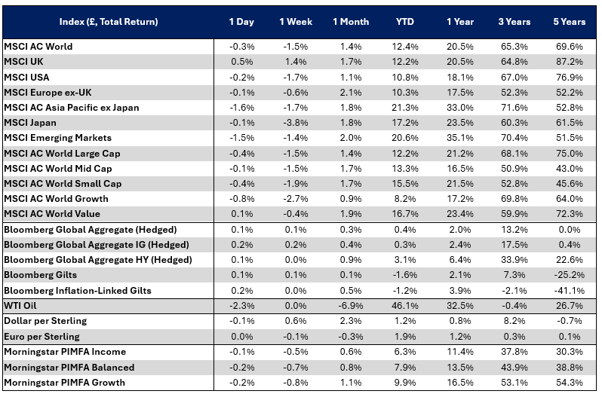
Markets began the final week of August on a cautious footing. US equities moved lower as semiconductor stocks remained under pressure ahead of Nvidia’s results, with the S&P 500 and Nasdaq retreating while broader market performance was more resilient. Bond markets found support as Brent crude fell back from last week’s sharp gains after the US outlined further pressure on Iran but stopped short of announcing major new measures. Treasury yields moved lower, although European bond markets were less responsive as natural gas prices rose to their highest level since early 2023 amid concerns over low European storage levels. Trade tensions also remained in focus after the US announced higher tariffs on Canadian automotive imports.
Trade wars and energy risks re-emerge
The key theme remains the interaction between energy prices, inflation expectations and interest rates. While oil prices eased yesterday, European natural gas prices continued to rise, highlighting that energy supply risks have not disappeared. European gas storage levels are currently at their lowest seasonal level since the data series began in 2009, raising concerns about energy availability heading into winter. At the same time, ongoing tensions involving Iran and continued disruption to grain exports from the Black Sea region underline how geopolitical developments can quickly feed through to commodity markets and inflation expectations. These pressures are being closely watched by central banks, with markets continuing to price further policy tightening in several regions.
What does Brooks Macdonald think?
Recent market moves reinforce the view that investors remain highly sensitive to any developments that could influence inflation, growth expectations and bond yields. The decline in oil prices provided short-term relief for fixed income markets, but higher natural gas prices and broader commodity uncertainty suggest inflation risks have not fully faded. At the same time, the breakdown in US-Canada trade talks serves as a reminder that tariffs and trade disputes remain an important market risk, with the potential to weigh on growth while adding to price pressures. Against this backdrop, semiconductor weakness shows that highly valued growth sectors continue to face scrutiny as investors assess whether earnings can justify elevated expectations. We remain constructive on the economic backdrop, with markets to be driven by the balance between resilient growth, inflation risks and policy uncertainty in the short term.
Please continue to check our blog content for advice, planning issues and the latest investment market and economic updates from leading investment houses.
Alexander James Roberts
25/08/2026