
Please see the below article from Brooks Macdonald detailing their discussions on French fiscal market pressures. Received this morning 08/10/2026.
What has happened?
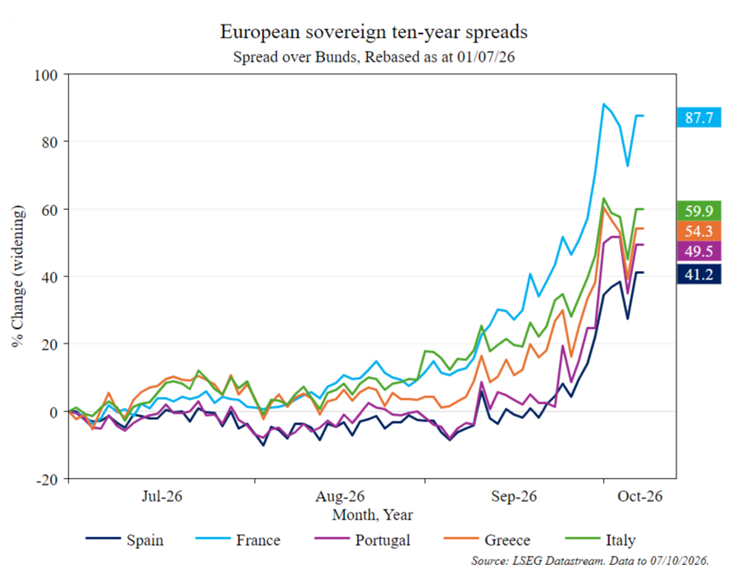
Global markets weakened as renewed French fiscal concerns and rising energy prices pushed government bond yields higher. France’s 10-year yield rose to 4.86%, widening its spread over German Bunds by 12 basis points, while selling extended to Italian debt and UK gilts, where the 10-year yield reached a post-2007 high. European equities fell sharply, led by banks, while the euro weakened against the US dollar. US equities retreated modestly from record highs, although weak market breadth and a four-month low for smaller companies indicated greater pressure beneath the headline indices. US Treasuries stabilised following a strong 10-year auction, but longer-dated yields remained elevated. Oil prices also rose overnight as tensions involving Iran and the Strait of Hormuz intensified.
Fiscal and energy risks collide
The combination of sovereign-debt concerns and higher energy costs presents a difficult policy trade-off for Europe. France’s deteriorating fiscal position has increased the risk premium demanded by investors, while contagion into Italian and Spanish bonds suggests that markets are testing the credibility of the wider euro-area framework. At the same time, Brent crude above $100 a barrel and rising European gas and diesel prices are adding to inflation expectations. This leaves the European Central Bank balancing persistent inflation against tightening financial conditions and weaker risk appetite. Although direct intervention remains unlikely while the disruption is viewed as primarily country-specific, a broader deterioration in market functioning could alter the policy response.
What does Brooks Macdonald think?
The latest moves reinforce the importance of balancing economic resilience against a less supportive valuation and interest-rate backdrop. Elevated bond yields and geopolitical risks may continue to challenge highly leveraged companies, rate-sensitive sectors and governments with limited fiscal flexibility. However, stronger starting yields also improve the prospective income available from high-quality fixed income, while robust corporate earnings should provide some support for equities. We therefore favour maintaining diversified exposure rather than reacting to short-term volatility, with an emphasis on balance-sheet quality, sustainable earnings and selective duration. Key risks include further escalation in the Middle East, a broader spread of French bond-market stress and evidence that higher energy costs are becoming embedded in inflation expectations.
Please continue to check our blog content for advice, planning issues and the latest investment, market and economic updates from leading investment houses.
Alex Clare
08/10/2026