
Please see today’s Daily Investment Bulletin from Brooks Macdonald:
What has happened
The equity rebound that was in place for much of Tuesday’s trading session in global markets reversed into a net sell-off into the US close. Coming a bit out of the blue, as we have remarked earlier this week, as we close in on the long Easter weekend later this week, thinning trading volumes can at times contribute to increased volatility in asset markets, so this may have been a factor behind the late sell-off yesterday – that and perhaps some end-of-calendar-quarter repositioning might also have been in the mix. To be fair, it’s hard to pin the blame on the economic data that featured yesterday – in US focused-data, consumer confidence held more or less steady month-on-month, while durable goods data showed orders climbed above expectations. Elsewhere, in currency markets the drama over the last 24hrs has been around weakness in the Japanese Yen (JPY), which hit 34-year lows overnight (of 151.97 JPY to the US$) – the weakness was prompted by seen-as-dovish remarks from Bank of Japan (BoJ) member Tamura saying that the BoJ must proceed “slowly” towards normalising its ultra-loose policy. Finally, early morning data has showed that Australia’s inflation rate remained at +3.4% year-on-year in February for the third straight month against analyst expectations for a +3.5% gain.
US bridge collapse risks some inflationary supply-side shocks
In the early hours of Tuesday morning US time, a major bridge in Baltimore, Maryland collapsed after a container ship ‘Dali’, chartered by Danish shipping giant Maersk crashed into it. The Francis Scott Key Bridge, some 1.6 miles long, leads to the Port of Baltimore, the deepest harbour in Maryland’s Chesapeake Bay. It is the busiest US port for car shipments and is also the largest US port by volume for handling farm and construction machinery.
China’s Alibaba scraps logistics unit IPO
Chinese tech giant Alibaba announced on Tuesday that it was scrapping the planned US $1bn+ IPO of its Cainiao smart logistics unit (planned for the Hong Kong stock exchange), with the company citing “challenging IPO market conditions”. Alibaba’s shares are down around 18% over the past year. Reflecting deteriorating market conditions in China, with economic headwinds and hitherto regulatory uncertainty, Alibaba chairman Tsai described the market as “pretty depressed”.
What does Brooks Macdonald think
The US bridge collapse in Baltimore will likely have economic implications that serve as a reminder of supply-chain inflation risks. With global seaborne trade having to divert to other ports along the US eastern seaboard, the expected added cost impact is likely to ultimately feed through into higher prices to the US consumer, as businesses look to recoup increased transportation costs. As a result, at the edges it might show up in US inflation data in the coming months – while important to keep the size impact in perspective, it is nonetheless an additional incremental factor to add into the broader inflation mix for both markets and policymakers to reflect on.
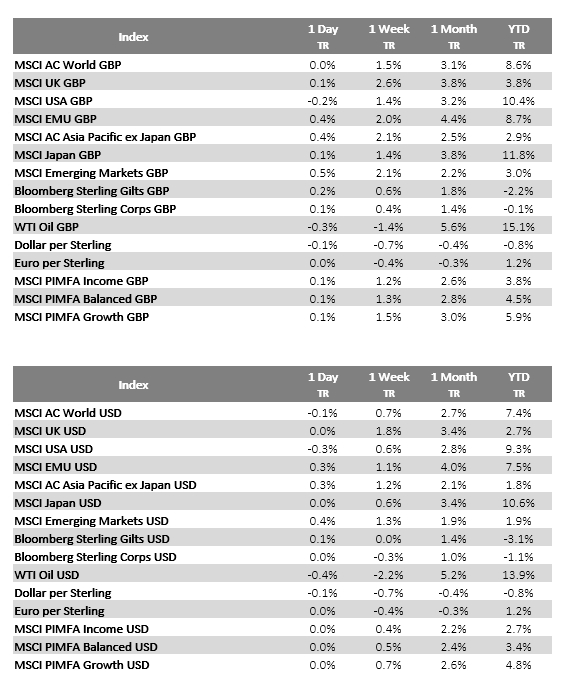
Bloomberg as at 27/03/2024. TR denotes Net Total Return.
Please continue to check our blog content for advice and planning issues and the latest investment, markets and economic updates from leading investment houses.
Charlotte Clarke
27/03/2024