
Please see this week’s Markets in a Minute update below from Brewin Dolphin, received yesterday afternoon – 08/09/2026.
Are U.S. interest rates set to rise?
What will be the deciding factor for the Federal Reserve – the jobs market or consumer price inflation?
Key highlights
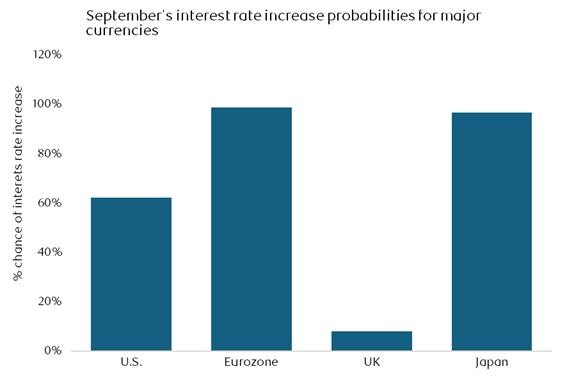
- The hawks take wing: Major central banks will announce their interest rate decisions over the next couple of weeks. The Federal Reserve and European Central Bank are expected to raise rates, while the Bank of England is expected to hold.
- U.S. hike: The implied odds of a U.S. rate hike moved from possible to probable as consumer price inflation, rather than an overheating jobs market, is pressing the Federal Reserve into action.
- Europe’s gas problem returns: European bond yields rose last week as gas futures climbed on fears of supply shortages due to continued tension in the Middle East.
The hawks take wing
As summer draws to a close, the heat remains for the world’s major central banks. This month, all of them set rates and for once, the outlook points in different directions.
The U.S. attempted to set the tone a couple of weeks ago, when Federal Reserve (the Fed) Chair Kevin Warsh spoke at the Jackson Hole Economic Policy Symposium. His message was uncompromising: the inflation target isn’t up for negotiation and rates may need to rise.
The market reaction was striking, with the dollar rallying and gold and bonds easing. Having talked tough on inflation before without following through, with his own credibility already under scrutiny, any hint of softness should have been unthinkable. The implied odds of a U.S. rate hike moved from possible to probable.
It’s consumer price inflation rather than an overheating jobs market that’s pressing the Fed into action. This message was underscored by a full week of U.S. labour market data, which suggested lower staff turnover as staff feel less confident about being able to move to higher-paying jobs. Meanwhile, surveys suggested staff demand remains healthy.
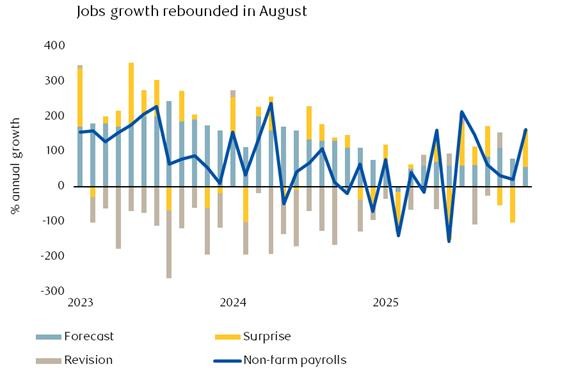
That culminated in a stronger-than-expected jobs report showing 167,000 new jobs created in August, and a small upgrade to last month’s surprisingly weak report. It’s likely enough to spur the Fed into action even though wage growth remained modest, and the unemployment rate was unchanged, with labour force participation increasing.
Source: LSEG Datastream
A different kind of U.S. policy shift occurred in relation to the Iran war. Having announced a shift from military to economic pressure, the U.S. has been drawn back into hot conflict, putting further upward pressure on consumer prices.
Europe’s gas problem returns
European bond yields pushed higher over the week as gas futures climbed on fears of supply shortages. Inventories have been low for the season, as buyers held off in the hope that peace in the Middle East would bring prices down. With the regional conflict dragging on, those hopes have been dashed.
It’s been easier for crude tankers to navigate the Strait of Hormuz, but shipping of liquefied natural gas (LNG) remains severely impaired given the danger of a potential strike on an LNG carrier (a specialised ship designed to transport liquefied natural gas).
Benchmark Dutch gas futures are now more than double their pre-war levels. For Europe, energy costs continue to drive the inflation story and help explain why the European Central Bank (ECB) is expected to raise rates next week.
The U.S. decision, which will be made in a couple of weeks, is tough to predict, but the central bank is expected to raise its federal funds rate. Meanwhile, the UK’s Bank of England (BoE) is likely to remain on hold. That’s despite last week’s British Retail Consortium shop price index showing the second-round effects of earlier energy price increases continuing.
However, retail activity remains subdued and house prices have softened. Even the business surveys show momentum is fading and with UK interest rates being amongst the highest of developed markets, the BoE perceives them as restrictive.
Source: Bloomberg
Leaning into gold
Our European Investment Committee met last week and made one change: we’ve raised our gold weighting, funded by trimming absolute return. This reverses a move from a few months ago and reflects the shift in gold’s own fortunes.
Gold had been weighed down by negative momentum and worries over central banks drawing down reserves during the U.S.-Iran conflict. That has given way to renewed interest in the debasement trade, the idea that persistent fiscal pressures erode the value of paper money over time. Warsh’s hawkish speech knocked gold temporarily and fresh hostilities with Iran added a further headwind by slowing reserve accumulation.
Debasement can come through Fed inaction; but the greater concerns are around the Fed’s independence being undermined. In the absence of something transformative happening to the national debt, debasement will remain the path of least resistance and we’re happy to let the gold weighting float higher.
Correspondingly, we remain underweight in bonds. Long-term yields have been rising due to uncertainty about the future path of interest rates and inflation. A credible Fed, one that convincingly anchors inflation, would be helpful in restraining yields in time – that probably starts with a September hike.
On equities, valuation remains the perennial worry. U.S. cyclically adjusted valuations sit close to prior peaks, though they’ve been higher in other markets before. Look beneath the surface and the picture is more balanced: just over half of S&P 500 companies trade on lower price-to-earnings ratios than their five-year average.
The aggregate multiple has crept up largely because a few high-priced names, Tesla among them, now carry more weight, but some of the biggest and best performing stocks have become significantly cheaper because their prices haven’t risen with their earnings. This shows that investors are questioning whether this extraordinary run of earnings can be sustained.
The past two quarters have beaten even year-ahead forecasts, something usually seen only coming out of a shock. This sets a demanding bar for next year’s comparisons but also suggests that analysts have been expecting a cyclical slowdown during what’s so far been a period of secular growth.
Please continue to check our blog content for advice, planning issues and the latest investment market and economic updates from leading investment houses.
Charlotte Clarke
09/09/2026