Team No Comments

LTA tax tipped to hit nearly £1.5bn by 2025

An interesting article received this morning, 28/03/2022, in our financial media.

The number of people caught by the lifetime allowance (LTA) is predicted to hit 29,757 and raise nearly £1.5bn in tax by 2025.

Canada Life’s forecast shows more people will be caught each tax year and that means the total value of charges will increase accordingly.

The LTA was introduced in the tax year 2006-2007. It is the total amount an individual can build up in pension benefits without incurring a tax charge.

At the time of its introduction, the LTA was fixed at £1.5m. While it has been increased in the following tax years, the LTA has been constantly reduced since 2012-2013.

The last tax year on record is 2019-2020 when the LTA was £1.055m. In that period, it affected 8,510 people and brought the government £342m in taxes.

Lifetime allowance from its introduction until tax year 2019-2020

Tax yearLTATotal individuals affected by LTATotal value of charges £mYoY increase in individualsYoY increase in total charges
2006-07£1.5m4506
2007-08£1.6m6101436%133%
2008-09£1.65m8302436%71%
2009-10£1.75m890327%33%
2010-11£1.8m1,1803733%16%
2011-12£1.8m1,270467%24%
2012-13£1.5m1,6806032%30%
2013-14£1.5m2,4609746%61%
2014-15£1.25m3,10010426%7%
2015-16£1.25m3,57015915%53%
2016-17£1m5,00020240%27%
2017-18£1m7,04026941%33%
2018-19£1.03m7,1302831%5%
2019-20£1.055m8,51034219%21%

Source: Canada Life


The total value of charges from the LTA has increased every year since the introduction of LTA.

Canada Life technical director Andrew Tully told Money Marketing: “Over the last five years, it has gone up on average by 28% a year.

“If we assume it keeps growing up the same rate, in a few years’ time, we will get to about one and a half billion pounds.

“It starts to get quite interesting from a government point of view and this is only going to go in one direction.”

Estimated figures for the lifetime allowance until tax year 2025-2026

Tax yearLTATotal individuals affected by LTATotal value of charges £m
2020-21£1.0731m10,484437
2021-22£1.0731m12,917559
2022-23£1.0731m15,913714
2023-24£1.0731m19,605912
2024-25£1.0731m24,1541,166
2025-26£1.0731m29,7571,490

Source: Canada Life


As more people have defined contribution pots, Tully warned that more and more people will potentially have to take the LTA in consideration as they move toward retirement.

Tully also urged advisers to inform their clients using drawdown about a potential second tax charge when they turn 75.

He said: “When you take your benefits, it will be tested against a lifetime allowance and there might be a tax charge.

“But if you use drawdown, there is also a second tax charge at age 75.”

If an individual went into drawdown 15 years ago at the age of 60, the government will look at their pension benefits again.

It will measure the growth between the moment this individual went into drawdown and against the current LTA.

Should the amount exceed the limits of the LTA, the individual will have to pay a tax charge.

How to end lifetime allowance quirk leaving DC savers short-changed

Tully said: “That is an area where advisers need to be talking to their clients.

“It is probably not the worst tax charge to face because it means you have got a really nice pension pot and it has grown quite nicely.

“But clients should be aware of it. Clients are going to be upset if suddenly a big tax charge hits them and they did not know anything about it.”

Comment

This LTA tax charge is one of Rishi’s ‘stealth taxes’ in its current format.  The Lifetime Allowance has been frozen for 5 years as outlined in the table above.

From my point of view, if you are paying this particular tax, it means that you have got a good level of pension benefits.  That’s a really positive position to be in.

You have a variety of different strategies to deal with this Lifetime Allowance tax, it depends on your circumstances, needs and objectives to determine the right strategy for you.

The additional revenue raised will help the State now given our current economic situation.

Steve Speed

28/03/2022

Team No Comments

Stocks soar on Russia-Ukraine peace talks

Please see below Markets in a Minute article received from Brewin Dolphin yesterday evening, which provides a positive update on markets despite the continuing Russian invasion of Ukraine.

Stock markets surged last week on hopes of a positive outcome from Russia-Ukraine peace negotiations.

The pan-European STOXX 600 rose 5.4%, Germany’s Dax added 5.8% and the UK’s FTSE 100 gained 3.5%. Fighting continued throughout the week, but ongoing talks to end the conflict boosted investor sentiment.

Stock markets in the US ended their two-week losing streak as oil prices declined and the Federal Reserve increased interest rates in line with expectations. The S&P 500 rose 6.2% and the Nasdaq soared 8.2%.

The positive sentiment fed through to Japan, where the Nikkei 225 added 6.6% after the government said it would lift all remaining domestic coronavirus restrictions from 21 March. Hong Kong’s Hang Seng also rose 4.2%, whereas the Shanghai Composite eased 1.8%.

Key port of Mariupol under siege

Stocks started this week on a more subdued note amid news Ukraine’s key port, Mariupol, was under siege by Russian military. The STOXX 600 was flat on Monday (21 March), whereas the Dax and CAC 40 both lost 0.6% on concerns the conflict might not end as soon as hoped. The commodity-heavy FTSE 100 managed a 0.5% gain, boosted by a rise in oil and metal prices, while the Dow shed 0.6% to end its four-day rally.

In economic news, asking prices for UK homes rose by 1.7% in March, the biggest monthly rise for this time of year in 18 years. Rightmove said the jump was partly driven by a mismatch between supply and demand, with more than twice as many buyers as sellers. On an annual basis, asking prices were up 10.4% and have topped £350,000 for the first time.

UK and European indices started Tuesday in the green, with the FTSE 100 and STOXX 600 both up 0.5% at the start of trading.

Fed approves first rate hike in three years

Last week saw the Federal Reserve approve its first interest rate hike in more than three years. After keeping the benchmark interest rate at near zero during the pandemic, the US central bank said it would raise rates by 25 basis points. It also pencilled in increases at each of the six remaining meetings this year, pointing to a rate of 1.9% by the end of 2022 – a whole percentage point higher than indicated in December.

The Fed increased its inflation estimates, forecasting a 4.1% increase in the core personal consumption expenditures (PCE) price index this year, up from the previous projection of 2.7% in December. Core PCE is expected to ease to 2.7% and 2.3% in 2023 and 2024, respectively. The Fed reduced its gross domestic product (GDP) growth forecast for 2022 from 4.0% to 2.8%, citing the potential implications of the Ukraine war.

“The invasion of Ukraine by Russia is causing tremendous human and economic hardship,” the statement said. “The implications for the US economy are highly uncertain, but in the near term the invasion and related events are likely to create additional upward pressure on inflation and weigh on economic activity.”

US retail sales disappoint

US retail sales rose by just 0.3% month-on-month in February, less than the 0.4% increase forecast by economists in a Reuters poll. The figures were held back by a 3.7% drop in receipts at online retailers. Sales at furniture stores and health and personal care stores also declined by 1.0% and 1.8%, respectively, according to the Commerce Department.

The smaller-than-expected increase in retail sales in February has been partly attributed to an upwardly revised 4.9% surge the previous month, the largest gain in ten months, as well as households cutting spending on goods as gasoline and food prices soar. Core retail sales (excluding gasoline, building materials and food services) fell by 1.2% in February following an upwardly revised 6.7% gain in January. On an annual basis, overall retail sales increased by 17.6%.

UK base rate lifted for third month in a row

Here in the UK, the Bank of England (BoE) announced an increase in the base interest rate for the third month in a row. The BoE’s monetary policy committee voted 8-1 in favour of an additional 0.25% increase in the main bank rate, taking it to 0.75%.

It comes after UK inflation surged to a 30-year high and a warning that it could increase further following Russia’s invasion of Ukraine. The BoE said the war has led to large increases in energy and other commodity prices and is likely to exacerbate global supply chain disruptions. “Global inflationary pressures will strengthen considerably further over coming months, while growth in economies that are net energy importers, including the UK, is likely to slow,” it stated.

China pledges support for economy

Over in China, the country’s vice premier Lui He said last week that Beijing would roll out support for the Chinese economy and introduce more market-friendly policies. The announcement last Wednesday helped Hong Kong’s Hang Seng record its best trading session in over 13 years, closing 9.1% higher.

According to the Xinhua news agency, China’s Financial Stability and Development Committee said the government should roll out policies favourable to capital markets, while being cautious in introducing contractionary measures. The committee said China’s monetary policy should “actively respond” to support the economy and new credit should help maintain “appropriate growth”. It claimed the Chinese government continues to support companies’ listing of shares overseas and has maintained “good communications” with US regulators on Chinese companies’ listings in the US. Beijing has also paused plans to expand trials of the property tax announced at the end of last year, Xinhua reported.

Please check in again with us shortly for further relevant content and news.

Chloe

23/03/2022

Team No Comments

Ukraine/Russia negotiations continue

Please find below, an update on the ongoing negotiations between Ukraine and Russia and the impacts on markets, received from Brooks Macdonald, yesterday afternoon – 21/03/2022

  • Global equities rallied last week as Ukraine negotiations continued, China hinted at state support and the Federal Reserve meeting concluded
  • The Bank of England and Federal Reserve both increased interest rates last week, citing fears over inflation
  • The Federal Reserve revealed robust economic growth forecasts despite the impact of inflation on the cost of living

Global equities rallied last week as Ukraine negotiations continued, China hinted at state support and the Fed meeting concluded

Whilst last week proved a very strong week for risk assets, this of course needs to be compared to the volatility of March in aggregate. Technology outperformed, with reports of Chinese state support and the Federal Reserve (Fed) meeting both boosting sentiment towards the sector.

Negotiations between Russia and Ukraine continued last week which helped buoy risk appetite. Last night, Turkey’s Foreign Minister suggested that a peace deal and ceasefire was possible assuming neither side changed its negotiating demands too dramatically. The starting point, that Ukraine will agree to be a neutral country and commit to not join NATO, appears to have softened Russia’s prior hard-line approach to talks. After reports broke that Russia had requested military and economic aid from China, China has been in the spotlight over its position on the Ukraine war. On Friday President Biden and President Xi Jinping discussed China’s position over a call and both sides concluded with hopes for a peaceful resolution which saw no further escalation. The latter comment may well allude to suggestions from US intelligence sources that nuclear sabre-rattling could recommence should the Ukraine war become protracted.

The Bank of England and Federal Reserve both increased interest rates last week, citing fears over inflation

After the Bank of England and Federal Reserve both hiked rates last week, we will hear from a steady stream of central bankers this week, giving us more colour on the content of the discussions. The Federal Reserve ‘dot plot’ of interest rate forecasts showed a wide disparity of views amongst the Fed members, suggesting the speeches this week won’t be running off a shared narrative. Fed Chair Powell will be speaking today as well as on Wednesday. The Bank of England warned on inflation and economic growth when it hiked rates last week, the US has taken a different approach, showing heightened inflation expectations alongside robust economic growth forecasts. How the Fed speakers address their expected resilience of the economy in face of tightening monetary policy and cost of living squeezes will be of particular interest.

The Federal Reserve revealed robust economic growth forecasts despite the impact of inflation on the cost of living

The Fed are likely to come under significant pressure over the next few weeks as many economists have criticised the bullish economic growth projections as disconnected from the reality of consumer demand. Should the bond market conclude that the Fed speakers’ belief in the Fed’s own economic growth numbers is less than universal, we could see an extension of the technology outperformance that we saw after meeting last week, as markets price in the risk that the Fed will need to blink in the face of slowing growth.

The information in this article does not constitute advice or a recommendation and investment decisions should not be made on the basis of it. This article is for the information of the recipient only and should not be reproduced, copied or made available to others. The price of investments and the income from them may go down as well as up and neither is guaranteed. Investors may not get back the capital they invested. Past performance is not a reliable indicator of future results.

The MSCI information may only be used for your internal use, may not be reproduced or re-disseminated in any form and may not be used as a basis for or a component of any financial instruments or products or indices. None of the MSCI information is intended to constitute investment advice or a recommendation to make (or refrain from making) any kind of investment decision and may not be relied on as such. Historical data and analysis should not be taken as an indication or guarantee of any future performance analysis, forecast or prediction. The MSCI information is provided on an “as is” basis and the user of this information assumes the entire risk of any use made of this information. MSCI, each of its affiliates and each other person involved in or related to compiling, computing or creating any MSCI information (collectively, the “MSCI Parties”) expressly disclaims all warranties (including, without limitation, any warranties of originality, accuracy, completeness, timeliness, non-infringement, merchantability and fitness for a particular purpose) with respect to this information. Without limiting any of the foregoing, in no event shall any MSCI Party have any liability for any direct, indirect, special, incidental, punitive, consequential (including, without limitation, lost profits) or any other damages.

Please continue to check our Blog content for advice and planning issues and the latest investment, markets and economic updates from leading investment houses

David Purcell

22nd March 2022

Team No Comments

Protecting your pension in difficult times

Please see below article received from Brewin Dolphin recently, which provides advice on how to protect your pension in these uncertain times, amidst rising inflation and stock market volatility.

It can be difficult to make decisions about how to safeguard your lifetime savings when you’re feeling anxious and unsure about the future. A financial adviser can help you decide on the best route for you but, in the meantime, these are some of the main considerations.

Avoid making rash decisions

It’s perfectly natural to be worried about your investments and the impact of wider economic events on your pension’s performance. However, letting your emotions cloud your judgement could prove extremely costly in the long run. Selling investments that have fallen in value risks crystallising losses; and if the markets recover quickly, you could miss out on subsequent gains.

Before you rush into making any decisions, take a step back and try to understand how recent events may have affected your broader retirement plans. A financial adviser can give you a clear picture of your savings, such as how long they’re likely to last, and whether your goals are still achievable.

Beware inflation

When stock markets are volatile, you might be tempted to start shifting all your retirement savings into cash. However, this might not be the wisest move. As well as the risk of crystallising losses and selling good quality investments at an unfavourable time, you’ll be at the mercy of inflation, which in the UK recently reached a 30-year high. Over time, inflation has the potential to erode the purchasing power of your savings, which means your money might not last for as long as you need it to.

Although cash is important for short-term expenditure and unexpected costs, the current rates of interest on cash savings products tend to be very low and below the rate of inflation. Keeping a portion of your pension invested in the stock market will give it the chance grow in real terms, tax efficiently, over what is hopefully a long retirement. If you don’t need the growth, then instead of cashing in you could move to a lower-risk level to try to limit the level of volatility while still, hopefully, at least keeping pace with inflation.

If you’ve not yet reached retirement, a market dip could present an opportunity to top up your pension; the income tax relief and potential market recovery could give your fund a serious boost. But whether this is appropriate for you will depend on your exact circumstances, objectives, and time horizon, and you should always seek advice before investing.

Maintain a diversified portfolio

Beware that taking on too much investment risk could cause problems. If you’re approaching retirement, your investment time horizon is likely to be much shorter than that of younger investors, meaning you have less time to recover from market downturns. And if you’re already drawing an income, investment losses can deplete your pension savings more quickly, thereby increasing the risk of you running out of money.

One way to seek to safeguard against losses is to hold a range of diversified assets, with different risk and return characteristics. Different asset classes tend to perform differently to one another in a range of market conditions, which can help to minimise overall losses and smooth returns over time.

If you are in the process of de-risking your pension portfolio you could, for example, take gains from the best-performing investments to buy more defensive assets, that are well positioned to weather future market volatility. Doing this by yourself can be complicated. An adviser will help you balance your portfolio to ensure you have the right mix of investments for you, and that they’re appropriate for your stage of life.

Consider your income strategy

If you are already in retirement and markets have dipped, it might make sense to draw from cash holdings to avoid having to sell investments that have fallen in value. You might also want to consider allocating a larger proportion of your portfolio to income-producing assets to meet longer-term spending needs. Again, a financial adviser can help you decide on the right income strategy for your individual circumstances.

Next steps

Understanding the steps you need to take to protect your pension from market volatility and inflation isn’t always easy. The key is to remain calm, and remember that stock markets tend to recover, given time. Seeking some smart advice can help you feel confident you’re doing the right thing and that you’re on track to meet your goals, regardless of where you are in your financial journey.

We will continue to publish relevant content and news on a regular basis, so please check in again with us shortly.

Chloe

15/03/2022

Team No Comments

Blackfinch Group Monday Market Update

Please find below, an update on global markets, received from Blackfinch, this morning – 14/03/2022

  • UK fuel prices hit record highs as the surge in crude oil prices continued. Unleaded petrol hit £1.61 a litre on Thursday, up from £1.51 per litre at the start of March, while diesel reached £1.70 a litre.
  • UK gross domestic product (GDP) was estimated to have increased by 0.8% in January. This was a notable improvement from the 0.2% contraction in December, suggesting the UK economy had shrugged off the negative impacts of the fast-spreading Omicron COVID-19 variant.
  • Figures released by the Office for National Statistics showed every sector in the UK grew in January, with services up 0.8%, production up 0.7% and construction up by 1.1%.

  • Propelled by surging costs for gas, food and housing, US consumer inflation climbed to an annual rate of 7.9% at the end of February, the sharpest rise since 1982, with even higher price increases to come.
  • As various experts highlighted, the reported rise in US inflation came before Russia’s invasion of Ukraine sparked dramatic surges in oil, gas, wheat, metal and other commodity prices.
  • In the US, job vacancies remained high in January as firms continued to struggle to hire workers. According to the Job Openings and Labor Turnover Survey (JOLTS), there were 11.3m job openings at US firms in January, ahead of the 10.9m forecast.
  • The European Central Bank (ECB) announced it would speed up the end of its asset purchase programme – designed to help European economies weather the COVID-19 pandemic – sooner than expected. The announcement sent eurozone bond yields soaring. 
  • The ECB also raised its inflation projections and cut its economic growth outlook, believing war in Ukraine was likely to keep commodity prices high, holding back the ability of households to spend and businesses to invest.
  • Eurozone inflation forecasts for 2022 were revised upwards from 3.2% in December to an average of 5.1%. The forecast for 2023 was also raised from 1.8% to 2.1%. 
  • Western governments announced plans to impose punitive tariffs on Russian trade to further isolate Moscow from the global economy following the invasion of Ukraine.
  • Inflation in Brazil hit a seven-year high as the country’s cost-of-living crisis intensified. Consumer prices increased 10.54% in the year to February, ahead of expectations, with monthly inflation rising to just over 1%.

Please continue to check our Blog content for advice and planning issues and the latest investment, markets and economic updates from leading investment houses

David Purcell

14th March 2022

Team No Comments

A Double Edged Sword

Please find below, an update on how the Russian invasion of Ukraine is impacting markets, received from Tatton, Friday Evening – 04/03/2022

During the course of this week, the impacts of the war on global financial assets changed in nature. Last week, we wrote that minor sanctions were a help for asset prices even if the sanctions did not match the level of outrage. Starting Sunday, the European Union (EU), US and UK imposed new sanctions almost every day. Perhaps inevitably, this has resulted in equity market weakness.

There are separate aspects of the week’s market moves. One is centred around liquidity and the risk of contagion across the financial system. In a separate article below, we write about how Russian equities and bonds have not only seen their values plummet, the inability to trade them at any price has then impacted broader emerging market mutual funds and exchange-traded funds (ETFs).

Often, as in the global financial crisis of 2008-2009, markets worry about the banking system. As the blue line in the chart below shows, currently European financial credit spreads do not show exceptional levels of stress. That’s potentially quite comforting. However, direct sanctions on Russian banks have created problems for financial institutions that share larger lending and trading flows with them. For example, Raiffeisen Bank of Austria saw its share price dive again this week after Europe’s weekend sanction announcements.

Over two weeks, Raiffeisen’s share price has halved, with the collapse in its value being more than all of the Russian-based assets and businesses it had under management. However, its fall in creditworthiness accounts for the rest – other banks are much less willing to transact with it, so its ongoing going costs rise dramatically.

In our opinion, one difficult aspect has been the interplay between sanctions on Russian banks and energy and commodity markets. For example, European utility companies are not barred from buying Russian oil and gas. However, they have difficulty in paying for it in the normal way. Rebuilding these payment channels will take time. If businesses are still able to buy Russian energy, then authorities must ensure financial channels are open to make those energy purchases. Moreover, companies will need reasonable reassurance that energy sourcing sanctions won’t be put in place later, and that they will be protected from other reputational risks.

The confluence of issues has led to another surge in global oil and European gas prices. In past weeks of rising spot prices, the prices of log-dated contracts didn’t rise as quickly. It has therefore been interesting how futures markets have seen longer-dated contracts moving up sharply, perhaps indicating a more extended surge in costs.

And therein lies the other aspect prompting equity market weakness combined with bond market strength. Government bond yields across the developed world have dropped sharply. This is almost certainly because investors have substantially downgraded real growth estimates amid greater inflation pressures for this year. The epicentre has been Europe, but the rise in energy costs has meant the US is also affected.

Bruce Kasman, JP Morgan’s chief economist gave us his team’s thoughts on Thursday evening. They have revised global growth for 2022 lower by 0.8%, down to 3.1%. Here is the table of their new estimates and the extent of the revisions:

Russia is expected to contract almost 10% (in rouble terms). Europe’s growth is now expected to be +2.5%, down from +4.6% previously. The main hit will be for this first quarter.

US growth stays almost unaltered (+2.7%, from +2.8% previously) while China remains at +5.6%. The stability of their stock markets in recent days suggests that investors are broadly in line with these estimates.

Bond markets are telling us a similar story. In particular, the yields on inflation-linked bonds have headed down sharply as increased demand for safe haven assets saw bond prices soar. US ten-year ‘real’ yields are back down to -1.0%, where they were last year. Fixed coupon yields have fallen back to 1.75%. German inflation-linked bonds are at -2.6%, substantially below last year’s low of -2.1%. Fixed coupon yields moved back into negative territory, at -0.16%.

These bond moves also may be telling us that central banks could look through the current input cost-push inflation and keep monetary policy accommodative for the time being, thereby allowing elevated levels of inflation persist for longer. In his three-hour testimony to Congress, US Federal Reserve (Fed) chair Jay Powell said interest rates will still almost certainly go up 0.25% on 16 March, less than the 0.5% almost universally expected two weeks ago. Even today’s startlingly strong US employment numbers (non-farm payroll data) (which suggested the US economy added 678,000 jobs in February) failed to push up fixed coupon yields.

JP Morgan’s economists suggested their growth forecasts are probably still too high. A lot depends on the passage of energy prices so, with European natural gas prices pushing up to new highs again on Friday afternoon, equity markets remain vulnerable.

So, is there any hope? We believe there is. As JP Morgan suggests in its forecasts, the damage is to Europe growth estimates. While there will be a big hit from energy costs, a lot of nominal spending will be unaffected. Impetus from the EU’s Next Generation Fund will continue through this year and next, come what may. And, the massive increase in defence spending by the German government will also come through quickly. A lot of this will be spent among European defence manufacturers (the UK should also benefit). Defence spending has a large ‘multiplier’ effect – the spending being recycled round the economy. Looking out beyond 2022, growth could be shifted up to a higher, not lower, level over the next few years.

Over the short term, as has been the case for the past weeks, much depends on energy costs and how long they remain elevated. While the de-coupling of bond yields to oil prices is heartening, it would be good to see the Brent crude spot price fall back from today’s $120 per barrel to a more manageable level well below $100.

Ultimately, when risks are obvious and emotions are running at a high level, markets will overshoot the downside at some point. Of course, it’s difficult to know when that is. Meanwhile, the strategy of remaining calm and waiting for the market to cool off has usually proved beneficial, and we think it probably still is.

Please continue to check our Blog content for advice and planning issues and the latest investment, markets and economic updates from leading investment houses

David Purcell

7th March 2022

Team No Comments

Markets volatile as Russia invades Ukraine

Please see below ‘Markets in a Minute’ article received from Brewin Dolphin yesterday evening, which conveys the effect that Russia’s ongoing illegal and unwarranted invasion of Ukraine is having on global markets.

Russia’s invasion of Ukraine sparked heightened stock market volatility and a flight to safe-haven assets last week.

Shares in Europe declined as the crisis led to increased uncertainty and fears of higher inflation. The pan-European STOXX 600 fell 1.6% and Germany’s Dax slumped 3.2%. The FTSE 100 slipped 0.3%, with a rebound on Friday helping to limit losses. Markets in Asia also fell. Japan’s Nikkei 225 shed 2.4%, China’s Shanghai Composite lost 1.1% and Hong Kong’s Hang Seng plunged 6.4%.

In the US, the S&P 500 slumped on Thursday to nearly 15% below its peak at the start of the year, putting it firmly in correction territory. A sharp rally on Friday meant it ended the week up 0.8%, as Western sanctions proved to be less severe than expected, especially in relation to Russia’s energy sector. The Nasdaq finished the week up 1.1% while the Dow was largely flat.

Sanctions-hit rouble plunges to record low

The Russian rouble plunged to a record low on Monday (28 February), sliding 28% versus the US dollar, after countries around the world imposed sanctions on Russian politicians, officials, oligarchs, banks and companies.

Several countries said they would block Russia’s central bank from deploying its international reserves in a way that undermines the impact of sanctions, and some Russian lenders are being removed from the SWIFT financial messaging system for international payments.

The tougher sanctions and lack of progress in the RussiaUkraine ceasefire talks led to another volatile day for stocks. The FTSE 100 managed to pare some of its earlier losses to close down 0.4% on Monday, while Germany’s Dax slid 0.7%. Over in the US, the S&P 500 and the Dow slipped 0.2% and 0.5%, respectively, whereas the Nasdaq managed a 0.4% gain.

UK and European indices were mixed at the start of trading on Tuesday as the military fight in Ukraine intensified.

Wall Street’s ‘fear gauge’ soars

A key measure of stock market volatility surged to its highest level in a year last week, as Russia’s full-scale invasion of Ukraine gave already anxious investors the jitters. According to FactSet, the CBOE Volatility Index – otherwise known as the ‘fear gauge’ on Wall Street – jumped to 36.74 during the day on Thursday, well above its long-term average of about 20.

Yields on core eurozone bonds and UK gilts also fell as the invasion drove a flight to safety (bond prices and yields move in opposite directions). Longer-term US Treasury yields declined for much of the week, but then rose as US stocks rallied on Friday.

US core PCE inflation soars

Last week saw the release of some important economic data, although this paled in comparison to the events in Ukraine. In the US, a key inflation measure showed prices rose at their fastest rate in nearly 39 years. The core personal consumption expenditures (PCE) price index, the Federal Reserve’s primary inflation gauge, rose 5.2% in January from a year ago. Including food and energy prices, the headline PCE was up by 6.1%, the biggest increase since February 1982.

Despite this, consumer spending in the US accelerated faster than expected, increasing 2.1% month-on-month in January. This was above the 1.6% estimate and came after a 0.8% decline in December. The increase was reflected in stronger orders for durable goods, which rose by 1.6%, double the expected 0.8% gain.

US economy rebounds from Omicron

Manufacturing and services activity in the US rebounded in February as virus containment measures, tightened to fight the Omicron wave, were scaled back. IHS Markit’s flash composite output purchasing managers’ index (PMI) rose to 56.0 from an 18-month low of 51.1 in January. Services firms led the rise, although manufacturers also registered a stronger increase in output, buoyed by a slight easing of supply bottlenecks.

“With demand rebounding and firms seeing a relatively modest impact on order books from the Omicron wave, future output expectations improved to the highest for 15 months, and jobs growth accelerated to the highest since last May, adding to the upbeat picture,” said Chris Williamson, chief business economist at IHS Markit.

However, inflationary pressures intensified in February, with the rate of input price inflation quickening from January’s ten-month low, driven by higher raw material, transport and wage costs. Global shortages of raw materials and lingering supply chain disruptions were again cited, albeit less so than in prior months. Meanwhile, prices charged for goods and services in the US rose at a record pace as companies continued to share additional cost burdens with customers.

Please check in again with us soon for further relevant content and news.

Chloe

02/03/2022

Team No Comments

Ukraine invasion: Implications for Investors

Please find below, an update on how Russia’s conflict with Ukraine will impact markets, received from Brewin Dolphin yesterday evening – 24/02/2022

As Russian forces invade Ukraine, Guy Foster, Brewin Dolphin’s Chief Strategist, analyses the impact on stock markets, the economy and investors.

Stock markets around the globe have slumped on news that Russia has launched a full-scale invasion of Ukraine. What are the implications for investors, and does this change the equity market outlook?

How have stock markets reacted?

Stock markets have taken today’s news badly because it represents the ebbing away of the potential for peaceful de-escalation. At the time of writing, the pan-European STOXX 600 is down 3.8% and Germany’s Dax has shed just over 5%, reflecting the country’s heavy reliance on Russian energy supplies. The commodity-heavy FTSE 100 has lost 3.2%, with surging oil prices helping to limit losses.

Today’s stock market sell off is a continuation of the heightened volatility we have seen in the first two months of the year. Escalating tensions in the weeks leading up to the invasion, coupled with the risk of rising inflation and interest rate hikes, have been weighing heavily on investor sentiment.

 The major risk to stock markets right now is the increase in uncertainty. When uncertainty rises, the ‘risk premium’ increases. In other words, equity valuations fall as investors require higher potential returns to compensate for the higher perceived risks. There is also a risk of contagion to emerging markets more broadly.

The reason why markets are so focused on the current conflict is that Russia is an important source of, and Ukraine is an important transit country for, oil. Supply disruption could lead to further increases in the price of oil, which could exacerbate already high inflation in Europe, resulting in continued market volatility.

What is the potential economic impact?

At this early stage, it is difficult to predict the economic impact.

First, we do not know what Russia’s ambitions are for Ukraine. It is also unclear how long the conflict could last, although the news coming through suggests Russian and Ukrainian military forces are balanced in number, and so the conflict is unlikely to be easily won either way.

Second, while sanctions could hold back Russia’s economic growth, Western leaders generally have a very limited range of sanctions that they are willing and able to deploy. Cutting off Russia from financial markets would only have an impact when it comes to seeking financing. Russia doesn’t need to do this while energy prices stay high.

Some have suggested barring Russia from the SWIFT communication system that facilitates international money transfers, but that would seem to impede payment for much-needed Russian gas supplies. In all likelihood, sanctions will focus on individuals and some Russian institutions; there will be great reluctance to threaten commodity supplies upon which Europe, in particular, is heavily dependent.

If sanctions did cause economic disruption in Russia, this is unlikely to have much of an impact on global growth, as Russia’s economy represents only around 1.8% of global gross domestic product. The much greater concern is the extent to which disruptions to oil supply could dampen economic growth more broadly.

What is the longer-term outlook?

While events in Ukraine are extremely concerning, it is worth bearing in mind that from an investment perspective, steep declines in stock markets are not unusual, and they tend to be short lived. History shows us that equities have been resilient during periods of crisis in the past, such as the Cuban Missile Crisis, the Iraqi invasion of Kuwait, and 9/11. The impact of these events on the markets, and indeed the economy, were much more fleeting than their significance in modern history.

Stock markets tend to be disconcertingly dispassionate about political and human tragedy unless it has an overt economic impact. They also tend to anticipate geopolitical risks in advance, which means the onset of conflict can often be the moment that uncertainty peaks. So, while stock markets are likely to remain volatile in the short term, this may be more to do with ongoing concerns about inflation and interest rates. The longer-term outlook for the global economy and equities remains positive as the pandemic-related headwinds reduce, with job and wage gains becoming more common. The events in Russia will contribute to the overall framework we have for assessing the opportunities to grow wealth over the longer term.

Please continue to check our Blog content for advice and planning issues and the latest investment, markets and economic updates from leading investment houses

David Purcell

25th February 2022

Team No Comments

The Cash ISA paradox – rates are rising, but things are getting tougher for savers

Cash savings have suffered death by a thousand rate cuts over the last decade, but the cash paradox is that even though rates are now on the up, things look like they will get even tougher for savers. That’s because elevated inflation is going to eat up any gains from higher interest rates on cash and will take an extra pound of flesh for its trouble too. Please see below article received from AJ Bell yesterday for further detail on this.

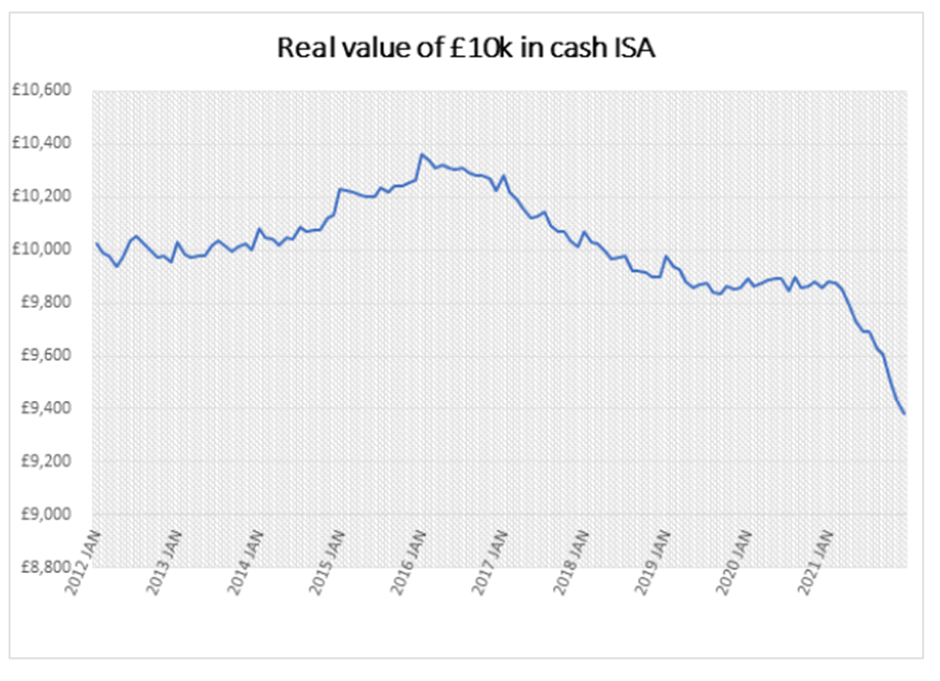
£10,000 invested ten years ago would now be worth just £9,385 today, after inflation is taken into account. This lost decade for cash savers has of course been caused by ultra-loose monetary policy, though inflation has remained largely contained. What is alarming is that in the next twelve months alone, Cash ISA savers face a similar loss in buying power to the one they have experienced over the last decade. £10,000 saved into the average Cash ISA today could be worth just £9,600 this time next year, based on the latest Bank of England forecasts for interest rates and inflation, and the current margin between base rate and ISA rates.

So despite interest rates falling to rock bottom over the last ten years, worse may yet be in store for cash savers. Longer term, higher rates should be positive for Cash ISA savers, if inflation tails off in the way the Bank of England expects. If it doesn’t, the last ten years of slow and steady inflationary erosion could end up looking like a walk in the park.

Those who shop around will likely be able to improve their lot, slightly. The current best buy ISA is offering 0.6% per annum, according to Moneyfacts, which compares to 0.34% for the average Cash ISA. As interest rates rise, the wedge between the most competitive and least competitive Cash ISAs can be expected to grow, as some banks attempt to attract new customers by bumping up their rate, while others try too eek out some extra profits by keeping rates low until savers start voting with their feet.

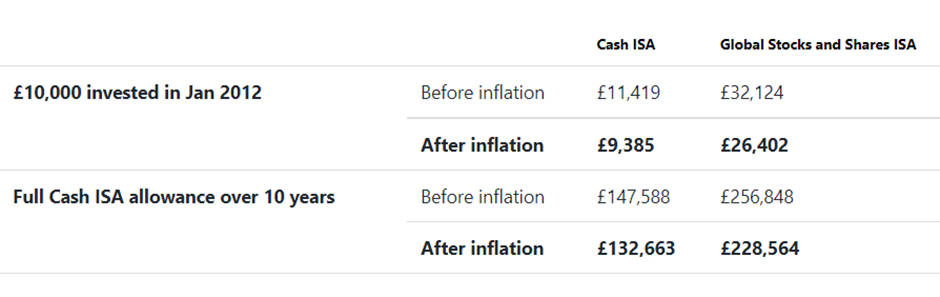
Meanwhile Stocks and Shares ISA investors have been big winners from the last ten years. £10,000 invested in the average global stock market fund within an ISA would now be worth £26,402 after inflation is taken into account. Over any ten year period, the odds are heavily stacked in favour of a stock investor compared to a cash saver. But the loose monetary policy of the last decade has helped exacerbate that trend. Looking forward, tightening monetary policy may well prove to be a false friend to cash savers, if accompanied by sustained inflationary pressures. High inflation isn’t exactly good news for shares either, but companies can at least offset increasing costs by pushing price rises onto consumers. Investing in shares therefore looks like the best way to beat inflation over the long term.

The FCA’s latest strategic focus on encouraging those with high levels of cash saving to invest for the longer term is therefore well-timed. The regulator reckons that 8.6 million consumers hold over £10,000 of investible assets as cash. HMRC data shows that £443 billion was put into Cash ISAs between 2010 and 2020, compared with £206 billion invested into Stocks and Shares ISAs over the same period. Clearly low interest rates have not hugely deterred Cash ISA savers to date, but the return of high inflation means poor cash rates will really start to bite, and will likely push savers up the risk spectrum in search of inflation-busting returns. Those who are thinking of taking on more risk by investing in the stock market might consider doing so through a monthly savings plan, which will make for a smoother ride.

The lost decade for cash in numbers

Since January 2012, the average interest rate paid on Cash ISA balances has sunk from 2.5% to a record low of 0.3%. A combination of low interest rates and bank funding schemes like Funding for Lending and the Term Funding Scheme have seen cash rates drop to almost zero. Inflation has been relatively benign over this period, averaging 2%, directly in line with the Bank of England’s target. Even so, £10,000 invested in a Cash ISA ten years ago would be worth £9,385 in real terms today.

By contrast the average Global Stocks and Shares ISA (invested in the IA Global fund sector average) has turned £10,000 invested into £26,402 over the same period, after adjusting for inflation. If you had saved your full Cash ISA allowance over these ten years, equivalent to £142,220 of contributions, that would now be worth £132,663 in real terms, if saved in the average Cash ISA. If invested in the average Global Stocks and Shares ISA instead, it would be now worth £228,564, after adjusting for inflation.

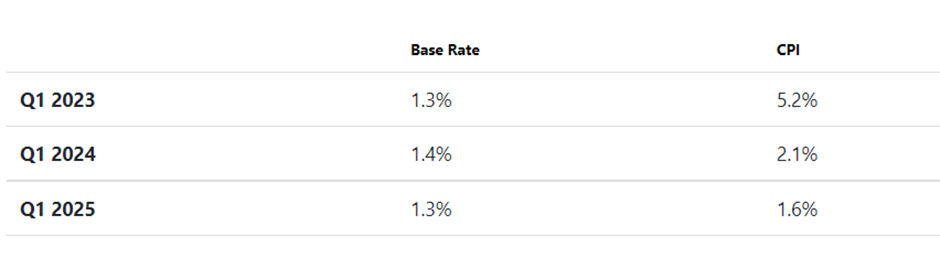
Looking forward, the market is expecting rates to rise, and the Bank of England is forecasting that inflation will fall away next year. The latest forecast from the Bank is shown in the table below. The rate of interest paid on the average Cash ISA currently stands 0.09% above the Bank of England base rate, so assuming that margin holds, and the Bank’s forecasts are accurate, that would mean £10,000 saved in the average Cash ISA today would be worth around £9,600 this time next year*. Beyond that, the Bank expects inflation to moderate, but interest rate hikes are expected to tail off too. Of course, the Bank has repeatedly underestimated inflationary pressures of late, and if elevated inflation sticks around for longer, that could be even more ruinous for cash savings.

Please check in again with us shortly for further relevant content and news.

Chloe

21/02/2022

Team No Comments

Blackfinch Asset Management – A focus on company fundamentals

Please see below, an update from Blackfinch regarding their approach to investments going forward in 2022, received yesterday evening – 15/02/2022

Markets have been volatile so far this year as the prospect of higher-for-longer inflation and rising interest rates have weighed on investor sentiment. These risks have been most pronounced in company valuations, which last year reached historically high levels in certain stock market sectors.

In general, when interest rates rise, investors can look elsewhere for returns instead of buying richly valued shares. What we have seen in 2022 is a reversion to more normal valuations as investors rotate away from the returns potential available from ‘growth’ stocks into more traditional ‘value’ stocks trading at levels below what they are believed to be worth.

It’s important for us to review the fundamentals of the companies we invest in before making a significant switch into other areas of the stock market. For example, the US is typically known as a growth market due to its dominant technology sector. These companies are often high quality, with investors required to pay higher valuations based on more attractive prospects. Currently, large cap companies in the S&P 500 index are reporting earnings for the fourth quarter of 2021. For the earnings season to date, 356 companies have released updates, and aggregate sales growth year-over-year has been 16%. On the same basis, earnings have increased by an even bigger 27%. However, this year the S&P 500 has fallen almost 6% (for sterling-based investors). This disconnect between strong fundamentals, but declining stock prices is due to the deflation in valuations that has driven stock markets this year.

Looking at individual companies, even though earnings have been strong, stock prices have still declined. Apple, Microsoft and Alphabet announced results that beat expectations – Apple was the standout performer after generating $124bn of revenue in a single quarter – yet their share prices are all down so far this year. We still hold these companies in the portfolios through our S&P 500 index fund.

Although this has declined in 2022, we view the underlying fundamentals of the companies as highly attractive and have retained our exposure to this fund.

Our portfolios also hold quality-based strategies in Europe, such as Premier Miton European Opportunities and Liontrust Special Situations. In much of the same way as the US market has fallen, both funds are down so far this year. However, on a longer time horizon, both have delivered top quartile performance compared to other funds in their respective sectors. We believe that quality companies with competitive advantages and growth potential still offer investors attractive returns over a long-term holding period.

We also allocate assets to traditional value sectors to diversify our portfolios. The UK offers higher income from dividends when compared to other developed markets. However, although value sectors have outperformed this year, we have avoided changing our allocations to overweight. For example, with the price of crude oil rallying to an eight-year high, profitability in the Oil & Gas sector has been raised, and therefore the sector looks attractive in the short term. However, as we believe the Oil & Gas industry is in structural decline, we would not feel comfortable holding significant exposure to these assets over a longer period.

The risks of inflation and rising interest rates will, no doubt, have an impact on returns for investors this year. However, looking further ahead, we still view holding quality companies with attractive growth potential as the best drivers of long-term returns. We will continue to update you on our portfolio activity as the economic outlook progresses.

Please continue to check our Blog content for advice and planning issues and the latest investment, markets and economic updates from leading investment houses.

David Purcell

16th February 2022