Team No Comments

Evelyn Partners Update – August US CPI Inflation

Please see below article received from Evelyn Partners yesterday evening, which conveys their thoughts on yesterday’s US CPI inflation announcement.

What happened?

US August annual headline CPI inflation rose 3.7% (consensus: +3.6%), compared to 3.2% in July. In monthly terms, CPI rose 0.6% (consensus: +0.6%), compared to a gain of 0.2% in July.

August annual core inflation (excluding food and energy) rose 4.3% (consensus: +4.3%), versus 4.7% in July. In monthly terms, core CPI rose 0.3% (consensus: +0.2%), compared to a gain of 0.2% in July.

What does it mean?

August’s inflation report saw the monthly headline rate jump to 0.6%, its highest rate since June 2022. Much of this upward pricing pressure came from energy, with the monthly inflation rate for the sector accelerating to 5.6%. A significant driving factor of this was the recent surge in crude oil, which prompted gasoline prices at the pump to rise during August. The index for gasoline was the largest contributor to the monthly all items increase, accounting for over half the increase.

In a repeat of July, unfavourable base effects continued to put upward pressure on the annual headline rate, with a favourable 0.1% monthly reading from August 2022 dropping out of the annual comparison. In Contrast, the next two prints for September and October have more constructive starting points, so should allow room for the annual rate to begin to decelerate again from next month.

Core goods continues to remain soft with the annual rate for the sector now at 0.2%. Used cars and trucks were once again the main driver of this category with prices having fallen now for three consecutive months. However, core services remain stickier, but have been slowly decelerating. Shelter continues to put upward pressure on the index, accelerating 0.3% on the month.

Combining these core sectors paints a very promising picture for the overall core inflation rate which decelerated to 4.3% on an annual basis in August. Calculating core inflation in a 3-month annualised basis yields an encouraging 2.2%, which should instil the Fed with confidence that their battle against inflation is approaching its final stages.

Despite the labour market showing signs of easing, with non-farm payrolls adding less than 200k jobs in each of the last three months, persistent wage growth could prove problematic for this goldilocks inflation story. Average hourly earnings continue to remain resilient, gaining 4.3% for the year in August, which remains too high to be consistent with the Fed’s 2% inflation target. With real wage growth in positive territory, this could prompt an increase in consumption, rendering the Fed’s task of bringing inflation back to target more challenging.

Bottom Line

With two months of reassuring new data under their belts, the FOMC committee members should feel they have enough evidence of easing inflation and a softening labour market conditions to resist hiking at next week’s monetary policy meeting. However, with the US economy continuing to expand, it is likely the FOMC will be able to keep rates higher for longer, so rate cuts are likely not yet on the horizon.

Please check in again with us soon for further relevant content and news.

Chloe

14/09/2023
Team No Comments

Brooks Macdonald Daily Investment Bulletin

Please see below article received from Brooks Macdonald this morning, which provides a succinct but detailed update on global markets.

What has happened

Equities had another poor day after investors reacted negatively to a stronger-than-expected US ISM services reading. Good economic news remains bad news for markets as it suggests a stronger economy which is likely to keep inflationary pressures sticky. Both European and US equity indices lost more than half a percent yesterday with technology shares particularly poorly impacted by the risk of higher interest rates to tackle the robust economic backdrop.

US ISM

The ISM services survey not only remained in expansion territory but saw a very strong result, against market expectations for a more subdued reading. The ISM survey provides an alternative narrative to some of the more recent economic data that suggests the US economy is losing some momentum. Within the data, the employment component hit a 21-month high implying strong hiring intentions and job security, by extension the market interprets this as a tight labour market which will keep wage growth pressures high. The chances of a further Fed rate hike has come back again and is currently hovering around a 50:50 chance. The US interest rate pricing in for December 2024 hit a new high for this cycle, sitting at 4.45% as the bond market positions for a ‘higher for longer’ interest rate outcome.

European central bank

With the ECB meeting next week, European monetary policy remains in focus with bond markets now implying a one-third chance of an additional ECB interest rate cut at the upcoming meeting. A few of the more hawkish ECB speakers yesterday described the meeting as a ‘close call’ while one said that the central bank should ‘take one more step’. There was some dissent to this hawkish drumbeat however with Italy’s Visco saying that he believed ‘we are near the level where we can stop raising rates’.

What does Brooks Macdonald think

UK monetary policy was also a source of currency volatility yesterday after Bank of England Governor Bailey said that monetary policy was ‘near the top of the cycle’. This catalysed a further weakening of Sterling vs the US dollar, an exchange rate that has seen increased dollar strength since the middle of the summer. UK inflation remains stubbornly high, however the Bank of England appear keen to pose a dovish counterweight to a market narrative that sees UK interest rates remain at elevated levels well into 2025.

Index 1 Day1 Week1 MonthYTD 
 TRTRTRTR 
MSCI AC World GBP 0.0%0.6%1.1%10.1% 
MSCI UK GBP -0.1%-0.6%-1.0%2.0% 
MSCI USA GBP -0.1%0.7%2.1%13.9% 
MSCI EMU GBP -0.1%-1.8%-2.4%8.8% 
MSCI AC Asia Pacific ex Japan GBP 0.2%1.5%-1.1%-0.9% 
MSCI Japan GBP 1.3%4.0%3.0%11.3% 
MSCI Emerging Markets GBP 0.2%1.0%-1.3%1.3% 
Bloomberg Sterling Gilts GBP -0.1%-0.9%-1.1%-5.1% 
Bloomberg Sterling Corps GBP -0.2%-0.6%-0.8%0.1% 
WTI Oil GBP 1.6%9.1%8.1%5.5% 
Dollar per Sterling -0.5%-1.7%-1.9%3.5% 
Euro per Sterling -0.5%0.1%0.7%3.2% 
MSCI PIMFA Income GBP 0.0%0.0%-0.1%3.0% 
MSCI PIMFA Balanced GBP 0.0%0.1%0.1%4.1% 
MSCI PIMFA Growth GBP 0.0%0.3%0.3%5.8% 
 
Index 1 Day1 Week1 MonthYTD 
 TRTRTRTR 
MSCI AC World USD -0.6%-1.1%-1.1%13.8% 
MSCI UK USD -0.7%-2.2%-3.2%5.4% 
MSCI USA USD -0.7%-1.0%-0.1%17.7% 
MSCI EMU USD -0.7%-3.5%-4.6%12.4% 
MSCI AC Asia Pacific ex Japan USD -0.4%-0.2%-3.3%2.4% 
MSCI Japan USD 0.7%2.3%0.7%15.0% 
MSCI Emerging Markets USD -0.4%-0.7%-3.4%4.7% 
Bloomberg Sterling Gilts USD -0.6%-2.8%-3.2%-1.4% 
Bloomberg Sterling Corps USD -0.7%-2.5%-2.9%3.9% 
WTI Oil USD 1.0%7.2%5.7%9.1% 
Dollar per Sterling -0.5%-1.7%-1.9%3.5% 
Euro per Sterling -0.5%0.1%0.7%3.2% 
MSCI PIMFA Income USD -0.6%-1.7%-2.3%6.4% 
MSCI PIMFA Balanced USD -0.6%-1.6%-2.1%7.6% 
MSCI PIMFA Growth USD -0.6%-1.3%-1.9%9.4% 
   Bloomberg as at 07/09/2023. TR denotes Net Total Return    

Please check in again with us shortly for further relevant content and news.

Chloe

07/09/2023

Team No Comments

Brooks Macdonald – Daily Investment Bulletin

Please see below article received from Brooks Macdonald this morning, which provides a succinct but detailed global market update.

What has happened

Equities continued their rally yesterday as optimism around a US soft landing economic outcome rose as labour market data pointed to a further slowing in activity. Bad news for the economy is being treated as good news for markets as it implies that monetary policy tightening is having an impact on the real economy which should bring down inflation and may mean that the Fed can pause their interest rate hikes for now.

Jobs and economic data

The ADP report on private sector payrolls was released yesterday with a lower level of growth than the market was expecting. The wages for both job-changers and job-stayers slowed with the year-on-year growth rates for both cohorts falling to their lowest levels since mid to late 2021. It is important to stress that these numbers remain very high by pre-COVID standards but there are signs of a softening in labour market tightness. The second driver of the soft landing narrative was the second revision to the Q2 GDP growth figure which showed a weaker economy than the first reading implied. The US growth rate was revised from an annualised rate of 2.4% down to 2.1%. Alongside this core PCE inflation, the Fed’s preferred measure of inflation, was revised down 1/10th of a percentage point, bringing the reading closer to the central bank’s target level.

European inflation

The news was less positive within Europe however, with the German flash CPI print showing greater stickiness than the market had expected, still running at 6.4%. Spanish inflation, which has recently seen a lurch downwards, picked up from last month with the measure now running at 2.4%. Later today we receive the Euro-Area wide inflation release which, despite the German figures yesterday, is still expected to fall from last month’s reading.

What does Brooks Macdonald think

The ongoing divergence between European and US inflation sets a tricky backdrop for the ECB when they meet in a fortnight. Market expectations apportion just over a 50% chance that the central bank feels it needs to hike by a further 25bps at that meeting. With fears of European stagflation front and centre yesterday, European indices underperformed their US peers.

Index 1 Day1 Week1 MonthYTD 
 TRTRTRTR 
MSCI AC World GBP -0.3%1.9%-1.1%9.5% 
MSCI UK GBP 0.1%2.2%-2.1%2.5% 
MSCI USA GBP -0.3%1.9%-0.2%13.1% 
MSCI EMU GBP -0.4%1.9%-2.6%10.8% 
MSCI AC Asia Pacific ex Japan GBP -0.3%2.4%-4.1%-2.3% 
MSCI Japan GBP 0.0%0.8%-2.1%7.0% 
MSCI Emerging Markets GBP -0.7%1.9%-3.9%0.3% 
Bloomberg Sterling Gilts GBP 0.1%0.6%-0.8%-4.2% 
Bloomberg Sterling Corps GBP 0.1%0.4%-0.4%0.7% 
WTI Oil GBP -0.2%3.5%2.6%-3.2% 
Dollar per Sterling 0.6%0.0%-1.0%5.3% 
Euro per Sterling 0.2%-0.6%-0.2%3.1% 
MSCI PIMFA Income GBP -0.2%1.1%-0.9%3.0% 
MSCI PIMFA Balanced GBP -0.2%1.2%-1.0%4.0% 
MSCI PIMFA Growth GBP -0.3%1.4%-1.2%5.5% 
 
Index 1 Day1 Week1 MonthYTD 
 TRTRTRTR 
MSCI AC World USD 0.5%1.9%-2.3%15.1% 
MSCI UK USD 0.9%2.2%-3.3%7.8% 
MSCI USA USD 0.4%1.8%-1.4%18.8% 
MSCI EMU USD 0.4%1.9%-3.8%16.5% 
MSCI AC Asia Pacific ex Japan USD 0.4%2.3%-5.2%2.7% 
MSCI Japan USD 0.8%0.8%-3.3%12.4% 
MSCI Emerging Markets USD 0.1%1.9%-5.1%5.4% 
Bloomberg Sterling Gilts USD 1.2%0.9%-1.9%1.4% 
Bloomberg Sterling Corps USD 1.2%0.8%-1.4%6.5% 
WTI Oil USD 0.6%3.5%1.3%1.7% 
Dollar per Sterling 0.6%0.0%-1.0%5.3% 
Euro per Sterling 0.2%-0.6%-0.2%3.1% 
MSCI PIMFA Income USD 0.6%1.0%-2.1%8.2% 
MSCI PIMFA Balanced USD 0.5%1.2%-2.2%9.3% 
MSCI PIMFA Growth USD 0.5%1.4%-2.4%10.9% 
  Bloomberg as at 31/08/2023. TR denotes Net Total Return    

Please check in again with us soon for further relevant content and news.

Chloe

31/08/2023

Team No Comments

The Daily Update: FOMC Minutes

Please see below article received from EPIC Investment Partners this morning, which provides a detailed overview of the FOMC meeting last month.

The minutes released yesterday from last month’s FOMC meeting offered little new insight to the path for future rate hikes, reiterating the Fed’s data-dependent stance. They did, however, show that two Fed officials favoured holding rates steady last month – others saw significant upside risks to inflation that could require further tightening.

The minutes noted that “uncertainty about the economic outlook remained elevated and agreed that policy decisions at future meetings should depend on the totality of the incoming information and its implications for the economic outlook and inflation, as well as for the balance of risks. Participants expected that the data in the coming months would help clarify the extent to which the disinflation process was continuing, with product and labour markets reaching a better balance between demand and supply.”

In regards to the two officials favouring a pause, the minutes said: “A couple of participants indicated that they favoured leaving the target range for the fe  deral funds rate unchanged or that they could have supported such a proposal. They judged that maintaining the current degree of restrictiveness at this time would likely result in further progress toward the Committee’s goals while allowing the Committee time to further evaluate this progress”.

There is uncertainty around the economic outlook though. “Participants noted that real GDP growth had continued to exhibit resilience in the first half of the year and that the economy had been showing considerable momentum. A gradual slowdown in economic activity nevertheless appeared to be in progress, consistent with the restraint placed on demand by the cumulative tightening of monetary policy since early last year and the associated effects on financial conditions,” the minutes noted.

Members acknowledged the tick down in inflation ahead of the meeting but remain concerned. They stated that “most participants continued to see significant upside risks to inflation, which could require further tightening of monetary policy. Participants did cite several tentative signs that inflation pressures could be abating. Nonetheless, several participants commented that significant disinflationary pressures had yet to become apparent in the prices of core services excluding housing. Participants stressed that the Committee would need to see more data on inflation and further signs that aggregate demand and aggregate supply were moving into better balance to be confident that inflation pressures were abating, and that inflation was on course to return to 2% over time.”

Please check in again with us soon for further relevant content and market news.

Chloe

17/08/2023

Team No Comments

Stocks fall on US credit rating downgrade

Please see below article received from Brewin Dolphin yesterday afternoon, which provides an update on global market performance.

Most major stock markets fell last week after rating agency Fitch downgraded the US government’s credit rating.

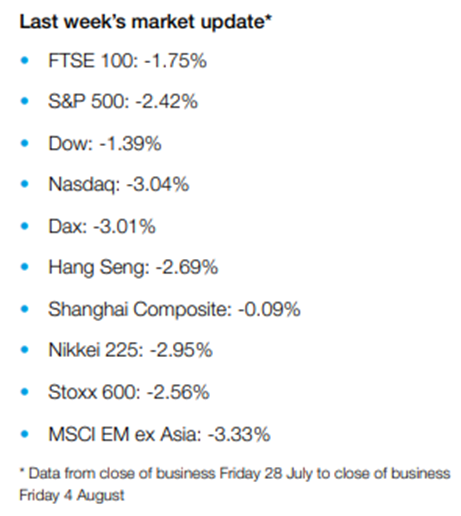
This marked the second time in history that a leading credit agency has downgraded US debt. Fitch cut its rating from AAA to AA+, citing concerns about the state of the country’s finances and its debt burden. The announcement weighed on stocks, with the S&P 500, Dow and Nasdaq finishing the week down 2.4%, 1.4% and 3.0%, respectively.

The UK’s FTSE 100 lost 1.8% after the Bank of England (BoE) indicated that interest rates were likely to stay higher for longer. The pan-European Stoxx 600 and Germany’s Dax fell 2.6% and 3.0%, respectively, following disappointing European corporate earnings reports.

In China, the Shanghai Composite was flat as investors weighed measures that aim to boost consumption and support the real estate market against a 33.1% year-on[1]year slump in new home sales in July.

Investors await US inflation report

US indices rose on Monday (7 August) ahead of the release of US inflation numbers later in the week. The Dow rallied 1.2% and the S&P 500 gained 0.9%. Investors will be scrutinising the report for any clues as to the Federal Reserve’s next interest rate decision in September.

UK and European indices were mixed on Monday and then fell at the start of trading on Tuesday, after data showed exports from China fell by 14.5% year-on-year in July, the biggest drop since the start of the pandemic. Closer to home, the value of UK retail sales grew by just 1.5% year-on-year in July, much lower than the 12-month average of 3.9%, according to the British Retail Consortium and KPMG. The slowdown was partly due to easing inflation (the figures are not adjusted for inflation) as well as wet weather.

BoE raises base rate to 5.25%

Last week saw the Bank of England lift the UK’s base interest rate by a quarter of a percentage point to 5.25%, a new 15-year high. In its statement, the BoE said that some key indicators, notably wage growth, “suggest that some of the risks from more persistent inflationary pressures may have begun to crystallise”.

The BoE hinted that interest rates were likely to stay high for some time, saying it would “ensure the bank rate is sufficiently restrictive for sufficiently long to return inflation to the 2% target”. The bank expects inflation to fall to 4.9% by the end of the year. Although the BoE does not forecast a recession in the coming years, gross domestic product (GDP) is expected to remain below pre-pandemic levels as a result of high interest rates.

UK house prices plummet

UK house prices fell in July at their fastest annual rate since 2009, according to Nationwide. House prices fell by 0.2% from the previous month and by 3.8% from a year ago, worse than the 3.5% annual decline seen in June. The price of a typical home is now 4.5% below the August 2022 peak.

Robert Gardner, Nationwide’s chief economist, said housing affordability remains stretched for those looking to buy a home with a mortgage. For example, a first-time buyer with a 20% deposit who earns the average wage would see monthly mortgage payments account for 43% of their take-home pay (assuming a 6% mortgage rate). This is up from 32% a year ago and well above the long[1]run average of 29%.

Separate data from the BoE showed the value of net mortgage lending fell in the second quarter compared to the first quarter, marking the first quarterly contraction since records began in 1987.

US labour market cools

Over in the US, Friday’s closely watched nonfarm payrolls report showed the labour market cooled slightly in July. The economy added 187,000 new jobs, slightly below expectations of 200,000. The figure for June was revised lower to 185,000 from 209,000, while May’s number was reduced by 25,000 to 281,000. The report from the Labor Department also showed the unemployment rate fell back down to 3.5% from 3.6% the previous month, showing continued tightness in the labour market. Average hourly earnings rose by 0.4% month-on-month, which is above what is considered consistent with the Federal Reserve hitting its inflation target.

Japan’s services sector softens

Japan’s services sector activity grew at a slower pace in July as new business growth eased and cost pressures remained high. The final au Jibun Bank purchasing managers’ index (PMI) showed the headline services index fell slightly to 53.8 in July from 54.0 in June. This was the slowest pace of growth since January. Average cost burdens faced by service providers accelerated for the first time since April amid reports of higher electricity, fuel, raw material and labour costs. Business confidence remained strong in July, but the degree of optimism slipped to a five-month low.

Meanwhile, the manufacturing PMI slipped further into contraction territory to 49.6 in July from 49.8 in June. Firms attributed the decline to weak customer demand for manufactured goods in both domestic and international markets. More positively, input price inflation eased to the softest level since February 2021, and business confidence was the second highest in 18 months.

Please check in again soon for further relevant content and market news.

Chloe

09/08/2023

Team No Comments

Markets in positive mood following better US inflation data

Please see below article received from Brooks Macdonald yesterday afternoon, which provides a detailed market commentary as we head into August.

  • Better inflation data buoys hopes that the US economy might be able to pull-off a soft landing
  • Bank of Japan intervenes to dampen government bond yield moves
  • Company Q2 earnings reports reach the half-way point, so far so good
  • Another interest rate hike expected from the Bank of England later this week

Better inflation data buoys hopes that the US economy might be able to pull-off a soft landing

Markets finished last week in positive mood, as softer US inflation data increasingly suggested the economy might be able to pull-off a so-called ‘soft’ landing (where economic growth slows but avoids recession). Buoying sentiment, both US personal consumption prices and employment costs saw annual gains come in a shade weaker than expected. Looking forward, this week is a relatively busy one for data. It starts with Eurozone consumer inflation later this morning, followed by the US Federal Reserve’s (Fed) latest Senior Loan Officer Opinion Survey on bank lending out later today. Central bank decisions are due from the Reserve Bank of Australia on Tuesday and the Bank of England (BoE) on Thursday. Elsewhere, after last week’s better US Gross Domestic Product (GDP) Q2 print, this week we get some US purchasing manager survey data on manufacturing and services on Tuesday and Thursday respectively. Wrapping up the week, the US monthly non-farm jobs report is out on Friday, where the consensus is looking for 200,000 jobs added in July.

Bank of Japan intervenes to dampen government bond yield moves

After the Bank of Japan (BoJ) surprised markets last Friday by effectively loosening its grip on its yield-curve-control monetary policy, this morning we have been reminded that there still limits to how far the BoJ wants to travel for now. Earlier today the BoJ announced an unscheduled Japanese Government Bond (JGB) purchase operation, spending 300bn yen (around $2.1bn) to buy 5-to-10-year bonds at market yields. This looks consistent with BoJ Governor Kazuo Ueda’s comments last week that the BoJ was ‘not ready’ to allow yields to move freely. It is also interesting that in last week’s latest BoJ forecasts, while it raised its median estimate for fiscal 2023 core consumer inflation (Consumer Price Index (CPI) all items less fresh food and energy) to 3.2% from 2.5% previously, there was no change to fiscal 2024 at 1.7% or fiscal 2025 at 1.8%, which both sit below the BoJ’s 2% inflation target.

Company Q2 earnings reports reach the half-way point, so far so good

We are now half-way through the US company results season, with 51% of US large-market-capitalised companies having reported Q2 results. According to the latest Factset ‘earnings insight’ report, 80% have reported Earnings Per Share (EPS) above consensus, which is above the 10-year average of 73%. Revenues are also so far proving resilient, with 64% of companies reporting revenues above consensus, just about better than the 10-year average of 63%. Meanwhile the longer-term earnings outlook appears to continue to push-back against wider recession fears, with calendar year-on-year earnings growth expected to rise from a flat +0.4% this year, to +12.6% in 2024. Markets are discounting machines, calibrating expected future outcomes into asset prices today. With a strong year-on-year pickup in earnings growth expected next year, that is helping to give oxygen to markets currently.

Another interest rate hike expected from the Bank of England later this week

After hikes from both the Fed and the European Central Bank last week, the BoE is expected to follow suit on Thursday. It is still a bit of a close call however between a 25 basis points (bp) or 50bp hike, The BoE will be weighing up strong wage data on the one hand, but against this, there was the better-than-expected consumer inflation data. On balance, markets expect the BoE to hike by 25bps (which would take interest rates up from 5.00% currently, to 5.25%, which would be the BoE’s 14th consecutive hike in this cycle) but reiterate data-dependency for its forward guidance.

Please check in again with us soon for further relevant content and market news.

Chloe

01/08/2023

Team No Comments

Is cash king again?

Please see below article received from Brooks Macdonald this morning, which reminds readers to remain invested for long-term growth.

Cash savers are currently enjoying the highest returns in nearly two decades, with some popular savings accounts offering fixed-term deposit rates over 5% p.a. After a prolonged period of virtually zero return on cash, rates today are multiple times higher compared to previous years, and investors are naturally keen to put more into cash than they have done so previously. So, are investors right to prioritise cash? To answer this question, we examine the role of cash in the context of inflation, investment horizon and opportunity cost of reinvestment. Despite the current attractiveness of cash deposit rates, cash may not be the best place to be for long-term investors.

Cash is not inflation-proof

Cash offers certainty only in its nominal value but not its real value, which is measured by the resilience of its purchasing power over time. Inflation erodes the purchasing power of any asset. While cash may retain its real value to some extent during periods of low inflation, its purchasing power rapidly diminishes during times of high inflation. In fact, in the past two decades, there were only three isolated years where cash managed to outperform inflation and retain its purchasing power. Even during the era of subdued inflation that preceded the COVID pandemic, deposit rates languished at levels even lower. Despite the recent surge in cash rates, they still fall short of the prevailing higher inflation rates. Consequently, relying solely on cash rates often proves inadequate in terms of providing comprehensive real value protection.

A diversified portfolio could be a better option for long-term investors

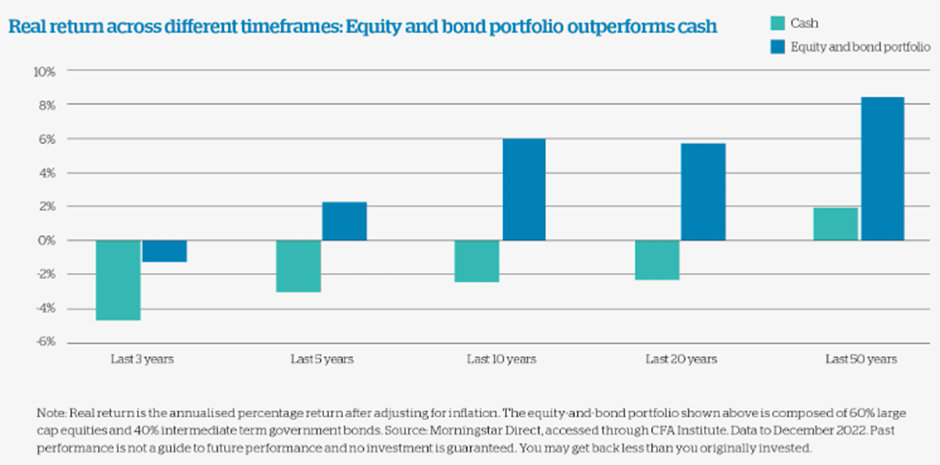
It is important to examine the case for cash in comparison to other investment instruments such as equities and bonds. For investors with long-term goals, a diversified 60% equities and 40% bonds portfolio can hold greater potential for generating real returns. If we examine the excess returns of cash vs. an equities and bonds portfolio across varying time horizons, we see that over the past 3, 5, 10 and 20 years, cash savings have delivered negative real returns, thereby diminishing the purchasing power of depositors. While cash managed to retain a level of real value over a 50-year period which will incorporate many different economic cycles, it is still lower than the returns generated by the equities and bonds portfolio. By contrast, the equities and bonds portfolio has consistently delivered returns that outpaced inflation across timeframes of 5 to 50 years, regardless of the prevailing macroeconomic conditions.

Hidden costs of fixed-term deposits

Investors attracted by the higher rates offered by fixed-term deposits are often locked in for a period of time. One key consideration for depositors in these situations is reinvestment risk, which is the risk of earning lower returns when choosing a new investment after their original fixed-term investment has expired. Once the fixed rate reaches its end, they must either renew at potentially lower rates or explore alternative investment options. However, the financial landscape at that time could differ significantly, and the investor could have missed attractive entry points in equity and bond markets. Historical analysis also reveals that high deposit rates rarely persist over an extended period. Looking at past patterns, in the five previous hiking cycles, the Bank of England typically maintained peak interest rates for an average of 9 months between its last hike and its first rate cut. It is unlikely for higher rates to endure, and investors risk sacrificing long-term opportunities for the allure of short-term ‘guaranteed’ gains.

What does it mean for investors?

While current cash deposit rates may be attractive, investors should carefully evaluate the role of cash in light of inflation, investment horizon, and reinvestment risks. So, whilst holding cash can be a useful tool for investors with a very short investment horizon, a diversified investment portfolio could provide better returns for investors seeking to preserve and grow their wealth over the long term.

Please check in again with us soon for further relevant content and news.

Chloe

25/07/2023

Team No Comments

Weekly Market Commentary: This week’s focus will be on US employment data release

Please see below article received from Brooks Macdonald this morning, which concentrates on economic developments in the US and the consequent effects on markets.

  • We now enter the second half of the calendar year after a strong Q1 and more mixed Q2 2023.
  • Soft PCE data along with consumer spending data suggest price pressures may be fading which helped catalyse the week end rally in markets.
  • All eyes on US employment data at the end of the week which will provide further insight to the inflationary outlook. 

We now enter the second half of the calendar year after a strong Q1 and more mixed Q2 2023.

The first half of the year, proved to be a strong half for financial markets however it is fairer to say that Q1 was strong and Q2 somewhat more mixed. In terms of the 2023 leader boards, the US technology sector has surged ahead, driven by the mega-cap names and hopes of a generative Artificial Intelligence (AI) revolution. The half-year was capped off by a strong week for equities, with the rally particularly strong on Friday after Friday’s personal spending and Personal Consumption Expenditures (PCE) data suggested that inflation may be moderating in the United States.

Soft PCE data along with consumer spending data suggest price pressures may be fading which helped catalyse the week end rally in markets.

The PCE inflation index for May came in line with market expectations, at 3.8% year-on-year however the core inflation number missed a 4.7% estimate, coming in at 4.6%. The month-on-month increase in US core services inflation was the smallest since June 2022 which helped catalyse the week end rally in markets. Lastly, consumer spending was softer than the market expected which may suggest that some of the demand-side impetus behind the uptick in prices may be fading.

All eyes on US employment data at the end of the week which will provide further insight to the inflationary outlook.

This week’s focus will be on the non-farm payroll report which will give insights into the US employment picture. The headline number of new jobs created is expected to have slowed from 339k in May to 215k in June with average hourly earnings and the length of the workweek expected to be unchanged. While the headline number is expected to ease from the last reading, we are still some way off a level that would imply an imminent recession. A resilient employment report sits in contrast to some of the other lead indicators which are pointing to a slowdown however the outsized strength of the labour market has been a key driver of market inflation expectations so far this year. The Institute of Supply Management (ISM) manufacturing data is out today and is expected to show the US manufacturing sector still in contraction after turning negative in November last year.

With core inflation easing slightly in the US, and the manufacturing sector in clear contraction, the market is awaiting a change in the US employment situation that will bring some of the inflation readings down more decisively. If we see a smaller-than-expected number of new jobs created last month, there will be an expectation that this will filter into weaker hourly earnings in future months which will weigh on consumption as the second half of the year develops.

Please check in again with us soon for further relevant content and market news.

Chloe

04/07/2023

Team No Comments

Stocks rise after Fed skips rate hike in June

Please see below ‘Markets in a Minute’ article received from Brewin Dolphin yesterday afternoon, which provides a succinct but detailed global market and economic update.

Most major stock markets rose last week after the US Federal Reserve refrained from raising interest rates in June.

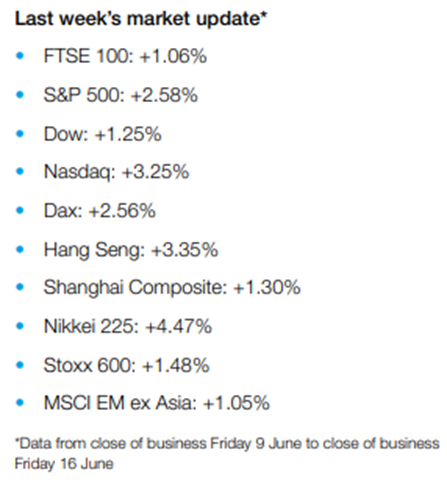
In the US, the S&P 500 enjoyed its longest stretch of daily gains since November 2021 and finished the week up 2.6%. The Nasdaq and the Dow added 3.3% and 1.3%, respectively, after a notable easing of US inflation also helped to boost investor sentiment.

Stock markets in Europe also rallied, with the Stoxx 600 and Germany’s Dax up 1.5% and 2.6%, respectively. The FTSE 100 gained 1.1% following a rebound in UK gross domestic product (GDP) in April.

In Asia, the Nikkei 225 surged 4.5% to its highest level in over three decades after the Bank of Japan chose to leave its ultra-loose monetary policy unchanged. The Shanghai Composite and the Hang Seng rallied 1.3% and 3.4%, respectively, after the People’s Bank of China cut a key policy rate for the first time in ten months.

UK house prices cool

Stock markets finished in the red on Monday (19 June) as investors took profits following last week’s rally. The FTSE 100 fell 0.7% and the Stoxx 600 lost 1.0% in a quiet day for trading. US indices were closed on Monday to mark the Juneteenth national holiday.

In economic news, Rightmove’s house price index showed average new seller asking prices slipped by £82 in June from the previous month. While this was a very small decrease (house prices were flat in percentage terms), it was notable in that it was the first monthly decline so far this year, and the first for this time of year since 2017. Rightmove said the recent significant increases in mortgage rates hadn’t affected buyer demand yet, but were creating “renewed disruption and uncertainty among movers trying to calculate how much they can afford to borrow and repay”. In the last four weeks, the average mortgage rate for a five-year fixed 85% loan-to-value mortgage has jumped from 4.56% to 5.20%.

Fed leaves interest rates unchanged

Last week saw the US Federal Reserve vote unanimously to skip an interest rate increase in June and instead hold the federal funds rate at the target range of between 5.00% and 5.25%. This was the first time the Fed had kept rates unchanged since March 2022. Fed chair Jerome Powell said it was a prudent move given “how far and how fast we’ve moved”.

However, Powell also signalled that further rate hikes are on the cards this year. He said the meeting next month would be a “live” one, which has been interpreted as meaning the Fed is likely to raise rates by 0.25 percentage points on 26 July.

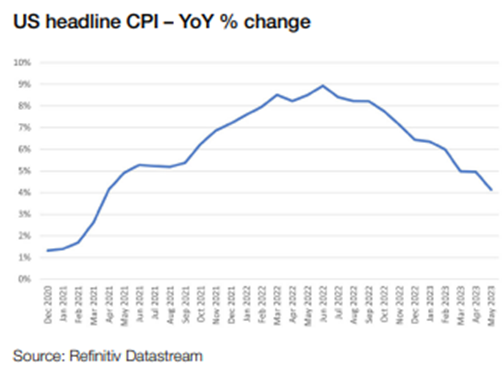
The Fed’s decision came a day after the Labor Department issued its latest consumer price index (CPI) report. Headline inflation eased to 4.0% year-on-year in May, down from 4.9% in April and the slowest annual pace since March 2021.

On a monthly basis, prices rose by just 0.1% after increasing by 0.4% in April. However, core CPI – which excludes food and energy – rose by 0.4% for the third consecutive month.

ECB increases rates to highest level in 22 years

The European Central Bank (ECB) also met last week and decided to increase its key deposit rate by a quarter of a percentage point to 3.5%, the highest in 22 years. ECB president Christine Lagarde said another rate hike in July was “very likely” and that the ECB was “not thinking about pausing”. In a statement, the ECB said that while inflation was coming down, it is projected to remain “too high for too long”.

Despite seeing an easing in inflation, the ECB increased its forecast for core inflation for 2023 to 5.1%, up from 4.6% previously. This was mainly due to wage increases – average wages grew by 5.2% in the first quarter compared with a year ago. Meanwhile, the eurozone economy is expected to grow by 0.9% this year and 1.5% in 2024, down from the ECB’s previous estimates of 1.0% and 1.6%, respectively.

Bank of Japan sticks to ultra-low rates

The week ended with another major central bank meeting – this time at the Bank of Japan (BoJ). Although inflation in Japan has proved stronger than expected, the BoJ chose to maintain its -0.1% short-term interest rate target and a 0% cap on the ten-year bond yield set under its yield curve control policy. The bank reiterated its view that inflation will slow later this year.

“The bank will patiently continue with monetary easing while nimbly responding to developments in economic activity and prices as well as financial conditions,” it said. “By doing so, it will aim to achieve the price stability target of 2% in a sustainable and stable manner, accompanied by wage increases.”

UK economy returns to growth in April

The UK economy returned to growth in April, with GDP expanding by 0.2% month-on-month after contracting by 0.3% in March, according to the Office for National Statistics. This was driven by an increase in car sales and customer spending in pubs and bars. The rise in activity was partly offset by junior doctors’ strikes, which held back health sector output.

The return to growth has added to expectations that the Bank of England will raise interest rates for the 13th time in a row when it meets on Thursday. It has also raised hopes that the UK will avoid a recession this year. Earlier this month, the OECD upgraded its economic growth forecasts for the UK. It expects GDP to grow by 0.3% this year and 1.0% in 2024, much better than its previous forecasts of a 0.2% decline in 2023 and a 0.9% rise in 2024. Nevertheless, all the other economies in the G7 apart from Germany are expected to grow at faster rates this year.

Please check in again with us soon for further relevant content and market news.

Chloe

21/06/2023

Team No Comments

Weekly market commentary: The focal point this week is the Fed rate announcement due Wednesday

Please see below article received from Brooks Macdonald yesterday afternoon, which provides a global market and economic update.

  • China continues to be a global inflation outlier, with consumer price pressures absent, while producer prices fall further into outright deflation
  • Central banks from US, Europe and Japan decide on interest rates this week, hot on the heels of surprise hikes from Australia and Canada last week
  • US consumer price inflation in focus this week, and while inflation rates are expected to fall, core prices are still being judged as relatively stickier
  • The flipside of sticky inflation, economic growth is proving more resilient, as UK Confederation of British Industry (CBI) last week upgrades its economic outlook for this year and next

What happened last week and what are the highlights ahead for markets this week

Global equities arguably had a better week last week than bonds, thanks to continued resilience of large cap US technology stocks in particular. For bond markets meanwhile, surprise hikes from central banks in Australia and Canada spooked bond investors, as they worried about the read-across for the US Federal Reserve (Fed) who meet later this week. Yields on US 10-year Treasuries were up +4.9 basis points (bps) on the week (including +2.1bps on Friday), finishing the week at 3.74%. Looking to the week ahead, we have central bank interest rate policy decisions, in calendar order from the Fed (Wednesday), the European Central bank (ECB, Thursday), and the Bank of Japan (BoJ, Friday). For the Fed, ahead of the meeting, we also get the latest May monthly reading of US CPI (Consumer Price Index) inflation on Tuesday. Rate hikes this week are thought to be most likely to come from the ECB, with the Fed expected to ‘skip’ a hike until July, while the BoJ is expected to continue to stay unchanged. In economic data due elsewhere, US Retail Sales are due Thursday and before that UK monthly GDP (Gross Domestic Product) for April is due Wednesday – expectations are for a month-on-month gain of 0.2%.

China continues to be a big global inflation outlier

Against the sticky and still-high inflation ‘run-of-play’ that we are seeing in most developed economies globally at the moment, economic data out from China on Friday gave markets an important reminder that the world’s second-biggest economy has a very different message: China continues to be a global inflation outlier. China’s latest CPI print for May edged up only slightly to 0.2% year-on-year (versus 0.1% year-on-year in April), while PPI (Producer Price Index) deflation looked entrenched, plunging -4.6% year-on-year. On PPI specifically, it was the eighth straight month of producer deflation and the steepest fall since February 2016. All in all, with inflation currently absent in China, that leaves its central bank with lots of room for manoeuvre to support its economy over the reminder of this year, should it be needed.

Central banks from US, Europe and Japan decide on interest rates this week, hot on the heels of surprise hikes from Australia and Canada

Last week’s central bank meetings from the Reserve Bank of Australia (RBA) and the Bank of Canada (BoC) are an important lead into this week in terms of how their actions has shaped expectations. Both the RBA and the BoC had been expected to leave their rates unchanged, but in the event, both hiked by 25bps. The BoC was particularly noteworthy – after its previous last hike in January, the Canadian central bank had signalled a pause, keeping rates on hold at their March and April meetings. That willingness to sit back however disappeared last week, and Canadian interest rates, at 4.75%, are now at 22-year highs. Driving the increased hawkishness has been inflation stickiness, a theme common to many central banks recently – in Canada’s case, annual CPI inflation rose to 4.4% in April, the first increase in 10 months.

The most important central bank of them all? US Federal Reserve meets

The focal point this week is the Fed rate announcement due Wednesday. For this week, Fed Funds futures are currently pricing in a circa 30% probability of a June hike of 25bps. By contrast, it seems the Fed might yet ‘skip’ a hike in June, only to post a rate-hike at their following meeting in late-July, where the probability of a hike rises to circa 55%. Also, important to look at this week with the Fed’s statement will be their latest Summary of Economic Projections, including their so-called ‘dot-plot’ of interest rate expectations. Feeding into the Fed’s rate decision will be the US CPI print due tomorrow. While the CPI ‘all-times’ annual rate is expected to drop to 4.1% in May (from 4.9% in April), much of that drop comes from the tougher comparative last year when energy and food prices were soaring. For the core CPI print (excluding energy and food prices), this is expected to be running higher at 5.3% but still down on April’s 5.5%.

The flipside of sticky inflation, economic growth is proving more resilient

For most western economies, inflation continues to be above target, especially in the case of core prices. Driving this inflation stickiness however, the flipside is that GDP data for some economies is proving to be somewhat more resilient than had been feared at the start of this year. Take the UK for example – estimates out last Friday from the UK CBI point to +0.4% GDP growth this year (up from a contraction of 0.4% previously), followed by +1.8% in 2024 (versus +1.6% previously). As the CBI noted in its press release “the [UK] economy looks to have fared better than expected in first half of 2023, and is set to steer clear of a recession … tailwinds to growth have strengthened since our previous forecast in December 2022: the global outlook has improved”.

Please check in again with us soon for further relevant content and market news.

Chloe

13/06/2023