Team No Comments

AJ Bell – Five themes to watch in 2024

Happy new year to all! Please see the below article from AJ Bell providing their insight on the five themes to watch for investors in 2024. Received last week.

No adviser or client knows what is coming next, and whether inflation, stagflation or deflation will result from the combination of the interest rate pauses, Quantitative Tightening, pay increases, rising debt and elevated geopolitical tensions.

Basing investment strategies on just one scenario is probably not going to be good idea and portfolio construction may need to address range of outcomes, especially as we have elections to be fought (and electorates to be influenced) on both sides of the Atlantic in the next twelve months.

Carefully following five major investment themes may help advisers and clients sense which way the wind is blowing so they can try to obtain the best possible risk-adjusted returns for their portfolios, especially once they take the all-important issue of valuation into account.

Debt

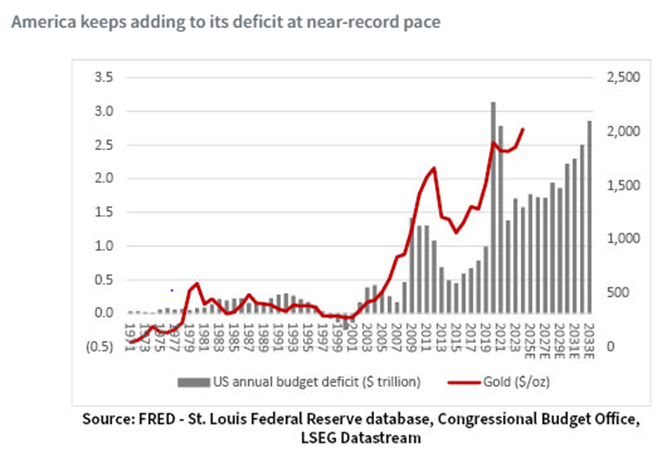
Debt-to-GDP is one barometer to watch, but according to the Bank of International Settlements it should be studied in conjunction with the percentage of tax income that is used to meet the interest costs. When that latter figure got to around 20% in 2007 (and was still rising), the financial markets buckled and nearly took the global economy with them.
FRED – St. Louis Federal Reserve database, Congressional Budget Office, LSEG Datastream

China and France are the two countries in this invidious position now, but the USA is catching up fast, as the Biden administration spends like fury on the CHIPS and Inflation Reduction Acts.

America’s latest annual fiscal deficit was $1.7 trillion, in the year to September 2023, the third-worst number on record, and the annualised interest bill has hit $1 trillion, or 20% of tax income. America cannot afford to keep interest rates where they are for long and there is a risk that the Fed has to cut rates to keep the burden manageable and take risks with inflation. This may be why gold (and Bitcoin, for that matter) are on a roll. Markets are pricing in five rate cuts from the Fed in 2024, but because inflation is cooling and growth benign, not because debt is a problem and interest costs are squeezing economic growth.

Wages

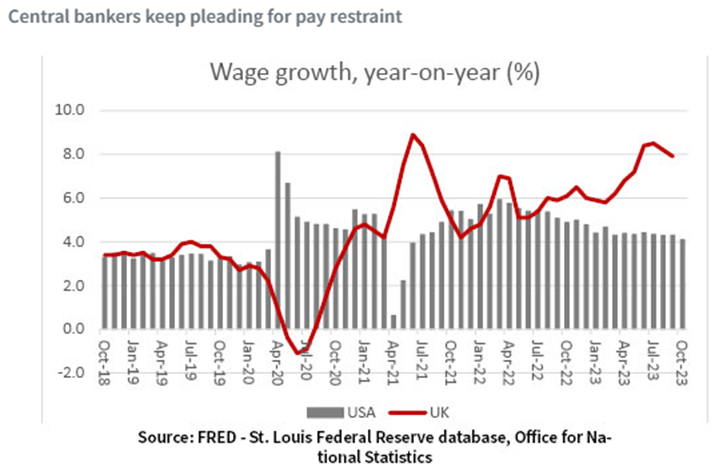
The 1970s’ inflationary outburst may have been prompted by loose monetary policy in the UK (and loose fiscal policy in the USA), followed by 1973’s oil price shock, but a vicious circle of higher pay demands, higher prices, higher pay demands, and higher prices then developed.
FRED – St. Louis Federal Reserve database, Office for National Statistics

Financial markets may therefore cheer a modest increase in unemployment, and central bankers accept it, as higher joblessness could help to put a lid on wages and inflation and thus provide scope for rate cuts. Equally, a sharp rise in the jobless rate could signal economic trouble, or at least more than is currently factored in by consensus earnings forecasts, so policymakers have a tricky balancing act here.

The Magnificent Seven

The stock

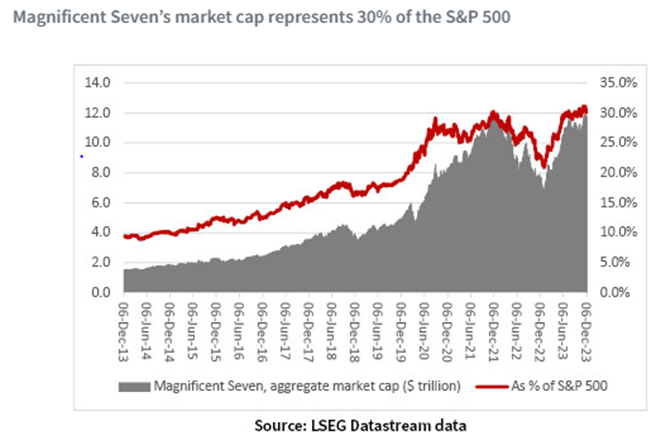
markets’ rally in 2023, and the return to favour of Alphabet, Amazon, Apple, Meta, Microsoft, NVIDIA and Tesla, suggests equities are pricing in an economic soft landing and a return to the low-growth, low-inflation and low-interest-rate environment of the 2010s that did so much to help the performance of long-duration assets like bonds and growth sectors, such as technology.
LSEG Datastream data

They might be right. But if they are wrong – and those five Fed rate cuts do not appear on schedule in 2024 – then the Magnificent Seven’s aggregate $11.8 trillion market cap could look exposed, for all of their dominant positions in their respective industries. Their share price and profit wobbles of 2022 showed they are not entirely immune to the economic cycle, so an unexpected recession could be one challenge. Sustained inflation could be another if it keeps rates higher than expected and boosts nominal growth from downtrodden cyclicals and value stocks. Again, only a perfect middle path may do.

The yield curve

Bond yie

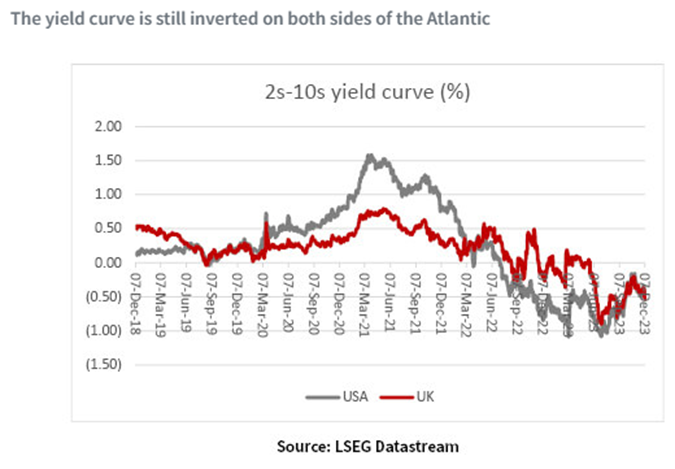
lds are falling again, but the yield curve remains inverted, whereby ten-year yields on Government bonds are lower than those on the two-year in the UK and USA. This is seen as a warning that a recession is on the way, as it means bond markets are factoring in interest rate cuts (the ten-year would usually have to offer a higher yield to compensate holders for the extra risk scope for things to go wrong over the longer lifespan of the debt).
LSEG Datastream data

It is not an infallible signal, but examples of soft economic landings are hard to find and stock markets are currently doing their best to ignore the bond market’s quite different message.

Oil and copper

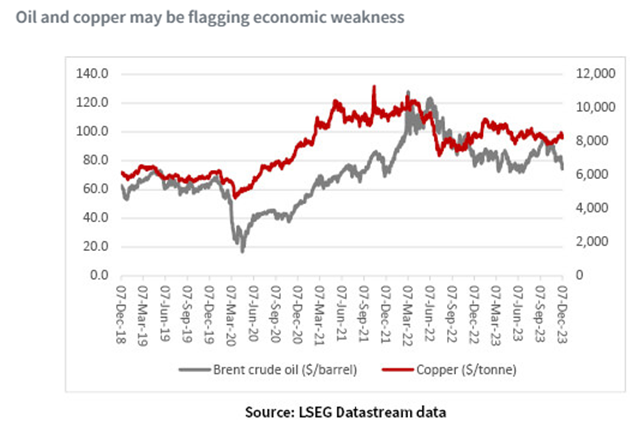
If equities are pricing in a soft landing and fixed-income markets a harder one, commodity traders are even more confused. Oil’s renewed weakness may speak of recession. Copper, a reliable indicator of global economic health due to its many uses, is doing nothing. Gold looks to be fretting about debts and stagflation.
LSEG Datastream data

The messages from stocks, bonds and raw materials are therefore contradictory. But such are the globe’s debts that it seems likely central banks (and politicians) would rather play fast and loose and risk inflation or stagflation than recession and deflation. The experiences of 2007-09 and 2020-21 would suggest as much, anyway.

Past performance is not a guide to future performance and some investments need to be held for the long term.

Please check our blog content for advice, planning issues and the latest investment, market and economic updates from leading investment houses.

Alex Clare

02/01/2024.
Team No Comments

A Happy New Year to all!

Markets

It has been another really interesting (probably too interesting?) year for us with markets, economies and invested assets being challenged again throughout 2023.

Although it has been a very bad year for conflicts globally and the ongoing human cost, this has not been the main focus for investors.  Central bank’s policies globally has been the focus for investors.  We continue to watch and interpret the data around inflation, interest rates, productivity and employment in particular.  Keeping a close eye on wage inflation.

The good news is that central banks such as the Fed, the Bank of England and the European Central Bank (ECB), look like they may have stopped increasing interest rates.  Interest rates may have plateaued.  Markets are now looking at when interest rates might fall, and this could be as early as the second quarter of 2024 for the UK perhaps?  And the second half of 2024 for the Fed and the ECB?

When interest rates do fall, we should see an improvement in investments.  In J P Morgan’s view (Long Term Capital Markets Assumptions Report and webinar launch 30/10/2023), we are in a better position for investment returns than we have been for a few years, in a more normalised market.

J P Morgan state the need for a well diversified portfolio given the current outlook, with both ‘active’ and ‘tactical’ fund management.

This appears to be the broad consensus view, although as ever, we have both Bears and Bulls.  A few fund managers are sitting on the fence and making provision for either outcome.

However, over the long term, history has proven that invested assets significantly outperform cash.  You just need to remain invested and focus on your long-term objectives.

Business Update

We have had a busy year again here at P and B IFA.  Our focus remains on servicing our existing clients and keeping them up to date with what is going on in our world and anything that might have an impact on our clients’ plans.

This year we have had significant legislative change for pensions in the Spring Budget with further clarification in the Autumn Statement and in the detail in the Autumn Finance Bill.  These changes are generally good news for our clients but not without complexity.

However, from a tax point of view we continue to see reductions in allowances and stealth taxes as some allowances and tax thresholds remain frozen, and other thresholds lowered.  This all results in a bigger tax take for the State. 

Being tax efficient and using your allowances is more important than ever.

In addition regulatory change moves at a pace with the implementation of Consumer Duty regulations at the end of July.  These changes are as ever about protecting our clients, this time they come with significant time cost to the business.

Thankfully, the use of digital technology for meetings, cutting out a lot of travel time, has allowed me to deal with the legislative and regulatory changes without working 24/7, although I don’t think I’ve ever worked harder.

We continue to work on the business and I’ve taken input from several external consultants over the year as we continually strive to offer a great service to our clients.  This is to the benefit of our clients and our staff.  I’ll keep you posted on any developments.

Consumer Duty regulations apply more broadly than to just IFAs like ourselves.  The good news here is that we hope that the new regulations will help us receive a better service from providers, life offices and platforms etc.  Now we spend too much time as the buffer working on behalf of our clients.  This year we have had to educate the staff at life offices and platforms about the new pension legislation changes, so that they can understand our instructions on behalf of our clients.

It was worthwhile in the end.  From a pension legislation point of view, we are in a better place than at the start of 2023.

Summary

It has been a busy year for all of us, but I think we are in a better place now.  Things have moved on for economies, markets and invested assets and I feel like we are making progress, although risks remain, and volatility could continue for a while.

We have improved pension legislation too, that is good news and should help us keep our pension funding at the right level as for most of us it is extremely tax efficient.

Compared to this time last year, I’m feeling more positive about the new year.  It won’t be straight forward, but I think we are starting to see improvements to the outlook.

Politically it will be an interesting year, hopefully with a normal democratic process, particularly in the US.

Wishing you and yours a healthy, happy and prosperous New Year.  I’d love to see an outbreak of peace and goodwill globally.

All the best!

Steve Speed

29/12/2023

Team No Comments

Brooks Macdonald – Outlook for 2024

Please see below an article published by Brooks Macdonald which was received yesterday afternoon and outlines their outlook for markets in 2024:

Glass half empty or full? Outlook 2024

As we near the end of 2023, we are at a crossroads for both economies and investments. During 2023 sentiment has oscillated between two different investment scenarios, the glass-half-full camp, and the glass-half-empty camp. The challenge is to construct portfolios while recognising that either scenario could occur. Given the uncertainty which prevails, we believe that maintaining a balance is key.

2023 has been a year in which investment markets have encountered cross winds. On the positive side, equity markets have benefited from a new age in technology, driven by generative artificial intelligence (AI). At the same time, geopolitical risks have heightened with Russia’s ongoing invasion of Ukraine alongside the conflict in the Middle East between Israel and Hamas. Furthermore, China-US relations remain fraught, despite recent efforts to improve them.

Inflation is the key focus for policy makers and with interest rates clearly in restrictive territory, the glass-half-empty camp is waiting for the full impact of higher interest rates on consumers and companies. At the same time, any worsening of the situation in the Middle East or tightening of supply by the OPEC+ members would lead to a rise in the oil price, causing further upward pressure on inflation.

The glass-half-full camp believe that given labour markets remain tight, wage growth will be robust. In the US, many consumers still have post-pandemic savings to spend and unlike in the UK, for example, have 30-year fixed rate mortgages meaning they are insulated from the recent rate rises.

The key question for both camps is whether consumers and companies will remain solvent while policy makers wait for inflation to fall back to the Central Banks’ targets.

How did we get here?

After a tough 2022 when both equities and bonds posted negative returns, 2023 has seen a recovery, at least in equity markets. At the time of writing, government bonds are still in negative territory, despite the fall in yields (and corresponding rise in prices) seen since the peak of mid-October. The MSCI All Country World Index is up 10.4% in total return, sterling terms. However, the same index adjusted on an equal-weight basis (where each stock has an equivalent weight in the index, removing the dominance of so-called ‘mega-cap’ stocks), is down -1.4%. This difference highlights the impressive performance of a small number of technology-related names which are perceived to be beneficiaries of AI.

The age of Generative AI

The new age of AI started with the launch of Chat GPT in November 2022. Chat GPT is what is known as a large language model-based chatbot developed by Open AI, enabling users to generate media (be it text, code, pictures and more). By January 2023 it had over 100 million users per month and was the fastest growing consumer software application in history. Investor attention turned to companies believed to be the enablers of AI, particularly those focused on designing the necessary

The picture in Euro Area and the UK is less robust, with the IMF forecasting growth of less than 1% in 2023 and an only modest recovery in 2024.

semiconductors: Nvidia, the US chip designer, has risen by comfortably more than 200% year to date. The key question is the size of the productivity gains across the broader economy. The US National Bureau of Economic Research looked at a staggered introduction of a generative AI-based conversational assistant using data from over five thousand customer support agents and found that access to the tool increased productivity, as measured by issues resolved per hour, by 14% on average. Clearly gains of this magnitude will help mitigate the effects of higher interest rates and wage costs.

Corporate earnings growth remains robust

After the boost from the post pandemic recovery, corporate earnings growth expectations are lower but still in positive territory. Data from Factset indicates that companies are delivering better than expected earnings-per-share numbers at an historically high rate. Looking ahead to 2024, current consensus estimates point to an expected annual US company earnings growth rate of over 11%. The operating environment is also becoming more favourable: post pandemic supply chain disruptions have ceased and trade volume growth of 3.3% in 2024 is expected, compared to 0.8% in 2023*.

Economic growth picture still mixed

Central Banks continue to face the challenge of bringing down inflation while avoiding a recession. They also must ensure financial stability and avoid a situation such as the failure of regional US banks in Q1 2023. The three main regional drivers of growth are the US, Europe (including UK) and China. The US reported annual real GDP growth of 4.9% in Q3 2023, well ahead of the Fed’s own estimate of long-term real GDP growth of 1.8%. Growth in China remains healthy, with the IMF forecasting China’s real GDP growth in 2024 of 4.6%.

However, the picture in Euro Area and the UK is less robust, with the IMF forecasting growth of less than 1% in 2023 and an only modest recovery in 2024. These differences illustrate the importance of using an asset allocation framework that can adjust for regional settings.

Investors face three outcomes for economic growth. First, a hard landing, which is a contraction in economic activity, sharply rising unemployment, and a collapse in consumer spending. Second, a soft landing, with a gradual slowing of growth, a recession avoided and a moderate rise in unemployment. Third, no landing, with economic growth continuing at the current rate. The first outcome would imply we should reduce equities and add to longer duration bonds, given the likelihood that interest rates would then be cut significantly. If the third were to materialise, we should add to equities and reduce more defensive assets such as fixed income. Over the course of the year, the soft landing outcome has become more likely but far from certain, so we aim to maintain a balance within portfolios for investors.

Bonds: income is back

Over the course of the past two years, the rise in bond yields has meant that bonds can once again provide a counterbalance to other asset classes within portfolios. This increase in yields available from longer dated bonds gave us the opportunity to increase slightly the duration within the bond portfolios, thereby locking in higher yields. We believe it is too soon to increase duration significantly though, given the risk that inflation may persist for longer. Within corporate bonds we continue to prefer higher quality investment grade bonds over the more speculative high yield, as we believe the additional yield available does not adequately compensate us for the additional risk of the latter.

The equity barbell remains in place

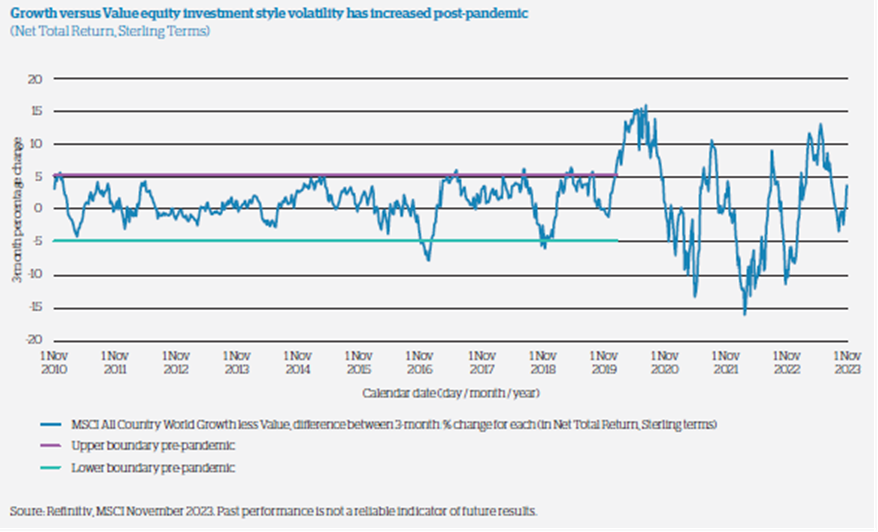
The graph below shows how, since the pandemic, the style leadership of the equity market has changed more frequently and become more pronounced. For this reason, we have implemented a barbell approach in the equity portfolios, whereby we aim to achieve an equal weighting of both value and growth investment styles. Given the range of possible economic scenarios together with current heightened geo-political risks, the barbell approach remains. Despite this balance, we continue to take conviction views on a geographical basis, emphasising the different investment styles through our core equity and thematic exposures.

Conclusion

As we weigh up the investment outlook, the challenge for asset allocators is how to take a calculated position to keep exposure to more than one economic scenario materialising. There is currently insufficient visibility for us to back a single sustained outcome. Instead, staying invested but keeping balance continues to be our goal.

Please continue to check our Blog content for advice and planning issues and the latest investment, markets and economic updates from leading investment houses.

Carl Mitchell – Dip PFS

Independent Financial Adviser

22/12/2023

Team No Comments

Brooks Macdonald – Daily Investment Bulletin

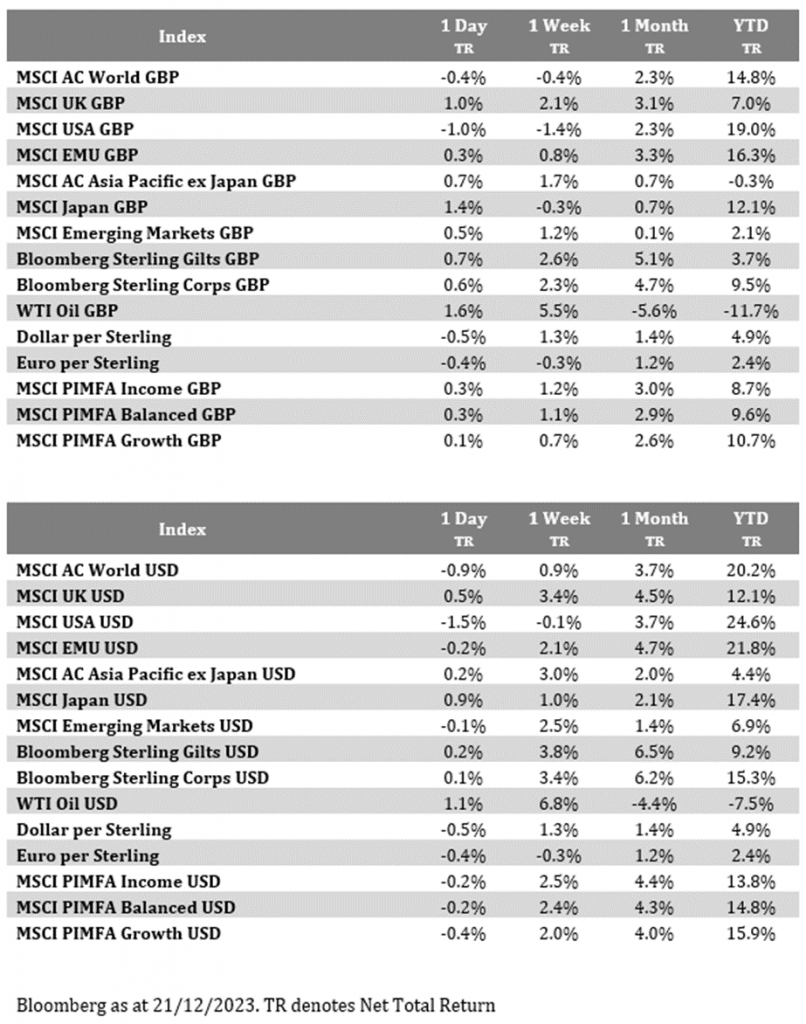
Please see below, Brooks Macdonald’s ‘Daily Investment Bulletin’ which provides a brief analysis of the key factors currently affecting global markets. Received this afternoon – 21/12/2023

What has happened?

The relentless march higher of US equity markets was interrupted late on Wednesday with the headline index off c. -1.5% on the day. The catalyst is not clear however after markets have traded solely in one direction for several weeks, regardless of central bank speakers or the incoming data, a snap back is arguably warranted.

Central banks

Despite the negative tone within equity markets, bond markets continued their rally with the US 10-year Treasury yield falling to 3.85% while the 2-year yield is now just 4.33%. Investors continued to ramp up their expectations of imminent interest rate cuts with bond markets now implying a 92% probability of a cut by March and 1.5% of cuts next year in totality. One of the factors that may have caused the sharp sell-off late yesterday is the growing gulf between the Fed’s dot plot of interest rate expectations and what is priced into the market.

Inflation

There was good news for the UK yesterday as headline CPI inflation fell more than the market was expecting to 3.9%. This was 0.4% below expectations but the Core CPI number, which excludes food and energy, saw an even more dramatic move lower, coming in at 5.1% versus 5.6% expected. Investors increased the number of interest rate cuts they are expecting from the Bank of England in 2024 and the gilt yield curve rallied. Over in Germany, the Producer Price Index inflation numbers showed significant deflation with the index contracting by -7.9% year-on-year compared to -7.5% expected. This helped European bond markets share in the rally seen in the US and UK.

What does Brooks Macdonald think?

On top of the positive inflation stories yesterday, the Conference Board’s US consumer confidence showed a resilient US consumer. Despite this, equities fell quite substantially at the end of the day which suggests a degree of investor fatigue around quite how quickly the market outlook has shifted from bleak at the end of October to unashamedly bullish by the end of the year.

Please continue to check our blog content for advice and planning updates from leading investment managers.

Alex Kitteringham

21st December 2023

Team No Comments

Evelyn Partners Update – UK November CPI inflation

Please see below article received from Evelyn Partners this afternoon, which provides an economic update as we approach Christmas and the end of 2023.

What happened?

UK November annual headline CPI inflation was reported at 3.9% (consensus: 4.4%), its lowest pace in over two years, versus 4.6% in October. In monthly terms, CPI fell 0.2% (consensus: +0.1%), compared to remaining flat at 0% in October.

November annual core CPI (excluding food, energy, alcohol and tobacco) was 5.1% (consensus: 5.6%), versus 5.7% in October. In monthly terms, core CPI was -0.3% (consensus: +0.2%), versus 0.3% in October.

What does it mean?

Today’s encouraging inflation print confirms the continuation of the downward trend in inflation. Just over a year on from headline CPI peaking at 11.1% in October 2022, it has since decelerated by over 7% points, with much of that deceleration in the headline rate coming from lower energy prices in the transport (i.e. fuel) and housing and household services (i.e. gas and electricity) categories. What was even more promising was the downward movement in core inflation, which has decelerated to its lowest rate since January 2022.

As it stands, Brent crude oil prices are now down roughly 4% for the year despite heightened geopolitical risk in the Middle East and OPEC+ output cuts. This reduces the risk of upside in retail petrol and diesel fuel prices. This weakness in oil prices has been reflected in the CPI basket for transport which decelerated by 1.7% in November. On an annual basis this segment of the economy is now exhibiting deflation, with the 12-month inflation rate turning negative.

Looking elsewhere in the divisional breakdown, goods inflation has now decelerated to 2.0% on an annual basis. While services, although slowing, remains more resilient at 6.3% for the last 12 months.

Food and non-alcoholic beverages continue to put pressure on the wallets of households, with this segment exhibiting the highest monthly inflation rate for any category at 0.3% for November. On an annual basis, prices in this segment have risen by 9.2%.

Bottom Line

With both headline and core CPI inflation slowing at a faster rate than expected in November, this should reassure policy setters at the Bank of England that high interest rates are having the desired effect of materially decelerating inflation. The Monetary Policy Committee should now be able to focus on when to cut rates, rather than if additional tightening is required. Money markets are currently expecting these interest rate cuts to materialise in the second quarter of 2024.

Please check in again with us soon for further relevant content and market news.

Chloe

20/12/2023

Team No Comments

Brewin Dolphin Markets in a Minute

Please see below article received from Brewin Dolphin yesterday afternoon, which comments on US inflation figures, interest rate decisions from the Federal Reserve and Bank of England, and Chinese economic data.

The glass is very much half full for the investment world at the moment, with good news being taken as such and bad news being shrugged off.

Continuing the theme of the last two months, gains have come from the anticipation of a more benign inflationary outlook. European inflation numbers have seemed to endorse that view, dropping quite sharply over the last few months. US inflation has been more nuanced; data released last week were broadly in line with expectations, but the underlying composition of inflation could give cause for concern.

US core inflation picked up during November to a pace that would be inconsistent with the Federal Reserve meeting its inflation target. It is well understood that core inflation is heavily influenced by shelter, and shelter inflation will reflect rents and changes in house prices with a lag, representing the time it takes for tenancy agreements to be renewed. That means there should be some disinflation to come from the housing slowdown that has already occurred. More recently, the impact of housing on the consumer price index (CPI) has become clouded. Demand for new housing seems depressed but house prices have been rising for the last few months. The recent sharp decline in bond yields means that US mortgage rates have been declining, which ought to offer further support for house prices and have some knock-on effect for shelter CPI.

Moreover, the Fed looks beyond core CPI these days to try and gauge underlying price pressures. While core inflation strips out volatile food and energy prices, so-called ‘supercore’ inflation comprises services inflation excluding energy and housing. This measure should reflect the general level of inflationary pressure driven by the balance of the labour market. It accelerated slightly this month and has been running ahead of the Fed’s implied inflation target for the last four months.

Interest rates

With this backdrop, the Federal Reserve announced its latest changes to monetary policy. Broadly, policy was left unchanged, as had been universally expected, but the press conference and statement surprised the market by being more dovish than anticipated. The Fed cut its inflation expectations and raised its growth expectations for what is left of 2023. More meaningfully, it also lowered the expected interest rate at the end of 2024 to a level that implies three interest rate cuts will take place over the year. This comes at a time when the Fed is also expecting inflation to remain above target (albeit only modestly). It is surprising the Fed would endorse rate cuts whilst seeming to tolerate above target inflation. For context, market-based interest rate expectations moved lower and now imply nearly six interest rate cuts over the next twelve months.

Labour markets are the key determinant of the inflationary environment but are often observed to be lagging indicators. By the time the unemployment rate has started rising, it has often developed a momentum that makes it difficult to stop. The fear of this, at a time when Fed chairman Jerome Powell believes policy is “well into restrictive territory”, will be the motivation for this dovish tilt.

One factor that has been helpful in curtailing inflation in the US is the relatively benign performance of wages. Wage growth peaked around the turn of last year in America but has not yet done so definitively in the UK or eurozone.

Europe

That discrepancy probably motivated the Bank of England (BoE) in its more hawkish tone. Three Monetary Policy Committee (MPC) members voted to raise interest rates again, believing there was evidence of persistent inflationary pressure. They were outvoted and policy was left on hold.

The MPC decision came after the release of quite weak monthly gross domestic product (GDP) data on Wednesday, on top of Tuesday’s relatively poor labour market data. BoE governor Andrew Bailey took a more predictable line, emphasising the battle to contain inflation was not yet won and the Bank would “take the decisions necessary to get inflation all the way back to 2%”.

All central banks become heavily motivated by the latest economic data at potential turning points in interest rate cycles. The data for the UK does seem quite weak, whereas there are tentative signs of the European economy recovering some momentum. This morning saw a slight setback in the purchasing managers indices for Germany and France. This was mirrored by the UK’s ailing manufacturing sector but bucked by the UK services sector, which expanded faster for a fourth consecutive month.

Meanwhile, in the east…

A lot of data was released last week detailing the Chinese economy. There are some signs of recovery, with annual growth numbers like the 10% expansion in retail sales seeming quite healthy. This is somewhat illusory though, as China was in lockdown this time last year. The thorn in the side of the Chinese economy remains the property market. Data released today showed the continued decline in new home prices. It comes after the conclusion of the Central Economic Work Conference (CEWC). The post-meeting communique signalled some measures would come in to try to bring relief to the Chinese economy. But the promise was vague and modest, suggesting perhaps a couple of interest rate cuts and a further easing of required reserves at banks (which would enable them to lend more to the economy).

China maintained its growth target of around 5%, which sounds ambitious given the weakness of the economy. But, again, this reflects the fact that last year, China was in lockdown, and so growing 5% from that depressed level should be neither taxing nor impressive.

Please check in with us again soon for further relevant content and market news.

Chloe

20/12/2023

Team No Comments

Brooks Macdonald: Weekly Market Commentary

Please see this week’s Weekly Market Commentary from Brooks Macdonald which provides a brief analysis of the key factors currently affecting global investment markets:

  • The Santa Claus rally is underway after the Federal Reserve allows the market’s interest rate pivot to continue
  • Despite pushback from some Federal Reserve speakers, markets expect the first US cut during Q1 2024
  • Meanwhile, the Bank of Japan may only now exit its negative interest rate policy this week

After the Federal Reserve endorsed the market’s dovish pivot of US interest rate policy, risk appetite received a significant boost. By the end of the week, the US bond market implied 141bps of interest rate cuts by the end of 2024 and an over three-quarter chance that the first cut would take place by March. Bonds rallied against this backdrop with both the 2-year and 10-year yields down c. 0.3% on the week, this marks the best week for US Treasuries since the extreme market volatility of March 2020. Equities also performed strongly with the US leading the way with a 7th consecutive weekly advance.

Despite the Fed meeting sounding relatively dovish, Fed speakers on Friday were keen to push back against the growing consensus around a Q1 2024 first cut. President Williams said that the Fed ‘aren’t really talking about rate cuts’ yet and that March felt ‘premature.’ President Bostic struck a similar tone, saying that he wasn’t ‘really feeling that this is an imminent thing.’ Bostic suggested that the Fed may only start cutting interest rates from Q3, offering a counterweight to the strong bond market rally of last week. By the end of Friday the market had reduced the quantum of cuts expected in 2024 by 8bps.

The central bank focus will continue this week even as we approach the Christmas period. There has been much speculation as to whether the Bank of Japan’s negative interest rate policy would be ending at this meeting, with the market apportioning a rough 50:50 chance of that outcome. Reports have suggested that the Bank of Japan may hold off an announcement this week but strongly signal the move as ‘live’ for January’s meeting.

Whether the policy comes to an end at this meeting or next meeting is an aside to the remarkable fact that the US has gone through a full rate hiking cycle but that the disinflationary forces in Japan have been so powerful that only now is a positive interest rate on the cards.

Please continue to check our blog content for advice and planning issues and the latest investment, markets and economic updates from leading investment houses.

Andrew Lloyd DipPFS

19/12/2023

Team No Comments

Tatton Investment Management – Monday Digest

Please see the below Tatton Investment Management Monday Digest article received this morning – 18/12/2023.

Policy and politics set to play a pivotal role in 2024 

Heading into 2024, capital markets are in a somewhat contradictory position. Global growth has been slow (and in some places negative) for some time, while central banks have raised interest rates at the fastest pace in a generation. But despite all those challenges, equities have had a good year overall. With inflation finally falling, central banks are now loosening their vice grips, and bond markets are predicting a slew of rate cuts from the major players starting as early as March. That has pushed risk valuations in favour of equities and, perhaps more importantly over the long term, has even bolstered growth expectations. How these expectations play out will be crucial for markets next year.

And yet, anxiety lingers. The rise in equity valuations has left stocks looking a little expensive, particularly in light of damp growth expectations in some regions. And despite the fact that no one seems to believe them, central bankers beyond the US are still toeing the official line that rates will have to stay higher for longer pretty much everywhere. 

The consistent theme of this year has been that whenever markets look overexcited, monetary policymakers pour cold water over rate cut expectations. The policy outlook has become the dominant driver of markets, and ignoring what policymakers tell us has made for a volatile ride in investments all year. We expect this to continue for at least the early part of 2024. Ever since the financial crash of 2008, investors have been extremely sensitive to expected monetary policy, and 2023 was no different. This is historically unusual, but it could just be because – for most of that period – rates have been historically low. Rates staying lower for longer increases the sensitivity to rate changes because longer-duration assets gain in relative value and thus make up a larger share of the market (the so-called duration effect). Now that real interests (inflation-adjusted, i.e. what is left after inflation is subtracted) have moved higher, it is possible we will see fewer valuation effects and more focus on earnings stability and growth.

Growth prospects for the UK and Europe greatly deteriorated this year, while the US powered ahead thanks to the incredible resilience of the American consumer and considerable fiscal stimulus. Now, with inflation plummeting, interest rates will surely follow here and in Europe. Across the Atlantic, however, and regardless of the latest Fed acknowledgment that rates have peaked, market expectation remains that looser policy there might take some time. As we go through 2024, that could mean underperformance in the world’s largest economy – a reversal of what we have seen for years. If that happens, bond and equity dispersion will be joined by currency volatility. Such volatility makes firm predictions difficult. Looser monetary policy and (in the latter half of the year) an economic recovery in Europe are likely. Beyond that, unfortunately, we can only predict unpredictability.

Outlook for regions

US: The US was indisputably the standout performer this year, with US equities once again outperforming other markets. But the US economy might not be as strong as its global peers in 2024. Partly, this is about starting points; the US has grown more quickly than the rest but that growth did not spread outwards in 2023. Next year could see US demand providing more external support. That past strength is also likely to keep the Fed relatively less accommodative than other central banks (despite investors perceiving a dovish shift in the Fed’s policy following its December 2023 meeting). This could mean underperformance in US markets relative to Europe or even Emerging Markets. Currency volatility may result, perhaps continuing the recent trend of dollar weakness, which is again generally a growth positive for the global economy. There is also the small matter of a presidential election next year, which is likely to bring further spending promises and plenty of political instability. That being said, energy – especially natural gas and electricity – is much cheaper than in Europe and nowhere looks ready to match the depth and dynamism of the US economy.

The US might well become the victim of its own success in 2024. The liquidity from the pandemic period still is yet to be worked off. Meanwhile the lagged impacts from the pandemic-inspired loose fiscal stance are likely to keep the Fed from cutting rates as early as the European Central Bank (ECB) in Europe, even though growth is weakening. Markets seem to have a rosy view of Fed policy at the moment and so could end up disappointed. In our view, interest rates are likely to come down in Europe (and possibly even in the UK) before the US. These factors could bite in the second half of the year. At that point, Fed policy will have sucked up most of the excess liquidity while real disposable income growth may be slowing (possibly as wages growth slows and goods deflation lessens). We may even see the US flirt with recession. If so, currency volatility and, hence, wider market volatility, is likely.

UK: Monetary policy is perhaps the most important part of Britain’s outlook for 2024. Despite the perceived hawkishness of the Bank of England’s Monetary Policy Committee (MPC), we expect interest rates to come down, thanks to inflation finally falling back to target, and rate cuts should be underway by the summer. This will mean falling bond yields and a pick-up in equity valuations. UK equities are notably cheaper than global counterparts on a price-to-earnings basis, reflecting years of neglect by foreign investors. Valuations have plenty of room to climb and – since we expect positive bond market movements – Britain looks good value.

Next year will almost certainly see another General Election (though the latest possible date is January 2025, which is unlikely but cannot be fully ruled out) which, barring an historic turnaround, is likely to deliver a Labour government. Given Keir Starmer’s cautious approach, though, we do not expect this will dramatically change medium-term growth prospects or financial conditions. There are some hopes that trade negotiations with Europe might be improved by a structurally less antagonistic government, but any effect from this will likely be long in the future. Overall, it will likely be slow and steady for UK investors, but starting from a low base will help.

Eurozone: Economic weakness should mean supportive European monetary policy early in 2024. With any luck, and with the global economic tide potentially turning, this could translate into stronger growth in the second half of the year. These cyclical factors, combined with the relative cheapness of European equity versus the US, should mean market outperformance as of late, but risks remain. There is a risk that the European Central Bank (ECB) has overtightened already, throwing the fragile economy into deeper recession than needed. On the other hand, the continent is still recovering from its energy price shock and the fiscal deterioration it brought. We do not think these factors will disrupt what is ultimately a positive story, but we must stay wary.

We expect tight fiscal policy to be a feature of most major regions in 2024, but probably more so in Europe. That only increases the urgency of the ECB’s rate cuts, which are now a matter of when not if. Headline Eurozone inflation has been on a downward path for months. Markets have subsequently brought forward their rate cut expectations to as early as March. And even then, many commentators are suggesting the ECB is once again ‘behind the curve’ on inflation – only this time in reverse. With so much gloom around the Eurozone economy, growth optimism may seem strange. But looser monetary conditions and a recovery in global growth are sure to benefit the Eurozone. European equities are some of the most cyclical there are; the start of a new cycle should serve them well.

Emerging Markets: If our central scenario of a global cyclical recovery and weaker dollar plays out, Emerging Markets (EMs) stand to benefit in 2024. This would be helped by a Chinese economic recovery, particularly if consumers there felt confident again. With the inherent economic and financial risks surrounding the world’s second largest economy, EMs would do well to focus on securing their own prospects. Fortunately, this is already underway, particularly for regions like Brazil that sorted their inflation problems early.

For China, the main question is now not whether Beijing is willing to soften its deleveraging stance and promote growth, but whether it can. Private sector business confidence appears to have plummeted when one looks at market-based indicators. While government borrowing is now rising, private sector borrowing continues to decline.  The recent spike in consumer default numbers, and the weak pricing power for goods exporters, suggests it might not be so easy. Even with central government support, we expect China to radiate disinflation for at least the early parts of 2024.

The green shoots of a global recovery, if and when they show, should boost sentiment around EM assets. But with the global economy in such a precarious position, 2024 will likely be another year where differentiating between EMs is key. 

Outlook for asset classes

Bonds: In line with our expectations for government and central bank policies, we expect bond market dispersion in 2024. Despite ECB President Christine Lagarde indicating a continued bias towards tightening, a mild tightening in fiscal policy, softening wage rises, energy price falls and generally lower inflation should allow interest rates to fall sooner in Europe than in the US. That is likely to mean a widening of the gap between US and European yields in the early part of the year. 

Shifts in the long-term risk premia – how long-term bonds are valued against short rates – have become more prominent in 2023. These have fallen sharply since October, dropping below historic averages. With inflation still lingering, we expect them to move higher in 2024 – primarily in the US. Relative risk valuations will impact credit spreads too, but these have thankfully been resilient. Even though growth is weak (and in some cases negative) investors do not seem to fear widespread bankruptcies or financial instability. That is good, since it will likely mean a ‘buy the dip’ mentality in corporate bond markets.

Equities: We expect global equities to be a tale of two halves, especially in the US. The heavily anticipated global recession – if it comes – will mean stagnant or falling corporate earnings, lowering the base attractiveness of stocks. On the other hand, a lot of that negativity is already priced into current equity values, after global stock markets saw heavy losses in 2022. Investors are tempted to look forward to the cycle after this one – when central banks will loosen policy and growth can start again. Optimists are hopeful about the next cycle, pessimists are still worried about this one, and everyone else is caught in the middle. Markets will likely go back and forth between these two modes until the underlying economic data makes it clear who is right.

The strength of the US equity market, much like its domestic economy, has been unparalleled in recent years. In particular, the outperformance of the US mega caps was stunning in 2023. Share prices for the so-called ‘Magnificent Seven’ – the most highly valued companies in the S&P 500 – increased by more than 70% in response to the generative AI investment craze, while the remaining stocks in the S&P gained just 10%. Whatever the justification for this outperformance, it means the US continues to be more expensive (on a price-to-earnings basis) than anywhere else.
 
Comparatively, British and European stocks are trading at cheap valuations. This is certainly true for the UK, whose attractiveness as an investment destination has been in decline since before Brexit. These, historically relatively cheap valuations are still a little pricey in absolute terms, at least for where interest rates are. But Europe’s rate cuts are effectively confirmed at this point, while we have argued elsewhere that the UK must follow suit. If global growth is stronger than expected, British and European equities stand to benefit.

The rest of the global equity picture is mixed for 2024. In Japan, improvements in corporate structures have gone under the radar in recent years, but it is clear that companies and shareholders are seeing the fruits of structural change. Margins are improving (from admittedly low levels) and Japanese workers are among the cheapest in the world for their skill levels. Any pick-up in exports (which can only come from a global cyclical rebound) will likely have second-round effects on wages and domestic demand, making Japanese stocks a worthwhile bet.

Currencies: Assuming our policy and economic outlook holds up, the US dollar should decline in 2024, but with bouts of volatility in currency markets. The dollar has become undeniably expensive over the last few years – thanks to impressive capital flows into the US – and this process has to stop at some point. There is every reason to think that point will come next year. Even a mild outperformance from outside of the US would likely cause some capital outflow, lowering the dollar’s value. The Japanese yen could be a particular beneficiary – considering its current cheapness on a purchasing power basis.

Commodities: Commodity prices – oil and gas in particular – will probably stay weak into the start of 2024. As the year goes on, though, global growth expectations should shift. Global growth usually means stronger commodity demand, so prices should be supported. But the amount of support depends on many factors, like where growth is expected to come from and in what form. Outside of oil and gas, metals have slowly lost ground – with the exception of iron and steel. This will not turn around until growth recovers, which is unlikely before the middle of 2024.

The biggest demand swing could come from China, whose government has made clear it prioritises consumer demand and building activity. If Beijing keeps revving the economy, prices for commodities in general will be well-supported. In this sense, we should keep an eye on commodity prices, as these could signal a wider recovery.

Property: There is potential for a property rebound in 2024, but whether it happens will depend on policy. The past year has been difficult for residential property, but activity has picked up across the world – even in China’s ailing building sector. This happened after the fall back in long-term bond yields, which suggests current rates are cheap enough to spark building activity. 

Commercial real estate, on the other hand, is still in a clearing phase. The stable, post-pandemic level of demand for retail and office space is not yet clear, while input costs (including insurance) are also in flux. The end of 2023 has seen European real estate investment vehicles come under pressure – a trend that will likely be repeated across the world.

The biggest hope for property prices is government building policy. Next year will see nearly half the world’s population go through elections, and building is an easy sell for most politicians. In multiple regions, we have already seen suggestions of looser planning regulation. This has the potential to unlock substantial amount of growth for the wider economy. Prospective governments might see this as an easy win, considering that many building projects are at least partially funded by private groups, lowering the spending that appears on their balance sheets.

Please continue to check our Blog content for advice and planning issues and the latest investment, markets and economic updates from leading investment houses.

Charlotte Clarke

18/12/2023

Team No Comments

Evelyn Partners Update – December Bank of England MPC Decision

Please see the below article from Eveleyn Partners detailing their thoughts on today’s Bank of England MPC decision to continue to hold interest rates at 5.25%. Received this afternoon 14/12/2023.

What happened?

The Bank of England (BoE) held the base rate at 5.25% at their meeting today. This was the third consecutive meeting at which they have held rates at this level and was in line with market expectations.

The committee was split in its vote, as it was in November, 6-3, with the three external members of the committee continuing to prefer another 25bps increase.

What does it mean?

Today’s decision by the Bank of England will not come as a surprise to markets.  What is of interest is the tone and rhetoric of the statement today. The Bank maintained its hawkish stance, that rates would need to be “sufficiently restrictive for sufficiently long” and leaving the door open for further tightening should inflationary pressures persist. That contrasted with yesterday’s FOMC statement which took a more dovish tone.

The economic backdrop to today’s meeting remains difficult. The economic data has been mixed since their November meeting, and the while progress on inflation has been made, uncertainty remains around the outlook. CPI inflation has fallen by 2.1% to 4.6%, undershooting the committee’s estimate of 4.8%. In terms of real GDP, October figures showed a 0.3% contraction, which leaves the economy set to undershoot the Banks 0.1% estimate for growth in Q4.

The fiscal backdrop has also changed, with the Chancellor easing policy in the Autumn statement and government suggesting there might be more to come in the Spring Budget, potentially adding inflationary pressure.

After the November MPC meeting, the first cut in interest rates had been priced in for August 2024. Since then, markets have grown increasingly optimistic about the timing of rate cuts – expected in May shortly before today’s meeting and remained little changed immediately after.

Bottom Line

We think the UK economy faces more inflationary challenges than some of its global peers, in particular the US, and would suggest the market for UK rates has been swept up recently in a wave of euphoria over interest cuts coming sooner than previously expected. Our view is that while the direction of travel is correct, there is risk that markets are disappointed when cuts do not come through as quickly as currently priced in.

Please check our blog content for advice, planning issues and the latest investment, market and economic updates from leading investment houses.

Alex Clare

14/12/2023

Team No Comments

Evelyn Partners Update – December FOMC monetary policy decision

Please see the below article from Evelyn Partners detailing their thoughts on the Fed’s decision to continue to hold interest rates at their present level. Received this morning 14/12/2023.

What happened?

The Federal Open Market Committee (FOMC) voted to keep rates on hold at 5.25-5.5% for the third meeting in a row. This marks the end of the US tightening cycle.

What does it mean?

Last night we received some good news from across the pond: the US Federal Reserve signalled that the tightening cycle is over, and it will pivot to easier monetary policy next year.

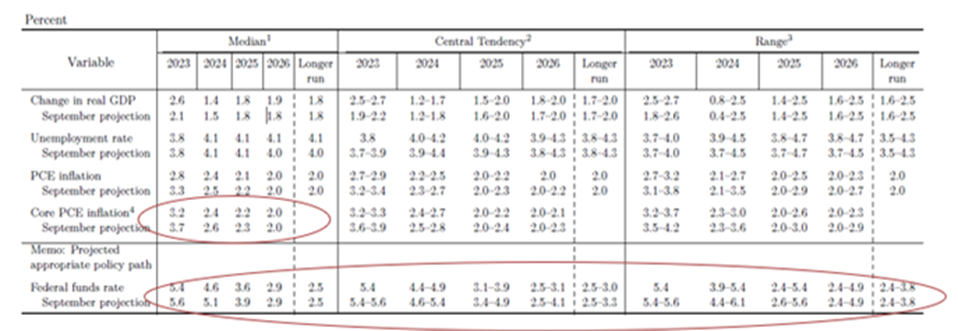
This signal came via three sources. First, the summary of economic projections, which collates the forecasts of committee members, showed that monetary policy is likely to be easier next year. The projections show that the median expectations for interest rates in 2024 were revised down from 5.1% to 4.6%—a notable move given that the previous forecasts were only submitted 3 months. This change was driven by a major downside surprise in the recent inflation data: the committee now expects core PCE inflation to be around 3.2% for 2023, instead of 3.7%.

Second, the dot plot – which maps the committee’s projections in more detail – also showed a notable decline in interest rates in the coming years.

In response, the Fed funds futures, which capture market-implied future interest rates, moved to price in 6 cuts next year, instead of the 4 expected before the meeting. The Fed isn’t expected to cut at its next meeting in January, but the market then anticipants three consecutive cuts from March to June, and it assigns a high probability of cuts in July and September. 

Third, Chair Powell half-heartedly pushed back against the market’s dovish interpretation of this evidence. He noted that it was “too early to declare victory” but admitted that the committee had been talking about when to cut rates. He also said that the Fed would need to start cutting rates “way before” inflation reached its 2% target. These statements imply the next step will be to cut rates.

Unsurprisingly, markets rallied strongly on this news. The S&P 500 and Nasdaq gained ~+1.4%, while the US 10-year yield fell below 4% having topped 5% as recently as September.

Bottom Line

Last night the US Federal Reserve signalled that the tightening cycle is over, and it will pivot to easier monetary policy next year.

Unsurprisingly, markets rallied strongly on this news. The S&P 500 and Nasdaq gained ~+1.4%, while the US 10-year yield fell below 4% having topped 5% as recently as September.

Please check our blog content for advice, planning issues and the latest investment, market and economic updates from leading investment houses.

Alex Clare

14/12/2023