Team No Comments

Epic Investment Partners – The Daily Update | BoJ Rate Hike / Tooth Fairy

Please see today’s daily update from EPIC Investment Partners below:

To call it well flagged would be an understatement. Overnight, the Bank of Japan (BoJ) ended the world’s last negative rate policy, raising interest rates for the first time in 17 years. The central bank raised rates to the range of 0% to 0.1%, from -0.1%, after acknowledging its long-held goal of 2% inflation was within sight. The bank will also scrap its yield curve control (YCC) policy, along with purchases of exchange traded funds and Japan real estate investment trusts (J-REITS). However, it will continue buying long-end JGB’s at “broadly the same amount” as before.  

As we mentioned in Friday’s Daily Update, it was reported that the BoJ’s decision hinged on the outcome of the yearly wage negotiations by Japan’s largest union, Rengo. Japan’s largest companies agreed to hike wages by 5.28% for 2024, the largest increase in 33 years, and 3.5% above the average of the last 20 years.  

In the statement released after the decision, the BoJ said: “Services prices have continued to increase moderately, partly due to the moderate wage increases seen thus far”. “As these recent data and anecdotal information have gradually shown that the virtuous cycle between wages and prices has become more solid, the Bank judged it came in sight that the prices stability target would be achieved in a sustainable and stable manner toward the end of the projection period of the January 2024 outlook report,” the central bank added. 

In the post-meeting news conference BoJ Governor Kazuo Ueda comments were balanced. Ueda admitted that the stronger-than-expected wage growth had played a large role in the decision. He reiterated that the price target was within sight and that the upward economic cycle has been confirmed by recent data releases. However, he expects the BoJ to remain accommodative until the underlying inflation eventually reaches 2%, whilst not taking the option of future hikes off the table. 

Talking of inflation, one person whose prices have sky-rocketed over the last year is the tooth fairy. According to a report in the WSJ, it appears that if the tooth fairy leaves your little ones a pound under their pillow for their teeth, they are entitled to feel hard done by.  

In 2023, the average payout for a lost tooth in the US was at a record high of $6.23, a 20% increase from 2022. However, that’s not the half of it. The report also states some of the jaw-dropping items some children get for losing their teeth. This includes silver fairy necklaces, Louis Vuitton bracelets, even brand-new iPhones!

Please check our blog content for advice, planning issues and the latest investment, market and economic updates from leading investment houses.

Charlotte Clarke

19/03/2024

Team No Comments

Brooks Macdonald Daily Investment Bulletin

Please see below article received from Brooks Macdonald this morning, which provides a global economic and market update.

What has happened

Over the past week, the financial markets grappled with persistent inflationary pressures. Key economic indicators, such as the US Consumer Price Index (CPI) and Producer Price Index (PPI), exceeded forecasts, signalling more persistent inflation. Concurrently, oil prices experienced a significant uptick, with Brent crude reaching $85 per barrel, a high not seen since October. These developments prompted a reassessment of the Federal Reserve’s potential interest rate trajectory. Market expectations for a rate reduction by the Fed shifted, with futures markets now indicating approximately a 60% likelihood of a cut by June, a stark contrast to the nearly certain expectation of a cut two weeks prior. The prospect of fewer rate cuts led to a rise in global yields and a slight downturn in equities. The S&P 500 fell 0.13%, and the small-cap Russell 2000 index was particularly hard hit, falling by 2.08% over the week .

Important decision from the Bank of Japan tomorrow

The Bank of Japan (BoJ) is poised to terminate its negative interest rate policy (NIRP), which would represent its first rate hike since February 2007. The BoJ is reportedly considering an increase in the short-term interest rate from the current -0.1% by over 10 basis points to a range between 0% and 0.1%. This move is based on the assessment that economic conditions are now favourable for achieving a stable 2% inflation rate. In addition to ending NIRP, the BoJ is also expected to discontinue its yield curve control (YCC) policy and halt new purchases of exchange-traded funds (ETFs) and Japan real estate investment trusts (J-REITs), although it may maintain some level of Japanese government bond (JGB) purchases to manage yield volatility post-policy change.

What does Brooks Macdonald think

The upcoming week could be pivotal for the financial markets, as we will see multiple central bank decision. The most important one is Bank of Japan, which is likely to increase rates to 0% tomorrow, marking an end to the era of global negative interest rates. This event may overshadow the Federal Reserve meeting on Wednesday, where no interest rate adjustment is expected but it should provide insights into the Fed’s stance on inflation. Additionally, the Bank of England (BoE) is scheduled to hold its policy meeting on Thursday, rounding out a significant week for central banks worldwide.

Please check in again with us soon for further relevant content and market news.

Chloe

18/03/2024

Team No Comments

US Elections: How Biden and Trump could impact markets

Please see below article received from M&G Wealth Investments yesterday afternoon, which anticipates the markets’ reaction to the result of the November 2024 US presidential election.

2024 has a busy election calendar and governments may be more inclined to reduce taxes and spend more, in an effort to win over voters.

The November 2024 US elections are still a long way off but with the US Presidential nominees now set, we’re starting to think about the future outcomes and market scenarios. Given the sharp policy differences between the two political parties the election outcome could have profound political, economic and market implications – but this is also dependent on the scale of the candidate’s victory. These are our thoughts and what we’re watching:

2025: Expect a deluge of legislation

In the past decade, presidents have moved to enact their flagship policies early in their term. This is because there’s a risk of the House and Senate changing in the ‘mid-term’ elections two years later. In addition, political parties tend to stop working to pass legislation or approve new appointments in the run up to elections. For example, Donald Trump’s key policy of tax cuts was delivered in 2017 and reduced the headline rate of corporate taxes from 35% to 21%. President Joseph Biden’s Infrastructure legislation came in 2021 and the Inflation Reduction Act in 2022. These are examples of key policies that have influenced the US economy and markets.

What does this mean? There’s a narrow window for legislation to be passed in the US. Regardless of who wins, we expect a deluge of new legislation in 2025 and we would expect both candidates to continue spending and borrowing.

If Biden’s Back

We’d expect a Biden victory to reinforce the existing agenda of The American Jobs Plan – investment in infrastructure, transportation, and manufacturing, alongside a focus on building alliances abroad.

Regulation of technology companies and artificial intelligence could be a new area of focus. So far, the European Union has been taking more significant actions to regulate technology companies than the US. We could see this change, as artificial intelligence impacts more areas of society. Within the election itself, the ability to create fake videos, images and voices could have a profound impact.

Immigration is also likely to be high on the agenda, as it’s a key political issue. Biden recently negotiated an agreement on immigration with the US Senate. However, the House of Representatives has declined to consider it citing that it’s too close to an election. If the House of Representatives doesn’t take any action on the current proposal, Biden will want to do that quickly at the start of his next term.

If Trump is Triumphant

We expect to see large tax cuts for companies and individuals if Trump prevails. The real estate sector would likely be a significant beneficiary, as this would support Trump’s personal business interests. Reducing corporate taxes would boost company profits, so we’d probably see an initial boost for stocks. Consumer spending power would increase as well. Longer term, though, this could lead to higher inflation.

Trump has made no secret if his disdain for higher interest rates. It’s not surprising, given that higher interest rates create a more challenging environment for property developers. Jerome Powell’s term as Chair of the US Federal Reserve ends in 2026 and the next President would have to nominate a successor. Trump might replace Powell with someone more likely to reduce interest rates. There is a longer term risk that if Trump were able to appoint several individuals to the Federal Reserve board willing to take direction from him, then monetary policy could cease to be fully independent. A scenario where the market loses confidence in US monetary policy is the biggest risk to financial markets. We might see interest rates reduced in the short term, but combined with tax cuts this could lead to higher inflation in the long run.

Foreign policy would also see change under Trump, with the United States pulling back from international diplomacy. Laws have been changed to prevent Trump from withdrawing the US from North Atlantic Treaty Organisation (NATO), a joint defense agreement created after World War 2.  He could undermine it in other ways, such as not providing funding or not appointing representatives to interact with the organization. With the conflict between Ukraine and Russia ongoing, this would weaken Europe’s position.

What does this mean for investors?

Markets tend to look through election ‘noise’ in the run-up until the outcome is better known. The US economy is in a strong place as a result of four years of spending and investment. It’s an increasingly insulated and self-sufficient economy. We haven’t changed our investment approach in anticipation of the election.  If Trump is re-elected then we expect increased volatility and unpredictability.  But, even with Biden continuing for a second term we’re still likely to face a volatile environment.

Over the past year, we’ve increased exposure to government bonds. Government bonds, and particularly US Treasuries, can perform well during periods of uncertainty. There’s also one potential silver lining: there has been greater divergence in economies recently – most notably in economic growth and inflation. If this trend continues, it could make it easier to have diversification within portfolios.

Please check in again with us soon for further relevant content and market news.

Chloe

15/03/2024

Team No Comments

Brooks Macdonald: Daily Investment Bulletin

Please see today’s Daily Investment Bulletin from Brooks Macdonald:

What has happened

Yesterday, we saw small pullbacks in the market with the S&P 500 slightly retreating by 0.19% from its record peak, while the yields on 10-year Treasuries edged up for the third consecutive day. Tech sector underperformed, as NASDAQ lost 0.54% and the ‘Magnificent 7’ group fell 0.74%. These movements reflect growing concerns about the sustainability of the recent market rally, particularly considering the S&P 500’s sharp rise of over 25% in less than 100 trading sessions. Additionally, inflation remains a key point of focus, with the US CPI release casting doubt on the Federal Reserve’s ability to implement rate cuts by June.

PPI and retail sales preview

Today’s spotlight will continue to shine on inflation with the release of the US Producer Price Index (PPI) and retail sales data. The PPI is particularly significant as it includes several components that contribute to the Personal Consumption Expenditures (PCE) inflation measure, which the Federal Reserve targets. Although the PCE data will not be available until the end of March, today’s PPI figures will provide a clearer indication of what to expect. Meanwhile, the retail sales report is not anticipated to significantly alter the broader narrative of consumer resilience, despite some recent indications of a cooling labour market that could signal a deceleration in consumption growth.

What does Brooks Macdonald think

Although the tech sector underperformed yesterday, it is still the biggest driver of recent market momentum. Tuesday’s gains in the stock market, post-CPI release, were propelled by tech companies such as Nvidia and Oracle, which reported earnings that surpassed expectations, and Wednesday’s modest pullback was again led by the tech industry. Notably, Tesla’s shares dropped by 4.54%, making it the poorest performer in the S&P 500 year-to-date with a 31.8% decline, surpassing Boeing’s downturn. This increasing divergence within the tech mega-caps is certainly one to watch as it could affect overall investors’ sentiment and the scope of broadening of the current equity market rally.

Please continue to check our blog content for advice and planning issues and the latest investment, markets and economic updates from leading investment houses.

Andrew Lloyd DipPFS

14/03/2024

Team No Comments

Evelyn Partners – Investment Outlook

Please see below March’s Investment Outlook from Evelyn Partners, which was received late yesterday (12/03/2024) afternoon:

Balancing growth and inflation

Global economic growth continues to be resilient, providing a backbone of support for companies to deliver on analysts’ earnings expectations. The J.P. Morgan Global Composite Purchasing Managers’ Index, a lead indicator for Gross Domestic Product (GDP), covering both manufacturing and services, shows evidence of gathering steam in January. It reached a level that is consistent with global real GDP growth of 2.8% and has steadily improved over the last few months.

In short, economies have been able to defy the pessimistic expectations from a year ago due largely to healthy job creation as firms continue to replace workers that left the workforce during the Covid pandemic. US demand for available workers (employed plus job openings) is running around 2 million higher than the supply of workers (employed plus unemployed). This points to a healthy jobs market and increases the likelihood that the US can avoid a recession.

A key risk for financial markets is that rapid growth rekindles inflationary pressure and central bankers reconsider their intentions to cut interest rates. Although in the Monetary Policy Committee’s (MPC) last interest rate setting meeting, some Bank of England (BoE) observers noted that inflation could drop below 2% in spring, enough to warrant an interest rate cut. Indeed, the BoE removed its tightening bias and shifted to a more neutral setting by arguing that risks were “more evenly balanced”.

However, elevated wage growth is still a concern for the hawks on the MPC. The Bank’s annual Agents Survey expects wages to expand by 5.4% in 2024, which is above the latest 4% rate of consumer price inflation in January. Should wage data come in stronger than expected it could lead to upward, cost-push pressure on prices. Under that scenario investors could have to wait until later in the year for interest rate cuts.

Wage inflation is less of a problem for the US central bank. The comprehensive Employment Cost Index (ECI), which includes wages, bonuses, and benefits for US civilian workers, grew 4.2% in the fourth quarter of 2023 from a year ago. This is down from a peak of 5.1% in the second quarter of 2022. Importantly, the number of workers quitting their jobs to look for better paid opportunities has steadily fallen over the past year. As a lead indicator for the ECI, the quit rate suggests that the risk of an upward spiral in overall compensation rates has likely eased. Given that consumer inflation is getting close to its 2% target rate, the Federal Reserve will probably feel confident to begin an interest rate cutting cycle in the coming months.

Overall, investors are becoming a little more comfortable that central banks can balance growth and inflation. Given the economic backdrop is relatively benign, the pressure could be on firms to exceed, or at least meet, market expectations for company earnings, and particularly for large-cap stocks.

Size matters for earnings delivery

The Magnificent Seven companies (i.e. Alphabet, Amazon, Apple, Meta, Microsoft, Nvidia and Tesla) have become a dominant proportion of equity benchmarks. This group currently accounts for 29% of the S&P 500 by market capitalisation and were responsible for around 60% of the returns achieved by the index in 2023.

These Magnificent Seven stocks generated significant net income to enable them to outperform the equity benchmark last year. However, this year has been a different story, as only four of the seven names are currently outperforming the S&P 500. This recent earnings season could hold some clues as to why. Nvidia and Meta have been the biggest drivers of returns so far in 2024, as both companies beat analysts’ estimates and posted strong earnings figures for the fourth quarter of 2023. Take Nvidia, a company that is best known for designing some of the world’s most advanced computing chips. It has seen its earnings for the most recent quarter increase by over 450% compared to 12 months prior.

This rapidly increasing demand for chips is due to firms implementing Artificial Intelligence (AI) into their businesses, as advanced chips are essential to accelerating AI-led processes. This bumper earnings report saw Nvidia’s market capitalisation increase by over $275 billion on the day following its latest earnings announcement, the largest daily increase in market value for any listed company ever.

In contrast, Tesla has been the worst performer of the group this year. It was the only member of the Magnificent Seven to miss on analyst earnings expectations in the fourth quarter and has since seen large downward revisions to its earnings growth outlook. Falling profit margins have hindered the electric vehicle maker’s profitability. This could be in part due to recent price cuts implemented to stay competitive against rival Chinese electric vehicle manufacturers. With this constrained earnings outlook and considering that they’re the only member with a market value below $1 trillion, it might be time to reassess their membership of this exclusive club.

To summarise, the macro environment remains supportive for company earnings, and particularly for large cap stocks to drive the overall market. However, there are still risks. Analysts have already forecast strong earnings outlooks for most of these Magnificent Seven companies over the next five years and valuations have been bid up. The risk is this group of stocks fail to achieve these elevated expectations. Given the Magnificent Seven make up a decent chunk of the US (and global) stock markets, should they miss their earnings forecasts it would likely prove a headwind for stocks overall. Nevertheless, on balance, solid economic growth and lower inflation means this risk is probably manageable.

Please continue to check our blog content for advice and planning issues and the latest investment, markets and economic updates from leading investment houses.

Carl Mitchell – DipPFS

Independent Financial Adviser

13/03/2024

Team No Comments

Blackfinch Investment LTD – The Monday Market Update

Please see the below article from Blackfinch Investment LTD providing a brief analysis of the key factors currently affecting global markets and economies. Received yesterday.

UK

Chancellor of the Exchequer, Jeremy Hunt, delivered a Spring Budget that received a muted market reaction. The key takeaway for households was that the main rate of Class 1 employee National Insurance Contributions would be reduced from 10% to 8% from 6th April. This was in addition to the 2p cut announced at the 2023 Autumn Statement 2023 which came into effect from 6th January.

Hunt also announced the introduction of a new Individual Savings Account (ISA) and British Savings Bonds. The UK ISA will give savers an extra £5,000 tax-free allowance on top of the existing £20,000 ISA allowance, to encourage investment into UK-focused assets.

The latest House Price Index from Halifax reported that UK house prices increased 0.4% in February, the fifth monthly rise in a row. Property prices were 1.7% higher on an annual basis, a slowdown from the 2.3% increase in the 12 months to January. An average UK home now costs £291,699, around £1,000 more than last month.

Housebuilding, which has been contracting in recent months, saw its biggest turnaround since January. The Purchasing Managers’ Index (PMI) jumped to 49.8, up from the previous month’s 44.2, reflecting the recent boost in sentiment that interest rate cuts are coming this year.

The S&P Global UK composite PMI, which tracks activity at services companies and manufacturers, increased from 52.9 in January to 53.0 in February. This indicated a pick-up in growth, after service sector companies reported a sustained increase in business activity, with the fastest rise in new work since May 2023.

North America

Recent US economic data boosted expectations that the Federal Reserve could begin cutting rates sooner than expected, with concern of a ‘hot’ jobs market beginning to dissipate. The US unemployment rate rose to 3.9%, the highest since January 2022, against expectations of staying at 3.7%. In terms of wage growth, average hourly earnings rose 0.1% in February from January, less than the 0.3% growth forecast by economists. Finally, the US Labor Department reported the US economy added 275k jobs in February, more than the expected 200k.

Europe

The European Central Bank (ECB) left its key interest rate at 4.50% after its latest policy meeting. Importantly, its latest staff projections show inflation forecasts has been revised down to an average 2.3% in 2024 and 2.0% in 2025. These forecasts has raised hopes that borrowing costs could come down sooner than thought.

Turkey’s consumer price index (CPI) increased by 67.07% annually in February, up from 64.9% in January, showing prices rising even faster than expected. On a monthly basis, prices rose by 4.53% in February. The Turkish central bank maintained interest rates at 45%, pausing a hiking cycle that had lifted borrowing costs by 3,650 basis points since May 2023. A year ago, rates were down at 8.5%, before a series of hikes to cool inflation.

The final Eurozone Gross Domestic Product (GDP) estimate confirmed the economy stagnated in Q4, barely improving on the 0.1% contraction seen in Q3. A historical data revision meant overall GDP growth came in at 0.4% last year, 0.1% lower than previously thought.

German factory orders plunged 11.3% month-on-month in January following an upwardly-revised 12% rise in December 2023. While the wild swings were attributed to volatility in big-ticket orders, core orders shrank 2.1% over the month. Core investment and consumer goods orders contracted over the month, as the impact of past rate hikes dampened consumer demand and the elevated uncertainty derailed investment.

Asia

According to the revised estimates, Japanese GDP grew 0.1% quarter-on-quarter in the fourth quarter of 2023, instead of a 0.1% dip in the initial estimate, reflecting an upgrade in business investment.

India became the fourth largest stock market in the world with a market capitalisation of INR 390trn (over USD 4.6trn) at the end of February, following five consecutive years of growth. The bull run reflects the combination of strong domestic and foreign buying.

Please continue to check our blog content for advice, planning issues and the latest investment, market and economic updates from leading investment houses.

Alex Clare

12/03/2024

Team No Comments

Tatton Investment Management: Monday Digest

Please see below, Tatton Investment Management’s ‘Monday Digest’ providing a brief analysis of the key factors currently affecting global markets and economies. Received this morning – 11/03/2024

At least currency markets noticed the budget

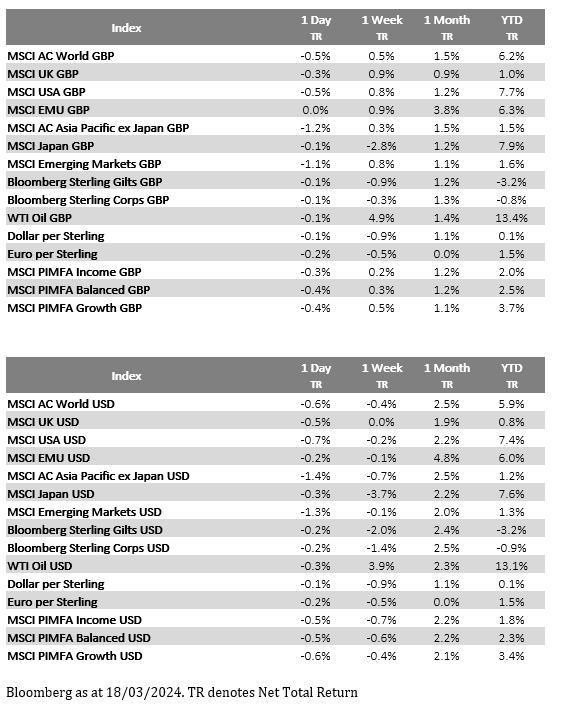
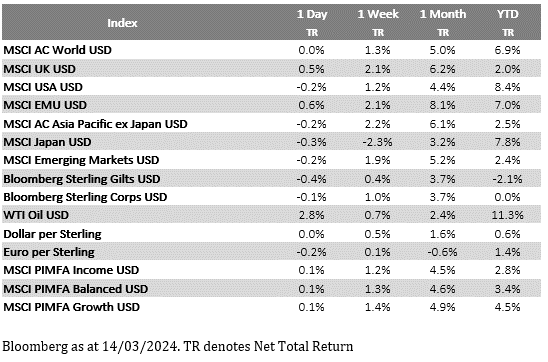
Markets gained again last week, with the S&P 500 hitting another all-time high. But thanks to sterling gaining 1.5% against the US dollar, our table shows negative index returns. Sterling strength may be partly about Jeremy Hunt’s budget, despite the chancellor not giving away so much in the way of fiscal handouts. 

The national insurance cut could boost growth, while the freezing of fuel duties will not. The extra ISA allowance seemed more about show; more of a sop than a solution to Britain’s obvious domestic investment problems. Even these small offerings were enough to send our currency higher, though, with foreign investors becoming more optimistic on sterling assets. The outperformance of UK small cap versus large cap was encouraging too.

Rishi Sunak is unlikely to remain Prime Minister for long, but foreign investors are predicting a relatively smooth transition to a new centrist government, and the budget bolstered those perceptions. Mortgage holders will thank him for not raising borrowing costs. So too will the Labour Party, as it means they will more likely be able to borrow to invest.

The euro also rose, thanks to the European Central Bank (ECB) leaving interest rates unchanged. The ECB will likely cut by the summer, but President Lagarde seems reluctant to be the first developed market central banker to cut. Federal Reserve chair Jay Powell was similarly mildly hawkish in his testimony to US congress, but investors think a cut is at hand. 

Data released on Friday suggests 275,000 US jobs were added in February. That is extremely strong, but the initial data is suspect, as shown by downward revisions to December and January’s initial estimates. Citi Research’s economic surprise indicator shows US economy data is now undershooting economists’ expectations. UK data is starting to beat lowered forecasts while Europe is increasingly beating economist expectations – a great benefit to European equity markets and currency. 

What stands out the most, though, is falling volatility across markets – back to or below pre-pandemic levels in most cases. This tends to go in hand with higher equity valuations, as we are seeing now. High valuations also mean that the market has priced in strong future growth. It may be difficult to get more optimistic so that may mean only mild capital gains. We are likely to see more weeks with small gains but little drama.

Tight might soon feel tighter

Balance sheet adjustments – buying or selling assets – are one of the key ways the Federal Reserve (Fed) manages liquidity in the financial system. One of the most impressive things about the Fed’s post-pandemic quantitative tightening (QT – the selling of bonds and mortgage-backed securities) is that it has gotten so little attention. The infamous ‘taper tantrum’ of 2013 caused upsets in markets – and that was just a suggestion that the Fed might not buy as many bonds as it had, not the current outright balance sheet reduction. 

Reverse repo operations are one of the key tools the Fed has used to temper the effects of QT. In these, the Fed sells securities for cash now and, at the same time, buys them back at a future settlement date – thereby reducing the current cash in the system. They were crucial in the pandemic for draining excess liquidity that the Fed’s own QE had injected, which was causing short-term “congestion”. Reverse repos have been falling significantly for a while, and this reduction has counteracted the tightening effects of QT. The Fed has been tightening with one hand and loosening with another. 

That will likely change, though. The Fed hasn’t told us of any definite plans to taper QT (it is in the ‘talking about talking about it phase’) but the rate of change in reverse repos has already fallen and will level off more the closer operations get to zero. Continuing QT in this phase will probably mean that tight may feel tighter, making markets more volatile.

The key indicator is the gap between interbank lending and the Fed’s reserve rate on repo. When they come closer together it means liquidity levels are at equilibrium. 

The Fed could offset any short-term problems by adjusting repos or QT – but we suspect this could become a politically charged topic this election year. Donald Trump might again criticize the Fed for buying up government debt, so the FOMC will want to keep a low profile. But in a sense they might be damned if they do (through allegations of political interference) and damned if they don’t (through market volatility). This poses more risks to stock and credit valuations. QT hasn’t hurt markets yet, but it still can.

Returning M&A returns?

Mergers and acquisitions are trending up. Corporate deals are usually a sign of business confidence, so it makes sense this is happening when markets are buoyant. M&A activity fell dramatically over the last year, thanks to interest rate rises, but Morgan Stanley researchers think we will see a 50% rise this year compared to 2023. 

M&A deals need motive and financial opportunity. Activity was massive during the pandemic thanks to extraordinary liquidity, but dramatically shrank through rate rises. Rates are now expected to fall – but rate expectations don’t necessarily set current funding costs. Corporate balance sheets and credit spreads have improved, though, while rallying stock markets have helped companies get more capital. We can see this in Capital One’s all-share buyout of Discover Financial, for example. 

There is a huge amount of ‘dry powder’ – capital ready to be invested – held by businesses or private equity funds. Morgan Stanley estimates that global non-financial companies hold $5.6 trillion in cash, while private investors sit on $2.5tn. The US will probably see a lot of activity in private market deals, with less visible partial takeovers or ‘carve-outs’. Regional banks will need to consolidate too, and real estate is primed for M&A. 

Researchers also think Europe will lead the way in M&A activity after a relative drought, with consolidations among asset managers and tie ups between telecoms companies. Japan will likely rebound too, thanks to cyclical factors as well as long-term improvements in corporate governance. Globally, Morgan Stanley expects financials to see the most deals, while energy, health and technology could also stand out. 

M&A activity could catalyse a rotation from growth to value in markets, since the targets for M&A are usually always undervalued companies. Broadly it should mean more money going into stock markets, but the previous big winners will have less to gain.

Please continue to check our blog content for advice and planning issues from leading investment houses.

Alex Kitteringham

11th March 2024

Team No Comments

Blackfinch Asset Management – Monthly Market Moves

Please see below article received from Blackfinch this morning, which provides a detailed global market update for February 2024.

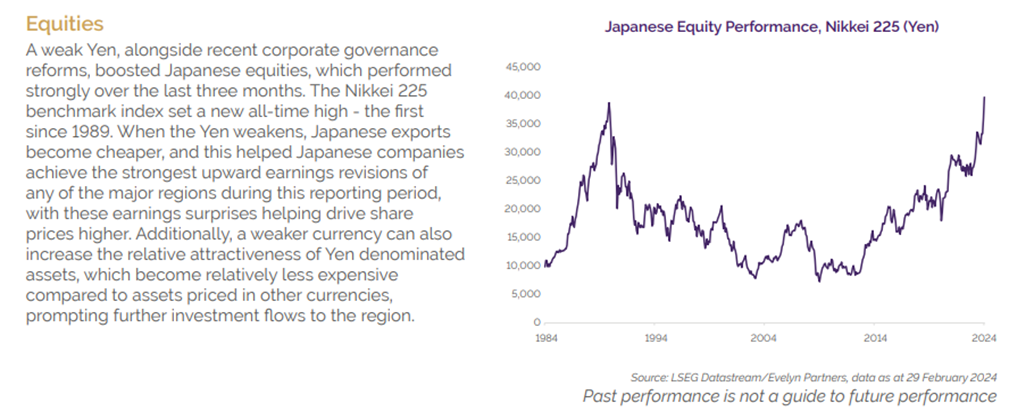
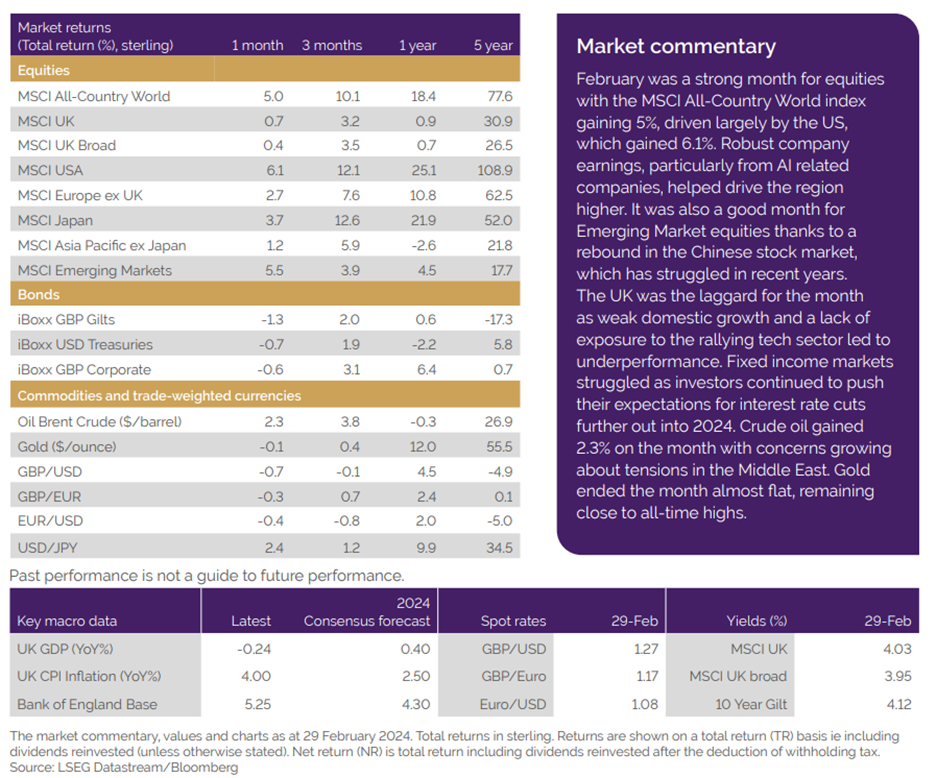
February was a record-breaking month for equity market returns, with several regional indices hitting all-time highs. The key stories were in the US and Japan, with US returns driven by the darling of the Artificial Intelligence (AI) world, Nvidia, boosting sentiment across the market. Japan boasted an impressive corporate earnings season, as well as stark improvements in corporate governance, which helped Japan’s largest index burst through the ceiling set at the end of 1989, when Tokyo real estate was the most valuable on the planet. On the economic front, the UK officially moved into its long-expected technical recession, which sparked some concern for domestic investors. Disappointing inflation data in the US was
largely shrugged off in equity markets by the sheer excitement of AI, as well as the US economy continuing its strong economic growth trend.

Bank of England hints that interest rate cuts are coming…
but not quite yet


• The UK officially moved into a technical recession – defined as two
consecutive quarters of falling national output – at the end of 2023.
The Office for National Statistics (ONS) reported that UK gross domestic
product (GDP) declined by a larger-than-expected 0.3% in the fourth
quarter, following a fall of 0.1% in the third quarter. Although this caused
some concern for local investors, Bank of England (BoE) Governor Andrew
Bailey said he expects this recession will be “shallow” and short-lived.


• UK consumer price index (CPI) inflation remained at 4% in January.
Economists had expected a small increase to 4.2%, meaning it was a softer
reading than predicted and reaffirmed hopes of meeting the BoE’s 2% target.

• The BoE’s decision to maintain interest rates at 5.25% in February, a 16-year high, was no surprise. However, the decision wasn’t unanimous, as varying Monetary Policy Committee (MPC) members voted in different directions, with some preferring to increase the rate by 0.25% and another member opting to reduce it by 0.25%.


• The ONS reported that annual growth in regular earnings, excluding
bonuses, was 6.2% in the fourth quarter of 2023, while pay rises, including
bonuses, reached 5.8%. Economists had expected 6.0% and 5.6%,
respectively. A strong jobs market and wage growth will likely make the
MPC apprehensive about cutting interest rates too soon.

China fighting an uphill battle to economic recovery


• China continued to fight deflationary pressures in January, adding to
uncertainty surrounding its economic outlook, with prices having fallen
at the fastest rate in 15 years. CPI inflation declined 0.8% year-on-year
for January, which marked the fourth straight month of declines and
the sharpest contraction since 2009, after the Global Financial Crisis.
The inflation rate was dragged down by falling food prices, which
dropped by 5.9% year-on-year.


• China did report some encouraging economic data in terms of increased
revenue. Revenue from tourism during the Lunar New Year holiday surged
47.3% year-on-year and surpassed 2019 levels. Domestic tourism spending
hit 632.7bn yuan (£69.7bn), according to government figures, thanks to a
domestic travel boom amid a longer-than-usual break.

• However, we are still seeing a continued trend that foreign direct investment (FDI) into China last year increased by the lowest amount since the early 1990s. China’s direct investment liabilities, a broad measure of FDI, rose by $33bn in 2023, down 81.7% from 2022, according to the State
Administration of Foreign Exchange.

US economy proves too strong for its own good, quashing hopes
of earlier interest rate cuts


• US CPI inflation declined to 3.1% in January, down from 3.4% in December,
but higher than the 2.9% reading economists expected. This was a
disappointing figure at the headline level.


• However, the Personal Consumption Expenditures (PCE) index – the
preferred inflation measure of the Federal Reserve (Fed) – increased by
2.4% in the year to January, down from 2.6% in December. This would have
helped reassure the Fed that inflationary pressures were easing. The core
PCE index, excluding food and energy costs, showed prices rose 2.8% in
the year to January, down from 2.9% a month earlier.


• Despite the positive PCE inflation news, the US jobs market appeared far
too strong for the Fed to consider cutting interest rates just yet. The US
Labor Department reported that employers added 353k new jobs in January taking the unemployment rate to 3.7%, still close to the 50-year low.

• The most disconcerting feature of the jobs report for the Fed was the
strength in worker pay, as average hourly earnings jumped by a surprisingly strong 0.6%. That was the fastest increase in two years, lifting the year-over-year increase to 4.5% from 4.3% in December. This is not the direction the Fed wants to see, as it views taming wages as a critical step in wrestling inflation down to its target.


Summary

As mentioned, it paid dividends to be an equity investor in February. Although economic data across the globe was somewhat mixed, investors in Western markets were again swept up in the AI craze. China was the surprise package for the month, however, with indices rallying due to more targeted stimulus measures from the government. Despite this, Chinese equities remain at 20+ year lows against broader equities. The mood music in the region is still gloomy, as overseas investment expanded at the slowest pace in 30 years in 2023, although GDP did grow by 5%.

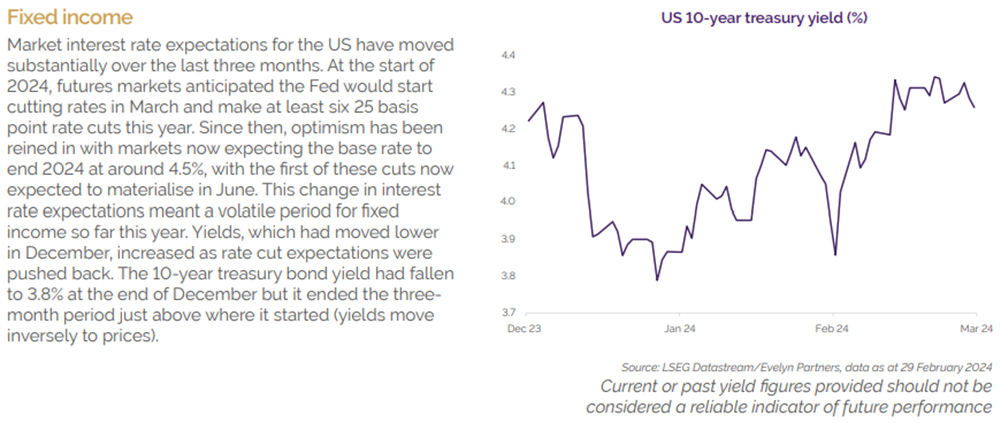
Turning to bonds, the outlook turned negative on rate cuts, with the yield on the ten-year UK government bond (gilt) rising from 3.79% at the start of February to 4.12% by the end of the month, and with the ten-year US Treasury yield increasing from 3.92% to finish the month paying 4.26%. The outlook for high-quality investment grade bonds continued to improve, as February saw over $150bn in new issuance in the US, a record-breaking amount.


Away from equities and bonds, property and infrastructure both fell in value for the month. These assets are particularly sensitive to shifts in interest rate expectations and fell victim to the conclusion from the market that interest rate cuts may not come as quickly as previously hoped, especially in the US.

Please check in again with us soon for further relevant content and market news.

Chloe

08/03/2024

Team No Comments

AJ Bell – 2024 Spring Budget Summary

Please see below an article published by AJ Bell late yesterday (06/03/2024) afternoon summarising the main points from the Chancellors Spring Budget which was delivered in Parliament yesterday.

Today’s Budget was short on surprises, with most of the key announcement already having been briefed to the national media advance.

Key changes announced today include the proposed introduction of a British ISA, a further cut to National Insurance rates for both employed and self-employed workers, relaxation of the ‘high income’ child benefit tax charge, and a proposed summer date for the government’s forthcoming NatWest share offer to retail investors.

British/UK ISA

The Chancellor announced plans to launch a new UK ISA (although he referred to it as a ‘British ISA’ during his speech in parliament), with an annual subscription allowance of £5,000

This will be in addition to the existing £20,000 ISA allowance, with all investments restricted to UK assets.

A consultation on the plans will run until 6 June 2024, with the government proposing that the UK ISA would be restricted to UK shares, gilts and UK corporate bonds. The consultation also suggests preventing holders keeping cash in the accounts, effectively forcing them to invest the money in UK assets.

There is still much to be confirmed and the proposals could yet change considerably, especially given that any future UK ISA product is likely to be introduced after the next General Election.

National Insurance

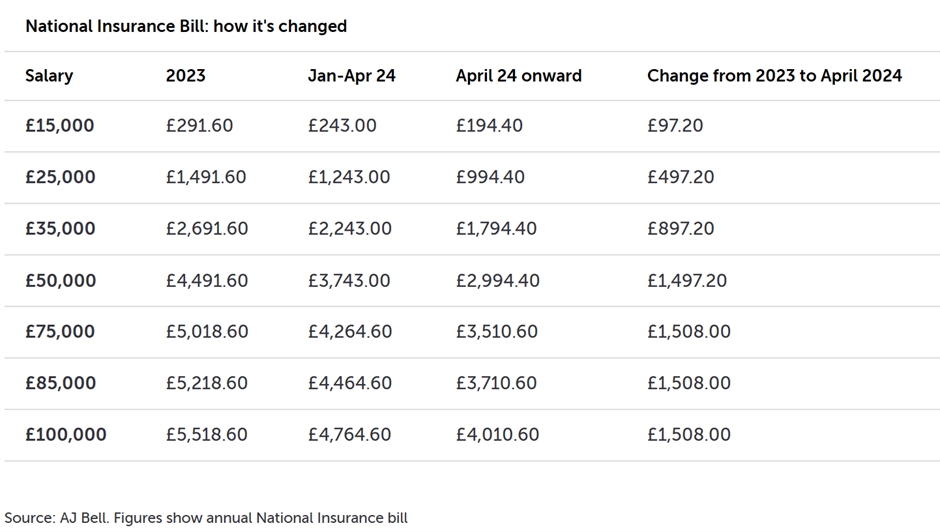
The government has announced a further cut of 2 percentage points to National Insurance, following the cut previously announced at the Autumn Statement and which applied to employed workers’ payslips from January this year.

In aggregate, it means a cut of 4 percentage points to the entry rate of National Insurance since December 2023, with better paid workers seeing a £1,508 boost as a result of the cuts.

It is worth bearing in mind that income tax thresholds have been put into deep freeze, creating a so-called ‘fiscal drag’ effect that has pulled many people into a higher rate of income tax.

For many taxpayers, these changes will only go part way to making up for the additional tax they’re paying as a result of the freeze on income tax thresholds and the personal allowance.

Self-employed NI will also be cut further. Around 2 million self-employed people will see a boost to their earnings from next month, as their National Insurance bill drops significantly. The previously-announced changes from the Autumn Statement were due to come in from April but have now been superseded by a further significant cut to rates. It means that the National Insurance rate for Class 4 contributions paid by the self employed has been cut from 9% to 6%, at the same time as the Government has scrapped Class 2 contributions.

Child benefit

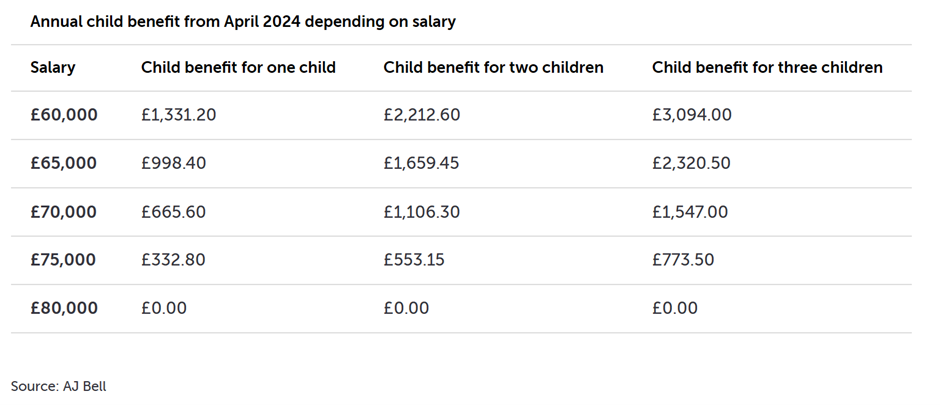
Under the current system, child benefit is gradually withdrawn for those earning more than £50,000 a year. It means households with one earner bringing home £60,000 a year currently get nothing (they can still claim child benefit, but repay it through the high income tax charge).

Under the government’s proposed reforms, the point at which child benefit begins to be withdrawn will increase to £60,000.

Those earning between £60,000-£80,000 a year will see their child benefit gradually withdrawn. So this is good news for those households with earnings of between £50,000-£80,000 who would previously have had to repay any child benefit claimed, but will now be eligible for at least some of it.

Looking further ahead, the government says it wants to reform the system so that eligibility is based on a couple’s combined earnings. Currently, a sole earner on £60,000 gets no child benefit while two earners each on £49,000 will get the full benefit. The reforms could change that, although they aren’t pencilled in until April 2026. Much could change before then.

NatWest

Government has previously pledged to launch a retail share offer for NatWest, giving ordinary investors a chance to buy a chunk of the bank, which remains partially under state ownership.

The Chancellor signalled this could happen in the summer ‘at the earliest’, declining to set a clear timetable for the sale.

There is a fine line to tread here, since the government needs to balance getting a good deal for the taxpayer, while also offering an enticing opportunity for investors without suppressing the value of shares already in circulation.

Please continue to check our blog content for advice and planning issues and the latest investment, markets and economic updates from leading investment houses.

Carl Mitchell – DipPFS

Independent Financial Adviser

07/03/2024

Team No Comments

Brewin Dolphin – Markets in a Minute

Please see this week’s Markets in a Minute update from Brewin Dolphin, which was received yesterday evening:

Guy Foster, Chief Strategist, discusses recent economic growth data, while Janet Mui, Head of Market Analysis, analyses US inflation and consumer spending data.

The trend of the market reaching new highs continued at the end of February. The S&P 500 had already broken new ground but was joined by the NASDAQ, which surpassed its previous high seen at the end of 2021.

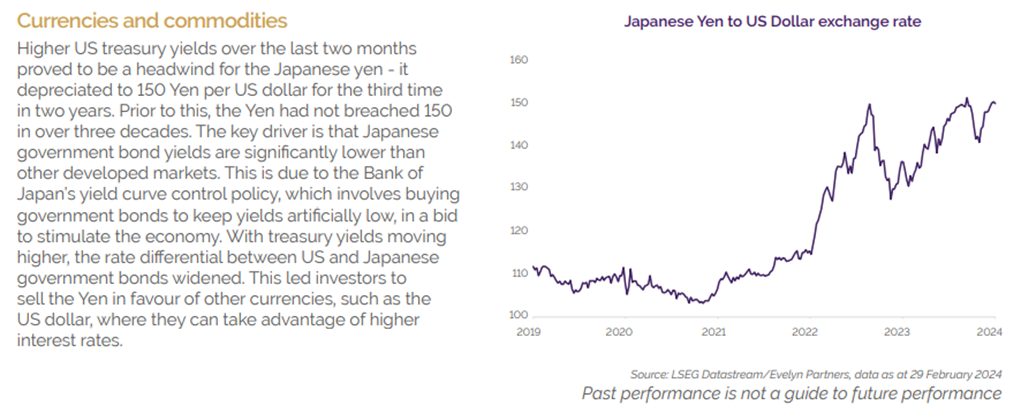
Japan has seen very strong index performance. Part of that has been aided by rapid yen depreciation. As a result, the Nikkei 225 also reached a new all-time high the week before last. But while the US markets are surpassing levels seen in 2021, the Nikkei is making a first all-time high since an extraordinary bubble in stocks and realestate at the end of the 1980s.

The Nikkei index is one of a few price-weighted indices (another being the Dow Jones in the US) where each company’s weight reflects how big its share price is rather than the relative size of the company. Japan’s more conventional TOPIX index remains well short of its late80’s high.

The FTSE 100 remains 4% off its record high, experienced early last year. Like many regions, the UK has underperformed the US recently, but the performance of indices exaggerates the extent. Overall, The UK market generates a dividend yield of 4% which is significantly driven by the energy sector.

Over the past couple of weeks, the stock market experienced fluctuations near record highs as traders awaited a barrage of economic data and remarks from Federal Reserve speakers on interest rates. The market absorbed heavy Treasury and corporate sales amidst month-end positioning, with US yields rising after government note auctions. Blue-chip companies sold a record amount of bonds in February to capitalise on investor demand amid lower borrowing costs.

The most obvious banana skin for the market overall was the US personal consumption expenditure (PCE) data. This ostensibly measures spending and feeds into gross domestic product (GDP). GDP is normally quoted in real terms, meaning it is adjusted for inflation. The Federal Reserve has typically preferred to measure consumer price changes through the PCE over the consumer prices index (CPI). PCE covers a broader range of goods and services, as well as a broader definition of consumers. The PCE process for changing the weightings of categories over time is perceived to be better, and its treatment of housing costs is more reflective of actual costs suffered by homeowners.

CPI, on the other hand, is released earlier during the month and certainly sounds more like the measures of inflation used in other regions (although some argue PCE is methodologically closer to other countries’ inflation calculations).

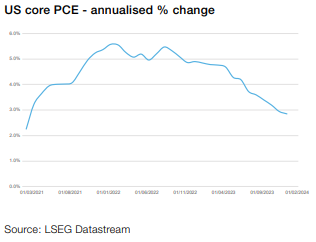
Perhaps the most critical difference between CPI and PCE in recent months is that core PCE, which excludes food and energy, has declined faster than core CPI, and thus paints a rosier picture of the consumer environment, which puts less pressure on policymakers to maintain high interest rates.

It was therefore a boon to investors to see the core PCE price index rising by just 2.8% over the twelve months to January (PCE data are released late relative to CPI). This is the slowest pace of price increases since March 2021. The data were taken positively by the market, seeming to justify hopes of lower interest rates later in the year. Afterall, real spending by consumers declined. But despite the slowdown in the annual rate of inflation, the monthly data were pretty strong, seeming more consistent with the CPI data from earlier in the month.

Gauging trends in inflation is difficult during January when a significant seasonal adjustment needs to be made. There were also a lot of one-off factors distorting consumer activity (such as weather), a strong month for dividend income, and a jump in cost-of-living adjustments for social security payments.

For now, markets expect to see interest rates declining as soon as June, but that will depend upon how policymakers interpret these data.

Federal Reserve speakers continued to influence market sentiment, with officials expressing readiness to lower rates if necessary. However, they emphasised the economy’s strength and the need for caution in policy adjustments.

Boston Federal Reserve president, Susan Collins, and New York’s John Williams, believe it will be appropriate to cut rates for the first time later this year, which is consistent with Raphael Bostic of the Atlanta Federal Reserve, who expects to cut this summer. Federal Reserve governor Michelle Bowman expects inflation to continue to decline further, with interest rates held at their current level — but said it’s too soon to begin rate cuts.

Please continue to check our blog content for advice and planning issues and the latest investment, markets and economic updates from leading investment houses.

Andrew Lloyd DipPFS

06/03/2024