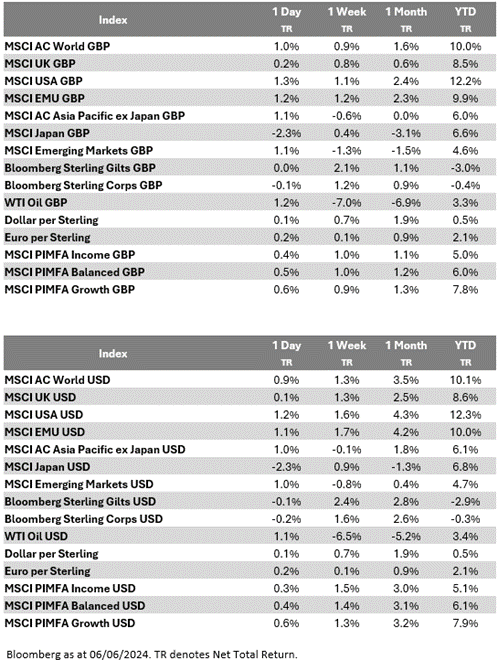
Please see below an article from EPIC Partners providing their daily round-up on markets, which was received this morning (07/06/2024):
No, don’t worry, at least not about us.
In a move that has left many Londoners nostalgic, the Evening Standard, a staple of the city’s daily commute since 1827, is set to transition from a daily to a weekly print edition. This shift underscores the challenges faced by traditional news outlets in an era where financial sustainability is increasingly arduous.
The newspaper has reported significant financial losses, totalling £84.5 million over the past six years, contributing to a decline in circulation from 850,000 to approximately 250,000. Factors such as reduced commuting, increased remote work, and Wi-Fi availability on the Tube have all played a role.
Changing news consumption patterns are affecting the industry globally. These shifts have allowed opportunistic players like Alden Global Capital, often considered a stereotypical “vulture fund,” to acquire numerous newspapers in the US and implement severe cost-cutting measures.
There are other models, however. Reuters, for instance, has capitalised on early knowledge of significant developments to make trades before releasing the news to the market. Hunterbrook Capital, a hedge fund, is copying that model and has raised $100 million to trade based on scoops from its affiliated newsroom, Hunterbrook Media. Unlike firms that take short positions before publishing their research, such as Hindenburg Research and Muddy Waters, Hunterbrook has established Chinese walls between its trading and journalistic arms. Whether this will suffice to fend off regulators and lawyers remains an open question.
The situation with the Evening Standard is a stark reminder of a critical issue: who pays for high-quality, fact-based journalism? Free content with ads doesn’t seem to cover costs, micropayments haven’t gained traction, and many only skim headlines rather than reading full articles. This funding gap is something that opportunistic investors have been keen to exploit, threatening the future of long-form investigative journalism.
High-quality journalism is crucial not only for democracy but also for efficient markets and vital for uncovering malfeasance, from corporate fraud to government corruption, playing a key role in maintaining public trust and informed decision-making. This is also essential for our investments to ensure risk-awareness and appropriate management.
As the Evening Standard’s daily edition sails off into the sunset, rest assured that we will continue to deliver our daily dispatches. We continue to see it, say it. Sorted.
Have a good weekend.
Please continue to check our blog content for advice, planning issues and the latest investment, market and economic updates from leading investment houses.
Please see the below update from Evelyn Partners for their thoughts on this afternoon’s (06/06/2024) ECB monetary policy decision:
What happened?
The European Central Bank (ECB) cut interest rates by a well communicated 25bps at their meeting today, taking their key deposit rate to 3.75%, main refinancing rate to 4.25% and marginal lending facility to 4.5% – from 4.00%, 4.5% and 4.75% respectively.
The inflation projection for 2024 was upgraded to 2.5%, from 2.3%, 2025 was upgraded to 2.2%, from 2.0%, and reiterated at 1.9% in 2026.
Guidance was updated to include a new line “The Governing Council is not pre-committing to a particular rate path.”
What does it mean?
The ECB’s decision comes after a nine-month period of being on hold and is their first cut since the beginning of 2016.
The move lower comes a day after the Bank of Canada became the first G7 central bank to cut rates in this cycle with their 25bp move lower to 4.75%, but notably ahead of the US Fed who has typically led monetary policy loosening in previous cycles.
Given that the move was so widely anticipated and already priced into the market, the focus was on the inflation projection and language surrounding future moves.
Arguably the upgrades to Inflation guidance struck a hawkish tone (introducing the hawkish cut?!) but the initial market reaction was surprisingly muted…
Unsurprisingly, and like other central banks, the guidance maintained a data dependent tone.
“The Governing Council is determined to ensure that inflation returns to its 2% medium-term target in a timely manner. It will keep policy rates sufficiently restrictive for as long as necessary to achieve this aim. The Governing Council will continue to follow a data-dependent and meeting-by-meeting approach to determining the appropriate level and duration of restriction. In particular, its interest rate decisions will be based on its assessment of the inflation outlook in light of the incoming economic and financial data, the dynamics of underlying inflation and the strength of monetary policy transmission. The Governing Council is not pre-committing to a particular rate path.”
Bottom Line
The ECB’s Governing Council cut rates by 25bps taking their key deposit rate to 3.75%. Markets are pricing a second incremental cut in September/October and third in the first quarter of 2025 demonstrating a ‘steady as she goes’ approach given the high levels of uncertainty and persistence in services inflation domestically and arguably also abroad.
Please continue to check our blog content for advice, planning issues and the latest investment, market and economic updates from leading investment houses.
Please see below today’s Daily Investment Bulletin from Brooks Macdonald, which was received this morning, 06/06/2024:
What has happened
Ahead of an expected interest rate cut from the European Central Bank likely later today, the Bank of Canada (BoC) has got there before it. Yesterday, the BoC became the first central bank out of the so-called ‘G7’ group of leading economic nations to cut its interest rates in the current monetary policy cycle, cutting by 25 basis points to 4.75%. Not only that, the BoC governor Macklem said yesterday that it was “reasonable to expect further cuts”. Elsewhere, economic confidence in markets returned on Wednesday with US services industry survey data out that was stronger than expected. In marked contrast to the manufacturing data earlier in the week. US services Purchasing Managers Index (PMI) from the Institute for Supply Management jumped 4.4 points month-on-month to 53.8. It was well above market estimates and was the highest reading in 9 months. Equity markets were buoyed by the better data with gains led by tech stocks, while government bond yields generally edged lower.
Nvidia reaches another milestone
Nvidia, the US megacap technology semi-conductor chip designer has hit another milestone. The poster child for the generative Artificial Intelligence (AI) boom, Nvidia’s share price was up +5.16% yesterday in US$ terms. With it, Nvidia narrowly overtook Apple to become the second largest quoted company in the US, with a market capitalisation of US$ 3.012 trillion, versus Apple’s US$ 3.003 trillion. For context, Microsoft is still number one with a market capitalisation of US$ 3.151 trillion. The latest surge in Nvidia’s share price has come about following news over the past few days that the company plans to upgrade its AI technology every year, announcing new generation chips in development earmarked for launches in 2025 and 2026. Key to the latest enthusiasm around the stock, CEO Huang is looking to broaden the company’s customer base beyond the handful of cloud-computing tech giants that have hitherto generated much of its sales.
Oil prices see supply headwinds
Although the oil price saw a small bounce yesterday, it has dropped over the past week. Driving the fall was the latest OPEC+ meeting last weekend (the Organization of the Petroleum Exporting Countries plus non-OPEC members including Russia). Previously, OPEC+ members have been curbing output by a total of 5.86 million barrels per day (mbpd), or about 5.7% of global demand. At their latest meeting however, while OPEC+ agreed to extend 3.66 mbpd of cuts until the end of 2025, it said it would only prolong cuts of 2.2mbpd by three months until the end of September 2024. After September, OPEC+ plans to gradually phase out the cuts of 2.2mbpd over the course of a year from October 2024 to September 2025. That incremental supply is being seen as a headwind for prices and could signal some weakening in resolve amongst OPEC+ members to continue their supply curb discipline.
What does Brooks Macdonald think
Regular readers could be forgiven for thinking that it is not a Daily Investment Bulletin without mention somewhere about inflation! Over in Asia, inflation data out last month from Japan suggests that the recent recovery in prices, something which the Bank of Japan (BoJ) has hitherto been trying to engineer, is at risk. Japan’s so called ‘core-core’ Consumer Price Index (CPI) annual inflation, which exes out both fresh food and energy prices, dropped for the eighth month in a row in April. At an annual rate of +2.4%, it was the slowest inflation pace since September 2022, and not that far from the central bank’s 2% inflation target. For Japan’s central bank, there is a desire to try to normalise interest rates higher, after ending negative rates earlier this year. Should inflation rates continue to weaken, that could curtail the BoJ’s room for hiking, and risk putting yet more pressure on an already weak Japanese Yen currency this year.
Please continue to check our blog content for advice, planning issues and the latest investment, market and economic updates from leading investment houses.
Please see the below article from Brewin Dolphin providing their discussions on the potential impact of Donald Trump’s conviction on the upcoming US election.
The U.S. election is still more than five months away, but last week saw a significant milestone on the campaign trail.
Former President Donald Trump had been waylaid by the inconvenience of a trial for allegedly falsifying business records, in a case that stemmed from efforts to pay hush money to an adult film star. The jury unanimously found him guilty on 34 separate counts, prompting celebrations from many of his adversaries.
The outcome and the circumstances leading to the case would surely have been terminal for the electoral prospects of a conservative candidate for a government position, however, it is unclear whether they will have a material adverse effect on the former president’s odds of success.
It would be unusual for a convicted felon to serve as president, but it is not prohibited by the constitution. It would also be impractical for a jailed president to discharge his duties, but jailtime seems unlikely for a first-time offender and would likely be deferred in the event that this was the sentence.
While Trump cannot argue his case in the conservative[1]leaning Supreme Court, he does have a path and realistic grounds for appeal, so the conviction may yet be overturned.
The market reaction to Trump’s conviction
If the conviction doesn’t provide any legal impediments to a second Trump presidency, would it provide political ones? There was a flurry of activity on the PredictIt site, an online prediction market that allows users to buy shares for or against an event such as the U.S. presidential election. This activity briefly saw President Biden overtake his rival but since then, the gap has returned in Trump’s favour for now, though a little smaller than it was.
With the impact of Trump’s conviction on the electoral race uncertain, there was no discernible market reaction. It remains difficult to say with confidence which candidate the markets would prefer. Neither offers a path to fiscal sustainability, although President Biden would be expected to allow Trump’s temporary tax cuts to expire.
At the same time, Trump’s erratic and unpredictable execution of foreign and trade policy creates risks which investors won’t welcome.
The U.S. bond market was volatile last week, however, with low demand for a five-year auction spooking bond investors. The bid-to-cover ratio of 2.3 was the lowest in a year. This suggests less demand than we have seen in recent auctions, although a ratio of more than two suggests demand levels are generally strong.
More impactful than the uncertain electoral outlook is the uncertain economic outlook for the time being.
Consumer and business confidence improving
Last week, economic data was generally strong, continuing to undermine the case for interest rate cuts. There wasn’t a huge amount of economic data, but the Conference Board survey of consumer confidence was notably strong and would seem to undermine the impression that the U.S. economy is slowing down.
It is also worth noting that in the U.S., there is a strong relationship between consumer confidence and a recovery in the value of personal pension plans, which may have left households feeling more positive.
In the UK, business confidence, as measured by a survey of Lloyds’ business customers, continues to imply remarkable economic strength. Business confidence seems to have recovered to a level not seen since the end of 2015, before the run-up to the Brexit referendum.
The series, which measures the share of companies increasing prices, rose to an all-time high (this series only dates back to 2018). This will be a challenge to those hoping for continued moderation of price growth. As noted a couple of weeks ago, it is possible that June contains the last significant decline in the inflation rate, before base effects make it more reflective of these near-term price trends.
UK election outlook – as it stands
The UK election is already looming large, with just one calendar month to go at the time of writing. Despite the impression that the economy is strong and gaining momentum, voters seem unmoved.
The political benefits of two successive cuts to National Insurance rates have been limited. Indeed, polling released last week suggested why. Firstly, voters don’t believe either party will be able to meet their pledges to lower or even maintain taxes. Secondly, supporters of both parties would have a marginal preference for more spending on public services rather than lower taxes.
The UK election outcome remains Labour’s to lose. The next significant milestone would be the release of the manifestos, at which point analysis of tax and spending plans can take place.
However, as polling has revealed, the public has very low trust in government fiscal plans and shares the scepticism of the International Monetary Fund (IMF). The IMF has suggested additional ways of raising tax revenues to meet the demands of increased departmental spending, given the needs for more spending on healthcare and more investment on the carbon transition.
Please continue to check our blog content for advice, planning issues and the latest investment market and economic updates from leading investment houses.
Please see today’s daily update from EPIC Investment Partners received this morning:
In a historic moment for Mexico, Claudia Sheinbaum has been elected as the country’s first female president after a decisive victory at the polls, a giant leap in Mexico’s traditionally machismo culture. Sheinbaum’s win represents a continuation of the nationalistic energy policies pursued by outgoing President Andrés Manuel López Obrador and his Morena party. Moreover, Sheinbaum is expected to live up to her reputation of being efficient, unlike many of her predecessors, an esteem she earned during her tenure as Mexico City mayor.
Sheinbaum has promised to double down on strengthening and revitalising Mexico’s vital state-owned companies like the oil giant Pemex and electricity utility CFE. The president-elect aims to invest heavily to modernise these strategic assets and position them as drivers of economic growth and energy independence for Mexico.
After decades of underinvestment, Sheinbaum believes prioritising and properly funding Pemex and CFE is the best way to unlock their full potential as key producers for the Mexican people. For Sheinbaum, revitalising Pemex and CFE is about more than just economics and energy self-sufficiency. It reflects her nationalistic vision of reasserting Mexican sovereignty over strategic industries and natural resources. While critics argue these state firms require private investment to thrive, the incoming administration seems committed to an opposing path of doubling down on government ownership and control.
With a strong mandate, Sheinbaum appears determined to make the revival of Pemex and CFE a top priority. She stated she will pour billions into upgrades at Pemex’s aging refineries, as well as complete major projects like the new Olmeca refinery and coker units. This would allow Mexico to slash its dependence on imported refined petroleum products. Sheinbaum also wants CFE to lead renewable energy development nationwide. This falls in line with her 2024-2030 roadmap, which aims to “decarbonise the energy matrix as quickly as possible”.
Mexico is one of only two G20 nations that does not have a net zero emission target. So Sheinbaum, a climate scientist with green ambitions, is clearly the right person to commence the shift. However, López Obrador’s legacy and influence would likely impede significant shifts from the current administration’s approach, potentially forcing her to pay a political price for substantial green reforms. Nonetheless, investors have welcomed the continuity and policy certainty presented by Sheinbaum so far. There is optimism that under the Sheinbaum government’s firm control over the energy sector will provide stability.
Sheinbaum’s presidency is a giant leap in Mexico’s traditionally machismo culture. Who would have thought the old boys’ club would be disrupted by a bold, green-thinking woman determined to reassert sovereignty? With her firm hand on the wheel, Mexico’s path to energy independence and decarbonisation is sure to be one wild ride. Buckle up, the age of mujeres is here!
Please continue to check our blog content for the latest advice and planning issues from leading investment firms.
Please see below article received from AJ Bell yesterday morning, with our thoughts added at the end for your perusal.
Given the rate at which prime ministers (and chancellors) seem to come and go, investors may be rightly inclined to avoid second-guessing the result of the next general election, which is now set for Thursday 4 July.
The lack of available cash in the government’s kitty, the Conservatives’ occasionally frayed relationship with ‘business’ and the likelihood that Labour took on board Trussonomics’ lesson that unfunded promises could prompt chaos may all mean that investors could be in the mood to take Sir Keir Starmer’s big lead in the polls, and any eventual victory, in their stride, even if the FTSE All-Share’s record shows it seems to prefer a Tory government, on average.
The prospect of a government spearheaded by Sir Keir and Rachel Reeves is unlikely to spark the sort of fear that would have been inspired by an administration whose driving forces were Jeremy Corbyn and John McDonnell. Moreover, the current Conservative government, whose tenure effectively dates back to 2010 and covers a flurry of five prime ministers, could be seen as having taken an increasingly interventionist approach to the economy, given such initiatives as sugar taxes, Help to Buy, energy price caps, windfall taxes on North Sea oil producers, 2021’s National Security and Investment Act and proposals for changes to the 2005 Gambling Act under the recent review.
Increasingly vocal and forceful regulators, such as the Financial Conduct Authority, Ofcom, Ofgem, Ofwat and the Competition and Markets Authority, appear to be responding to public pressure for greater action, and perhaps the hardest part for investors going forward will be spotting which industry or sectors will come under scrutiny next, in the wake of such recent examples as betting, funeral services and veterinary services.
The headline data suggests that a Labour government, and a change in the identity of the incumbent in 10 Downing Street, need not be seen as an inherently bad thing.
A study of all sixteen of the general elections since the inception of the FTSE All-Share in 1962 shows that the UK stock market is by no means frightened of a change in government and it may even welcome it. On average, the FTSE All-Share has recorded a double-digit percentage gain in the first year after an election which sees one prime minister ejected from office and another, new one ushered into it. There are also greater average gains when a government changes relative to when it remains the same.
Source: LSEG Datastream data. *1964/66 to 1970 Wilson governments and 1974/74 to 1979 Wilson/Callaghan governments counted as one term. 2019 Conservative government to 22 May 2024
Labour governments can also point to healthy average stock market gains during the terms of their five prime ministers during the 42-year era of the FTSE All-Share.
That said, the UK equity market has done better since 1962, on average, when the Conservatives have triumphed at the ballot box.
Source: LSEG Datastream data. *1964/66 to 1970 Wilson governments and 1974/74 to 1979 Wilson/Callaghan governments counted as one term. 2019 Conservative government to 22 May 2024. **Adjusted for retail price index (RPI).
Some investors could therefore be forgiven for wishing for a Conservative government, on financial grounds, irrespective of their personal political preferences, especially as the average real, post-inflation return from the FTSE All-Share is markedly superior under Conservative governments than it is Labour ones.
The size of a government’s majority seems to be matter of indifference to stock market investors, even if any incumbent in 10 Downing Street will be looking for a thumping advantage in the House of Commons, so they can get on with the business of governing the country and formulating policy, rather than having to constantly curry favour with their own MPs first.
Margaret Thatcher’s crushing 1983 general election win helped to set the tone for her second term and that period yielded the best nominal (and real, post-inflation) returns from the FTSE All-Share from any post-1962 administration. However, Tony Blair’s second-term majority was even bigger, and that period yielded negative returns for investors in UK equities, using the FTSE All-Share as a benchmark.
Source: LSEG Datastream data. *Wilson initially PM with a minority of 33 after February 1974 and then with a majority of 3 after October 1974. Wilson stepped down in April 1976. **Wilson initially won a majority of 3 in 1964 which was increased to 96 in 1966. ***Blair stepped down in June 2007. ****Cameron stepped down in July 2016. *****Johnson resigned in July 2022. Liz Truss took over in September 2022 and was replaced by Rishi Sunak in October 2022. ******May’s initial working majority was based on a deal with the DUP. *******Performance under current government as of 22 May 2024
Again, the role of inflation is important here. The 1974-79 Labour administration that began under Harold Wilson and ended under James Callaghan started off with a tiny majority but on paper generated healthy returns for the FTSE All-Share, which rocketed. However, once those returns take a spiral in the RPI measure of inflation into account (and RPI is used as it offers a longer history than CPI), then investors actually lost out in real terms, in what was a difficult decade for shareholders, owing to the ravages of inflation.
Source: LSEG Datastream data. *Wilson initially PM with a minority of 33 after February 1974 and then with a majority of 3 after October 1974. Wilson stepped down in April 1976. **Wilson initially won a majority of 3 in 1964 which was increased to 96 in 1966. ***Blair stepped down in June 2007. ****Cameron’s majority relied on a coalition with the Liberal Democrats. He stepped down in July 2016. *****Johnson resigned in July 2022. Liz Truss took over in September 2022 and was replaced by Rishi Sunak in October 2022. ******May’s initial working majority was based on a deal with the DUP. *******Performance under current government as of 22 May 2024
Inflation also sorts out the real winners and losers, from the markets’ perspective, when it comes to individual prime ministers. Of the 13 prime ministers since 1964, four of the best five from the very narrow perspective of stock market perspective were Conservatives, once FTSE All-Share returns are measured in nominal terms.
But the shake-out comes in real, post-inflation terms, when four of the five best premierships for investors came under the Conservatives and the three worst under Labour.
This is not to make an economic point, rather than a political one. As former US president Bill Clinton’s strategist, James Carville, argued ahead of the then Arkansas governor’s 1992 election win, ‘It’s the economy, stupid.’ If the voters feel flush, they are more likely to vote for the incumbent government and less so if not, and inflation is a key part of that.
The galloping inflation of the 1970s, and subsequent labour unrest, did for both Ted Heath in 1974 and James Callaghan in 1979. In the latter case, public appetite for a change of tack was particularly strong and ushered into power the nation’s first female prime minister.
Gordon Brown had little or no chance, having had the bad luck to preside over the Great Financial Crisis of 2007-09 and Tony Blair’s second term coincided with the bursting of the technology, media and telecoms bubble, the blame for which could not be laid at Downing Street’s door under any circumstances.
What will be interesting this time around is the degree to which inflation and the economy shape public thinking once more. The Brexit vote dealt Theresa May a difficult hand and the pandemic gave Boris Johnson a dud one, but the public will remember inflation and the cost-of-living crisis. Regardless of whether they blame that on the Bank of England’s monetary experimentation, supply chain dislocations caused by the pandemic, the oil price spike that followed Russia’s invasion of Ukraine, or just stick it on the government may be a crucial factor in how the general election plays out.
For all that Rishi Sunak now feels able to claim the credit for a deceleration in the annual rate of inflation back to 2.3%, prices are still rising and not shrinking. Since Boris Johnson defeated Jeremy Corbyn in December 2019, the retail price index is up by 31.9% and the consumer price index by 23%, so the cumulative impact of inflation upon consumers’ spending power is damaging indeed.”
Source: Office for National Statistics
Comment
Markets appear to have priced in a Labour win and we don’t anticipate much volatility around the time of the UK General Election. It is interesting to note how events impact on the performance of markets for Governments.
The Tories have a far better outcome overall. But does this Labour Party look more Tory than Labour? And what will happen when elected?
Please see below, EPIC Investment Partners’ Daily Update detailing the latest figures on the strength of the US economy. Received this morning – 31/05/2024
The Fed’s Beige Book lived up to its name, revealing little in the way of new colour on the US economy, which it noted had maintained modest growth from early April to mid-May, though conditions varied across industries and regions.
Most districts reported slight economic expansion, though consumer spending remained subdued due to high inflation and uncertainties. Some sectors like travel/tourism and housing showed resilience. Employment rose slightly overall with modest job gains, but labour shortages persisted. Wage growth was moderate. Inflation continued rising modestly, with businesses facing consumer pushback on price hikes and smaller profit margins. Input costs were mixed, with some declines in material prices. Modest price growth was expected near-term.
Despite pockets of resilience, overall economic outlooks grew more pessimistic due to rising uncertainties and downside risks stemming from inflation, tighter financial conditions, and economic headwinds.
Furthermore, data released yesterday showed the US experienced a slower growth rate in the first quarter of the year than initially estimated, primarily due to weaker consumer spending on goods. GDP rose 1.3%yoy, lower than the previous estimate of 1.6%. Personal spending, which is the main driver of economic growth, advanced by 2.0%, a downward revision from the earlier estimate of 2.5%.
We also had an insight into corporate profits and inflation figures. Adjusted pre-tax profits for corporations declined by 0.6% in the first quarter, marking the first drop in a year. The Fed’s preferred inflation metric, the personal consumption expenditures price index (PCE), rose at an annualised rate of 3.3% in the first quarter, slightly lower than the initial projection. The core PCE gauge, which excludes food and energy, increased by 3.6%, a minor revision from the previous estimate of 3.7%. Markets will closely monitor the hotly anticipated PCE deflator readings for April, due later today. The headline figure is expected to have risen 0.3%mom and 2.7%yoy, and the core reading is forecast at 2.8%yoy.
Finally, it seems some crows have taken the phrase “bird brain” and given it a whole new meaning! In a remarkable discovery that might just ruffle a few feathers in the world of animal cognition, scientists in Germany recently found crows do in fact possess counting skills and are able to associate different sounds with numbers. These brainy birds have shown that they can not only outwit many seven-year-olds (“proven” in 2014), but they can now challenge most of their younger siblings with their arithmetic mastery. So, the next time you see a kindergartener excited about their counting skills, you can clap back with a resounding “Caw! Caw! Caw! Caw!”
Please continue to check our blog content for the latest advice and planning issues from leading investment firms.
Please see today’s daily update from EPIC Investment Partners Received this morning:
Gold is certainly dazzling investors this year. With the precious metal maintaining recent highs, uncharacteristically mirroring equity returns, and surprising commentators better used to obvious ‘safe haven’ status, it is interesting to reflect on its historic place in global financial stability. Perhaps the current phenomenal appetite by the Chinese, looking for a hedge against the potential economic instability of the world’s second largest economy amid a residential real estate crisis, reflects more of its traditional place in a financial cycle.
And where does ‘Bobby’ fit in? Sir Robert Peel, as Home Secretary, formed the Metropolitan London Police Force in 1829. The constables were known as ‘bobbies’ or ‘peelers’. Earlier in his career, he chaired the Bullion Committee at Westminster, charged with restoring national finances after expensive wars with France which had forced Britain to depart from the gold standard. The ‘Resumption of Cash Payments Act’ placed the country once more on the gold standard, and despite considerable scepticism, it soon became evidence of Britain’s possession of a sound currency, and economy, for the remainder of the nineteenth century.
His ‘Bank Charter Act’ of 1844 set the limit of how much currency the Bank of England could issue according to its holdings of gold and began the process of centralising note issuance. This became the second pillar of economic stability upon which the United Kingdom relied until 1914.
So, Sir ‘Bobby’ Peel may well have understood the current preoccupation of the Chinese with a dazzling precious metal, at a time of financial, domestic and global instability. He would have been less impressed with the sale of more than half of the UK’s gold bullion reserves between 1999-2002 at an average price of around $275 per ounce! Brown’s Bottom, indeed.
Please continue to check our blog content for the latest advice and planning issues from leading investment firms.
Please see below this yesterday’s global market round-up from Brewin Dolphin, which was received late yesterday afternoon – 28/05/2024:
The event which seemingly caught the world off guard last week was the announcement of a UK general election, which will be held on 4 July. The papers on Thursday morning were rife with stories of cabinet members being kept in the dark, and many asked why an election would be called now when the Conservatives lag so dramatically in the polls.
Theoretically, an election could have been held as late as next January, but that would have required campaigning over Christmas (which is not something voters would have appreciated). The working assumption had been that the election would take place in November.
Last month, we questioned that assumption:
“…an established preference exists to not have elections coinciding amongst members of the so-called Five Eyes intelligence collaboration alliance (driven by the U.S. and UK and incorporating Canada, Australia and New Zealand). The perception is that a change of power in these countries can complicate their responses to signals intelligence. The UK and U.S. electoral systems tend to mean complete changes in the executive government, rather than the evolving coalitions seen in other countries, which heightens the risk.”
So, there lies a political, or at least non-economic, reason not to have the election in November. Was it meaningful? It hasn’t been cited as such; instead, the decision is rumoured to have been made after the local elections, which were predictably terrible for the Conservatives, but perhaps not decisively great for Labour.
The economic rationale for a July election
Economic motivations seem clearer. The most obvious reason for calling a July election is the inflation rate announced on Thursday morning.
The figures showed a relatively sharp decline in the inflation rate, from 3.2% to 2.3%. This bookended a period in which the UK, which suffered unfortunately high inflation rates for many months, has seen a significant improvement in inflation figures (it peaked at more than 11% in late 2022 and was still nearly 9% a year ago).
The so-called base effect drove the decline in inflation that caused the apparent slowdown. This was therefore more a reflection of last April’s price increases dropping out of the numbers than this April’s price increases being particularly low.
To a lesser extent, the same thing will happen next month, providing a continuing narrative of lower inflation as we approach election day. The controversy is what happens after that, because the strength of services inflation in Wednesday’s report might cause prime minister Rishi Sunak to worry about lingering inflationary pressure, like that seen in the U.S. this year.
Another measure for underlying inflationary pressure is the monthly change in median prices, which has been picking up recently. The other reason for thinking last month that an earlier election might be on the cards was public finances, which were worse than the Office for Budget Responsibility (OBR) predicted at the Spring Budget:
“…these latest data suggest UK finances are getting tight. There will be little point in holding a fiscal event if there is no scope for further tax cuts. If forecasts are excessively optimistic, the risk is that fiscal policy might need to be tightened, a politically unpalatable prospect both parties are hoping to postpone until after the election.”
Another month’s public finance figures were announced on Wednesday. Although they were overshadowed by the inflation news, and then the election announcement itself, they have deteriorated again, and OBR forecasts will need to take account of compensation payments due in respect to the NHS contaminated blood scandal as these become sufficiently certain.
The scope for tax cuts is therefore falling. Meanwhile, growth is relatively good for now, bouncing back from a technical recession in the second half of 2023. Unemployment is relatively low, but jobs growth has been slowing, so there is more scope for joblessness to rise than decline.
So, overall, the economic backdrop for a 2024 election might not get much better than this.
While the rationale for an early election may exist, it doesn’t mean the government will prevail. Indeed, according to polling and election forecasters, a substantial Labour majority seems virtually inevitable.
Both parties will be working on their manifestos, and the changing state of public finances will complicate their efforts, but what do we know about their differences and what do they hope to change?
The dividing lines between the Conservatives and Labour
Labour has proposed several solutions to boost the British economy, including planning reform, better EU relations, the Green Prosperity Plan, and strengthening workers’ rights. It aims to increase funding for the NHS, schools, childcare, policing, and border security. To finance these initiatives, Labour plans to crack down on tax evasion, increase the energy tax levy, reform the non-domicile tax regime, abolish the carried interest loophole, and charge VAT on private school fees.
Labour also pledges to keep corporation tax at 25% and maintain current income and capital gains tax rates.
Labour’s Rachel Reeves aims to balance the budget and strengthen the OBR’s role. However, given the high government interest expenses, the deficit is expected to remain significant, with UK debt potentially rising to 300% of GDP by 2070. Concerns about government finances will persist for policymakers.
When the manifestos are written, likely in two or three weeks, they will be scored by the Institute for Fiscal Studies. It’s common for them both to err on the side of generosity. It’s likely that the gap may be particularly wide this year, and particularly so for Labour.
The Conservative Party has made life awkward for them with popular tax cuts and defence spending commitments, which Labour will have to reverse if it doesn’t want to limit its own initiatives. So far, it has suggested it will keep these commitments.
Since the announcement
Rishi Sunak’s election campaigning has been greatly hindered by the weather. As well as his campaign launch speech, it has also impacted economic statistics. If the prime minister was looking for April’s retail sales to fit the narrative of an improving economy, he’ll be disappointed. Consumers bought around 3% less in April this year than they did last year. Why? Probably because it was the sixth wettest April since 1836, with 55% more rainfall than average and about 20% less sunshine. Not a great shopping month.
Assuming some normalisation in weather patterns, some catch-up spending would see May and June recover some of that lost activity, which could give an impression of economic momentum as we approach election day.
Could there be more sinister weakness lurking behind the weather effects? Consumer confidence seems to have improved over the month, and based on the best data we can access, it seems even with a slowdown in employment growth, aggregate real wage growth is expanding.
Away from the UK
Provisional data for economic performance in May comes from the purchasing managers indices. They show that the UK economy continues to perform ok. Admittedly, the service sector seems to have slowed down markedly during May, but even that slower pace reflects a still-healthy expansion.
Globally, the services expansion still seems to have good momentum. Crucially, the U.S. bounced back with its strongest services business growth in a year.
Services activity has been expanding far faster than manufacturing, where companies have had to work through inventories built up after strong lockdown-driven demand for durable goods. We are hopeful the fourth quarter of 2023 marked the low for manufacturing, and the latest data support the expectation of a continued, if slow, recovery.
The other familiar theme we’ve discussed in these notes is our preference for semiconductors and Nvidia was among the last companies reporting this earnings season, issuing probably the most anticipated earnings release this quarter.
Nvidia is a good example of the real-world economic beneficiaries of the revolution in digitisation and artificial intelligence. Its valuation seems high, but its financial performance is stunning. A year ago, it made $7bn of revenue; the equivalent quarter just reported saw that rise to $26bn. Profits have increased from $2bn to nearly $15bn.
The observation that the U.S. equity market price-to-earnings ratio is at the upper end of its historic range is a fair one, but it has to be seen in the context of the extraordinary companies that have come to dominate the market.
A simple price-to-earnings ratio does not take account of the different pace of growth or the reliability of earnings constituents may have. It partly reflects profit margins but does not demonstrate the remarkable profitability of some members.
There has never been a time when such large companies have been able to grow profits at such an extraordinary pace. That is not to say that all members of the so-called Magnificent Seven are unambiguously positive, but excluding any of them based upon a crude measure of earnings multiples would be unwise
Please continue to check our blog content for advice and planning issues and the latest investment, markets and economic updates from leading investment houses.
Please see the below article from Tatton Investment Management providing a brief insight into markets over the past week.
Overview: Nvidia versus the Fed
Having had recovered to previous highs, markets were mostly flat to slightly down overall this week. Despite the surprise election call dominating our headlines, global markets were preoccupied with Nvidia’s corporate earnings and the US Federal Reserve meeting minutes.
In fact, the FTSE 100 barely reacted to the election news at all, with global trends seen as more important for UK stocks than domestic politics. In part this is because little is expected to change. A Labour victory is a practical certainty, but the party’s self-imposed spending rules will limit the economic effects. There may be a small boost to growth from public investment, but the policy change that would actually help – significantly improving trade and customs relations with the EU – is still unlikely. The Bank of England’s interest rate cuts, which will be unaffected by the election, are more important for the medium-term outlook.
In the US, Nvidia’s incredible six-fold jump in profits showed the AI boom is still going. The chipmaker’s earnings were eagerly anticipated, but in the end drowned out by dreary reminders from the Fed that growth brings inflation. The minutes from the Fed’s May 1 meeting noted that “Various participants mentioned a willingness to tighten policy further should risks to inflation materialise in a way that such an action became appropriate,”
This spooked investors, but shouldn’t really be a surprise. We know that inflation is a natural consequence of US strength. Price data since the meeting has been more encouraging too, and no one really thinks the Fed will tighten again soon.
Growth and inflation are acting like checks and balances on markets at the moment. Investors naturally get excited about strong business sentiment and profits, but these come with inflation pressures and ‘higher for longer’ prospects for interest rates. The Fed doesn’t actually have to do anything to keep markets from overreaching; the push and pull of growth and inflation expectations does it for them. Decent stock returns, underpinned by earnings growth, are likely in this environment – but melt ups are not. To us, that seems like a reasonable trade-off.
AI Trade Broadening?
“Nvidia day” has become a globally watched event, and the AI chipmaker didn’t disappoint. First quarter revenues were up 262% year-on-year, boosting its stock yet again, taking the world’s third biggest company to an incredible $2.5 trillion market cap. Nvidia is the undisputed champion of the AI craze, jumping from a $1tn to $2tn market cap in just nine months.
This stellar price action has some investors worried about Nvidia – and AI stocks in general – being overvalued. Despite being a landmark year for the company’s earnings growth, for example, Nvidia’s 2023 profits were still below Home Depot and only slightly above Russia’s sanction-hit Sberbank.
A couple of things need bearing in mind. One, stocks can be overvalued even if they possess great underlying potential and their products are genuinely transformative – as exactly happened during the dotcom bubble. And two, overvalued doesn’t always mean a bubble. Stock market bubbles are characterised by exuberance, which in general requires loose financial conditions – and those we don’t have currently.
AI stocks have high valuations, but so do many fast growing US companies – where the popular AI investment plays are. These valuations don’t seem unreasonable compared to the lofty predictions made of generative AI (Goldman Sachs think it will add 7% to global GDP over a 10-year period) and the profit growth already shown by the likes of Nvidia.
Investors are clearly focused on how these technologies will turn a profit, and not just sensationalism. Already we are seeing a broadening of the AI investment theme to second-round beneficiaries, like the materials or energy providers needed for large data centres. Goldman Sachs estimate that power demand from data centres will more than double by 2030, benefitting utilities and those financing power purchase agreements. Investors are focused on long-term opportunities and not just buzzwords. Working out what those profit opportunities are is crucial.
US election: it’s politics, stupid
Despite strong US growth, Americans are unhappy with President Biden’s handling of the economy. 58% disapprove of his policies, according to a Financial Times poll, and only 28% think he has benefitted the economy. Inflation is the biggest concern, as the less well-off are struggling with prices and interest rates more than anyone else. This inequality is one of the reasons many are unhappy despite strong aggregate data.
Another reason could be politics itself. There is a strong correlation between US consumer sentiment and party political allegiance. This is not just about votes, which might flock to whoever is considered to bring the better economic prospects, per the old adage “it’s the economy, stupid”. Party allegiance is much less likely to change – particularly in the polarised US – and it seems to have a big effect on what people think about the economy.
The divide between Democrats’ and Republicans’ economic outlooks more than doubled between the Obama and Trump presidencies, shrinking a little under Biden but staying much wider than before. Year-ahead inflation expectations is the biggest dividing line. Democrats were scared about inflation under Trump but now seem sanguine, while Republicans were completely relaxed until Biden came in and are now very worried about inflation.
Rather than votes being decided by how people feel about the economy, Americans’ views on the economy seem to be about who is in office. Maybe “it’s politics, stupid”. To make things more complicated, the US economy itself is hard to interpret at the moment. Growth and inflation is strong, but rates are uncertain and the signs are hard to put into a consistent narrative.
The political divide in economic sentiment is yet another complicating factor. Republicans are likely to see good news as bad news – fearing growth is inflationary – as we head into November, while Democrats will likely see good news as good news.ypto rally might run out of steam, but it is unlikely to reverse.
Please continue to check our blog content for advice, planning issues and the latest investment market and economic updates from leading investment houses.