Team No Comments

Brewin Dolphin – Markets in a Minute Update

Please see this weeks ‘Markets in a Minute Update’ from Brewin Dolphin

Brewin Dolphin – Markets in a Minute Update

Markets

Global share markets fell back last week amid worries about a second wave of the virus later this year.

Over the week:

  • US shares fell 2.3%
  • Eurozone shares fell 4.3%
  • Japanese shares lost 0.7%
  • Chinese shares fell 1.3%.

However, the mood changed as hopes of progress on a vaccine were boosted over the weekend, and the trend in new infections continued falling across Europe.

  • The FTSE100 gained 4.3% yesterday. Energy stocks outperformed on a rising oil price rebound in demand for fuel as economies open up again.
  • Stocks were up across Europe, while in the US, the Dow closed up by 3.8% and the S&P500 gained 3.1%.

Markets appear laser-focused on any good news on the fight against the virus and hopes for a quick economic recovery, while ignoring the downbeat economic data and more cautious forecasts.

No expense spared in hunt for vaccine

The government announced that it would provide a further £84m to fund the ongoing vaccine development at Oxford University and Imperial College London.

  • Oxford will receive £65.5m and ICL will receive £18.5m as the vaccine trials on humans and animals are expanded. The idea is to cut the development time for a vaccine from the usual eight years to just two years.
  • Oxford University has also agreed a licensing agreement with AstraZeneca for the commercialisation and manufacturing of their potential vaccine. If the trials are successful it means that AstraZeneca will make up to 30m doses available for UK residents by September, as part of an agreement to deliver a total of 100m doses.
  • The government also plans to contribute up to £93m towards the construction of a new vaccine manufacturing centre, which is intended to open next summer in Oxfordshire, and will have the capacity to produce enough doses for the entire UK population in as little as six months.

However, a note of caution. Nobody has ever succeeded in producing a vaccine for a coronavirus. Even if we develop one, we don’t yet know what depth of immune response it would generate and how long that response would last. It is possible, for example, for a vaccine to prevent suffering from a disease but without inhibiting its transmission. There are numerous reasons to be cautious but the government does at least appear to be throwing everything at its development, and the UK is among the frontrunners in the ongoing research.

Monetary policy

Last week we heard from Bank of England Governor Andrew Bailey. His most eye-catching comment was that the Bank of England can spread the cost of the crisis over time. This is a welcome statement, as it came against the backdrop of a leaked document from the treasury to the Daily Telegraph, which said the government faced a stark choice between spending cuts and tax hikes in order to prevent increased debt triggering a sovereign debt crisis. In other words, a return to austerity once the pandemic is under control.

Since austerity removes liquidity from the economy, it reduces investment and productive capacity, which is essential for economic growth, especially at a time when we will (hopefully) be emerging from recession. There has been a broad outcry from economists against the Treasury’s conclusions.

By way of tools to prevent this eventuality the Bank of England obviously has the ability to buy more bonds and also fund the government through the ways and means account (temporarily of course). At the same time the UK has a floating exchange rate which can decline to improve the attractiveness of UK debt at the cost of inflation to UK consumers. Therefore, there seems no risk of a sovereign debt crisis, even as debt to GDP does increase drastically.

Furlough scheme extended

Chancellor Rishi Sunak extended the job retention scheme that pays 80% of staff wages until the end of July, and then beyond to the end of October. It was due to finish at the end of June. During this longer extension there will be some sharing of the financial burden between the government and employers. There will be details emerging on this over the next fortnight allowing the standard “devil will be in the detail” conclusion. If the extended furlough scheme is not generous enough then it could see a serious increase in unemployment. If it is too generous it will see a serious increase in indebtedness. The latter looks the lesser evil for the time being.

Encouraging news from Asia

Asia is further ahead of the curve and generally seems to have better procedures for tracking and tracing potentially infectious individuals. Infection rates remain well contained. There were some stories of new infections in the Chinese cities of Wuhan and Jilin but the numbers are very low. The same is true for Hong Kong. Asia’s experience probably offers the best case of how we can expect the release of lockdowns to go in the west.

Activity is ramping up in China. Traffic jams have returned to Beijing while 100m students have returned to school across the country. Restaurants are also reporting that customers are dining out again, with no need for social distancing, although diners’ temperatures are usually taken on arrival.

Signs of life in UK property market

Rightmove said on Monday it saw an immediate release of pent-up demand on the day the housing market reopened last week.

Home-mover visits to Rightmove’s site returned to pre-lockdown levels on 13 May with circa 5.2m visits, up 4% on a year earlier. Unique sales enquiries were just 10% behind the same day in 2019, while rental enquiries hit the highest level since September 2019.

However, it seems likely that given the imminent recession, many properties will sell at a discount.

Oil price jumps

Oil prices rebounded by 20% in the week to Friday as production fell and demand rose (US gasoline demand rose by 22% in the last week of April). US WTI rose by a further 4% on Sunday to break through the $30 level for the first time in two months. Global benchmark Brent Crude rose by 3.9% at the weekend to more than $33 a barrel, and continued up past $34 yesterday.


Capital and income from it is at risk.
Neither simulated nor actual past performance are reliable indicators of future performance.
Performance is quoted before charges which will reduce illustrated performance.
Investment values may increase or decrease as a result of currency fluctuations.
The information contained in this document is believed to be reliable and accurate, but without further investigation cannot be warranted as to accuracy or completeness.

Some good news and signs that we are generally moving in the right direction. It may take some time before we reach our ‘new normal’, but these steps in the fight against the virus and some slight recovery in the markets are a good sign. However, we could see further downward legs before we move into full recovery. Volatility will continue.

Andrew Lloyd

20/05/2020

Team No Comments

Legal & General Update: The role of politics in a potential second wave

This piece is cut and pasted from an investment update from Legal & General Investment Management today (18/05/2020):

  The role of politics in a potential second wave
Media and investor attention has been drawn to the experience of the so-called ‘early easers’ of lockdowns, and so far the news has been quite good. There have been some localised outbreaks, but no material evidence yet of full-force second waves of COVID-19 emerging in countries like Austria, Korea and Germany.

That said, those countries all had manageable caseloads when paring back their restrictions – unlike the US, where active cases per capita are running around five times higher than they were in the early-easing countries at the time they began to unlock. Some American states that are relaxing stay-at-home guidance run serious risks of a secondary outbreak, especially with no contact tracing in place.

Looking deeper into the US, we see further evidence that the country should not be treated as one when it comes to the virus’s spread. Hospitalisation rates, which acted as a good leading indicator in Italy, are coming down in New York and New Jersey. But in much of the rest of the country, they are both high and consistent, implying those states have not passed their COVID-19 peaks even as they start to unlock.

Interestingly, the level of mobility in each state – an indicator of how serious lockdown measures are – is highly correlated with Trump’s vote share in the 2016 election, with the most Republican states the least locked down. Conversely, lockdown levels and hospitalisation rates show no relationship whatsoever, so it is politics, not epidemiology, that’s dictating the US approach to the restrictions.

What does unlocking mean for markets? The initial reaction may be positive as it means economic activity returns, but we believe such optimism is overdone. Unlocking will be slow and individuals will be reluctant to return to their previous lifestyles any time soon. To that extent, ending restrictions not only poses a risk of a second virus wave, but a market risk, too, as investors are disappointed by the slow speed of economic recovery.

J P Morgan also flagged up the management (or lack of it) of coronavirus in the USA as a potential issue/significant risk in their market update last Wednesday afternoon.

Steve Speed

18/05/2020

Team No Comments

Jupiter Coronavirus Update

Interesting input from the Jupiter Independent Funds Team below received on Friday evening 15/05/2020:


Jupiter Independent Funds Team

Data this week revealed the extent to which the government’s response to Covid-19 has left its financial projections in tatters. UK GDP in the first quarter declined by 2%, and in the month of March alone by 6%, but both only include one week of the lockdown. Second quarter figures to the end of June are likely to be closer to those projected by the Bank of England and The Office of Budget Responsibility, both of which see the economy shrinking by around 25%-30% over those three months. 

As cash flows to the Treasury reduce significantly (PAYE, business rate and VAT deferrals for companies, reduced duty income from fuel sales, air fares and property transactions, lower VAT receipts from retailers etc) but outgoings increase rapidly (e.g. the furlough and business interruption loan schemes), the Chancellor’s estimated 2020 budget deficit has blown out from £55bn at the time of the Budget in early March to £340bn and possibly even up to half a trillion pounds only 9 weeks later. The current furlough scheme to cover the 80% of the salaries of 7m employees (capped at £2500pm per person) costing £14bn per month is already more than the £12.5bn the Chancellor initially set aside in the Budget for his total Covid-19 lifeboat plan.  

We crossed the Rubicon last week in another sense too: that was the point at which more than 50% of the UK’s adult population became financially reliant on the state, either as public sector employees, or because they’re on benefits, or, now, they’re beneficiaries of the furlough scheme. The public sector has a vital role to play in society, however as harsh an observation as it might be particularly in current circumstances, that sector is not economically productive. The private commercial and industrial sectors create economic wealth and generate growth: it becomes an uphill struggle for any economy to grow when only a minority of the population is able to contribute to wealth creation (which, in circularity, includes the ability to pay for public services).

Labour’s manifesto pledge in the 2019 election to nationalise Royal Mail, the utilities, rail companies and BT’s Open Reach, and paying out PFI contractors in public services, was forecast to cost £450bn over 5 years. That would have incurred structural, long-term debt which they planned to recoup principally through higher taxes. Our present predicament which has arrived in relative terms in the blink of an eye is of the same order of magnitude but with the additional substantial headwind of a thumping great recession, the biggest in nearly a century. Within the constraints of the virus, it is not difficult to see the economic and political imperative to get the nation back in to productive employment. The Chancellor must ensure that the substantial debt the government has taken on is temporary, or at least transitory, and not structural. The longer the debt sits on the government’s balance sheet, particularly in the absence of recovery or growth, the greater the risk the international ratings agencies which assess governments’ creditworthiness take a dim view of the prospects. In that event, our national debt faces the possibility of being downgraded which immediately pushes up the cost of financing, not only for the government itself but also companies and individuals (e.g. for mortgages, car financing and credit card interest), all when the economy is least able to afford it. It is easy then to create a downward spiral. There will be difficult choices to make about how best to reduce the debt burden including cost savings and tax. But ultimately, the best way is to recover and restore growth. The state has made significant interventions to protect livelihoods as well as lives; it must now ensure that it is equally willing to let go again to ensure as far as possible that the debt burden is indeed transitory and not structural. With Labour and the Unions urging a New Social Contract, repaying the ‘debt to society’, it may be easier said than done. Time will tell!

We are living in interesting (challenging) times now but the future, how we recover and what society will look like are being impacted on by this pandemic and the response of our politicians and the people.  Hopefully, society will be fairer in future.

Jupiter Independent Funds Team manage the Merlin range of funds. 

Steve Speed

18/05/2020

Team No Comments

Jupiter Blog – Will Trump Weaponise Covid-19 in China Trade Dispute?

Please see below yesterdays (13/05/2020) article from Charles Sunnucks the Emerging Markets Fund Manager for Jupiter Asset Management:

Will Trump weaponise Covid-19 in China trade dispute?

As China continues to emerge from the worst effects of Covid-19, there is plenty of anecdotal evidence that pent up demand has created a snap back in sales since the lockdown ended, said Charles Sunnucks, Fund Manager, Emerging Markets. This is encouraging, but beyond the sugar rush of spiking activity due to pent-up demand and domestic stimulus; there is no doubt an unease about whether this pace can be kept up if developed nations do not stage a recovery. Ultimately, Charles’s view is that the recovery may well look more of a ‘W’ shape than ‘V’, as the reality of a very weak global backdrop hits.

In addition, there are signs of backlashes against China across a number of countries – the first foothills of what could become mountains of analysis into all the ‘could-haves, would-haves, should-haves’ of Chinese actions. Charles’s view is that this will only become more acute with the US Presidential election fast arriving on the horizon. Already, China is projected to import only $60bn from the US in 2020, due to the Covid-19 economic slowdown, which is well short of the almost $190bn committed to in the ‘phase 1’ trade agreement with the US – and it would not be a surprise if this was exploited by the US to extract further concessions.

So, what does likely rising hostility towards China mean for Chinese corporates? In higher value-add industries, such as technology, added Charles, Chinese policymakers are actively pursuing initiatives to grow export markets. This is the area where damage may be lasting, however. For instance, it will bring even greater scrutiny to Huawei’s 5G services and Chinese video sharing app Tik Tok; plus Chinese M&A abroad will likely be met with far greater regulatory examination than might have been the case four months ago, in Charles’ view. Even now a number of large US-listed Chinese firms are seeking Hong Kong listing.

Equity markets are a highly complex picture in China. Charles said that the market is home to quite a number of the most excessively valued companies globally, largely names listed in Shanghai/Shenzhen; but at the same time, he can identify some remarkable bottom-up opportunities, especially a number of firms not represented in the main indices that are trading at unprecedented valuations.

We will continue to monitor global markets and selectively communicate professional input to our clients.

Please keep safe and healthy.

Carl Mitchell – Dip PFS

IFA and Paraplanner

14/05/2020

Team No Comments

Brewin Dolphin – Market Update

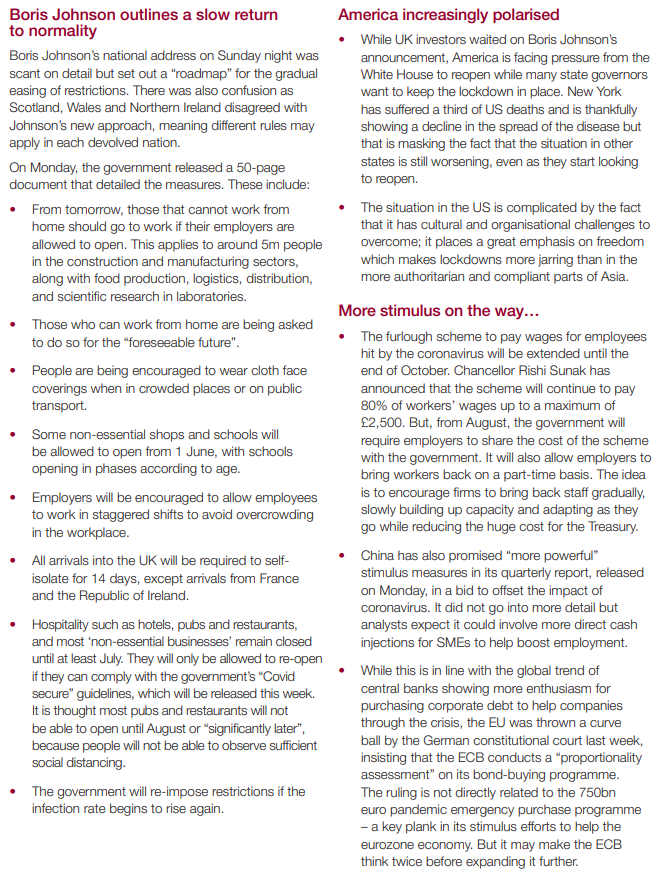
Please see below the copy and pasted latest investment market update from Brewin Dolphin, which was published yesterday (12/05/2020):

Markets are likely to remain extremely volatile for a while during these unprecedented times. It is important to remember and focus on your long-term investment goals and ultimately remain invested whilst markets recover.  

Please keep safe and healthy.

Carl Mitchell – Dip PFS

IFA and Paraplanner

13/05/2020

Team No Comments

Missing Out On Child Benefit?

Royal London posted the below article last week 07/05/2020

If your income has been affected by the coronavirus pandemic, you may now be entitled to claim child benefit, without having to pay the High Income Child Benefit Charge (HICBC).

If you’re one of the thousands of people in the UK who’ve seen their income fall as a result of the coronavirus pandemic you may be missing out on Child Benefit which is a valuable source of income. 

Child Benefit explained

Households with children under 16 (or 20 if they’re in certain types of education) are eligible to claim Child Benefit. This tax year, parents will be able to claim a Child Benefit payment of £21.05 a week for the first child and £13.95 for subsequent children. This is paid every four weeks1.

Aside from the payment, registering for Child Benefit means you can receive National Insurance (NI) credits towards your state pension if you’re off work and or don’t earn enough to pay NI. You can receive these until your youngest child is 12, and your child/children will automatically get a National Insurance number when they’re 16.

What is High Income Child Benefit Charge?

The High Income Child Benefit Charge was introduced from 7 January 2013.

Since that date, couples living together where one person’s income is £50,000 or over and where a child lives with them, are subject to a specific tax charge if they continue to receive Child Benefit payments. The tax charge is worked out at a rate of one per cent of the Child Benefit money you receive for every £100 you earn over £50,000.  

This means that for anyone earning over £60,000 the payment received through Child Benefit is effectively wiped out by the tax charge. 

However, if you or your partner earns more than £60,000, it is still worth registering for Child Benefit2 (so you qualify for National Insurance credits). You can then stop (or ‘opt out of’) receiving any payments.

What counts as income?

 It’s worth pointing out that you or your partner could earn more than £50,000 and still not have to pay the Child Benefit tax charge. That’s because HM Revenue and Customs looks at what’s called ‘adjusted net income’ when working out the tax charge you have to pay. This is your pay before tax, minus any pension3 contributions deducted from your pay and any Gift Aid charity donations.

Sources:

  1. https://www.gov.uk/child-benefit-payment-dates
  2. https://www.gov.uk/child-benefit-tax-charge
  3. https://www.gov.uk/child-benefit-tax-calculator/main

Will I qualify for Child Benefit if my income has been reduced because of coronavirus?

You may be able to claim Child Benefit again, but it will depend on your income.

For example, if you were earning £60,000 or slightly more and stopped claiming Child Benefit, but have now lost 20 per cent or more of your income under the government’s job retention scheme, your income will fall to £50,000 or below. This means you can once again become eligible to claim this benefit without being liable for the tax charge.

An interesting article, we would recommend that you check your eligibility for this benefit if your circumstances have recently changed, perhaps with a better tax position?

Even if you do not have any net gain immediately from claiming Child Benefit now you should still register for it to qualify for the National Insurance credits.  National Insurance credits will help you build up your State Pension provision.

Charlotte Ennis

13/05/2020

Team No Comments

Brewin Dolphin – Weekly Update ‘What’s Brewin’

Input from Brewin Dolphin below in their weekly update ‘What’s Brewin’ received late yesterday afternoon (11/05/2020).

I hope you had an enjoyable bank holiday – the third in lockdown! The PM, in a televised address last night, has replaced his unquestionably clear message of ‘Stay at home. Protect the NHS. Save lives.’ with a rather more murky slogan of, ‘Stay alert. Control the virus. Save lives.’ to coincide with the easing of lockdown measures this week. In a bid to get the economy moving, while urging those who can work at home to continue doing so, he has encouraged people in the construction and manufacturing industries to return to work. However, this must be done in a way that respects social distancing, with guidance due to be published this week. The devolved nations have all chosen to keep the ‘stay at home’ message and lockdown measures in place, leading to a strategic divergence across the UK. It will be interesting to see how this develops over the next few weeks.

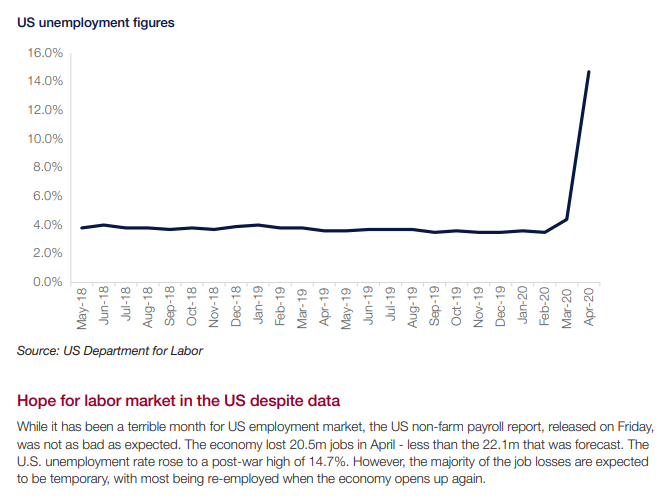
The major US indices rose on Friday; with the Nasdaq actually in positive territory by 1.7% YTD! This risk-on move came despite the depressing job reports that said the US unemployment rate spiked to 14.7% in April as the coronavirus forced a wide U.S. economic shutdown. That is the highest level since the Great Depression! However, there have been positive comments on the re-opening of parts of the economy and sentiment was boosted  by a Xinhua News Agency report that Chinese Vice Premier Liu He, Trade Representative Lightizer, and Treasury Secretary Mnuchin spoke Friday morning to pledge to create favourable conditions for a Phase 1 trade deal. This comes as a relief to markets after tensions rose between the US and China over the pandemic.

There has been much recent discussion about the shape of the recovery. Today, we’ll look at the market rebound, which has been dramatic since the market lows in March. Some analysts are concerned with the speed of this recovery as the full impact of the pandemic has yet to be quantified. They argue that typically, following a bear market, the recovery is more gradual. However, some believe that this has been an unprecedented market event and historical comparisons are less important. I have included a chart below to provide some context.

Markets in a Minute

  • The VIX, which is a measure of volatility, lost 11% to 28 on Friday. The last time it was at this level was 25 February and is off substantially from the mid-80’s in the midst of the crisis.
  • Tesla says it is planning to restart production at its factory in California in defiance of local government orders demanding it keep the plant closed.
  • Primark and Superdry have been boosted by opening shops in Europe
  • Fitness group Peloton, has benefitted from the lockdown measures with huge numbers of people exercising at home on the internet-connected bikes it pioneered. Shares surged by 17% on Thursday’s open to reach a record high.
  • Tickets for Walt Disney’s soon-to-be reopened Shanghai Disneyland sold out quickly, suggesting that consumers in the world’s second-largest economy are eager to get back to their pre-pandemic spending habits.

Stay safe and have a great week!

As you can see the consumer should help developed countries economies in their recovery.  It is still very finely balanced globally; the virus needs to be controlled.

Brewin Dolphin are Discretionary Fund Managers in the UK offering both Managed Portfolio Services and bespoke discretionary fund management.

Steve Speed

12/05/2020

Team No Comments

The Shape of the Recovery: V, W or L? Looking Beyond the Letters

Received by email today 11/05/2020 concerning potential investor concerns. SEI explore what markets suggest the potential recovery paths could be.

The Shape of the Recovery: V, W or L? Looking Beyond the Letters

  • It’s challenging to make accurate economic calls under normal circumstances
  • Add in the uncertainty around oil prices, interest rates and epidemiological models and there’s a serious lack of clarity about the future
  • While we believe that another significant pullback is likely, we also believe that long-term investors will be rewarded for their patience

Major economic setbacks can trigger a complex reordering of entire industries. Our current predicament has gone even further, forcing society to function under challenging conditions with consequences for every corner of the economy.

It’s challenging to make accurate economic calls even under more normal circumstances. Add in the direct and knock-on impacts of lockdowns, the range of potential paths that the COVID-19 outbreak could take, and the countless combinations of business and policy responses under each of these scenarios, and it is truly anyone’s guess what the future holds.

Why, then, do we try to distil these setbacks into simple shapes? Because humans—and financial markets— don’t like uncertainty. Despite that, guessing whether a recession and the ensuing recovery will look like a U, V or W provides minimal benefit to long-term investors. Focusing on the underlying fundamentals and economics, we believe, is more useful for framing investment decisions.

Searching for Clues

What do markets themselves suggest about the road ahead? A glance at the path of oil prices over the last few months certainly doesn’t project confidence for a strong rebound. The West Texas Intermediate oil price turned negative—a first—as its May 2020 contract neared expiration, and the June contract slid to between $10 and $20 per barrel at the end of April.

Low (and negative) prices imply that storage capacity has gotten full as demand plummeted during lockdown. The U.S. Energy Information Administration’s (EIA) April 2020 Short-Term Energy Outlook estimated “that the 2020 build could add 1.6 billion barrels to global inventories, which would fill them at or near their estimated full storage capacity levels.”

The EIA doesn’t see demand begin to cut into inventories until fourth-quarter 2020, and that assumes global consumption returns close to its long-term level starting in the third quarter (see Exhibit 1).

Interest rates also reflect considerable economic uncertainty. After falling sharply in late February and early March, long-term U.S. Treasury rates bounced into the second half of March. They have inched lower again in recent weeks. Long-term rates generally decline as economic conditions soften, so a flattening yield curve— anchored near zero on the short end—suggests there’s still great uncertainty about the economic road ahead.

Contagion Contingencies

Projections for the spread and fallout from COVID-19 have been subject to revision in recent weeks. First, they declined as the public adhered to social distancing and lockdown measures at a greater-than-expected rate. Then, as epidemiological models moved through their peaks and the narrative rolled on to the timing of reopening society, policies were forced to follow— loosening restrictions and pushing projections back upward.

Exhibit 1: World Liquid Fuels Production and Consumption Balance (millions of barrels per day)

The fluidity of COVID-19 forecasts is compounded by their wide potential ranges of outcomes. It’s completely in keeping with honest statistical modelling to offer a base case along with low and high projections, but such a wide range limits their utility for health-system planning purposes, let alone forecasts about the economy and financial markets.

SEI’s View

We spent much of February, March and April preaching patience and moderation in the face of steep selloffs and historic volatility. We contended that the decline was too fast and that it would likely be followed by a substantial rebound.

We think moderation is warranted again, albeit in the other direction. The rebound (notably driven by the same mega-cap technology firms that led the bull market) could eventually yield to another pullback, especially given the widespread uncertainty and shortage of concrete positive developments.

We expect the re-opening of the global economy to proceed cautiously and unevenly within and across countries. Many major developed-market countries still need to establish enhanced testing to track and isolate the outbreak before returning to broader re-opening. It will take time before this accrues to a meaningful increase in economic activity.

Many emerging markets are still seeing increased infection rates, so we’re far from a return to normal conditions. Moreover, there’s a possibility we may return to lockdown later this year if COVID-19 cases appear set to spike again.

Our investment managers are thinking in terms of years, rather than months, before the corporate earnings environment recovers from below-trend economic activity to more normal conditions. We believe there will be plenty of opportunities for skilled managers to capitalise on and that investors will be rewarded for their patience and moderation through shorter-term advances and declines.

As you can see SEI have a different view to some of their peers, with a slightly more negative (realistic?) view.

Since 1968, SEI has been a leader in the investment services industry, recognized for its history of innovation. Today, they serve about 11,300 clients, including banks, trust institutions, wealth management organizations, independent investment advisors, retirement plan sponsors, corporations, not-for-profit organizations, investment managers, hedge fund managers, and high-net-worth families. SEI manages or administers $920 billion in hedge, private equity, mutual fund and pooled or separately managed assets, including $283 billion in assets under management and $632 billion in client assets under administration.

Paul Green

11/05/2020

Team No Comments

Business Blog – Commercial Property in your Pension – why?

Over the years a proportion of our clients use their pension assets to buy a commercial property.  Why would they do this?

The general benefits are as follows:

  • You do not pay any tax on rental income received into a SIPP (Self Invested Personal Pension)
  • No capital gains tax is paid on disposal of a commercial property from a SIPP
  • For ‘connected tenants’ (a business owner renting their pension’s commercial property to their own business) rent is generally a tax deductible business expense
  • SIPPs generally are not subject to inheritance tax
  • In insolvency the pension assets are normally out of reach of the trustee in bankruptcy

These are fairly standard benefits above; in the current situation a few useful ideas are as follows:

  • If your limited company owns the commercial property sell it to your pension to inject cash into your business to help with cash flow challenges and/or repay loans
  • If you own your own commercial property personally you could sell your property to your SIPP and if your business needs capital, make a Director’s Loan into your company (if viable)
  • By selling the commercial property you own to your SIPP you reduce your personal inheritance tax bill (if applicable)
  • In the past I have had clients sell their commercial property to their business to enable them to change business bank

When we think of commercial property you would normally think of offices, warehouses, industrial units and shops.  In addition, some stranger commercial property could be:

  • Sports stadium
  • Museums
  • Zoos

It is important to buy only commercial property with your pension, buying residential property could incur tax charges of up to 70%.  If you are not sure we can quickly get opinion on whether a property is commercial or residential for pension purposes.

The process for commercial property into a SIPP is as below:

  1. Validate if it is a potential SIPP investment (commercial property)
  2. Acquisition.  This involves good ‘due diligence’
  3. Ongoing management of the property, rent reviews, leases, insurance etc.
  4. Disposal of the property

During the acquisition stage you are likely to need the assistance of a few professionals, your accountant, a solicitor, a surveyor, the SIPP provider and a bank if you need a loan to assist with the purchase.  And obviously your IFA!

Due diligence is thorough and includes a report on title, information on the lease (is it suitable?), legal title, insurance, VAT, a copy of the EPC and search results (environmental searches too).

Loans to assist Purchase

If you do not have enough capital in your pension fund to buy the required commercial property you could borrow funds to purchase it.  Loans are restricted to 50% of the pension fund value.

For example, if you had £240,000.00 in your pension you could borrow a further £120,000.00.  Please note that you must factor in fees etc.

Connected Purchases and Connected Tenants

If you already own the property and you sell it to yourself this is a connected purchase.  You will then rent the property to yourself and you would be a connected tenant.

Connected party transactions must be completed on commercial terms.  You pay a commercial price for the property and you pay a commercial rent.  Normal due diligence is completed.

Investments

Rent paid initially can be used to pay any loan off asap if there was a loan used in the purchase.  Rent can then be invested in standard investment assets in your SIPP.

Investments can be funded by lump sums and on a regular monthly basis.  Building good liquid assets alongside your property assets is good practice.

Fees

In general terms fees for commercial property purchase in a SIPP and ongoing fees are more expensive than a standard property purchase.  This is because it is more complicated.

You also have the additional costs of your SIPP provider and your IFA in comparison with a standard property purchase.  Are the additional fees worth paying?  That depends on your circumstances and objectives.  Please take advice.

Summary

Whilst it is not for everyone buying commercial property with your pension could be useful, particularly now.  Some general benefits are that you take control of your working environment, property maintenance (and hygiene now) and if you have the space you could have a tenant too.

You can also join together with your life partner or business partners to buy commercial property with a few SIPPs.  You would own the property in proportion to your percentage paid.  This can get complex later, particularly at retirement.

Occasionally a SIPP may not be the right pension vehicle for your commercial property purchase.  A few of my clients prefer the additional benefits a SSAS provides (Small Self-Administered Scheme).   We won’t go into the SSAS benefits in this blog.

Retirement options include retaining the property and using the rent paid as part of your retirement income or selling the property.  If you are selling your business and retaining the property in your SIPP, you should also negotiate good long lease terms to the buyer of your business.

Right now, it could be difficult to get a valuation on a property, but business will gradually start returning to normal over the rest of the year – hopefully, a vaccine will speed things up!

Steve Speed

11/05/2020

Team No Comments

Cornelian Asset Managers – The importance of remaining invested

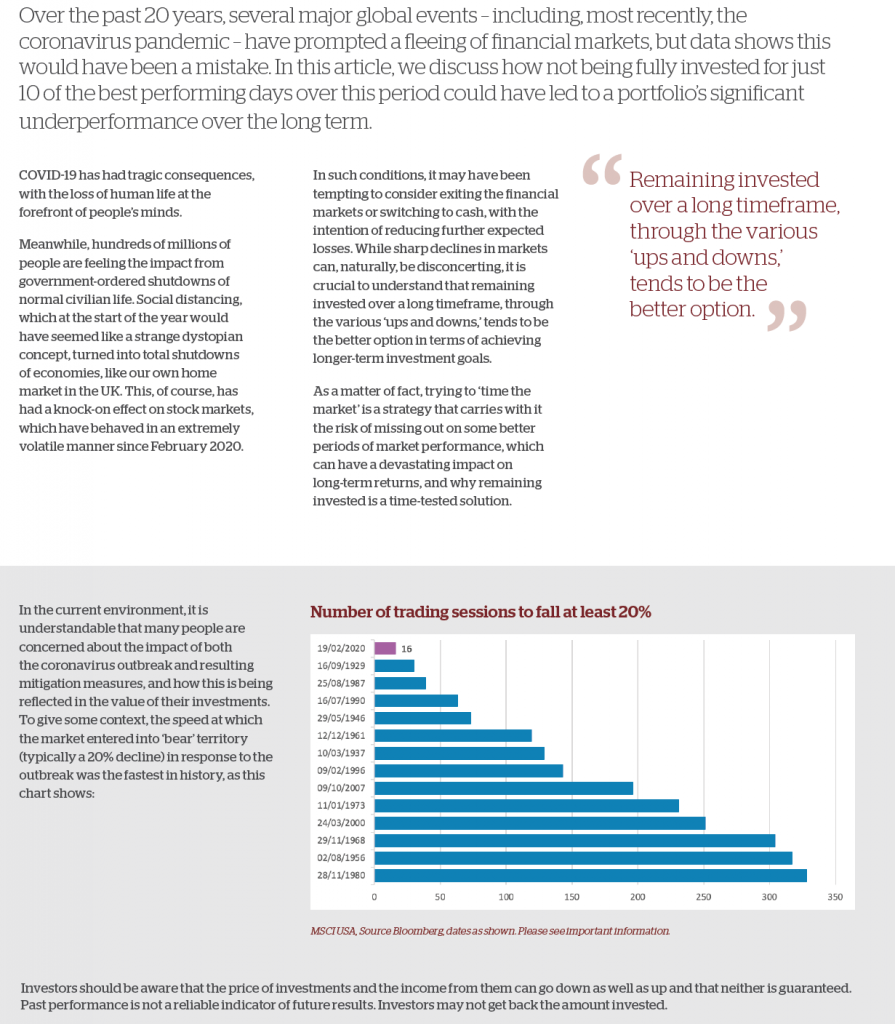
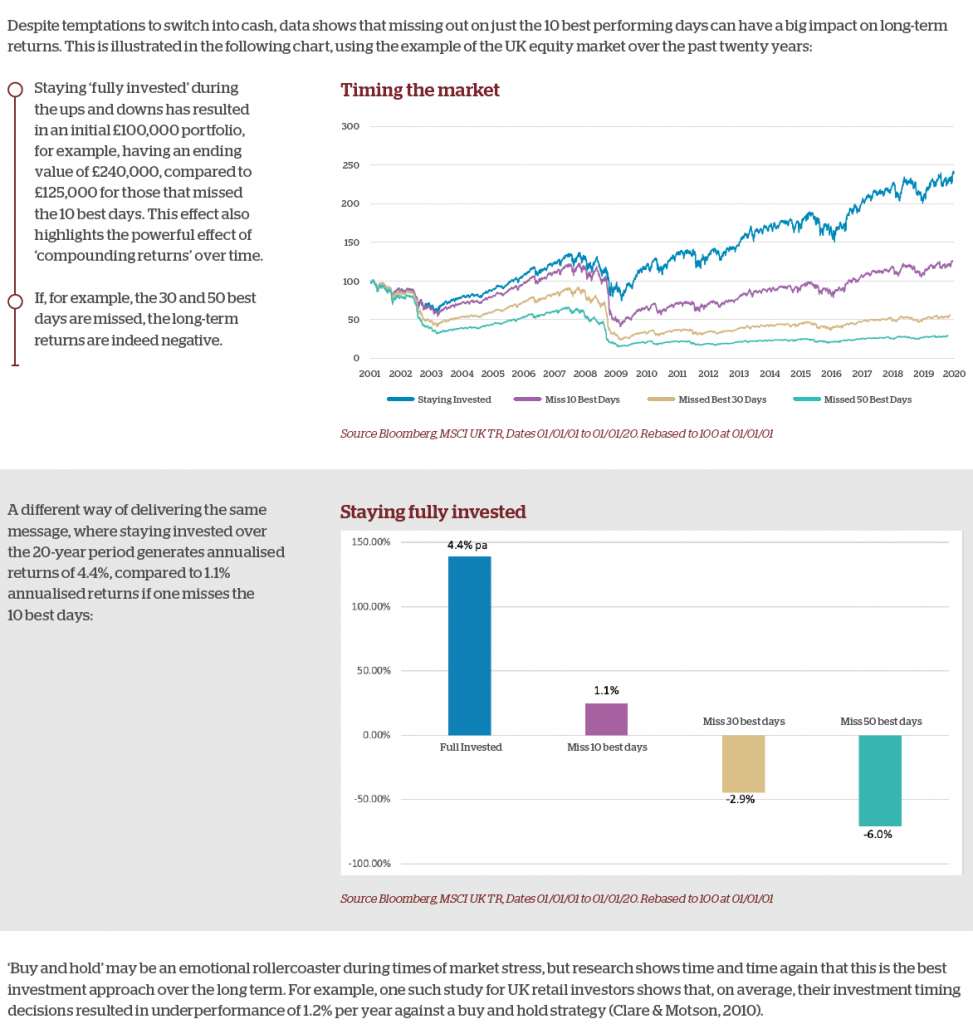
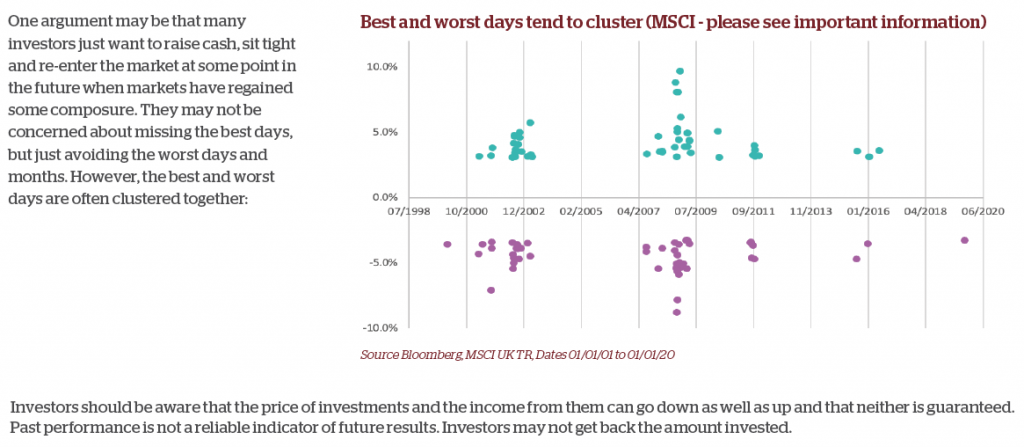
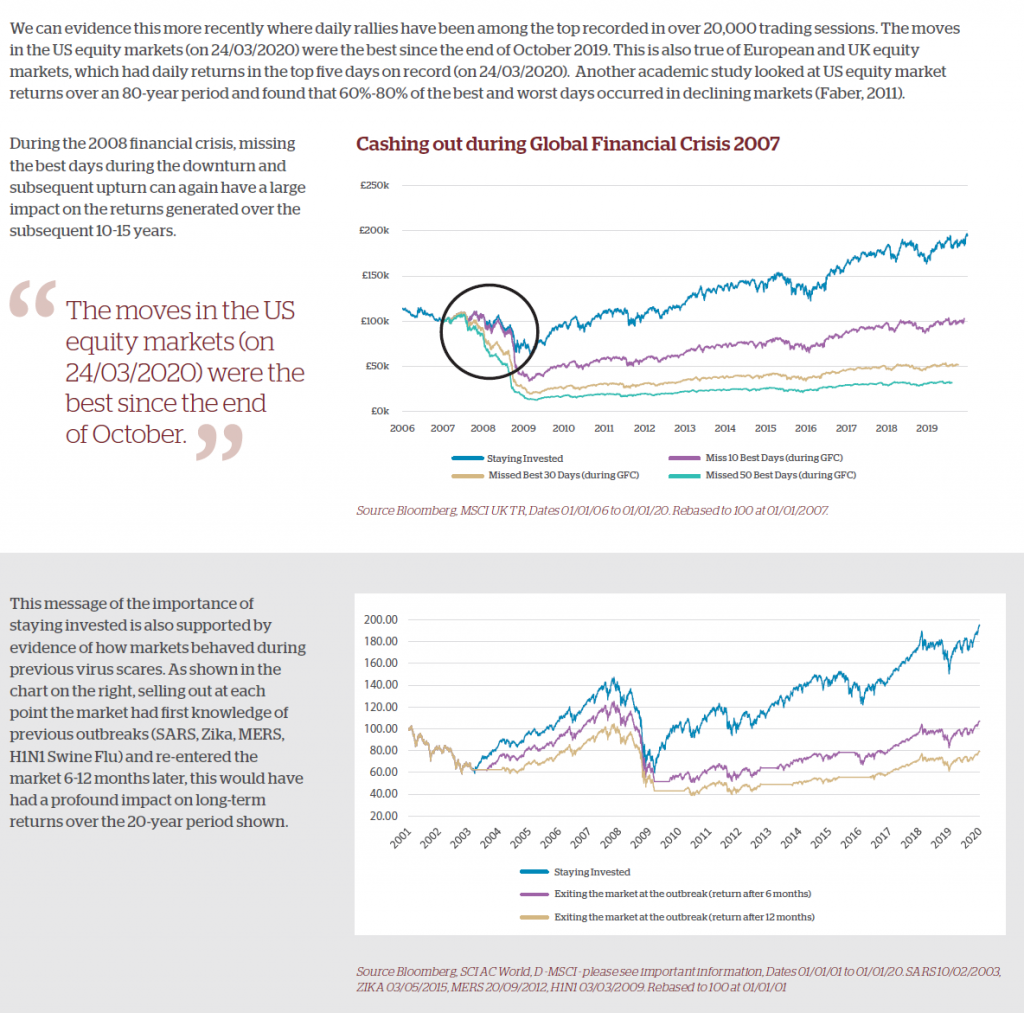
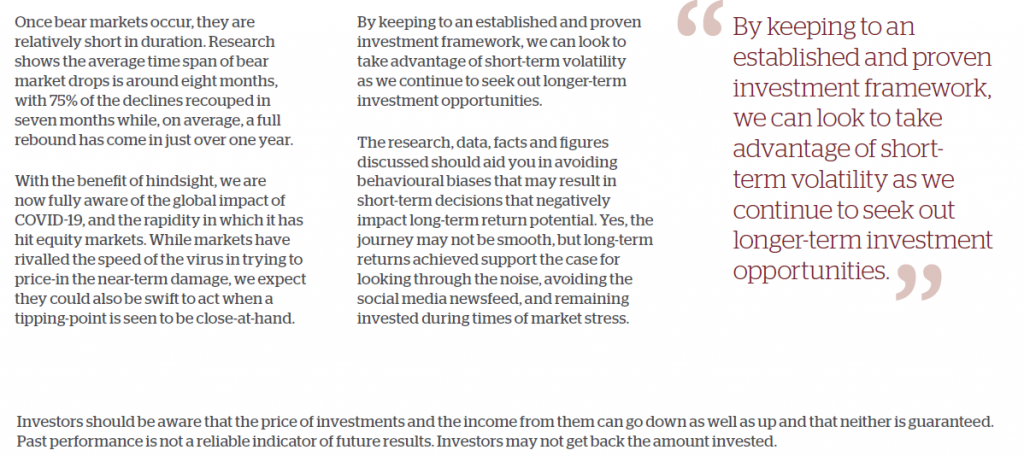
We have received a useful guide this week from Cornelian Asset Managers on the importance of remaining invested during the current investment climate. Cornelian have also recently been acquired by Brooks Macdonald Group plc, who are a leading Discretionary Fund Manager in the UK.

Hopefully, the above guide demonstrates the importance of remaining invested during market downturns. It helps highlight how trying to time the market and missing the best 10 days of investment returns can impact on the long-term investment returns generated.

The above guide relates to what we have been telling our clients since the beginning of this crisis, which is to ‘keep calm and remain invested’. You need to focus on your long-term investment objectives.

Please keep safe and healthy.

Carl Mitchell – Dip PFS

IFA and Paraplanner

07/05/2020