Team No Comments

The Cash ISA paradox – rates are rising, but things are getting tougher for savers

Cash savings have suffered death by a thousand rate cuts over the last decade, but the cash paradox is that even though rates are now on the up, things look like they will get even tougher for savers. That’s because elevated inflation is going to eat up any gains from higher interest rates on cash and will take an extra pound of flesh for its trouble too. Please see below article received from AJ Bell yesterday for further detail on this.

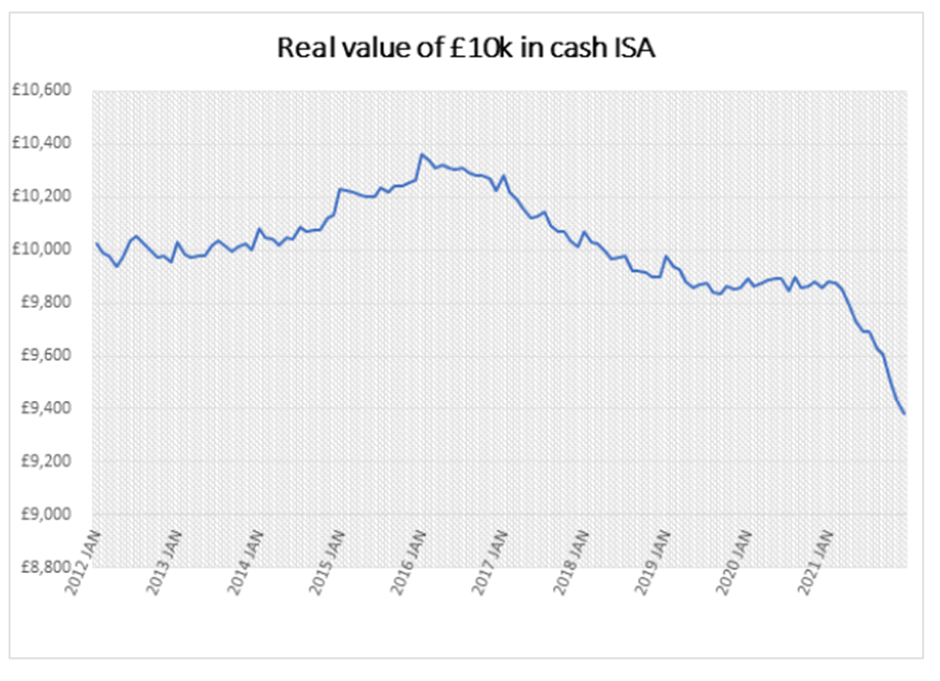
£10,000 invested ten years ago would now be worth just £9,385 today, after inflation is taken into account. This lost decade for cash savers has of course been caused by ultra-loose monetary policy, though inflation has remained largely contained. What is alarming is that in the next twelve months alone, Cash ISA savers face a similar loss in buying power to the one they have experienced over the last decade. £10,000 saved into the average Cash ISA today could be worth just £9,600 this time next year, based on the latest Bank of England forecasts for interest rates and inflation, and the current margin between base rate and ISA rates.

So despite interest rates falling to rock bottom over the last ten years, worse may yet be in store for cash savers. Longer term, higher rates should be positive for Cash ISA savers, if inflation tails off in the way the Bank of England expects. If it doesn’t, the last ten years of slow and steady inflationary erosion could end up looking like a walk in the park.

Those who shop around will likely be able to improve their lot, slightly. The current best buy ISA is offering 0.6% per annum, according to Moneyfacts, which compares to 0.34% for the average Cash ISA. As interest rates rise, the wedge between the most competitive and least competitive Cash ISAs can be expected to grow, as some banks attempt to attract new customers by bumping up their rate, while others try too eek out some extra profits by keeping rates low until savers start voting with their feet.

Meanwhile Stocks and Shares ISA investors have been big winners from the last ten years. £10,000 invested in the average global stock market fund within an ISA would now be worth £26,402 after inflation is taken into account. Over any ten year period, the odds are heavily stacked in favour of a stock investor compared to a cash saver. But the loose monetary policy of the last decade has helped exacerbate that trend. Looking forward, tightening monetary policy may well prove to be a false friend to cash savers, if accompanied by sustained inflationary pressures. High inflation isn’t exactly good news for shares either, but companies can at least offset increasing costs by pushing price rises onto consumers. Investing in shares therefore looks like the best way to beat inflation over the long term.

The FCA’s latest strategic focus on encouraging those with high levels of cash saving to invest for the longer term is therefore well-timed. The regulator reckons that 8.6 million consumers hold over £10,000 of investible assets as cash. HMRC data shows that £443 billion was put into Cash ISAs between 2010 and 2020, compared with £206 billion invested into Stocks and Shares ISAs over the same period. Clearly low interest rates have not hugely deterred Cash ISA savers to date, but the return of high inflation means poor cash rates will really start to bite, and will likely push savers up the risk spectrum in search of inflation-busting returns. Those who are thinking of taking on more risk by investing in the stock market might consider doing so through a monthly savings plan, which will make for a smoother ride.

The lost decade for cash in numbers

Since January 2012, the average interest rate paid on Cash ISA balances has sunk from 2.5% to a record low of 0.3%. A combination of low interest rates and bank funding schemes like Funding for Lending and the Term Funding Scheme have seen cash rates drop to almost zero. Inflation has been relatively benign over this period, averaging 2%, directly in line with the Bank of England’s target. Even so, £10,000 invested in a Cash ISA ten years ago would be worth £9,385 in real terms today.
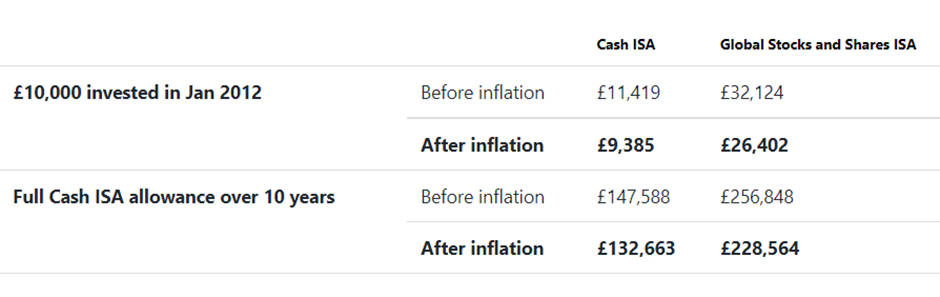
By contrast the average Global Stocks and Shares ISA (invested in the IA Global fund sector average) has turned £10,000 invested into £26,402 over the same period, after adjusting for inflation. If you had saved your full Cash ISA allowance over these ten years, equivalent to £142,220 of contributions, that would now be worth £132,663 in real terms, if saved in the average Cash ISA. If invested in the average Global Stocks and Shares ISA instead, it would be now worth £228,564, after adjusting for inflation.
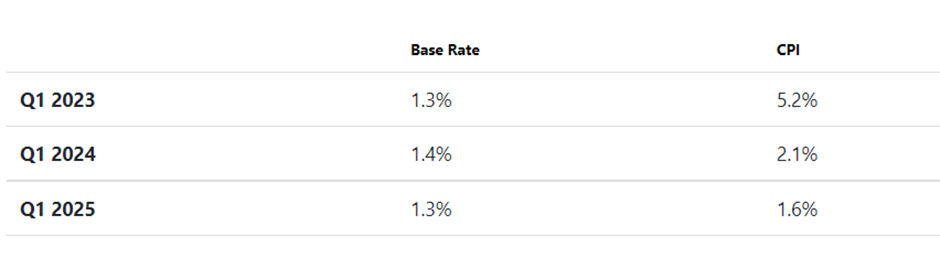
Looking forward, the market is expecting rates to rise, and the Bank of England is forecasting that inflation will fall away next year. The latest forecast from the Bank is shown in the table below. The rate of interest paid on the average Cash ISA currently stands 0.09% above the Bank of England base rate, so assuming that margin holds, and the Bank’s forecasts are accurate, that would mean £10,000 saved in the average Cash ISA today would be worth around £9,600 this time next year*. Beyond that, the Bank expects inflation to moderate, but interest rate hikes are expected to tail off too. Of course, the Bank has repeatedly underestimated inflationary pressures of late, and if elevated inflation sticks around for longer, that could be even more ruinous for cash savings.
Please check in again with us shortly for further relevant content and news.

Chloe

21/02/2022

Team No Comments

Invesco – Inflation and geopolitics increase the pressure on markets

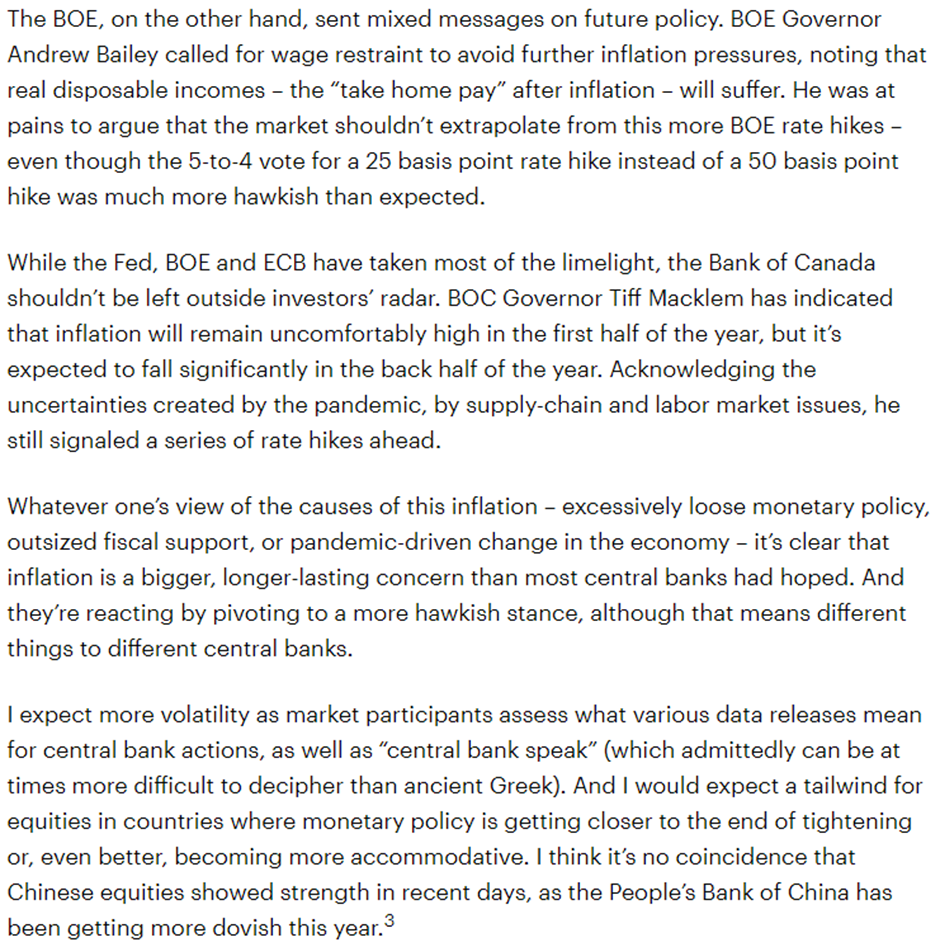
Please see below an article published by Invesco on Tuesday (15/02) and received yesterday afternoon, which covers their views on inflationary pressures and geopolitics and how these are impacting on markets:

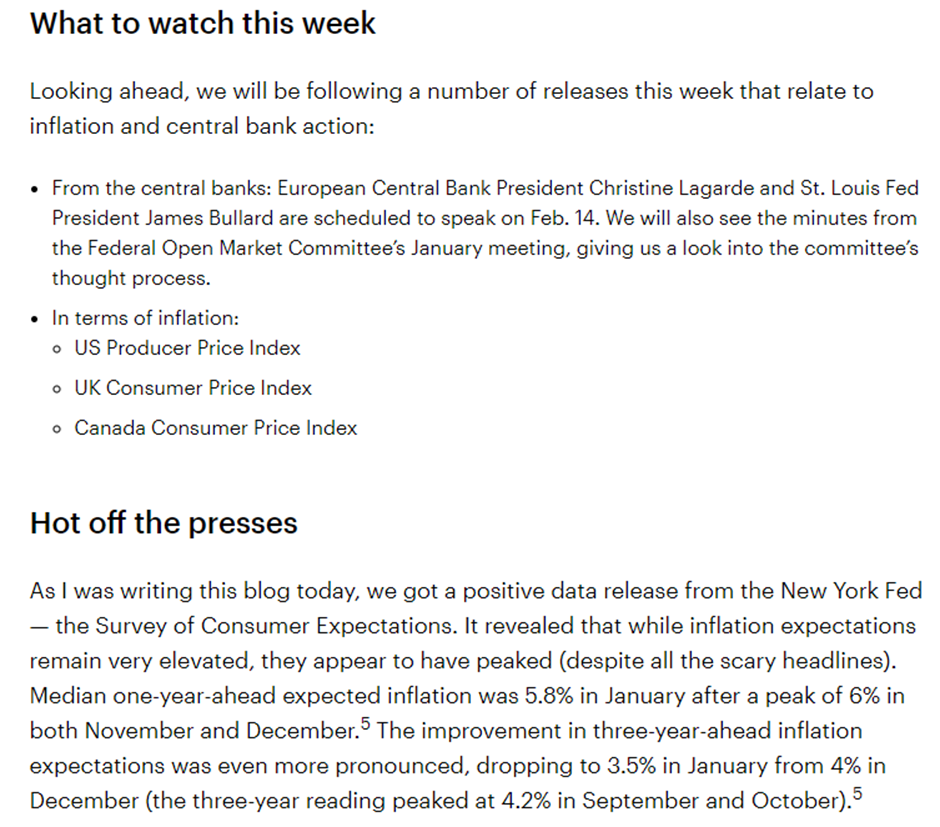
As you can see from the above, inflationary pressures globally are having a big impact on markets and the Fed’s outlook and proposed rate hikes by Q2 2022 have also impacted on investor sentiment. Supply chain issues also remain an issue and this could potentially be further exposed by events in Russia and possible sanctions that could be imposed.

The good news is that Covid cases are declining, and global economies are starting to transition back to a form of normality. It also appears that inflation expectations may have peaked, watch this space!

Please continue to check our Blog content for advice and planning issues and the latest investment, markets and economic updates from leading investment houses.

Please keep safe and healthy.

Carl Mitchell – Dip PFS

Independent Financial Adviser

18/02/2022

Team No Comments

Conflict and Capital Markets: Russian Intimidation of Ukraine

Please see below, an article from Tatton Investment Management detailing how increasing tension on the border of Ukraine has affected global markets – received yesterday afternoon – 16/02/2022.

From our phone calls and conversations we have with adviser firms, we know portfolio investors are concerned that the fear of Russia invading Ukraine is driving, at least in part, the poor start to the year experienced by capital markets. 

As laid out in recent editions of The Tatton Weekly, the cause of the current market volatility is not being caused by fears of Russia’s President Putin starting a European war, but is rooted in concerns that central banks may be moving too rapidly from monetary easing to tightening. Nevertheless, the two are loosely connected. Putin’s actions have left energy prices elevated for longer, which in turn keeps consumer price inflation elevated, which has arguably increased the pressure on central banks to act.

The current situation is undoubtedly worrying, and the political tensions are only exacerbating the most recent market weakness. Therefore, as we always do at a time of market-moving activity, we wanted to share our thoughts in a supplemental investment update. So, let’s begin by looking at what investors can learn from previous episodes of geopolitical stress.  

Recent history has relatively few episodes of war and near-war that might be considered to have been of global significance. Surprise actions such as the Iraq invasion of Kuwait and 9/11 (in 1990 and 2001, respectively) had negative impacts only after the event. However, drawn-out episodes have seen market weakness in the lead-up to but not after the outbreak of conflict. Both US-Iraq wars marked the start of stock market rallies, as did the Cuban Missile Crisis.

On those occasions, there were several other factors – aside from geopolitical tensions – which had contributed to weakness beforehand. Moreover, we also cannot attribute market strength to a sense of resolution. Nonetheless, it demonstrates that markets are reasonably efficient around such events; they go through a gradual process of discounting risk ahead of the event, rather than having a sudden unexpected dislocation as war starts. Unless they seriously impact global growth, we should expect the impacts caused by the negative surprise to pass quite quickly. Using this fairly limited history as a guide, from the current position, there is potential market upside as well as a downside.

In other words, we think the past tells us that – on balance and in market terms – we should not be too worried about market returns if the worst happens. Nonetheless, it is important to try to assess whether the current situation is markedly different. 

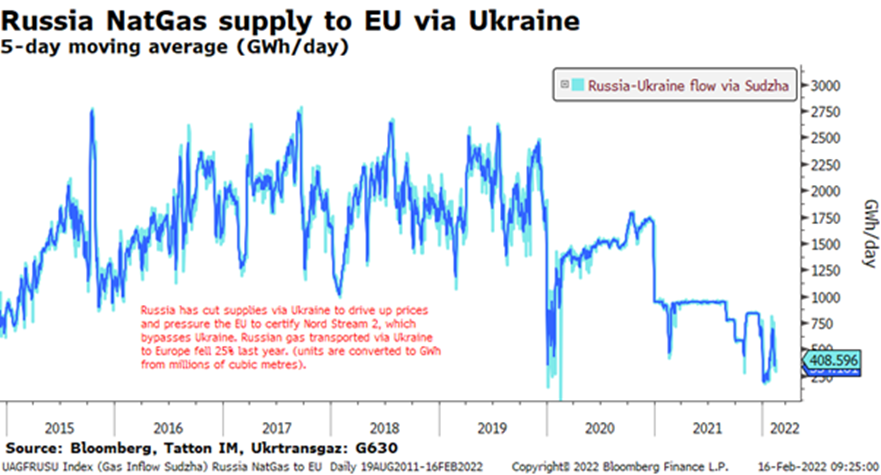
At this point, various markets have already priced in quite high levels of risk and consequence. This is particularly true of energy. Natural gas prices have been squeezed much higher this winter. Speculative buying has been a factor, but Russia’s actions in suppressing supply have almost certainly been the biggest driver. As we have noted before, Europe’s weak spot is its reliance on Russian energy, especially natural gas. The chart below shows that the gas supplies have been cut repeatedly, and do not seem to be related to the pandemic. 

Russia still needs to sell its oil and gas and Europe remains its major customer. According to Russia’s central bank, total exports (not just energy) reached $489.8 billion in 2021. Of that, crude oil accounted for $110.2 billion, oil products for $68.7 billion, pipeline natural gas for $54.2 billion, while liquefied natural gas accounted for $7.6 billion (In sum 49% of all exports). While the rise in prices will be welcome in Moscow, it will gain little if Russia cannot sell the volumes needed.

Growth in Russia is forecast to slow down to 2.3% for this year, having reached 4.3% in 2021. These growth numbers may sound healthy enough but, given the rise in energy prices, they are in fact mediocre. The Russian Ruble would usually benefit substantially from rising energy prices but has already declined 5% since peaking against the US Dollar in October. Russian foreign currency debt credit spreads have widened, and local interest rates have risen sharply. Russia’s financing costs face an even worse outcome if war breaks out. Russia’s citizens are unhappy, and the prospect of a war that threatens to kill or injure many young Russians is likely to make them even less so. Given this economic backdrop, we suspect Putin’s posturing will remain just that. Should there be an actual armed conflict, Russia needs to be as short-lived and containable as possible.

Events can change dramatically from one day to the next, however, we believe that current markets have already priced in the risk of a worsening of the Ukraine conflict within the confines described above.


As we mentioned at the beginning,  markets face a more substantial  threat from policy tightening by central banks and governments.  It may seem odd but if the Ukraine tension drags on or worsens, policymakers will feel less obliged to depress economic sentiment further.

Regular readers of our blogs will understand that markets are particularly volatile now and have been for a few months, mainly due to the policy changes from Central Banks and Governments.

In the circumstances we just need to remain invested, think about your long-term objectives and look through this short-term volatility.

If you are regularly monthly funding Pensions and Investments the volatility could help over the long-term too, ‘Pound Cost Averaging’ (see previous blogs).

Finally, Fund Managers use this volatility to buy good quality assets at the right price – ‘Active’ Fund Management.

Please continue to check our Blog content for advice and planning issues and the latest investment, markets and economic updates from ourselves and leading investment houses.

Alex Kitteringham

17/02/2022

Team No Comments

Blackfinch Asset Management – A focus on company fundamentals

Please see below, an update from Blackfinch regarding their approach to investments going forward in 2022, received yesterday evening – 15/02/2022

Markets have been volatile so far this year as the prospect of higher-for-longer inflation and rising interest rates have weighed on investor sentiment. These risks have been most pronounced in company valuations, which last year reached historically high levels in certain stock market sectors.

In general, when interest rates rise, investors can look elsewhere for returns instead of buying richly valued shares. What we have seen in 2022 is a reversion to more normal valuations as investors rotate away from the returns potential available from ‘growth’ stocks into more traditional ‘value’ stocks trading at levels below what they are believed to be worth.

It’s important for us to review the fundamentals of the companies we invest in before making a significant switch into other areas of the stock market. For example, the US is typically known as a growth market due to its dominant technology sector. These companies are often high quality, with investors required to pay higher valuations based on more attractive prospects. Currently, large cap companies in the S&P 500 index are reporting earnings for the fourth quarter of 2021. For the earnings season to date, 356 companies have released updates, and aggregate sales growth year-over-year has been 16%. On the same basis, earnings have increased by an even bigger 27%. However, this year the S&P 500 has fallen almost 6% (for sterling-based investors). This disconnect between strong fundamentals, but declining stock prices is due to the deflation in valuations that has driven stock markets this year.

Looking at individual companies, even though earnings have been strong, stock prices have still declined. Apple, Microsoft and Alphabet announced results that beat expectations – Apple was the standout performer after generating $124bn of revenue in a single quarter – yet their share prices are all down so far this year. We still hold these companies in the portfolios through our S&P 500 index fund.

Although this has declined in 2022, we view the underlying fundamentals of the companies as highly attractive and have retained our exposure to this fund.

Our portfolios also hold quality-based strategies in Europe, such as Premier Miton European Opportunities and Liontrust Special Situations. In much of the same way as the US market has fallen, both funds are down so far this year. However, on a longer time horizon, both have delivered top quartile performance compared to other funds in their respective sectors. We believe that quality companies with competitive advantages and growth potential still offer investors attractive returns over a long-term holding period.

We also allocate assets to traditional value sectors to diversify our portfolios. The UK offers higher income from dividends when compared to other developed markets. However, although value sectors have outperformed this year, we have avoided changing our allocations to overweight. For example, with the price of crude oil rallying to an eight-year high, profitability in the Oil & Gas sector has been raised, and therefore the sector looks attractive in the short term. However, as we believe the Oil & Gas industry is in structural decline, we would not feel comfortable holding significant exposure to these assets over a longer period.

The risks of inflation and rising interest rates will, no doubt, have an impact on returns for investors this year. However, looking further ahead, we still view holding quality companies with attractive growth potential as the best drivers of long-term returns. We will continue to update you on our portfolio activity as the economic outlook progresses.

Please continue to check our Blog content for advice and planning issues and the latest investment, markets and economic updates from leading investment houses.

David Purcell

16th February 2022

Team No Comments

Brewin Dolphin – Markets in a Minute

Please see below this week’s Markets in a Minute update from Brewin Dolphin – received late yesterday afternoon – 15/02/2022.


US inflation hits highest level in 40 years


Stock market volatility continued last week as fears about tighter monetary policy and a Russian invasion of Ukraine weighed on investor sentiment.

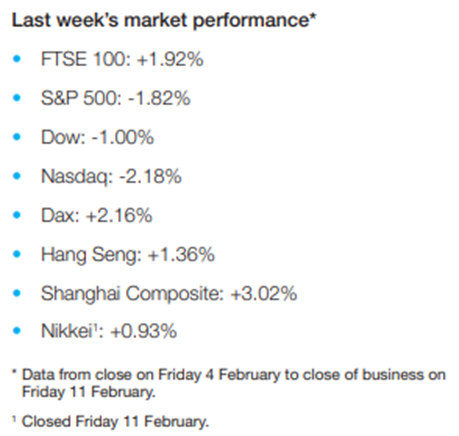
In the US, the technology-heavy Nasdaq ended the week 2.2% lower and remained in correction territory, down 15% from its recent peak. The S&P 500 declined 1.8% after the latest inflation data showed US consumer prices surged in January to their highest level since 1982.

Strong corporate earnings boosted shares in Europe, with the STOXX 600 rising 1.6% and Germany’s Dax gaining 2.2%. The FTSE 100 added 1.9% after data showed the UK economy grew by 7.5% in 2021.

In China, the Shanghai Composite surged 3.0% after economists said the worst of the country’s regulatory crackdown was over.

Russia-Ukraine tensions rattle markets

Stocks started this week in the red as tensions grew between Russia and Ukraine. The FTSE 100 tumbled 1.7% on Monday (14 February) with travel stocks worst hit.

The STOXX 600 fell 1.8% and Germany’s Dax lost 2.0%. Oil prices hit their highest levels in more than seven years amid concerns an invasion of Ukraine could disrupt supplies and spark retaliatory sanctions on Russia.


US shares dropped sharply on news the US is closing its embassy in Kyiv and moving diplomats to Western Ukraine. The S&P 500 managed to largely recover from the sharp selloff and ended Monday 0.4% lower, with energy stocks suffering the largest falls.


The FTSE 100 was up 0.8% at the start of trading on Tuesday, as investors digested the latest labour market data from the Office for National Statistics. Unemployment fell slightly to 4.1% in the fourth quarter of 2021 from 4.3% in the third quarter, while inflation-adjusted regular pay (excluding bonuses) fell by 0.8% year-on-year.

US consumer prices surge 7.5%

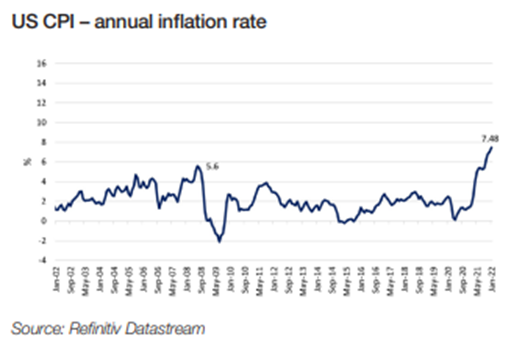
Soaring demand and lack of supply pushed US inflation to its highest level in 40 years in January. Consumer prices rose by 7.5% from a year earlier, and by a bigger-thanexpected 0.6% from the previous month, according to the Bureau of Labor Statistics.

Price rises for food, electricity and shelter were the largest contributors to the increase. Food prices rose by 0.9% month-on-month in January, following a 0.5% rise in December. Energy prices also rose by 0.9% in January. Core inflation, which strips out food and fuel, rose by 6.0% on an annual basis, driven by a 40.5% surge in the prices of used cars.

Concerns about inflation were evident in the University of Michigan’s preliminary gauge of consumer sentiment, which fell to its lowest level in more than a decade in early February. The index dropped to 61.7 from a final reading of 67.2 in January.

Richard Curtin, chief economist for the University of Michigan’s surveys of consumers, said the declines were driven by weakening personal financial prospects, with higher inflation spontaneously cited by one-third of all consumers. Nearly half expected declines in their inflation-adjusted incomes during the year ahead.

UK GDP rebounds from pandemic slump

UK gross domestic product (GDP) grew by a betterthan-expected 1.0% in the final quarter of 2021 as the hit from Omicron proved to be smaller than feared. GDP slipped by 0.2% in December, after growing by 0.7% the month before, as people worked from home and avoided Christmas socialising, according to the Office for National Statistics. This was better than the 0.6% contraction expected in a Reuters poll.

For 2021 as a whole, GDP grew by 7.5%, marking the biggest annual rise since 1941 and rebounding from the 9.4% plunge in 2020. However, economists are predicting slower growth in 2022 as rising inflation and soaring energy prices put further strain on households. The Bank of England recently cut its GDP growth forecast for 2022 to 3.75% from 5.0%.

Europe lowers growth forecast

The European Commission also lowered its outlook for economic growth in the eurozone to 4.0% in 2022 and 2.7% in 2023, down from 4.3% and 2.4% previously. European economic commissioner Paolo Gentiloni said multiple headwinds had chilled Europe’s economy this winter, including Omicron, soaring energy prices, and persistent supply chain disruptions. “With these headwinds expected to fade progressively, we project growth to pick up speed again already this spring,” he added.

Inflation is expected to reach 3.5% this year, higher than the European Commission’s November forecast of 2.2% and well above the European Central Bank’s 2.0% target. Next year, inflation is forecast to ease to 1.7%.

“Price pressures are likely to remain strong until the summer, after which inflation is projected to decline as growth in energy prices moderates and supply bottlenecks ease. However, uncertainty and risks remain high,” Gentiloni said.

China services activity slows

Activity in China’s services sector grew at the slowest pace in five months in January as the government introduced measures to contain localised cases of Covid-19. The Caixin / Markit services purchasing managers’ index fell from 53.1 in December to 51.4 in January – the lowest since August, although still above the 50-point mark that separates growth from contraction. Input costs rose at a sharper rate in January from the previous month, and confidence about the year ahead slipped to a 16-month low.

The data has increased expectations that China’s policymakers will introduce further support for the economy this year, rather than moving towards the more hawkish stance adopted by central banks in the West.

Please continue to check back for our latest blog posts and updates.

Charlotte Clarke

16/02/2022

Team No Comments

Bond markets balance interest rate hikes and Ukraine conflict risk

Please see Brooks Macdonald’s latest Weekly Market Commentary below:

Inflationary pressures clash with the risk of a Ukraine conflict, creating volatility in the bond market

Worsening geopolitical headlines late in the US trading session on Friday caused sentiment to plunge. Bond investors, in particular, were struggling to balance the US inflation/interest rate picture, which has driven yields higher, with the Ukraine crisis which could trigger a flight to quality. At the moment, the flight to quality trade is winning out with the US 10-year Treasury yield back to 1.9% after hitting 2% last week.

Late in the Friday trading session, the US warned of an imminent attack from Russia on Ukraine, with detailed invasion plans pointing to a military incursion starting on Wednesday. The immediate reaction to this news was a rapid fall in risk assets, a rally in government bond yields and a spike higher in the oil price. European equities are playing catch up this morning with European indices ranging from 2-3% down as risk appetite indiscriminately affects equity market sectors. Over the course of the weekend there was no further escalation however the market is now expecting an imminent breakout either to the upside or downside. With the US and NATO allies ready to deploy punitive sanctions, and the real human cost from a conflict, the stakes are undoubtedly high over the next week.

Central bankers fine tune their guidance with the major central bank meetings out of the way for February

Before the Ukraine headlines late on Friday, the main event of last week was the US Consumer Price Index release which showed a headline inflation rate of 7.5% year-on-year. Federal Reserve (Fed) speakers drove much of the market narrative pre and post the release, with President Bullard garnering particular attention for his discussion of the possibility of an inter meeting hike, which was later talked down by other governors. The European Central Bank (ECB) meanwhile tried to calm bond market nerves around an imminent tightening in Euro Area monetary policy, with President Lagarde keen to stress that the ECB had little appetite for a widening of peripheral European sovereign bond yields.

The minutes from the latest Federal Reserve meeting will be released this week and all eyes will be on a series of high profile central bank speakers

With the minutes from the Fed’s latest meeting being released and a series of high-profile central bankers speaking, this week will likely be dominated by central bank speak, particularly as the banks need to incorporate geopolitical risks into their forecasts and guidance.

Please continue to check our Blog content for advice and planning issues and the latest investment, markets and economic updates from leading investment houses.

Andrew Lloyd DipPFS

15/02/2022

Team No Comments

Investment climate change

Please see below article received from Tatton Investment Management on Friday evening, which provides a detailed update on markets and global economies.

Stock markets around the world continued their volatile trading pattern over the past week, although compared with January, trending slightly up rather than down. Bond markets, on the other hand, continued to retreat as yields continued to rise. This type of market action has now become characteristic for capital markets this year, as they experience their very own climate change, now that the coronavirus appears to have lost its lethal impact on the majority of the population.

We have written at length about the U-turn of the central banks, which have swung from downplaying (if not ignoring) inflationary pressures to seemingly becoming more concerned about fighting inflation than ensuring the continued wellbeing of the economy. This week continued very much in the same vein, but several new data points are beginning to offer more clues into the direction of travel beyond central bank action.

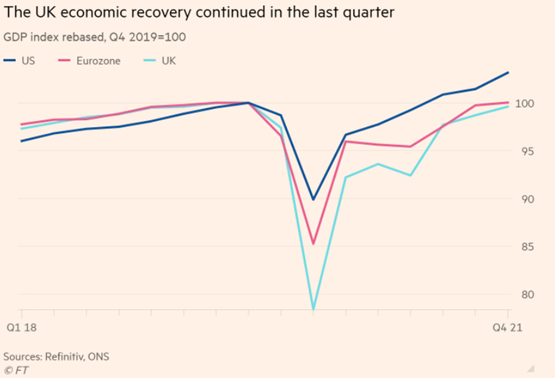
In the UK, GDP growth of 7.5% was reported for 2021, which put the economy roughly back to where we were before the pandemic started back, this time two years ago. The chart below illustrates how the V-shaped recovery has not only taken place in the UK, but also Europe, while the US is the outlier that has surpassed the starting level. As we know, this was substantially achieved by larger and less targeted handouts by the US government that resulted in a significant consumer demand boost. The increased levels of inflation are, to a large extent, the undesired side effect of this necessary, but hard to fine-tune, bridging support for the affected population.

The latest monthly inflation data for the US was therefore keenly awaited and, when it came in higher than hoped at (also) 7.5%, US stocks sold off as they quickly priced in that the US Fed will tighten and raise rates even faster than previously anticipated. Looking at the granular inflation data though, the strong market reaction felt counterintuitive, given all the major inflation-driving components of last year had continued to decline in their contribution, especially durable goods (the things we were most keen to order during the pandemic). What may have caused the negative surprise is that inflation appeared to have started ‘leaking into’ areas broadly unaffected by supply chain issues, and which are seen as more ‘sticky’ (not tending to reverse prices easily), especially the services sector.

On the other hand, there was some good news from the data on wage rises. While overall US wage growth has picked up to an uncomfortable 5%, this is very much concentrated among the very lowest earners. While this means wage growth is not sustained across the whole of the labour market, it also suggests  the forces of capitalism are currently addressing the problem of inequality that has become such a divisive force – not just for American society.

Given bond yields are now broadly back to where they stood before the pandemic, equities have not in fact performed too badly so far this month. It appears markets are getting their collective heads around the ‘investment climate change’, and one could argue that by now quite a lot of rising yield headwind has been priced in without causing the substantial ‘damage’ the doomsayers had predicted.

This may be, because the inflation headlines this week were flanked by more positive data from the real economy, which would also explain why implicit long-term growth expectations as expressed by certain parts of the bond markets (ten-year yields, ten-year forward) communicated increasing optimism as they did not mirror the negative vibes from the flattening of the yield curve as they usually do, but went the other way.

To this end, January monetary data from China indicated that the leadership there had once again opened the credit stimulus taps – which has in the past resulted in growth stimulus spilling over into the rest of the global economy. On the trade side, volumes improved in the stream of goods with China which should reduce supply chain issues and stimulate the Eurozone economy.

In the wider world of emerging markets, we may see similar central bank loosening tendencies as in China, given they have already been in a tightening cycle since early last year and are therefore far more likely at the end of it compared to western central banks. This would add to China’s demand stimulus and bring positive growth impulses to global trade (we touch on this in this week’s article on commodities).

In Europe and the UK, strong 2021 growth came about despite significant reductions in inventories. This means that the rebuilding of those inventories in 2022 should carry some of the 2021 demand boost into GDP growth this year. Most surprising, perhaps, was data showing that despite all post-Brexit trade regulation frictions, the trade volumes between continental Europe and the UK are returning to pre-Brexit levels. As observed in the past, when Europe’s economy does well from resurgent global demand, so does the UK and, with the trade linkage seemingly healing, this is good news for domestic growth prospects.

Of course, not all is well and there are plenty of dark clouds still on the horizon, be they the cost-of-living challenge from energy prices reducing aggregate consumer demand, or Russia’s President Putin still threatening to extend the fossil fuel shortage that is now the main driver of inflation. However, the overall mix of data this week provided positive evidence that the current economic slowdown may not be as deep-seated as feared, and that capital markets appear to expect subsiding inflationary pressures will also lower the pressures on central banks to tighten too fast and too soon. The Bank of England’s chief economist’s remarks this week to that end were positively received.

Judging from the significant relative moves between different sectors and investment styles like Growth and Value, the message of change in the investment climate appears to be getting through. Positive returns may no longer be as readily available across all asset classes, sectors and styles, but for those who analyse, search and skilfully anticipate the progress of this uncharted post-pandemic economic cycle, there should be ample opportunities (For more, please read our article on the dynamics of small cap equities).

We endeavour to publish relevant content and news on a regular basis, so please check in again with us soon.

Chloe

14/02/2022

Team No Comments

Invesco – Europe echoes the Fed’s hawkish tone

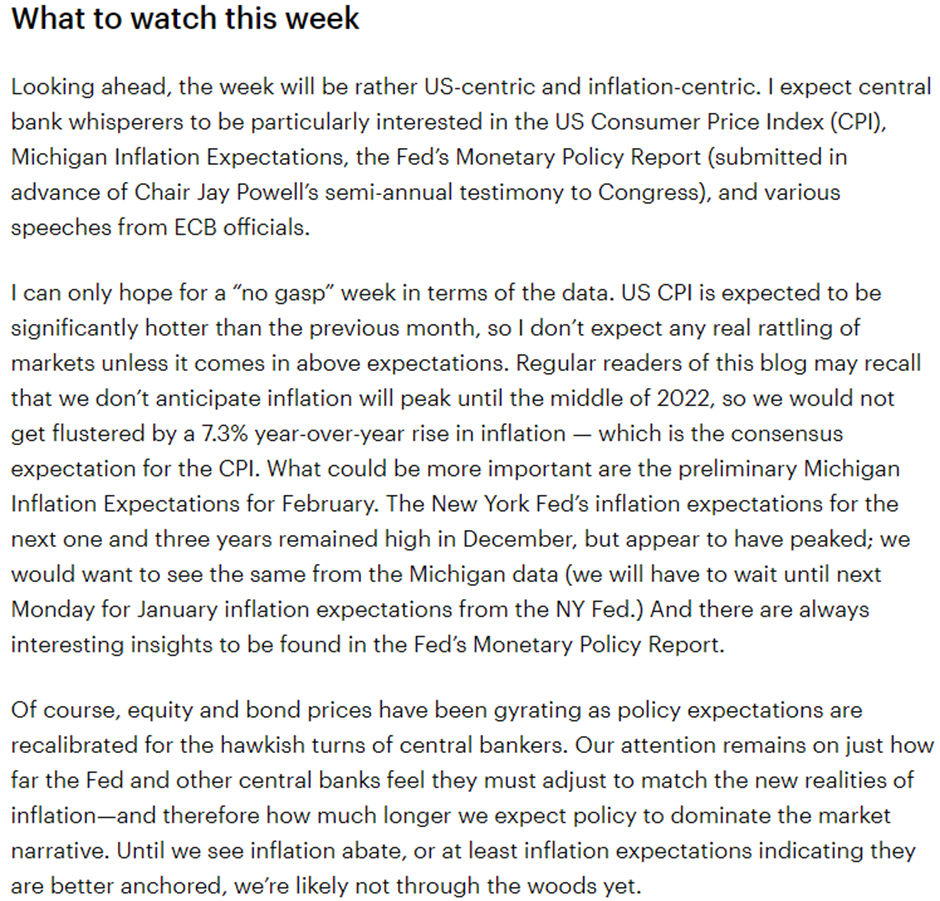
Please see below an article published by Invesco on Wednesday (09/02/2022) and received yesterday (10/02) afternoon detailing their current views on Central Bank’s policy changes:

Please continue to check our Blog content for advice and planning issues and the latest investment, markets and economic updates from leading investment houses.

Please keep safe and healthy.

Carl Mitchell – Dip PFS

Independent Financial Adviser

11/02/2022

Team No Comments

Daily Investment Bulletin

Please find below, the Daily Investment Bulletin update received from Brooks Macdonald this afternoon – 10/02/2022

What has happened

Risk appetite surged yesterday with a broad rally across most major sectors as central bank speak pushed back against the market’s aggressive interest rate pricing. Technology has been a particular beneficiary of this rally and yesterday’s session is another sign that the fate of the sector is showing signs of decoupling away from the grind higher in US bond yields.

Central bank speak

After the comments from Bank of France President Villeroy on Monday, suggesting that monetary tightening expectations in the market may have gone too far, bond markets began to stabilise after a choppy few days. Yesterday we heard from Fed voting member Mester of the Cleveland Fed, Mester said that she didn’t see a compelling reason to raise rates by 50bps when lift off occurs (widely expected to be in the March meeting). In the UK, the Bank of England’s Chief Economist, who pushed back against market pricing at the end of last year, said that ‘I worry that taking unusually large policy steps may validate a market narrative that bank policy is either foot-to-the-floor on the accelerator or foot-to-the-floor with the brake.’ European bond markets reacted positively, with German bunds finally ending their run of 11 consecutive days of yield rises.

US CPI

Today sees the week’s main event, the latest US inflation numbers. Most central banks have stressed the humility required around forward guidance given the uncertainties around inflation and growth for the rest of this year. Today’s CPI number will be closely watched to see if the month-on-month path of inflation is starting to slow. Consensus is expecting US CPI to increase by 0.5% over the last month (reaching 7.3% year-on-year) and for US Core CPI to also rise by 0.5% over the month and 5.9% over the last year. Both Core and headline CPI grew by 0.6% in December so if the consensus is achieved, this would show a slowing of the inflation rate. There is room for caution however, 0.5% month-on-month inflation is still a hefty increase and there may be signs of distortion due to the Omicron variant.

What does Brooks Macdonald think?

Few are expecting a ‘turn’ in inflation data until April/May of this year when the month-on-month figures are expected to start moderating. Should we see inflation come in to the downside today, the current rally may gather further steam. That said, we should be very conscious of impacts from the Omicron variant distorting the information we can garner from one data release in isolation.

Please continue to check our Blog content for advice and planning issues and the latest investment, markets and economic updates from leading investment houses.

David Purcell

10/02/2022

Team No Comments

Brewin Dolphin: Markets in a Minute

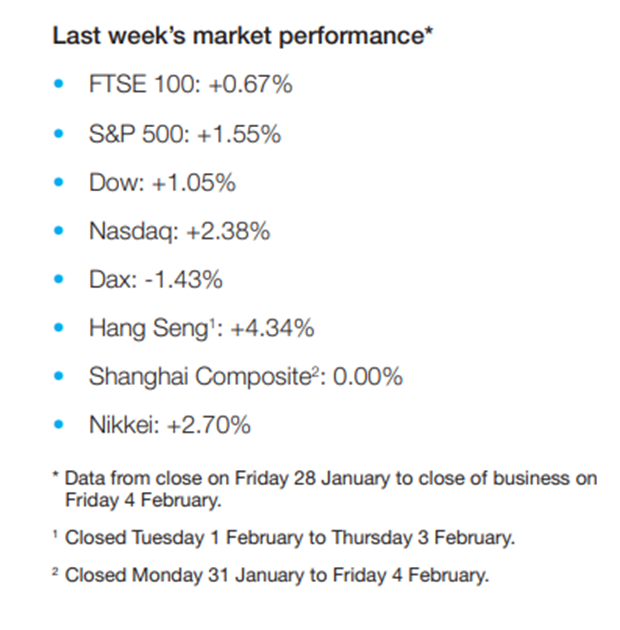
Please see below, Brewin Dolphin’s latest ‘Markets in a Minute’ update, examining last week’s global market performance – Received late yesterday afternoon – 08/02/2022

Stocks mixed as US earnings season ramps up

Equities were mixed last week as investors weighed mostly positive US earnings reports against the threat of rising interest rates.

The pan-European STOXX 600 fell 0.7% after European Central Bank (ECB) president Christine Lagarde declined to rule out an increase in interest rates this year. Germany’s Dax fell 1.4% and France’s CAC 40 slipped 0.2%. The UK’s FTSE 100 edged up 0.7%, despite the Bank of England’s (BoE) decision to hike the base interest rate for a second month in a row.

Over in the US, the S&P 500 finished a volatile week up 1.6% as investors digested fourth quarter earnings reports from big technology companies including Alphabet (Google’s parent), Amazon, and Meta (formerly Facebook). A surprise jump in US payrolls pushed the yield on the ten-year US Treasury note to its highest level since 2019.

China’s financial markets were closed last week for the Lunar New Year.

Tech selloff drives US stocks lower

US equities started this week in the red, with the S&P 500 and the Nasdaq down 0.4% and 0.6%, respectively, on Monday (7 February) following a selloff in big tech names. Investors are set to receive another batch of fourth quarter earnings in the coming days, including Disney, Pfizer and Coca-Cola. Meanwhile, the consumer price index, due on Thursday, is expected to add further weight to the case for hiking interest rates.

Germany’s Dax managed a 0.7% gain on Monday, despite data showing the country’s industrial output fell by 0.3% month-on-month in December, driven by supply chain bottlenecks and a decline in construction. In the UK, house prices rose 0.3% in January from the previous month, the slowest pace since June. Halifax said house price growth is expected to slow considerably over the next 12 months as households grapple with the cost-of-living crisis.

At the start of trading on Tuesday, the FTSE 100 was up around 0.6% as the latest BRC-KPMG survey showed total retail sales increased by 11.9% in January from a year ago.

BoE increases interest rate to 0.5%

Last week, the BoE’s monetary policy committee voted to increase the base interest rate by 25 basis points to 0.5%. This marked the first back-to-back rate hike since 2004. It came after data revealed UK inflation surged to a 30-year high in December amid rising energy costs and ongoing supply chain issues. The BoE also raised its inflation forecast to an April peak of 7.25%, which would be the highest since 1991.

The Bank warned that UK households would see their inflation-adjusted post-tax disposable income fall by 2% this year because of higher energy bills, taxes, and comparatively weak earnings. This would be the biggest fall ever recorded. Noting that higher costs would depress consumer spending and economic growth, the Bank cut its gross domestic product (GDP) growth forecast for 2022 from 5.0% to 3.75%.

The BoE’s report came shortly after Ofgem said households on default variable gas and electricity tariffs and those with prepayment meters would see their bills rise by around £700 in April, a 54% increase. In response, chancellor Rishi Sunak announced households would get £200 off energy bills in October, to be repaid over five years. Those in council tax bands A to D will also receive a £150 rebate.

ECB ‘much closer’ to inflation target

The odds of the ECB hiking interest rates this year have increased after Lagarde said the bank was “getting much closer” to hitting its target on inflation. Lagarde did not explicitly rule out increasing interest rates, but instead said there was consensus among ECB policymakers about the decision to keep rates unchanged.

“Compared with our expectations in December, risks to the inflation outlook are tilted to the upside, particularly in the near term,” Lagarde said.

She added: “We are all concerned to take the right steps at the right time, and I think there was also a concern and a determination around the table not to rush into a decision unless we had a proper and thorough assessment based on data and the analytical work that will take place in the next few weeks.”

Lagarde’s comments have been described as hawkish, and interpreted as signalling a shift to tightening monetary policy from March.

US payrolls beat estimates

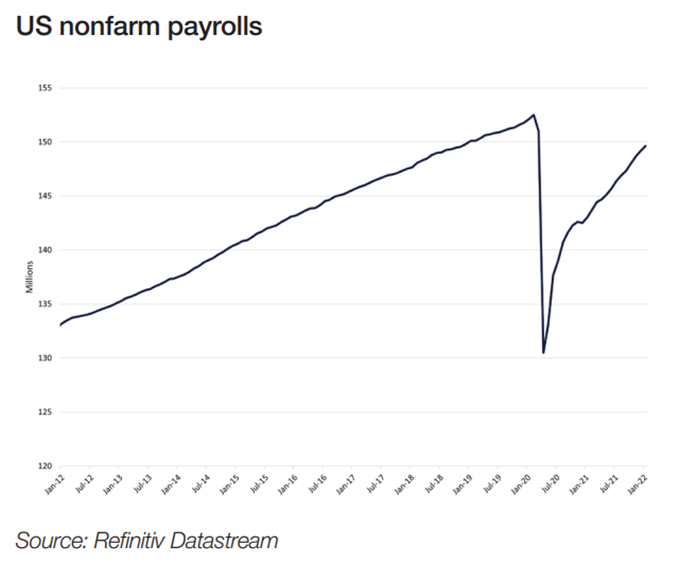
US nonfarm payrolls jumped by 467,000 in January despite surging Omicron infections. This was well ahead of the 150,000 increase predicted in a Dow Jones poll, and came a week after the government warned the numbers could be low because of the pandemic.

The Labor Department report also contained sizeable revisions to data from the previous two months. December’s increase was lifted from 199,000 to 510,000, and November’s from 249,000 to 647,000. These changes brought the total for 2021 to just under 6.67 million, the biggest single-year gain in US history.

Earnings also rose sharply by 0.7% from the previous month and by 5.7% on an annual basis, providing further confirmation that inflation is accelerating. The unemployment rate edged higher to 4.0% from 3.9% in December. However, a broader measure of unemployment, which includes people who want to work but have given up searching and those working part-time because they cannot find full-time employment, dropped from 7.3% to 7.1%, the lowest since February 2020.

Please continue to check our Blog content for advice and planning issues and the latest investment, markets and economic updates from leading investment houses.

Alex Kitteringham

09/02/2022