Team No Comments

The Daily Update: BoE Stays Put / Nonfarm Payrolls / Billionaire to Broke

Please see below article received from EPIC Investment Partners this morning, which coversthe Bank of England’s stance on keeping the base rate at 5.25%.

As expected, the Bank of England followed the Fed, voting 6-3 in favour of keeping the base rate at 5.25%, with a warning that monetary policy will likely need to stay tight for an “extended period of time”. Andrew Bailey, the Governor of the central bank, warned that whilst progress had been made in the fight against inflation, it was still too high and there was “absolutely no room for complacency”. 

“We will keep interest rates high enough for long enough to make sure we get inflation all the way back to the 2% target. We will be watching closely to see if further increases in interest rates are needed, but even if they are not needed, it is much too early to be thinking about rate cuts,” Bailey said, adding that the committee would rely on future data to balance the risks “between doing too little and doing too much”. 

In its latest Monetary Policy Report released with the decision, the committee acknowledged that inflation has fallen below the earlier projections made in August. The bank’s revised outlook now sees the consumer price index (CPI) at around 4.75% in Q4 of 2023, followed by a fall to about 4.5% in Q1 of the next year and a further drop down to 3.75% in Q2. 

As for the UK’s GDP, it is now expected to have stagnated in Q3 2023, which is a weaker performance compared to the MPC’s August forecasts. The GDP is now projected to exhibit only 0.1% growth in the fourth quarter, also falling short of the previous expectations from August. 

This was the first MPC that former US Federal Reserve Chair Ben Bernanke attended, as part of his review into the Old Lady’s forecasts and communications. The BoE appointed Bernanke in July to examine the forecast process after heavy criticism from politicians and some economists for underestimating the threat inflation posed. His review is focused on the lessons to be learned for future forecasts “during times of significant uncertainty.” It will not pass judgment on past policy decisions.

Today sees the penultimate Nonfarm Payrolls numbers for 2023. The market is going for +180k lower than October’s bumper +336k with an unemployment rate of 3.8%, hourly earnings of 0.3% and a participation rate of 62.8%. 

Lastly, how the mighty have fallen. “Crypto King” Sam Bankman-Fried had gone from being (a supposedly) multi-billionaire to a broke, convicted fraudster who faces decades behind bars. The 31-year-old former CEO of FTX was found guilty by a jury on all seven charges of fraud and conspiracy against him. The sentencing for these charges, which carry up to 115 years in prison, is scheduled for March 2024. 

A jury took just over four hours yesterday, including dinner, to conclude that Bankman-Fried stole USD 8 billion in customer funds from his crypto exchange FTX to fund risky investments, political contributions, and luxury real estate.

Please check in again with us shortly for further relevant content and news.

Chloe

03/11/2023

Team No Comments

Invesco – The Big Headlines Q3 2023

Please see below an article published by Invesco and received late yesterday (26/10/2023) afternoon, which provides a snapshot of the big headlines of Q3 2023:

Please check our blog content for advice, planning issues and the latest investment, market and economic updates from leading investment houses.

Carl Mitchell – DipPFS

Independent Financial Adviser

27/10/2023

Team No Comments

Brooks Macdonald Weekly market commentary: Interest rates expected to remain unchanged as inflation eases

Please see below, Brooks Macdonald’s ‘Weekly Market Commentary’ which provides a brief update on global investment markets received late yesterday afternoon:

  • Markets still cautious but investors unwind some of the recent flight-to-safety moves as prices of US Treasuries, gold, and crude drop a little.
  • European Central Bank are meeting on monetary policy, but expectations are for interest rates to stay unchanged as inflation continues to ease.
  • First read of US Q3 GDP (Gross Domestic Product) is due, as markets brace for a very strong reading, and again pushing back on recession worries.
  • Latest Q3 company results season continues to unfold, as a host of so-called ‘Big Tech’ companies including Microsoft are due to report this week.


Investors unwind some of the recent flight-to-safety moves

Markets are still in a cautious mood, but there are signs that some of the recent investor-flight-to-safety is unwinding at the edges. In the latest Middle East news on the conflict between Israel and Gaza, this is following the release of two US hostages by Hamas at the end of last week, as well as humanitarian aid starting to move through Egypt’s border with Gaza at the weekend. Prices of US Treasuries, gold, and crude oil have all dropped a little coming into Monday. Looking forward, there is a lot for investors to get their teeth into this week. Global flash PMIs (Purchasing Manager Indices) out Tuesday will be important for markets to try to gauge the resilience of economic momentum in the US, including the services component, as well getting a handle on the relative slowdown in Europe currently. As well as more Q3 company results due out this week, we also have the first read of US Q3 GDP on Thursday, while September PCE (Personal Consumption Expenditures) inflation data and Tokyo CPI (Consumer Price Index) are both due on Friday. The highlight of the week though is likely to be the European Central Bank (ECB) meeting on Thursday.

European Central Bank expected to keep interest rates on hold

The focus for investors in Europe this week is the latest European Central Bank (ECB) decision due on Thursday. On balance, expectations are for the central bank to keep rates on hold, not least given progress on the inflation front later has been better than expected – the Euro Area consumer annual inflation print was 4.3% in September, the lowest in almost 2 years, since October 2021. Instead, attention is likely to be on the ECB’s messaging around how long it could keep rates at current levels. As an aside, not that the two events are linked, but the day before the ECB decision, another key global central bank, the Bank of Canada (BoC), is also deciding on rates – while expectations are for a hold on rates there as well, any views around the BoC’s outlook on global inflation and growth dynamics might still weigh for the ECB as they meet.

Key US economic data likely to continue to push back on recession worries

On Thursday, we are due to get the preliminary estimate of US 3Q GDP. With increasing optimism about the growth trajectory for the US economy and hopes of a so-called ‘soft-landing’, this print will be very important. According to the Atlanta Federal Reserve’s ‘NowGDP’, their estimate is for a Q3 GDP annualised growth rate of 5.4%, which is clearly well above the Fed’s longer-run economic growth model assumption of 1.8%. The following day, on Friday, we get US personal income and spending data, together with the US Federal Reserve’s preferred PCE (Personal Consumption Expenditures) inflation gauge. It is worth bearing in mind that this data is following recent resilient prints for both CPI and retail sales in recent weeks.

Q3 company results season continues, with ‘Big Tech’ firms amongst the reports to watch

While attention continues to be focused on events in the Middle East, markets will also be watching more Q3 company results land. While it is still early days in the reporting season, with just under a fifth of US companies having reported Q3 numbers so far, according to FactSet, 73% of those companies reported have delivered earnings ahead of expectations, which is more or less in-line with the 10-year average of 74%. Out this week, so-called ‘Big Tech’ firms will be a highlight, with numbers due from the sector including Microsoft, Alphabet, Meta, Amazon, and Intel. Given the oil price volatility lately, of particular interest will be results from Exxon, Chevron, and Total. Also, there should be plenty of opportunities to calibrate the current strength of the consumer, given numbers are due from the likes of Coca-Cola and Heineken, as well as a raft of US and European car makers.

Please continue to check our blog content for advice and planning issues and the latest investment, markets and economic updates from leading investment houses.

Andrew Lloyd DipPFS

24th October 2023

Team No Comments

Brewin Dolphin – Markets in a Minute

Please see below the latest ‘Markets in Minute’ update from Brewin Dolphin, which covers their views on recent events in markets and was received late yesterday (17/10/2023) afternoon:

Please continue to check our Blog content for advice and planning issues and the latest investment, markets and economic updates from leading investment houses.

Carl Mitchell – Dip PFS

Independent Financial Adviser

18/10/2023

Team No Comments

Weekly market commentary: US earnings season steps into gear this week

Please see below article received from Brooks Macdonald yesterday afternoon, which provides a global market update with reference to the Israel/Hamas conflict.

  • The Israel/Hamas conflict leads to significant loss of life and financial markets raise the probability of a reduction in oil supply
  • US earnings season steps into gear this week with major financials reporting alongside some important technology names
  • UK inflation data and employment data will be in focus on Tuesday and Wednesday as markets weigh UK recession risks

Last week saw equity and bond markets dominated by the events in the Middle East as well as a set of more dovish US Federal Reserve speakers. Friday saw rising concerns of a ground offensive in Gaza which saw US Treasury yields fall as investors sought safety in the US dollar and sovereign debt. The fact that this ground offensive has yet to begin has helped a cautious optimism to creep into early equity trading this week.

This week sees the US earnings season begin in earnest with a heavy focus on financials alongside a few technology heavyweights. Highlights include Tesla and Netflix which both report on Wednesday and are likely to have an outsized impact on market sentiment given their size as well as the importance of the tech focused magnificent seven to index returns this year. In terms of economic data, US retail sales will be closely watched after Friday’s University of Michigan consumer confidence surprised significantly to the downside. Also of importance will be the weekly jobless claims which have been holding up very strongly. This week is the week used for the US nonfarm payroll surveys so the jobless claims will give an insight into the US employment report in a few weeks’ time.

The UK sees the release of inflation data as well as labour market data this week. Tuesday contains the UK Claimant Count data which looks at unemployment using the % of individuals claiming unemployment benefit. This reading is lower than the wider unemployment measures as some eligible individuals do not claim unemployment benefit and some unemployed individuals are not eligible. UK unemployment is now 0.8% above the lows for the cycle and UK unemployment has increased faster than any other country in the developed world so one to watch. UK inflation meanwhile is expected to stay sticky with a 0.4% month-on-month gain at the headline level, leaving the year-on-year gain at 6.5% versus 6.7% the month prior.

Outside of the US and Europe, markets will also be paying close attention to the Japanese Consumer Price Index (CPI) release on Friday. The Bank of Japan is beginning to react to a higher inflation backdrop after struggling against deflation for decades. The 31 October central bank meeting could see the bank’s policy of yield curve control, effectively quantitative easing in the sovereign bond market, finally end. Friday’s CPI release will be a key input into that decision.

Please check in again with us soon for further relevant content and news.

Chloe

17/10/2023

Team No Comments

Tatton Investment Management: Monday Digest

Please see below the Tatton ‘Monday Digest’, which was received this morning (09/10/2023) and provides their views on global economic news from the past week:

Overview: Recession fears return

The balmy autumn temperatures have continued into October, but September’s market chill has also carried through and that is more troubling. Continuing the recent trend, last week saw a further rise in global long bond yields, despite some weakness signals from the global economy. The 10-year US Treasury benchmark hit a yield of 4.88% in early trading on Tuesday – its highest yield in 15 years. Other government bond markets duly responded, although rose slightly less. Yields subsequently fell back over the week but crept back towards their highs after another extremely strong US jobs report on Friday (with 336,000 new jobs reported). Because of the inverse correlation between yields and bond valuations, this meant a fall in in the global bond index price of about 1.5%. Global equity markets also fell, but mostly due to the valuation impact of rising bond yields rather than pessimism over economic growth and any impact on earnings.

While there is no denying that the forecasts for a slowdown this year have proved wrong – in the US and even here in the UK, market volatility has shifted up across all asset classes which suggests global market liquidity is getting tighter – not surprising, given the continued drain by central banks and the substantial losses across bond markets and, to some extent, commodity markets. Tighter financial conditions make it more likely that growth will slow so we suspect that, in themselves and just like with oil, higher bond yields now probably mean lower bond yields later.

For equity and credit markets, it may be that bond yields plateau and then fall without too much impact. However, the tightening of liquidity is not a helpful signal and the risks of a sharper bout of volatility are clear. Ahead of the next round of rate meetings, central bankers could make things worse if their comments were seen as hawkish. However, inflation data is likely to be helpful rather than a hindrance, so we should perhaps expect them to sound slightly dovish in the next few days and weeks. We certainly hope so.

Brazil’s new era

As the ‘B’ in ‘BRICS’, South America’s largest economy naturally has a lot of growth potential. Like many of its emerging market (EM) neighbours, it also has a bit of an unstable reputation. Many investors would ascribe to it all the regular EM hallmarks: high inflation, corruption and currency woes. South American countries also have a particular reputation for political frailty, fiscal excess and debt crises. That said, Brazil’s economy has never come close to the chaos of its hyperinflation crisis of the late 1980s and early ’90s, where inflation topped 70% month-on-month for the first three months of 1990 and took seven years to stabilise. From 1990 to 1994, it had four different national currencies rolled out in a series of unconventional and mostly unsuccessful plans to stem the crisis. But the Brazil of today is markedly different. 

Like most countries, Brazil saw prices rise as it came out of the pandemic, but its inflation rate peaked in early 2022 and has come down considerably since. In fact, Brazil’s consumer price index (CPI) inflation rate has been below the UK’s every single month for more than a year, touching a low of 3.16% in June. Its government debt is fairly well contained too. Again, pandemic-era emergency spending forced an increase in the country’s debt-to-GDP ratio, but the spike was much smaller than comparable jumps in the UK and US. Improvements have not come at the expense of growth either. GDP growth has come in above 2% in all but one quarter since Q2 2021, the exception being a respectable 1.9% expansion in the last three months of 2022. Its most recent figure of 3.4% in the three months to June 2023 is impressive enough on its own, but even more so when one considers the broader global economic headwinds, as global demand has slowed and supply become tighter.

After last October’s presidential election, where Luiz Inácio Lula da Silva was elected for a third term at the expense of Jair Bolsonaro, the transition from far-right Bolsonaro to left-wing Lula was expected to be difficult and potentially violent, but in the end was remarkably smooth, all things considered. In particular, there was no significant Trump-style insurrection attempt, and Lula has proven surprisingly effective at pulling the different political factions together for compromise. Even fears that Lula would loosen fiscal policy dramatically, worsen inflation and send bond yields skyward failed to materialise. In fact, Lula’s recent rhetoric has been remarkably controlled – backing the balanced budget pledge and fiscal reduction targets of his under-pressure finance minister Fernando Haddad. In the spring, Brazil’s 10-year yields fell from above 13.5% to below 11%. And while these have risen since, the step up has been closely in line with global bond market moves.

This is helping Brazil to be seen as a viable investment destination. Despite a challenging third quarter for global stock markets, Brazil’s stock market is up 12.3% over the last six months in local currency terms. Its currency has not fared too poorly either – losing recently against the dollar as all global currencies have, but by no more so than the euro, for example. It is very likely that Brazil has been a beneficiary of western investors’ exodus from Chinese assets this year. And in terms of trade reconfiguration, Brazil might end up being one of the biggest beneficiaries of US decoupling attempts from China – as Mexico has been to this point.

Undoubtedly, the fiscal control on public spending and monetary control on private debt growth comes at a cost and the next two quarters will feel substantially less ‘growthy’ to most Brazilians. This will test Lula’s popularity and may bring pressure to ease. Of course, if global growth comes under significant pressure, an easing in one or both may be warranted. But, while policy inevitably must be responsive, there is a growing sense that the path is one of stability and that could make this feel like a new era. Certainly, the world needs a politically and economically stable Brazil. Brazil is no longer the risky country it once was, and it is in everyone’s interest to make sure it never is again.

Please continue to check our Blog content for advice and planning issues and the latest investment, markets and economic updates from leading investment houses.

Carl Mitchell – Dip PFS

Independent Financial Adviser

09/10/2023

Team No Comments

EPIC Investment Partners – Daily Update

Please see below the latest ‘Daily Update’ from EPIC Investment Partners, which covers their views on recent events in markets and was received this afternoon (05/10/2023):

In what may be the first signs that the US’s tight labour market could be loosening, companies on the other side of the pond added the fewest number of jobs since the start of 2021 last month, along with pay growth slowing. Private payrolls rose 89k in September after climbing 180k the month before, versus a market consensus of 150k, according to figures by the ADP Research Institute in collaboration with Stanford Digital Economy Lab. Annual wage growth slowed to 5.9%, the 12th consecutive monthly decline.

Nela Richardson, chief economist at ADP said: “We are seeing a steepening decline in jobs this month. Additionally, we are seeing a steady decline in wages in the past 12 months”. Within the numbers virtually all jobs added came from leisure and hospitality, whist there were job losses in professional and business services, transportation and utilities, along with manufacturing. ADP’s performance as a predictor of the overall economy is patchy, however, it’s one to be aware of.

It has also been reported that US 30-year fixed mortgages topped 7.5% for the first time since the turn of the century. According to the Mortgage Bankers Association, fixed rate mortgages rose 12bp to 7.53% at the end of September. From there, borrowing costs have continued to rise this week, with the Mortgage News Daily, which updates more frequently, putting 30-year fixed deal at 7.72% on Tuesday. Of course, this has a knock effect and consumer demand is starting to dry up. The purchase index which measures mortgage applications for the purchase of a home fell 5.7% from a week ago, with purchase applications at their lowest level since Apollo 13 was released.

One market that is moving in the opposite direction from its recent highs is oil, which dropped sharply again today, with West Texas now trading below $85 per barrel, down from over $93pb last week. As we have recently discussed, oil has been grinding higher since its near $70pb low in June on continued supply side deficiencies, particularly on the back of OPEC supply cuts. However, the selling has been driven by a change in demand side dynamics. The US Energy Information Administration (EIA) released their crude oil inventory report yesterday, which showed the four-week average of implied gasoline demand fell to the lowest level in 25 years for this time of year, whilst oil exports from the US soared. There were also supply-side drivers as well, as Cushing Oklahoma crude stockpiles rose slightly after seven straight weeks of decline.

Please continue to check our Blog content for advice and planning issues and the latest investment, markets and economic updates from leading investment houses.

Carl Mitchell – Dip PFS

Independent Financial Adviser

05/10/2023

Team No Comments

Weekly market commentary: Q3 saw significant rises in oil prices which impacted market inflation expectations

Please see below article received from Brooks Macdonald yesterday afternoon, which provides a global market update and a review of the third quarter of 2023.

  • The 3rd quarter of 2023 saw significant rises in oil prices which impacted market inflation expectations
  • While a US government shutdown has been avoided, negotiators only have six weeks to forge a new deal
  • The US jobs report on Friday will be vitally important given the Fed’s focus on labour market data

Markets have now closed out the third quarter of 2023, a quarter which saw oil prices rise by almost one third and 10-year US Treasury yields rise by more than 0.7%. At the same time, US equities lost ground with the index off almost 5% in September. Last week was challenging for risk assets however some positive inflation data on Friday helped mitigate the negative tone with the US personal consumption expenditures (PCE) inflation measure coming in below market expectations.

Another factor driving the risk off tone from last week was fears over an imminent US government shutdown. Just before the deadline on Saturday night, a deal was agreed which will keep the government operating until mid-November. This is a stop-gap measure which allows both sides to continue negotiations without the economic impact of a temporary shutdown. The news has supported equity indices today with the US futures market pointing to gains when the market opens. The avoidance of a shutdown also means we will receive US economic data on time this week with the most important of these being the US employment report on Friday.

The US jobs report on Friday arrives as markets debate the future path of inflation given signs of slowing economic growth but still robust US labour data. The market is expecting a slowdown in the number of new jobs created with September showing gains of 156.5k new jobs compared to 187k in August. Before we get to this data, today’s Institute for Supply Management (ISM) manufacturing data, followed by the services equivalent on Wednesday, will focus market attention. The market is expecting a slight improvement in the manufacturing survey which remains stubbornly in contractionary territory, but for the pace of US services sector expansion to moderate slightly.

With much of the volatility of the last few weeks stemming from bond markets, this week’s range of central bank speakers will be closely watched. With US Treasury yields surging recently, the question is whether the US Federal Reserve (Fed) speakers look to calm the bond market and imply that there is a certain level of bond yields which the Fed is uncomfortable with. The longer yields remain at elevated levels, the higher the likelihood that ‘something breaks’ and the Fed will be keenly aware of this risk after the Silicon Valley Bank (SVB) saga earlier in the year.

Please check in again with us soon for further relevant content and news.

Chloe

03/10/2023

Team No Comments

Brewin Dolphin – Markets in a Minute

Please see below the latest ‘Markets in Minute’ update from Brewin Dolphin, which covers their views on recent events in markets and was received late yesterday (26/09/2023) afternoon:

Please continue to check our Blog content for advice and planning issues and the latest investment, markets and economic updates from leading investment houses.

Carl Mitchell – Dip PFS

Independent Financial Adviser

27/09/2023

Team No Comments

Evelyn Partners Update – September Bank of England MPC Decision

Please see below article received this afternoon from Evelyn Partners, which reports on the Bank of England’s holding of the base rate at 5.25%.

What happened?

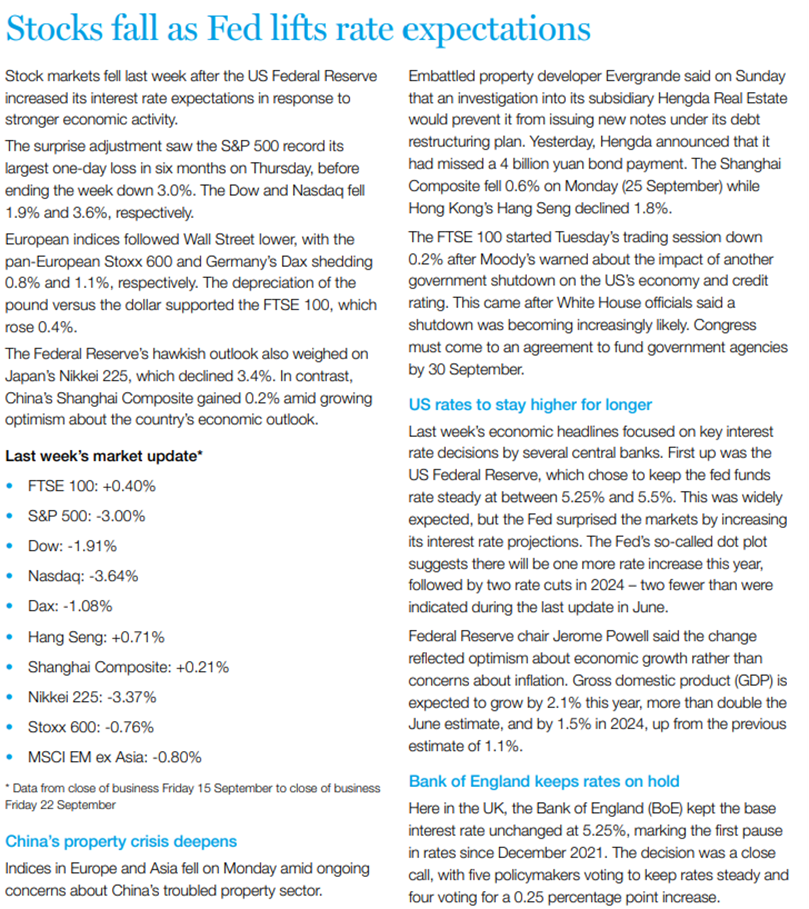
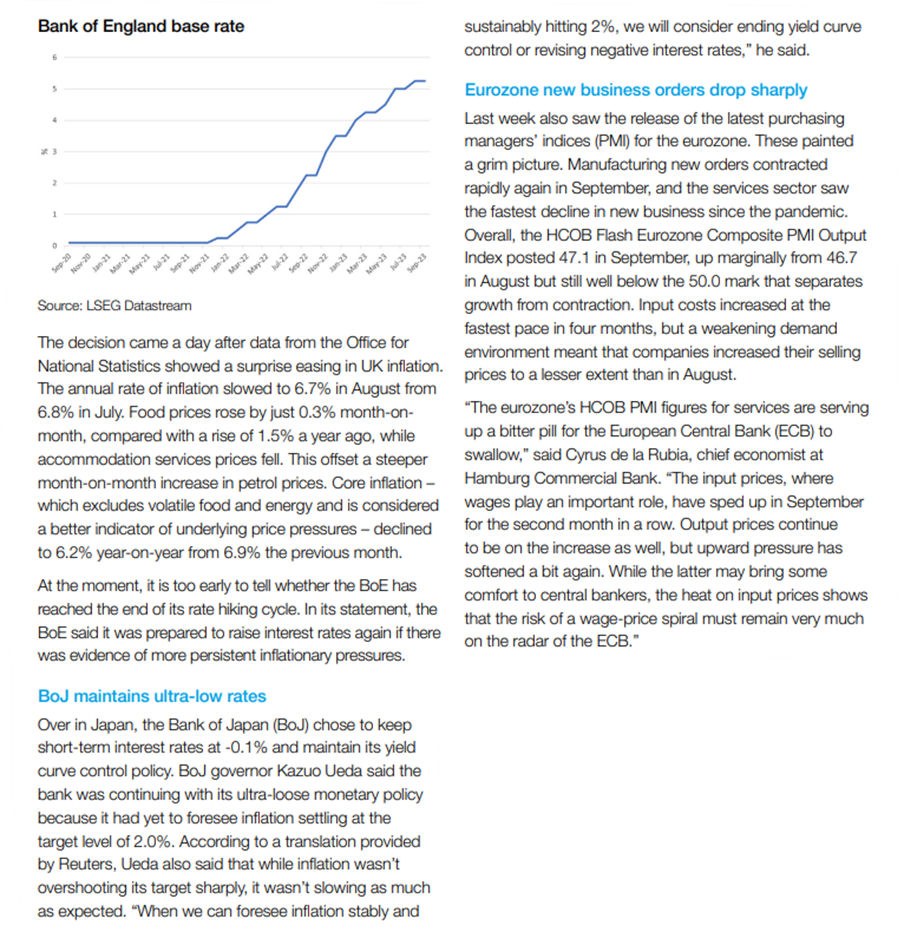
The Bank of England held the base rate at 5.25% at their meeting today. This ends the run of 14 consecutive interest rate increases.

The committee vote was split, with 5-4 members voting in favour of maintaining interest rates.

What does it mean?

Going into today’s meeting, money markets were split 50:50 on whether the Bank of England would raise interest rates. In the end the MPC voted to hold the base rate at 5.25%. Notably, the Bank also said that policy must be restrictive for ‘sufficiently long’, indicating that interest rates will be held higher for longer.

The decision follows some good progress on the inflation front over recent months. Annual headline CPI inflation reached 11.1% in October last year, but it has since fallen by over 4 percentage points. August’s data saw headline inflation surprise on the downside, printing 6.7% year-on-year (vs the consensus expectation of 7.0%). The Prime Minister’s pledge to halve inflation this year, from 10.1% in January to approximately 5% in December, looks to be on track; economists expect inflation to average 4.5% in the fourth quarter of this year.

A key threat, however, comes from the energy sector. The price of oil has increased in recent months as Saudi Arabia and Russia extended voluntary supply cuts to the end of this year. This comes on top of cuts agreed by OPEC+, a group of oil exporters, to the end of 2024. Higher oil prices typically take around one-month to feed through to petrol prices, so we can expect to see higher prices in the coming weeks and months. Another lingering source of inflation in the UK comes from rents, which have yet to peak. Having said that, we still expect inflation to ease in Q4; lower energy costs following the October change to the Ofgem price cap will help households across the country.

In the absence of further shocks, it looks like the BoE is now at, or very close to, the end of its hiking cycle. Attention will now turn to rate cuts, although markets are only pricing one 25 bps cut by the middle of 2024. This is consistent with our expectation that the Bank will keep policy tight through 2024 as they continue to fight inflation.

A continuation of its restrictive policy is supported by the empirical evidence. A recent paper by International Monetary Fund analysed over 100 inflation shock episodes in 56 countries since the 1970. It finds that ‘Countries that resolved inflation implemented restrictive policies more consistently over time’. The BoE and other CBs will be well aware of these findings and will not want to repeat the mistakes of their predecessors by easing policy too early.

In response to the decision, the pound sold-off, hitting its lowest level in six months. While UK equities rallied on the news.

Bottom Line

A close vote saw the Bank of England decide to hold the base rate at 5.25%. We are now at, or very close to, the end of the hiking cycle, but we expect monetary policy to remain restrictive for the foreseeable future.

Please check in again with us shortly for further relevant content and market news.

Chloe

21/09/2023