
Please see below the daily update article from Brooks Macdonald, received this morning – 18/08/2026:
What has happened?
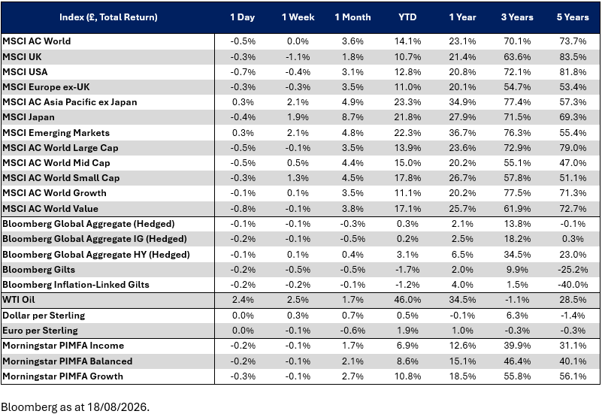
With little sign of a breakthrough between the US and Iran, investors increasingly priced in a prolonged disruption to oil supplies through the Strait of Hormuz. As a result, Brent crude oil rose +2.65% to close above $90/bbl for the first time in two weeks. The rise in oil prices weighed on risk assets on both sides of the Atlantic, as investors considered the potential inflationary impact of higher energy costs. The S&P 500 fell -0.52%, marking its weakest session of August so far, although a rebound in semiconductor stocks helped limit the decline, with the Philadelphia Semiconductor Index gaining +1.64%. Market weakness was broad-based, with the equal-weighted S&P 500 falling -0.92%, its largest decline in more than a month. European markets closed before the sell-off fully gathered pace, but the STOXX 600 still fell -0.22%, extending its losing streak to four consecutive sessions.
Markets brace for a longer standoff
Yesterday’s headlines suggested that both sides remain far apart from an agreement. President Trump said he had no interest in extending the 60-day memorandum of understanding agreed in June, while also reiterating that he was in no hurry to secure a deal. Although Trump referenced a potential back channel with members of Iran’s Revolutionary Guard, Iranian officials rejected the claim, stating that no talks were taking place. Comments from US Energy Secretary Chris Wright also pointed to a patient approach, with the administration focused on playing the “long game” with Iran.
What does Brooks Macdonald think?
Markets are responding not just to higher oil prices, but to what they could mean for inflation and interest rates. A sustained period of elevated energy costs would make it harder for inflation to continue moderating, potentially turning central banks more hawkish. This helps explain why bond markets also came under pressure yesterday, particularly at the longer end of the yield curve. 30-year government bond yields reached multi-year highs across several major markets, reflecting not only higher inflationary pressure but also lingering concerns over fiscal sustainability.
Please continue to check our blog content for advice, planning issues and the latest investment market and economic updates from leading investment houses.
Andrew Lloyd
18/08/2026